

ASTM F2327-21
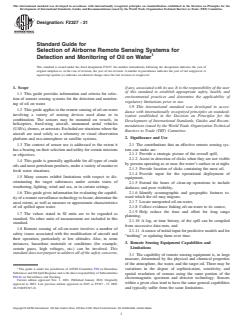
(Guide)Standard Guide for Selection of Airborne Remote Sensing Systems for Detection and Monitoring of Oil on Water
General Information
- Abstract
SIGNIFICANCE AND USE
2.1 The contributions that an effective remote sensing system can make are:
2.1.1 Provide a strategic picture of the overall spill,
2.1.2 Assist in detection of slicks when they are not visible by persons operating at, or near, the water's surface or at night,
2.1.3 Provide location of slicks containing the most oil,
2.1.4 Provide input for the operational deployment of equipment,
2.1.5 Extend the hours of clean-up operations to include darkness and poor visibility,
2.1.6 Identify oceanographic and geographic features toward which the oil may migrate,
2.1.7 Locate unreported oil-on-water,
2.1.8 Collect evidence linking oil-on-water to its source,
2.1.9 Help reduce the time and effort for long range planning,
2.1.10 A log, or time history, of the spill can be compiled from successive data runs, and
2.1.11 A source of initial input for predictive models and for “truthing” or updating them over time.
SCOPE
1.1 This guide provides information and criteria for selection of remote sensing systems for the detection and monitoring of oil on water.
1.2 This guide applies to the remote sensing of oil-on-water involving a variety of sensing devices used alone or in combination. The sensors may be mounted on vessels, in helicopters, fixed-wing aircraft, unmanned aerial vehicles (UAVs), drones, or aerostats. Excluded are situations where the aircraft are used solely as a telemetry or visual observation platform and exo-atmosphere or satellite systems.
1.3 The context of sensor use is addressed to the extent it has a bearing on their selection and utility for certain missions or objectives.
1.4 This guide is generally applicable for all types of crude oils and most petroleum products, under a variety of marine or fresh water situations.
1.5 Many sensors exhibit limitations with respect to discriminating the target substances under certain states of weathering, lighting, wind and sea, or in certain settings.
1.6 This guide gives information for evaluating the capability of a remote surveillance technology to locate, determine the areal extent, as well as measure or approximate characteristics of oil spilled upon water.
1.7 The values stated in SI units are to be regarded as standard. No other units of measurement are included in this standard.
1.8 Remote sensing of oil-on-water involves a number of safety issues associated with the modification of aircraft and their operation, particularly at low altitudes. Also, in some instances, hazardous materials or conditions (for example, certain gases, high voltages, etc.) can be involved. This standard does not purport to address all of the safety concerns, if any, associated with its use. It is the responsibility of the user of this standard to establish appropriate safety, health, and environmental practices and determine the applicability of regulatory limitations prior to use.
1.9 This international standard was developed in accordance with internationally recognized principles on standardization established in the Decision on Principles for the Development of International Standards, Guides and Recommendations issued by the World Trade Organization Technical Barriers to Trade (TBT) Committee.
- Status
- Published
- Publication Date
- 31-Oct-2021
- Technical Committee
- F20 - Hazardous Substances and Oil Spill Response
- Drafting Committee
- F20.16 - Surveillance and Tracking
Buy Documents

ASTM F2327-21 - Standard Guide for Selection of Airborne Remote Sensing Systems for Detection and Monitoring of Oil on Water
REDLINE ASTM F2327-21 - Standard Guide for Selection of Airborne Remote Sensing Systems for Detection and Monitoring of Oil on Water
Overview
ASTM F2327-21: Standard Guide for Selection of Airborne Remote Sensing Systems for Detection and Monitoring of Oil on Water provides authoritative guidance for selecting appropriate remote sensing technologies during oil spill events over water bodies. Developed by ASTM International, this guide is essential for those responsible for oil spill response, offering criteria for evaluating various airborne sensor systems used to detect, track, and monitor oil pollution on marine and freshwater surfaces.
This standard supports professionals in environmental monitoring, regulatory compliance, and emergency response by detailing the capabilities and limitations of available remote sensing technology. Its focus is on airborne and vessel-mounted sensors, including those on helicopters, fixed-wing aircraft, drones, UAVs, and aerostats, while satellite-based systems are excluded.
Key Topics
Core Contributions of Remote Sensing in Oil Spill Detection:
- Comprehensive Spill Visualization: Offers strategic overviews of spills, including mapping the extent and movement of oil slicks.
- Enhanced Detection: Assists in locating oil slicks not visible at the surface or during nighttime and poor visibility conditions.
- Operational Inputs: Provides actionable data for deploying clean-up resources and extending response operations beyond daylight hours.
- Spill Tracking and Evidence Gathering: Enables identification of key oceanographic and geographic migration features, detection of unreported spills, and the collection of data essential for regulatory or legal purposes.
- Data for Planning and Modeling: Compiles time-sequenced records for predictive modeling and improves “truthing” of simulation results.
Sensor Types and Selection Factors:
- Visual Sensors: Effective in daylight with widespread availability but limited by low light or visual obstructions.
- Infrared (IR): Detects thermal contrast in thicker oil slicks; performance declines with oil weathering or other debris.
- Ultraviolet (UV): Identifies very thin layers such as sheens, though not unique to oil-often used alongside IR.
- Radar: Provides all-weather, day/night capability; detects oil by identifying areas of water surface damping, though prone to false positives.
- Microwave Radiometers: Excels in low visibility, still maturing for commercial applications.
- Laser Fluorosensors: Uniquely identifies oil by its fluorescence, enabling discrimination between different oil types.
Sensor Selection Considerations:
- Operational setting (e.g., day/night, weather conditions)
- Mission objective (e.g., tactical response, regulatory compliance)
- Spatial coverage and resolution needs
- Aircraft compatibility and deployment logistics
- Cost and system availability
Applications
Practical applications for ASTM F2327-21 cover a broad spectrum:
- Emergency Oil Spill Response: Rapid detection and mapping of oil slicks to enable swift mobilization of containment and recovery resources.
- Environmental Monitoring: Long-term observation and documentation of oil pollution incidents for compliance and remediation efforts.
- Regulatory Surveillance: Support for governmental and non-governmental agencies in enforcing environmental regulations by confirming and quantifying illegal discharges.
- Operational Decision Support: Input for tactical maneuvering of clean-up equipment in dynamic spill scenarios, even in challenging visual conditions.
- Historical Spill Analysis: Compilation of spill event logs through sequential flights, supporting research, and model validation.
Related Standards
Consider consulting these closely associated standards and guides:
- ASTM F1776: Guide for Development of Remote Sensing Capability for Detection and Monitoring of Hydrocarbon Releases
- ASTM F1196: Standard Guide for Training for Oil Spill Response
- EPA Oil Spill Surveillance Guidance
- IMO Guidelines for Oil Spill Response and Remote Sensing
By following ASTM F2327-21, organizations can ensure they are equipped to select the most appropriate airborne remote sensing technologies for efficient, effective oil spill detection and response. This standard is essential for safeguarding water resources and meeting environmental compliance requirements.
Buy Documents
ASTM F2327-21 - Standard Guide for Selection of Airborne Remote Sensing Systems for Detection and Monitoring of Oil on Water
REDLINE ASTM F2327-21 - Standard Guide for Selection of Airborne Remote Sensing Systems for Detection and Monitoring of Oil on Water
Get Certified
Connect with accredited certification bodies for this standard

BSI Group
BSI (British Standards Institution) is the business standards company that helps organizations make excellence a habit.

Bureau Veritas
Bureau Veritas is a world leader in laboratory testing, inspection and certification services.

DNV
DNV is an independent assurance and risk management provider.
Sponsored listings
Frequently Asked Questions
ASTM F2327-21 is a guide published by ASTM International. Its full title is "Standard Guide for Selection of Airborne Remote Sensing Systems for Detection and Monitoring of Oil on Water". This standard covers: SIGNIFICANCE AND USE 2.1 The contributions that an effective remote sensing system can make are: 2.1.1 Provide a strategic picture of the overall spill, 2.1.2 Assist in detection of slicks when they are not visible by persons operating at, or near, the water's surface or at night, 2.1.3 Provide location of slicks containing the most oil, 2.1.4 Provide input for the operational deployment of equipment, 2.1.5 Extend the hours of clean-up operations to include darkness and poor visibility, 2.1.6 Identify oceanographic and geographic features toward which the oil may migrate, 2.1.7 Locate unreported oil-on-water, 2.1.8 Collect evidence linking oil-on-water to its source, 2.1.9 Help reduce the time and effort for long range planning, 2.1.10 A log, or time history, of the spill can be compiled from successive data runs, and 2.1.11 A source of initial input for predictive models and for “truthing” or updating them over time. SCOPE 1.1 This guide provides information and criteria for selection of remote sensing systems for the detection and monitoring of oil on water. 1.2 This guide applies to the remote sensing of oil-on-water involving a variety of sensing devices used alone or in combination. The sensors may be mounted on vessels, in helicopters, fixed-wing aircraft, unmanned aerial vehicles (UAVs), drones, or aerostats. Excluded are situations where the aircraft are used solely as a telemetry or visual observation platform and exo-atmosphere or satellite systems. 1.3 The context of sensor use is addressed to the extent it has a bearing on their selection and utility for certain missions or objectives. 1.4 This guide is generally applicable for all types of crude oils and most petroleum products, under a variety of marine or fresh water situations. 1.5 Many sensors exhibit limitations with respect to discriminating the target substances under certain states of weathering, lighting, wind and sea, or in certain settings. 1.6 This guide gives information for evaluating the capability of a remote surveillance technology to locate, determine the areal extent, as well as measure or approximate characteristics of oil spilled upon water. 1.7 The values stated in SI units are to be regarded as standard. No other units of measurement are included in this standard. 1.8 Remote sensing of oil-on-water involves a number of safety issues associated with the modification of aircraft and their operation, particularly at low altitudes. Also, in some instances, hazardous materials or conditions (for example, certain gases, high voltages, etc.) can be involved. This standard does not purport to address all of the safety concerns, if any, associated with its use. It is the responsibility of the user of this standard to establish appropriate safety, health, and environmental practices and determine the applicability of regulatory limitations prior to use. 1.9 This international standard was developed in accordance with internationally recognized principles on standardization established in the Decision on Principles for the Development of International Standards, Guides and Recommendations issued by the World Trade Organization Technical Barriers to Trade (TBT) Committee.
SIGNIFICANCE AND USE 2.1 The contributions that an effective remote sensing system can make are: 2.1.1 Provide a strategic picture of the overall spill, 2.1.2 Assist in detection of slicks when they are not visible by persons operating at, or near, the water's surface or at night, 2.1.3 Provide location of slicks containing the most oil, 2.1.4 Provide input for the operational deployment of equipment, 2.1.5 Extend the hours of clean-up operations to include darkness and poor visibility, 2.1.6 Identify oceanographic and geographic features toward which the oil may migrate, 2.1.7 Locate unreported oil-on-water, 2.1.8 Collect evidence linking oil-on-water to its source, 2.1.9 Help reduce the time and effort for long range planning, 2.1.10 A log, or time history, of the spill can be compiled from successive data runs, and 2.1.11 A source of initial input for predictive models and for “truthing” or updating them over time. SCOPE 1.1 This guide provides information and criteria for selection of remote sensing systems for the detection and monitoring of oil on water. 1.2 This guide applies to the remote sensing of oil-on-water involving a variety of sensing devices used alone or in combination. The sensors may be mounted on vessels, in helicopters, fixed-wing aircraft, unmanned aerial vehicles (UAVs), drones, or aerostats. Excluded are situations where the aircraft are used solely as a telemetry or visual observation platform and exo-atmosphere or satellite systems. 1.3 The context of sensor use is addressed to the extent it has a bearing on their selection and utility for certain missions or objectives. 1.4 This guide is generally applicable for all types of crude oils and most petroleum products, under a variety of marine or fresh water situations. 1.5 Many sensors exhibit limitations with respect to discriminating the target substances under certain states of weathering, lighting, wind and sea, or in certain settings. 1.6 This guide gives information for evaluating the capability of a remote surveillance technology to locate, determine the areal extent, as well as measure or approximate characteristics of oil spilled upon water. 1.7 The values stated in SI units are to be regarded as standard. No other units of measurement are included in this standard. 1.8 Remote sensing of oil-on-water involves a number of safety issues associated with the modification of aircraft and their operation, particularly at low altitudes. Also, in some instances, hazardous materials or conditions (for example, certain gases, high voltages, etc.) can be involved. This standard does not purport to address all of the safety concerns, if any, associated with its use. It is the responsibility of the user of this standard to establish appropriate safety, health, and environmental practices and determine the applicability of regulatory limitations prior to use. 1.9 This international standard was developed in accordance with internationally recognized principles on standardization established in the Decision on Principles for the Development of International Standards, Guides and Recommendations issued by the World Trade Organization Technical Barriers to Trade (TBT) Committee.
ASTM F2327-21 is classified under the following ICS (International Classification for Standards) categories: 13.020.40 - Pollution, pollution control and conservation. The ICS classification helps identify the subject area and facilitates finding related standards.
ASTM F2327-21 is available in PDF format for immediate download after purchase. The document can be added to your cart and obtained through the secure checkout process. Digital delivery ensures instant access to the complete standard document.
Standards Content (Sample)
This international standard was developed in accordance with internationally recognized principles on standardization established in the Decision on Principles for the
Development of International Standards, Guides and Recommendations issued by the World Trade Organization Technical Barriers to Trade (TBT) Committee.
Designation: F2327 − 21
Standard Guide for
Selection of Airborne Remote Sensing Systems for
Detection and Monitoring of Oil on Water
This standard is issued under the fixed designation F2327; the number immediately following the designation indicates the year of
original adoption or, in the case of revision, the year of last revision. A number in parentheses indicates the year of last reapproval. A
superscript epsilon (´) indicates an editorial change since the last revision or reapproval.
1. Scope if any, associated with its use. It is the responsibility of the user
of this standard to establish appropriate safety, health, and
1.1 This guide provides information and criteria for selec-
environmental practices and determine the applicability of
tion of remote sensing systems for the detection and monitor-
regulatory limitations prior to use.
ing of oil on water.
1.9 This international standard was developed in accor-
1.2 This guide applies to the remote sensing of oil-on-water
dance with internationally recognized principles on standard-
involving a variety of sensing devices used alone or in
ization established in the Decision on Principles for the
combination. The sensors may be mounted on vessels, in
Development of International Standards, Guides and Recom-
helicopters, fixed-wing aircraft, unmanned aerial vehicles
mendations issued by the World Trade Organization Technical
(UAVs), drones, or aerostats. Excluded are situations where the
Barriers to Trade (TBT) Committee.
aircraft are used solely as a telemetry or visual observation
2. Significance and Use
platform and exo-atmosphere or satellite systems.
2.1 The contributions that an effective remote sensing sys-
1.3 The context of sensor use is addressed to the extent it
tem can make are:
has a bearing on their selection and utility for certain missions
2.1.1 Provide a strategic picture of the overall spill,
or objectives.
2.1.2 Assist in detection of slicks when they are not visible
1.4 This guide is generally applicable for all types of crude
by persons operating at, or near, the water’s surface or at night,
oils and most petroleum products, under a variety of marine or
2.1.3 Provide location of slicks containing the most oil,
fresh water situations.
2.1.4 Provide input for the operational deployment of
1.5 Many sensors exhibit limitations with respect to dis-
equipment,
criminating the target substances under certain states of
2.1.5 Extend the hours of clean-up operations to include
weathering, lighting, wind and sea, or in certain settings.
darkness and poor visibility,
2.1.6 Identify oceanographic and geographic features to-
1.6 This guide gives information for evaluating the capabil-
ward which the oil may migrate,
ity of a remote surveillance technology to locate, determine the
2.1.7 Locate unreported oil-on-water,
areal extent, as well as measure or approximate characteristics
2.1.8 Collect evidence linking oil-on-water to its source,
of oil spilled upon water.
2.1.9 Help reduce the time and effort for long range
1.7 The values stated in SI units are to be regarded as
planning,
standard. No other units of measurement are included in this
2.1.10 A log, or time history, of the spill can be compiled
standard.
from successive data runs, and
1.8 Remote sensing of oil-on-water involves a number of
2.1.11 Asource of initial input for predictive models and for
safety issues associated with the modification of aircraft and
“truthing” or updating them over time.
their operation, particularly at low altitudes. Also, in some
3. Remote Sensing Equipment Capabilities and
instances, hazardous materials or conditions (for example,
Limitations
certain gases, high voltages, etc.) can be involved. This
standard does not purport to address all of the safety concerns,
3.1 The capability of remote sensing equipment is, in large
measure, determined by the physical and chemical properties
of the atmosphere, the water, and the target oil. There may be
variations in the degree of sophistication, sensitivity, and
This guide is under the jurisdiction of ASTM Committee F20 on Hazardous
Substances and Oil Spill Response and is the direct responsibility of Subcommittee
spatial resolution of sensors using the same portion of the
F20.16 on Surveillance and Tracking.
electromagnetic spectrum and detector technology. Sensors
Current edition approved Nov. 1, 2021. Published January 2022. Originally
within a given class tend to have the same general capabilities
approved in 2003. Last previous edition approved in 2015 as F2327 – 15. DOI:
10.1520/F2327-21. and typically suffer from the same limitations.
Copyright © ASTM International, 100 Barr Harbor Drive, PO Box C700, West Conshohocken, PA 19428-2959. United States
F2327 − 21
3.2 Combinations of sensors offer broader spectral coverage 3.6 A responder may require the data on an oil spill, 24
which, in turn, permit better probability of detection, better hours per day, independent of the prevailing weather.
discrimination, and effective operation over a broader range of
3.7 Information from remote sensing is required in a timely
weather and lighting conditions. Certain combinations, or
manner. Strategic or enforcement information, such as the
sensorsuites,arewell-documented,andtheiruseisparticularly
overall extent and location of a spill, should be available
suited to oil spill response missions.
preferably within two to four hours from information gathering
3.3 The performance of virtually all sensors can be en-
to presentation.
hanced by a variety of real-time, near real-time or post
3.8 Tactical information, such as steering information for
processing techniques applied to the acquired data or imagery.
response vessels, should be available in as little as five minutes
Furthermore, image or data fusion can greatly enhance the
from detection to communication.The acceptable data delivery
utility of the remote sensing output or product. Similarly, there
time is a function of the dynamics of the slick, proximity to
exists a variety of technological considerations and organiza-
critical areas, and the availability of clean-up resources.
tional ramifications that relate to the delivery of the remote
sensing information to the user.
3.9 Thermal imaging may provide relative thickness infor-
mation useful to oil spill countermeasures, that is information
3.4 Certain parameters need to be identified and quantified
that the slick is thicker than sheen.
to provide an oil spill response decision-maker with all of the
information needed to best respond to a spill. These are:
3.10 The passive microwave sensor is currently available to
3.4.1 Location—of the approximate center and edges of the
give information on oil thickness.
spill,
3.11 Table 1 lists sensors based upon their mode of opera-
3.4.2 Geometry—source or origin, total area, orientation
tion. Summary information on their advantages and disadvan-
and lengths of major and minor axes, fragmentation, and
tages is presented.
distribution,
3.4.3 Physical conditions—oil appearance, entrained debris,
3.12 Table 2 presents a summary of key attributes which
3.4.4 Environmental conditions—wave height and direc-
generally influence the selection of remote sensing instrumen-
tion; water temperature; position of oceanic fronts, conver-
tation.
gence and divergence zones,
3.13 Table3addressesthemissionspecificaspectsofsensor
3.4.5 Proximity of threatened resources, and
selection.
3.4.6 Location of response equipment.
3.4.7 Thickness or relative thickness of the slick.
4. Summary
3.5 Remote sensing can contribute to all of the above data
needs. Depending on the spill situation and the employment of 4.1 The information presented in this guide should be
remote sensing, some of this information may already be considered a starting point for sensor selection. In addition to
the context of use and the attributes of the various types of
available, or can be determined more cost-effectively by other
means. For example, in a response mode, or tactical employ- sensors, the system planner will have to give due consideration
ment of remote sensing, it is likely that the source, general to the capabilities of the aircraft and the information needs of
location and type of oil have been reported well in advance of the users before finalizing the system design. Both sensor
the launch of the remote sensing platform. In a regulatory or technology, and image and data analysis capabilities are
patrol context, this information may not be available. The spill evolving rapidly. Some equipment is not commercially-
situation influences the priorities among the elements of available and requires assembly and in some cases requires
information and, thereby, influences the selection priorities for development. Up to two years lead time may be required for
sensors. some equipment.
F2327 − 21
TABLE 1 Sensor Characteristics
Sensor/ Band Principal of Operation Positive Features Limitations
Visual Operate in, and near, the (human) visible Equipment is widely available, generally Oil is generally perceptible over the entire visible
spectrum (400 to 750 nm). Using photographic inexpensive, light and easily accommodated spectrum, but not uniquely so. As such, instances
films, scanners with one or more narrow band on most any aerial platform. Imagery is in of
...
This document is not an ASTM standard and is intended only to provide the user of an ASTM standard an indication of what changes have been made to the previous version. Because
it may not be technically possible to adequately depict all changes accurately, ASTM recommends that users consult prior editions as appropriate. In all cases only the current version
of the standard as published by ASTM is to be considered the official document.
Designation: F2327 − 15 F2327 − 21
Standard Guide for
Selection of Airborne Remote Sensing Systems for
Detection and Monitoring of Oil on Water
This standard is issued under the fixed designation F2327; the number immediately following the designation indicates the year of
original adoption or, in the case of revision, the year of last revision. A number in parentheses indicates the year of last reapproval. A
superscript epsilon (´) indicates an editorial change since the last revision or reapproval.
1. Scope
1.1 This guide provides information and criteria for selection of remote sensing systems for the detection and monitoring of oil
on water.
1.2 This guide applies to the remote sensing of oil-on-water involving a variety of sensing devices used alone or in combination.
The sensors may be mounted on vessels, in helicopters, fixed-wing aircraft, unmanned aerial vehicles (UAVs), drones, or aerostats.
Excluded are situations where the aircraft isare used solely as a telemetry or visual observation platform and exo-atmosphere or
satellite systems.
1.3 The context of sensor use is addressed to the extent it has a bearing on their selection and utility for certain missions or
objectives.
1.4 This guide is generally applicable for all types of crude oils and most petroleum products, under a variety of marine or fresh
water situations.
1.5 Many sensors exhibit limitations with respect to discriminating the target substances under certain states of weathering,
lighting, wind and sea, or in certain settings.
1.6 This guide gives information for evaluating the capability of a remote surveillance technology to locate, determine the areal
extent, as well as measure or approximate certain other characteristics of oil spilled upon water.
1.7 The values stated in SI units are to be regarded as standard. No other units of measurement are included in this standard.
1.8 Remote sensing of oil-on-water involves a number of safety issues associated with the modification of aircraft and their
operation, particularly at low altitudes. Also, in some instances, hazardous materials or conditions (for example, certain gases, high
voltages, etc.) can be involved. This standard does not purport to address all of the safety concerns, if any, associated with its use.
It is the responsibility of the user of this standard to establish appropriate safety safety, health, and healthenvironmental practices
and determine the applicability of regulatory requirementslimitations prior to use.
1.9 This international standard was developed in accordance with internationally recognized principles on standardization
established in the Decision on Principles for the Development of International Standards, Guides and Recommendations issued
by the World Trade Organization Technical Barriers to Trade (TBT) Committee.
This guide is under the jurisdiction of ASTM Committee F20 on Hazardous Substances and Oil Spill Response and is the direct responsibility of Subcommittee F20.16
on Surveillance and Tracking.
Current edition approved Oct. 1, 2015Nov. 1, 2021. Published November 2015January 2022. Originally approved in 2003. Last previous edition approved in 20082015
as F2327 – 08.F2327 – 15. DOI: 10.1520/F2327-15.10.1520/F2327-21.
Copyright © ASTM International, 100 Barr Harbor Drive, PO Box C700, West Conshohocken, PA 19428-2959. United States
F2327 − 21
2. Significance and Use
2.1 The contributions that an effective remote sensing system can make are:
2.1.1 Provide a strategic picture of the overall spill,
2.1.2 Assist in detection of slicks when they are not visible by persons operating at, or near, the water’s surface or at night,
2.1.3 Provide location of slicks containing the most oil,
2.1.4 Provide input for the operational deployment of equipment,
2.1.5 Extend the hours of clean-up operations to include darkness and poor visibility,
2.1.6 Identify oceanographic and geographic features toward which the oil may migrate,
2.1.7 Locate unreported oil-on-water,
2.1.8 Collect evidence linking oil-on-water to its source,
2.1.9 Help reduce the time and effort for long range planning,
2.1.10 A log, or time history, of the spill can be compiled from successive data runs, and
2.1.11 A source of initial input for predictive models and for “truthing” or updating them over time.
3. Remote Sensing Equipment Capabilities and Limitations
3.1 The capability of remote sensing equipment is, in large measure, determined by the physical and chemical properties of the
atmosphere, the water, and the target oil. There may be variations in the degree of sophistication, sensitivity, and spatial resolution
of sensors using the same portion of the electromagnetic spectrum and detector technology. Sensors within a given class tend to
have the same general capabilities and typically suffer from the same limitations.
3.2 Combinations of sensors offer broader spectral coverage which, in turn, permit better probability of detection, better
discrimination, and effective operation over a broader range of weather and lighting conditions. Certain combinations, or sensor
suites, are well documented, well-documented, and their use is particularly suited to oil spill response missions.
3.3 The performance of virtually all sensors can be enhanced by a variety of real-time, near real-time or post processing techniques
applied to the acquired data or imagery. Furthermore, image or data fusion can greatly enhance the utility of the remote sensing
output or product. Similarly, there exists a variety of technological considerations and organizational ramifications that relate to
the delivery of the remote sensing information to the user.
3.4 Certain parameters need to be identified and quantified to provide an oil spill response decision-maker with all of the
information needed to best respond to a spill. These are:
3.4.1 Location—of the approximate center and edges of the spill,
3.4.2 Geometry—source or origin, total area, orientation and lengths of major and minor axes, fragmentation, and distribution,
3.4.3 Physical conditions—oil appearance, entrained debris,
3.4.4 Environmental conditions—wave height and direction; water temperature; position of oceanic fronts, convergence and
divergence zones,
3.4.5 Proximity of threatened resources, and
3.4.6 Location of response equipment.
F2327 − 21
3.4.7 Thickness or relative thickness of the slick.
3.5 Remote sensing can contribute to all of the above data needs. Depending on the spill situation and the employment of remote
sensing, some of this information may already be available, or can be determined more cost effectively cost-effectively by other
means. For example, in a response mode, or tactical employment of remote sensing, it is likely that the source, general location
and type of oil have been reported well in advance of the launch of the remote sensing platform. In a regulatory or patrol context,
this information may not be available. The spill situation influences the priorities among the elements of information and, thereby,
influences the selection priorities for sensors.
3.6 A responder may require the data on an oil spill, 24 hours per day, independent of the prevailing weather.
3.7 Information from remote sensing is required in a timely manner. Strategic or enforcement information, such as the overall
extent and location of a spill, should be available preferably within two to four hours from information gathering to presentation.
3.8 Tactical information, such as steering information for response vessels, should be available in as little as five minutes from
detection to communication. The acceptable data delivery time is a function of the dynamics of the slick, proximity to critical areas,
and the availability of clean-up resources.
3.9 Thermal imaging may provide relative thickness information useful to oil spill countermeasures, that is information that the
slick is thicker than sheen.
3.10 The passive microwave sensor is currently available to give information on oil thickness.
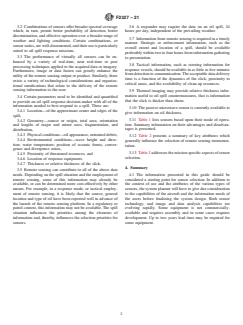
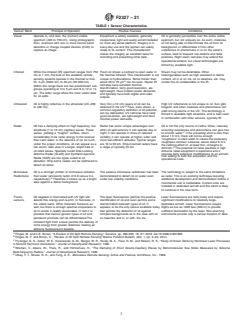
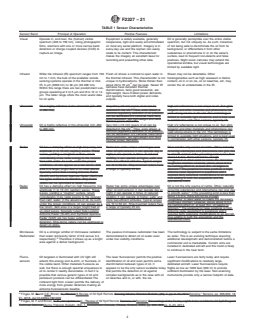
3.11 Table 1 lists sensors based upon their mode of operation. Summary information on their advantages and disadvantages is
presented.
3.12 Table 2 presents a summary of key attributes which generally influence the selection of remote sensing instrumentation.
3.13 Table 3 addresses the mission specific aspects of sensor selection.
4. Summary
4.1 The information presented in this guide should be considered a starting point for sensor selection. In addition to the context
of use and the attributes of the various types of sensors, the system planner will have to give due consideration to the capabilities
of the aircraft and the information needs of the users before finalizing the system design. Both sensor technology, and image and
data analysis capabilities are evolving rapidly. Some equipment is not commercially-available and requires assembly and in some
cases requires development. Up to two years lead time may be required for some equipment.
F2327 − 21
TABLE 1 Sensor Characteristics
Sensor/ Band Principal of Operation Positive Features Limitations
Visual Operate in, and near, the (human) visible Equipment is widely available, generally Oil is generally perceptible over the entire visible
spectrum (400 to 750 nm). Using photographic inexpensive, light and easily accommodated spectrum, but not uniquely so. As such, instances
films, scanners with one or more narrow band on most any aerial platform. Imagery is in of not being able to discriminate the oil from its
detectors or charge coupled devices (CCD) to every-day use and the layman can easily background, or differentiate it from other
capture an image. relate to its content. This characteristic substances or phenomena in or on the water’s
makes the imagery an excellent base for surface, lead to frequent non-detects and false
recording and presenting other data. positives. Night vision cameras may extend the
operational window, but visual technologies are
limited by available light.
Infrared While the infrared (IR) spectrum ranges from 750 Fresh oil shows a contrast to open water in Sheen may not be detectable. Other
nm to 1 mm, the bulk of the available remote the thermal infrared. This characteristic is not heterogeneities such as high seaweed or debris
sensing systems operate in the thermal or mid- unique to hydrocarbons. Slicks thicker than content, oil in or on ice, oil on beaches, etc. may
A
...