

ASTM C998-17
(Practice)Standard Practice for Sampling Surface Soil for Radionuclides
General Information
- Abstract
SIGNIFICANCE AND USE
5.1 Soil provides a source material for the determination of selected radionuclides and serves as an integrator of the deposition of airborne materials. Soil sampling should not be used as the primary measurement system to demonstrate compliance with applicable radionuclides in air standards. This should be done by air sampling or by measuring emission rates. Soil sampling does serve as a secondary system, and in many cases, is the only available avenue if insufficient air sampling occurred at the time of an incident. For many insoluble radionuclides, the primary exposure pathway to the general population is by inhalation. The resuspension of transuranic elements has received considerable attention (1, 2)4 and their measurement in soil is one means of establishing compliance with the U.S. Environmental Protection Agency (EPA) guidelines on exposure to transuranic elements. Soil sampling can provide useful information for other purposes, such as plant uptake studies, total inventory of various radionuclides in soil due to atmospheric nuclear tests, and the accumulation of radionuclides as a function of time. A soil sampling and analysis program as part of a preoperational environmental monitoring program serves to establish baseline concentrations. Consideration was given to these criteria in preparing this practice.
5.2 Soil collected using this practice and subsequent analysis can be used to monitor radionuclide deposition of emissions from nuclear facilities. The critical factors necessary to provide this information are sampling location, time of sampling, frequency of sampling, sample size, and maintenance of the integrity of the sample prior to analysis. Since the soil is considered to be a heterogeneous medium, multipoint sampling is necessary. The samples must represent the conditions existing in the area for which data are desired.
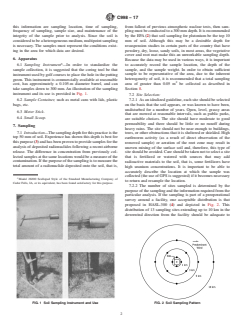
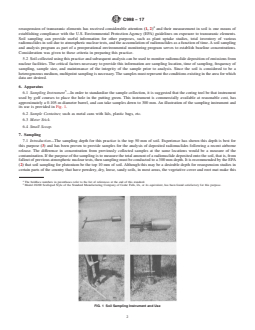
FIG. 1 Soil Sampling Instrument and Use
SCOPE
1.1 This practice covers the sampling of surface soil for the purpose of obtaining a sample representative of a particular area for subsequent chemical analysis of selected radionuclides. This practice describes one acceptable approach to collect soil samples for radiochemical analysis.
1.2 The values stated in SI units are to be regarded as standard. No other units of measurement are included in this standard.
1.3 This standard does not purport to address all of the safety concerns, if any, associated with its use. It is the responsibility of the user of this standard to establish appropriate safety and health practices and determine the applicability of regulatory limitations prior to use.
1.4 This international standard was developed in accordance with internationally recognized principles on standardization established in the Decision on Principles for the Development of International Standards, Guides and Recommendations issued by the World Trade Organization Technical Barriers to Trade (TBT) Committee.
- Status
- Published
- Publication Date
- 31-May-2017
- Technical Committee
- C26 - Nuclear Fuel Cycle
- Drafting Committee
- C26.05 - Methods of Test


Overview
ASTM C998-17 is the Standard Practice for Sampling Surface Soil for Radionuclides, published by ASTM International. This standard outlines procedures for the collection of surface soil samples intended for subsequent chemical analysis of radionuclide content. Soil serves as a critical integrator of airborne radioactive contaminants, providing valuable secondary data for environmental monitoring, especially when direct air sampling is unavailable or insufficient. ASTM C998-17 supports compliance with regulatory guidelines and the planning of environmental radiological surveys around nuclear facilities or sites where radionuclide deposition may have occurred.
Key Topics
- Purpose of Soil Sampling: Soil sampling for radionuclides helps determine the presence and distribution of radioactive contamination resulting from atmospheric deposition, accidental releases, or site operations.
- Sampling Methodology: The standard provides detailed protocols for establishing representative sampling locations, recommended sampling depths, and appropriate sample collection instruments-typically coring tools or soil rings.
- Sample Representation and Integrity: Emphasis is placed on obtaining samples that accurately reflect the area conditions, accounting for the heterogeneity of soil. Compositing multiple cores (usually ten per site) is recommended to achieve a representative sample.
- Documentation: Accurate documentation-including location, depth, and conditions-is essential to maintain traceability and repeatability.
- Best Practices: Guidance is provided on selecting undisturbed sampling sites, avoiding contamination, and cleaning tools between samples. The standard underlines the importance of maintaining sample integrity until laboratory analysis.
Applications
The ASTM C998-17 standard is applied in a variety of scenarios, including:
- Environmental Monitoring: Used in preoperational and routine monitoring programs at nuclear power plants, waste repositories, and research facilities.
- Regulatory Compliance: Supports verification of compliance with environmental guidelines established by regulatory authorities such as the U.S. Environmental Protection Agency (EPA), especially for transuranic elements.
- Incident Response: Enables retrospective assessment where air sampling was insufficient during a radiological event or accidental release, providing baseline or post-incident contamination levels.
- Research and Assessment: Facilitates studies of radionuclide plant uptake, evaluation of atmospheric nuclear test fallout, and long-term accumulation trends in soil.
- Remediation Planning: Informing site characterization and remediation strategies by identifying contaminated zones and tracking changes over time.
Related Standards
When implementing ASTM C998-17, the following standards and references may also be relevant:
- ASTM C859: Terminology Relating to Nuclear Materials
- ASTM D1129: Terminology Relating to Water
- IAEA-TECDOC-1415: Soil Sampling for Environmental Contaminants (International Atomic Energy Agency)
- MARLAP Chapter 10: Multi-Agency Radiological Laboratory Analytical Protocols
- HASL-300: EML Procedures Manual (historical reference for soil and environmental radiological monitoring)
Other applicable standards and guides may be necessary based on local regulations, site-specific conditions, and analytical requirements.
Practical Value
Adhering to ASTM C998-17 ensures that soil sampling for radionuclides is conducted in a consistent, accurate, and reliable manner. This standard:
- Enhances the quality and comparability of environmental data
- Supports environmental protection and public health by facilitating the detection and monitoring of radioactive contamination
- Provides a defensible basis for regulatory compliance and scientific analysis
- Streamlines environmental assessments through clear, standardized procedures
By following ASTM C998-17, organizations can effectively monitor radionuclide deposition in surface soils, underpinning robust environmental stewardship and regulatory assurance.
Relations
- Effective Date
- 01-Jun-2017
- Effective Date
- 01-Jan-2024
- Effective Date
- 01-May-2020
- Effective Date
- 01-Feb-2018
- Effective Date
- 15-Jun-2014
- Effective Date
- 15-Jan-2014
- Effective Date
- 01-Jun-2013
- Effective Date
- 01-May-2013
- Effective Date
- 01-Nov-2010
- Effective Date
- 01-Aug-2010
- Effective Date
- 01-Mar-2010
- Effective Date
- 01-Feb-2010
- Effective Date
- 15-Feb-2009
- Effective Date
- 15-Sep-2008
- Effective Date
- 01-Sep-2006
Get Certified
Connect with accredited certification bodies for this standard

CIS Institut d.o.o.
Personal Protective Equipment (PPE) certification body. Notified Body NB-2890 for EU Regulation 2016/425 PPE.

Kiwa BDA Testing
Building and construction product certification.
Kmetijski inštitut Slovenije
Agricultural Institute of Slovenia. Soil testing, plant health, agricultural product analysis.
Sponsored listings
Frequently Asked Questions
ASTM C998-17 is a standard published by ASTM International. Its full title is "Standard Practice for Sampling Surface Soil for Radionuclides". This standard covers: SIGNIFICANCE AND USE 5.1 Soil provides a source material for the determination of selected radionuclides and serves as an integrator of the deposition of airborne materials. Soil sampling should not be used as the primary measurement system to demonstrate compliance with applicable radionuclides in air standards. This should be done by air sampling or by measuring emission rates. Soil sampling does serve as a secondary system, and in many cases, is the only available avenue if insufficient air sampling occurred at the time of an incident. For many insoluble radionuclides, the primary exposure pathway to the general population is by inhalation. The resuspension of transuranic elements has received considerable attention (1, 2)4 and their measurement in soil is one means of establishing compliance with the U.S. Environmental Protection Agency (EPA) guidelines on exposure to transuranic elements. Soil sampling can provide useful information for other purposes, such as plant uptake studies, total inventory of various radionuclides in soil due to atmospheric nuclear tests, and the accumulation of radionuclides as a function of time. A soil sampling and analysis program as part of a preoperational environmental monitoring program serves to establish baseline concentrations. Consideration was given to these criteria in preparing this practice. 5.2 Soil collected using this practice and subsequent analysis can be used to monitor radionuclide deposition of emissions from nuclear facilities. The critical factors necessary to provide this information are sampling location, time of sampling, frequency of sampling, sample size, and maintenance of the integrity of the sample prior to analysis. Since the soil is considered to be a heterogeneous medium, multipoint sampling is necessary. The samples must represent the conditions existing in the area for which data are desired. FIG. 1 Soil Sampling Instrument and Use SCOPE 1.1 This practice covers the sampling of surface soil for the purpose of obtaining a sample representative of a particular area for subsequent chemical analysis of selected radionuclides. This practice describes one acceptable approach to collect soil samples for radiochemical analysis. 1.2 The values stated in SI units are to be regarded as standard. No other units of measurement are included in this standard. 1.3 This standard does not purport to address all of the safety concerns, if any, associated with its use. It is the responsibility of the user of this standard to establish appropriate safety and health practices and determine the applicability of regulatory limitations prior to use. 1.4 This international standard was developed in accordance with internationally recognized principles on standardization established in the Decision on Principles for the Development of International Standards, Guides and Recommendations issued by the World Trade Organization Technical Barriers to Trade (TBT) Committee.
SIGNIFICANCE AND USE 5.1 Soil provides a source material for the determination of selected radionuclides and serves as an integrator of the deposition of airborne materials. Soil sampling should not be used as the primary measurement system to demonstrate compliance with applicable radionuclides in air standards. This should be done by air sampling or by measuring emission rates. Soil sampling does serve as a secondary system, and in many cases, is the only available avenue if insufficient air sampling occurred at the time of an incident. For many insoluble radionuclides, the primary exposure pathway to the general population is by inhalation. The resuspension of transuranic elements has received considerable attention (1, 2)4 and their measurement in soil is one means of establishing compliance with the U.S. Environmental Protection Agency (EPA) guidelines on exposure to transuranic elements. Soil sampling can provide useful information for other purposes, such as plant uptake studies, total inventory of various radionuclides in soil due to atmospheric nuclear tests, and the accumulation of radionuclides as a function of time. A soil sampling and analysis program as part of a preoperational environmental monitoring program serves to establish baseline concentrations. Consideration was given to these criteria in preparing this practice. 5.2 Soil collected using this practice and subsequent analysis can be used to monitor radionuclide deposition of emissions from nuclear facilities. The critical factors necessary to provide this information are sampling location, time of sampling, frequency of sampling, sample size, and maintenance of the integrity of the sample prior to analysis. Since the soil is considered to be a heterogeneous medium, multipoint sampling is necessary. The samples must represent the conditions existing in the area for which data are desired. FIG. 1 Soil Sampling Instrument and Use SCOPE 1.1 This practice covers the sampling of surface soil for the purpose of obtaining a sample representative of a particular area for subsequent chemical analysis of selected radionuclides. This practice describes one acceptable approach to collect soil samples for radiochemical analysis. 1.2 The values stated in SI units are to be regarded as standard. No other units of measurement are included in this standard. 1.3 This standard does not purport to address all of the safety concerns, if any, associated with its use. It is the responsibility of the user of this standard to establish appropriate safety and health practices and determine the applicability of regulatory limitations prior to use. 1.4 This international standard was developed in accordance with internationally recognized principles on standardization established in the Decision on Principles for the Development of International Standards, Guides and Recommendations issued by the World Trade Organization Technical Barriers to Trade (TBT) Committee.
ASTM C998-17 is classified under the following ICS (International Classification for Standards) categories: 13.080.05 - Examination of soils in general. The ICS classification helps identify the subject area and facilitates finding related standards.
ASTM C998-17 has the following relationships with other standards: It is inter standard links to ASTM C998-05(2010)e1, ASTM C859-24, ASTM D1129-13(2020)e2, ASTM D420-18, ASTM C859-14a, ASTM C859-14, ASTM C859-13a, ASTM C859-13, ASTM C859-10b, ASTM C859-10a, ASTM D1129-10, ASTM C859-10, ASTM C859-09, ASTM C859-08, ASTM D1129-06ae1. Understanding these relationships helps ensure you are using the most current and applicable version of the standard.
ASTM C998-17 is available in PDF format for immediate download after purchase. The document can be added to your cart and obtained through the secure checkout process. Digital delivery ensures instant access to the complete standard document.
Standards Content (Sample)
This international standard was developed in accordance with internationally recognized principles on standardization established in the Decision on Principles for the
Development of International Standards, Guides and Recommendations issued by the World Trade Organization Technical Barriers to Trade (TBT) Committee.
Designation: C998 − 17
Standard Practice for
Sampling Surface Soil for Radionuclides
This standard is issued under the fixed designation C998; the number immediately following the designation indicates the year of
original adoption or, in the case of revision, the year of last revision. A number in parentheses indicates the year of last reapproval. A
superscript epsilon (´) indicates an editorial change since the last revision or reapproval.
1. Scope 3. Terminology
1.1 This practice covers the sampling of surface soil for the 3.1 Except as otherwise defined herein, definitions of terms
purpose of obtaining a sample representative of a particular are as given in Terminology C859.
area for subsequent chemical analysis of selected radionu-
3.2 Definitions:
clides. This practice describes one acceptable approach to
3.2.1 sampling, n—obtaining a representative portion of the
collect soil samples for radiochemical analysis.
material concerned (see Terminology D1129).
1.2 The values stated in SI units are to be regarded as
4. Summary of Practice
standard. No other units of measurement are included in this
standard. 4.1 Guidance is provided for the collection of soil samples
to a depth of 50 mm. Ten core samples are collected in a
1.3 This standard does not purport to address all of the
specified pattern and composited to obtain sufficient sample so
safety concerns, if any, associated with its use. It is the
as to be representative of the area.
responsibility of the user of this standard to establish appro-
priate safety and health practices and determine the applica-
5. Significance and Use
bility of regulatory limitations prior to use.
5.1 Soil provides a source material for the determination of
1.4 This international standard was developed in accor-
selected radionuclides and serves as an integrator of the
dance with internationally recognized principles on standard-
deposition of airborne materials. Soil sampling should not be
ization established in the Decision on Principles for the
used as the primary measurement system to demonstrate
Development of International Standards, Guides and Recom-
compliance with applicable radionuclides in air standards.This
mendations issued by the World Trade Organization Technical
shouldbedonebyairsamplingorbymeasuringemissionrates.
Barriers to Trade (TBT) Committee.
Soil sampling does serve as a secondary system, and in many
cases, is the only available avenue if insufficient air sampling
2. Referenced Documents
occurred at the time of an incident. For many insoluble
2.1 ASTM Standards:
radionuclides, the primary exposure pathway to the general
C859 Terminology Relating to Nuclear Materials
population is by inhalation. The resuspension of transuranic
D420 Guide to Site Characterization for Engineering Design
elements has received considerable attention (1, 2) and their
and Construction Purposes (Withdrawn 2011)
measurement in soil is one means of establishing compliance
D1129 Terminology Relating to Water
with the U.S. Environmental Protection Agency (EPA) guide-
2.2 Other References:
lines on exposure to transuranic elements. Soil sampling can
MARLAP, Chapter 10
provide useful information for other purposes, such as plant
IAEA-TECDOC-1415, Soil Sampling for Environmental
uptake studies, total inventory of various radionuclides in soil
Contaminants
due to atmospheric nuclear tests, and the accumulation of
radionuclides as a function of time. A soil sampling and
analysis program as part of a preoperational environmental
This practice is under the jurisdiction of ASTM Committee C26 on Nuclear
monitoring program serves to establish baseline concentra-
Fuel Cycle and is the direct responsibility of Subcommittee C26.05 on Methods of
tions. Consideration was given to these criteria in preparing
Test.
this practice.
CurrenteditionapprovedJune1,2017.PublishedJuly2017.Originallyapproved
ɛ1
in 1983. Last previous edition approved in 2010 as C998 – 05 (2010) . DOI:
5.2 Soil collected using this practice and subsequent analy-
10.1520/C0998-17.
sis can be used to monitor radionuclide deposition of emissions
For referenced ASTM standards, visit the ASTM website, www.astm.org, or
contact ASTM Customer Service at service@astm.org. For Annual Book of ASTM from nuclear facilities.The critical factors necessary to provide
Standards volume information, refer to the standard’s Document Summary page on
the ASTM website.
3 4
The last approved version of this historical standard is referenced on The boldface numbers in parentheses refer to the list of references at the end of
www.astm.org. this standard.
Copyright © ASTM International, 100 Barr Harbor Drive, PO Box C700, West Conshohocken, PA 19428-2959. United States
C998 − 17
this information are sampling location, time of sampling, from fallout of previous atmospheric nuclear tests, then sam-
frequency of sampling, sample size, and maintenance of the plingmustbeconductedtoa300mmdepth.Itisrecommended
integrity of the sample prior to analysis. Since the soil is by the EPA (2) that soil sampling for plutonium be the top 10
consideredtobeaheterogeneousmedium,multipointsampling mm of soil. Although this may be a desirable depth for
is necessary. The samples must represent the conditions exist- resuspension studies in certain parts of the country that have
ing in the area for which data are desired. powdery, dry, loose, sandy soils, in most areas, the vegetative
cover and root mat make this an unworkable sampling depth.
6. Apparatus
Because the data may be used in various ways, it is important
to accurately record the sample location, the depth of the
6.1 Sampling Instrument —In order to standardize the
sample, and the sample weight. In order to obtain sufficient
sample collection, it is suggested that the coring tool be that
sample to be representative of the area, due to the inherent
instrument used by golf courses to place the hole in the putting
green. This instrument is commercially available at reasonable heterogeneity of soil, it is recommended that a total sampling
area of greater than 0.05 m be collected as described in
cost, has approximately a 0.105-m diameter barrel, and can
take samples down to 300 mm.An illustration of the sampling Section 8.
instrument and its use is provided in Fig. 1.
7.2 Site Selection:
7.2.1 As an idealized guideline, each site should be selected
6.2 Sample Container, such as metal cans with lids, plastic
on the basis that the soil appears, or was known to have been,
bags, etc.
undisturbed for a number of years. Open, level, grassy areas
6.3 Meter Stick.
that are mowed at reasonable intervals, such as public parks,
6.4 Small Scoop.
are suitable choices. The site should have moderate to good
permeability and there should be little or no runoff during
7. Sampling
heavy rains. The site should not be near enough to buildings,
7.1 Introduction—Thesamplingdepthforthispracticeisthe
trees, or other obstructions that it is sheltered or shielded. High
top 50 mm of soil. Experience has shown this depth is best for
earthworm activity (as a result of direct observation of the
thispurpose (3)andhasbeenproventoprovidesamplesforthe
removed sample) or aeration of the root zone may result in
analysis of deposited radionuclides following a recent airborne
uneven mixing of the surface soil and, therefore, this type of
release. The difference in concentration
...
This document is not an ASTM standard and is intended only to provide the user of an ASTM standard an indication of what changes have been made to the previous version. Because
it may not be technically possible to adequately depict all changes accurately, ASTM recommends that users consult prior editions as appropriate. In all cases only the current version
of the standard as published by ASTM is to be considered the official document.
´1
Designation: C998 − 05 (Reapproved 2010) C998 − 17
Standard Practice for
Sampling Surface Soil for Radionuclides
This standard is issued under the fixed designation C998; the number immediately following the designation indicates the year of
original adoption or, in the case of revision, the year of last revision. A number in parentheses indicates the year of last reapproval. A
superscript epsilon (´) indicates an editorial change since the last revision or reapproval.
ε NOTE—The units statement in subsection 1.2 was added editorially in June 2010.
1. Scope
1.1 This practice covers the sampling of surface soil for the purpose of obtaining a sample representative of a particular area
for subsequent chemical analysis of selected radionuclides. This practice describes one acceptable approach to collect soil samples
for radiochemical analysis.
1.2 The values stated in SI units are to be regarded as standard. No other units of measurement are included in this standard.
1.3 This standard does not purport to address all of the safety concerns, if any, associated with its use. It is the responsibility
of the user of this standard to establish appropriate safety and health practices and determine the applicability of regulatory
limitations prior to use.
1.4 This international standard was developed in accordance with internationally recognized principles on standardization
established in the Decision on Principles for the Development of International Standards, Guides and Recommendations issued
by the World Trade Organization Technical Barriers to Trade (TBT) Committee.
2. Referenced Documents
2.1 ASTM Standards:
C859 Terminology Relating to Nuclear Materials
D420 Guide to Site Characterization for Engineering Design and Construction Purposes (Withdrawn 2011)
D1129 Terminology Relating to Water
2.2 Other References:
MARLAP, Chapter 10
IAEA-TECDOC-1415, Soil Sampling for Environmental Contaminants
3. Terminology
3.1 Except as otherwise defined herein, definitions of terms are as given in Terminology C859.
3.2 Definitions:
3.2.1 sampling, n—obtaining a representative portion of the material concerned (see Terminology D1129).
4. Summary of Practice
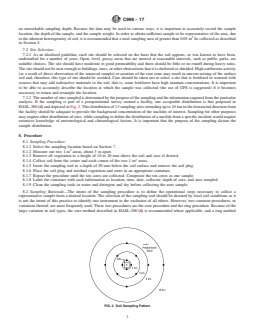
4.1 Guidance is provided for the collection of soil samples to a depth of 50 mm. Ten core samples are collected in a specified
pattern and composited to obtain sufficient sample so as to be representative of the area.
5. Significance and Use
5.1 Soil provides a source material for the determination of selected radionuclides and serves as an integrator of the deposition
of airborne materials. Soil sampling should not be used as the primary measurement system to demonstrate compliance with
applicable radionuclides in air standards. This should be done by air sampling or by measuring emission rates. Soil sampling does
serve as a secondary system, and in many cases, is the only available avenue if insufficient air sampling occurred at the time of
an incident. For many insoluble radionuclides, the primary exposure pathway to the general population is by inhalation. The
This practice is under the jurisdiction of ASTM Committee C26 on Nuclear Fuel Cycle and is the direct responsibility of Subcommittee C26.05 on Methods of Test.
Current edition approved June 1, 2010June 1, 2017. Published June 2010July 2017. Originally approved in 1983. Last previous edition approved in 20052010 as
ɛ1
C998 – 05.C998 – 05 (2010) . DOI: 10.1520/C0998-05R10E01.10.1520/C0998-17.
For referenced ASTM standards, visit the ASTM website, www.astm.org, or contact ASTM Customer Service at service@astm.org. For Annual Book of ASTM Standards
volume information, refer to the standard’s Document Summary page on the ASTM website.
The last approved version of this historical standard is referenced on www.astm.org.
Copyright © ASTM International, 100 Barr Harbor Drive, PO Box C700, West Conshohocken, PA 19428-2959. United States
C998 − 17
resuspension of transuranic elements has received considerable attention (1, 2) and their measurement in soil is one means of
establishing compliance with the U.S. Environmental Protection Agency (EPA) guidelines on exposure to transuranic elements.
Soil sampling can provide useful information for other purposes, such as plant uptake studies, total inventory of various
radionuclides in soil due to atmospheric nuclear tests, and the accumulation of radionuclides as a function of time. A soil sampling
and analysis program as part of a preoperational environmental monitoring program serves to establish baseline concentrations.
Consideration was given to these criteria in preparing this practice.
5.2 Soil collected using this practice and subsequent analysis can be used to monitor radionuclide deposition of emissions from
nuclear facilities. The critical factors necessary to provide this information are sampling location, time of sampling, frequency of
sampling, sample size, and maintenance of the integrity of the sample prior to analysis. Since the soil is considered to be a
heterogeneous medium, multipoint sampling is necessary. The samples must represent the conditions existing in the area for which
data are desired.
6. Apparatus
6.1 Sampling Instrument —In order to standardize the sample collection, it is suggested that the coring tool be that instrument
used by golf courses to place the hole in the putting green. This instrument is commercially available at reasonable cost, has
approximately a 0.105-m diameter barrel, and can take samples down to 300 mm. An illustration of the sampling instrument and
its use is provided in Fig. 1.
6.2 Sample Container, such as metal cans with lids, plastic bags, etc.
6.3 Meter Stick.
6.4 Small Scoop.
7. Sampling
7.1 Introduction—The sampling depth for this practice is the top 50 mm of soil. Experience has shown this depth is best for
this purpose (3) and has been proven to provide samples for the analysis of deposited radionuclides following a recent airborne
release. The difference in concentration from previously collected samples at the same locations would be a measure of the
contamination. If the purpose of the sampling is to measure the total amount of a radionuclide deposited onto the soil, that is, from
fallout of previous atmospheric nuclear tests, then sampling must be conducted to a 300 mm depth. It is recommended by the EPA
(2) that soil sampling for plutonium be the top 10 mm of soil. Although this may be a desirable depth for resuspension studies in
certain parts of the country that have powdery, dry, loose, sandy soils, in most areas, the vegetative cover and root mat make this
The boldface numbers in parentheses refer to the list of references at the end of this standard.
Model 28200 Scalloped Style of the Standard Manufacturing Company of Cedar Falls, IA, or its equivalent, has been found satisfactory for this purpose.
FIG. 1 Soil Sampling Instrument and Use
C998 − 17
an unworkable sampling depth. Because the data may be used in various ways, it is important to accurately record the sample
location, the depth of the sample, and the sample weight. In order to obtain sufficient sample to be representative of the area, due
to the inherent heterogeneity of soil, it is recommended that a total sampling area of greater than 0.05 m be collected as described
in Section 8.
7.2 Site Selection:
7.2.1 As an idealized guideline, each site should be
...