

ASTM B176-18
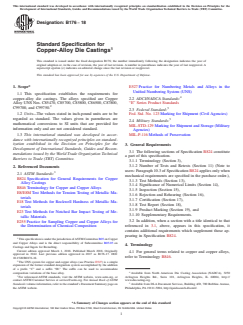
(Specification)Standard Specification for Copper-Alloy Die Castings
General Information
- Abstract
ABSTRACT
This specification establishes the requirements for copper-alloy die castings and covers Copper Alloy UNS Nos. C85700, C85800, C86500, C87800, C99700, and C99750. The material shall conform to the chemical composition requirements prescribed for copper, tin, lead, zinc, iron, nickel, cobalt, aluminum, manganese, silicon, antimony, sulphur, and phosphorus. Unless specified, acceptance of die castings under this specification shall not depend on mechanical properties determined by tension or impact tests. Requirements for sampling for chemical analysis, dimensions, mass, internal soundness, and pressure tightness are given.
SCOPE
1.1 This specification establishes the requirements for copper-alloy die castings. The alloys specified are Copper Alloy UNS Nos. C85470, C85700, C85800, C86500, C87800, C99700, and C99750.2
1.2 Units—The values stated in inch-pound units are to be regarded as standard. The values given in parentheses are mathematical conversions to SI units that are provided for information only and are not considered standard.
1.3 This international standard was developed in accordance with internationally recognized principles on standardization established in the Decision on Principles for the Development of International Standards, Guides and Recommendations issued by the World Trade Organization Technical Barriers to Trade (TBT) Committee.
- Status
- Published
- Publication Date
- 28-Feb-2018
- Technical Committee
- B05 - Copper and Copper Alloys
- Drafting Committee
- B05.05 - Castings and Ingots for Remelting
Overview
ASTM B176-18: Standard Specification for Copper-Alloy Die Castings defines the requirements for the composition, manufacturing, and marking of copper-alloy die castings. This international standard covers several copper alloys, including UNS Nos. C85470, C85700, C85800, C86500, C87800, C99700, and C99750. The specification ensures consistent chemical composition and product quality for die cast copper and copper alloy parts, facilitating reliable performance and compliance for end users in various industries.
Key Topics
- Material Composition: The standard specifies required ranges and maximum limits for copper, tin, lead, zinc, iron, nickel, cobalt, aluminum, manganese, silicon, antimony, sulfur, and phosphorus in listed alloys.
- Scope of Acceptance: Unless otherwise ordered, mechanical properties like tensile and impact strength are not required for acceptance. Chemical composition and other qualitative criteria are prioritized.
- Sampling and Inspection: Guidelines are provided for sampling procedures, inspection lot definitions, and general quality checks to ensure consistent production quality.
- Dimensional Requirements: Permissible variations are mandated to be within those specified in engineering drawings or relevant contract documents.
- Product Marking and Packaging: Shipping containers must be clearly marked with order-specific information. Standards for packaging are included to minimize damage and deterioration during transport and storage.
- Soundness, Pressure Tightness, and Finish: Special requirements, such as internal soundness and pressure tightness, must be specified contractually if required. The as-cast finish and other characteristics should comply with pre-agreed standards.
Applications
Copper-alloy die castings manufactured according to ASTM B176-18 are widely used where high corrosion resistance, dimensional stability, and good machinability are needed. Typical applications include:
- Plumbing and Pipe Fittings: Ensures reliable performance in water systems and valves thanks to corrosion-resistant bronze and brass alloys.
- Automotive Components: Delivers precision and durability in parts such as connectors, housings, and fittings.
- Electrical Hardware: Offers excellent conductivity and strength for terminals, connectors, and enclosures.
- Industrial Equipment: Provides robust performance in gears, bushings, and custom mechanical assemblies.
- Marine Applications: Alloys specified under B176-18 resist saltwater corrosion, making them suitable for shipboard hardware and pumps.
Related Standards
For comprehensive compliance and to ensure optimal performance of copper-alloy die castings, reference should also be made to the following related standards:
- ASTM B824 - General Requirements for Copper Alloy Castings (contains key test and terminology details applicable to ASTM B176-18)
- ASTM B846 - Terminology for Copper and Copper Alloys
- ASTM E8/E8M - Test Methods for Tension Testing of Metallic Materials
- ASTM E18 - Test Methods for Rockwell Hardness of Metallic Materials
- ASTM E23 - Test Methods for Notched Bar Impact Testing of Metallic Materials
- ASTM E255 - Practice for Sampling Copper and Copper Alloys for Determination of Chemical Composition
- ASTM E527 - Practice for Numbering Metals and Alloys in the Unified Numbering System (UNS)
- Federal Standard No. 123 - Marking for Shipment (Civil Agencies)
- MIL-STD-129 - Marking for Shipment and Storage (Military Agencies)
- MIL-P-116 - Methods of Preservation
Practical Value
ASTM B176-18 is crucial for buyers, manufacturers, and engineers seeking to specify copper-alloy die castings that deliver repeatable quality, traceability, and compatibility with modern manufacturing processes. Its adoption helps reduce manufacturing disputes and ensures interoperability across many demanding applications, from industrial machinery to critical infrastructure.
Keywords: ASTM B176-18, copper-alloy die castings, UNS C85470, C85700, C85800, C86500, C87800, C99700, C99750, brass die casting, bronze casting standard, alloy composition, die cast quality standards, copper alloy specification.
Relations
- Effective Date
- 01-Mar-2018
- Effective Date
- 01-Apr-2024
- Effective Date
- 01-Jan-2024
- Effective Date
- 01-Aug-2019
- Effective Date
- 01-Jan-2019
- Effective Date
- 01-Jul-2018
- Effective Date
- 01-Jul-2017
- Effective Date
- 01-Apr-2017
- Effective Date
- 15-Oct-2016
- Effective Date
- 15-Jul-2016
- Effective Date
- 01-Apr-2016
- Effective Date
- 01-Jan-2016
- Effective Date
- 01-Feb-2015
- Effective Date
- 01-Apr-2014
- Effective Date
- 01-Jun-2013
Get Certified
Connect with accredited certification bodies for this standard

Element Materials Technology
Materials testing and product certification.

Inštitut za kovinske materiale in tehnologije
Institute of Metals and Technology. Materials testing, metallurgical analysis, NDT.
Sponsored listings
Frequently Asked Questions
ASTM B176-18 is a technical specification published by ASTM International. Its full title is "Standard Specification for Copper-Alloy Die Castings". This standard covers: ABSTRACT This specification establishes the requirements for copper-alloy die castings and covers Copper Alloy UNS Nos. C85700, C85800, C86500, C87800, C99700, and C99750. The material shall conform to the chemical composition requirements prescribed for copper, tin, lead, zinc, iron, nickel, cobalt, aluminum, manganese, silicon, antimony, sulphur, and phosphorus. Unless specified, acceptance of die castings under this specification shall not depend on mechanical properties determined by tension or impact tests. Requirements for sampling for chemical analysis, dimensions, mass, internal soundness, and pressure tightness are given. SCOPE 1.1 This specification establishes the requirements for copper-alloy die castings. The alloys specified are Copper Alloy UNS Nos. C85470, C85700, C85800, C86500, C87800, C99700, and C99750.2 1.2 Units—The values stated in inch-pound units are to be regarded as standard. The values given in parentheses are mathematical conversions to SI units that are provided for information only and are not considered standard. 1.3 This international standard was developed in accordance with internationally recognized principles on standardization established in the Decision on Principles for the Development of International Standards, Guides and Recommendations issued by the World Trade Organization Technical Barriers to Trade (TBT) Committee.
ABSTRACT This specification establishes the requirements for copper-alloy die castings and covers Copper Alloy UNS Nos. C85700, C85800, C86500, C87800, C99700, and C99750. The material shall conform to the chemical composition requirements prescribed for copper, tin, lead, zinc, iron, nickel, cobalt, aluminum, manganese, silicon, antimony, sulphur, and phosphorus. Unless specified, acceptance of die castings under this specification shall not depend on mechanical properties determined by tension or impact tests. Requirements for sampling for chemical analysis, dimensions, mass, internal soundness, and pressure tightness are given. SCOPE 1.1 This specification establishes the requirements for copper-alloy die castings. The alloys specified are Copper Alloy UNS Nos. C85470, C85700, C85800, C86500, C87800, C99700, and C99750.2 1.2 Units—The values stated in inch-pound units are to be regarded as standard. The values given in parentheses are mathematical conversions to SI units that are provided for information only and are not considered standard. 1.3 This international standard was developed in accordance with internationally recognized principles on standardization established in the Decision on Principles for the Development of International Standards, Guides and Recommendations issued by the World Trade Organization Technical Barriers to Trade (TBT) Committee.
ASTM B176-18 is classified under the following ICS (International Classification for Standards) categories: 77.150.30 - Copper products. The ICS classification helps identify the subject area and facilitates finding related standards.
ASTM B176-18 has the following relationships with other standards: It is inter standard links to ASTM B176-17, ASTM E23-24, ASTM E8/E8M-24, ASTM B846-19a, ASTM B846-19, ASTM E18-18, ASTM E18-17, ASTM B824-17, ASTM B824-16, ASTM E8/E8M-16, ASTM E23-16a, ASTM E23-16, ASTM E8/E8M-15, ASTM B824-14, ASTM E8/E8M-13. Understanding these relationships helps ensure you are using the most current and applicable version of the standard.
ASTM B176-18 is available in PDF format for immediate download after purchase. The document can be added to your cart and obtained through the secure checkout process. Digital delivery ensures instant access to the complete standard document.
Standards Content (Sample)
This international standard was developed in accordance with internationally recognized principles on standardization established in the Decision on Principles for the
Development of International Standards, Guides and Recommendations issued by the World Trade Organization Technical Barriers to Trade (TBT) Committee.
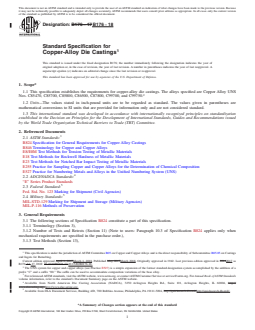
Designation:B176 −18
Standard Specification for
Copper-Alloy Die Castings
This standard is issued under the fixed designation B176; the number immediately following the designation indicates the year of
original adoption or, in the case of revision, the year of last revision. A number in parentheses indicates the year of last reapproval. A
superscript epsilon (´) indicates an editorial change since the last revision or reapproval.
This standard has been approved for use by agencies of the U.S. Department of Defense.
1. Scope* E527 Practice for Numbering Metals and Alloys in the
Unified Numbering System (UNS)
1.1 This specification establishes the requirements for
copper-alloy die castings. The alloys specified are Copper 2.2 ADCI/NADCA Standards:
Alloy UNS Nos. C85470, C85700, C85800, C86500, C87800, “E” Series Product Standards
C99700, and C99750. 5
2.3 Federal Standard:
1.2 Units—The values stated in inch-pound units are to be Fed. Std. No. 123 Marking for Shipment (Civil Agencies)
regarded as standard. The values given in parentheses are 5
2.4 Military Standards:
mathematical conversions to SI units that are provided for
MIL-STD-129 Marking for Shipment and Storage (Military
information only and are not considered standard.
Agencies)
1.3 This international standard was developed in accor-
MIL-P-116 Methods of Preservation
dance with internationally recognized principles on standard-
ization established in the Decision on Principles for the
3. General Requirements
Development of International Standards, Guides and Recom-
3.1 The following sections of Specification B824 constitute
mendations issued by the World Trade Organization Technical
a part of this specification.
Barriers to Trade (TBT) Committee.
3.1.1 Terminology (Section 3),
3.1.2 Number of Tests and Retests (Section 11) (Note to
2. Referenced Documents
users: Paragraph 10.3 of Specification B824 applies only when
2.1 ASTM Standards:
mechanical requirements are specified in the purchase order.),
B824 Specification for General Requirements for Copper
3.1.3 Test Methods (Section 13),
Alloy Castings
3.1.4 Significance of Numerical Limits (Section 14),
B846 Terminology for Copper and Copper Alloys
3.1.5 Inspection (Section 15),
E8/E8M Test Methods for Tension Testing of Metallic Ma-
3.1.6 Rejection and Rehearing (Section 16),
terials
3.1.7 Certification (Section 17),
E18 Test Methods for Rockwell Hardness of Metallic Ma-
3.1.8 Test Report (Section 18),
terials
3.1.9 Product Marking (Section 19), and
E23 Test Methods for Notched Bar Impact Testing of Me-
3.1.10 Supplementary Requirements.
tallic Materials
3.2 In addition, when a section with a title identical to that
E255 Practice for Sampling Copper and Copper Alloys for
the Determination of Chemical Composition referenced in 3.1, above, appears in this specification, it
contains additional requirements which supplement those ap-
pearing in Specification B824.
ThisspecificationisunderthejurisdictionofASTMCommitteeB05onCopper
and Copper Alloys and is the direct responsibility of Subcommittee B05.05 on
4. Terminology
Castings and Ingots for Remelting.
Current edition approved March 1, 2018. Published March 2018. Originally
4.1 For general terms related to copper and copper alloys,
approved in 1942. Last previous edition approved in 2017 as B176-17. DOI:
refer to Terminology B846.
10.1520/B0176-18.
The UNS system for copper and copper alloys (see Practice E527) is a simple
expansion of the former standard designation system accomplished by the addition
of a prefix “C” and a suffix “00.” The suffix can be used to accommodate
composition variations of the base alloy. Available from North American Die Casting Association (NADCA), 3250
For referenced ASTM standards, visit the ASTM website, www.astm.org, or Arlington Heights Rd., Suite 101, Arlington Heights, IL 60004, http://
contact ASTM Customer Service at service@astm.org. For Annual Book of ASTM www.diecasting.org.
Standards volume information, refer to the standard’s Document Summary page on Available from DLA Document Services, Building 4/D, 700 Robbins Avenue,
the ASTM website. Philadelphia, PA 19111-5094, http://quicksearch.dla.mil/.
*A Summary of Changes section appears at the end of this standard
Copyright © ASTM International, 100 Barr Harbor Drive, PO Box C700, West Conshohocken, PA 19428-2959. United States
B176−18
TABLE 2 Sum of All Named Elements Analyzed
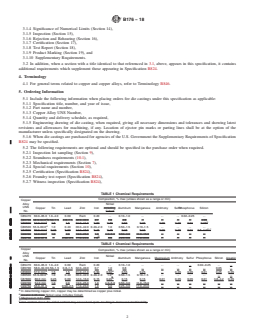
5. Ordering Information
Copper Alloy Copper Plus Named
5.1 Include the following information when placing orders
UNS No. Elements, % min
for die castings under this specification as applicable:
C85470 99.5
5.1.1 Specification title, number, and year of issue,
C85700 98.7
C85800 98.7
5.1.2 Part name and number,
C86500 99.0
5.1.3 Copper Alloy UNS Number,
C87800 99.5
5.1.4 Quantity and delivery schedule, as required,
C99700 99.7
C99750 99.7
5.1.5 Engineering drawing of die casting, when required,
giving all necessary dimensions and tolerances and showing
latest revisions and allowances for machining, if any. Location
ofejectorpinmarksorpartinglinesshallbeattheoptionofthe
manufacturer unless specifically designated on the drawing.
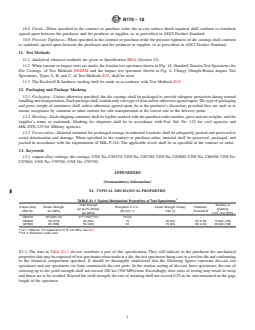
7. Mechanical Property Requirements
5.1.6 When die castings are purchased for agencies of the
U.S. Government the Supplementary Requirements of Speci- 7.1 Unless specified in the purchase order, acceptance of die
fication B824 may be specified.
castings under this specification shall not depend on mechani-
cal properties determined by tension or impact tests. Table
5.2 The following requirements are optional and should be
X1.1 shows typical mechanical properties.
specified in the purchase order when required.
5.2.1 Inspection lot sampling (Section 9),
7.2 When minimum mechanical properties are specified in
5.2.2 Soundness requirements (10.1),
the purchase order the mechanical properties shall be agreed
5.2.3 Mechanical requirements (Section 7),
upon between the manufacturer or supplier and the purchaser.
5.2.4 Special requirements (Section 10),
5.2.5 Certification (Specification B824),
8. Dimensions, Mass, and Permissible Variations
5.2.6 Foundry test report (Specification B824),
8.1 Permissible variations in dimensions shall be within the
5.2.7 Witness inspection (Specification B824),
limits specified on the drawings or in the contract or purchase
5.2.8 Product marking (Specification B824), and
order.
5.2.9 Packaging requirements (Section 12).
8.1.1 Any dimensions for which a tolerance is not specified
shall be in accord with ADCI Product Standard Series E1 to
6. Chemical Composition
E16 inclusive.
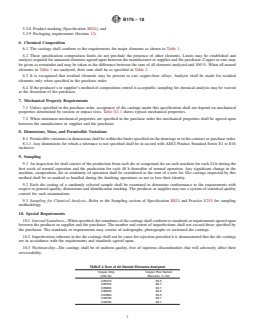
6.1 The castings shall conform to the requirements for
major elements as shown in Table 1.
9. Sampling
6.2 These specification composition limits do not preclude
9.1 An inspection lot shall consist of the production from
the presence of other elements. Limits may be established and
each die or compound die on each machine for each 24 h
analysis required for unnamed elements agreed upon between
during the first week of normal operation and the production
the manufacturer or supplier and the purchaser. Copper or zinc
for each 48 h thereafter of normal operation. Any significant
may be given as remainder and may be taken as the difference
change in the machine, composition, die or continuity of
between the sum of all elements analyzed and 100 %.When all
operation shall be considered as the start of a new lot. Die
named elements in Table 1 are analyzed, their sum shall be as
castings inspected by this method shall be so marked or
specified in Table 2.
handled during the finishing operations as not to lose their
6.3 It is recognized that residual elements may be present in identity.
cast copper-base alloys. Analysis shall be made for residual
9.2 Each die casting of a randomly selected sample shall be
elements only when specified in the purchase order.
examined to determine conformance to the requirements with
6.4 If the producer’s or supplier’s method of composition respect to general quality, dimensions and identification mark-
control is acceptable, sampling for chemical analysis may be ing. The producer or supplier may use a system of statistical
waived at the discretion of the purchaser. quality control for such examinations.
TABLE 1 Chemical Requirements
Copper
Composition, % max (unless shown as a range or min)
Alloy
Copper Tin Lead Zinc Iron Nickel Aluminum Manganese Magnesium Antimony Sulfur Phosphorus Silicon Arsenic
UNS No.
C85470 60.0–65.0 1.0–4.0 0.09 Rem 0.20 . 0.10–1.0 . . . . 0.02–0.25 . .
C85700 58.0–64.0 0.50–1.5 0.8–1.5 32.0–40.0 0.7 1.0 0.8 . . . . . 0.05 .
A B
C85800 57.0 min 1.5 1.5 31.0–41.0 0.50 0.50 0.55 0.25 . 0.05 0.05 0.01 0.25 0.05
A B
C86500 55.0–60.0 1.0 0.40 36.0–42.0 0.40–2.
...
This document is not an ASTM standard and is intended only to provide the user of an ASTM standard an indication of what changes have been made to the previous version. Because
it may not be technically possible to adequately depict all changes accurately, ASTM recommends that users consult prior editions as appropriate. In all cases only the current version
of the standard as published by ASTM is to be considered the official document.
Designation: B176 − 17 B176 − 18
Standard Specification for
Copper-Alloy Die Castings
This standard is issued under the fixed designation B176; the number immediately following the designation indicates the year of
original adoption or, in the case of revision, the year of last revision. A number in parentheses indicates the year of last reapproval. A
superscript epsilon (´) indicates an editorial change since the last revision or reapproval.
This standard has been approved for use by agencies of the U.S. Department of Defense.
1. Scope*
1.1 This specification establishes the requirements for copper-alloy die castings. The alloys specified are Copper Alloy UNS
Nos. C85470, C85700, C85800, C86500, C87800, C99700, and C99750.
1.2 Units—The values stated in inch-pound units are to be regarded as standard. The values given in parentheses are
mathematical conversions to SI units that are provided for information only and are not considered standard.
1.3 This international standard was developed in accordance with internationally recognized principles on standardization
established in the Decision on Principles for the Development of International Standards, Guides and Recommendations issued
by the World Trade Organization Technical Barriers to Trade (TBT) Committee.
2. Referenced Documents
2.1 ASTM Standards:
B824 Specification for General Requirements for Copper Alloy Castings
B846 Terminology for Copper and Copper Alloys
E8/E8M Test Methods for Tension Testing of Metallic Materials
E18 Test Methods for Rockwell Hardness of Metallic Materials
E23 Test Methods for Notched Bar Impact Testing of Metallic Materials
E255 Practice for Sampling Copper and Copper Alloys for the Determination of Chemical Composition
E527 Practice for Numbering Metals and Alloys in the Unified Numbering System (UNS)
2.2 ADCI/NADCA Standards:
“E” Series Product Standards
2.3 Federal Standard:
Fed. Std. No. 123 Marking for Shipment (Civil Agencies)
2.4 Military Standards:
MIL-STD-129 Marking for Shipment and Storage (Military Agencies)
MIL-P-116 Methods of Preservation
3. General Requirements
3.1 The following sections of Specification B824 constitute a part of this specification.
3.1.1 Terminology (Section 3),
3.1.2 Number of Tests and Retests (Section 11) (Note to users: Paragraph 10.3 of Specification B824 applies only when
mechanical requirements are specified in the purchase order.),
3.1.3 Test Methods (Section 13),
This specification is under the jurisdiction of ASTM Committee B05 on Copper and Copper Alloys and is the direct responsibility of Subcommittee B05.05 on Castings
and Ingots for Remelting.
Current edition approved April 1, 2017March 1, 2018. Published May 2017March 2018. Originally approved in 1942. Last previous edition approved in 20142017 as
B176-14.-17. DOI: 10.1520/B0176-17.10.1520/B0176-18.
The UNS system for copper and copper alloys (see Practice E527) is a simple expansion of the former standard designation system accomplished by the addition of a
prefix “C” and a suffix “00.” The suffix can be used to accommodate composition variations of the base alloy.
For referenced ASTM standards, visit the ASTM website, www.astm.org, or contact ASTM Customer Service at service@astm.org. For Annual Book of ASTM Standards
volume information, refer to the standard’s Document Summary page on the ASTM website.
Available from North American Die Casting Association (NADCA), 3250 Arlington Heights Rd., Suite 101, Arlington Heights, IL 60004, http://
www.diecasting.org.http://www.diecasting.org.
Available from DLA Document Services, Building 4/D, 700 Robbins Avenue, Philadelphia, PA 19111-5094, http://quicksearch.dla.mil/http://quicksearch.dla.mil/.
*A Summary of Changes section appears at the end of this standard
Copyright © ASTM International, 100 Barr Harbor Drive, PO Box C700, West Conshohocken, PA 19428-2959. United States
B176 − 18
3.1.4 Significance of Numerical Limits (Section 14),
3.1.5 Inspection (Section 15),
3.1.6 Rejection and Rehearing (Section 16),
3.1.7 Certification (Section 17),
3.1.8 Test Report (Section 18),
3.1.9 Product Marking (Section 19), and
3.1.10 Supplementary Requirements.
3.2 In addition, when a section with a title identical to that referenced in 3.1, above, appears in this specification, it contains
additional requirements which supplement those appearing in Specification B824.
4. Terminology
4.1 For general terms related to copper and copper alloys, refer to Terminology B846.
5. Ordering Information
5.1 Include the following information when placing orders for die castings under this specification as applicable:
5.1.1 Specification title, number, and year of issue,
5.1.2 Part name and number,
5.1.3 Copper Alloy UNS Number,
5.1.4 Quantity and delivery schedule, as required,
5.1.5 Engineering drawing of die casting, when required, giving all necessary dimensions and tolerances and showing latest
revisions and allowances for machining, if any. Location of ejector pin marks or parting lines shall be at the option of the
manufacturer unless specifically designated on the drawing.
5.1.6 When die castings are purchased for agencies of the U.S. Government the Supplementary Requirements of Specification
B824 may be specified.
5.2 The following requirements are optional and should be specified in the purchase order when required.
5.2.1 Inspection lot sampling (Section 9),
5.2.2 Soundness requirements (10.1),
5.2.3 Mechanical requirements (Section 7),
5.2.4 Special requirements (Section 10),
5.2.5 Certification (Specification B824),
5.2.6 Foundry test report (Specification B824),
5.2.7 Witness inspection (Specification B824),
TABLE 1 Chemical Requirements
Composition, % max (unless shown as a range or min)
Copper
Alloy
Nickel
UNS
Copper Tin Lead Zinc Iron including Aluminum Manganese Antimony SulfurPhosphorus Silicon
No.
Cobalt
C85470 60.0–65.0 1.0–4.0 0.09 Rem 0.20 . 0.10–1.0 . . . 0.02–0.25 .
A
C85700 58.0–64.0 0.50–1.5 0.8–1.5 32.0–40.0 0.7 1.0 0.8 . . . . 0.05
A B
C85800 57.0 min 1.5 1.5 31.0–41.0 0.50 0.50 0.55 0.25 0.05 0.05 0.01 0.25
A
C86500 55.0–60.0 1.0 0.40 36.0–42.0 0.40–2.0 1.0 0.50–1.5 0.10–1.5 . . . .
A B,C
C87800 80.0 min 0.25 0.09 12.0–16.0 0.15 0.20 0.15 0.15 0.05 0.05 0.01 3.8–4.2
A
C99700 54.0 min 1.0 2.0 19.0–25.0 1.0 4.0–6.0 0.50–3.0 11.0–15.0 . . . .
D
C99750 55.0–61.0 . 0.50–2.5 17.0–23.0 1.0 5.0 0.25–3.0 17.0–23.0 . . . .
TABLE 1 Chemical Requirements
Copper
Composition, % max (unless shown as a range or min)
Alloy
Nickel
UNS
Copper Tin Lead Zinc Iron Aluminum Manganese Magnesium Antimony Sulfur Phosphorus Silicon Arsenic
No.
C85470 60.0–65.0 1.0–4.0 0.09 Rem 0.20 . 0.10–1.0 . . . . 0.02–0.25 . .
C85700 58.0–64.0 0.50–1.5 0.8–1.5 32.0–40.0 0.7 1.0 0.8 . . . . . 0.05 .
A B
C85800 57.0 min 1.5 1.5 31.0–41.0 0.50 0.50 0.55 0.25 . 0.05 0.05 0.01 0.25 0.05
A B
C86500 55.0–60.0 1.0 0.40 36.0–42.0 0.40–2.0 1.0 0.50–1.5 0.10–1.5 . . . . . .
B
C87800 80.0 min 0.25 0.09 12.0–16.0 0.15 0.20 0.15 0.15 0.01 0.05 0.05 0.01 3.8–4.2 0.05
C99700 54.0 min 1.0 2.0 19.0–25.0 1.0 4.0–6.0 0.50–3.0 11.0–15.0 . . . . . .
C99750 55.0–61.0 . 0.50–2.5 17.0–23.0 1.0 5.0 0.25–3.0 17.0–23.0 . . . . . .
A
In determining copper min, copper may be determined as copper plus nickel.
B
Arsenic 0.05 max. Nickel value includes Cobalt.
C
Magnesium 0.01 max.
D
Iron content above the nickel content may cause hard spots resulting in decreased machinability.
B176 − 18
5.2.8 Product marking (Specification B824), and
5.2.9 Packaging requirements (Section 12).
6. Chemical Composition
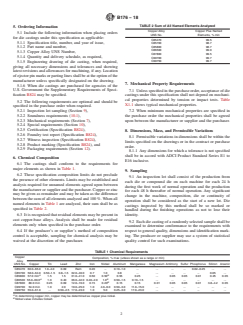
6.1 The castings shall conform to the requirements for major elements as shown in Table 1.
6.2 These specification composition limits do not preclude the presence of other elements. Limits may be established and
analysis required for unnamed elements agreed upon between the manufacturer or supplier and the purchaser. Copper or zinc may
be given as remainder and may be taken as the difference between the sum of all elements analyzed and 100 %. When all named
elements in Table 1 are analyzed, their sum shall be as specified in Table 2.
6.3 It is recognized that residual elements may be present in cast copper-base alloys. Analysis shall be made for residual
elements only when specified in the purchase order.
6.4 If the producer’s or supplier’s method of composition control is acceptable, sampling for chemical analysis may be waived
at the discretion of the purchaser.
7. Mechanical Property Requirements
7.1 Unless specified in the purchase order, acceptance of die castings under this specification shall not depend on mechanical
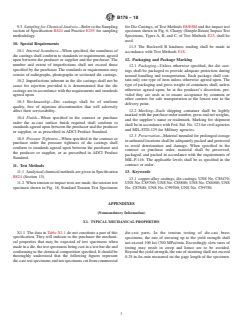
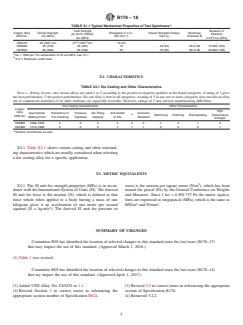
properties determined by tension or impact tests. Table X1.1 shows typical mechanical properties.
7.2 When minimum mechanical properties are specified in the purchase order the mechanical properties shall be agreed upon
between the manufacturer or supplier and the purchaser.
8. Dimensions, Mass, and Permissible Variations
8.1 Permissible variations in dimensions shall be within the limits specified on the drawings or in the contract or purchase order.
8.1.1 Any dimensions for which a tolerance is not
...