

ASTM D609-17(2022)
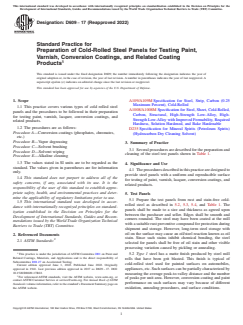
(Practice)Standard Practice for Preparation of Cold-Rolled Steel Panels for Testing Paint, Varnish, Conversion Coatings, and Related Coating Products
General Information
- Abstract
ABSTRACT
Test
SIGNIFICANCE AND USE
4.1 The procedures described in this practice are designed to provide steel panels with a uniform and reproducible surface for testing of paint, varnish, lacquer, conversion coatings, and related products.
SCOPE
1.1 This practice covers various types of cold rolled steel panels and the procedures to be followed in their preparation for testing paint, varnish, lacquer, conversion coatings, and related products.
1.2 The procedures are as follows:
Procedure A—Conversion coatings (phosphates, chromates,
etc.)
Procedure B—Vapor degreasing
Procedure C—Solvent brushing
Procedure D—Solvent wiping
Procedure E—Alkaline cleaning
1.3 The values stated in SI units are to be regarded as the standard. The values given in parentheses are for information only.
1.4 This standard does not purport to address all of the safety concerns, if any, associated with its use. It is the responsibility of the user of this standard to establish appropriate safety, health, and environmental practices and determine the applicability of regulatory limitations prior to use.
1.5 This international standard was developed in accordance with internationally recognized principles on standardization established in the Decision on Principles for the Development of International Standards, Guides and Recommendations issued by the World Trade Organization Technical Barriers to Trade (TBT) Committee.
- Status
- Published
- Publication Date
- 31-May-2022
- Technical Committee
- D01 - Paint and Related Coatings, Materials, and Applications
- Drafting Committee
- D01.27 - Accelerated Testing


Overview
ASTM D609-17(2022), Standard Practice for Preparation of Cold-Rolled Steel Panels for Testing Paint, Varnish, Conversion Coatings, and Related Coating Products, is an international standard published by ASTM International. This standard details the procedures required to prepare cold-rolled steel panels, ensuring a consistent and reproducible surface condition. Its primary goal is to provide reliable substrates for evaluating the performance of paint, varnish, lacquer, conversion coatings, and related products on steel panels under controlled laboratory conditions.
Uniform panel preparation as prescribed by ASTM D609-17 is essential for achieving consistent test results and comparability across paint and coating tests. The standard is recognized by organizations worldwide, including U.S. federal agencies, for its role in product development, quality assurance, and regulatory compliance in the coatings industry.
Key Topics
- Panel Types and Standards: The practice specifies several types of cold-rolled steel panels (matte, flat-polished, smooth) based on surface finish and thickness. Reference is made to applicable ASTM steel specifications such as A109/A109M and A1008/A1008M.
- Preparation Procedures: The standard outlines five main procedures to clean and prepare steel panels:
- Conversion coatings (such as phosphates and chromates)
- Vapor degreasing
- Solvent brushing
- Solvent wiping
- Alkaline cleaning
- Surface Condition Criteria: Panel surfaces must be rust and stain-free, with uniform roughness and finish. Visual inspection and specific surface roughness parameters are recommended.
- Protection and Handling: Guidelines are provided to prevent recontamination and rusting after preparation, including using corrosion-inhibiting paper and handling with lint-free gloves.
- Safety and Environmental Practices: Users are responsible for identifying and adhering to relevant safety, health, and environmental regulations associated with panel preparation operations.
Applications
ASTM D609-17(2022) is widely used in various sectors involving protective coatings and surface finishing on steel:
- Coatings Research and Development: Provides a standard substrate for laboratory testing of new paint, varnish, and coating formulations.
- Quality Control & Performance Testing: Ensures consistent results in product validation, including assessments of adhesion, corrosion resistance, gloss, flexibility, and other key coating properties.
- Regulatory & Certification Testing: Supports compliance with building, automotive, and appliance industry standards that reference reproducible benchmarking of coating materials.
- Comparative Product Evaluation: Facilitates objective comparison between different coatings or pretreatment methods by removing substrate variation from test results.
- Education and Training: Serves as a teaching resource for best practices in preparing and testing surface coatings.
Following ASTM D609-17 improves the reliability and repeatability of test outcomes in industrial, research, and regulatory environments.
Related Standards
Professionals commonly reference ASTM D609-17(2022) alongside these standards:
- ASTM A109/A109M: Specification for Steel, Strip, Carbon (Cold-Rolled)
- ASTM A1008/A1008M: Specification for Steel, Sheet, Cold-Rolled
- ASTM D235: Specification for Mineral Spirits (Petroleum Spirits)
- ASTM D01 Series: Various standards on paint and related coatings, materials, and applications
Many international and national coating and corrosion testing standards also reference or harmonize with ASTM D609 guidelines for substrate preparation.
Keywords: ASTM D609-17, steel panel preparation, coating test panels, cold-rolled steel, paint testing, varnish testing, surface preparation standard, conversion coatings, quality control, substrate-coatings application, industrial coatings standards
Relations
- Effective Date
- 01-Mar-2024
- Effective Date
- 01-Nov-2023
- Effective Date
- 01-Nov-2023
- Effective Date
- 01-Nov-2018
- Effective Date
- 01-Sep-2018
- Effective Date
- 01-Sep-2016
- Effective Date
- 01-Sep-2016
- Effective Date
- 01-Nov-2015
- Effective Date
- 01-May-2015
- Effective Date
- 01-May-2014
- Effective Date
- 01-Oct-2013
- Effective Date
- 01-Oct-2013
- Effective Date
- 01-Nov-2012
- Effective Date
- 01-Mar-2012
- Effective Date
- 01-Apr-2011
Get Certified
Connect with accredited certification bodies for this standard

Element Materials Technology
Materials testing and product certification.

Inštitut za kovinske materiale in tehnologije
Institute of Metals and Technology. Materials testing, metallurgical analysis, NDT.
Sponsored listings
Frequently Asked Questions
ASTM D609-17(2022) is a standard published by ASTM International. Its full title is "Standard Practice for Preparation of Cold-Rolled Steel Panels for Testing Paint, Varnish, Conversion Coatings, and Related Coating Products". This standard covers: ABSTRACT Test SIGNIFICANCE AND USE 4.1 The procedures described in this practice are designed to provide steel panels with a uniform and reproducible surface for testing of paint, varnish, lacquer, conversion coatings, and related products. SCOPE 1.1 This practice covers various types of cold rolled steel panels and the procedures to be followed in their preparation for testing paint, varnish, lacquer, conversion coatings, and related products. 1.2 The procedures are as follows: Procedure A—Conversion coatings (phosphates, chromates, etc.) Procedure B—Vapor degreasing Procedure C—Solvent brushing Procedure D—Solvent wiping Procedure E—Alkaline cleaning 1.3 The values stated in SI units are to be regarded as the standard. The values given in parentheses are for information only. 1.4 This standard does not purport to address all of the safety concerns, if any, associated with its use. It is the responsibility of the user of this standard to establish appropriate safety, health, and environmental practices and determine the applicability of regulatory limitations prior to use. 1.5 This international standard was developed in accordance with internationally recognized principles on standardization established in the Decision on Principles for the Development of International Standards, Guides and Recommendations issued by the World Trade Organization Technical Barriers to Trade (TBT) Committee.
ABSTRACT Test SIGNIFICANCE AND USE 4.1 The procedures described in this practice are designed to provide steel panels with a uniform and reproducible surface for testing of paint, varnish, lacquer, conversion coatings, and related products. SCOPE 1.1 This practice covers various types of cold rolled steel panels and the procedures to be followed in their preparation for testing paint, varnish, lacquer, conversion coatings, and related products. 1.2 The procedures are as follows: Procedure A—Conversion coatings (phosphates, chromates, etc.) Procedure B—Vapor degreasing Procedure C—Solvent brushing Procedure D—Solvent wiping Procedure E—Alkaline cleaning 1.3 The values stated in SI units are to be regarded as the standard. The values given in parentheses are for information only. 1.4 This standard does not purport to address all of the safety concerns, if any, associated with its use. It is the responsibility of the user of this standard to establish appropriate safety, health, and environmental practices and determine the applicability of regulatory limitations prior to use. 1.5 This international standard was developed in accordance with internationally recognized principles on standardization established in the Decision on Principles for the Development of International Standards, Guides and Recommendations issued by the World Trade Organization Technical Barriers to Trade (TBT) Committee.
ASTM D609-17(2022) is classified under the following ICS (International Classification for Standards) categories: 77.140.50 - Flat steel products and semi-products. The ICS classification helps identify the subject area and facilitates finding related standards.
ASTM D609-17(2022) has the following relationships with other standards: It is inter standard links to ASTM A109/A109M-24, ASTM A1008/A1008M-23, ASTM A1008/A1008M-23e1, ASTM A109/A109M-16(2018), ASTM A1008/A1008M-18, ASTM A1008/A1008M-16, ASTM A109/A109M-16, ASTM A109/A109M-15, ASTM A1008/A1008M-15, ASTM A109/A109M-14, ASTM A109/A109M-13, ASTM A1008/A1008M-13, ASTM A1008/A1008M-12a, ASTM A1008/A1008M-12, ASTM A1008/A1008M-11. Understanding these relationships helps ensure you are using the most current and applicable version of the standard.
ASTM D609-17(2022) is available in PDF format for immediate download after purchase. The document can be added to your cart and obtained through the secure checkout process. Digital delivery ensures instant access to the complete standard document.
Standards Content (Sample)
This international standard was developed in accordance with internationally recognized principles on standardization established in the Decision on Principles for the
Development of International Standards, Guides and Recommendations issued by the World Trade Organization Technical Barriers to Trade (TBT) Committee.
Designation: D609 − 17 (Reapproved 2022)
Standard Practice for
Preparation of Cold-Rolled Steel Panels for Testing Paint,
Varnish, Conversion Coatings, and Related Coating
Products
This standard is issued under the fixed designation D609; the number immediately following the designation indicates the year of
original adoption or, in the case of revision, the year of last revision. A number in parentheses indicates the year of last reapproval. A
superscript epsilon (´) indicates an editorial change since the last revision or reapproval.
This standard has been approved for use by agencies of the U.S. Department of Defense.
1. Scope A109/A109M Specification for Steel, Strip, Carbon (0.25
Maximum Percent), Cold-Rolled
1.1 This practice covers various types of cold rolled steel
A1008/A1008M Specification for Steel, Sheet, Cold-Rolled,
panels and the procedures to be followed in their preparation
Carbon, Structural, High-Strength Low-Alloy, High-
for testing paint, varnish, lacquer, conversion coatings, and
Strength Low-Alloy with Improved Formability, Required
related products.
Hardness, Solution Hardened, and Bake Hardenable
1.2 The procedures are as follows:
D235 Specification for Mineral Spirits (Petroleum Spirits)
Procedure A—Conversion coatings (phosphates, chromates,
(Hydrocarbon Dry Cleaning Solvent)
etc.)
Procedure B—Vapor degreasing
3. Summary of Practice
Procedure C—Solvent brushing
3.1 Several procedures are described for the preparation and
Procedure D—Solvent wiping
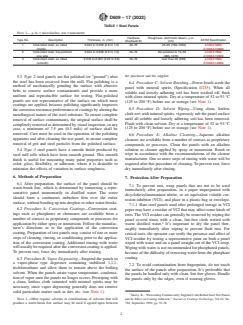
cleaning of the steel test panels shown in Table 1.
Procedure E—Alkaline cleaning
1.3 The values stated in SI units are to be regarded as the
4. Significance and Use
standard. The values given in parentheses are for information
4.1 Theproceduresdescribedinthispracticearedesignedto
only.
provide steel panels with a uniform and reproducible surface
1.4 This standard does not purport to address all of the
for testing of paint, varnish, lacquer, conversion coatings, and
safety concerns, if any, associated with its use. It is the
related products.
responsibility of the user of this standard to establish appro-
priate safety, health, and environmental practices and deter-
5. Test Panels
mine the applicability of regulatory limitations prior to use.
5.1 Prepare the test panels from rust and stain-free cold-
1.5 This international standard was developed in accor-
rolled steel as described in 5.2, 5.3, 5.4, and Table 1. The
dance with internationally recognized principles on standard-
panels shall be made to a size and thickness as agreed upon
ization established in the Decision on Principles for the
between the purchaser and seller. Edges shall be smooth and
Development of International Standards, Guides and Recom-
corners rounded. The steel may have been coated at the mill
mendations issued by the World Trade Organization Technical
with a suitable rust preventive compound for protection during
Barriers to Trade (TBT) Committee.
shipment and storage. However, long-term steel storage with
oil on the surface may cause an oil/steel reaction known as oil
2. Referenced Documents
stain. Since such stains inhibit chemical bonding, the steel
2.1 ASTM Standards:
selected for panels shall be free of oil stain and other visible
processing variation caused by pickling or annealing.
This practice is under the jurisdiction of ASTM Committee D01 on Paint and
5.2 Type 1 steel has a matte finish produced by steel mill
Related Coatings, Materials, and Applications and is the direct responsibility of
rolls that have been grit blasted. This finish is typical of
Subcommittee D01.27 on Accelerated Testing.
cold-rolled steel used for painted surfaces on automobiles,
Current edition approved June 1, 2022. Published June 2022. Originally
appliances, etc. Such surfaces can be partially characterized by
approved in 1941. Last previous edition approved in 2017 as D609 – 17. DOI:
10.1520/D0609-17R22.
measuring the average peak-to-valley distance and the number
For referenced ASTM standards, visit the ASTM website, www.astm.org, or
of peaks per unit area. However, conversion coating and paint
contact ASTM Customer Service at service@astm.org. For Annual Book of ASTM
performance on such surfaces may vary because of different
Standards volume information, refer to the standard’s Document Summary page on
the ASTM website. oxidation, annealing procedures, and surface conditions.
Copyright © ASTM International, 100 Barr Harbor Drive, PO Box C700, West Conshohocken, PA 19428-2959. United States
D609 − 17 (2022)
TABLE 1 Steel Panels
NOTE 1— µ in. = microinches; nm = nanometer.
Hardness Roughness (Arithmetic Mean), µ in.
Type No. Description Thickness, in. (mm) ASTM Specification
(Rockwell B) (nm)
1 Cold-rolled steel, as rolled 0.024 to 0.038 (0.6 to 1.0) 40–75 25–65 (760–1650) A109/A109M,
(matte) A1008/A1008M
2 Cold-rolled steel, flat-polished 0.024 to 0.038 (0.6 to 1.0) 40–75 flat polished to 15–50 A109/A109M,
one side (380–1270) A1008/A1008M
3 Cold-rolled steel, as rolled 0.010 to 0.024 (0.25 to 0.6) 40–75 less than 20 (500) A109/A109M,
(smooth) A1008/A1008M
the purchaser and the supplier.
5.3 Type 2 steel panels are flat polished (or “ground”) after
the steel has been received from the mill. Flat polishing is a
6.4 Procedure C: Solvent Brushing—Power-brush scrub the
method of mechanically grinding the surface with abrasive
panel with mineral spirits (Specification D235). When all
belts to remove surface contaminants and provide a more
soluble and loosely adhering soil has been washed off, flush
uniform and reproducible surface for testing. Flat-polished
with clean mineral spirits. Dry at a temperature of 52 to 93 °C
panels are not representative of the surface on which most
(125 to 200 °F) before use or storage (see Note 1).
coatings are applied, because polishing significa
...