

SIST EN 300 440-1 V1.6.1:2010
(Main)Electromagnetic compatibility and Radio spectrum Matters (ERM) - Short range devices - Radio equipment to be used in the 1 GHz to 40 GHz frequency range - Part 1: Technical characteristics and test methods
General Information
- Abstract
In response to the R&TTE-CA query (document ERM_39_40_39
The present document applies to the following Short Range Device major equipment types:
- Generic Short Range Devices, including alarms, telecommand, telemetry, data transmission in general, etc.
- Radio Frequency IDentification (RFID).
- Radiodetermination, including detection, movement and alert applications.
These radio equipment types are capable of operating in the permitted frequency bands within the 1 GHz to 40 GHz range as specified in table 1:
- either with a Radio Frequency (RF) output connection and dedicated antenna or with an integral antenna;
- for all types of modulation;
- with or without speech.
Table 1 shows a list of the frequency bands as designated by the European Commission Decisions on Short Range Devices [i.6], [i.7] and the CEPT/ERC Recommendation 70-03 [i.1] as known at the date of publication of the present document.
- Status
- Published
- Publication Date
- 14-Sep-2010
- Technical Committee
- MOC - Mobile Communications
- Current Stage
- 6060 - National Implementation/Publication (Adopted Project)
- Start Date
- 30-Aug-2010
- Due Date
- 04-Nov-2010
- Completion Date
- 15-Sep-2010
Buy Documents

ETSI EN 300 440-1 V1.6.1 (2010-04) - Electromagnetic compatibility and Radio spectrum Matters (ERM); Short range devices; Radio equipment to be used in the 1 GHz to 40 GHz frequency range; Part 1: Technical characteristics and test methods
ETSI EN 300 440-1 V1.6.1 (2010-08) - Electromagnetic compatibility and Radio spectrum Matters (ERM); Short range devices; Radio equipment to be used in the 1 GHz to 40 GHz frequency range; Part 1: Technical characteristics and test methods

Overview
SIST EN 300 440-1 V1.6.1:2010 is the ETSI-derived Slovenian standard for Short Range Devices (SRD) operating in the 1 GHz to 40 GHz radio-frequency range. Published by SIST/ETSI, it specifies technical characteristics and test methods to assess electromagnetic compatibility (EMC), radiated and conducted emissions, and radio performance for generic SRDs, RFID and radiodetermination equipment. This edition clarifies the appropriate detector for measuring spurious emissions and aligns measurement upper frequency limits (for carriers above 20 GHz) and shielded RF anechoic chamber calibration with commonly available measuring receivers.
Key topics and technical requirements
- Scope and device categories: Generic SRDs (alarms, telemetry, data links), RFID, radiodetermination (detection, movement, alert).
- Frequency coverage: Equipment operating within 1 GHz–40 GHz, including devices with integral or external antennas and all modulation types.
- Emissions measurements:
- Methods for radiated and conducted spurious emissions, including cabinet and antenna-related spurious radiation.
- Clarification of the appropriate detector to use when measuring spurious emissions.
- Adjustment of measurement upper frequency limits for carriers >20 GHz to match available measuring receivers.
- Radiated power and spectrum metrics:
- Equivalent isotropically radiated power (e.i.r.p.) measurement methods and presentation.
- Permitted operating frequency ranges and measurement procedures (including FHSS).
- Receiver performance:
- Adjacent channel selectivity, blocking/desensitization, and spurious emissions from receivers.
- Test conditions and infrastructure:
- Test power sources, ambient temperature conditions (normal and extreme), artificial antennas and test fixtures.
- Requirements for measuring receivers, test sites and validation of shielded RF anechoic chambers (calibration upper limit aligned with measurement range).
- Spectrum access techniques: provisions such as Listen Before Talk (LBT) timing parameters and duty cycle declarations for certain access methods.
Practical applications and who uses this standard
- Product manufacturers and RF designers use the standard to design SRDs that meet EMC and spurious-emission requirements for European markets.
- Test laboratories and certification bodies apply the specified test methods (radiated/conducted measurements, chamber validation, receiver setup) for type approval and compliance testing.
- Regulatory authorities and conformity assessors reference the standard when enforcing decisions and recommendations (e.g., European Commission Decisions on SRDs, CEPT/ERC Recommendation 70‑03).
- Procurement, QA and R&D teams use it to verify e.i.r.p., receiver immunity, FHSS/LBT behavior, and chamber calibration requirements.
Related standards and references
- ETSI/ETSI EN series documents and European Commission Decisions on Short Range Devices.
- CEPT/ERC Recommendation 70‑03 (listed in the standard as a key reference).
Keywords: SIST EN 300 440-1, Short Range Devices, 1 GHz to 40 GHz, EMC, spurious emissions, e.i.r.p., RFID, measuring receiver, RF anechoic chamber, FHSS, Listen Before Talk.
Buy Documents
ETSI EN 300 440-1 V1.6.1 (2010-04) - Electromagnetic compatibility and Radio spectrum Matters (ERM); Short range devices; Radio equipment to be used in the 1 GHz to 40 GHz frequency range; Part 1: Technical characteristics and test methods
ETSI EN 300 440-1 V1.6.1 (2010-08) - Electromagnetic compatibility and Radio spectrum Matters (ERM); Short range devices; Radio equipment to be used in the 1 GHz to 40 GHz frequency range; Part 1: Technical characteristics and test methods
Get Certified
Connect with accredited certification bodies for this standard

ANCE
Mexican certification and testing association.

Intertek Slovenia
Intertek testing, inspection, and certification services in Slovenia.

LNE (Laboratoire National de Métrologie et d'Essais)
French national laboratory for metrology and testing.
Sponsored listings
Frequently Asked Questions
SIST EN 300 440-1 V1.6.1:2010 is a standard published by the Slovenian Institute for Standardization (SIST). Its full title is "Electromagnetic compatibility and Radio spectrum Matters (ERM) - Short range devices - Radio equipment to be used in the 1 GHz to 40 GHz frequency range - Part 1: Technical characteristics and test methods". This standard covers: In response to the R&TTE-CA query (document ERM_39_40_39 <http://docbox.etsi.org/erm/erm/meeting39_40/ERM_39_40_39_LS_RTTECA_to_ERM_re_EN_300_440-1_detector.zip>), EN 300 440-1 will be slightly revised in order to clarify which is the appropriate detector to be used for measuring spurious emissions. The following parameters will also be modified: ·for carrier frequencies above 20 GHz, in measurements of unwanted emissions in the spurious domain and spurious emissions, the upper frequency of the measurements will be consistent with the market actual commonly available measuring receivers. the upper limit of the calibration of the shielded RF anechoic chamber will be brought in line with the above bullet point's upper frequency measurement. The present document applies to the following Short Range Device major equipment types: - Generic Short Range Devices, including alarms, telecommand, telemetry, data transmission in general, etc. - Radio Frequency IDentification (RFID). - Radiodetermination, including detection, movement and alert applications. These radio equipment types are capable of operating in the permitted frequency bands within the 1 GHz to 40 GHz range as specified in table 1: - either with a Radio Frequency (RF) output connection and dedicated antenna or with an integral antenna; - for all types of modulation; - with or without speech. Table 1 shows a list of the frequency bands as designated by the European Commission Decisions on Short Range Devices [i.6], [i.7] and the CEPT/ERC Recommendation 70-03 [i.1] as known at the date of publication of the present document.
In response to the R&TTE-CA query (document ERM_39_40_39 <http://docbox.etsi.org/erm/erm/meeting39_40/ERM_39_40_39_LS_RTTECA_to_ERM_re_EN_300_440-1_detector.zip>), EN 300 440-1 will be slightly revised in order to clarify which is the appropriate detector to be used for measuring spurious emissions. The following parameters will also be modified: ·for carrier frequencies above 20 GHz, in measurements of unwanted emissions in the spurious domain and spurious emissions, the upper frequency of the measurements will be consistent with the market actual commonly available measuring receivers. the upper limit of the calibration of the shielded RF anechoic chamber will be brought in line with the above bullet point's upper frequency measurement. The present document applies to the following Short Range Device major equipment types: - Generic Short Range Devices, including alarms, telecommand, telemetry, data transmission in general, etc. - Radio Frequency IDentification (RFID). - Radiodetermination, including detection, movement and alert applications. These radio equipment types are capable of operating in the permitted frequency bands within the 1 GHz to 40 GHz range as specified in table 1: - either with a Radio Frequency (RF) output connection and dedicated antenna or with an integral antenna; - for all types of modulation; - with or without speech. Table 1 shows a list of the frequency bands as designated by the European Commission Decisions on Short Range Devices [i.6], [i.7] and the CEPT/ERC Recommendation 70-03 [i.1] as known at the date of publication of the present document.
SIST EN 300 440-1 V1.6.1:2010 is classified under the following ICS (International Classification for Standards) categories: 33.060.20 - Receiving and transmitting equipment; 33.100.01 - Electromagnetic compatibility in general. The ICS classification helps identify the subject area and facilitates finding related standards.
SIST EN 300 440-1 V1.6.1:2010 is available in PDF format for immediate download after purchase. The document can be added to your cart and obtained through the secure checkout process. Digital delivery ensures instant access to the complete standard document.
Standards Content (Sample)
Final draft ETSI EN 300 440-1 V1.6.1 (2010-04)
European Standard (Telecommunications series)
Electromagnetic compatibility
and Radio spectrum Matters (ERM);
Short range devices;
Radio equipment to be used
in the 1 GHz to 40 GHz frequency range;
Part 1: Technical characteristics and
test methods
2 Final draft ETSI EN 300 440-1 V1.6.1 (2010-04)
Reference
REN/ERM-TG28-045-1
Keywords
radio, SRD, testing
ETSI
650 Route des Lucioles
F-06921 Sophia Antipolis Cedex - FRANCE
Tel.: +33 4 92 94 42 00 Fax: +33 4 93 65 47 16
Siret N° 348 623 562 00017 - NAF 742 C
Association à but non lucratif enregistrée à la
Sous-Préfecture de Grasse (06) N° 7803/88
Important notice
Individual copies of the present document can be downloaded from:
http://www.etsi.org
The present document may be made available in more than one electronic version or in print. In any case of existing or
perceived difference in contents between such versions, the reference version is the Portable Document Format (PDF).
In case of dispute, the reference shall be the printing on ETSI printers of the PDF version kept on a specific network drive
within ETSI Secretariat.
Users of the present document should be aware that the document may be subject to revision or change of status.
Information on the current status of this and other ETSI documents is available at
http://portal.etsi.org/tb/status/status.asp
If you find errors in the present document, please send your comment to one of the following services:
http://portal.etsi.org/chaircor/ETSI_support.asp
Copyright Notification
No part may be reproduced except as authorized by written permission.
The copyright and the foregoing restriction extend to reproduction in all media.
© European Telecommunications Standards Institute 2010.
All rights reserved.
TM TM TM TM
DECT , PLUGTESTS , UMTS , TIPHON , the TIPHON logo and the ETSI logo are Trade Marks of ETSI registered
for the benefit of its Members.
TM
3GPP is a Trade Mark of ETSI registered for the benefit of its Members and of the 3GPP Organizational Partners.
LTE™ is a Trade Mark of ETSI currently being registered
for the benefit of its Members and of the 3GPP Organizational Partners.
GSM® and the GSM logo are Trade Marks registered and owned by the GSM Association.
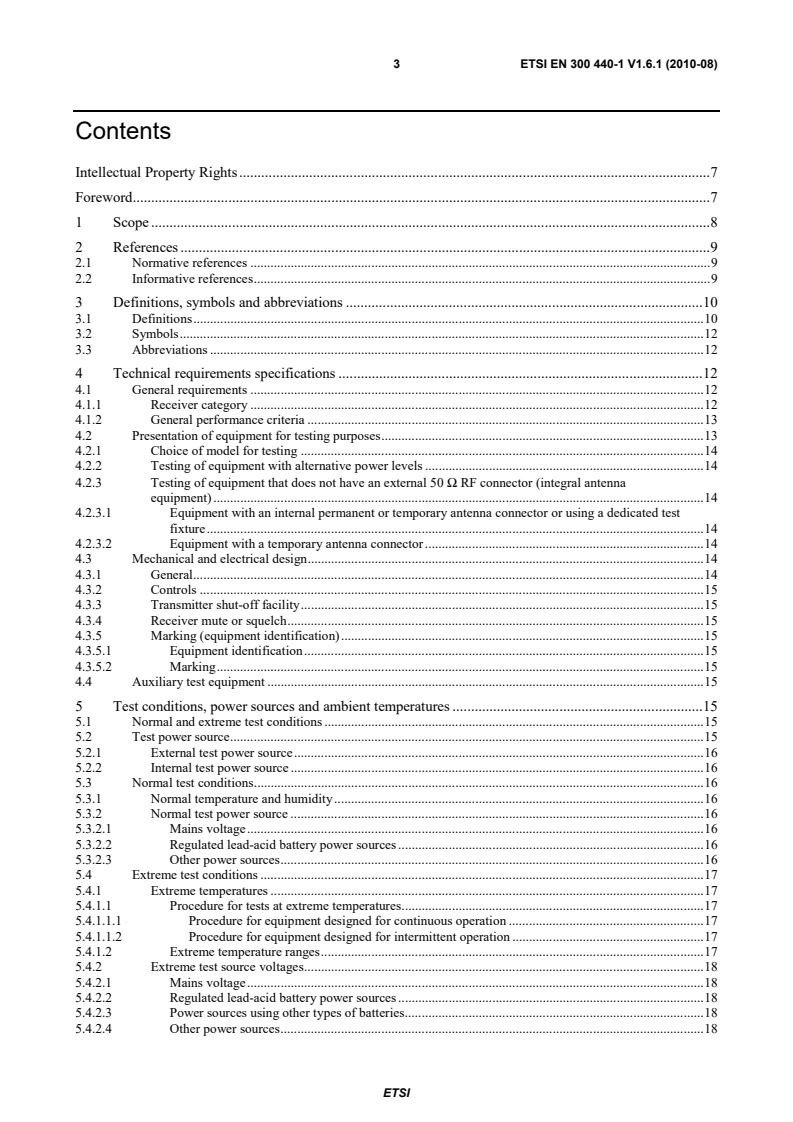
ETSI
3 Final draft ETSI EN 300 440-1 V1.6.1 (2010-04)
Contents
Intellectual Property Rights . 7
Foreword . 7
1 Scope . 8
2 References . 9
2.1 Normative references . 9
2.2 Informative references . 9
3 Definitions, symbols and abbreviations . 10
3.1 Definitions . 10
3.2 Symbols . 12
3.3 Abbreviations . 12
4 Technical requirements specifications . 13
4.1 General requirements . 13
4.1.1 Receiver category . 13
4.1.2 General performance criteria . 13
4.2 Presentation of equipment for testing purposes . 13
4.2.1 Choice of model for testing . 14
4.2.2 Testing of equipment with alternative power levels . 14
4.2.3 Testing of equipment that does not have an external 50 Ω RF connector (integral antenna
equipment) . 14
4.2.3.1 Equipment with an internal permanent or temporary antenna connector or using a dedicated test
fixture . 14
4.2.3.2 Equipment with a temporary antenna connector . 14
4.3 Mechanical and electrical design . 15
4.3.1 General . 15
4.3.2 Controls . 15
4.3.3 Transmitter shut-off facility . 15
4.3.4 Receiver mute or squelch . 15
4.3.5 Marking (equipment identification) . 15
4.3.5.1 Equipment identification . 15
4.3.5.2 Marking . 15
4.4 Auxiliary test equipment . 15
5 Test conditions, power sources and ambient temperatures . 15
5.1 Normal and extreme test conditions . 15
5.2 Test power source . 16
5.2.1 External test power source . 16
5.2.2 Internal test power source . 16
5.3 Normal test conditions . 16
5.3.1 Normal temperature and humidity . 16
5.3.2 Normal test power source . 16
5.3.2.1 Mains voltage . 16
5.3.2.2 Regulated lead-acid battery power sources . 17
5.3.2.3 Other power sources . 17
5.4 Extreme test conditions . 17
5.4.1 Extreme temperatures . 17
5.4.1.1 Procedure for tests at extreme temperatures . 17
5.4.1.1.1 Procedure for equipment designed for continuous operation . 17
5.4.1.1.2 Procedure for equipment designed for intermittent operation . 17
5.4.1.2 Extreme temperature ranges . 18
5.4.2 Extreme test source voltages . 18
5.4.2.1 Mains voltage . 18
5.4.2.2 Regulated lead-acid battery power sources . 18
5.4.2.3 Power sources using other types of batteries . 18
5.4.2.4 Other power sources . 18
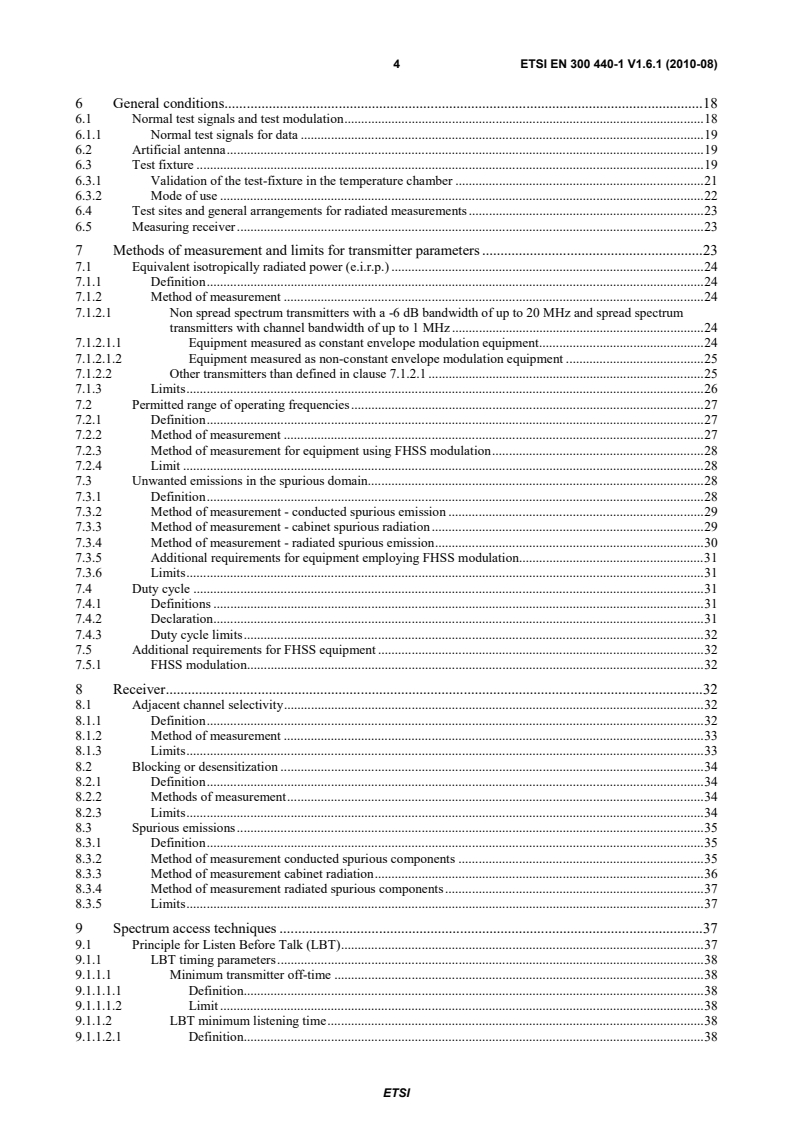
ETSI
4 Final draft ETSI EN 300 440-1 V1.6.1 (2010-04)
6 General conditions . 19
6.1 Normal test signals and test modulation . 19
6.1.1 Normal test signals for data . 19
6.2 Artificial antenna . 19
6.3 Test fixture . 19
6.3.1 Validation of the test-fixture in the temperature chamber . 21
6.3.2 Mode of use . 22
6.4 Test sites and general arrangements for radiated measurements . 23
6.5 Measuring receiver . 23
7 Methods of measurement and limits for transmitter parameters . 23
7.1 Equivalent isotropically radiated power (e.i.r.p.) . 24
7.1.1 Definition . 24
7.1.2 Method of measurement . 24
7.1.2.1 Non spread spectrum transmitters with a -6 dB bandwidth of up to 20 MHz and spread spectrum
transmitters with channel bandwidth of up to 1 MHz . 24
7.1.2.1.1 Equipment measured as constant envelope modulation equipment . 24
7.1.2.1.2 Equipment measured as non-constant envelope modulation equipment . 25
7.1.2.2 Other transmitters than defined in clause 7.1.2.1 . 25
7.1.3 Limits . 26
7.2 Permitted range of operating frequencies . 27
7.2.1 Definition . 27
7.2.2 Method of measurement . 27
7.2.3 Method of measurement for equipment using FHSS modulation . 28
7.2.4 Limit . 28
7.3 Unwanted emissions in the spurious domain. 28
7.3.1 Definition . 28
7.3.2 Method of measurement - conducted spurious emission . 29
7.3.3 Method of measurement - cabinet spurious radiation . 29
7.3.4 Method of measurement - radiated spurious emission . 30
7.3.5 Additional requirements for equipment employing FHSS modulation . 31
7.3.6 Limits . 31
7.4 Duty cycle . 31
7.4.1 Definitions . 31
7.4.2 Declaration . 31
7.4.3 Duty cycle limits . 32
7.5 Additional requirements for FHSS equipment . 32
7.5.1 FHSS modulation . 32
8 Receiver . . 32
8.1 Adjacent channel selectivity . 32
8.1.1 Definition . 32
8.1.2 Method of measurement . 33
8.1.3 Limits . 33
8.2 Blocking or desensitization . 33
8.2.1 Definition . 34
8.2.2 Methods of measurement . 34
8.2.3 Limits . 34
8.3 Spurious emissions . 35
8.3.1 Definition . 35
8.3.2 Method of measurement conducted spurious components . 35
8.3.3 Method of measurement cabinet radiation . 36
8.3.4 Method of measurement radiated spurious components . 37
8.3.5 Limits . 37
9 Spectrum access techniques . 37
9.1 Principle for Listen Before Talk (LBT) . 37
9.1.1 LBT timing parameters . 38
9.1.1.1 Minimum transmitter off-time . 38
9.1.1.1.1 Definition. 38
9.1.1.1.2 Limit . 38
9.1.1.2 LBT minimum listening time . 38
9.1.1.2.1 Definition. 38
ETSI
5 Final draft ETSI EN 300 440-1 V1.6.1 (2010-04)
9.1.1.2.2 Limit for minimum listening time . 38
9.1.1.3 Acknowledge transmissions . 39
9.1.1.4 Maximum transmitter on-time . 39
9.1.1.4.1 Definition. 39
9.1.1.4.2 Limit . 39
9.1.1.5 Declaration of LBT parameters . 39
9.1.1.6 Equipment with or without LBT using transmitter time-out-timer . 39
9.2 Receiver LBT threshold and transmitter max on-time . 39
9.2.1 Definitions . 40
9.2.2 Method of measurements . 40
9.2.3 Limits . 40
9.3 Detect And Avoid techniques (DAA) . 41
9.4 Adaptive Frequency Agility (AFA) . 41
9.4.1 Introduction. 41
10 Measurement uncertainty . 41
10.1 Measurement uncertainty is greater than maximum acceptable uncertainty . 42
Annex A (normative): Radiated measurements . 43
A.1 General requirements for measurements involving the use of radiated fields. 43
A.2 Test Sites . 44
A.2.1 Outdoor test site . 44
A.2.2 Indoor test site . 45
A.2.3 Shielded anechoic test site . 46
A.2.3.1 Influence of parasitic reflections in anechoic chambers . 46
A.2.3.2 Calibration of the shielded RF anechoic chamber . 46
A.3 Antennas . 48
A.3.1 Test antenna . 48
A.3.2 Substitution antenna . 48
A.3.3 Artificial antenna . 48
A.4 Test Practice and Auxiliary Test Equipment . 49
A.5 Measuring distance . 49
A.5.1 Standard position . 49
A.5.2 Auxiliary cables . 49
Annex B (normative): General description of measurement methods . 50
B.1 Conducted measurements . 50
B.2 Radiated measurements . 50
Annex C (normative): Power limits for RFID systems operating in the 2,45 GHz ISM band . 52
C.1 Power limits and frequency band . 52
C.1.1 Additional requirements for 2,45 GHz 4 W e.i.r.p. indoor RFID equipment . 52
C.1.2 Spectrum mask . 53
Annex D (informative): Example of implementation for restriction of 4 W RFID to in-building use
only . 54
Annex E (normative): Limits for GBSAR operating in the frequency range 17,1 GHz to 17,3 GHz . 56
E.1 Introduction . 56
E.2 Effective radiated power (e.i.r.p.) . 56
E.2.1 Definition . 56
E.2.2 Method of measurement . 56
E.2.3 Limits . 56
E.3 Permitted range of operating frequencies . 56
E.3.1 Definition . 56
E.3.2 Method of measurement . 56
ETSI
6 Final draft ETSI EN 300 440-1 V1.6.1 (2010-04)
E.3.3 Limits . 57
E.4 Principles of Detection And Avoid (DAA) . 57
E.4.1 General DAA test set-up . 57
E.4.2 Test signals . 58
E.4.3 DAA threshold . 58
E.4.3.1 Definition . 58
E.4.3.2 Method of measurement . 58
E.4.3.3 Limit . 59
E.4.4 DAA timing parameters . 59
E.4.4.1 Minimum listen Time . 59
E.4.4.1.1 Definition . 59
E.4.4.1.2 Method of measurement . 59
E.4.4.1.3 Limit for minimum listen time . 60
E.4.4.2 Minimum listen time after detection . 60
E.4.4.2.1 Definition . 60
E.4.4.2.2 Method of measurement . 60
E.4.4.2.3 Limit . 61
E.4.4.3 Maximum transmitter on-time . 61
E.4.4.3.1 Definition . 61
E.4.4.3.2 Method of measurement . 61
E.4.4.3.3 Limit . 62
E.4.4.4 Minimum transmitter off-time . 62
E.4.4.4.1 Definition . 62
E.4.4.4.2 Method of measurement . 62
E.4.4.4.3 Limit . 63
E.5 Antenna pattern . 63
E.5.1 Definition . 63
E.5.2 Method of measurements . 63
E.5.3 Limits . 65
Annex F (informative): Bibliography . 66
History . 67
ETSI
7 Final draft ETSI EN 300 440-1 V1.6.1 (2010-04)
Intellectual Property Rights
IPRs essential or potentially essential to the present document may have been declared to ETSI. The information
pertaining to these essential IPRs, if any, is publicly available for ETSI members and non-members, and can be found
in ETSI SR 000 314: "Intellectual Property Rights (IPRs); Essential, or potentially Essential, IPRs notified to ETSI in
respect of ETSI standards", which is available from the ETSI Secretariat. Latest updates are available on the ETSI Web
server (http://webapp.etsi.org/IPR/home.asp).
Pursuant to the ETSI IPR Policy, no investigation, including IPR searches, has been carried out by ETSI. No guarantee
can be given as to the existence of other IPRs not referenced in ETSI SR 000 314 (or the updates on the ETSI Web
server) which are, or may be, or may become, essential to the present document.
Foreword
This European Standard (Telecommunications series) has been produced by ETSI Technical Committee
Electromagnetic compatibility and Radio spectrum Matters (ERM), and is now submitted for the ETSI standards
One-step Approval Procedure.
For non EU countries the present document may be used for regulatory (Type Approval) purposes.
The present document includes improvements to the previous version of the standard that take advantage of technical
developments within the SRD industry. In particular this includes optional features such as Listen Before Talk (LBT)
and Detect And Avoid (DAA).
The present document is part 1 of a multi-part deliverable covering Electromagnetic compatibility and Radio spectrum
Matters (ERM); Short range devices; Radio equipment to be used in the 1 GHz to 40 GHz frequency range, as identified
below:
Part 1: "Technical characteristics and test methods";
Part 2: "Harmonized EN covering essential requirements of article 3.2 of the R&TTE Directive".
Proposed national transposition dates
Date of latest announcement of this EN (doa): 3 months after ETSI publication
Date of latest publication of new National Standard
or endorsement of this EN (dop/e): 6 months after doa
Date of withdrawal of any conflicting National Standard (dow): 6 months after doa
ETSI
8 Final draft ETSI EN 300 440-1 V1.6.1 (2010-04)
1 Scope
The present document applies to the following Short Range Device major equipment types:
• Generic Short Range Devices, including alarms, telecommand, telemetry, data transmission in general, etc.
• Radio Frequency IDentification (RFID).
• Radiodetermination, including detection, movement and alert applications.
These radio equipment types are capable of operating in the permitted frequency bands within the 1 GHz to 40 GHz
range as specified in table 1:
• either with a Radio Frequency (RF) output connection and dedicated antenna or with an integral antenna;
• for all types of modulation;
• with or without speech.
Table 1 shows a list of the frequency bands as designated by the European Commission Decisions on Short Range
Devices [i.6], [i.7] and the CEPT/ERC Recommendation 70-03 [i.1] as known at the date of publication of the present
document.
Table 1: Short Range Devices within the 1 GHz to 40 GHz permitted frequency bands
Frequency Bands Applications Notes
Transmit and Receive 2 400 MHz to 2 483,5 MHz Generic use
Transmit and Receive 2 400 MHz to 2 483,5 MHz Detection, movement and alert
applications
Transmit and Receive (a) 2 446 MHz to 2 454 MHz RFID See annex C
Transmit and Receive (b) 2 446 MHz to 2 454 MHz RFID See annex C
Transmit and Receive 5 725 MHz to 5 875 MHz Generic use
Transmit and Receive 9 200 MHz to 9 500 MHz Radiodetermination: radar,
detection, movement and alert
applications
Transmit and Receive 9 500 MHz to 9 975 MHz Radiodetermination:
radar, detection, movement and
alert applications
Transmit and Receive 10,5 GHz to 10,6 GHz Radiodetermination:
radar, detection, movement and
alert applications
Transmit and Receive 13,4 GHz to 14,0 GHz Radiodetermination:
Radar, detection, movement
and alert applications
Transmit and Receive 17,1 GHz to 17,3 GHz Radiodetermination: See annex E
GBSAR detecting, movement
and alert applications
Transmit and Receive 24,00 GHz to 24,25 GHz Generic use and for
Radiodetermination: detection,
movement and alert
applications
NOTE: (a) and (b) refer to two different operational restrictions for different power levels in the same frequency
band.
NOTE 1: Table 1 represents the most widely implemented position within the European Union [i.6], [i.7] and the
CEPT countries [i.1], but it should not be assumed that all designated bands are available in all countries.
NOTE 2: In addition, it should be noted that other frequency bands may be available in a country within the
frequency range 1 GHz to 40 GHz covered by the present document. See the European Commission
Decisions on Short Range Devices [i.6], [i.7] and the CEPT ERC Recommendation 70-03 [i.1] as
implemented through National Radio Interfaces (NRI) and additional NRI as relevant.
ETSI
9 Final draft ETSI EN 300 440-1 V1.6.1 (2010-04)
NOTE 3: On non-harmonized parameters, national administrations may impose certain conditions such as the type
of modulation, frequency, channel/frequency separations, maximum transmitter radiated power, duty
cycle, and the inclusion of an automatic transmitter shut-off facility, as a condition for the issue of an
individual or general licence, or as a condition for the issuing of Individual Rights for use of spectrum or
General Authorization, or as a condition for use “under licence exemption” as it is in most cases for Short
Range Devices.
The present document covers fixed stations, mobile stations and portable stations.
Applications using Ultra Wide Band (UWB) technology are not covered by the present document.
The present document does not require measurements for radiated emissions below 25 MHz.
2 References
References are either specific (identified by date of publication and/or edition number or version number) or
non-specific.
• For a specific reference, subsequent revisions do not apply.
• Non-specific reference may be made only to a complete document or a part thereof and only in the following
cases:
- if it is accepted that it will be possible to use all future changes of the referenced document for the
purposes of the referring document;
- for informative references.
Referenced documents which are not found to be publicly available in the expected location might be found at
http://docbox.etsi.org/Reference.
NOTE: While any hyperlinks included in this clause were valid at the time of publication ETSI cannot guarantee
their long term validity.
2.1 Normative references
The following referenced documents are indispensable for the application of the present document. For dated
references, only the edition cited applies. For non-specific references, the latest edition of the referenced document
(including any amendments) applies.
[1] CISPR 16 (2006) (parts 1-1, 1-4 and 1-5): "Specification for radio disturbance and immunity
measuring apparatus and methods; Part 1: Radio disturbance and immunity measuring apparatus".
[2] ITU-T Recommendation O.41: "Psophometer for use on telephone-type circuits".
[3] ITU-T Recommendation O.153: "Basic parameters for the measurement of error performance at
bit rates below the primary rate".
2.2 Informative references
The following referenced documents are not essential to the use of the present document but they assist the user with
regard to a particular subject area. For non-specific references, the latest version of the referenced document (including
any amendments) applies.
[i.1] CEPT/ERC Recommendation 70-03: "Relating to the use of Short Range Devices (SRD)".
[i.2] ITU-R Recommendation SM.1755: "Characteristics of ultra-wideband technology".
[i.3] Directive 1999/5/EC of the European Parliament and of the Council of 9 March 1999 on radio
equipment and telecommunications terminal equipment and the mutual recognition of their
conformity (R&TTE Directive).
ETSI
10 Final draft ETSI EN 300 440-1 V1.6.1 (2010-04)
[i.4] ETSI TR 100 028 (V1.4.1) (all parts): "Electromagnetic compatibility and Radio spectrum Matters
(ERM); Uncertainties in the measurement of mobile radio equipment characteristics".
[i.5] ETSI EN 300 440-2 (V1.2.1): "Electromagnetic compatibility and Radio spectrum Matters (ERM);
Short range devices; Radio equipment to be used in the 1 GHz to 40 GHz frequency range;
Part 2: Harmonized EN covering essential requirements of article 3.2 of the R&TTE Directive".
[i.6] European Commission Decision 2006/771/EC of 9 November 2006 on harmonization of the radio
spectrum for use by short-range devices.
[i.7] European Commission Decision 2008/432/EC of 23 May 2008 (amending Decision 2006/771/EC)
on harmonization of the radio spectrum for use by short-range devices.
3 Definitions, symbols and abbreviations
3.1 Definitions
For the purposes of the present document, the following terms and definitions apply:
adjacent channels: those two channels offset from the nominal channel by the nominal channel bandwidth
alarm: use of radio communication for indicating an alarm condition at a distant location
alternate adjacent channels: those two channels offset from the nominal channel by double the channel bandwidth
NOTE 1: The wanted channel is described by the occupied bandwidth (see definition below) of the wanted
emissions; i.e. the width of a frequency band such that, below the lower and above the upper frequency
limits, the mean powers emitted are each equal to a specified percentage 0,5 % of the total mean power of
a given emission. In addition, the necessary bandwidth of the emissions as defined by the ITU-R radio
regulations is not to exceed the wanted channel.
f
c
Lower Wanted Upper Upper
Lower
Alternate
Alternate Channel Adjacent
Adjacent
Figure 1: Adjacent and alternate adjacent channel definitions
NOTE 2: For equipment to be used in a frequency band where channelization is not defined by regulation, the
channel spacing of the equipment is defined by the provider.
artificial antenna: non-radiating dummy load equal to the nominal impedance specified by the provider
assigned frequency band: frequency band within which the device is authorized to operate and to perform the intended
function of the equipment
chip: unit of modulation used in Direct Sequence Spread Spectrum (DSSS) modulation
chip rate: number of chips per second
conducted measurements: measurements which are made using a direct connection to the equipment under test
ETSI
11 Final draft ETSI EN 300 440-1 V1.6.1 (2010-04)
dedicated antenna: removable antenna supplied and tested with the radio equipment, designed as an indispensable part
of the equipment
Direct Sequence Spread Spectrum (DSSS): form of modulation where a combination of data to be transmitted and a
fixed code sequence (chip sequence) is used to directly modulate a carrier, e.g. by phase shift keying
NOTE: The code rate determines the occupied bandwidth.
fixed station: equipment intended for use in a fixed location
Frequency Hopping Spread Spectrum (FHSS): spread spectrum technique in which the transmitter signal occupies a
number of frequencies in time, each for some period of time, referred to as the dwell time
NOTE: Transmitter and receiver follow the same frequency hop pattern. The number of hop positions and the
bandwidth per hop position determine the oc
...
European Standard (Telecommunications series)
Electromagnetic compatibility
and Radio spectrum Matters (ERM);
Short range devices;
Radio equipment to be used
in the 1 GHz to 40 GHz frequency range;
Part 1: Technical characteristics and
test methods
2 ETSI EN 300 440-1 V1.6.1 (2010-08)
Reference
REN/ERM-TG28-045-1
Keywords
radio, SRD, testing
ETSI
650 Route des Lucioles
F-06921 Sophia Antipolis Cedex - FRANCE
Tel.: +33 4 92 94 42 00 Fax: +33 4 93 65 47 16
Siret N° 348 623 562 00017 - NAF 742 C
Association à but non lucratif enregistrée à la
Sous-Préfecture de Grasse (06) N° 7803/88
Important notice
Individual copies of the present document can be downloaded from:
http://www.etsi.org
The present document may be made available in more than one electronic version or in print. In any case of existing or
perceived difference in contents between such versions, the reference version is the Portable Document Format (PDF).
In case of dispute, the reference shall be the printing on ETSI printers of the PDF version kept on a specific network drive
within ETSI Secretariat.
Users of the present document should be aware that the document may be subject to revision or change of status.
Information on the current status of this and other ETSI documents is available at
http://portal.etsi.org/tb/status/status.asp
If you find errors in the present document, please send your comment to one of the following services:
http://portal.etsi.org/chaircor/ETSI_support.asp
Copyright Notification
No part may be reproduced except as authorized by written permission.
The copyright and the foregoing restriction extend to reproduction in all media.
© European Telecommunications Standards Institute 2010.
All rights reserved.
TM TM TM TM
DECT , PLUGTESTS , UMTS , TIPHON , the TIPHON logo and the ETSI logo are Trade Marks of ETSI registered
for the benefit of its Members.
TM
3GPP is a Trade Mark of ETSI registered for the benefit of its Members and of the 3GPP Organizational Partners.
LTE™ is a Trade Mark of ETSI currently being registered
for the benefit of its Members and of the 3GPP Organizational Partners.
GSM® and the GSM logo are Trade Marks registered and owned by the GSM Association.
ETSI
3 ETSI EN 300 440-1 V1.6.1 (2010-08)
Contents
Intellectual Property Rights . 7
Foreword . 7
1 Scope . 8
2 References . 9
2.1 Normative references . 9
2.2 Informative references . 9
3 Definitions, symbols and abbreviations . 10
3.1 Definitions . 10
3.2 Symbols . 12
3.3 Abbreviations . 12
4 Technical requirements specifications . 12
4.1 General requirements . 12
4.1.1 Receiver category . 12
4.1.2 General performance criteria . 13
4.2 Presentation of equipment for testing purposes . 13
4.2.1 Choice of model for testing . 14
4.2.2 Testing of equipment with alternative power levels . 14
4.2.3 Testing of equipment that does not have an external 50 Ω RF connector (integral antenna
equipment) . 14
4.2.3.1 Equipment with an internal permanent or temporary antenna connector or using a dedicated test
fixture . 14
4.2.3.2 Equipment with a temporary antenna connector . 14
4.3 Mechanical and electrical design . 14
4.3.1 General . 14
4.3.2 Controls . 15
4.3.3 Transmitter shut-off facility . 15
4.3.4 Receiver mute or squelch . 15
4.3.5 Marking (equipment identification) . 15
4.3.5.1 Equipment identification . 15
4.3.5.2 Marking . 15
4.4 Auxiliary test equipment . 15
5 Test conditions, power sources and ambient temperatures . 15
5.1 Normal and extreme test conditions . 15
5.2 Test power source . 15
5.2.1 External test power source . 16
5.2.2 Internal test power source . 16
5.3 Normal test conditions . 16
5.3.1 Normal temperature and humidity . 16
5.3.2 Normal test power source . 16
5.3.2.1 Mains voltage . 16
5.3.2.2 Regulated lead-acid battery power sources . 16
5.3.2.3 Other power sources . 16
5.4 Extreme test conditions . 17
5.4.1 Extreme temperatures . 17
5.4.1.1 Procedure for tests at extreme temperatures . 17
5.4.1.1.1 Procedure for equipment designed for continuous operation . 17
5.4.1.1.2 Procedure for equipment designed for intermittent operation . 17
5.4.1.2 Extreme temperature ranges . 17
5.4.2 Extreme test source voltages . 18
5.4.2.1 Mains voltage . 18
5.4.2.2 Regulated lead-acid battery power sources . 18
5.4.2.3 Power sources using other types of batteries . 18
5.4.2.4 Other power sources . 18
ETSI
4 ETSI EN 300 440-1 V1.6.1 (2010-08)
6 General conditions . 18
6.1 Normal test signals and test modulation . 18
6.1.1 Normal test signals for data . 19
6.2 Artificial antenna . 19
6.3 Test fixture . 19
6.3.1 Validation of the test-fixture in the temperature chamber . 21
6.3.2 Mode of use . 22
6.4 Test sites and general arrangements for radiated measurements . 23
6.5 Measuring receiver . 23
7 Methods of measurement and limits for transmitter parameters . 23
7.1 Equivalent isotropically radiated power (e.i.r.p.) . 24
7.1.1 Definition . 24
7.1.2 Method of measurement . 24
7.1.2.1 Non spread spectrum transmitters with a -6 dB bandwidth of up to 20 MHz and spread spectrum
transmitters with channel bandwidth of up to 1 MHz . 24
7.1.2.1.1 Equipment measured as constant envelope modulation equipment . 24
7.1.2.1.2 Equipment measured as non-constant envelope modulation equipment . 25
7.1.2.2 Other transmitters than defined in clause 7.1.2.1 . 25
7.1.3 Limits . 26
7.2 Permitted range of operating frequencies . 27
7.2.1 Definition . 27
7.2.2 Method of measurement . 27
7.2.3 Method of measurement for equipment using FHSS modulation . 28
7.2.4 Limit . 28
7.3 Unwanted emissions in the spurious domain. 28
7.3.1 Definition . 28
7.3.2 Method of measurement - conducted spurious emission . 29
7.3.3 Method of measurement - cabinet spurious radiation . 29
7.3.4 Method of measurement - radiated spurious emission . 30
7.3.5 Additional requirements for equipment employing FHSS modulation . 31
7.3.6 Limits . 31
7.4 Duty cycle . 31
7.4.1 Definitions . 31
7.4.2 Declaration . 31
7.4.3 Duty cycle limits . 32
7.5 Additional requirements for FHSS equipment . 32
7.5.1 FHSS modulation . 32
8 Receiver . . 32
8.1 Adjacent channel selectivity . 32
8.1.1 Definition . 32
8.1.2 Method of measurement . 33
8.1.3 Limits . 33
8.2 Blocking or desensitization . 34
8.2.1 Definition . 34
8.2.2 Methods of measurement . 34
8.2.3 Limits . 34
8.3 Spurious emissions . 35
8.3.1 Definition . 35
8.3.2 Method of measurement conducted spurious components . 35
8.3.3 Method of measurement cabinet radiation . 36
8.3.4 Method of measurement radiated spurious components . 37
8.3.5 Limits . 37
9 Spectrum access techniques . 37
9.1 Principle for Listen Before Talk (LBT) . 37
9.1.1 LBT timing parameters . 38
9.1.1.1 Minimum transmitter off-time . 38
9.1.1.1.1 Definition. 38
9.1.1.1.2 Limit . 38
9.1.1.2 LBT minimum listening time . 38
9.1.1.2.1 Definition. 38
ETSI
5 ETSI EN 300 440-1 V1.6.1 (2010-08)
9.1.1.2.2 Limit for minimum listening time . 38
9.1.1.3 Acknowledge transmissions . 39
9.1.1.4 Maximum transmitter on-time . 39
9.1.1.4.1 Definition. 39
9.1.1.4.2 Limit . 39
9.1.1.5 Declaration of LBT parameters . 39
9.1.1.6 Equipment with or without LBT using transmitter time-out-timer . 39
9.2 Receiver LBT threshold and transmitter max on-time . 39
9.2.1 Definitions . 40
9.2.2 Method of measurements . 40
9.2.3 Limits . 40
9.3 Detect And Avoid techniques (DAA) . 41
9.4 Adaptive Frequency Agility (AFA) . 41
9.4.1 Introduction. 41
10 Measurement uncertainty . 41
10.1 Measurement uncertainty is greater than maximum acceptable uncertainty . 42
Annex A (normative): Radiated measurements . 43
A.1 General requirements for measurements involving the use of radiated fields. 43
A.2 Test Sites . 44
A.2.1 Outdoor test site . 44
A.2.2 Indoor test site . 45
A.2.3 Shielded anechoic test site . 46
A.2.3.1 Influence of parasitic reflections in anechoic chambers . 46
A.2.3.2 Calibration of the shielded RF anechoic chamber . 46
A.3 Antennas . 48
A.3.1 Test antenna . 48
A.3.2 Substitution antenna . 48
A.3.3 Artificial antenna . 48
A.4 Test Practice and Auxiliary Test Equipment . 49
A.5 Measuring distance . 49
A.5.1 Standard position . 49
A.5.2 Auxiliary cables . 49
Annex B (normative): General description of measurement methods . 50
B.1 Conducted measurements . 50
B.2 Radiated measurements . 50
Annex C (normative): Power limits for RFID systems operating in the 2,45 GHz ISM band . 52
C.1 Power limits and frequency band . 52
C.1.1 Additional requirements for 2,45 GHz 4 W e.i.r.p. indoor RFID equipment . 52
C.1.2 Spectrum mask . 53
Annex D (informative): Example of implementation for restriction of 4 W RFID to
in-building use only . 54
Annex E (normative): Limits for GBSAR operating in the frequency range 17,1 GHz to
17,3 GHz . 56
E.1 Introduction . 56
E.2 Effective radiated power (e.i.r.p.) . 56
E.2.1 Definition . 56
E.2.2 Method of measurement . 56
E.2.3 Limits . 56
E.3 Permitted range of operating frequencies . 56
E.3.1 Definition . 56
ETSI
6 ETSI EN 300 440-1 V1.6.1 (2010-08)
E.3.2 Method of measurement . 56
E.3.3 Limits . 57
E.4 Principles of Detection And Avoid (DAA) . 57
E.4.1 General DAA test set-up . 57
E.4.2 Test signals . 58
E.4.3 DAA threshold . 58
E.4.3.1 Definition . 58
E.4.3.2 Method of measurement . 58
E.4.3.3 Limit . 59
E.4.4 DAA timing parameters . 59
E.4.4.1 Minimum listen Time . 59
E.4.4.1.1 Definition . 59
E.4.4.1.2 Method of measurement . 59
E.4.4.1.3 Limit for minimum listen time . 60
E.4.4.2 Minimum listen time after detection . 60
E.4.4.2.1 Definition . 60
E.4.4.2.2 Method of measurement . 60
E.4.4.2.3 Limit . 61
E.4.4.3 Maximum transmitter on-time . 61
E.4.4.3.1 Definition . 61
E.4.4.3.2 Method of measurement . 61
E.4.4.3.3 Limit . 62
E.4.4.4 Minimum transmitter off-time . 62
E.4.4.4.1 Definition . 62
E.4.4.4.2 Method of measurement . 62
E.4.4.4.3 Limit . 63
E.5 Antenna pattern . 63
E.5.1 Definition . 63
E.5.2 Method of measurements . 63
E.5.3 Limits . 65
Annex F (informative): Bibliography . 66
History . 67
ETSI
7 ETSI EN 300 440-1 V1.6.1 (2010-08)
Intellectual Property Rights
IPRs essential or potentially essential to the present document may have been declared to ETSI. The information
pertaining to these essential IPRs, if any, is publicly available for ETSI members and non-members, and can be found
in ETSI SR 000 314: "Intellectual Property Rights (IPRs); Essential, or potentially Essential, IPRs notified to ETSI in
respect of ETSI standards", which is available from the ETSI Secretariat. Latest updates are available on the ETSI Web
server (http://webapp.etsi.org/IPR/home.asp).
Pursuant to the ETSI IPR Policy, no investigation, including IPR searches, has been carried out by ETSI. No guarantee
can be given as to the existence of other IPRs not referenced in ETSI SR 000 314 (or the updates on the ETSI Web
server) which are, or may be, or may become, essential to the present document.
Foreword
This European Standard (Telecommunications series) has been produced by ETSI Technical Committee
Electromagnetic compatibility and Radio spectrum Matters (ERM).
For non EU countries the present document may be used for regulatory (Type Approval) purposes.
The present document includes improvements to the previous version of the standard that take advantage of technical
developments within the SRD industry. In particular this includes optional features such as Listen Before Talk (LBT)
and Detect And Avoid (DAA).
The present document is part 1 of a multi-part deliverable covering Electromagnetic compatibility and Radio spectrum
Matters (ERM); Short range devices; Radio equipment to be used in the 1 GHz to 40 GHz frequency range, as identified
below:
Part 1: "Technical characteristics and test methods";
Part 2: "Harmonized EN covering the essential requirements of article 3.2 of the R&TTE Directive".
National transposition dates
Date of adoption of this EN: 17 August 2010
Date of latest announcement of this EN (doa): 30 November 2010
Date of latest publication of new National Standard
or endorsement of this EN (dop/e): 31 May 2011
Date of withdrawal of any conflicting National Standard (dow): 31 May 2011
ETSI
8 ETSI EN 300 440-1 V1.6.1 (2010-08)
1 Scope
The present document applies to the following Short Range Device major equipment types:
• Generic Short Range Devices, including alarms, telecommand, telemetry, data transmission in general, etc.
• Radio Frequency IDentification (RFID).
• Radiodetermination, including detection, movement and alert applications.
These radio equipment types are capable of operating in the permitted frequency bands within the 1 GHz to 40 GHz
range as specified in table 1:
• either with a Radio Frequency (RF) output connection and dedicated antenna or with an integral antenna;
• for all types of modulation;
• with or without speech.
Table 1 shows a list of the frequency bands as designated by the European Commission Decisions on Short Range
Devices [i.6], [i.7] and the CEPT/ERC Recommendation 70-03 [i.1] as known at the date of publication of the present
document.
Table 1: Short Range Devices within the 1 GHz to 40 GHz permitted frequency bands
Frequency Bands Applications Notes
Transmit and Receive 2 400 MHz to 2 483,5 MHz Generic use
Transmit and Receive 2 400 MHz to 2 483,5 MHz Detection, movement and alert
applications
Transmit and Receive (a) 2 446 MHz to 2 454 MHz RFID See annex C
Transmit and Receive (b) 2 446 MHz to 2 454 MHz RFID See annex C
Transmit and Receive 5 725 MHz to 5 875 MHz Generic use
Transmit and Receive 9 200 MHz to 9 500 MHz Radiodetermination: radar,
detection, movement and alert
applications
Transmit and Receive 9 500 MHz to 9 975 MHz Radiodetermination:
radar, detection, movement and
alert applications
Transmit and Receive 10,5 GHz to 10,6 GHz Radiodetermination:
radar, detection, movement and
alert applications
Transmit and Receive 13,4 GHz to 14,0 GHz Radiodetermination:
Radar, detection, movement
and alert applications
Transmit and Receive 17,1 GHz to 17,3 GHz Radiodetermination: See annex E
GBSAR detecting, movement
and alert applications
Transmit and Receive 24,00 GHz to 24,25 GHz Generic use and for
Radiodetermination: detection,
movement and alert
applications
NOTE: (a) and (b) refer to two different operational restrictions for different power levels in the same frequency
band.
NOTE 1: Table 1 represents the most widely implemented position within the European Union [i.6], [i.7] and the
CEPT countries [i.1], but it should not be assumed that all designated bands are available in all countries.
NOTE 2: In addition, it should be noted that other frequency bands may be available in a country within the
frequency range 1 GHz to 40 GHz covered by the present document. See the European Commission
Decisions on Short Range Devices [i.6], [i.7] and the CEPT ERC Recommendation 70-03 [i.1] as
implemented through National Radio Interfaces (NRI) and additional NRI as relevant.
ETSI
9 ETSI EN 300 440-1 V1.6.1 (2010-08)
NOTE 3: On non-harmonized parameters, national administrations may impose certain conditions such as the type
of modulation, frequency, channel/frequency separations, maximum transmitter radiated power, duty
cycle, and the inclusion of an automatic transmitter shut-off facility, as a condition for the issue of an
individual or general licence, or as a condition for the issuing of Individual Rights for use of spectrum or
General Authorization, or as a condition for use “under licence exemption” as it is in most cases for Short
Range Devices.
The present document covers fixed stations, mobile stations and portable stations.
Applications using Ultra Wide Band (UWB) technology are not covered by the present document.
The present document does not require measurements for radiated emissions below 25 MHz.
2 References
References are either specific (identified by date of publication and/or edition number or version number) or
non-specific. For specific references, only the cited version applies. For non-specific references, the latest version of the
reference document (including any amendments) applies.
Referenced documents which are not found to be publicly available in the expected location might be found at
http://docbox.etsi.org/Reference.
NOTE: While any hyperlinks included in this clause were valid at the time of publication ETSI cannot guarantee
their long term validity.
2.1 Normative references
The following referenced documents are necessary for the application of the present document.
[1] CISPR 16 (2006) (parts 1-1, 1-4 and 1-5): "Specification for radio disturbance and immunity
measuring apparatus and methods; Part 1: Radio disturbance and immunity measuring apparatus".
[2] ITU-T Recommendation O.41: "Psophometer for use on telephone-type circuits".
[3] ITU-T Recommendation O.153: "Basic parameters for the measurement of error performance at
bit rates below the primary rate".
2.2 Informative references
The following referenced documents are not necessary for the application of the present document but they assist the
user with regard to a particular subject area.
[i.1] CEPT/ERC Recommendation 70-03: "Relating to the use of Short Range Devices (SRD)".
[i.2] ITU-R Recommendation SM.1755: "Characteristics of ultra-wideband technology".
[i.3] Directive 1999/5/EC of the European Parliament and of the Council of 9 March 1999 on radio
equipment and telecommunications terminal equipment and the mutual recognition of their
conformity (R&TTE Directive).
[i.4] ETSI TR 100 028 (V1.4.1) (all parts): "Electromagnetic compatibility and Radio spectrum Matters
(ERM); Uncertainties in the measurement of mobile radio equipment characteristics".
[i.5] ETSI EN 300 440-2 (V1.2.1): "Electromagnetic compatibility and Radio spectrum Matters (ERM);
Short range devices; Radio equipment to be used in the 1 GHz to 40 GHz frequency range;
Part 2: Harmonized EN covering essential requirements of article 3.2 of the R&TTE Directive".
[i.6] European Commission Decision 2006/771/EC of 9 November 2006 on harmonization of the radio
spectrum for use by short-range devices.
ETSI
10 ETSI EN 300 440-1 V1.6.1 (2010-08)
[i.7] European Commission Decision 2008/432/EC of 23 May 2008 (amending Decision 2006/771/EC)
on harmonization of the radio spectrum for use by short-range devices.
3 Definitions, symbols and abbreviations
3.1 Definitions
For the purposes of the present document, the following terms and definitions apply:
adjacent channels: those two channels offset from the nominal channel by the nominal channel bandwidth
alarm: use of radio communication for indicating an alarm condition at a distant location
alternate adjacent channels: those two channels offset from the nominal channel by double the channel bandwidth
NOTE 1: The wanted channel is described by the occupied bandwidth (see definition below) of the wanted
emissions; i.e. the width of a frequency band such that, below the lower and above the upper frequency
limits, the mean powers emitted are each equal to a specified percentage 0,5 % of the total mean power of
a given emission. In addition, the necessary bandwidth of the emissions as defined by the ITU-R radio
regulations is not to exceed the wanted channel.
f
c
Upper
Lower Lower Wanted Upper
Alternate Channel Adjacent Alternate
Adjacent
Figure 1: Adjacent and alternate adjacent channel definitions
NOTE 2: For equipment to be used in a frequency band where channelization is not defined by regulation, the
channel spacing of the equipment is defined by the provider.
artificial antenna: non-radiating dummy load equal to the nominal impedance specified by the provider
assigned frequency band: frequency band within which the device is authorized to operate and to perform the intended
function of the equipment
chip: unit of modulation used in Direct Sequence Spread Spectrum (DSSS) modulation
chip rate: number of chips per second
conducted measurements: measurements which are made using a direct connection to the equipment under test
dedicated antenna: removable antenna supplied and tested with the radio equipment, designed as an indispensable part
of the equipment
Direct Sequence Spread Spectrum (DSSS): form of modulation where a combination of data to be transmitted and a
fixed code sequence (chip sequence) is used to directly modulate a carrier, e.g. by phase shift keying
NOTE: The code rate determines the occupied bandwidth.
fixed station: equipment intended for use in a fixed location
ETSI
11 ETSI EN 300 440-1 V1.6.1 (2010-08)
Frequency Hopping Spread Spectrum (FHSS): spread spectrum technique in which the transmitter signal occupies a
number of frequencies in time, each for some period of time, referred to as the dwell time
NOTE: Transmitter and receiver follow the same frequency hop pattern. The number of hop positions and the
bandwidth per hop position determine the occupied bandwidth.
identification system: equipment consisting of a transmitter(s), receiver(s) (or a combination of the two) and an
antenna(s) to identify objects by means of a transponder
integral antenna: permanent fixed antenna, which may be built-in, designed as an indispensable part of the equipment
mobile station: equipment normally fixed in a vehicle or used as a transportable station
necessary bandwidth: width of the emitted frequency band which is just sufficient to ensure the transmission of
information at the rate and with the quality required under specified conditions
NOTE: The necessary bandwidth
...
2003-01.Slovenski inštitut za standardizacijo. Razmnoževanje celote ali delov tega standarda ni dovoljeno.Electromagnetic compatibility and Radio spectrum Matters (ERM) - Short range devices - Radio equipment to be used in the 1 GHz to 40 GHz frequency range - Part 1: Technical characteristics and test methods33.100.01Elektromagnetna združljivost na splošnoElectromagnetic compatibility in general33.060.20Sprejemna in oddajna opremaReceiving and transmitting equipmentICS:Ta slovenski standard je istoveten z:EN 300 440-1 Version 1.6.1SIST EN 300 440-1 V1.6.1:2010en01-oktober-2010SIST EN 300 440-1 V1.6.1:2010SLOVENSKI
STANDARD
ETSI ETSI EN 300 440-1 V1.6.1 (2010-08) 2
Reference REN/ERM-TG28-045-1 Keywords radio, SRD, testing ETSI 650 Route des Lucioles F-06921 Sophia Antipolis Cedex - FRANCE
Tel.: +33 4 92 94 42 00
Fax: +33 4 93 65 47 16
Siret N° 348 623 562 00017 - NAF 742 C Association à but non lucratif enregistrée à la Sous-Préfecture de Grasse (06) N° 7803/88
Important notice Individual copies of the present document can be downloaded from: http://www.etsi.org The present document may be made available in more than one electronic version or in print. In any case of existing or perceived difference in contents between such versions, the reference version is the Portable Document Format (PDF). In case of dispute, the reference shall be the printing on ETSI printers of the PDF version kept on a specific network drive within ETSI Secretariat. Users of the present document should be aware that the document may be subject to revision or change of status. Information on the current status of this and other ETSI documents is available at http://portal.etsi.org/tb/status/status.asp If you find errors in the present document, please send your comment to one of the following services: http://portal.etsi.org/chaircor/ETSI_support.asp Copyright Notification No part may be reproduced except as authorized by written permission. The copyright and the foregoing restriction extend to reproduction in all media.
© European Telecommunications Standards Institute 2010. All rights reserved.
DECTTM, PLUGTESTSTM, UMTSTM, TIPHONTM, the TIPHON logo and the ETSI logo are Trade Marks of ETSI registered for the benefit of its Members. 3GPPTM is a Trade Mark of ETSI registered for the benefit of its Members and of the 3GPP Organizational Partners. LTE™ is a Trade Mark of ETSI currently being registered for the benefit of its Members and of the 3GPP Organizational Partners. GSM® and the GSM logo are Trade Marks registered and owned by the GSM Association. SIST EN 300 440-1 V1.6.1:2010
ETSI ETSI EN 300 440-1 V1.6.1 (2010-08) 3 Contents Intellectual Property Rights . 7 Foreword . 7 1 Scope . 8 2 References . 9 2.1 Normative references . 9 2.2 Informative references . 9 3 Definitions, symbols and abbreviations . 10 3.1 Definitions . 10 3.2 Symbols . 12 3.3 Abbreviations . 12 4 Technical requirements specifications . 12 4.1 General requirements . 12 4.1.1 Receiver category . 12 4.1.2 General performance criteria . 13 4.2 Presentation of equipment for testing purposes . 13 4.2.1 Choice of model for testing . 14 4.2.2 Testing of equipment with alternative power levels . 14 4.2.3 Testing of equipment that does not have an external 50 Ω RF connector (integral antenna equipment) . 14 4.2.3.1 Equipment with an internal permanent or temporary antenna connector or using a dedicated test fixture . 14 4.2.3.2 Equipment with a temporary antenna connector . 14 4.3 Mechanical and electrical design . 14 4.3.1 General . 14 4.3.2 Controls . 15 4.3.3 Transmitter shut-off facility . 15 4.3.4 Receiver mute or squelch . 15 4.3.5 Marking (equipment identification) . 15 4.3.5.1 Equipment identification . 15 4.3.5.2 Marking . 15 4.4 Auxiliary test equipment . 15 5 Test conditions, power sources and ambient temperatures . 15 5.1 Normal and extreme test conditions . 15 5.2 Test power source . 15 5.2.1 External test power source . 16 5.2.2 Internal test power source . 16 5.3 Normal test conditions . 16 5.3.1 Normal temperature and humidity . 16 5.3.2 Normal test power source . 16 5.3.2.1 Mains voltage . 16 5.3.2.2 Regulated lead-acid battery power sources . 16 5.3.2.3 Other power sources . 16 5.4 Extreme test conditions . 17 5.4.1 Extreme temperatures . 17 5.4.1.1 Procedure for tests at extreme temperatures . 17 5.4.1.1.1 Procedure for equipment designed for continuous operation . 17 5.4.1.1.2 Procedure for equipment designed for intermittent operation . 17 5.4.1.2 Extreme temperature ranges . 17 5.4.2 Extreme test source voltages . 18 5.4.2.1 Mains voltage . 18 5.4.2.2 Regulated lead-acid battery power sources . 18 5.4.2.3 Power sources using other types of batteries . 18 5.4.2.4 Other power sources . 18 SIST EN 300 440-1 V1.6.1:2010
ETSI ETSI EN 300 440-1 V1.6.1 (2010-08) 4 6 General conditions . 18 6.1 Normal test signals and test modulation . 18 6.1.1 Normal test signals for data . 19 6.2 Artificial antenna . 19 6.3 Test fixture . 19 6.3.1 Validation of the test-fixture in the temperature chamber . 21 6.3.2 Mode of use . 22 6.4 Test sites and general arrangements for radiated measurements . 23 6.5 Measuring receiver . 23 7 Methods of measurement and limits for transmitter parameters . 23 7.1 Equivalent isotropically radiated power (e.i.r.p.) . 24 7.1.1 Definition . 24 7.1.2 Method of measurement . 24 7.1.2.1 Non spread spectrum transmitters with a -6 dB bandwidth of up to 20 MHz and spread spectrum transmitters with channel bandwidth of up to 1 MHz . 24 7.1.2.1.1 Equipment measured as constant envelope modulation equipment . 24 7.1.2.1.2 Equipment measured as non-constant envelope modulation equipment . 25 7.1.2.2 Other transmitters than defined in clause 7.1.2.1 . 25 7.1.3 Limits . 26 7.2 Permitted range of operating frequencies . 27 7.2.1 Definition . 27 7.2.2 Method of measurement . 27 7.2.3 Method of measurement for equipment using FHSS modulation . 28 7.2.4 Limit . 28 7.3 Unwanted emissions in the spurious domain. 28 7.3.1 Definition . 28 7.3.2 Method of measurement - conducted spurious emission . 29 7.3.3 Method of measurement - cabinet spurious radiation . 29 7.3.4 Method of measurement - radiated spurious emission . 30 7.3.5 Additional requirements for equipment employing FHSS modulation . 31 7.3.6 Limits . 31 7.4 Duty cycle . 31 7.4.1 Definitions . 31 7.4.2 Declaration . 31 7.4.3 Duty cycle limits . 32 7.5 Additional requirements for FHSS equipment . 32 7.5.1 FHSS modulation . 32 8 Receiver . 32 8.1 Adjacent channel selectivity . 32 8.1.1 Definition . 32 8.1.2 Method of measurement . 33 8.1.3 Limits . 33 8.2 Blocking or desensitization . 34 8.2.1 Definition . 34 8.2.2 Methods of measurement . 34 8.2.3 Limits . 34 8.3 Spurious emissions . 35 8.3.1 Definition . 35 8.3.2 Method of measurement conducted spurious components . 35 8.3.3 Method of measurement cabinet radiation . 36 8.3.4 Method of measurement radiated spurious components . 37 8.3.5 Limits . 37 9 Spectrum access techniques . 37 9.1 Principle for Listen Before Talk (LBT) . 37 9.1.1 LBT timing parameters . 38 9.1.1.1 Minimum transmitter off-time . 38 9.1.1.1.1 Definition. 38 9.1.1.1.2 Limit . 38 9.1.1.2 LBT minimum listening time . 38 9.1.1.2.1 Definition. 38 SIST EN 300 440-1 V1.6.1:2010
ETSI ETSI EN 300 440-1 V1.6.1 (2010-08) 5 9.1.1.2.2 Limit for minimum listening time . 38 9.1.1.3 Acknowledge transmissions . 39 9.1.1.4 Maximum transmitter on-time . 39 9.1.1.4.1 Definition. 39 9.1.1.4.2 Limit . 39 9.1.1.5 Declaration of LBT parameters . 39 9.1.1.6 Equipment with or without LBT using transmitter time-out-timer . 39 9.2 Receiver LBT threshold and transmitter max on-time . 39 9.2.1 Definitions . 40 9.2.2 Method of measurements . 40 9.2.3 Limits . 40 9.3 Detect And Avoid techniques (DAA) . 41 9.4 Adaptive Frequency Agility (AFA) . 41 9.4.1 Introduction. 41 10 Measurement uncertainty . 41 10.1 Measurement uncertainty is greater than maximum acceptable uncertainty . 42 Annex A (normative): Radiated measurements . 43 A.1 General requirements for measurements involving the use of radiated fields. 43 A.2 Test Sites . 44 A.2.1 Outdoor test site . 44 A.2.2 Indoor test site . 45 A.2.3 Shielded anechoic test site . 46 A.2.3.1 Influence of parasitic reflections in anechoic chambers . 46 A.2.3.2 Calibration of the shielded RF anechoic chamber . 46 A.3 Antennas . 48 A.3.1 Test antenna . 48 A.3.2 Substitution antenna . 48 A.3.3 Artificial antenna . 48 A.4 Test Practice and Auxiliary Test Equipment . 49 A.5 Measuring distance . 49 A.5.1 Standard position . 49 A.5.2 Auxiliary cables . 49 Annex B (normative): General description of measurement methods . 50 B.1 Conducted measurements . 50 B.2 Radiated measurements . 50 Annex C (normative): Power limits for RFID systems operating in the 2,45 GHz ISM band . 52 C.1 Power limits and frequency band . 52 C.1.1 Additional requirements for 2,45 GHz 4 W e.i.r.p. indoor RFID equipment . 52 C.1.2 Spectrum mask . 53 Annex D (informative): Example of implementation for restriction of 4 W RFID to in-building use only . 54 Annex E (normative): Limits for GBSAR operating in the frequency range 17,1 GHz to 17,3 GHz . 56 E.1 Introduction . 56 E.2 Effective radiated power (e.i.r.p.) . 56 E.2.1 Definition . 56 E.2.2 Method of measurement . 56 E.2.3 Limits . 56 E.3 Permitted range of operating frequencies . 56 E.3.1 Definition . 56 SIST EN 300 440-1 V1.6.1:2010
ETSI ETSI EN 300 440-1 V1.6.1 (2010-08) 6 E.3.2 Method of measurement . 56 E.3.3 Limits . 57 E.4 Principles of Detection And Avoid (DAA) . 57 E.4.1 General DAA test set-up . 57 E.4.2 Test signals . 58 E.4.3 DAA threshold . 58 E.4.3.1 Definition . 58 E.4.3.2 Method of measurement . 58 E.4.3.3 Limit . 59 E.4.4 DAA timing parameters . 59 E.4.4.1 Minimum listen Time . 59 E.4.4.1.1 Definition . 59 E.4.4.1.2 Method of measurement . 59 E.4.4.1.3 Limit for minimum listen time . 60 E.4.4.2 Minimum listen time after detection . 60 E.4.4.2.1 Definition . 60 E.4.4.2.2 Method of measurement . 60 E.4.4.2.3 Limit . 61 E.4.4.3 Maximum transmitter on-time . 61 E.4.4.3.1 Definition . 61 E.4.4.3.2 Method of measurement . 61 E.4.4.3.3 Limit . 62 E.4.4.4 Minimum transmitter off-time . 62 E.4.4.4.1 Definition . 62 E.4.4.4.2 Method of measurement . 62 E.4.4.4.3 Limit . 63 E.5 Antenna pattern . 63 E.5.1 Definition . 63 E.5.2 Method of measurements . 63 E.5.3 Limits . 65 Annex F (informative): Bibliography . 66 History . 67
ETSI ETSI EN 300 440-1 V1.6.1 (2010-08) 7 Intellectual Property Rights IPRs essential or potentially essential to the present document may have been declared to ETSI. The information pertaining to these essential IPRs, if any, is publicly available for ETSI members and non-members, and can be found in ETSI SR 000 314: "Intellectual Property Rights (IPRs); Essential, or potentially Essential, IPRs notified to ETSI in respect of ETSI standards", which is available from the ETSI Secretariat. Latest updates are available on the ETSI Web server (http://webapp.etsi.org/IPR/home.asp). Pursuant to the ETSI IPR Policy, no investigation, including IPR searches, has been carried out by ETSI. No guarantee can be given as to the existence of other IPRs not referenced in ETSI SR 000 314 (or the updates on the ETSI Web server) which are, or may be, or may become, essential to the present document. Foreword This European Standard (Telecommunications series) has been produced by ETSI Technical Committee Electromagnetic compatibility and Radio spectrum Matters (ERM). For non EU countries the present document may be used for regulatory (Type Approval) purposes. The present document includes improvements to the previous version of the standard that take advantage of technical developments within the SRD industry. In particular this includes optional features such as Listen Before Talk (LBT) and Detect And Avoid (DAA). The present document is part 1 of a multi-part deliverable covering Electromagnetic compatibility and Radio spectrum Matters (ERM); Short range devices; Radio equipment to be used in the 1 GHz to 40 GHz frequency range, as identified below: Part 1: "Technical characteristics and test methods"; Part 2: "Harmonized EN covering the essential requirements of article 3.2 of the R&TTE Directive".
National transposition dates Date of adoption of this EN: 17 August 2010 Date of latest announcement of this EN (doa): 30 November 2010 Date of latest publication of new National Standard or endorsement of this EN (dop/e):
31 May 2011 Date of withdrawal of any conflicting National Standard (dow): 31 May 2011
ETSI ETSI EN 300 440-1 V1.6.1 (2010-08) 8 1 Scope The present document applies to the following Short Range Device major equipment types: • Generic Short Range Devices, including alarms, telecommand, telemetry, data transmission in general, etc. • Radio Frequency IDentification (RFID). • Radiodetermination, including detection, movement and alert applications. These radio equipment types are capable of operating in the permitted frequency bands within the 1 GHz to 40 GHz range as specified in table 1: • either with a Radio Frequency (RF) output connection and dedicated antenna or with an integral antenna; • for all types of modulation; • with or without speech. Table 1 shows a list of the frequency bands as designated by the European Commission Decisions on Short Range Devices [i.6], [i.7] and the CEPT/ERC Recommendation 70-03 [i.1] as known at the date of publication of the present document. Table 1: Short Range Devices within the 1 GHz to 40 GHz permitted frequency bands
Frequency Bands Applications Notes Transmit and Receive 2 400 MHz to 2 483,5 MHz Generic use
Transmit and Receive 2 400 MHz to 2 483,5 MHz Detection, movement and alert applications
Transmit and Receive (a) 2 446 MHz to 2 454 MHz RFID See annex C Transmit and Receive (b) 2 446 MHz to 2 454 MHz RFID See annex C Transmit and Receive 5 725 MHz to 5 875 MHz Generic use
Transmit and Receive 9 200 MHz to 9 500 MHz Radiodetermination: radar, detection, movement and alert applications
Transmit and Receive 9 500 MHz to 9 975 MHz Radiodetermination: radar, detection, movement and alert applications
Transmit and Receive 10,5 GHz to 10,6 GHz Radiodetermination: radar, detection, movement and alert applications
Transmit and Receive 13,4 GHz to 14,0 GHz Radiodetermination: Radar, detection, movement and alert applications
Transmit and Receive 17,1 GHz to 17,3 GHz Radiodetermination: GBSAR detecting, movement and alert applications See annex E Transmit and Receive 24,00 GHz to 24,25 GHz Generic use and for Radiodetermination: detection, movement and alert applications
NOTE: (a) and (b) refer to two different operational restrictions for different power levels in the same frequency band.
NOTE 1: Table 1 represents the most widely implemented position within the European Union [i.6], [i.7] and the CEPT countries [i.1], but it should not be assumed that all designated bands are available in all countries. NOTE 2: In addition, it should be noted that other frequency bands may be available in a country within the frequency range 1 GHz to 40 GHz covered by the present document. See the European Commission Decisions on Short Range Devices [i.6], [i.7] and the CEPT ERC Recommendation 70-03 [i.1] as implemented through National Radio Interfaces (NRI) and additional NRI as relevant. SIST EN 300 440-1 V1.6.1:2010
ETSI ETSI EN 300 440-1 V1.6.1 (2010-08) 9 NOTE 3: On non-harmonized parameters, national administrations may impose certain conditions such as the type of modulation, frequency, channel/frequency separations, maximum transmitter radiated power, duty cycle, and the inclusion of an automatic transmitter shut-off facility, as a condition for the issue of an individual or general licence, or as a condition for the issuing of Individual Rights for use of spectrum or General Authorization, or as a condition for use “under licence exemption” as it is in most cases for Short Range Devices. The present document covers fixed stations, mobile stations and portable stations. Applications using Ultra Wide Band (UWB) technology are not covered by the present document. The present document does not require measurements for radiated emissions below 25 MHz. 2 References References are either specific (identified by date of publication and/or edition number or version number) or non-specific. For specific references, only the cited version applies. For non-specific references, the latest version of the reference document (including any amendments) applies. Referenced documents which are not found to be publicly available in the expected location might be found at http://docbox.etsi.org/Reference. NOTE: While any hyperlinks included in this clause were valid at the time of publication ETSI cannot guarantee their long term validity. 2.1 Normative references The following referenced documents are necessary for the application of the present document. [1] CISPR 16 (2006) (parts 1-1, 1-4 and 1-5): "Specification for radio disturbance and immunity measuring apparatus and methods; Part 1: Radio disturbance and immunity measuring apparatus". [2] ITU-T Recommendation O.41: "Psophometer for use on telephone-type circuits". [3] ITU-T Recommendation O.153: "Basic parameters for the measurement of error performance at bit rates below the primary rate". 2.2 Informative references The following referenced documents are not necessary for the application of the present document but they assist the user with regard to a particular subject area. [i.1] CEPT/ERC Recommendation 70-03: "Relating to the use of Short Range Devices (SRD)". [i.2] ITU-R Recommendation SM.1755: "Characteristics of ultra-wideband technology". [i.3] Directive 1999/5/EC of the European Parliament and of the Council of 9 March 1999 on radio equipment and telecommunications terminal equipment and the mutual recognition of their conformity (R&TTE Directive). [i.4] ETSI TR 100 028 (V1.4.1) (all parts): "Electromagnetic compatibility and Radio spectrum Matters (ERM); Uncertainties in the measurement of mobile radio equipment characteristics". [i.5] ETSI EN 300 440-2 (V1.2.1): "Electromagnetic compatibility and Radio spectrum Matters (ERM); Short range devices; Radio equipment to be used in the 1 GHz to 40 GHz frequency range; Part 2: Harmonized EN covering essential requirements of article 3.2 of the R&TTE Directive". [i.6] European Commission Decision 2006/771/EC of 9 November 2006 on harmonization of the radio spectrum for use by short-range devices. SIST EN 300 440-1 V1.6.1:2010
ETSI ETSI EN 300 440-1 V1.6.1 (2010-08) 10 [i.7] European Commission Decision 2008/432/EC of 23 May 2008 (amending Decision 2006/771/EC) on harmonization of the radio spectrum for use by short-range devices. 3 Definitions, symbols and abbreviations 3.1 Definitions For the purposes of the present document, the following terms and definitions apply: adjacent channels: those two channels offset from the nominal channel by the nominal channel bandwidth alarm: use of radio communication for indicating an alarm condition at a distant location alternate adjacent channels: those two channels offset from the nominal channel by double the channel bandwidth NOTE 1: The wanted channel is described by the occupied bandwidth (see definition below) of the wanted emissions; i.e. the width of a frequency band such that, below the lower and above the upper frequency limits, the mean powers emitted are each equal to a specified percentage 0,5 % of the total mean power of a given emission. In addition, the necessary bandwidth of the emissions as defined by the ITU-R radio regulations is not to exceed the wanted channel. fcLowerAlternateUpperAlternateLowerAdjacentUpperAdjacentWantedChannel Figure 1: Adjacent and alternate adjacent channel definitions NOTE 2: For equipment to be used in a frequency band where channelization is not defined by regulation, the channel spacing of the equipment is defined by the provider. artificial antenna: non-radiating dummy load equal to the nominal impedance specified by the provider assigned frequency band: frequency band within which the device is authorized to operate and to perform the intended function of the equipment chip: unit of modulation used in Direct Sequence Spread Spectrum (DSSS) modulation chip rate: number of chips per second conducted measurements: measurements which are made using a direct connection to the equipment under test dedicated antenna: removable antenna supplied and tested with the radio equipment, designed as an indispensable part of the equipment Direct Sequence Spread Spectrum (DSSS): form of modulation where a combination of data to be transmitted and a fixed code sequence (chip sequence) is used to directly modulate a carrier, e.g. by phase shift keying NOTE: The code rate determines the occupied bandwidth. fixed station: equipment intended for use in a fixed location SIST EN 300 440-1 V1.6.1:2010
ETSI ETSI EN 300 440-1 V1.6.1 (2010-08) 11 Frequency Hopping Spread Spectrum (FHSS): spread spectrum technique in which the transmitter signal occupies a number of frequencies in time, each for some period of time, referred to as the dwell time NOTE: Transmitter and receiver follow the same frequency hop pattern. The number of hop positions and the bandwidth per hop position determine the occupied bandwidth. identification system: equipment consisting of a transmitter(s), receiver(s) (or a combination of the two) and an antenna(s) to identify objects by means of a transponder integral antenna: permanent fixed antenna, which may be built-in, designed as an indispensable part of the equipment mobile station: equipment normally fixed in a vehicle or used as a transportable station necessary bandwidth: width of the emitted frequency band which is just sufficient to ensure the transmission of information at the rate and with the quality required under specified conditions NOTE: The necessary bandwidth including the frequency tolerances is a
...