

SIST EN 300 444 V2.5.1:2017
(Main)Digital Enhanced Cordless Telecommunications (DECT) - Generic Access Profile (GAP)
General Information
- Abstract
The present document specifies that set of technical requirements for Digital Enhanced Cordless Telecommunications
(DECT) Fixed Part (FP) and DECT Portable Part (PP) necessary for the support of the Generic Access Profile (GAP).
The GAP is applicable to all DECT Portable radio Terminations (PT) and Fixed radio Terminations (FT) which under
the scope of ETSI EN 300 176-2 [10] (i.e. 3,1 kHz telephony teleservice) and specifies the minimum functionality that
is supported by all other 3,1 kHz voice profiles.
The objective of the present document is to ensure the Air Interface (AI) inter-operability of DECT equipment capable
of 3,1 kHz telephony applications, in such a way that any DECT PT conforming to the procedures described in the
present document is inter-operable with any DECT FT conforming to the procedures described in the present document.
The profile consists of the minimum mandatory requirements that allow a 3,1 kHz teleservice connection to be
established, maintained and released between a FT and a PT with the appropriate access rights, irrespective of whether
the FP provides residential, business or public access services.
In addition, the present document defines the features, services, procedures etc. for both the FT and the PT, which are
provision mandatory either in the PT or in the FT, as well as some elements that are provision optional but still process
mandatory.
Mobility Management (MM) procedures at the DECT AI to support incoming calls and outgoing calls are included.
Inter-working between the FT and the attached network is outside the scope of the present document.
- Status
- Published
- Public Enquiry End Date
- 30-Sep-2017
- Publication Date
- 07-Nov-2017
- Technical Committee
- MOC - Mobile Communications
- Current Stage
- 6060 - National Implementation/Publication (Adopted Project)
- Start Date
- 23-Oct-2017
- Due Date
- 28-Dec-2017
- Completion Date
- 08-Nov-2017
Buy Documents
ETSI EN 300 444 V2.4.8 (2017-07) - Digital Enhanced Cordless Telecommunications (DECT); Generic Access Profile (GAP)
ETSI EN 300 444 V2.5.1 (2017-10) - Digital Enhanced Cordless Telecommunications (DECT); Generic Access Profile (GAP)

Overview
SIST EN 300 444 V2.5.1:2017 - also published as ETSI EN 300 444 V2.5.1 (2017-10) - defines the Digital Enhanced Cordless Telecommunications (DECT) Generic Access Profile (GAP). The standard specifies the minimum technical requirements for DECT Fixed Part (FP) and Portable Part (PP) equipment to ensure air‑interface interoperability for 3.1 kHz telephony teleservices. GAP guarantees that any DECT PT conforming to the document interoperates with any DECT FT conforming to it, regardless of residential, business or public access contexts. Inter‑working between the FT and external networks is explicitly outside the scope.
Key Topics and Requirements
- Interoperability focus: Minimum mandatory functionality to establish, maintain and release a 3.1 kHz teleservice connection between FT and PT.
- Device roles covered: Requirements and mandatory/optional provisions for both DECT Fixed Parts (FT) and Portable Parts (PT).
- Layered procedures: Definitions and requirements across protocol layers - NWK (network), DLC (data link control), MAC (medium access control), PHL (physical layer) - including service and feature mappings.
- Call procedures: Detailed Mobility Management (MM) and call control procedures for incoming and outgoing calls, including message flows and exceptional cases (release collisions, timers, rejections).
- Speech & audio: Speech coding and audio feature definitions relevant to 3.1 kHz telephony.
- Operational behavior: Handling of transactions, message formats, timers and error/exception conditions to ensure predictable cross‑vendor behavior.
- Keywords reflected in content: DECT, GAP, Generic Access Profile, ETSI EN 300 444, 3.1 kHz telephony, air interface interoperability, Fixed Part, Portable Part, mobility management, TDD, TDMA.
Practical Applications and Who Uses This Standard
- Device manufacturers: Implement DECT FT and PT products (cordless handsets, base stations, public DECT access points) that interoperate across vendors.
- Test and certification labs: Build conformance test suites and validate GAP compliance for product certification and Plugtests.
- System integrators & installers: Ensure DECT equipment will operate correctly in mixed vendor deployments for residential, enterprise or public access.
- Network planners/operators: Define deployment requirements where DECT provides voice services or interoperates with broader telephony systems (note: FT-to-network interworking is out of scope).
- Standards developers & researchers: Reference GAP when extending DECT profiles or aligning new voice profiles to the minimum 3.1 kHz teleservice baseline.
Related Standards
- ETSI EN 300 176-2 - referenced for the 3.1 kHz telephony teleservice scope.
- ETSI publications and national adoptions (SIST) that mirror ETSI EN 300 444.
This standard is essential for anyone developing, testing or deploying DECT devices and services who needs guaranteed air‑interface compatibility for classic telephony over DECT.
Buy Documents
ETSI EN 300 444 V2.4.8 (2017-07) - Digital Enhanced Cordless Telecommunications (DECT); Generic Access Profile (GAP)
ETSI EN 300 444 V2.5.1 (2017-10) - Digital Enhanced Cordless Telecommunications (DECT); Generic Access Profile (GAP)
Get Certified
Connect with accredited certification bodies for this standard

ANCE
Mexican certification and testing association.

Intertek Slovenia
Intertek testing, inspection, and certification services in Slovenia.

LNE (Laboratoire National de Métrologie et d'Essais)
French national laboratory for metrology and testing.
Sponsored listings
Frequently Asked Questions
SIST EN 300 444 V2.5.1:2017 is a standard published by the Slovenian Institute for Standardization (SIST). Its full title is "Digital Enhanced Cordless Telecommunications (DECT) - Generic Access Profile (GAP)". This standard covers: The present document specifies that set of technical requirements for Digital Enhanced Cordless Telecommunications (DECT) Fixed Part (FP) and DECT Portable Part (PP) necessary for the support of the Generic Access Profile (GAP). The GAP is applicable to all DECT Portable radio Terminations (PT) and Fixed radio Terminations (FT) which under the scope of ETSI EN 300 176-2 [10] (i.e. 3,1 kHz telephony teleservice) and specifies the minimum functionality that is supported by all other 3,1 kHz voice profiles. The objective of the present document is to ensure the Air Interface (AI) inter-operability of DECT equipment capable of 3,1 kHz telephony applications, in such a way that any DECT PT conforming to the procedures described in the present document is inter-operable with any DECT FT conforming to the procedures described in the present document. The profile consists of the minimum mandatory requirements that allow a 3,1 kHz teleservice connection to be established, maintained and released between a FT and a PT with the appropriate access rights, irrespective of whether the FP provides residential, business or public access services. In addition, the present document defines the features, services, procedures etc. for both the FT and the PT, which are provision mandatory either in the PT or in the FT, as well as some elements that are provision optional but still process mandatory. Mobility Management (MM) procedures at the DECT AI to support incoming calls and outgoing calls are included. Inter-working between the FT and the attached network is outside the scope of the present document.
The present document specifies that set of technical requirements for Digital Enhanced Cordless Telecommunications (DECT) Fixed Part (FP) and DECT Portable Part (PP) necessary for the support of the Generic Access Profile (GAP). The GAP is applicable to all DECT Portable radio Terminations (PT) and Fixed radio Terminations (FT) which under the scope of ETSI EN 300 176-2 [10] (i.e. 3,1 kHz telephony teleservice) and specifies the minimum functionality that is supported by all other 3,1 kHz voice profiles. The objective of the present document is to ensure the Air Interface (AI) inter-operability of DECT equipment capable of 3,1 kHz telephony applications, in such a way that any DECT PT conforming to the procedures described in the present document is inter-operable with any DECT FT conforming to the procedures described in the present document. The profile consists of the minimum mandatory requirements that allow a 3,1 kHz teleservice connection to be established, maintained and released between a FT and a PT with the appropriate access rights, irrespective of whether the FP provides residential, business or public access services. In addition, the present document defines the features, services, procedures etc. for both the FT and the PT, which are provision mandatory either in the PT or in the FT, as well as some elements that are provision optional but still process mandatory. Mobility Management (MM) procedures at the DECT AI to support incoming calls and outgoing calls are included. Inter-working between the FT and the attached network is outside the scope of the present document.
SIST EN 300 444 V2.5.1:2017 is classified under the following ICS (International Classification for Standards) categories: 33.070.30 - Digital Enhanced Cordless Telecommunications (DECT). The ICS classification helps identify the subject area and facilitates finding related standards.
SIST EN 300 444 V2.5.1:2017 is available in PDF format for immediate download after purchase. The document can be added to your cart and obtained through the secure checkout process. Digital delivery ensures instant access to the complete standard document.
Standards Content (Sample)
Draft ETSI EN 300 444 V2.4.8 (2017-07)
EUROPEAN STANDARD
Digital Enhanced Cordless Telecommunications (DECT);
Generic Access Profile (GAP)
2 Draft ETSI EN 300 444 V2.4.8 (2017-07)
Reference
REN/DECT-00309
Keywords
access, DECT, generic, IMT-2000, mobility,
profile, radio, synchronization, TDD, TDMA
ETSI
650 Route des Lucioles
F-06921 Sophia Antipolis Cedex - FRANCE
Tel.: +33 4 92 94 42 00 Fax: +33 4 93 65 47 16
Siret N° 348 623 562 00017 - NAF 742 C
Association à but non lucratif enregistrée à la
Sous-Préfecture de Grasse (06) N° 7803/88
Important notice
The present document can be downloaded from:
http://www.etsi.org/standards-search
The present document may be made available in electronic versions and/or in print. The content of any electronic and/or
print versions of the present document shall not be modified without the prior written authorization of ETSI. In case of any
existing or perceived difference in contents between such versions and/or in print, the only prevailing document is the
print of the Portable Document Format (PDF) version kept on a specific network drive within ETSI Secretariat.
Users of the present document should be aware that the document may be subject to revision or change of status.
Information on the current status of this and other ETSI documents is available at
https://portal.etsi.org/TB/ETSIDeliverableStatus.aspx
If you find errors in the present document, please send your comment to one of the following services:
https://portal.etsi.org/People/CommiteeSupportStaff.aspx
Copyright Notification
No part may be reproduced or utilized in any form or by any means, electronic or mechanical, including photocopying
and microfilm except as authorized by written permission of ETSI.
The content of the PDF version shall not be modified without the written authorization of ETSI.
The copyright and the foregoing restriction extend to reproduction in all media.
© ETSI 2017.
All rights reserved.
TM TM TM
DECT , PLUGTESTS , UMTS and the ETSI logo are Trade Marks of ETSI registered for the benefit of its Members.
TM
3GPP and LTE™ are Trade Marks of ETSI registered for the benefit of its Members and
of the 3GPP Organizational Partners.
oneM2M logo is protected for the benefit of its Members
GSM® and the GSM logo are Trade Marks registered and owned by the GSM Association.
ETSI
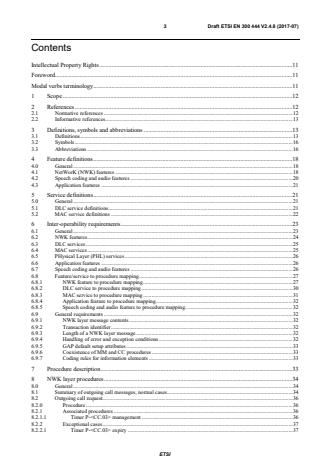
3 Draft ETSI EN 300 444 V2.4.8 (2017-07)
Contents
Intellectual Property Rights . 11
Foreword . 11
Modal verbs terminology . 11
1 Scope . 12
2 References . 12
2.1 Normative references . 12
2.2 Informative references . 13
3 Definitions, symbols and abbreviations . 13
3.1 Definitions . 13
3.2 Symbols . 16
3.3 Abbreviations . 16
4 Feature definitions . 18
4.0 General . 18
4.1 NetWorK (NWK) features . 18
4.2 Speech coding and audio features . 20
4.3 Application features . 21
5 Service definitions . 21
5.0 General . 21
5.1 DLC service definitions . 21
5.2 MAC service definitions . 22
6 Inter-operability requirements . 23
6.1 General . 23
6.2 NWK features . 24
6.3 DLC services . 25
6.4 MAC services . 25
6.5 PHysical Layer (PHL) services . 26
6.6 Application features . 26
6.7 Speech coding and audio features . 26
6.8 Feature/service to procedure mapping . 27
6.8.1 NWK feature to procedure mapping . 27
6.8.2 DLC service to procedure mapping . 30
6.8.3 MAC service to procedure mapping . 31
6.8.4 Application feature to procedure mapping . 32
6.8.5 Speech coding and audio feature to procedure mapping. 32
6.9 General requirements . 32
6.9.1 NWK layer message contents . 32
6.9.2 Transaction identifier . 32
6.9.3 Length of a NWK layer message . 32
6.9.4 Handling of error and exception conditions . 32
6.9.5 GAP default setup attributes . 33
6.9.6 Coexistence of MM and CC procedures . 33
6.9.7 Coding rules for information elements . 33
7 Procedure description . 33
8 NWK layer procedures . 34
8.0 General . 34
8.1 Summary of outgoing call messages, normal cases . 34
8.2 Outgoing call request . 36
8.2.0 Procedure . 36
8.2.1 Associated procedures . 36
8.2.1.1 Timer P- management . 36
8.2.2 Exceptional cases . 37
8.2.2.1 Timer P- expiry . 37
ETSI
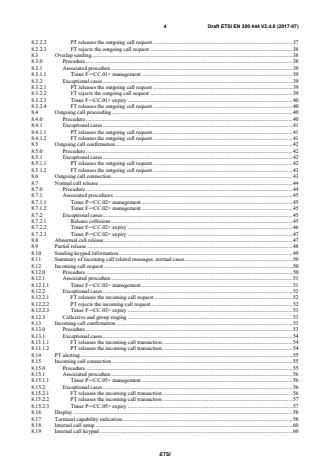
4 Draft ETSI EN 300 444 V2.4.8 (2017-07)
8.2.2.2 PT releases the outgoing call request . 37
8.2.2.3 FT rejects the outgoing call request . 38
8.3 Overlap sending . 38
8.3.0 Procedure . 38
8.3.1 Associated procedure . 39
8.3.1.1 Timer F- management . 39
8.3.2 Exceptional cases . 39
8.3.2.1 PT releases the outgoing call request . 39
8.3.2.2 FT rejects the outgoing call request . 39
8.3.2.3 Timer F- expiry . 40
8.3.2.4 FT releases the outgoing call request . 40
8.4 Outgoing call proceeding . 40
8.4.0 Procedure . 40
8.4.1 Exceptional cases . 41
8.4.1.1 PT releases the outgoing call request . 41
8.4.1.2 FT releases the outgoing call request . 41
8.5 Outgoing call confirmation. 42
8.5.0 Procedure . 42
8.5.1 Exceptional cases . 42
8.5.1.1 PT releases the outgoing call request . 42
8.5.1.2 FT releases the outgoing call request . 43
8.6 Outgoing call connection . 43
8.7 Normal call release . 44
8.7.0 Procedure . 44
8.7.1 Associated procedures . 45
8.7.1.1 Timer P- management . 45
8.7.1.2 Timer F- management . 45
8.7.2 Exceptional cases . 45
8.7.2.1 Release collisions . 45
8.7.2.2 Timer F- expiry . 46
8.7.2.3 Timer P- expiry . 47
8.8 Abnormal call release . 47
8.9 Partial release . 48
8.10 Sending keypad information. 49
8.11 Summary of incoming call related messages, normal cases . 50
8.12 Incoming call request . 50
8.12.0 Procedure . 50
8.12.1 Associated procedure . 51
8.12.1.1 Timer F- management . 51
8.12.2 Exceptional cases . 52
8.12.2.1 FT releases the incoming call request . 52
8.12.2.2 PT rejects the incoming call request . 52
8.12.2.3 Timer F- expiry . 53
8.12.3 Collective and group ringing . 53
8.13 Incoming call confirmation . 53
8.13.0 Procedure . 53
8.13.1 Exceptional cases . 54
8.13.1.1 FT releases the incoming call transaction . 54
8.13.1.2 PT releases the incoming call transaction . 54
8.14 PT alerting . 55
8.15 Incoming call connection . 55
8.15.0 Procedure . 55
8.15.1 Associated procedure . 56
8.15.1.1 Timer P- management . 56
8.15.2 Exceptional cases . 56
8.15.2.1 FT releases the incoming call transaction . 56
8.15.2.2 PT releases the incoming call transaction . 57
8.15.2.3 Timer P- expiry . 57
8.16 Display . 58
8.17 Terminal capability indication . 58
8.18 Internal call setup . 60
8.19 Internal call keypad . 60
ETSI
5 Draft ETSI EN 300 444 V2.4.8 (2017-07)
8.20 Service call setup . 61
8.21 Service call keypad . 61
8.22 Identification of PP . 61
8.22.0 Procedure . 61
8.22.1 Associated procedure . 62
8.22.1.1 Timer F- management . 62
8.22.2 Exceptional cases . 63
8.22.2.1 Identity not existing in the PT . 63
8.22.2.2 Timer F- expiry . 63
8.23 Authentication of FT using DSAA . 63
8.23.0 Procedure . 63
8.23.1 Associated procedure . 64
8.23.1.1 Timer P- management . 64
8.23.2 Exceptional cases . 64
8.23.2.1 Authentication algorithm/key not supported . 64
8.23.2.2 FT Authentication failure (authentication challenge RES2 has wrong value) . 65
8.23.2.3 Timer P- expiry . 65
8.24 Authentication of PP using DSAA . 65
8.24.0 Procedure . 65
8.24.1 Associated procedure . 67
8.24.1.1 Timer F- management . 67
8.24.2 Exceptional cases . 67
8.24.2.1 Authentication algorithm/key not supported . 67
8.24.2.2 Timer F- expiry . 67
8.23.2.3 PP Authentication failure (authentication challenge RES1 has wrong value) . 67
8.25 Authentication of user using DSAA . 68
8.25.0 Procedure . 68
8.25.1 Associated procedure . 68
8.25.1.1 Timer F- management . 68
8.25.2 Exceptional cases . 69
8.25.2.1 Authentication algorithm/key not supported . 69
8.25.2.2 Timer F- expiry . 69
8.26 Incrementing the ZAP value . 69
8.27 Storing the DCK . 70
8.28 Location registration. 70
8.28.0 Procedure . 70
8.28.1 Associated procedures . 72
8.28.1.1 Timer P- management . 72
8.28.1.2 Timer F- management . 72
8.28.2 Exceptional cases . 72
8.28.2.1 FT rejects the location registration procedure . 72
8.28.2.2 Failure of location registration procedure . 73
8.28.2.3 PT rejects the identity assignment . 73
8.28.2.4 Timer F- expiry. 73
8.29 Location update . 73
8.30 Obtaining access rights . 75
8.30.0 Procedure . 75
8.30.1 Associated procedure . 76
8.30.1.1 Timer P- management . 76
8.30.2 Exceptional cases . 77
8.30.2.1 FT rejects the access rights . 77
8.30.2.2 Timer P- expiry. 77
8.31 FT terminating access rights . 77
8.31.0 Procedure . 77
8.31.1 Associated procedure . 78
8.31.1.1 Timer F- management . 78
8.31.2 Exceptional cases . 79
8.31.2.1 PT rejects the termination request . 79
8.31.2.2 Timer F- expiry. 79
8.32 Key allocation . 79
8.32.0 Procedure . 79
8.32.1 Associated procedures . 81
ETSI
6 Draft ETSI EN 300 444 V2.4.8 (2017-07)
8.32.1.1 Timer F- management . 81
8.32.1.2 Timer P- management . 81
8.32.2 Exceptional cases . 81
8.32.2.1 Timer F- expiry . 81
8.32.2.2 Timer P- expiry . 81
8.32.2.3 Allocation-type element is unacceptable . 82
8.32.2.4 Authentication of PT fails . 82
8.32.2.5 Authentication of FT fails . 82
8.33 Cipher-switching initiated by FT using DSC . 83
8.33.0 Procedure . 83
8.33.1 Associated procedure . 84
8.33.1.1 Timer F- management . 84
8.33.2 Exceptional cases . 84
8.33.2.1 PT rejects the cipher request . 84
8.33.2.2 Timer F- expiry . 85
8.34 Cipher-switching initiated by PT using DSC . 85
8.34.0 Procedure . 85
8.34.1 Associated procedure . 86
8.34.1.1 Timer P- management . 86
8.34.2 Exceptional cases . 86
8.34.2.1 FT rejects the cipher request . 86
8.34.2.2 Timer P- expiry . 87
8.35 Indirect FT initiated link establishment . 87
8.35.0 Procedure . 87
8.35.1 Associated procedure . 88
8.35.1.1 Timer F- management . 88
8.35.2 Exceptional cases . 89
8.35.2.1 The IPUI received in the {LCE-PAGE-RESPONSE} does not match . 89
8.35.2.2 Timer expiry . 89
8.35.2.3 Release from the higher entity . 90
8.36 Direct PT initiated link establishment . 90
8.36.0 Procedure . 90
8.36.1 Exceptional case . 91
8.36.1.1 Link establishment failure . 91
8.37 Link release "normal" . 92
8.37.0 Procedure . 92
8.37.1 Associated procedure . 93
8.37.1.1 Timer management . 93
8.37.2 Exceptional cases . 93
8.37.2.1 Timer expiry . 93
8.37.2.2 Outstanding data has been discarded. 94
8.38 Link release "abnormal" . 94
8.39 Link release "maintain" . 94
8.39.0 Procedure . 94
8.39.1 Associated procedure . 95
8.39.1.1 Timer management . 95
8.40 Enhanced FT initiated U- plane connection . 95
8.41 Calling Line Identification Presentation (CLIP) Indication . 96
8.42 Calling Name Identification Presentation (CNIP) Indication . 96
8.43 Internal Call Calling Line Identification Presentation (CLIP) . 97
8.44 Internal Call Calling Name Identification Presentation (CNIP) . 98
8.45 Enhanced security procedures . 99
8.45.0 General . 99
8.45.1 Encryption of all calls . 100
8.45.2 Re-keying during a call . 100
8.45.3 Early encryption . 101
8.45.4 Subscription requirements . 102
8.45.5 Enhanced security regarding legacy devices. 103
8.45.5.0 General . 103
8.45.5.1 Behaviour of FPs regarding legacy PPs . 103
8.45.5.2 Behaviour of PPs regarding legacy FPs . 103
8.45.5.3 Behaviour regarding legacy 'repeater' devices . 104
ETSI
7 Draft ETSI EN 300 444 V2.4.8 (2017-07)
8.45.6 Authentication of FT using DSAA2 . 105
8.45.6.0 Procedure . 105
8.45.6.1 Associated procedure . 106
8.45.6.1.1 Timer P- management . 106
8.45.6.2 Exceptional cases . 107
8.45.6.2.1 Authentication algorithm/key not supported . 107
8.45.6.2.2 FT Authentication failure (authentication challenge RES2 has wrong value) . 107
8.45.6.2.3 Timer P- expiry . 107
8.45.7 Authentication of PP using DSAA2 . 107
8.45.7.0 Procedure . 107
8.45.7.1 Associated procedure . 110
8.45.7.1.1 Timer F- management . 110
8.45.7.2 Exceptional cases . 110
8.45.7.2.1 Authentication algorithm/key not supported . 110
8.45.7.2.2 Timer F- expiry . 110
8.45.7.2.3 PP Authentication failure (authentication challenge RES1 has wrong value) . 110
8.45.8 Authentication of user using DSAA2 . 111
8.45.8.0 Procedure . 111
8.45.8.1 Associated procedure . 111
8.45.8.1.1 Timer F- management . 111
8.45.8.2 Exceptional cases . 112
8.45.8.2.1 Authentication algorithm/key not supported . 112
8.45.8.2.2 Timer F- expiry . 112
8.45.9 Key allocation using DSAA2. 112
8.45.9.0 Procedure . 112
8.45.9.1 Associated procedures . 114
8.45.9.1.1 Timer F- management . 114
8.45.9.1.2 Timer P- management . 114
8.45.9.2 Exceptional cases .
...
EUROPEAN STANDARD
Digital Enhanced Cordless Telecommunications (DECT);
Generic Access Profile (GAP)
2 ETSI EN 300 444 V2.5.1 (2017-10)
Reference
REN/DECT-00309
Keywords
access, DECT, generic, IMT-2000, mobility,
profile, radio, synchronization, TDD, TDMA
ETSI
650 Route des Lucioles
F-06921 Sophia Antipolis Cedex - FRANCE
Tel.: +33 4 92 94 42 00 Fax: +33 4 93 65 47 16
Siret N° 348 623 562 00017 - NAF 742 C
Association à but non lucratif enregistrée à la
Sous-Préfecture de Grasse (06) N° 7803/88
Important notice
The present document can be downloaded from:
http://www.etsi.org/standards-search
The present document may be made available in electronic versions and/or in print. The content of any electronic and/or
print versions of the present document shall not be modified without the prior written authorization of ETSI. In case of any
existing or perceived difference in contents between such versions and/or in print, the only prevailing document is the
print of the Portable Document Format (PDF) version kept on a specific network drive within ETSI Secretariat.
Users of the present document should be aware that the document may be subject to revision or change of status.
Information on the current status of this and other ETSI documents is available at
https://portal.etsi.org/TB/ETSIDeliverableStatus.aspx
If you find errors in the present document, please send your comment to one of the following services:
https://portal.etsi.org/People/CommiteeSupportStaff.aspx
Copyright Notification
No part may be reproduced or utilized in any form or by any means, electronic or mechanical, including photocopying
and microfilm except as authorized by written permission of ETSI.
The content of the PDF version shall not be modified without the written authorization of ETSI.
The copyright and the foregoing restriction extend to reproduction in all media.
© ETSI 2017.
All rights reserved.
TM TM TM
DECT , PLUGTESTS , UMTS and the ETSI logo are trademarks of ETSI registered for the benefit of its Members.
TM
3GPP and LTE™ are trademarks of ETSI registered for the benefit of its Members and
of the 3GPP Organizational Partners.
oneM2M logo is protected for the benefit of its Members.
GSM® and the GSM logo are trademarks registered and owned by the GSM Association.
ETSI
3 ETSI EN 300 444 V2.5.1 (2017-10)
Contents
Intellectual Property Rights . 11
Foreword . 11
Modal verbs terminology . 11
1 Scope . 12
2 References . 12
2.1 Normative references . 12
2.2 Informative references . 13
3 Definitions, symbols and abbreviations . 13
3.1 Definitions . 13
3.2 Symbols . 16
3.3 Abbreviations . 16
4 Feature definitions . 18
4.0 General . 18
4.1 NetWorK (NWK) features . 18
4.2 Speech coding and audio features . 20
4.3 Application features . 21
5 Service definitions . 21
5.0 General . 21
5.1 DLC service definitions . 21
5.2 MAC service definitions . 22
6 Inter-operability requirements . 23
6.1 General . 23
6.2 NWK features . 24
6.3 DLC services . 25
6.4 MAC services . 25
6.5 PHysical Layer (PHL) services . 26
6.6 Application features . 26
6.7 Speech coding and audio features . 26
6.8 Feature/service to procedure mapping . 27
6.8.1 NWK feature to procedure mapping . 27
6.8.2 DLC service to procedure mapping . 30
6.8.3 MAC service to procedure mapping . 31
6.8.4 Application feature to procedure mapping . 32
6.8.5 Speech coding and audio feature to procedure mapping. 32
6.9 General requirements . 32
6.9.1 NWK layer message contents . 32
6.9.2 Transaction identifier . 32
6.9.3 Length of a NWK layer message . 32
6.9.4 Handling of error and exception conditions . 32
6.9.5 GAP default setup attributes . 33
6.9.6 Coexistence of MM and CC procedures . 33
6.9.7 Coding rules for information elements . 33
7 Procedure description . 33
8 NWK layer procedures . 34
8.0 General . 34
8.1 Summary of outgoing call messages, normal cases . 34
8.2 Outgoing call request . 36
8.2.0 Procedure . 36
8.2.1 Associated procedures . 36
8.2.1.1 Timer P- management . 36
8.2.2 Exceptional cases . 37
8.2.2.1 Timer P- expiry . 37
ETSI
4 ETSI EN 300 444 V2.5.1 (2017-10)
8.2.2.2 PT releases the outgoing call request . 37
8.2.2.3 FT rejects the outgoing call request . 38
8.3 Overlap sending . 38
8.3.0 Procedure . 38
8.3.1 Associated procedure . 39
8.3.1.1 Timer F- management . 39
8.3.2 Exceptional cases . 39
8.3.2.1 PT releases the outgoing call request . 39
8.3.2.2 FT rejects the outgoing call request . 39
8.3.2.3 Timer F- expiry . 40
8.3.2.4 FT releases the outgoing call request . 40
8.4 Outgoing call proceeding . 40
8.4.0 Procedure . 40
8.4.1 Exceptional cases . 41
8.4.1.1 PT releases the outgoing call request . 41
8.4.1.2 FT releases the outgoing call request . 41
8.5 Outgoing call confirmation. 42
8.5.0 Procedure . 42
8.5.1 Exceptional cases . 42
8.5.1.1 PT releases the outgoing call request . 42
8.5.1.2 FT releases the outgoing call request . 43
8.6 Outgoing call connection . 43
8.7 Normal call release . 44
8.7.0 Procedure . 44
8.7.1 Associated procedures . 45
8.7.1.1 Timer P- management . 45
8.7.1.2 Timer F- management . 45
8.7.2 Exceptional cases . 45
8.7.2.1 Release collisions . 45
8.7.2.2 Timer F- expiry . 46
8.7.2.3 Timer P- expiry . 47
8.8 Abnormal call release . 47
8.9 Partial release . 48
8.10 Sending keypad information. 49
8.11 Summary of incoming call related messages, normal cases . 50
8.12 Incoming call request . 50
8.12.0 Procedure . 50
8.12.1 Associated procedure . 51
8.12.1.1 Timer F- management . 51
8.12.2 Exceptional cases . 52
8.12.2.1 FT releases the incoming call request . 52
8.12.2.2 PT rejects the incoming call request . 52
8.12.2.3 Timer F- expiry . 53
8.12.3 Collective and group ringing . 53
8.13 Incoming call confirmation . 53
8.13.0 Procedure . 53
8.13.1 Exceptional cases . 54
8.13.1.1 FT releases the incoming call transaction . 54
8.13.1.2 PT releases the incoming call transaction . 54
8.14 PT alerting . 55
8.15 Incoming call connection . 55
8.15.0 Procedure . 55
8.15.1 Associated procedure . 56
8.15.1.1 Timer P- management . 56
8.15.2 Exceptional cases . 56
8.15.2.1 FT releases the incoming call transaction . 56
8.15.2.2 PT releases the incoming call transaction . 57
8.15.2.3 Timer P- expiry . 57
8.16 Display . 58
8.17 Terminal capability indication . 58
8.18 Internal call setup . 60
8.19 Internal call keypad . 60
ETSI
5 ETSI EN 300 444 V2.5.1 (2017-10)
8.20 Service call setup . 60
8.21 Service call keypad . 61
8.22 Identification of PP . 61
8.22.0 Procedure . 61
8.22.1 Associated procedure . 62
8.22.1.1 Timer F- management . 62
8.22.2 Exceptional cases . 62
8.22.2.1 Identity not existing in the PT . 62
8.22.2.2 Timer F- expiry . 62
8.23 Authentication of FT using DSAA . 63
8.23.0 Procedure . 63
8.23.1 Associated procedure . 64
8.23.1.1 Timer P- management . 64
8.23.2 Exceptional cases . 64
8.23.2.1 Authentication algorithm/key not supported . 64
8.23.2.2 FT Authentication failure (authentication challenge RES2 has wrong value) . 64
8.23.2.3 Timer P- expiry . 65
8.24 Authentication of PP using DSAA . 65
8.24.0 Procedure . 65
8.24.1 Associated procedure . 67
8.24.1.1 Timer F- management . 67
8.24.2 Exceptional cases . 67
8.24.2.1 Authentication algorithm/key not supported . 67
8.24.2.2 Timer F- expiry . 67
8.23.2.3 PP Authentication failure (authentication challenge RES1 has wrong value) . 67
8.25 Authentication of user using DSAA . 68
8.25.0 Procedure . 68
8.25.1 Associated procedure . 68
8.25.1.1 Timer F- management . 68
8.25.2 Exceptional cases . 69
8.25.2.1 Authentication algorithm/key not supported . 69
8.25.2.2 Timer F- expiry . 69
8.26 Incrementing the ZAP value . 69
8.27 Storing the DCK . 70
8.28 Location registration. 70
8.28.0 Procedure . 70
8.28.1 Associated procedures . 72
8.28.1.1 Timer P- management . 72
8.28.1.2 Timer F- management . 72
8.28.2 Exceptional cases . 72
8.28.2.1 FT rejects the location registration procedure . 72
8.28.2.2 Failure of location registration procedure . 73
8.28.2.3 PT rejects the identity assignment . 73
8.28.2.4 Timer F- expiry. 73
8.29 Location update . 73
8.30 Obtaining access rights . 75
8.30.0 Procedure . 75
8.30.1 Associated procedure . 76
8.30.1.1 Timer P- management . 76
8.30.2 Exceptional cases . 77
8.30.2.1 FT rejects the access rights . 77
8.30.2.2 Timer P- expiry. 77
8.31 FT terminating access rights . 77
8.31.0 Procedure . 77
8.31.1 Associated procedure . 78
8.31.1.1 Timer F- management . 78
8.31.2 Exceptional cases . 79
8.31.2.1 PT rejects the termination request . 79
8.31.2.2 Timer F- expiry. 79
8.32 Key allocation . 79
8.32.0 Procedure . 79
8.32.1 Associated procedures . 81
ETSI
6 ETSI EN 300 444 V2.5.1 (2017-10)
8.32.1.1 Timer F- management . 81
8.32.1.2 Timer P- management . 81
8.32.2 Exceptional cases . 81
8.32.2.1 Timer F- expiry . 81
8.32.2.2 Timer P- expiry . 81
8.32.2.3 Allocation-type element is unacceptable . 82
8.32.2.4 Authentication of PT fails . 82
8.32.2.5 Authentication of FT fails . 82
8.33 Cipher-switching initiated by FT using DSC . 83
8.33.0 Procedure . 83
8.33.1 Associated procedure . 84
8.33.1.1 Timer F- management . 84
8.33.2 Exceptional cases . 84
8.33.2.1 PT rejects the cipher request . 84
8.33.2.2 Timer F- expiry . 85
8.34 Cipher-switching initiated by PT using DSC . 85
8.34.0 Procedure . 85
8.34.1 Associated procedure . 86
8.34.1.1 Timer P- management . 86
8.34.2 Exceptional cases . 86
8.34.2.1 FT rejects the cipher request . 86
8.34.2.2 Timer P- expiry . 87
8.35 Indirect FT initiated link establishment . 87
8.35.0 Procedure . 87
8.35.1 Associated procedure . 88
8.35.1.1 Timer F- management . 88
8.35.2 Exceptional cases . 89
8.35.2.1 The IPUI received in the {LCE-PAGE-RESPONSE} does not match . 89
8.35.2.2 Timer expiry . 89
8.35.2.3 Release from the higher entity . 90
8.36 Direct PT initiated link establishment . 90
8.36.0 Procedure . 90
8.36.1 Exceptional case . 91
8.36.1.1 Link establishment failure . 91
8.37 Link release "normal" . 92
8.37.0 Procedure . 92
8.37.1 Associated procedure . 93
8.37.1.1 Timer management . 93
8.37.2 Exceptional cases . 93
8.37.2.1 Timer expiry . 93
8.37.2.2 Outstanding data has been discarded. 94
8.38 Link release "abnormal" . 94
8.39 Link release "maintain" . 94
8.39.0 Procedure . 94
8.39.1 Associated procedure . 95
8.39.1.1 Timer management . 95
8.40 Enhanced FT initiated U- plane connection . 95
8.41 Calling Line Identification Presentation (CLIP) Indication . 96
8.42 Calling Name Identification Presentation (CNIP) Indication . 96
8.43 Internal Call Calling Line Identification Presentation (CLIP) . 97
8.44 Internal Call Calling Name Identification Presentation (CNIP) . 98
8.45 Enhanced security procedures . 99
8.45.0 General . 99
8.45.1 Encryption of all calls . 100
8.45.2 Re-keying during a call . 100
8.45.3 Early encryption . 101
8.45.4 Subscription requirements . 102
8.45.5 Enhanced security regarding legacy devices. 103
8.45.5.0 General . 103
8.45.5.1 Behaviour of FPs regarding legacy PPs . 103
8.45.5.2 Behaviour of PPs regarding legacy FPs . 103
8.45.5.3 Behaviour regarding legacy 'repeater' devices . 104
ETSI
7 ETSI EN 300 444 V2.5.1 (2017-10)
8.45.6 Authentication of FT using DSAA2 . 105
8.45.6.0 Procedure . 105
8.45.6.1 Associated procedure . 106
8.45.6.1.1 Timer P- management . 106
8.45.6.2 Exceptional cases . 107
8.45.6.2.1 Authentication algorithm/key not supported . 107
8.45.6.2.2 FT Authentication failure (authentication challenge RES2 has wrong value) . 107
8.45.6.2.3 Timer P- expiry . 107
8.45.7 Authentication of PP using DSAA2 . 107
8.45.7.0 Procedure . 107
8.45.7.1 Associated procedure . 110
8.45.7.1.1 Timer F- management . 110
8.45.7.2 Exceptional cases . 110
8.45.7.2.1 Authentication algorithm/key not supported . 110
8.45.7.2.2 Timer F- expiry . 110
8.45.7.2.3 PP Authentication failure (authentication challenge RES1 has wrong value) . 110
8.45.8 Authentication of user using DSAA2 . 111
8.45.8.0 Procedure . 111
8.45.8.1 Associated procedure . 111
8.45.8.1.1 Timer F- management . 111
8.45.8.2 Exceptional cases . 112
8.45.8.2.1 Authentication algorithm/key not supported . 112
8.45.8.2.2 Timer F- expiry . 112
8.45.9 Key allocation using DSAA2. 112
8.45.9.0 Procedure . 112
8.45.9.1 Associated procedures . 114
8.45.9.1.1 Timer F- management . 114
8.45.9.1.2 Timer P- management . 114
8.45.9.2 Exceptional cases .
...
2003-01.Slovenski inštitut za standardizacijo. Razmnoževanje celote ali delov tega standarda ni dovoljeno.Digital Enhanced Cordless Telecommunications (DECT) - Generic Access Profile (GAP)33.070.30'(&7Digital Enhanced Cordless Telecommunications (DECT)ICS:Ta slovenski standard je istoveten z:ETSI EN 300 444 V2.5.1 (2017-10)SIST EN 300 444 V2.5.1:2017en01-december-2017SIST EN 300 444 V2.5.1:2017SLOVENSKI
STANDARD
EUROPEAN STANDARD SIST EN 300 444 V2.5.1:2017
ETSI ETSI EN 300 444 V2.5.1 (2017-10) 2
Reference REN/DECT-00309 Keywords access, DECT, generic, IMT-2000, mobility, profile, radio, synchronization, TDD, TDMA ETSI 650 Route des Lucioles F-06921 Sophia Antipolis Cedex - FRANCE
Tel.: +33 4 92 94 42 00
Fax: +33 4 93 65 47 16
Siret N° 348 623 562 00017 - NAF 742 C Association à but non lucratif enregistrée à la Sous-Préfecture de Grasse (06) N° 7803/88
Important notice The present document can be downloaded from: http://www.etsi.org/standards-search The present document may be made available in electronic versions and/or in print. The content of any electronic and/or print versions of the present document shall not be modified without the prior written authorization of ETSI. In case of any existing or perceived difference in contents between such versions and/or in print, the only prevailing document is the print of the Portable Document Format (PDF) version kept on a specific network drive within ETSI Secretariat. Users of the present document should be aware that the document may be subject to revision or change of status. Information on the current status of this and other ETSI documents is available at https://portal.etsi.org/TB/ETSIDeliverableStatus.aspx If you find errors in the present document, please send your comment to one of the following services: https://portal.etsi.org/People/CommiteeSupportStaff.aspx Copyright Notification No part may be reproduced or utilized in any form or by any means, electronic or mechanical, including photocopying and microfilm except as authorized by written permission of ETSI. The content of the PDF version shall not be modified without the written authorization of ETSI. The copyright and the foregoing restriction extend to reproduction in all media.
© ETSI 2017. All rights reserved.
DECTTM, PLUGTESTSTM, UMTSTM and the ETSI logo are trademarks of ETSI registered for the benefit of its Members. 3GPPTM and LTE™ are trademarks of ETSI registered for the benefit of its Members and of the 3GPP Organizational Partners. oneM2M logo is protected for the benefit of its Members. GSM® and the GSM logo are trademarks registered and owned by the GSM Association. SIST EN 300 444 V2.5.1:2017
ETSI ETSI EN 300 444 V2.5.1 (2017-10) 3 Contents Intellectual Property Rights . 11 Foreword . 11 Modal verbs terminology . 11 1 Scope . 12 2 References . 12 2.1 Normative references . 12 2.2 Informative references . 13 3 Definitions, symbols and abbreviations . 13 3.1 Definitions . 13 3.2 Symbols . 16 3.3 Abbreviations . 16 4 Feature definitions . 18 4.0 General . 18 4.1 NetWorK (NWK) features . 18 4.2 Speech coding and audio features . 20 4.3 Application features . 21 5 Service definitions . 21 5.0 General . 21 5.1 DLC service definitions . 21 5.2 MAC service definitions . 22 6 Inter-operability requirements . 23 6.1 General . 23 6.2 NWK features . 24 6.3 DLC services . 25 6.4 MAC services . 25 6.5 PHysical Layer (PHL) services . 26 6.6 Application features . 26 6.7 Speech coding and audio features . 26 6.8 Feature/service to procedure mapping . 27 6.8.1 NWK feature to procedure mapping . 27 6.8.2 DLC service to procedure mapping . 30 6.8.3 MAC service to procedure mapping . 31 6.8.4 Application feature to procedure mapping . 32 6.8.5 Speech coding and audio feature to procedure mapping. 32 6.9 General requirements . 32 6.9.1 NWK layer message contents . 32 6.9.2 Transaction identifier . 32 6.9.3 Length of a NWK layer message . 32 6.9.4 Handling of error and exception conditions . 32 6.9.5 GAP default setup attributes . 33 6.9.6 Coexistence of MM and CC procedures . 33 6.9.7 Coding rules for information elements . 33 7 Procedure description . 33 8 NWK layer procedures . 34 8.0 General . 34 8.1 Summary of outgoing call messages, normal cases . 34 8.2 Outgoing call request . 36 8.2.0 Procedure . 36 8.2.1 Associated procedures . 36 8.2.1.1 Timer P- management . 36 8.2.2 Exceptional cases . 37 8.2.2.1 Timer P- expiry . 37 SIST EN 300 444 V2.5.1:2017
ETSI ETSI EN 300 444 V2.5.1 (2017-10) 4 8.2.2.2 PT releases the outgoing call request . 37 8.2.2.3 FT rejects the outgoing call request . 38 8.3 Overlap sending . 38 8.3.0 Procedure . 38 8.3.1 Associated procedure . 39 8.3.1.1 Timer F- management . 39 8.3.2 Exceptional cases . 39 8.3.2.1 PT releases the outgoing call request . 39 8.3.2.2 FT rejects the outgoing call request . 39 8.3.2.3 Timer F- expiry . 40 8.3.2.4 FT releases the outgoing call request . 40 8.4 Outgoing call proceeding . 40 8.4.0 Procedure . 40 8.4.1 Exceptional cases . 41 8.4.1.1 PT releases the outgoing call request . 41 8.4.1.2 FT releases the outgoing call request . 41 8.5 Outgoing call confirmation. 42 8.5.0 Procedure . 42 8.5.1 Exceptional cases . 42 8.5.1.1 PT releases the outgoing call request . 42 8.5.1.2 FT releases the outgoing call request . 43 8.6 Outgoing call connection . 43 8.7 Normal call release . 44 8.7.0 Procedure . 44 8.7.1 Associated procedures . 45 8.7.1.1 Timer P- management . 45 8.7.1.2 Timer F- management . 45 8.7.2 Exceptional cases . 45 8.7.2.1 Release collisions . 45 8.7.2.2 Timer F- expiry . 46 8.7.2.3 Timer P- expiry . 47 8.8 Abnormal call release . 47 8.9 Partial release . 48 8.10 Sending keypad information. 49 8.11 Summary of incoming call related messages, normal cases . 50 8.12 Incoming call request . 50 8.12.0 Procedure . 50 8.12.1 Associated procedure . 51 8.12.1.1 Timer F- management . 51 8.12.2 Exceptional cases . 52 8.12.2.1 FT releases the incoming call request . 52 8.12.2.2 PT rejects the incoming call request . 52 8.12.2.3 Timer F- expiry . 53 8.12.3 Collective and group ringing . 53 8.13 Incoming call confirmation . 53 8.13.0 Procedure . 53 8.13.1 Exceptional cases . 54 8.13.1.1 FT releases the incoming call transaction . 54 8.13.1.2 PT releases the incoming call transaction . 54 8.14 PT alerting . 55 8.15 Incoming call connection . 55 8.15.0 Procedure . 55 8.15.1 Associated procedure . 56 8.15.1.1 Timer P- management . 56 8.15.2 Exceptional cases . 56 8.15.2.1 FT releases the incoming call transaction . 56 8.15.2.2 PT releases the incoming call transaction . 57 8.15.2.3 Timer P- expiry . 57 8.16 Display . 58 8.17 Terminal capability indication . 58 8.18 Internal call setup . 60 8.19 Internal call keypad . 60 SIST EN 300 444 V2.5.1:2017
ETSI ETSI EN 300 444 V2.5.1 (2017-10) 5 8.20 Service call setup . 60 8.21 Service call keypad . 61 8.22 Identification of PP . 61 8.22.0 Procedure . 61 8.22.1 Associated procedure . 62 8.22.1.1 Timer F- management . 62 8.22.2 Exceptional cases . 62 8.22.2.1 Identity not existing in the PT . 62 8.22.2.2 Timer F- expiry . 62 8.23 Authentication of FT using DSAA . 63 8.23.0 Procedure . 63 8.23.1 Associated procedure . 64 8.23.1.1 Timer P- management . 64 8.23.2 Exceptional cases . 64 8.23.2.1 Authentication algorithm/key not supported . 64 8.23.2.2 FT Authentication failure (authentication challenge RES2 has wrong value) . 64 8.23.2.3 Timer P- expiry . 65 8.24 Authentication of PP using DSAA . 65 8.24.0 Procedure . 65 8.24.1 Associated procedure . 67 8.24.1.1 Timer F- management . 67 8.24.2 Exceptional cases . 67 8.24.2.1 Authentication algorithm/key not supported . 67 8.24.2.2 Timer F- expiry . 67 8.23.2.3 PP Authentication failure (authentication challenge RES1 has wrong value) . 67 8.25 Authentication of user using DSAA . 68 8.25.0 Procedure . 68 8.25.1 Associated procedure . 68 8.25.1.1 Timer F- management . 68 8.25.2 Exceptional cases . 69 8.25.2.1 Authentication algorithm/key not supported . 69 8.25.2.2 Timer F- expiry . 69 8.26 Incrementing the ZAP value . 69 8.27 Storing the DCK . 70 8.28 Location registration. 70 8.28.0 Procedure . 70 8.28.1 Associated procedures . 72 8.28.1.1 Timer P- management . 72 8.28.1.2 Timer F- management . 72 8.28.2 Exceptional cases . 72 8.28.2.1 FT rejects the location registration procedure . 72 8.28.2.2 Failure of location registration procedure . 73 8.28.2.3 PT rejects the identity assignment . 73 8.28.2.4 Timer F- expiry. 73 8.29 Location update . 73 8.30 Obtaining access rights . 75 8.30.0 Procedure . 75 8.30.1 Associated procedure . 76 8.30.1.1 Timer P- management . 76 8.30.2 Exceptional cases . 77 8.30.2.1 FT rejects the access rights . 77 8.30.2.2 Timer P- expiry. 77 8.31 FT terminating access rights . 77 8.31.0 Procedure . 77 8.31.1 Associated procedure . 78 8.31.1.1 Timer F- management . 78 8.31.2 Exceptional cases . 79 8.31.2.1 PT rejects the termination request . 79 8.31.2.2 Timer F- expiry. 79 8.32 Key allocation . 79 8.32.0 Procedure . 79 8.32.1 Associated procedures . 81 SIST EN 300 444 V2.5.1:2017
ETSI ETSI EN 300 444 V2.5.1 (2017-10) 6 8.32.1.1 Timer F- management . 81 8.32.1.2 Timer P- management . 81 8.32.2 Exceptional cases . 81 8.32.2.1 Timer F- expiry . 81 8.32.2.2 Timer P- expiry . 81 8.32.2.3 Allocation-type element is unacceptable . 82 8.32.2.4 Authentication of PT fails . 82 8.32.2.5 Authentication of FT fails . 82 8.33 Cipher-switching initiated by FT using DSC . 83 8.33.0 Procedure . 83 8.33.1 Associated procedure . 84 8.33.1.1 Timer F- management . 84 8.33.2 Exceptional cases . 84 8.33.2.1 PT rejects the cipher request . 84 8.33.2.2 Timer F- expiry . 85 8.34 Cipher-switching initiated by PT using DSC . 85 8.34.0 Procedure . 85 8.34.1 Associated procedure . 86 8.34.1.1 Timer P- management . 86 8.34.2 Exceptional cases . 86 8.34.2.1 FT rejects the cipher request . 86 8.34.2.2 Timer P- expiry . 87 8.35 Indirect FT initiated link establishment . 87 8.35.0 Procedure . 87 8.35.1 Associated procedure . 88 8.35.1.1 Timer F- management . 88 8.35.2 Exceptional cases . 89 8.35.2.1 The IPUI received in the {LCE-PAGE-RESPONSE} does not match . 89 8.35.2.2 Timer expiry . 89 8.35.2.3 Release from the higher entity . 90 8.36 Direct PT initiated link establishment . 90 8.36.0 Procedure . 90 8.36.1 Exceptional case . 91 8.36.1.1 Link establishment failure . 91 8.37 Link release "normal" . 92 8.37.0 Procedure . 92 8.37.1 Associated procedure . 93 8.37.1.1 Timer management . 93 8.37.2 Exceptional cases . 93 8.37.2.1 Timer expiry . 93 8.37.2.2 Outstanding data has been discarded. 94 8.38 Link release "abnormal" . 94 8.39 Link release "maintain" . 94 8.39.0 Procedure . 94 8.39.1 Associated procedure . 95 8.39.1.1 Timer management . 95 8.40 Enhanced FT initiated U- plane connection . 95 8.41 Calling Line Identification Presentation (CLIP) Indication . 96 8.42 Calling Name Identification Presentation (CNIP) Indication . 96 8.43 Internal Call Calling Line Identification Presentation (CLIP) . 97 8.44 Internal Call Calling Name Identification Presentation (CNIP) . 98 8.45 Enhanced security procedures . 99 8.45.0 General . 99 8.45.1 Encryption of all calls . 100 8.45.2 Re-keying during a call . 100 8.45.3 Early encryption . 101 8.45.4 Subscription requirements . 102 8.45.5 Enhanced security regarding legacy devices. 103 8.45.5.0 General . 103 8.45.5.1 Behaviour of FPs regarding legacy PPs . 103 8.45.5.2 Behaviour of PPs regarding legacy FPs . 103 8.45.5.3 Behaviour regarding legacy 'repeater' devices . 104 SIST EN 300 444 V2.5.1:2017
ETSI ETSI EN 300 444 V2.5.1 (2017-10) 7 8.45.6 Authentication of FT using DSAA2 . 105 8.45.6.0 Procedure . 105 8.45.6.1 Associated procedure . 106 8.45.6.1.1 Timer P- management . 106 8.45.6.2 Exceptional cases . 107 8.45.6.2.1 Authentication algorithm/key not supported . 107 8.45.6.2.2 FT Authentication failure (authentication challenge RES2 has wrong value) . 107 8.45.6.2.3 Timer P- expiry . 107 8.45.7 Authentication of PP using DSAA2 . 107 8.45.7.0 Procedure . 107 8.45.7.1 Associated procedure . 110 8.45.7.1.1 Timer F- management . 110 8.45.7.2 Exceptional cases . 110 8.45.7.2.1 Authentication algorithm/key not supported . 110 8.45.7.2.2 Timer F- expiry . 110 8.45.7.2.3 PP Authentication failure (authentication challenge RES1 has wrong value) . 110 8.45.8 Authentication of user using DSAA2 . 111 8.45.8.0 Procedure . 111 8.45.8.1 Associated procedure . 111 8.45.8.1.1 Timer F- management . 111 8.45.8.2 Exceptional cases . 112 8.45.8.2.1 Authentication algorithm/key not supported . 112 8.45.8.2.2 Timer F- expiry . 112 8.45.9 Key allocation using DSAA2. 112 8.45.9.0 Procedure . 112 8.45.9.1 Associated procedures . 114 8.45.9.1.1 Timer F- management . 114 8.45.9.1.2 Timer P- management . 114 8.45.9.2 Exceptional cases . 115 8.45.9.2.1 Tim
...