

SIST EN 300 176-2 V2.4.1:2022
(Main)Digital Enhanced Cordless Telecommunications (DECT) - Test specification - Part 2: Audio and speech
General Information
- Abstract
The present document specifies the tests applicable to all Digital Enhanced Cordless Telecommunications (DECT)
equipment accessing any DECT frequency band (including applicable IMT-2000 frequency bands) and the tests
applicable to DECT speech and audio transmission using any of the codecs and any of the audio specifications
described in ETSI EN 300 175-8 [8].
The aims of the present document are to ensure:
• efficient use of frequency spectrum;
• no harm done to any connected network and its services;
• no harm done to other radio networks and services;
• no harm done to other DECT equipment or its services;
• interworking of terminal equipment via any public telecommunications network, including the ISDN/PSTN
network and the Internet,
through testing those provisions of ETSI EN 300 175-1 [1] to ETSI EN 300 175-8 [8] which are relevant to these aims.
The tests of ETSI EN 300 176 are split into two parts:
• part 1 [9] covers testing of radio frequency parameters, security elements and those DECT protocols that
facilitate the radio frequency tests and efficient use of frequency spectrum;
• part 2 (the present document) describes testing of speech and audio requirements between network interface
and DECT PT, or between a DECT CI air interface and alternatively a DECT PT or FT.
The present document is not applicable to terminal equipment specially designed for the disabled (e.g. with
amplification of received speech as an aid for the hard of hearing).
DECT terminal equipment consists of the following elements:
a) Fixed Part (FP);
b) Portable Part (PP);
c) Cordless Terminal Adapter (CTA);
d) Wireless Relay Stations (WRS) (FP and PP combined).
The present document is structured to allow tests of either:
a) the FP and PP together; or
b) the FP and PP as separate items.
Where the DECT FP is connected to a PSTN, and there are any peculiarities in the requirements for voice telephony,
these will be accommodated within the FP.
- Status
- Published
- Public Enquiry End Date
- 30-Apr-2022
- Publication Date
- 23-May-2022
- Technical Committee
- MOC - Mobile Communications
- Current Stage
- 6060 - National Implementation/Publication (Adopted Project)
- Start Date
- 23-May-2022
- Due Date
- 28-Jul-2022
- Completion Date
- 24-May-2022
Buy Documents
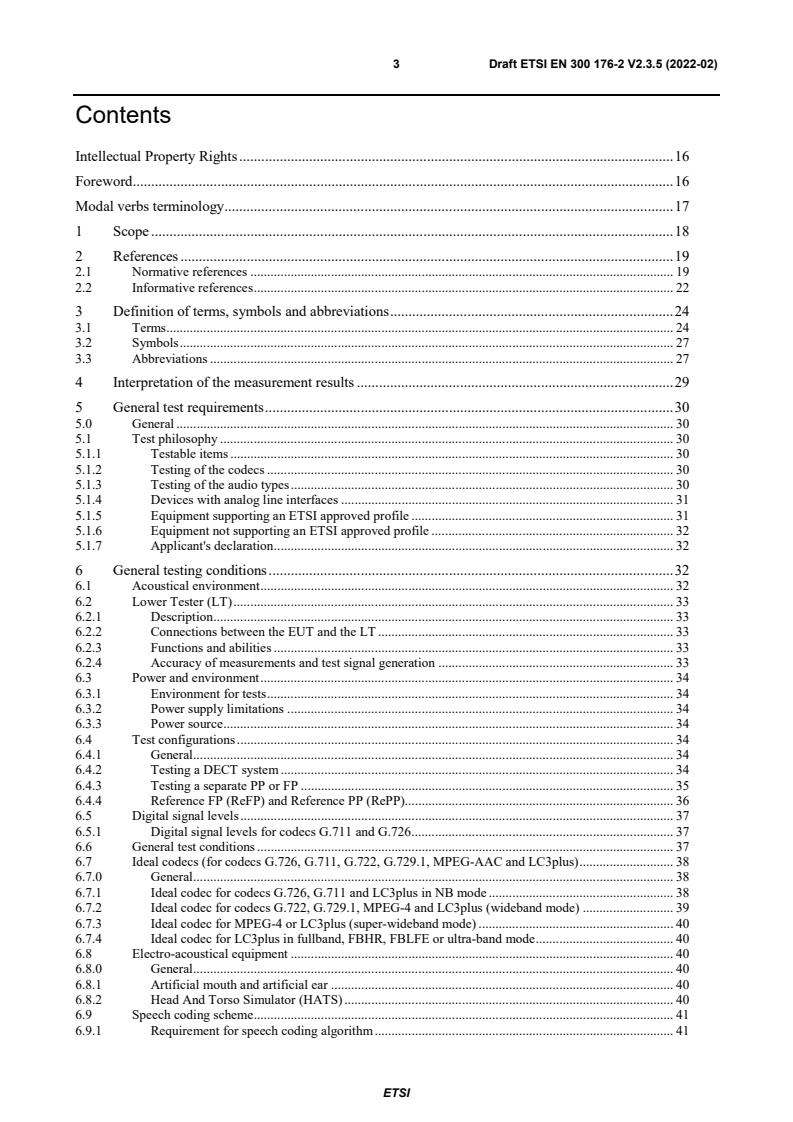
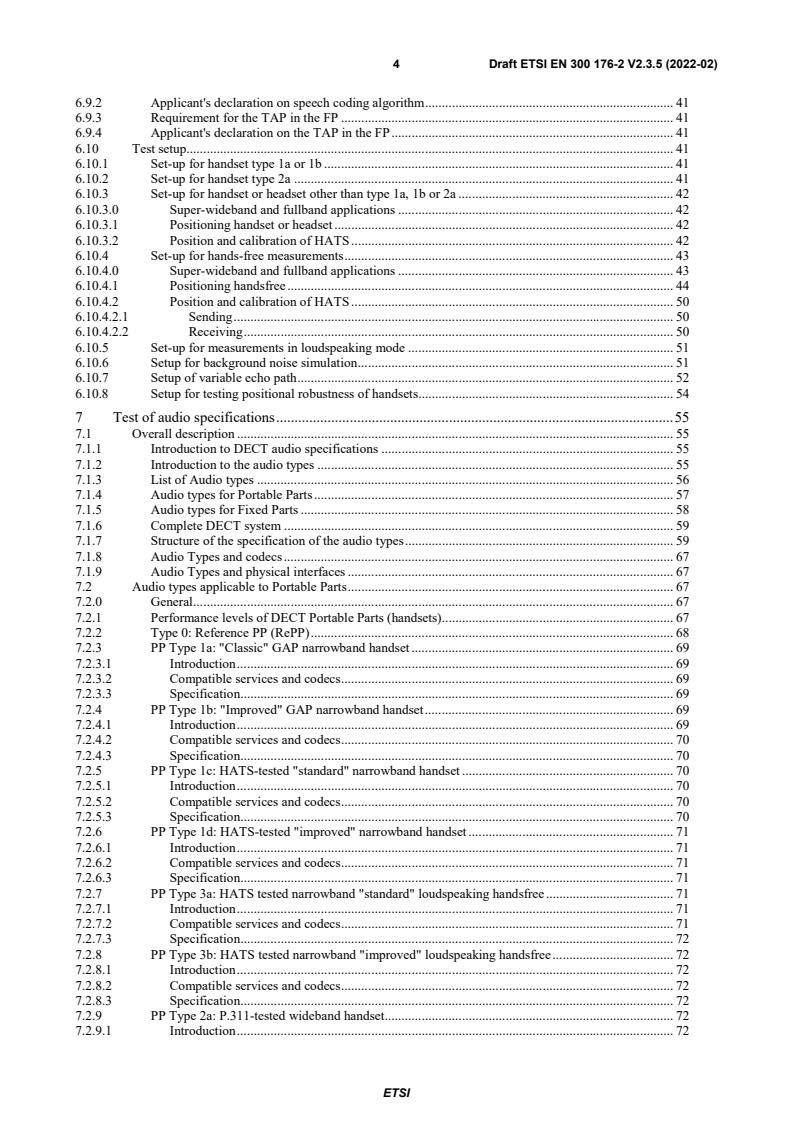
ETSI EN 300 176-2 V2.3.5 (2022-02) - Digital Enhanced Cordless Telecommunications (DECT); Test specification; Part 2: Audio and speech
ETSI EN 300 176-2 V2.4.1 (2022-05) - Digital Enhanced Cordless Telecommunications (DECT); Test specification; Part 2: Audio and speech

Overview
SIST EN 300 176-2 V2.4.1:2022 is the Slovenian adoption of the European Standard outlining the test specification for Digital Enhanced Cordless Telecommunications (DECT), focusing on Part 2: Audio and Speech. Developed by the Slovenian Institute for Standardization (SIST) in alignment with ETSI EN 300 176-2, this document details the comprehensive testing requirements for DECT equipment’s audio and speech transmission across all DECT frequency bands, including those designated for IMT-2000. The primary aim is to ensure the efficient use of the frequency spectrum, prevent harm to any connected networks or services, and guarantee interoperability and quality of speech and audio services.
Key Topics
- Scope of Testing: Applies to all DECT equipment – Fixed Parts (FP), Portable Parts (PP), Cordless Terminal Adapters (CTA), and Wireless Relay Stations (WRS) – regardless of frequency band.
- Audio and Speech Transmission: Covers tests for a wide range of audio specifications and codecs described in ETSI EN 300 175-8, targeting voice and audio quality over DECT systems.
- Interoperability and Safety: Ensures no harm to existing networks (e.g., ISDN, PSTN, and Internet) or to other DECT and radio services, while supporting public network requirements.
- Test Configurations: Supports testing of FP and PP both jointly and individually, accommodating various configurations based on real-world deployment.
- Coding Technologies: Relates to popular audio codecs (e.g., narrowband, wideband, superwideband, fullband, LC3plus), supporting both traditional and advanced DECT speech services.
- Exclusions: Specifically notes that the requirements do not apply to specialized terminals for the disabled (such as those with amplified speech for hearing impairment).
Applications
The standard is essential for manufacturers, test labs, and integrators of DECT equipment to:
- Validate Product Compliance: Ensure that DECT phones, headsets, wireless adapters, and repeaters meet stringent audio and speech transmission requirements.
- Guarantee Audio Quality: Test and optimize devices for handsfree, loudspeaking, and headset performance across various audio bands, ensuring conversation clarity and voice integrity.
- Meet Regulatory Requirements: Adhere to European and international market regulations for spectrum use, network safety, and service non-interference.
- Facilitate Interoperability: Confirm device compatibility for seamless operation across different networks and service providers, benefitting both end-users and network operators.
- Ensure Robust Communication: Support high-quality telephony and voice access over DECT in diverse environments such as homes, offices, public networks, and VoIP services.
Related Standards
For comprehensive DECT standardization, the following references are crucial:
- ETSI EN 300 175-8: Defines the audio specifications and codecs relevant to DECT equipment.
- ETSI EN 300 175-1 to 175-8: Covers all foundational requirements for DECT communications, including protocol, signaling, and network interface specifications.
- SIST EN 300 176-1: Complements Part 2 by outlining tests for radio frequency parameters, security elements, and DECT protocol efficiency.
- IMT-2000 Standards: Guidelines for frequency allocations shared with the IMT-2000 wireless networks.
- Other ITU and ETSI standards: Applicable audio codecs such as G.711, G.722, and LC3plus, referenced for speech quality and interoperability.
SIST EN 300 176-2 V2.4.1:2022 is a key standard for achieving high-performance, regulatory-compliant, and user-friendly digital cordless telecommunication equipment. Implementing its testing methodology is essential for robust, reliable, and interoperable DECT audio and speech solutions.
Buy Documents
ETSI EN 300 176-2 V2.3.5 (2022-02) - Digital Enhanced Cordless Telecommunications (DECT); Test specification; Part 2: Audio and speech
ETSI EN 300 176-2 V2.4.1 (2022-05) - Digital Enhanced Cordless Telecommunications (DECT); Test specification; Part 2: Audio and speech
Get Certified
Connect with accredited certification bodies for this standard

ANCE
Mexican certification and testing association.

Intertek Slovenia
Intertek testing, inspection, and certification services in Slovenia.

LNE (Laboratoire National de Métrologie et d'Essais)
French national laboratory for metrology and testing.
Sponsored listings
Frequently Asked Questions
SIST EN 300 176-2 V2.4.1:2022 is a standard published by the Slovenian Institute for Standardization (SIST). Its full title is "Digital Enhanced Cordless Telecommunications (DECT) - Test specification - Part 2: Audio and speech". This standard covers: The present document specifies the tests applicable to all Digital Enhanced Cordless Telecommunications (DECT) equipment accessing any DECT frequency band (including applicable IMT-2000 frequency bands) and the tests applicable to DECT speech and audio transmission using any of the codecs and any of the audio specifications described in ETSI EN 300 175-8 [8]. The aims of the present document are to ensure: • efficient use of frequency spectrum; • no harm done to any connected network and its services; • no harm done to other radio networks and services; • no harm done to other DECT equipment or its services; • interworking of terminal equipment via any public telecommunications network, including the ISDN/PSTN network and the Internet, through testing those provisions of ETSI EN 300 175-1 [1] to ETSI EN 300 175-8 [8] which are relevant to these aims. The tests of ETSI EN 300 176 are split into two parts: • part 1 [9] covers testing of radio frequency parameters, security elements and those DECT protocols that facilitate the radio frequency tests and efficient use of frequency spectrum; • part 2 (the present document) describes testing of speech and audio requirements between network interface and DECT PT, or between a DECT CI air interface and alternatively a DECT PT or FT. The present document is not applicable to terminal equipment specially designed for the disabled (e.g. with amplification of received speech as an aid for the hard of hearing). DECT terminal equipment consists of the following elements: a) Fixed Part (FP); b) Portable Part (PP); c) Cordless Terminal Adapter (CTA); d) Wireless Relay Stations (WRS) (FP and PP combined). The present document is structured to allow tests of either: a) the FP and PP together; or b) the FP and PP as separate items. Where the DECT FP is connected to a PSTN, and there are any peculiarities in the requirements for voice telephony, these will be accommodated within the FP.
The present document specifies the tests applicable to all Digital Enhanced Cordless Telecommunications (DECT) equipment accessing any DECT frequency band (including applicable IMT-2000 frequency bands) and the tests applicable to DECT speech and audio transmission using any of the codecs and any of the audio specifications described in ETSI EN 300 175-8 [8]. The aims of the present document are to ensure: • efficient use of frequency spectrum; • no harm done to any connected network and its services; • no harm done to other radio networks and services; • no harm done to other DECT equipment or its services; • interworking of terminal equipment via any public telecommunications network, including the ISDN/PSTN network and the Internet, through testing those provisions of ETSI EN 300 175-1 [1] to ETSI EN 300 175-8 [8] which are relevant to these aims. The tests of ETSI EN 300 176 are split into two parts: • part 1 [9] covers testing of radio frequency parameters, security elements and those DECT protocols that facilitate the radio frequency tests and efficient use of frequency spectrum; • part 2 (the present document) describes testing of speech and audio requirements between network interface and DECT PT, or between a DECT CI air interface and alternatively a DECT PT or FT. The present document is not applicable to terminal equipment specially designed for the disabled (e.g. with amplification of received speech as an aid for the hard of hearing). DECT terminal equipment consists of the following elements: a) Fixed Part (FP); b) Portable Part (PP); c) Cordless Terminal Adapter (CTA); d) Wireless Relay Stations (WRS) (FP and PP combined). The present document is structured to allow tests of either: a) the FP and PP together; or b) the FP and PP as separate items. Where the DECT FP is connected to a PSTN, and there are any peculiarities in the requirements for voice telephony, these will be accommodated within the FP.
SIST EN 300 176-2 V2.4.1:2022 is classified under the following ICS (International Classification for Standards) categories: 33.070.30 - Digital Enhanced Cordless Telecommunications (DECT). The ICS classification helps identify the subject area and facilitates finding related standards.
SIST EN 300 176-2 V2.4.1:2022 is available in PDF format for immediate download after purchase. The document can be added to your cart and obtained through the secure checkout process. Digital delivery ensures instant access to the complete standard document.
Standards Content (Sample)
Draft ETSI EN 300 176-2 V2.3.5 (2022-02)
EUROPEAN STANDARD
Digital Enhanced Cordless Telecommunications (DECT);
Test specification;
Part 2: Audio and speech
2 Draft ETSI EN 300 176-2 V2.3.5 (2022-02)
Reference
REN/DECT-00360
Keywords
7 kHz, audio, codec, DECT, handsfree, IMT-2000,
LC3plus, loudspeaking, mobility, narrowband,
quality, radio, regulation, speech, superwideband,
TDD, TDMA, telephony, terminal, testing, voice,
wideband
ETSI
650 Route des Lucioles
F-06921 Sophia Antipolis Cedex - FRANCE
Tel.: +33 4 92 94 42 00 Fax: +33 4 93 65 47 16
Siret N° 348 623 562 00017 - APE 7112B
Association à but non lucratif enregistrée à la
Sous-Préfecture de Grasse (06) N° w061004871
Important notice
The present document can be downloaded from:
http://www.etsi.org/standards-search
The present document may be made available in electronic versions and/or in print. The content of any electronic and/or
print versions of the present document shall not be modified without the prior written authorization of ETSI. In case of any
existing or perceived difference in contents between such versions and/or in print, the prevailing version of an ETSI
deliverable is the one made publicly available in PDF format at www.etsi.org/deliver.
Users of the present document should be aware that the document may be subject to revision or change of status.
Information on the current status of this and other ETSI documents is available at
https://portal.etsi.org/TB/ETSIDeliverableStatus.aspx
If you find errors in the present document, please send your comment to one of the following services:
https://portal.etsi.org/People/CommiteeSupportStaff.aspx
Notice of disclaimer & limitation of liability
The information provided in the present deliverable is directed solely to professionals who have the appropriate degree of
experience to understand and interpret its content in accordance with generally accepted engineering or
other professional standard and applicable regulations.
No recommendation as to products and services or vendors is made or should be implied.
In no event shall ETSI be held liable for loss of profits or any other incidental or consequential damages.
Any software contained in this deliverable is provided "AS IS" with no warranties, express or implied, including but not
limited to, the warranties of merchantability, fitness for a particular purpose and non-infringement of intellectual property
rights and ETSI shall not be held liable in any event for any damages whatsoever (including, without limitation, damages
for loss of profits, business interruption, loss of information, or any other pecuniary loss) arising out of or related to the use
of or inability to use the software.
Copyright Notification
No part may be reproduced or utilized in any form or by any means, electronic or mechanical, including photocopying and
microfilm except as authorized by written permission of ETSI.
The content of the PDF version shall not be modified without the written authorization of ETSI.
The copyright and the foregoing restriction extend to reproduction in all media.
© ETSI 2022.
All rights reserved.
ETSI
3 Draft ETSI EN 300 176-2 V2.3.5 (2022-02)
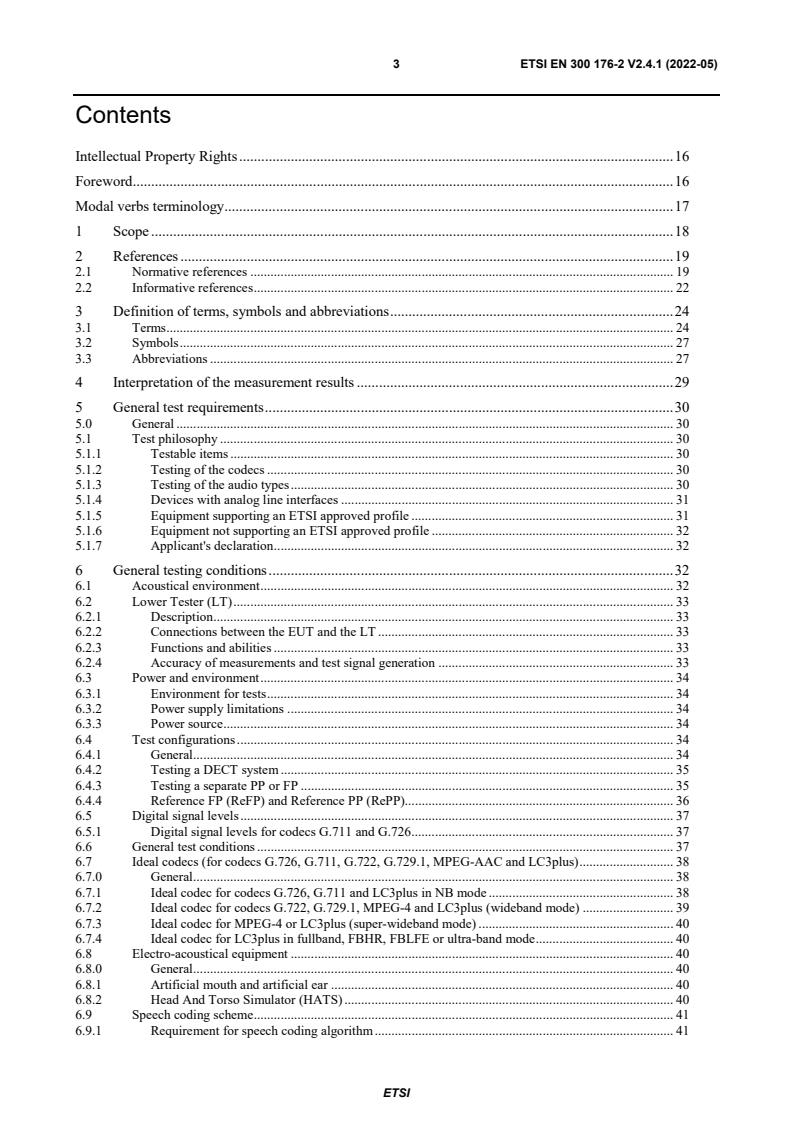
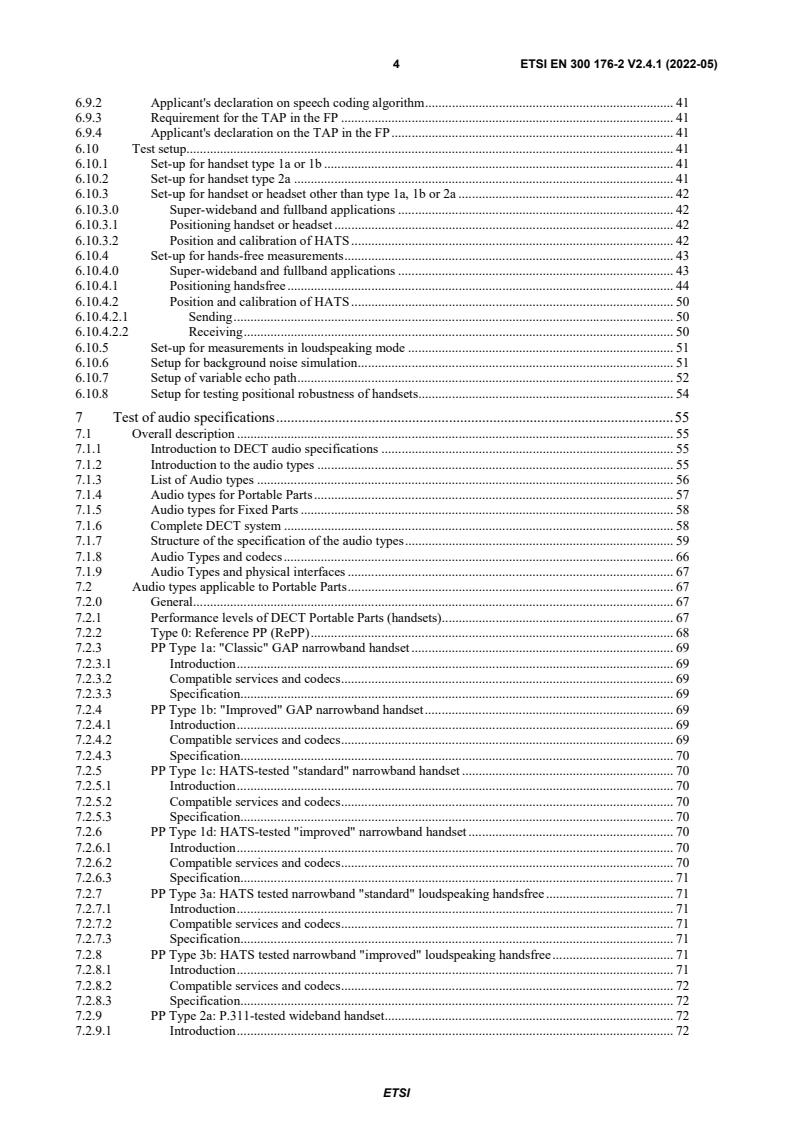
Contents
Intellectual Property Rights . 16
Foreword . 16
Modal verbs terminology . 17
1 Scope . 18
2 References . 19
2.1 Normative references . 19
2.2 Informative references . 22
3 Definition of terms, symbols and abbreviations . 24
3.1 Terms . 24
3.2 Symbols . 27
3.3 Abbreviations . 27
4 Interpretation of the measurement results . 29
5 General test requirements . 30
5.0 General . 30
5.1 Test philosophy . 30
5.1.1 Testable items . 30
5.1.2 Testing of the codecs . 30
5.1.3 Testing of the audio types . 30
5.1.4 Devices with analog line interfaces . 31
5.1.5 Equipment supporting an ETSI approved profile . 31
5.1.6 Equipment not supporting an ETSI approved profile . 32
5.1.7 Applicant's declaration . 32
6 General testing conditions . 32
6.1 Acoustical environment . 32
6.2 Lower Tester (LT) . 33
6.2.1 Description . 33
6.2.2 Connections between the EUT and the LT . 33
6.2.3 Functions and abilities . 33
6.2.4 Accuracy of measurements and test signal generation . 33
6.3 Power and environment . 34
6.3.1 Environment for tests . 34
6.3.2 Power supply limitations . 34
6.3.3 Power source . 34
6.4 Test configurations . 34
6.4.1 General . 34
6.4.2 Testing a DECT system . 34
6.4.3 Testing a separate PP or FP . 35
6.4.4 Reference FP (ReFP) and Reference PP (RePP). 36
6.5 Digital signal levels . 37
6.5.1 Digital signal levels for codecs G.711 and G.726 . 37
6.6 General test conditions . 37
6.7 Ideal codecs (for codecs G.726, G.711, G.722, G.729.1, MPEG-AAC and LC3plus) . 38
6.7.0 General . 38
6.7.1 Ideal codec for codecs G.726, G.711 and LC3plus in NB mode . 38
6.7.2 Ideal codec for codecs G.722, G.729.1, MPEG-4 and LC3plus (wideband mode) . 39
6.7.3 Ideal codec for MPEG-4 or LC3plus (super-wideband mode) . 40
6.7.4 Ideal codec for LC3plus in fullband, FBHR, FBLFE or ultra-band mode . 40
6.8 Electro-acoustical equipment . 40
6.8.0 General . 40
6.8.1 Artificial mouth and artificial ear . 40
6.8.2 Head And Torso Simulator (HATS) . 40
6.9 Speech coding scheme . 41
6.9.1 Requirement for speech coding algorithm . 41
ETSI
4 Draft ETSI EN 300 176-2 V2.3.5 (2022-02)
6.9.2 Applicant's declaration on speech coding algorithm . 41
6.9.3 Requirement for the TAP in the FP . 41
6.9.4 Applicant's declaration on the TAP in the FP . 41
6.10 Test setup. 41
6.10.1 Set-up for handset type 1a or 1b . 41
6.10.2 Set-up for handset type 2a . 41
6.10.3 Set-up for handset or headset other than type 1a, 1b or 2a . 42
6.10.3.0 Super-wideband and fullband applications . 42
6.10.3.1 Positioning handset or headset . 42
6.10.3.2 Position and calibration of HATS . 42
6.10.4 Set-up for hands-free measurements . 43
6.10.4.0 Super-wideband and fullband applications . 43
6.10.4.1 Positioning handsfree . 44
6.10.4.2 Position and calibration of HATS . 50
6.10.4.2.1 Sending . 50
6.10.4.2.2 Receiving . 50
6.10.5 Set-up for measurements in loudspeaking mode . 51
6.10.6 Setup for background noise simulation . 51
6.10.7 Setup of variable echo path . 52
6.10.8 Setup for testing positional robustness of handsets. 54
7 Test of audio specifications . 55
7.1 Overall description . 55
7.1.1 Introduction to DECT audio specifications . 55
7.1.2 Introduction to the audio types . 55
7.1.3 List of Audio types . 56
7.1.4 Audio types for Portable Parts . 57
7.1.5 Audio types for Fixed Parts . 58
7.1.6 Complete DECT system . 59
7.1.7 Structure of the specification of the audio types . 59
7.1.8 Audio Types and codecs . 67
7.1.9 Audio Types and physical interfaces . 67
7.2 Audio types applicable to Portable Parts . 67
7.2.0 General . 67
7.2.1 Performance levels of DECT Portable Parts (handsets). 67
7.2.2 Type 0: Reference PP (RePP) . 68
7.2.3 PP Type 1a: "Classic" GAP narrowband handset . 69
7.2.3.1 Introduction . 69
7.2.3.2 Compatible services and codecs . 69
7.2.3.3 Specification. 69
7.2.4 PP Type 1b: "Improved" GAP narrowband handset . 69
7.2.4.1 Introduction . 69
7.2.4.2 Compatible services and codecs . 70
7.2.4.3 Specification. 70
7.2.5 PP Type 1c: HATS-tested "standard" narrowband handset . 70
7.2.5.1 Introduction . 70
7.2.5.2 Compatible services and codecs . 70
7.2.5.3 Specification. 70
7.2.6 PP Type 1d: HATS-tested "improved" narrowband handset . 71
7.2.6.1 Introduction . 71
7.2.6.2 Compatible services and codecs . 71
7.2.6.3 Specification. 71
7.2.7 PP Type 3a: HATS tested narrowband "standard" loudspeaking handsfree . 71
7.2.7.1 Introduction . 71
7.2.7.2 Compatible services and codecs . 71
7.2.7.3 Specification. 72
7.2.8 PP Type 3b: HATS tested narrowband "improved" loudspeaking handsfree . 72
7.2.8.1 Introduction . 72
7.2.8.2 Compatible services and codecs . 72
7.2.8.3 Specification. 72
7.2.9 PP Type 2a: P.311-tested wideband handset. 72
7.2.9.1 Introduction . 72
ETSI
5 Draft ETSI EN 300 176-2 V2.3.5 (2022-02)
7.2.9.2 Compatible services and codecs . 72
7.2.9.3 Specification. 72
7.2.10 PP Type 2b: HATS-tested "standard" wideband handset or headset . 72
7.2.10.1 Introduction . 72
7.2.10.2 Compatible services and codecs . 73
7.2.10.3 Specification. 73
7.2.11 PP Type 2c: HATS tested "improved" wideband handset or headset . 73
7.2.11.1 Introduction . 73
7.2.11.2 Compatible services and codecs . 73
7.2.11.3 Specification. 73
7.2.12 PP Type 4a: HATS tested wideband "standard" loudspeaking handsfree . 73
7.2.12.1 Introduction . 73
7.2.12.2 Compatible services and codecs . 74
7.2.12.3 Specification. 74
7.2.13 PP Type 4b: HATS tested wideband "improved" loudspeaking and handsfree . 74
7.2.13.1 Introduction . 74
7.2.13.2 Compatible services and codecs . 74
7.2.13.3 Specification. 74
7.2.14 PP Type 5a: super-wideband 14 kHz handset or headset. 74
7.2.14.1 Introduction . 74
7.2.14.2 Compatible services and codecs . 75
7.2.14.3 Specification. 75
7.2.15 PP Type 5b: super-wideband 14 kHz loudspeaking handsfree . 75
7.2.15.1 Introduction . 75
7.2.15.2 Compatible services and codecs . 75
7.2.15.3 Specification. 75
7.2.16 PP Type 6: PPs with external 2 wire, 3,1 kHz telephony interface . 75
7.2.16.1 Introduction . 75
7.2.16.2 Compatible services and codecs . 75
7.2.16.3 Specification. 75
7.2.17 PP Type 7a: fullband 20 kHz handset or headset . 75
7.2.17.1 Introduction . 75
7.2.17.2 Compatible services and codecs . 75
7.2.17.3 Specification. 75
7.2.18 PP Type 7b: fullband 20 kHz loudspeaking handsfree . 76
7.2.18.1 Introduction . 76
7.2.18.2 Compatible services and codecs . 76
7.2.18.3 Specification. 76
7.2.19 PP Types 7c, d, e, f: fullband 20 kHz stereo audio device . 76
7.2.19.1 Introduction . 76
7.2.19.2 Compatible services and codecs . 76
7.2.19.3 Specification. 76
7.2.20 PP Type 7g: FBHR 24 kHz headset device . 76
7.2.20.1 Introduction . 76
7.2.20.2 Compatible services and codecs . 76
7.2.20.3 Specification. 77
7.2.21 PP Type 7h: FBHR 24 kHz loudspeaking device . 77
7.2.21.1 Introduction . 77
7.2.21.2 Compatible services and codecs . 77
7.2.21.3 Specification. 77
7.2.22 PP Type 7i: FBLFE 250 Hz loudspeaking device . 77
7.2.22.1 Introduction . 77
7.2.22.2 Compatible services and codecs . 77
7.2.22.3 Specification. 77
7.2.23 PP Type 7j: fullband 20 kHz low-latency microphone device . 77
7.2.23.1 Introduction . 77
7.2.23.2 Compatible services and codecs . 77
7.2.23.3 Specification. 77
7.2.24 PP Type 8a: ultra-band 48 kHz headset device . 78
7.2.24.1 Introduction . 78
7.2.24.2 Compatible services and codecs . 78
7.2.24.3 Specification. 78
ETSI
6 Draft ETSI EN 300 176-2 V2.3.5 (2022-02)
7.2.25 PP Type 8b: ultra-band 48 kHz loudspeaking device . 78
7.2.25.1 Introduction . 78
7.2.25.2 Compatible services and codecs . 78
7.2.25.3 Specification. 78
7.3 Audio transmission types applicable to Fixed Parts . 78
7.3.0 General . 78
7.3.1 FP Type 0: Reference FP (ReFP) . 79
7.3.2 FP Type 1a: "classical" Fixed Part for ISDN Network . 79
7.3.2.1 Introduction . 79
7.3.2.2 Compatible services and codecs . 79
7.3.2.3 Specifications . 80
7.3.2.3.1 Transcoding and equalization . 80
7.3.2.3.2 PP Type detection . 80
7.3.2.3.3 Activation of audio processing functions . 80
7.3.2.3.4 Transmission specification . 80
7.3.3 FP Type 1b: Fixed Part for ISDN Network . 81
7.3.3.1 Introduction . 81
7.3.3.2 Compatible services and codecs . 81
7.3.3.3 Specification. 81
7.3.3.3.1 Transcoding and equalization . 81
7.3.3.3.2 PP Type detection . 81
7.3.3.3.3 Activation of audio processing functions . 82
7.3.3.3.4 Transmission specification . 82
7.3.4 FP Type 2: FP with analog 2-wire interface, 3,1 kHz service . 82
7.3.4.1 Introduction . 82
7.3.4.2 Compatible services, physical interfaces and codecs . 82
7.3.4.3 Specification. 83
7.3.4.3.1 Transcoding, equalization and conversion . 83
7.3.4.3.2 PP Type detection and activation of audio processing functions . 83
7.3.4.3.3 Transmission specification . 83
7.3.5 FP Type 3: VoIP narrowband Fixed Part . 83
7.3.5.1 Introduction . 83
7.3.5.2 Compatible services, physical interfaces and codecs . 83
7.3.5.3 Specification. 84
7.3.5.3.1 Transcoding and equalization . 84
7.3.5.3.2 PP Type detection . 84
7.3.5.3.3 Activation of audio processing functions . 85
7.3.5.3.4 Transmission specification . 85
7.3.6 FP Type 4: ISDN wideband Fixed Part . 85
7.3.6.1 Introduction . 85
7.3.6.2 Compatible services and codecs . 85
7.3.6.3 Specification. 86
7.3.6.3.1 Transcoding and equalization . 86
7.3.6.3.2 PP Type detection . 86
7.3.6.3.3 Activation of audio processing functions . 86
7.3.6.3.4 Transmission specification . 86
7.3.7 FP Type 5: VoIP wideband, super-wideband, fullband, FBHR or ultra-band Fixed Part . 87
7.3.7.1 Introduction . 87
7.3.7.2 Compatible services, physical interfaces and codecs . 87
7.3.7.3 Specification. 87
7.3.7.3.1 Transcoding and equalization . 87
7.3.7.3.2 PP type detection . 88
7.3.7.3.3 Activation of audio processing functions . 88
7.3.7.3.4 Transmission specification . 88
7.3.8 FP Type 6a: FP handling an Internal call inside a DECT FP (any service) . 88
7.3.8.1 Introduction . 88
7.3.8.2 Compatible services, physical interfaces and codecs . 89
7.3.8.3 Specification. 89
7.3.9 FP Type 6b: FP handling an n-party conference inside a DECT FP (any service) . 89
7.3.9.1 Introduction . 89
7.3.9.2 Compatible services, physical interfaces and codecs . 89
7.3.9.3 Specification for the conference bridge. 89
ETSI
7 Draft ETSI EN 300 176-2 V2.3.5 (2022-02)
7.3.10 FP Type 7: DECT Repeater Part (REP) . 89
7.3.10.1 Introduction . 89
7.3.10.2 Compatible services, physical interfaces and codecs . 89
7.3.10.3 Specification. 90
7.4 Additional features . 90
7.4.1 Introduction. 90
7.4.2 Echo canceller in Fixed Part . 90
7.4.3 Echo suppressor in Fixed Part. 91
7.5 Transmission characteristics for Portable Parts . 91
7.5.1 Transmission characteristics for Portable Part type 1a ("Classic GAP" handset) . 91
7.5.1.1 PP frequency responses . 91
7.5.1.1.1 Sending . 91
7.5.1.1.2 Receiving . 92
7.5.1.2 PP sending and receiving loudness ratings . 92
7.5.1.2.1 Nominal values . 92
7.5.1.2.2 User-controlled volume control in PP . 93
7.5.1.2.3 PP adaptive volume control . 94
7.5.1.3 Sidetone . 94
7.5.1.3.1 Talker sidetone . 94
7.5.1.3.2 Listener sidetone . 95
7.5.1.4 Terminal coupling loss . 96
7.5.1.4.1 Weighted Terminal Coupling Loss (TCLw) . 96
7.5.1.4.2 Stability loss . 97
7.5.1.5 Distortion . 98
7.5.1.5.1 Sending . 98
7.5.1.5.2 Receiving . 99
7.5.1.5.3 Sidetone . 99
7.5.1.6 Out of band signals. 99
7.5.1.6.1 Sending (discrimination against out of band input signals) . 99
7.5.1.6.2 Receiving (spurious out of band signals) . 100
7.5.1.7 Noise . 100
7.5.1.7.1 Sending . 100
7.5.1.7.2 Band-limited noise. 100
7.5.1.7.3 Receiving . 101
7.5.1.7.4 Level of sampling frequency (receiving) . 101
7.5.1.8 Acoustic shock . 101
7.5.1.8.1 Continuous signal . 101
7.5.1.8.2 Peak signal . 101
7.5.1.9 PP Delay . 102
7.5.1.10 PP ambient noise rejection . 103
7.5.2 Additional requirements for PP type 1b ("improved GAP" handset) . 103
7.5.2.0 General . 103
7.5.2.1 Terminal coupling loss . 103
7.5.2.1.1 Weighted Terminal Coupling Loss (TCLw) . 103
7.5.2.2 Atten
...
EUROPEAN STANDARD
Digital Enhanced Cordless Telecommunications (DECT);
Test specification;
Part 2: Audio and speech
2 ETSI EN 300 176-2 V2.4.1 (2022-05)
Reference
REN/DECT-00360
Keywords
7 kHz, audio, codec, DECT, handsfree, IMT-2000,
LC3plus, loudspeaking, mobility, narrowband,
quality, radio, regulation, speech, superwideband,
TDD, TDMA, telephony, terminal, testing, voice,
wideband
ETSI
650 Route des Lucioles
F-06921 Sophia Antipolis Cedex - FRANCE
Tel.: +33 4 92 94 42 00 Fax: +33 4 93 65 47 16
Siret N° 348 623 562 00017 - APE 7112B
Association à but non lucratif enregistrée à la
Sous-Préfecture de Grasse (06) N° w061004871
Important notice
The present document can be downloaded from:
http://www.etsi.org/standards-search
The present document may be made available in electronic versions and/or in print. The content of any electronic and/or
print versions of the present document shall not be modified without the prior written authorization of ETSI. In case of any
existing or perceived difference in contents between such versions and/or in print, the prevailing version of an ETSI
deliverable is the one made publicly available in PDF format at www.etsi.org/deliver.
Users of the present document should be aware that the document may be subject to revision or change of status.
Information on the current status of this and other ETSI documents is available at
https://portal.etsi.org/TB/ETSIDeliverableStatus.aspx
If you find errors in the present document, please send your comment to one of the following services:
https://portal.etsi.org/People/CommiteeSupportStaff.aspx
If you find a security vulnerability in the present document, please report it through our
Coordinated Vulnerability Disclosure Program:
https://www.etsi.org/standards/coordinated-vulnerability-disclosure
Notice of disclaimer & limitation of liability
The information provided in the present deliverable is directed solely to professionals who have the appropriate degree of
experience to understand and interpret its content in accordance with generally accepted engineering or
other professional standard and applicable regulations.
No recommendation as to products and services or vendors is made or should be implied.
In no event shall ETSI be held liable for loss of profits or any other incidental or consequential damages.
Any software contained in this deliverable is provided "AS IS" with no warranties, express or implied, including but not
limited to, the warranties of merchantability, fitness for a particular purpose and non-infringement of intellectual property
rights and ETSI shall not be held liable in any event for any damages whatsoever (including, without limitation, damages
for loss of profits, business interruption, loss of information, or any other pecuniary loss) arising out of or related to the use
of or inability to use the software.
Copyright Notification
No part may be reproduced or utilized in any form or by any means, electronic or mechanical, including photocopying and
microfilm except as authorized by written permission of ETSI.
The content of the PDF version shall not be modified without the written authorization of ETSI.
The copyright and the foregoing restriction extend to reproduction in all media.
© ETSI 2022.
All rights reserved.
ETSI
3 ETSI EN 300 176-2 V2.4.1 (2022-05)
Contents
Intellectual Property Rights . 16
Foreword . 16
Modal verbs terminology . 17
1 Scope . 18
2 References . 19
2.1 Normative references . 19
2.2 Informative references . 22
3 Definition of terms, symbols and abbreviations . 24
3.1 Terms . 24
3.2 Symbols . 27
3.3 Abbreviations . 27
4 Interpretation of the measurement results . 29
5 General test requirements . 30
5.0 General . 30
5.1 Test philosophy . 30
5.1.1 Testable items . 30
5.1.2 Testing of the codecs . 30
5.1.3 Testing of the audio types . 30
5.1.4 Devices with analog line interfaces . 31
5.1.5 Equipment supporting an ETSI approved profile . 31
5.1.6 Equipment not supporting an ETSI approved profile . 32
5.1.7 Applicant's declaration . 32
6 General testing conditions . 32
6.1 Acoustical environment . 32
6.2 Lower Tester (LT) . 33
6.2.1 Description . 33
6.2.2 Connections between the EUT and the LT . 33
6.2.3 Functions and abilities . 33
6.2.4 Accuracy of measurements and test signal generation . 33
6.3 Power and environment . 34
6.3.1 Environment for tests . 34
6.3.2 Power supply limitations . 34
6.3.3 Power source . 34
6.4 Test configurations . 34
6.4.1 General . 34
6.4.2 Testing a DECT system . 35
6.4.3 Testing a separate PP or FP . 35
6.4.4 Reference FP (ReFP) and Reference PP (RePP). 36
6.5 Digital signal levels . 37
6.5.1 Digital signal levels for codecs G.711 and G.726 . 37
6.6 General test conditions . 37
6.7 Ideal codecs (for codecs G.726, G.711, G.722, G.729.1, MPEG-AAC and LC3plus) . 38
6.7.0 General . 38
6.7.1 Ideal codec for codecs G.726, G.711 and LC3plus in NB mode . 38
6.7.2 Ideal codec for codecs G.722, G.729.1, MPEG-4 and LC3plus (wideband mode) . 39
6.7.3 Ideal codec for MPEG-4 or LC3plus (super-wideband mode) . 40
6.7.4 Ideal codec for LC3plus in fullband, FBHR, FBLFE or ultra-band mode . 40
6.8 Electro-acoustical equipment . 40
6.8.0 General . 40
6.8.1 Artificial mouth and artificial ear . 40
6.8.2 Head And Torso Simulator (HATS) . 40
6.9 Speech coding scheme . 41
6.9.1 Requirement for speech coding algorithm . 41
ETSI
4 ETSI EN 300 176-2 V2.4.1 (2022-05)
6.9.2 Applicant's declaration on speech coding algorithm . 41
6.9.3 Requirement for the TAP in the FP . 41
6.9.4 Applicant's declaration on the TAP in the FP . 41
6.10 Test setup. 41
6.10.1 Set-up for handset type 1a or 1b . 41
6.10.2 Set-up for handset type 2a . 41
6.10.3 Set-up for handset or headset other than type 1a, 1b or 2a . 42
6.10.3.0 Super-wideband and fullband applications . 42
6.10.3.1 Positioning handset or headset . 42
6.10.3.2 Position and calibration of HATS . 42
6.10.4 Set-up for hands-free measurements . 43
6.10.4.0 Super-wideband and fullband applications . 43
6.10.4.1 Positioning handsfree . 44
6.10.4.2 Position and calibration of HATS . 50
6.10.4.2.1 Sending . 50
6.10.4.2.2 Receiving . 50
6.10.5 Set-up for measurements in loudspeaking mode . 51
6.10.6 Setup for background noise simulation . 51
6.10.7 Setup of variable echo path . 52
6.10.8 Setup for testing positional robustness of handsets. 54
7 Test of audio specifications . 55
7.1 Overall description . 55
7.1.1 Introduction to DECT audio specifications . 55
7.1.2 Introduction to the audio types . 55
7.1.3 List of Audio types . 56
7.1.4 Audio types for Portable Parts . 57
7.1.5 Audio types for Fixed Parts . 58
7.1.6 Complete DECT system . 58
7.1.7 Structure of the specification of the audio types . 59
7.1.8 Audio Types and codecs . 66
7.1.9 Audio Types and physical interfaces . 67
7.2 Audio types applicable to Portable Parts . 67
7.2.0 General . 67
7.2.1 Performance levels of DECT Portable Parts (handsets). 67
7.2.2 Type 0: Reference PP (RePP) . 68
7.2.3 PP Type 1a: "Classic" GAP narrowband handset . 69
7.2.3.1 Introduction . 69
7.2.3.2 Compatible services and codecs . 69
7.2.3.3 Specification. 69
7.2.4 PP Type 1b: "Improved" GAP narrowband handset . 69
7.2.4.1 Introduction . 69
7.2.4.2 Compatible services and codecs . 69
7.2.4.3 Specification. 70
7.2.5 PP Type 1c: HATS-tested "standard" narrowband handset . 70
7.2.5.1 Introduction . 70
7.2.5.2 Compatible services and codecs . 70
7.2.5.3 Specification. 70
7.2.6 PP Type 1d: HATS-tested "improved" narrowband handset . 70
7.2.6.1 Introduction . 70
7.2.6.2 Compatible services and codecs . 70
7.2.6.3 Specification. 71
7.2.7 PP Type 3a: HATS tested narrowband "standard" loudspeaking handsfree . 71
7.2.7.1 Introduction . 71
7.2.7.2 Compatible services and codecs . 71
7.2.7.3 Specification. 71
7.2.8 PP Type 3b: HATS tested narrowband "improved" loudspeaking handsfree . 71
7.2.8.1 Introduction . 71
7.2.8.2 Compatible services and codecs . 72
7.2.8.3 Specification. 72
7.2.9 PP Type 2a: P.311-tested wideband handset. 72
7.2.9.1 Introduction . 72
ETSI
5 ETSI EN 300 176-2 V2.4.1 (2022-05)
7.2.9.2 Compatible services and codecs . 72
7.2.9.3 Specification. 72
7.2.10 PP Type 2b: HATS-tested "standard" wideband handset or headset . 72
7.2.10.1 Introduction . 72
7.2.10.2 Compatible services and codecs . 72
7.2.10.3 Specification. 72
7.2.11 PP Type 2c: HATS tested "improved" wideband handset or headset . 73
7.2.11.1 Introduction . 73
7.2.11.2 Compatible services and codecs . 73
7.2.11.3 Specification. 73
7.2.12 PP Type 4a: HATS tested wideband "standard" loudspeaking handsfree . 73
7.2.12.1 Introduction . 73
7.2.12.2 Compatible services and codecs . 73
7.2.12.3 Specification. 74
7.2.13 PP Type 4b: HATS tested wideband "improved" loudspeaking and handsfree . 74
7.2.13.1 Introduction . 74
7.2.13.2 Compatible services and codecs . 74
7.2.13.3 Specification. 74
7.2.14 PP Type 5a: super-wideband 14 kHz handset or headset. 74
7.2.14.1 Introduction . 74
7.2.14.2 Compatible services and codecs . 74
7.2.14.3 Specification. 74
7.2.15 PP Type 5b: super-wideband 14 kHz loudspeaking handsfree . 74
7.2.15.1 Introduction . 74
7.2.15.2 Compatible services and codecs . 74
7.2.15.3 Specification. 75
7.2.16 PP Type 6: PPs with external 2 wire, 3,1 kHz telephony interface . 75
7.2.16.1 Introduction . 75
7.2.16.2 Compatible services and codecs . 75
7.2.16.3 Specification. 75
7.2.17 PP Type 7a: fullband 20 kHz handset or headset . 75
7.2.17.1 Introduction . 75
7.2.17.2 Compatible services and codecs . 75
7.2.17.3 Specification. 75
7.2.18 PP Type 7b: fullband 20 kHz loudspeaking handsfree . 75
7.2.18.1 Introduction . 75
7.2.18.2 Compatible services and codecs . 75
7.2.18.3 Specification. 75
7.2.19 PP Types 7c, d, e, f: fullband 20 kHz stereo audio device . 76
7.2.19.1 Introduction . 76
7.2.19.2 Compatible services and codecs . 76
7.2.19.3 Specification. 76
7.2.20 PP Type 7g: FBHR 24 kHz headset device . 76
7.2.20.1 Introduction . 76
7.2.20.2 Compatible services and codecs . 76
7.2.20.3 Specification. 76
7.2.21 PP Type 7h: FBHR 24 kHz loudspeaking device . 76
7.2.21.1 Introduction . 76
7.2.21.2 Compatible services and codecs . 76
7.2.21.3 Specification. 76
7.2.22 PP Type 7i: FBLFE 250 Hz loudspeaking device . 77
7.2.22.1 Introduction . 77
7.2.22.2 Compatible services and codecs . 77
7.2.22.3 Specification. 77
7.2.23 PP Type 7j: fullband 20 kHz low-latency microphone device . 77
7.2.23.1 Introduction . 77
7.2.23.2 Compatible services and codecs . 77
7.2.23.3 Specification. 77
7.2.24 PP Type 8a: ultra-band 48 kHz headset device . 77
7.2.24.1 Introduction . 77
7.2.24.2 Compatible services and codecs . 77
7.2.24.3 Specification. 77
ETSI
6 ETSI EN 300 176-2 V2.4.1 (2022-05)
7.2.25 PP Type 8b: ultra-band 48 kHz loudspeaking device . 77
7.2.25.1 Introduction . 77
7.2.25.2 Compatible services and codecs . 78
7.2.25.3 Specification. 78
7.3 Audio transmission types applicable to Fixed Parts . 78
7.3.0 General . 78
7.3.1 FP Type 0: Reference FP (ReFP) . 78
7.3.2 FP Type 1a: "classical" Fixed Part for ISDN Network . 79
7.3.2.1 Introduction . 79
7.3.2.2 Compatible services and codecs . 79
7.3.2.3 Specifications . 79
7.3.2.3.1 Transcoding and equalization . 79
7.3.2.3.2 PP Type detection . 80
7.3.2.3.3 Activation of audio processing functions . 80
7.3.2.3.4 Transmission specification . 80
7.3.3 FP Type 1b: Fixed Part for ISDN Network . 80
7.3.3.1 Introduction . 80
7.3.3.2 Compatible services and codecs . 80
7.3.3.3 Specification. 81
7.3.3.3.1 Transcoding and equalization . 81
7.3.3.3.2 PP Type detection . 81
7.3.3.3.3 Activation of audio processing functions . 81
7.3.3.3.4 Transmission specification . 82
7.3.4 FP Type 2: FP with analog 2-wire interface, 3,1 kHz service . 82
7.3.4.1 Introduction . 82
7.3.4.2 Compatible services, physical interfaces and codecs . 82
7.3.4.3 Specification. 82
7.3.4.3.1 Transcoding, equalization and conversion . 82
7.3.4.3.2 PP Type detection and activation of audio processing functions . 82
7.3.4.3.3 Transmission specification . 83
7.3.5 FP Type 3: VoIP narrowband Fixed Part . 83
7.3.5.1 Introduction . 83
7.3.5.2 Compatible services, physical interfaces and codecs . 83
7.3.5.3 Specification. 84
7.3.5.3.1 Transcoding and equalization . 84
7.3.5.3.2 PP Type detection . 84
7.3.5.3.3 Activation of audio processing functions . 84
7.3.5.3.4 Transmission specification . 85
7.3.6 FP Type 4: ISDN wideband Fixed Part . 85
7.3.6.1 Introduction . 85
7.3.6.2 Compatible services and codecs . 85
7.3.6.3 Specification. 85
7.3.6.3.1 Transcoding and equalization . 85
7.3.6.3.2 PP Type detection . 85
7.3.6.3.3 Activation of audio processing functions . 86
7.3.6.3.4 Transmission specification . 86
7.3.7 FP Type 5: VoIP wideband, super-wideband, fullband, FBHR or ultra-band Fixed Part . 86
7.3.7.1 Introduction . 86
7.3.7.2 Compatible services, physical interfaces and codecs . 86
7.3.7.3 Specification. 87
7.3.7.3.1 Transcoding and equalization . 87
7.3.7.3.2 PP type detection . 87
7.3.7.3.3 Activation of audio processing functions . 88
7.3.7.3.4 Transmission specification . 88
7.3.8 FP Type 6a: FP handling an Internal call inside a DECT FP (any service) . 88
7.3.8.1 Introduction . 88
7.3.8.2 Compatible services, physical interfaces and codecs . 88
7.3.8.3 Specification. 88
7.3.9 FP Type 6b: FP handling an n-party conference inside a DECT FP (any service) . 89
7.3.9.1 Introduction . 89
7.3.9.2 Compatible services, physical interfaces and codecs . 89
7.3.9.3 Specification for the conference bridge. 89
ETSI
7 ETSI EN 300 176-2 V2.4.1 (2022-05)
7.3.10 FP Type 7: DECT Repeater Part (REP) . 89
7.3.10.1 Introduction . 89
7.3.10.2 Compatible services, physical interfaces and codecs . 89
7.3.10.3 Specification. 89
7.4 Additional features . 90
7.4.1 Introduction. 90
7.4.2 Echo canceller in Fixed Part . 90
7.4.3 Echo suppressor in Fixed Part. 91
7.5 Transmission characteristics for Portable Parts . 91
7.5.1 Transmission characteristics for Portable Part type 1a ("Classic GAP" handset) . 91
7.5.1.1 PP frequency responses . 91
7.5.1.1.1 Sending . 91
7.5.1.1.2 Receiving . 92
7.5.1.2 PP sending and receiving loudness ratings . 92
7.5.1.2.1 Nominal values . 92
7.5.1.2.2 User-controlled volume control in PP . 93
7.5.1.2.3 PP adaptive volume control . 94
7.5.1.3 Sidetone . 94
7.5.1.3.1 Talker sidetone . 94
7.5.1.3.2 Listener sidetone . 95
7.5.1.4 Terminal coupling loss . 96
7.5.1.4.1 Weighted Terminal Coupling Loss (TCLw) . 96
7.5.1.4.2 Stability loss . 97
7.5.1.5 Distortion . 98
7.5.1.5.1 Sending . 98
7.5.1.5.2 Receiving . 99
7.5.1.5.3 Sidetone . 99
7.5.1.6 Out of band signals. 99
7.5.1.6.1 Sending (discrimination against out of band input signals) . 99
7.5.1.6.2 Receiving (spurious out of band signals) . 100
7.5.1.7 Noise . 100
7.5.1.7.1 Sending . 100
7.5.1.7.2 Band-limited noise. 100
7.5.1.7.3 Receiving . 101
7.5.1.7.4 Level of sampling frequency (receiving) . 101
7.5.1.8 Acoustic shock . 101
7.5.1.8.1 Continuous signal . 101
7.5.1.8.2 Peak signal . 101
7.5.1.9 PP Delay . 102
7.5.1.10 PP ambient noise rejection . 103
7.5.2 Additional requirements for PP type 1b ("improved GAP" handset) . 103
7.5.2.0 General . 103
7.5.2.1 Terminal coupling loss .
...
SLOVENSKI STANDARD
01-julij-2022
Digitalne izboljšane brezvrvične telekomunikacije (DECT) - Specifikacija preskusa
- 2. del: Zvok in govor
Digital Enhanced Cordless Telecommunications (DECT) - Test specification - Part 2:
Audio and speech
Ta slovenski standard je istoveten z: ETSI EN 300 176-2 V2.4.1 (2022-05)
ICS:
33.070.30 Digitalne izboljšane Digital Enhanced Cordless
brezvrvične telekomunikacije Telecommunications (DECT)
(DECT)
2003-01.Slovenski inštitut za standardizacijo. Razmnoževanje celote ali delov tega standarda ni dovoljeno.
EUROPEAN STANDARD
Digital Enhanced Cordless Telecommunications (DECT);
Test specification;
Part 2: Audio and speech
2 ETSI EN 300 176-2 V2.4.1 (2022-05)
Reference
REN/DECT-00360
Keywords
7 kHz, audio, codec, DECT, handsfree, IMT-2000,
LC3plus, loudspeaking, mobility, narrowband,
quality, radio, regulation, speech, superwideband,
TDD, TDMA, telephony, terminal, testing, voice,
wideband
ETSI
650 Route des Lucioles
F-06921 Sophia Antipolis Cedex - FRANCE
Tel.: +33 4 92 94 42 00 Fax: +33 4 93 65 47 16
Siret N° 348 623 562 00017 - APE 7112B
Association à but non lucratif enregistrée à la
Sous-Préfecture de Grasse (06) N° w061004871
Important notice
The present document can be downloaded from:
http://www.etsi.org/standards-search
The present document may be made available in electronic versions and/or in print. The content of any electronic and/or
print versions of the present document shall not be modified without the prior written authorization of ETSI. In case of any
existing or perceived difference in contents between such versions and/or in print, the prevailing version of an ETSI
deliverable is the one made publicly available in PDF format at www.etsi.org/deliver.
Users of the present document should be aware that the document may be subject to revision or change of status.
Information on the current status of this and other ETSI documents is available at
https://portal.etsi.org/TB/ETSIDeliverableStatus.aspx
If you find errors in the present document, please send your comment to one of the following services:
https://portal.etsi.org/People/CommiteeSupportStaff.aspx
If you find a security vulnerability in the present document, please report it through our
Coordinated Vulnerability Disclosure Program:
https://www.etsi.org/standards/coordinated-vulnerability-disclosure
Notice of disclaimer & limitation of liability
The information provided in the present deliverable is directed solely to professionals who have the appropriate degree of
experience to understand and interpret its content in accordance with generally accepted engineering or
other professional standard and applicable regulations.
No recommendation as to products and services or vendors is made or should be implied.
In no event shall ETSI be held liable for loss of profits or any other incidental or consequential damages.
Any software contained in this deliverable is provided "AS IS" with no warranties, express or implied, including but not
limited to, the warranties of merchantability, fitness for a particular purpose and non-infringement of intellectual property
rights and ETSI shall not be held liable in any event for any damages whatsoever (including, without limitation, damages
for loss of profits, business interruption, loss of information, or any other pecuniary loss) arising out of or related to the use
of or inability to use the software.
Copyright Notification
No part may be reproduced or utilized in any form or by any means, electronic or mechanical, including photocopying and
microfilm except as authorized by written permission of ETSI.
The content of the PDF version shall not be modified without the written authorization of ETSI.
The copyright and the foregoing restriction extend to reproduction in all media.
© ETSI 2022.
All rights reserved.
ETSI
3 ETSI EN 300 176-2 V2.4.1 (2022-05)
Contents
Intellectual Property Rights . 16
Foreword . 16
Modal verbs terminology . 17
1 Scope . 18
2 References . 19
2.1 Normative references . 19
2.2 Informative references . 22
3 Definition of terms, symbols and abbreviations . 24
3.1 Terms . 24
3.2 Symbols . 27
3.3 Abbreviations . 27
4 Interpretation of the measurement results . 29
5 General test requirements . 30
5.0 General . 30
5.1 Test philosophy . 30
5.1.1 Testable items . 30
5.1.2 Testing of the codecs . 30
5.1.3 Testing of the audio types . 30
5.1.4 Devices with analog line interfaces . 31
5.1.5 Equipment supporting an ETSI approved profile . 31
5.1.6 Equipment not supporting an ETSI approved profile . 32
5.1.7 Applicant's declaration . 32
6 General testing conditions . 32
6.1 Acoustical environment . 32
6.2 Lower Tester (LT) . 33
6.2.1 Description . 33
6.2.2 Connections between the EUT and the LT . 33
6.2.3 Functions and abilities . 33
6.2.4 Accuracy of measurements and test signal generation . 33
6.3 Power and environment . 34
6.3.1 Environment for tests . 34
6.3.2 Power supply limitations . 34
6.3.3 Power source . 34
6.4 Test configurations . 34
6.4.1 General . 34
6.4.2 Testing a DECT system . 35
6.4.3 Testing a separate PP or FP . 35
6.4.4 Reference FP (ReFP) and Reference PP (RePP). 36
6.5 Digital signal levels . 37
6.5.1 Digital signal levels for codecs G.711 and G.726 . 37
6.6 General test conditions . 37
6.7 Ideal codecs (for codecs G.726, G.711, G.722, G.729.1, MPEG-AAC and LC3plus) . 38
6.7.0 General . 38
6.7.1 Ideal codec for codecs G.726, G.711 and LC3plus in NB mode . 38
6.7.2 Ideal codec for codecs G.722, G.729.1, MPEG-4 and LC3plus (wideband mode) . 39
6.7.3 Ideal codec for MPEG-4 or LC3plus (super-wideband mode) . 40
6.7.4 Ideal codec for LC3plus in fullband, FBHR, FBLFE or ultra-band mode . 40
6.8 Electro-acoustical equipment . 40
6.8.0 General . 40
6.8.1 Artificial mouth and artificial ear . 40
6.8.2 Head And Torso Simulator (HATS) . 40
6.9 Speech coding scheme . 41
6.9.1 Requirement for speech coding algorithm . 41
ETSI
4 ETSI EN 300 176-2 V2.4.1 (2022-05)
6.9.2 Applicant's declaration on speech coding algorithm . 41
6.9.3 Requirement for the TAP in the FP . 41
6.9.4 Applicant's declaration on the TAP in the FP . 41
6.10 Test setup. 41
6.10.1 Set-up for handset type 1a or 1b . 41
6.10.2 Set-up for handset type 2a . 41
6.10.3 Set-up for handset or headset other than type 1a, 1b or 2a . 42
6.10.3.0 Super-wideband and fullband applications . 42
6.10.3.1 Positioning handset or headset . 42
6.10.3.2 Position and calibration of HATS . 42
6.10.4 Set-up for hands-free measurements . 43
6.10.4.0 Super-wideband and fullband applications . 43
6.10.4.1 Positioning handsfree . 44
6.10.4.2 Position and calibration of HATS . 50
6.10.4.2.1 Sending . 50
6.10.4.2.2 Receiving . 50
6.10.5 Set-up for measurements in loudspeaking mode . 51
6.10.6 Setup for background noise simulation . 51
6.10.7 Setup of variable echo path . 52
6.10.8 Setup for testing positional robustness of handsets. 54
7 Test of audio specifications . 55
7.1 Overall description . 55
7.1.1 Introduction to DECT audio specifications . 55
7.1.2 Introduction to the audio types . 55
7.1.3 List of Audio types . 56
7.1.4 Audio types for Portable Parts . 57
7.1.5 Audio types for Fixed Parts . 58
7.1.6 Complete DECT system . 58
7.1.7 Structure of the specification of the audio types . 59
7.1.8 Audio Types and codecs . 66
7.1.9 Audio Types and physical interfaces . 67
7.2 Audio types applicable to Portable Parts . 67
7.2.0 General . 67
7.2.1 Performance levels of DECT Portable Parts (handsets). 67
7.2.2 Type 0: Reference PP (RePP) . 68
7.2.3 PP Type 1a: "Classic" GAP narrowband handset . 69
7.2.3.1 Introduction . 69
7.2.3.2 Compatible services and codecs . 69
7.2.3.3 Specification. 69
7.2.4 PP Type 1b: "Improved" GAP narrowband handset . 69
7.2.4.1 Introduction . 69
7.2.4.2 Compatible services and codecs . 69
7.2.4.3 Specification. 70
7.2.5 PP Type 1c: HATS-tested "standard" narrowband handset . 70
7.2.5.1 Introduction . 70
7.2.5.2 Compatible services and codecs . 70
7.2.5.3 Specification. 70
7.2.6 PP Type 1d: HATS-tested "improved" narrowband handset . 70
7.2.6.1 Introduction . 70
7.2.6.2 Compatible services and codecs . 70
7.2.6.3 Specification. 71
7.2.7 PP Type 3a: HATS tested narrowband "standard" loudspeaking handsfree . 71
7.2.7.1 Introduction . 71
7.2.7.2 Compatible services and codecs . 71
7.2.7.3 Specification. 71
7.2.8 PP Type 3b: HATS tested narrowband "improved" loudspeaking handsfree . 71
7.2.8.1 Introduction . 71
7.2.8.2 Compatible services and codecs . 72
7.2.8.3 Specification. 72
7.2.9 PP Type 2a: P.311-tested wideband handset. 72
7.2.9.1 Introduction . 72
ETSI
5 ETSI EN 300 176-2 V2.4.1 (2022-05)
7.2.9.2 Compatible services and codecs . 72
7.2.9.3 Specification. 72
7.2.10 PP Type 2b: HATS-tested "standard" wideband handset or headset . 72
7.2.10.1 Introduction . 72
7.2.10.2 Compatible services and codecs . 72
7.2.10.3 Specification. 72
7.2.11 PP Type 2c: HATS tested "improved" wideband handset or headset . 73
7.2.11.1 Introduction . 73
7.2.11.2 Compatible services and codecs . 73
7.2.11.3 Specification. 73
7.2.12 PP Type 4a: HATS tested wideband "standard" loudspeaking handsfree . 73
7.2.12.1 Introduction . 73
7.2.12.2 Compatible services and codecs . 73
7.2.12.3 Specification. 74
7.2.13 PP Type 4b: HATS tested wideband "improved" loudspeaking and handsfree . 74
7.2.13.1 Introduction . 74
7.2.13.2 Compatible services and codecs . 74
7.2.13.3 Specification. 74
7.2.14 PP Type 5a: super-wideband 14 kHz handset or headset. 74
7.2.14.1 Introduction . 74
7.2.14.2 Compatible services and codecs . 74
7.2.14.3 Specification. 74
7.2.15 PP Type 5b: super-wideband 14 kHz loudspeaking handsfree . 74
7.2.15.1 Introduction . 74
7.2.15.2 Compatible services and codecs . 74
7.2.15.3 Specification. 75
7.2.16 PP Type 6: PPs with external 2 wire, 3,1 kHz telephony interface . 75
7.2.16.1 Introduction . 75
7.2.16.2 Compatible services and codecs . 75
7.2.16.3 Specification. 75
7.2.17 PP Type 7a: fullband 20 kHz handset or headset . 75
7.2.17.1 Introduction . 75
7.2.17.2 Compatible services and codecs . 75
7.2.17.3 Specification. 75
7.2.18 PP Type 7b: fullband 20 kHz loudspeaking handsfree . 75
7.2.18.1 Introduction . 75
7.2.18.2 Compatible services and codecs . 75
7.2.18.3 Specification. 75
7.2.19 PP Types 7c, d, e, f: fullband 20 kHz stereo audio device . 76
7.2.19.1 Introduction . 76
7.2.19.2 Compatible services and codecs . 76
7.2.19.3 Specification. 76
7.2.20 PP Type 7g: FBHR 24 kHz headset device . 76
7.2.20.1 Introduction . 76
7.2.20.2 Compatible services and codecs . 76
7.2.20.3 Specification. 76
7.2.21 PP Type 7h: FBHR 24 kHz loudspeaking device . 76
7.2.21.1 Introduction . 76
7.2.21.2 Compatible services and codecs . 76
7.2.21.3 Specification. 76
7.2.22 PP Type 7i: FBLFE 250 Hz loudspeaking device . 77
7.2.22.1 Introduction . 77
7.2.22.2 Compatible services and codecs . 77
7.2.22.3 Specification. 77
7.2.23 PP Type 7j: fullband 20 kHz low-latency microphone device . 77
7.2.23.1 Introduction . 77
7.2.23.2 Compatible services and codecs . 77
7.2.23.3 Specification. 77
7.2.24 PP Type 8a: ultra-band 48 kHz headset device . 77
7.2.24.1 Introduction . 77
7.2.24.2 Compatible services and codecs . 77
7.2.24.3 Specification. 77
ETSI
6 ETSI EN 300 176-2 V2.4.1 (2022-05)
7.2.25 PP Type 8b: ultra-band 48 kHz loudspeaking device . 77
7.2.25.1 Introduction . 77
7.2.25.2 Compatible services and codecs . 78
7.2.25.3 Specification. 78
7.3 Audio transmission types applicable to Fixed Parts . 78
7.3.0 General . 78
7.3.1 FP Type 0: Reference FP (ReFP) . 78
7.3.2 FP Type 1a: "classical" Fixed Part for ISDN Network . 79
7.3.2.1 Introduction . 79
7.3.2.2 Compatible services and codecs . 79
7.3.2.3 Specifications . 79
7.3.2.3.1 Transcoding and equalization . 79
7.3.2.3.2 PP Type detection . 80
7.3.2.3.3 Activation of audio processing functions . 80
7.3.2.3.4 Transmission specification . 80
7.3.3 FP Type 1b: Fixed Part for ISDN Network . 80
7.3.3.1 Introduction . 80
7.3.3.2 Compatible services and codecs . 80
7.3.3.3 Specification. 81
7.3.3.3.1 Transcoding and equalization . 81
7.3.3.3.2 PP Type detection . 81
7.3.3.3.3 Activation of audio processing functions . 81
7.3.3.3.4 Transmission specification . 82
7.3.4 FP Type 2: FP with analog 2-wire interface, 3,1 kHz service . 82
7.3.4.1 Introduction . 82
7.3.4.2 Compatible services, physical interfaces and codecs . 82
7.3.4.3 Specification. 82
7.3.4.3.1 Transcoding, equalization and conversion . 82
7.3.4.3.2 PP Type detection and activation of audio processing functions . 82
7.3.4.3.3 Transmission specification . 83
7.3.5 FP Type 3: VoIP narrowband Fixed Part . 83
7.3.5.1 Introduction . 83
7.3.5.2 Compatible services, physical interfaces and codecs . 83
7.3.5.3 Specification. 84
7.3.5.3.1 Transcoding and equalization . 84
7.3.5.3.2 PP Type detection . 84
7.3.5.3.3 Activation of audio processing functions . 84
7.3.5.3.4 Transmission specification . 85
7.3.6 FP Type 4: ISDN wideband Fixed Part . 85
7.3.6.1 Introduction . 85
7.3.6.2 Compatible services and codecs . 85
7.3.6.3 Specification. 85
7.3.6.3.1 Transcoding and equalization . 85
7.3.6.3.2 PP Type detection . 85
7.3.6.3.3 Activation of audio processing functions . 86
7.3.6.3.4 Transmission specification . 86
7.3.7 FP Type 5: VoIP wideband, super-wideband, fullband, FBHR or ultra-band Fixed Part . 86
7.3.7.1 Introduction . 86
7.3.7.2 Compatible services, physical interfaces and codecs . 86
7.3.7.3 Specification. 87
7.3.7.3.1 Transcoding and equalization . 87
7.3.7.3.2 PP type detection . 87
7.3.7.3.3 Activation of audio processing functions . 88
7.3.7.3.4 Transmission specification . 88
7.3.8 FP Type 6a: FP handling an Internal call inside a DECT FP (any service) . 88
7.3.8.1 Introduction . 88
7.3.8.2 Compatible services, physical interfaces and codecs . 88
7.3.8.3 Specification. 88
7.3.9 FP Type 6b: FP handling an n-party conference inside a DECT FP (any service) . 89
7.3.9.1 Introduction . 89
7.3.9.2 Compatible services, physical interfaces and codecs . 89
7.3.9.3 Specification for the conference bridge. 89
ETSI
7 ETSI EN 300 176-2 V2.4.1 (2022-05)
7.3.10 FP Type 7: DECT Repeater Part (REP) . 89
7.3.10.1 Introduction . 89
7.3.10.2 Compatible services, physical interfaces and codecs . 89
7.3.10.3 Specification. 89
7.4 Additional features . 90
7.4.1 Introduction. 90
7.4.2 Echo canceller in Fixed Part . 90
7.4.3 Echo suppressor in Fixed Part. 91
7.5 Transmission characteristics for Portable Parts . 91
7.5.1 Transmission characteristics for Portable Part type 1a ("Classic GAP" handset) . 91
7.5.1.1 PP frequency responses . 91
7.5.1.1.1 Sending . 91
7.5.1.1.2 Receiving . 92
7.5.1.2 PP sending and receiving loudness ratings . 92
7.5.1.2.1 Nominal values . 92
7.5.1.2.2 User-controlled volume control in PP . 93
7.5.1.2.3 PP adaptive volume control . 94
7.5.1.3 Sidetone . 94
7.5.1.3.1 Talker sidetone . 94
7.5.1.3.2 Listener sidetone . 95
7.5.1.4 Terminal coupling loss . 96
7.5.1.4.1 Weighted Terminal Coupling Loss (TCLw) . 96
7.5.1.4.2 Stability loss . 97
7.5.1.5 Distortion . 98
7.5.1.5.1 Sending . 98
7.5.1.5.2 Receiving . 99
7.5.1.5.3 Sidetone . 99
7.5.1.6 Out of band signals. 99
7.5.1.6.1 Sending (discrimination against out of band input signals) . 99
7.5.1.6.2 Receiving (spurious out of band signals) . 100
7.5.1.7 Noise . 100
7.5.1.7.1 Sending . 100
7.5.1.7.2 Band-limited noise. 100
7.5.1.7.3 Receiving . 101
7.5.1.7.4 Level of sampling frequency (receiving) . 101
7.5.1.8 Acoustic shock . 101
7.5.1.8.1 Continuous sig
...