

SIST EN 12821:2009
(Main)Foodstuffs - Determination of vitamin D by high performance liquid chromatography - Measurement of cholecalciferol (D3) or ergocalciferol (D2)
General Information
- Abstract
This European Standard specifies a method for the determination of vitamin D3 (cholecalciferol) or vitamin D2 (ergocalciferol) in foodstuffs by high performance liquid chromatography (HPLC).
Vitamin D3 is primary in foodstuffs of animal origin, while vitamin D2 is primary in wild mushrooms. Both vitamin D3 and vitamin D2 can be present in fortified foodstuffs. This European Standard is not applicable for samples with a content of vitamin D3 and vitamin D2.
Apart from the vitamin D activity from the parent forms, vitamin D3 and vitamin D2, the corresponding metabolites 25-hydroxy vitamin D and 1,25-dihydroxy vitamin D also contribute to the vitamin D activity. This European Standard does only include measurement of vitamin D3 or vitamin D2.
This European Standard provides the base for the analytical methods. It is intended to serve as a frame in which the analyst can define his own analytical work in accordance to the standard procedure.
This method has been validated in inter-laboratory tests on fortified and non-fortified samples such as margarine, milk, milk powder, liquid infant formula, infant formula, cooking oil, and fish oil at levels from 0,4 μg/100 g to 14 μg/100 g. Further information on the validation data is given in Annex D.
- Status
- Published
- Publication Date
- 18-May-2009
- Technical Committee
- KŽP - Agricultural food products
- Current Stage
- 6060 - National Implementation/Publication (Adopted Project)
- Start Date
- 19-May-2009
- Due Date
- 24-Jul-2009
- Completion Date
- 19-May-2009


Overview
EN 12821:2009 (CEN) specifies a standardized analytical method for the determination of vitamin D in foodstuffs by high performance liquid chromatography (HPLC). The method covers measurement of cholecalciferol (vitamin D3) or ergocalciferol (vitamin D2) as single analytes (the standard is not applicable to samples containing both D3 and D2). EN 12821:2009 defines sample preparation, saponification, extraction, semi-preparative normal‑phase HPLC cleanup and reverse‑phase analytical HPLC quantification using an internal standard and UV detection (typical detection at 265 nm). The method has been validated in inter‑laboratory studies on fortified and non‑fortified matrices (margarine, milk, milk powder, infant formula, cooking oil, fish oil) at 0.4 µg/100 g to 14 µg/100 g.
Key Topics
- Scope and limitations: Measurement of either vitamin D3 or vitamin D2 (not both together); does not measure hydroxylated metabolites (25‑OH‑D, 1,25‑(OH)2‑D).
- Sample preparation: Homogenization, saponification with alcoholic KOH, use of antioxidants (ascorbic acid, pyrogallol, BHT), protection from light and oxygen (amber glassware, nitrogen flushing).
- Extraction and cleanup: Organic solvent extraction followed by semi‑preparative normal‑phase HPLC to remove matrix interferences; optional additional cleanup (TLC, SPE, column chromatography) described in Annex E.
- HPLC analysis: Semi‑preparative normal‑phase fractionation followed by reverse‑phase analytical HPLC (C18 or equivalent); UV detection and identification by retention time and spectral profile (DAD if available).
- Quantification: Internal standard method - use D2 as internal standard when determining D3, and vice versa; peak area/height used for calculation.
- Reagents and standards: Detailed preparation of stock and working standard solutions, stability and storage requirements; use of high‑purity vitamin D reference substances.
- Validation & precision: Inter‑laboratory validation data summarized in Annex D; performance characteristics and precision guidance included.
Applications
- Routine testing in food testing laboratories for regulatory compliance and nutrition labeling.
- Quality control and verification for food manufacturers producing fortified foods (dairy, spreads, infant formulas, oils).
- Research labs assessing vitamin D content in animal products (D3) and mushrooms/wild fungi (D2).
- Support for trade, certification and public‑health monitoring where accurate vitamin D quantification in foodstuffs is required.
Related standards
- EN 12821:2009 supersedes EN 12821:2000 and was prepared by CEN/TC 275 (“Food analysis – Horizontal methods”).
- Normative reference: EN ISO 3696 (Water for analytical laboratory use).
Keywords: EN 12821:2009, vitamin D determination, HPLC, cholecalciferol, ergocalciferol, foodstuffs, internal standard, saponification, food analysis, CEN.
Relations
- Effective Date
- 01-Jul-2009
- Effective Date
- 28-Jan-2026
Get Certified
Connect with accredited certification bodies for this standard

BSI Group
BSI (British Standards Institution) is the business standards company that helps organizations make excellence a habit.

Bureau Veritas
Bureau Veritas is a world leader in laboratory testing, inspection and certification services.

DNV
DNV is an independent assurance and risk management provider.
Sponsored listings
Frequently Asked Questions
SIST EN 12821:2009 is a standard published by the Slovenian Institute for Standardization (SIST). Its full title is "Foodstuffs - Determination of vitamin D by high performance liquid chromatography - Measurement of cholecalciferol (D3) or ergocalciferol (D2)". This standard covers: This European Standard specifies a method for the determination of vitamin D3 (cholecalciferol) or vitamin D2 (ergocalciferol) in foodstuffs by high performance liquid chromatography (HPLC). Vitamin D3 is primary in foodstuffs of animal origin, while vitamin D2 is primary in wild mushrooms. Both vitamin D3 and vitamin D2 can be present in fortified foodstuffs. This European Standard is not applicable for samples with a content of vitamin D3 and vitamin D2. Apart from the vitamin D activity from the parent forms, vitamin D3 and vitamin D2, the corresponding metabolites 25-hydroxy vitamin D and 1,25-dihydroxy vitamin D also contribute to the vitamin D activity. This European Standard does only include measurement of vitamin D3 or vitamin D2. This European Standard provides the base for the analytical methods. It is intended to serve as a frame in which the analyst can define his own analytical work in accordance to the standard procedure. This method has been validated in inter-laboratory tests on fortified and non-fortified samples such as margarine, milk, milk powder, liquid infant formula, infant formula, cooking oil, and fish oil at levels from 0,4 μg/100 g to 14 μg/100 g. Further information on the validation data is given in Annex D.
This European Standard specifies a method for the determination of vitamin D3 (cholecalciferol) or vitamin D2 (ergocalciferol) in foodstuffs by high performance liquid chromatography (HPLC). Vitamin D3 is primary in foodstuffs of animal origin, while vitamin D2 is primary in wild mushrooms. Both vitamin D3 and vitamin D2 can be present in fortified foodstuffs. This European Standard is not applicable for samples with a content of vitamin D3 and vitamin D2. Apart from the vitamin D activity from the parent forms, vitamin D3 and vitamin D2, the corresponding metabolites 25-hydroxy vitamin D and 1,25-dihydroxy vitamin D also contribute to the vitamin D activity. This European Standard does only include measurement of vitamin D3 or vitamin D2. This European Standard provides the base for the analytical methods. It is intended to serve as a frame in which the analyst can define his own analytical work in accordance to the standard procedure. This method has been validated in inter-laboratory tests on fortified and non-fortified samples such as margarine, milk, milk powder, liquid infant formula, infant formula, cooking oil, and fish oil at levels from 0,4 μg/100 g to 14 μg/100 g. Further information on the validation data is given in Annex D.
SIST EN 12821:2009 is classified under the following ICS (International Classification for Standards) categories: 67.050 - General methods of tests and analysis for food products. The ICS classification helps identify the subject area and facilitates finding related standards.
SIST EN 12821:2009 has the following relationships with other standards: It is inter standard links to SIST EN 12821:2000, SIST EN ISO 3696:1998. Understanding these relationships helps ensure you are using the most current and applicable version of the standard.
SIST EN 12821:2009 is available in PDF format for immediate download after purchase. The document can be added to your cart and obtained through the secure checkout process. Digital delivery ensures instant access to the complete standard document.
Standards Content (Sample)
2003-01.Slovenski inštitut za standardizacijo. Razmnoževanje celote ali delov tega standarda ni dovoljeno.Lebensmittel - Bestimmung von Vitamin D mit Hochleistungs-Flüssigchromatographie - Bestimmung von Cholecalciferol (D3) oder Ergocalciferol (D2)Produits alimentaires - Dosage de la vitamine D par chromatographie liquide haute performance - Dosage du cholécalciférol (D3) et de l' ergocalciférol (D2)Foodstuffs - Determination of vitamin D by high performance liquid chromatography - Measurement of cholecalciferol (D3) or ergocalciferol (D2)67.050Splošne preskusne in analizne metode za živilske proizvodeGeneral methods of tests and analysis for food productsICS:Ta slovenski standard je istoveten z:EN 12821:2009SIST EN 12821:2009en,fr,de01-julij-2009SIST EN 12821:2009SLOVENSKI
STANDARDSIST EN 12821:20001DGRPHãþD
EUROPEAN STANDARDNORME EUROPÉENNEEUROPÄISCHE NORMEN 12821April 2009ICS 67.050Supersedes EN 12821:2000
English VersionFoodstuffs - Determination of vitamin D by high performanceliquid chromatography - Measurement of cholecalciferol (D3) orergocalciferol (D2)Produits alimentaires - Dosage de la vitamine D parchromatographie liquide haute performance - Dosage ducholécalciférol (D3) et de l' ergocalciférol (D2)Lebensmittel - Bestimmung von Vitamin D mitHochleistungs-Flüssigchromatographie - Bestimmung vonCholecalciferol (D3) oder Ergocalciferol (D2)This European Standard was approved by CEN on 21 February 2009.CEN members are bound to comply with the CEN/CENELEC Internal Regulations which stipulate the conditions for giving this EuropeanStandard the status of a national standard without any alteration. Up-to-date lists and bibliographical references concerning such nationalstandards may be obtained on application to the CEN Management Centre or to any CEN member.This European Standard exists in three official versions (English, French, German). A version in any other language made by translationunder the responsibility of a CEN member into its own language and notified to the CEN Management Centre has the same status as theofficial versions.CEN members are the national standards bodies of Austria, Belgium, Bulgaria, Cyprus, Czech Republic, Denmark, Estonia, Finland,France, Germany, Greece, Hungary, Iceland, Ireland, Italy, Latvia, Lithuania, Luxembourg, Malta, Netherlands, Norway, Poland, Portugal,Romania, Slovakia, Slovenia, Spain, Sweden, Switzerland and United Kingdom.EUROPEAN COMMITTEE FOR STANDARDIZATIONCOMITÉ EUROPÉEN DE NORMALISATIONEUROPÄISCHES KOMITEE FÜR NORMUNGManagement Centre:
Avenue Marnix 17,
B-1000 Brussels© 2009 CENAll rights of exploitation in any form and by any means reservedworldwide for CEN national Members.Ref. No. EN 12821:2009: ESIST EN 12821:2009
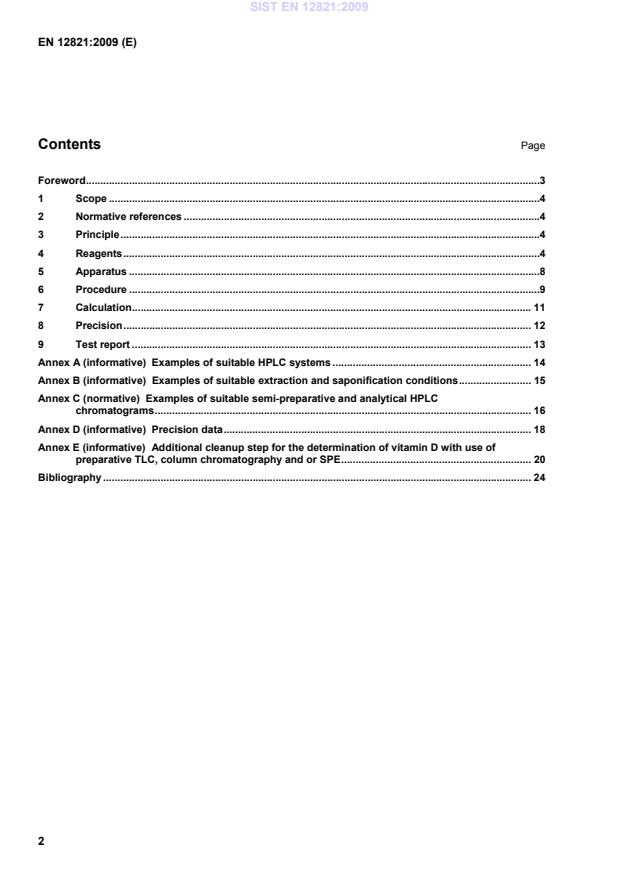
Examples of suitable HPLC systems . 14 Annex B (informative)
Examples of suitable extraction and saponification conditions . 15 Annex C (normative)
Examples of suitable semi-preparative and analytical HPLC chromatograms . 16 Annex D (informative)
Precision data . 18 Annex E (informative)
Additional cleanup step for the determination of vitamin D with use of preparative TLC, column chromatography and or SPE . 20 Bibliography . 24
4.9.2 Examples of solvent and solvent mixtures for reverse-phase analytical HPLC Examples of appropriate solvent and solvent mixtures (given as volume fractions) for reverse-phase analytical HPLC include: methanol; methanol and water (95 + 5) or (93 + 7); acetonitrile and methanol (80 + 20), (90 + 10) or (70 + 30); acetonitrile, chloroform and methanol (93 + 4 + 3).
= 18 843
m2/mol, calculated from the % 1cm 1E value, see [9]); b is the optical path length of the quartz cell in centimetres. 4.12.2 Vitamin D3 standard solution Pipette 1 ml of the vitamin D3 stock solution (4.11.2) into a one mark 100 ml volumetric flask and dilute to the mark with ethanol (4.4). This solution contains approximately 10 µg/ml of vitamin D3. Prepare this solution on the day of use. NOTE The mass concentration of the standard solution can be adjusted if necessary to suit the analytical requirements. Measure the absorption of the vitamin D3 standard solution in a 1 cm quartz cell at a wavelength of 265 nm using ethanol (4.4) in the reference path. Calculate the mass concentration of vitamin D3, D3, in microgram per millilitre of the standard solution using Equation (2): bMA×××=ερ1000D3265D3 (2) where: A265 is the absorption of the vitamin D3 standard solution at 265 nm; MD3 is the molar mass of vitamin D3 (MD3 = 384,6 g/mol); 0 is the molar absorption coefficient of vitamin D3 (here: 0
= 18 461
m2/mol, calculated from the % 1cm 1E value, see [9]); b is the optical path length of the quartz cell in centimetres. 4.13 Internal standard solutions 4.13.1 Vitamin D2 internal standard solution Pipette 10 ml of the vitamin D2 standard solution (4.12.1) into a one mark 100 ml volumetric flask and dilute to the mark with ethanol (4.4). Prepare this solution on the day of use. 4.13.2 Vitamin D3 internal standard solution Pipette 10 ml of the vitamin D3 standard solution (4.12.2) into a one mark 100 ml volumetric flask and dilute to the mark with ethanol (4.4). Prepare this solution on the day of use. NOTE If vitamin D3 is to be determined, then vitamin D2 is used as an internal standard. If vitamin D2 is to be determined, then vitamin D3 is used as an internal standard. SIST EN 12821:2009
NOTE Filtering of the mobile phase as well as of the sample test solution through a membrane filter prior to use or injection usually increases longevity of the columns. SIST EN 12821:2009
6.3 Preparation of the sample test solution 6.3.1 Saponification Saponify 10 g to 30 g of the test sample by refluxing, preferably under nitrogen, using suitable amounts of ethanol (4.4), water, an antioxidant (4.7) such as ascorbic acid, sodium ascorbate or pyrogallol and one of the potassium hydroxide solutions (4.6). Add the antioxidants to the sample prior to the addition of potassium hydroxide. Sodium sulfide (4.7) may also be added to obviate the oxidative catalytic effects of traces of metals. If vitamin D3 is to be determined, pipette an appropriate amount of vitamin D2 internal standard solution (4.13.1) into the saponification flask. The amount of vitamin D2 internal standard solution added shall be similar to the amount of vitamin D3 expected in the sample. If vitamin D2 is to be determined then vitamin D3 standard solution (4.13.2) shall be added as the internal standard. A sample that does not contain the internal standard should be taken through the analytical procedure to ensure that there is no sample matrix interference at the internal standard retention time. Examples of suitable ratios of reagents are given in Table 1. Table 1 — Examples of suitable ratios of reagents Sample Ethanol Pyrogallol Ascorbic acid /
Na ascorbate Potassium hydroxide 10 g to 30 g 100 ml 0,5 g to 1 g 1,0 g to 2,5 g 50 ml of a 50 g/100 ml solution
The usual time of saponification ranges from 20 min to 45 min with temperatures of 70 °C to 100 °C. Saponification may also be carried out at room temperature overnight (approximately 16 h) under otherwise same conditions. If after saponification and cooling, fat or oil is present on the surface of the saponification mixture, additional ethanolic potassium hydroxide has to be added and saponification time extended. NOTE Conditions found suitable for saponification of a margarine and a milk powder are shown in Annex B. SIST EN 12821:2009
HPLC system suitability Chromatograph a mixed vitamin D2 and D3 semi-preparative standard (4.14) on the semi-preparative HPLC system (5.6.1) until a single vitamin D peak is eluted with a reproducible retention time. Once achieved, this will allow precise band-cut collection of the vitamin D f
...