

SIST EN 16948:2017
(Main)Child protective products - Consumer fitted child resistant locking devices for cupboards and drawers - Safety requirements and test methods
General Information
- Abstract
This European Standard specifies requirements and test methods for locking devices fitted by consumers in a domestic environment for cupboards and drawers for restricting access by young children.
NOTE Child resistant locking devices only intended to be installed by professionals or that are an integral part of the cupboard and drawer system are beyond the scope of this standard.
- Status
- Published
- Public Enquiry End Date
- 01-Feb-2016
- Publication Date
- 13-Nov-2017
- Technical Committee
- OTR - Child use and care article
- Current Stage
- 6060 - National Implementation/Publication (Adopted Project)
- Start Date
- 30-Oct-2017
- Due Date
- 04-Jan-2018
- Completion Date
- 14-Nov-2017


Overview
EN 16948:2017 (CEN) is the European standard for consumer‑fitted child resistant locking devices for cupboards and drawers. It specifies safety requirements and test methods for locking devices that parents or household users install in a domestic environment to restrict access by young children. Devices intended only for professional installation or those that are integral to the cupboard/drawer system are outside the scope.
Key topics and technical requirements
- Child appeal: Devices must not be child‑appealing (no toy‑like shapes, entertainment effects, or attractive imagery).
- Child protective function: The locking mechanism must resist operation by young children. Acceptable designs include:
- single action that resists disengagement (tested per 5.5.2),
- two sequential actions where the second depends on the first (tested per 5.5.3),
- two simultaneous independent actions,
- use of a specifically designed removable tool (key/magnet),
- or compliance with the child panel test (see below).
- Child panel test (human‑subject test): If chosen, the full panel (200 children) requires at least 85% unable to disengage within the first 5 minutes and 80% unable after demonstration in the next 5 minutes. A sequential sampling option with statistical AQL/LQ parameters (AQL = 5%, LQ = 20%) is also described.
- Mechanical performance: Devices must retain mechanical function over their lifetime - durability, structural integrity and automatic re‑engagement where intended (see cyclic and structural tests 5.5.1, 5.5.4).
- Gap and entrapment: Maximum finger insertion gap when mounted must not exceed 30 mm for depths >10 mm (opening gap measurement 5.5.5).
- Small parts & sharp edges: Components that detach must not fit wholly into the small parts cylinder (5.5.6); accessible edges must be rounded/free of burrs.
- Information & marking: Point‑of‑sale information, user instructions (language of sale country), mounting guidance, and safety warnings are mandatory.
Practical applications and users
- Manufacturers and product designers developing consumer‑fitted cupboard/drawer locks
- Test laboratories performing compliance testing (child panel, mechanical, small parts)
- Retailers and procurement teams evaluating product safety and purchase information
- Regulatory bodies and consumer safety organizations assessing conformity in EU markets
- Installers and consumer educators who need to understand performance claims and instructions
Related standards
- EN 16948:2017 is a CEN standard and should be implemented as a national standard across EU member countries. Other EN standards for children’s products, toys or furniture safety may be relevant when assessing overall product compliance.
Keywords: EN 16948:2017, child protective products, child resistant locking devices, cupboards and drawers, safety requirements, test methods, child panel test, mechanical tests, small parts.
Frequently Asked Questions
SIST EN 16948:2017 is a standard published by the Slovenian Institute for Standardization (SIST). Its full title is "Child protective products - Consumer fitted child resistant locking devices for cupboards and drawers - Safety requirements and test methods". This standard covers: This European Standard specifies requirements and test methods for locking devices fitted by consumers in a domestic environment for cupboards and drawers for restricting access by young children. NOTE Child resistant locking devices only intended to be installed by professionals or that are an integral part of the cupboard and drawer system are beyond the scope of this standard.
This European Standard specifies requirements and test methods for locking devices fitted by consumers in a domestic environment for cupboards and drawers for restricting access by young children. NOTE Child resistant locking devices only intended to be installed by professionals or that are an integral part of the cupboard and drawer system are beyond the scope of this standard.
SIST EN 16948:2017 is classified under the following ICS (International Classification for Standards) categories: 97.140 - Furniture; 97.190 - Equipment for children. The ICS classification helps identify the subject area and facilitates finding related standards.
SIST EN 16948:2017 is available in PDF format for immediate download after purchase. The document can be added to your cart and obtained through the secure checkout process. Digital delivery ensures instant access to the complete standard document.
Standards Content (Sample)
2003-01.Slovenski inštitut za standardizacijo. Razmnoževanje celote ali delov tega standarda ni dovoljeno.Kindersicherheitsprodukte - Vom Verbraucher angebrachte kindergesicherte Sperrvorrichtungen für Schränke und Schubladen - Sicherheitsanforderungen und PrüfverfahrenArticles pour la sécurité des enfants - Dispositifs de fermeture à monter soi-même résistants aux enfants pour les armoires et les tiroirs - Exigences de sécurité et méthodes d'essaiChild protective products - Consumer fitted child resistant locking devices for cupboards and drawers - Safety requirements and test methods97.190Otroška opremaEquipment for children97.140PohištvoFurnitureICS:Ta slovenski standard je istoveten z:EN 16948:2017SIST EN 16948:2017en,fr,de01-december-2017SIST EN 16948:2017SLOVENSKI
STANDARD
EUROPEAN STANDARD NORME EUROPÉENNE EUROPÄISCHE NORM
EN 16948
July
t r s y ICS
{ yä s v r English Version
Child protective products æ Consumer fitted child resistant locking devices for cupboards and drawers æ Safety requirements and test methods Articles pour la sécurité des enfants æ Dispositifs de fermeture à monter soiæmême résistants aux enfants pour les armoires et les tiroirs æ Exigences de sécurité et méthodes d 5essai
Kindersicherheitsprodukte æ Vom Verbraucher angebrachte kindergesicherte Verriegelungsvorrichtungen für Schränke und Schubladen æ Sicherheitsanforderungen und Prüfverfahren This European Standard was approved by CEN on
s r April
t r s yä
egulations which stipulate the conditions for giving this European Standard the status of a national standard without any alterationä Upætoædate lists and bibliographical references concerning such national standards may be obtained on application to the CENæCENELEC Management Centre or to any CEN memberä
translation under the responsibility of a CEN member into its own language and notified to the CENæCENELEC Management Centre has the same status as the official versionsä
CEN members are the national standards bodies of Austriaá Belgiumá Bulgariaá Croatiaá Cyprusá Czech Republicá Denmarká Estoniaá Finlandá Former Yugoslav Republic of Macedoniaá Franceá Germanyá Greeceá Hungaryá Icelandá Irelandá Italyá Latviaá Lithuaniaá Luxembourgá Maltaá Netherlandsá Norwayá Polandá Portugalá Romaniaá Serbiaá Slovakiaá Sloveniaá Spainá Swedená Switzerlandá Turkey and United Kingdomä
EUROPEAN COMMITTEE FOR STANDARDIZATION COMITÉ EUROPÉEN DE NORMALISATION EUROPÄISCHES KOMITEE FÜR NORMUNG
CEN-CENELEC Management Centre:
Avenue Marnix 17,
B-1000 Brussels
t r s y CEN All rights of exploitation in any form and by any means reserved worldwide for CEN national Membersä Refä Noä EN
s x { v zã t r s y ESIST EN 16948:2017
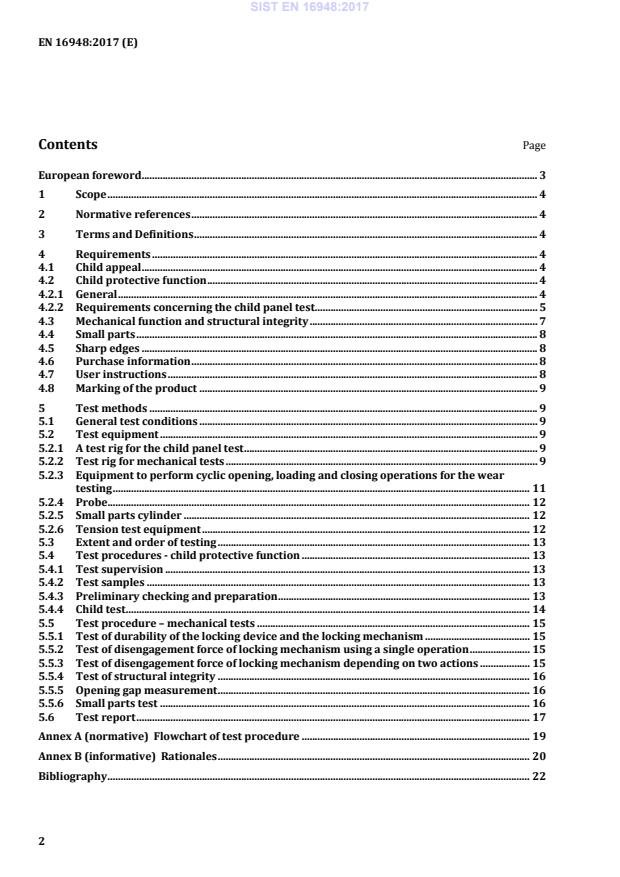
Flowchart of test procedure . 19 Annex B (informative)
Rationales . 20 Bibliography . 22
Key 1 number of locking mechanism not disengaged 4 limit line 2 2 number of locking mechanism disengaged 5 limit line 1 3 enlargement of chart scale
Acceptable quality limit (AQL) = 5 %; limiting quality (LQ): 20 %;
=
= 5 %, where
is the producer’s risk;
is the consumer’s risk. Figure 1 — Chart of a sequential child test procedure (before demonstration) for locking mechanism SIST EN 16948:2017
Key 1 number of locking mechanism not disengaged 3 limit line 2 2 number of locking mechanism disengaged 4 limit line 1 Acceptable quality limit (AQL) = 5 %; limiting quality (LQ): 20 %;
=
= 5 %, where
is the producer’s risk;
is the consumer’s risk. NOTE For an enlargement of the chart scale, see Figure 1. Figure 2 — Chart of a sequential child test procedure (after demonstration) for locking mechanism 4.2.2.4 Full test If a sequential procedure is not used and the full number of children is tested, the results shall be assessed in accordance with the requirements laid down in 4.2.2.2. 4.2.2.5 Additional information to be recorded Any other information deemed to be useful in assessing the interpretation of the result, such as the time required for children to disengage the locking mechanism and, where appropriate, to engage it properly, the method used by children to disengage it, etc. shall be recorded. 4.3 Mechanical function and structural integrity The locking device shall maintain its mechanical properties throughout its expected lifetime. The manufacturer shall indicate the type(s) of cupboards and drawers including the materials (e.g. glass, aluminium, PVC, wood) for which the locking device is or is not suitable. In particular, if fixings (e.g. screws) are provided with the locking device, the manufacturer shall ensure that they are suitable for the recommended material(s). If fixings are not provided, there shall be clear guidance on the type of fixings to be used with the device (see 4.6). When tested according to 5.5.1 and 5.5.4, none of the tested items or any part of the items shall be broken or have any visible cracks or permanent deformation or disengage. All devices shall be fully functional during and after the tests. For devices that are intended to re-engage automatically the automatic re-engagement function shall still operate after completion of the tests. For all locking devices when the product is mounted in accordance with the manufacturer's instructions, the maximum gap into which a child could insert its fingers shall not exceed 30 mm for a depth of more than 10 mm when tested in accordance with 5.5.5. SIST EN 16948:2017
...