

SIST EN 17191:2021
(Main)Children’s Furniture - Seating for children - Safety requirements and test methods
General Information
- Abstract
This document specifies safety requirements and test methods for seating specifically intended for children who are able to walk and sit by themselves.
It applies to seating intended to be placed on the floor for domestic and non-domestic use including in day care centres and for indoor and outdoor use.
NOTE 1 Seating includes but is not limited to chairs, benches, stools, bean bags, deckchairs, rocking chairs, reclining chairs, armchairs, foldable chairs and swivel chairs.
It applies to the seating function only. If the seating has additional functions or can be converted into other products, the relevant European Standards could, in addition, apply. (See B.2).
It does not apply to children's highchairs, childcare articles such as reclined cradles and seating in educational institutions for which other European Standards exist.
NOTE 2 Seating in educational institutions are covered by the European Standards EN 1729-1 and EN 1729-2.
It does not apply to swing chairs, wheelchairs, electrical safety or seating for children with special needs.
The document contains 4 annexes as follows:
- Annex A (informative) - Dimensional guidance for designing seating for children;
- Annex B (informative) - Rationale for the inclusion of the safety requirements;
- Annex C (informative) - Guidance for applicable tests according to seating size;
- Annex ZA (informative) - Relationship between this European Standard and the safety requirements of Directive 2001/95/EC aimed to be covered.
- Status
- Published
- Public Enquiry End Date
- 10-Sep-2019
- Publication Date
- 17-Aug-2021
- Technical Committee
- POH - Furniture
- Current Stage
- 6060 - National Implementation/Publication (Adopted Project)
- Start Date
- 02-Aug-2021
- Due Date
- 07-Oct-2021
- Completion Date
- 18-Aug-2021
- Directive
- 2001/95/EC - General product safetyOJ Ref: 13.9.2024, 2024/2406, L, OJ, OJ L OJ Date: 13-Sep-2024

Overview
EN 17191:2021 - published by CEN - defines safety requirements and test methods for children’s seating intended for children who can walk and sit independently. The standard covers seating placed on the floor for both domestic and non‑domestic use (including day care centres) and for indoor and outdoor use. It addresses the seating function only and is intended to ensure safer design, manufacture and testing of chairs, stools, benches, bean bags, deckchairs, rocking and reclining chairs, armchairs, foldable and swivel chairs for children.
Key topics and technical requirements
The standard specifies a comprehensive set of safety and test topics, including:
- General requirements and test conditions for sample preparation and application of forces.
- Entrapment and entanglement hazards - test probes, V‑shaped and irregular opening templates, and checks for finger entrapment.
- Small parts, choking and ingestion - use of small parts cylinder and tests for removable/fill material hazards.
- Strength, durability and stability - load points, seating/back loading tests, fatigue and stability tests (including special considerations for rocking/reclining chairs).
- Hazards from moving or folding parts - locking mechanisms and shearing/compression risk assessments.
- Surface, edge and corner safety; hazards from glass and thermal/fire risks.
- Chemical requirements for materials and flammability/thermal guidance.
- Product information, marking and instructions - durable markings, purchase information and user warnings.
- Test equipment guidance - descriptions of common test probes, feeler gauges and test masses.
- Informative annexes: Annex A (dimensional guidance), Annex B (rationale for requirements), Annex C (guidance for tests by seating size) and Annex ZA (relationship to Directive 2001/95/EC).
Practical applications and who uses it
EN 17191:2021 is essential for:
- Manufacturers and product designers creating children’s seating to meet EU safety expectations.
- Test laboratories and conformity assessors performing standardized safety and durability tests.
- Importers, retailers and procurement teams ensuring products comply with European market requirements.
- Childcare providers and facility managers specifying safe seating for day care centres and public spaces.
- Regulators and standards bodies referencing a harmonized framework for child seating safety.
Using EN 17191 helps reduce hazards (entrapment, choking, collapse), supports compliance with EU market safety rules, and guides design choices (dimensions, materials, locking mechanisms) that improve real‑world safety and usability.
Related standards
- EN 1729‑1 and EN 1729‑2 - seating and tables for educational institutions (not covered by EN 17191).
- Refer to Annex ZA for the relationship between EN 17191 and Directive 2001/95/EC (general product safety).
Relations
- Effective Date
- 28-Jan-2026
- Effective Date
- 28-Jan-2026
- Effective Date
- 28-Jan-2026
- Effective Date
- 28-Jan-2026
- Effective Date
- 28-Jan-2026
- Effective Date
- 28-Jan-2026
- Effective Date
- 28-Jan-2026
- Effective Date
- 28-Jan-2026
- Effective Date
- 28-Jan-2026
Frequently Asked Questions
SIST EN 17191:2021 is a standard published by the Slovenian Institute for Standardization (SIST). Its full title is "Children’s Furniture - Seating for children - Safety requirements and test methods". This standard covers: This document specifies safety requirements and test methods for seating specifically intended for children who are able to walk and sit by themselves. It applies to seating intended to be placed on the floor for domestic and non-domestic use including in day care centres and for indoor and outdoor use. NOTE 1 Seating includes but is not limited to chairs, benches, stools, bean bags, deckchairs, rocking chairs, reclining chairs, armchairs, foldable chairs and swivel chairs. It applies to the seating function only. If the seating has additional functions or can be converted into other products, the relevant European Standards could, in addition, apply. (See B.2). It does not apply to children's highchairs, childcare articles such as reclined cradles and seating in educational institutions for which other European Standards exist. NOTE 2 Seating in educational institutions are covered by the European Standards EN 1729-1 and EN 1729-2. It does not apply to swing chairs, wheelchairs, electrical safety or seating for children with special needs. The document contains 4 annexes as follows: - Annex A (informative) - Dimensional guidance for designing seating for children; - Annex B (informative) - Rationale for the inclusion of the safety requirements; - Annex C (informative) - Guidance for applicable tests according to seating size; - Annex ZA (informative) - Relationship between this European Standard and the safety requirements of Directive 2001/95/EC aimed to be covered.
This document specifies safety requirements and test methods for seating specifically intended for children who are able to walk and sit by themselves. It applies to seating intended to be placed on the floor for domestic and non-domestic use including in day care centres and for indoor and outdoor use. NOTE 1 Seating includes but is not limited to chairs, benches, stools, bean bags, deckchairs, rocking chairs, reclining chairs, armchairs, foldable chairs and swivel chairs. It applies to the seating function only. If the seating has additional functions or can be converted into other products, the relevant European Standards could, in addition, apply. (See B.2). It does not apply to children's highchairs, childcare articles such as reclined cradles and seating in educational institutions for which other European Standards exist. NOTE 2 Seating in educational institutions are covered by the European Standards EN 1729-1 and EN 1729-2. It does not apply to swing chairs, wheelchairs, electrical safety or seating for children with special needs. The document contains 4 annexes as follows: - Annex A (informative) - Dimensional guidance for designing seating for children; - Annex B (informative) - Rationale for the inclusion of the safety requirements; - Annex C (informative) - Guidance for applicable tests according to seating size; - Annex ZA (informative) - Relationship between this European Standard and the safety requirements of Directive 2001/95/EC aimed to be covered.
SIST EN 17191:2021 is classified under the following ICS (International Classification for Standards) categories: 97.140 - Furniture; 97.190 - Equipment for children. The ICS classification helps identify the subject area and facilitates finding related standards.
SIST EN 17191:2021 has the following relationships with other standards: It is inter standard links to SIST EN 71-3:2019+A1:2021, SIST EN 14988:2017+A1:2020, SIST EN 1728:2012, SIST EN 1022:2019, SIST EN ISO 13936-2:2004, SIST EN 71-2:2021, SIST EN 71-1:2015+A1:2018, SIST EN 1729-2:2012+A1:2016, SIST EN 1729-2:2023. Understanding these relationships helps ensure you are using the most current and applicable version of the standard.
SIST EN 17191:2021 is associated with the following European legislation: EU Directives/Regulations: 2001/95/EC; Standardization Mandates: M/527. When a standard is cited in the Official Journal of the European Union, products manufactured in conformity with it benefit from a presumption of conformity with the essential requirements of the corresponding EU directive or regulation.
SIST EN 17191:2021 is available in PDF format for immediate download after purchase. The document can be added to your cart and obtained through the secure checkout process. Digital delivery ensures instant access to the complete standard document.
Standards Content (Sample)
SLOVENSKI STANDARD
01-september-2021
Pohištvo za otroke - Sedežno pohištvo - Varnostne zahteve in preskusne metode
Children’s Furniture - Seating for children - Safety requirements and test methods
Kindermöbel - Kindersitzmöbel - Sicherheitstechnische Anforderungen und Prüfverfahren
Mobilier de puériculture et pour enfants - Sièges pour enfants - Exigences de sécurité et
méthodes d'essai
Ta slovenski standard je istoveten z: EN 17191:2021
ICS:
97.140 Pohištvo Furniture
97.190 Otroška oprema Equipment for children
2003-01.Slovenski inštitut za standardizacijo. Razmnoževanje celote ali delov tega standarda ni dovoljeno.
EN 17191
EUROPEAN STANDARD
NORME EUROPÉENNE
July 2021
EUROPÄISCHE NORM
ICS 97.140; 97.190
English Version
Children's Furniture - Seating for children - Safety
requirements and test methods
Mobilier de puériculture et pour enfants - Sièges pour Kindermöbel - Kindersitzmöbel - Sicherheitstechnische
enfants - Exigences de sécurité et méthodes d'essai Anforderungen und Prüfverfahren
This European Standard was approved by CEN on 30 May 2021.
CEN members are bound to comply with the CEN/CENELEC Internal Regulations which stipulate the conditions for giving this
European Standard the status of a national standard without any alteration. Up-to-date lists and bibliographical references
concerning such national standards may be obtained on application to the CEN-CENELEC Management Centre or to any CEN
member.
This European Standard exists in three official versions (English, French, German). A version in any other language made by
translation under the responsibility of a CEN member into its own language and notified to the CEN-CENELEC Management
Centre has the same status as the official versions.
CEN members are the national standards bodies of Austria, Belgium, Bulgaria, Croatia, Cyprus, Czech Republic, Denmark, Estonia,
Finland, France, Germany, Greece, Hungary, Iceland, Ireland, Italy, Latvia, Lithuania, Luxembourg, Malta, Netherlands, Norway,
Poland, Portugal, Republic of North Macedonia, Romania, Serbia, Slovakia, Slovenia, Spain, Sweden, Switzerland, Turkey and
United Kingdom.
EUROPEAN COMMITTEE FOR STANDARDIZATION
COMITÉ EUROPÉEN DE NORMALISATION
EUROPÄISCHES KOMITEE FÜR NORMUNG
CEN-CENELEC Management Centre: Rue de la Science 23, B-1040 Brussels
© 2021 CEN All rights of exploitation in any form and by any means reserved Ref. No. EN 17191:2021 E
worldwide for CEN national Members.
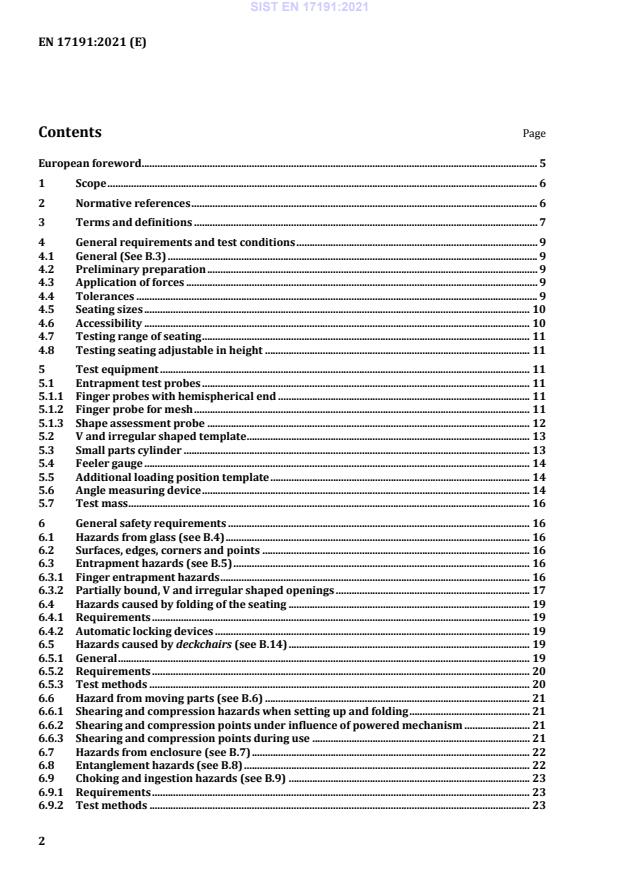
Contents Page
European foreword . 5
1 Scope . 6
2 Normative references . 6
3 Terms and definitions . 7
4 General requirements and test conditions . 9
4.1 General (See B.3) . 9
4.2 Preliminary preparation . 9
4.3 Application of forces . 9
4.4 Tolerances . 9
4.5 Seating sizes . 10
4.6 Accessibility . 10
4.7 Testing range of seating . 11
4.8 Testing seating adjustable in height . 11
5 Test equipment . 11
5.1 Entrapment test probes . 11
5.1.1 Finger probes with hemispherical end . 11
5.1.2 Finger probe for mesh . 11
5.1.3 Shape assessment probe . 12
5.2 V and irregular shaped template . 13
5.3 Small parts cylinder . 13
5.4 Feeler gauge . 14
5.5 Additional loading position template . 14
5.6 Angle measuring device . 14
5.7 Test mass . 16
6 General safety requirements . 16
6.1 Hazards from glass (see B.4) . 16
6.2 Surfaces, edges, corners and points . 16
6.3 Entrapment hazards (see B.5) . 16
6.3.1 Finger entrapment hazards . 16
6.3.2 Partially bound, V and irregular shaped openings . 17
6.4 Hazards caused by folding of the seating . 19
6.4.1 Requirements . 19
6.4.2 Automatic locking devices . 19
6.5 Hazards caused by deckchairs (see B.14) . 19
6.5.1 General . 19
6.5.2 Requirements . 20
6.5.3 Test methods . 20
6.6 Hazard from moving parts (see B.6) . 21
6.6.1 Shearing and compression hazards when setting up and folding . 21
6.6.2 Shearing and compression points under influence of powered mechanism . 21
6.6.3 Shearing and compression points during use . 21
6.7 Hazards from enclosure (see B.7) . 22
6.8 Entanglement hazards (see B.8) . 22
6.9 Choking and ingestion hazards (see B.9) . 23
6.9.1 Requirements . 23
6.9.2 Test methods . 23
6.9.3 Filling material . 24
6.9.4 Magnets . 26
6.10 Suffocation hazards (see B.10) . 26
7 Chemicals requirements (see B.11) . 27
8 Fire and thermal hazards (see B.12) . 27
9 Strength and durability requirements (see B.13) . 27
9.1 Test conditions . 27
9.1.1 Seat and back loading point . 27
9.1.2 Determination of the backrest angle (see B.15) . 28
9.1.3 Determination of the number of seats . 29
9.2 Seating size and test levels . 29
9.3 Requirements . 29
9.4 Strength and durability tests . 30
9.4.1 General . 30
9.4.2 Soft seating . 30
9.4.3 Seating intended for very young children only (see B.16) . 30
10 Stability requirements . 31
10.1 General . 31
10.2 Alternative rearwards stability tests for rocking and reclining chairs . 32
10.2.1 Rocking chairs. 32
10.2.2 Reclining chairs . 32
10.2.3 Summary . 33
11 Product information . 33
11.1 General . 33
11.2 Marking . 33
11.2.1 Requirements . 33
11.2.2 Durability of marking . 33
11.3 Purchase information . 34
11.4 Instructions for use . 34
11.4.1 General . 34
11.4.2 Warnings . 34
11.4.3 Additional information . 34
Annex A (informative) Dimensional guidance for designing seating for children . 35
Annex B (informative) Rationale for the inclusion of the safety requirements . 37
B.1 Introduction. 37
B.2 General (see Clause 1) . 37
B.3 Elevated seating for very young children (see 4.1) . 37
B.4 Hazards from glass (see 6.1) . 37
B.5 Entrapment hazards (see 6.3) . 38
B.6 Hazards from moving parts (see 6.6) . 38
B.7 Hazards from enclosure (see 6.7) . 38
B.8 Entanglements hazards (see 6.8) . 39
B.9 Choking and ingestion hazards (see 6.9) . 39
B.10 Suffocation hazards (see 6.10) . 39
B.11 Chemical hazards (see Clause 7) . 39
B.12 Fire and thermal hazards (see Clause 8) . 39
B.13 Strength and durability hazards (see Clause 9) . 39
B.14 Hazards due to unintentional folding (see 6.4 and 6.5) . 40
B.15 Determination of the backrest angle (see 9.1.2) . 40
B.16 Seating intended to be used by young children only (see 9.4.3) . 40
Annex C (informative) Guidance for applicable tests according to seating size . 41
Annex ZA (informative) Relationship between this European Standard and the safety
requirements of Directive 2001/95/EC aimed to be covered . 42
Bibliography . 49
European foreword
This document (EN 17191:2021) has been prepared by Technical Committee CEN/TC 207 “Furniture”,
the secretariat of which is held by UNI.
This European Standard shall be given the status of a national standard, either by publication of an
identical text or by endorsement, at the latest by January 2022, and conflicting national standards shall
be withdrawn at the latest by January 2022.
Attention is drawn to the possibility that some of the elements of this document may be the subject of
patent rights. CEN shall not be held responsible for identifying any or all such patent rights.
This document has been prepared under a standardization request given to CEN by the European
Commission and the European Free Trade Association and supports essential requirements of EU
Directive 2001/95/CE.
For relationship with EU Directive 2001/95/CE, see informative Annex ZA, which is an integral part of
this document.
Any feedback and questions on this document should be directed to the users’ national standards body.
A complete listing of these bodies can be found on the CEN website.
According to the CEN-CENELEC Internal Regulations, the national standards organisations of the
following countries are bound to implement this European Standard: Austria, Belgium, Bulgaria, Croatia,
Cyprus, Czech Republic, Denmark, Estonia, Finland, France, Germany, Greece, Hungary, Iceland, Ireland,
Italy, Latvia, Lithuania, Luxembourg, Malta, Netherlands, Norway, Poland, Portugal, Republic of North
Macedonia, Romania, Serbia, Slovakia, Slovenia, Spain, Sweden, Switzerland, Turkey and the United
Kingdom.
1 Scope
This document specifies safety requirements and test methods for seating specifically intended for
children who are able to walk and sit by themselves.
It applies to seating intended to be placed on the floor for domestic and non-domestic use including in
day care centres and for indoor and outdoor use.
NOTE 1 Seating includes but is not limited to chairs, benches, stools, bean bags, deckchairs, rocking chairs,
reclining chairs, armchairs, foldable chairs and swivel chairs.
It applies to the seating function only. If the seating has additional functions or can be converted into
other products, the relevant European Standards could, in addition, apply. (See B.2).
It does not apply to children's highchairs, childcare articles such as reclined cradles and seating in
educational institutions for which other European Standards exist.
NOTE 2 Seating in educational institutions are covered by the European Standards EN 1729-1 and EN 1729-2.
It does not apply to swing chairs, wheelchairs, electrical safety or seating for children with special needs.
The document contains 4 annexes as follows:
— Annex A (informative) - Dimensional guidance for designing seating for children;
— Annex B (informative) - Rationale for the inclusion of the safety requirements;
— Annex C (informative) - Guidance for applicable tests according to seating size;
— Annex ZA (informative) - Relationship between this European Standard and the safety requirements
of Directive 2001/95/EC aimed to be covered.
2 Normative references
The following documents are referred to in the text in such a way that some or all of their content
constitutes requirements of this document. For dated references, only the edition cited applies. For
undated references, the latest edition of the referenced document (including any amendments) applies.
EN 71-1:2014+A1:2018, Safety of toys - Part 1: Mechanical and physical properties
EN 71-2:2020, Safety of toys - Part 2: Flammability
EN 71-3:2019+A1:2021, Safety of toys - Part 3: Migration of certain elements
EN 1022:2018, Furniture - Seating - Determination of stability
EN 1728:2012, Furniture - Seating - Test methods for the determination of strength and durability
EN 1729-2:2012+A1:2015, Furniture - Chairs and tables for educational institutions - Part 2: Safety
requirements and test methods
EN 14988:2017+A1:2020, Children's high chairs - Requirements and test methods
As impacted by EN 1728:2012/AC:2013.
EN ISO 13936-2:2004, Textiles - Determination of the slippage resistance of yarns at a seam in woven
fabrics - Part 2: Fixed load method (ISO 13936-2:2004)
3 Terms and definitions
For the purposes of this document, the following terms and definitions apply.
ISO and IEC maintain terminological databases for use in standardization at the following addresses:
— IEC Electropedia: available at https://www.electropedia.org/;
— ISO Online browsing platform: available at https://www.iso.org/obp.
3.1
median plane
vertical plane running from front to rear through the centre of the seat, dividing the seating into two parts
Note 1 to entry: In most instances the two parts are symmetrical.
Note 2 to entry: See Figure 1.
Key
1 Median plane
Figure 1 — Median plane
3.2
seat height
vertical distance in the median plane between the floor, or the highest point of the footrest in case of tall
chairs, and the highest point on the front of the seat
Note 1 to entry: See 4.5.
3.3
tall chair
chair where the height of seat from the floor is higher than the seat height specified in the size mark and
with a footrest
Note 1 to entry: See 4.5 and Figure 2.
Note 2 to entry: Size marks are specified in Table A.1.
3.4
deckchair
foldable seating that can be set to one or more positions by means of a locking system at the transverse
bar and which has a suspended, flexible seat/back
Note 1 to entry: Figure 13 shows an example of a typical locking mechanism of a deckchair.
Note 2 to entry: Refer to B.14.
3.5
locking device
component that maintains part(s) of the product in the position of use
EXAMPLES Latch, hook, over-centre lock.
[SOURCE: EN 14988:2017+A1:2020, 3.6]
3.6
locking mechanism
assembly consisting of one or more locking device(s) and one or more operating device(s)
[SOURCE: EN 14988:2017+A1:2020, 3.9]
3.7
automatic locking device
mechanism which engages without the guidance of the user
3.8
operating device
part of the locking mechanism(s) designed to be activated by the carer by one or more action(s)
[SOURCE: EN 14988:2017+A1:2020, 3.7]
3.9
soft seating
seating with no internal support or frame, composed of a fabric, vinyl, leather or similar cover, over a soft
filling (such as foam, air, or polystyrene beads)
Note 1 to entry: Bean bags, and inflatable and foam seating are considered to be soft seating.
3.10
surface flash
rapid spread of flame over the surface of a material without ignition of its base structure at the same time
3.11
seat width
horizontal distance between vertical lines through the side edges of the seat surface at a distance equal
to half of the seat depth (t )
Note 1 to entry: See Figure A.2.
4 General requirements and test conditions
4.1 General (See B.3)
Size 1 seating as specified in 4.5 that allows a child to be elevated to the height of a dining table shall also
fulfil the requirements of EN 14988:2017+A1:2020 or shall be clearly sold as not intended for children
less than 3 years old.
NOTE Words in italics in Clause 4 are defined in Clause 3 (Terms and definitions).
4.2 Preliminary preparation
The seating shall be tested as delivered. Knock-down – ready to assemble / flat pack seating shall be
assembled according to the manufacturer’s instructions. If the instructions allow the seating to be
assembled or combined in different configurations, the most adverse combination shall be used for each
test. Knock-down fittings shall be tightened before testing. Further tightening shall not take place unless
specifically required by the manufacturer. If the configuration has to be changed to produce the worst-
case conditions, this shall be recorded in the test report.
Unless otherwise specified by the manufacturer, the sample for test shall be stored in indoor ambient
conditions for at least 24 h immediately prior to testing.
The tests shall be carried out at indoor ambient conditions.
Before beginning the testing, visually inspect the unit thoroughly. Record any defects so that they are not
assumed to have been caused by the tests.
4.3 Application of forces
The test forces in durability and static load tests (9.4) shall be applied sufficiently slowly to ensure that
negligible dynamic load is applied. The forces in durability tests shall be applied sufficiently slowly to
ensure that kinetic heating does not occur.
Unless otherwise stated:
— static forces shall be maintained for (10 ± 2) s;
— durability forces shall be maintained for (2 ± 1) s.
The forces may be replaced by masses. The relationship 10 N = 1 kg shall be used.
4.4 Tolerances
Unless otherwise stated, the following tolerances are applicable to the test equipment:
— Forces: ± 5 % of the nominal force;
— Velocities: ± 5 % of the nominal velocity;
— Masses: ± 1 % of the nominal mass;
— Dimensions: ± 1 mm of the nominal dimension;
— Angles: ± 2° of the nominal angle.
The accuracy for the positioning of loading pads and impact plates shall be ± 5 mm.
NOTE For the purposes of uncertainty measurement, test results are not considered to be adversely affected
when the above tolerances are met.
4.5 Seating sizes
The seating shall be tested with reference to the seat height (3.2), see Table 1.
Dimensions in millimetres
Table 1 — Seating sizes
Size Size 1 seating Size 2 seating Size 3 seating
Seat height (H) H ≤ 270 270 < H ≤ 360 H > 360
NOTE Annex A includes dimensional guidance for designing seating for children.
Seat height is measured according to 3.2 and Figure 2.
a) Seat height for tall chairs b) Seat height for all other seating
Key
H Seat height
1 The footrest
Figure 2 — Seat height
The seat height shall be measured with the seat (and footrest if any) unloaded.For seating where it is not
possible to determine a size (e.g. bean bags), it shall be tested as size 1 seating for all tests, except the
strength and durability tests (according to 9.4) for which it shall be tested as size 3 seating.
4.6 Accessibility
For the purpose of this document, all parts of the fully assembled seating are considered accessible to the
child.
4.7 Testing range of seating
If seating in a range of sizes is manufactured with identical construction details, it is only necessary to
carry out the complete strength, durability and stability tests on the largest size in the range, plus
additional stability tests on the smallest size in the range. In the event of failure of any seating in the above
test programme, the complete test programme shall be carried out on each seating size mark individually.
4.8 Testing seating adjustable in height
If the height of the seating can be adjusted, it is necessary to carry out the complete strength, durability
and stability tests with the seating in its highest position, plus additional stability tests with the seating
in its lowest position.
5 Test equipment
5.1 Entrapment test probes
5.1.1 Finger probes with hemispherical end
Probes with hemispherical ends made of plastics or other hard, smooth material, mounted on a force-
measuring device, see Figure 3.
Dimensions in millimetres
Key
1 hemispherical end
2 Line around circumference
3 +0 +01, +01, +01,
Ø 7 mm and 12 mm, 18 mm and 25 mm
−01, 0 0 0
Figure 3 — Finger probe with hemispherical end
5.1.2 Finger probe for mesh
+0
A probe with a diameter of 7 mm, mounted on a force-measuring device, with the end as specified in
−01,
Figure 4, made of plastics or other hard, smooth material. The end radius shall be (2,8 ± 0,2) mm.
Dimensions in millimetres
Figure 4 — Finger probe for mesh
5.1.3 Shape assessment probe
Probe made of plastics or other hard, smooth material with the dimensions shown in Figure 5.
Dimensions in millimetres
Key
A side view
B top view
C face view
D isometric view
Figure 5 — Shape assessment probe
5.2 V and irregular shaped template
Template made from plastics or other hard, smooth material with the dimensions given in Figure 6.
Dimensions in millimetres
Key
1 B portion
2 A portion
Figure 6 — V and irregular shaped template
5.3 Small parts cylinder
Cylinder having the dimensions as shown in Figure 7.
Dimensions in millimetres
Figure 7 — Small parts cylinder
5.4 Feeler gauge
Feeler gauge with a thickness of (0,4 ± 0,02) mm and an insertion edge radius of approximately 3 mm,
(see Figure 8).
Dimensions in millimetres
Figure 8 — Feeler gauge
5.5 Additional loading position template
In derogation to EN 1728:2012 and EN 1022:2018, the loading position template for seating-where the
seat and back are made of one suspended or hanging piece of flexible material (e.g. textile) shall be a
cylinder with a mass of (1 ± 0,5) kg and a diameter of (70 ± 10) mm.
5.6 Angle measuring device
An articulated steel device used to measure the angle between the seat and the backrest (see Figure 9)
with a total mass of (9 ± 0,1) kg and tolerance on dimensions of ± 2 mm.
All edges shall be chamfered.
Dimensions in millimetres
Key
1 Part to be placed onto the seat surface
2 Part to be placed onto the backrest
3 Hinge pin
D Diameter: 6 mm
E Mass: (4,495 ± 0,05) kg
F Mass: (4,501 ± 0,05) kg
G Mass of hinge axle: (17 ± 0,5) g, length 79,5 mm
Figure 9 — Angle measuring device
5.7 Test mass
A rigid cylinder (200 ± 5) mm in diameter and (300 ± 5) mm in height, having a mass of (15 + 0, 1/-0) kg
and with its centre of gravity in the centre of the cylinder. All edges shall have a radius of (5 ± 1) mm.
6 General safety requirements
6.1 Hazards from glass (see B.4)
There shall be no glass in seating for children.
6.2 Surfaces, edges, corners and points
All parts shall be designed so that physical injury and damage are avoided. This requirement is fulfilled
when:
— the edges of the seat, back rest and arm rests, which are in contact with the child when sitting in the
seating, are rounded or chamfered;
— the edges of handles are rounded in the direction of the force applied;
— all other accessible edges and corners are smooth, rounded or chamfered and with no burrs;
— there is no pointed or protruding surface that constitutes a puncture hazard;
— rough surfaces shall not cause injury during use.
6.3 Entrapment hazards (see B.5)
6.3.1 Finger entrapment hazards
6.3.1.1 Requirements
When tested in accordance with 6.3.1.2, there shall be no completely bound openings in rigid materials
that let the 7 mm probe (see 5.1.1) enter unless the depth of penetration is less than 10 mm or unless the
shape assessment probe (see 5.1.3) enters.
When measured in accordance with 6.3.1.2, it shall not be possible for the 7 mm finger probe for mesh
(see 5.1.2) to penetrate the holes of the mesh to the 7 mm diameter section.
6.3.1.2 Test method
Check whether the 7 mm probe (see 5.1.1) with an applied force of up to 30 N in any possible direction
can enter 10 mm or more into any opening. If the 7 mm probe enters 10 mm or more then the shape
assessment probe (5.1.3) shall also enter 10 mm or more with an applied force of up to 5 N.
Check whether the finger probe for mesh (see 5.1.2), penetrates holes in the mesh to the 7 mm diameter
section with an applied force of up to 30 N.
6.3.2 Partially bound, V and irregular shaped openings
6.3.2.1 Requirements
The following requirements apply to size 1 seating only.
Partially bound and V shaped openings with a lower edge ≥ 600 mm above the ground shall be
constructed so that, when tested in accordance with 6.3.2.2, either:
a) portion B of the V and irregular shaped openings template (5.2) does not enter the opening; or
b) the apex of portion A of the V and irregular shaped openings template (5.2) makes contact with the
base of the opening.
6.3.2.2 Test method
Position the ‘B’ portion of the template (see 5.2) between and perpendicular to the boundaries of the
opening, as shown in Figure 10 or Figure 11 as appropriate. If the full thickness of the template cannot
be inserted, there is no hazard.
If the template (see 5.2) can be inserted to a depth greater than the thickness of the template (45 mm),
apply the ‘A’ portion of the template, so that its centre line is in line with the centre line of the opening.
Ensure that the plane of the template is parallel and applied in line with the opening, as shown in
Figure 12. Insert the template along the centre line of the opening until its motion is restricted by contact
with the boundaries of the opening. If the template touches the bottom of the opening, there is no hazard.
Key
1 is not a hazard
2 is not a hazard
3 is a hazard
4 is a hazard
Figure 10 — Method of insertion of Portion B in a V shaped opening
Key
1 is not a hazard
2 is a hazard
Figure 11 — Method of insertion of Portion B in a small opening
Key
1 is not a hazard
2 is a hazard
Figure 12 — Method of insertion of Portion A
6.4 Hazards caused by folding of the seating
6.4.1 Requirements
6.4.1.1 General
The requirements in 6.4.1.2 and 6.4.1.3 do not apply to deckchairs (see 3.4).
There shall be at least one locking mechanism (see 3.6), which prevents a foldable seating from folding
when in use.
6.4.1.2 Incomplete deployment during the setting up
In order to prevent hazards due to incomplete deployment, the foldable seating shall fulfil one of the
following requirements:
a) the weight of the child in the foldable seating shall act to prevent folding; or
b) at least one locking device (3.5) shall engage automatically when the foldable seating is ready for use.
6.4.1.3 Unintentional folding of the seating
Unintentional folding of the foldable seating shall be prevented. This requirement is fulfilled if one of the
following conditions is met:
a) at least one operating device (see 3.8) requires a minimum force of 50 N to activate and a maximum
force of 300 N, before and after all locking mechanisms (see 3.6) have been operated 300 times; or
b) folding is only possible if at least one locking mechanism (see 3.6) requires the use of a tool; or
c) folding is only possible when two independent operating devices (see 3.8) are operated
simultaneously; or
d) there are two or more automatic locking devices (see 3.7) that cannot both be released by one single
action; or
e) folding of the foldable seating requires two consecutive actions, the first of which shall be maintained
while the second is carried out.
6.4.2 Automatic locking devices
6.4.2.1 Requirement
When tested in accordance with 6.4.2.2 automatic locking devices (see 3.7) shall not release or open.
6.4.2.2 Test method for automatic locking device
With all manual locking devices (see 3.5) disengaged, apply a force of 200 N to any part of the seating
except the operating device (see 3.8).
Apply the force in the direction most likely to cause the locking device to release.
6.5 Hazards caused by deckchairs (see B.14)
6.5.1 General
All deckchairs (see 3.4 and Figure 13), regardless of size, shall be fitted with a locking device (see 3.5) that
fulfils the requirements of 6.5.2.
Key
1 Locking position
2 Transverse bar
Figure 13 — Example of a locking mechanism of a deckchair
6.5.2 Requirements
During the tests, the transverse bar is allowed to disengage from its initial locking position.
At the end of each test (not only those specified in 6.5.3):
— the transverse bar shall be correctly engaged in any locking position;
— if during testing according to 6.5.3.1 the deckchair lifts without disengagement of the transverse bar
from its locked position before the 450N force is reached the requirement is considered as to be met;
— there shall be no fracture of any component or any joint;
— there shall be no loosening of any assembly intended to be rigid;
— there shall be no loss of function of the seating or any component.
6.5.3 Test methods
6.5.3.1 Disengagement tests under vertical and horizontal forces
6.5.3.1.1 General
The following tests shall be repeated in all positions of use:
— place the seating on the floor in a normal position of use. Prevent the seating from movement by
placing stops (see EN 1728:2012 , 5.3) against the front legs;
— the transverse bar shall be set correctly in its locking positions;
— load the seating with 3 loading discs as specified in EN 1022:2018, 5.7, the first disk at the loading
point and the remaining disks resting against the backrest.
If it is not possible to use the test discs specified in EN 1022:2018, they may be substituted with discs
with a smaller diameter but with the same mass and height.
6.5.3.1.2 Under an upwards vertical static force
Apply an upwards vertical force at the middle of the top of the frame until the seating starts to lift.
The maximum force shall be 450 N.
If the deckchair lifts and the transverse bar is disengaged before a 450N force is reached, the test shall be
continued until the distance between the transverse bar and its initial locking position is (200 ± 50) mm.
The force shall be released.
6.5.3.1.3 Under a horizontal static force
Apply a horizontal force at the middle of the top of the frame from the rear to the front until the seating
starts to lift.
The maximum force shall be 450 N.
If the deckchair lifts and the transverse bar is disengaged before a 450N force is reached, the test shall be
continued until the distance between the transverse bar and its initial locking position is (200 ± 50) mm.
The force shall be released.
6.5.3.2 Engagement/disengagement operation
Place the seating on the floor in a normal position of use in the mid position of its inclination.
The transverse bar shall be set correctly in its locking position.
The seat shall not be loaded, but the legs/feet shall be restrained by stops if the seating tends to overturn
during the test.
With an appropriate device, disengage then re-engage the transverse bar. This operation constitutes one
cycle.
If, during the test, the deckchair starts to lift, add a mass on the lowest part of the frame or on the feet to
prevent lifting.
Apply 2 000 cycles not exceeding 10 cycles per minute.
After this test, the tests specified in 6.5.3.1 shall be repeated in the mid position of the inclination to check
that the locking mechanism (3.6) is still working correctly.
6.6 Hazard from moving parts (see B.6)
6.6.1 Shearing and compression hazards when setting up and folding
Unless 6.6.2 or 6.6.3 is applicable, shearing and compression hazards that are created only during
erecting, adjusting or folding away the seating are acceptable because the user can be assumed to be in
control of his/her movements and to be able to cease applying the force immediately on experiencing
pain.
6.6.2 Shearing and compression points under influence of powered mechanism
To avoid shearing and compression points created under the influence of a powered mechanism, the
minimum clearance between parts moving relative to each other shall be 25 mm during all movements
unless the clearance between the parts is always less than 5 mm.
6.6.3 Shearing and compression points during use
To avoid shearing and compression points created by forces applied during normal use, the minimum
clearance between parts moving relative to each other shall be:
a) 12 mm for size 1 seating, unless the clearance between the parts is always less than 5 mm; and
b) 18 mm for sizes 2 and 3 seating, unless the clearance between the parts is always less than 5 mm.
For size 1 and 2, the forces applied during the static tests shall be used to assess the requirements.
For size 3, the forces applied during the durability tests shall be used to assess the requirements.
6.7 Hazards from enclosure (see B.7)
Seating which a child can enter shall conform to the following requirements:
a) any seating having a door, lid or similar device which encloses a continuous volume greater than
0,03 m and in which all internal dimensions are 150 mm or more shall provide at least two
unobstructed ventilation holes, each 650 mm or more, situated at least 150 mm apart. The total
ventilation area shall be provided when the seating is placed on the floor in any position and adjacent
to two vertical plane surfaces meeting at a 90° angle so as to simulate the corner of a room. The
ventilation area is not required if the continuous volume is effectively sub-divided into
compartment(s) by a permanent partition(s) or one or more bars making at least one dimension in
the compartment less than 150 mm;
b) for seating having a door, lid or similar device, it shall be possible to open the door, lid or similar
device by applying a force of 50 N or less from the inside;
NOTE This requirement precludes the use of buttons, zips and si
...