

SIST EN 1740:2001
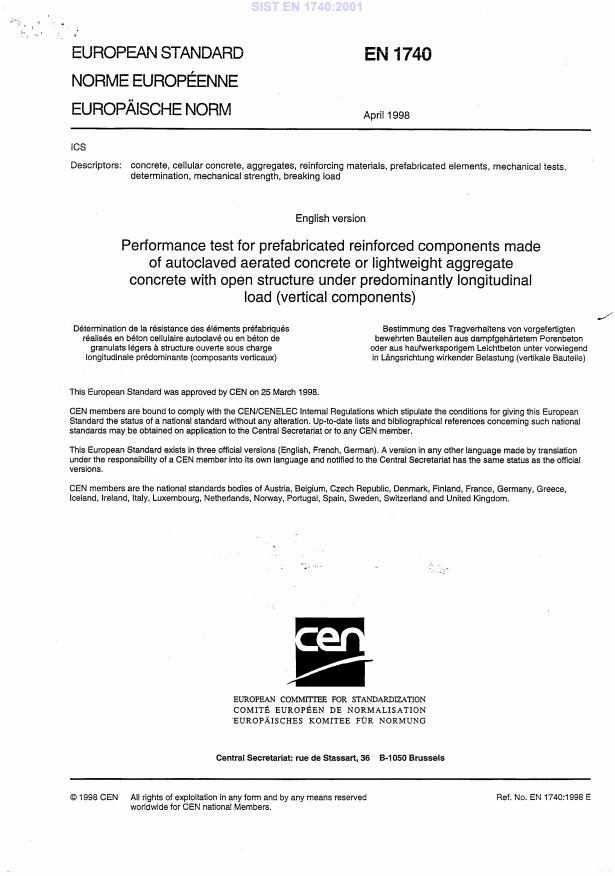
(Main)Performance test for prefabricated reinforced components made of autoclaved aerated concrete or lightweight aggregate concrete with open structure under predominantly longitudinal load (vertical components)
- Abstract
This European Standard specifies a method of determining the mechanical performances of prefabricated components made of autoclaved aerated concrete (AAC) according to prEN 12602 or lightweight aggregate concrete with open structure (LAC) according to prEN 1520 under longitudinal load which may be combined with transverse load. These performances include: - the deflections and maximum crack width in the serviceability limit state; - the loadbearing capacity (failure load); - the load-(vertical) deformation diagram, if required.
- Status
- Published
- Publication Date
- 31-Mar-2001
- Technical Committee
- BBB - Concrete, reinforced concrete and prestressed concrete
- Current Stage
- 6060 - National Implementation/Publication (Adopted Project)
- Start Date
- 01-Apr-2001
- Due Date
- 01-Apr-2001
- Completion Date
- 01-Apr-2001


SIST EN 1740:2001 is a Slovenian standard from SIST that adopts EN 1740:1998. It specifies a test method for prefabricated reinforced components made of autoclaved aerated concrete (AAC) or lightweight aggregate concrete (LAC) with open structure under predominantly longitudinal load, for use by engineers, laboratories, manufacturers, and anyone checking structural performance.
What does SIST EN 1740:2001 specify?
SIST EN 1740:2001 specifies how to determine the mechanical performance of prefabricated reinforced components made of AAC according to prEN 12602 or LAC with open structure according to prEN 1520. The method is for components loaded mainly in the longitudinal direction, and it also allows a transverse load to be applied together with that main load.
In practice, the standard is used to check how a vertical component behaves under load before it is put into service or accepted for supply. The scope covers three main results: deflections and maximum crack width in the serviceability limit state, loadbearing capacity as failure load, and, when needed, the load-(vertical) deformation diagram.
What are the key requirements of SIST EN 1740:2001?
SIST EN 1740:2001 is centered on a mechanical test that produces comparable results for prefabricated reinforced AAC and LAC components. The important point for users is that the document is not about material composition alone - it is about how the finished component performs when loaded.
- Test the component under predominantly longitudinal load. This reflects the normal working direction for the vertical component, so the result is relevant to real use.
- Allow combined transverse load where required. If a transverse load is part of the test setup, the standard still applies, which matters when the component sees more than one action in service.
- Determine deflection. Deflection shows how much the component bends under load, which is important for serviceability and fit with adjacent elements.
- Check maximum crack width in the serviceability limit state. This tells the reader whether cracking remains within acceptable service behavior, not only whether the component finally fails.
- Establish loadbearing capacity as failure load. This is the key structural outcome when deciding whether the component can sustain the required load before failure.
- Record the load-(vertical) deformation diagram if required. This gives the full load-versus-deformation behavior, which helps compare products and understand stiffness and reserve capacity.
- Apply the method to prefabricated reinforced AAC and LAC components only within the stated product families. That keeps test results tied to the intended component types rather than to concrete products in general.
For a buyer or quality manager, these points mean the standard supports both service performance checks and ultimate load checks in one document. For a laboratory, they define the outputs that the test report needs to provide.
What terms does SIST EN 1740:2001 define?
SIST EN 1740:2001 uses several technical terms that matter when reading test results.
- Autoclaved aerated concrete (AAC) - a concrete product family named in the scope and tested under this method.
- Lightweight aggregate concrete (LAC) - a second product family covered by the same test method.
- Open structure - the form of LAC covered by the standard.
- Serviceability limit state - the condition used to judge deflection and crack width under normal use.
- Loadbearing capacity - the maximum load the component can carry before failure.
- Failure load - the load at which the test ends because the component fails.
- Load-(vertical) deformation diagram - the curve showing how vertical deformation changes as load increases.
Who uses SIST EN 1740:2001?
SIST EN 1740:2001 is used by manufacturers of prefabricated reinforced AAC and LAC components, testing laboratories, and engineers responsible for structural assessment. Quality managers use it to compare products consistently, and buyers or specifiers use it when they need evidence of load performance for vertical components.
It is especially relevant where a product must be checked both for everyday behavior, such as deflection and cracking, and for ultimate strength. That makes it useful in product verification, type testing, and acceptance of prefabricated structural components.
What changed in SIST EN 1740:2001 from the previous edition?
SIST EN 1740:2001 is identical to EN 1740:1998.
Which standards are used with SIST EN 1740:2001?
SIST EN 1740:2001 is linked to two companion product standards named in its scope.
- prEN 12602 - identifies the AAC component family to which this test method applies.
- prEN 1520 - identifies the LAC component family with open structure to which this test method applies.
These references matter because they tell the user which prefabricated components are meant to be tested under this method.
What does the SIST EN 1740:2001 document contain?
SIST EN 1740:2001 contains a test method for measuring the structural behavior of prefabricated reinforced vertical components under longitudinal loading. Its content is focused on the test purpose, the load condition, and the performance results that must be obtained.
The document supports laboratory testing and product verification by defining how to determine deflection, crack width, failure load, and, when needed, the load-(vertical) deformation diagram. It is therefore a practical reference for checking service behavior and loadbearing capacity in one standardized procedure.
Relations
- Effective Date
- 29-Jul-2026
- Effective Date
- 28-Jan-2026
- Effective Date
- 28-Jan-2026
- Effective Date
- 28-Jan-2026
- Effective Date
- 28-Jan-2026
- Effective Date
- 28-Jan-2026
- Effective Date
- 28-Jan-2026
- Effective Date
- 28-Jan-2026
- Effective Date
- 28-Jan-2026
- Referred By
SIST EN 12602:2008+A1:2013 - Prefabricated reinforced components of autoclaved aerated concrete - Effective Date
- 28-Jan-2026
- Effective Date
- 28-Jan-2026
Get Certified
Connect with accredited certification bodies for this standard

DIBt (Deutsches Institut für Bautechnik)
German Institute for Building Technology.
DIN CERTCO
DIN Group product certification.

Aboma Certification B.V.
Specialized in construction, metal, and transport sectors.
Sponsored listings
Frequently Asked Questions
SIST EN 1740:2001 is a standard published by the Slovenian Institute for Standardization (SIST). Its full title is "Performance test for prefabricated reinforced components made of autoclaved aerated concrete or lightweight aggregate concrete with open structure under predominantly longitudinal load (vertical components)". This standard covers: This European Standard specifies a method of determining the mechanical performances of prefabricated components made of autoclaved aerated concrete (AAC) according to prEN 12602 or lightweight aggregate concrete with open structure (LAC) according to prEN 1520 under longitudinal load which may be combined with transverse load. These performances include: - the deflections and maximum crack width in the serviceability limit state; - the loadbearing capacity (failure load); - the load-(vertical) deformation diagram, if required.
This European Standard specifies a method of determining the mechanical performances of prefabricated components made of autoclaved aerated concrete (AAC) according to prEN 12602 or lightweight aggregate concrete with open structure (LAC) according to prEN 1520 under longitudinal load which may be combined with transverse load. These performances include: - the deflections and maximum crack width in the serviceability limit state; - the loadbearing capacity (failure load); - the load-(vertical) deformation diagram, if required.
SIST EN 1740:2001 is classified under the following ICS (International Classification for Standards) categories: 91.100.30 - Concrete and concrete products. The ICS classification helps identify the subject area and facilitates finding related standards.
SIST EN 1740:2001 has the following relationships with other standards: It is inter standard links to SIST EN 1520:2026, SIST EN 678:2001, SIST EN 1354:2005, SIST EN 992:2001, SIST EN 1353:2001, SIST EN 991:2001, SIST EN 679:2005, SIST EN 12602:2008, SIST EN 1520:2011, SIST EN 12602:2008+A1:2013, SIST EN 12602:2017. Understanding these relationships helps ensure you are using the most current and applicable version of the standard.
SIST EN 1740:2001 is associated with the following European legislation: EU Directives/Regulations: 305/2011, 89/106/EEC; Standardization Mandates: M/100. When a standard is cited in the Official Journal of the European Union, products manufactured in conformity with it benefit from a presumption of conformity with the essential requirements of the corresponding EU directive or regulation.
SIST EN 1740:2001 is available in PDF format for immediate download after purchase. The document can be added to your cart and obtained through the secure checkout process. Digital delivery ensures instant access to the complete standard document.
Standards Content (Sample)
2003-01.Slovenski inštitut za standardizacijo. Razmnoževanje celote ali delov tega standarda ni dovoljeno.ODGXMRþRBestimmung des Tragverhaltens von vorgefertigten bewehrten Bauteilen aus dampfgehärtetem Porenbeton oder aus haufwerksporigem Leichtbeton unter vorwiegend in Längsrichtung wirkender Belastung (vertikale Bauteile)Détermination de la résistance des éléments préfabriqués réalisés en béton cellulaire autoclavé ou en béton de granulats légers a structure ouverte sous charge longitudinale prédominante (composants verticaux)Performance test for prefabrica
...