

SIST EN 301 166-2 V1.2.3:2010
(Main)Electromagnetic compatibility and Radio spectrum Matters (ERM) - Land Mobile Service - Radio equipment for analogue and/or digital communication (speech and/or data) and operating on narrow band channels and having an antenna connector - Part 2: Harmonized EN covering essential requirements of article 3.2 of the R&TTE Directive
- Abstract
Follows revision of part 1 (WI adopted at ERM#33). So far, only change of version number of reference to part 1 is envisaged.
- Status
- Published
- Publication Date
- 15-Dec-2009
- Technical Committee
- MOC - Mobile Communications
- Current Stage
- 6060 - National Implementation/Publication (Adopted Project)
- Start Date
- 02-Dec-2009
- Due Date
- 06-Feb-2010
- Completion Date
- 16-Dec-2009
- Mandate
- M/284
Buy Documents


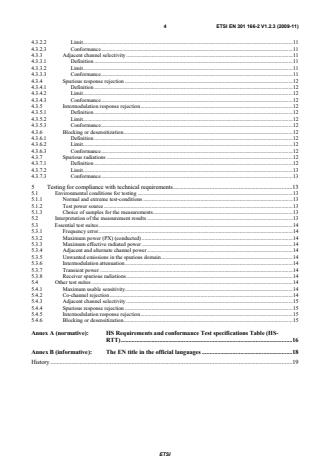
ETSI EN 301 166-2 V1.2.3 (2009-11) - Electromagnetic compatibility and Radio spectrum Matters (ERM); Land Mobile Service; Radio equipment for analogue and/or digital communication (speech and/or data) and operating on narrow band channels and having an antenna connector; Part 2: Harmonized EN covering essential requirements of article 3.2 of the R&TTE Directive



SIST EN 301 166-2 V1.2.3:2010 is the Slovenian adoption of ETSI EN 301 166-2 V1.2.3, a harmonized European standard for Land Mobile Service radio equipment. It specifies the essential requirements of article 3.2 of the R&TTE Directive for analogue and/or digital speech and/or data radios that operate on narrow band channels and have an antenna connector, or equivalent RF access in certain handportable equipment. Engineers, test laboratories, and conformity assessors use it to check spectrum use, transmitter and receiver performance, and the test evidence needed for presumption of conformity.
What does SIST EN 301 166-2 V1.2.3:2010 specify?
SIST EN 301 166-2 V1.2.3:2010 applies to radio transmitters and receivers used in stations in the Private Mobile Radio (PMR) service. It covers the land mobile service in the 30 MHz to 3 000 MHz transmit and receive bands, for equipment using narrow channel separations of less than 10 kHz and intended for speech and/or data.
The standard covers base stations, mobile stations, and handportable stations with an antenna connector or with a permanent or temporary internal 50 Ω RF connector that gives access to transmitter output and receiver input. Handportable equipment without any external or internal RF connector, and without the possibility of a temporary internal 50 Ω RF connector, is outside the scope.
The document is organized into clauses 1 to 5, plus two annexes.
| Annex | What it covers |
|---|---|
| Annex A | HS Requirements and conformance Test specifications Table (HS-RTT) for presumption of conformity under article 3.2 |
| Annex B | The EN title in the official languages |
What are the key requirements of SIST EN 301 166-2 V1.2.3:2010?
SIST EN 301 166-2 V1.2.3:2010 sets transmitter and receiver performance limits, then points to the test suites that demonstrate compliance. The practical aim is to show that the equipment uses spectrum efficiently and does not create harmful interference.
Transmitter performance
Clause 4.2 covers the main transmitter requirements: frequency error, maximum conducted power (PX), maximum effective radiated power, adjacent and alternate channel power, unwanted emissions in the spurious domain, intermodulation attenuation, transient power, and transmitter timeout timer.
For each of these, the standard gives the definition and then points back to the corresponding limit in EN 301 166-1. In practice, this means the radio must stay on frequency, keep output power within the allowed range, limit emissions into neighbouring channels and outside the wanted band, and control turn-on and turn-off behavior.
The transmitter timeout timer is handled by declaration and depends on the class and use of the equipment. The standard notes a 180 second limit for equipment operating in the 446.1 MHz to 446.2 MHz range. For users, this means the product design and declared feature set determine the timeout behavior that has to be documented.
Receiver performance
Clause 4.3 covers receiver requirements: maximum usable sensitivity, co-channel rejection, adjacent channel selectivity, spurious response rejection, intermodulation response rejection, blocking or desensitization, and spurious radiations.
These requirements matter because a receiver has to keep working in crowded radio environments. The limits control how well the equipment receives weak wanted signals, rejects strong signals on the same or nearby channels, and resists overload from unwanted signals.
For duplex equipment, the standard adds requirements tied to simultaneous transmission and reception. That affects design and testing because the receiver must be assessed while the transmitter is active.
Environmental conditions and test evidence
Clause 5 requires testing within the declared operational environmental profile. Tests are carried out at representative points inside those declared limits, and where performance changes with conditions, enough environmental variety must be used to give confidence in compliance.
The standard also requires normal and, where stated, extreme test conditions, with test conditions and procedures taken from EN 301 166-1. Test power source requirements and sample selection also come from Part 1. In practice, the manufacturer has to declare the operating environment and make sure the test campaign matches it.
Measurement uncertainty must be reported in the test record. The uncertainty values are to be calculated using TR 100 028 and kept within the figures referenced from EN 301 166-1. That matters because the pass/fail decision is based on the measured value compared with the relevant limit, with uncertainty documented.
Essential and other test suites
Clause 5.3 lists the essential test suites for transmitter frequency error, power, emissions, intermodulation attenuation, transient power, and receiver spurious radiations. Clause 5.4 lists the other test suites for receiver sensitivity and selectivity-type performance.
Annex A is the key cross-reference table. It links each requirement to a clause, marks it as unconditional or conditional, and identifies whether the test specification is part of the Essential Radio Test Suite or the Other Test Suite. For a conformity file, this annex is the map between the requirement and the evidence.
Integral antenna equipment
For equipment without an external antenna connector but with a permanent or temporary internal 50 Ω RF connector, the standard requires extra measurements with the equipment antenna connected to the station, not by using the connector. That affects handportable designs with integral antennas, because the compliance test must reflect the actual radiating configuration.
What terms does SIST EN 301 166-2 V1.2.3:2010 define?
- Private Mobile Radio (PMR) - The service area covered by the standard for land mobile radio stations.
- Channel Separation (CSP) - The narrow channel spacing used here, defined as less than 10 kHz.
- Channel BandWidth (CBW) - The channel bandwidth permitted by national administrations for these systems.
- Push-to-talk (PTT) - The key that starts the transmitter timeout timer when pressed.
- Radio Frequency (RF) connector - The connector used to access transmitter output and receiver input in covered handportable equipment.
- Harmonized Standard requirements and conformance Test specifications Table (HS-RTT) - The Annex A table that ties each requirement to its test specification and its test classification.
- Duplex equipment - Equipment that transmits and receives at the same time.
Who uses SIST EN 301 166-2 V1.2.3:2010?
Manufacturers of PMR base stations, mobile stations, and handportable radios use this standard when they design products for narrowband speech and/or data operation. Test laboratories use it to plan transmitter and receiver measurements and to record measurement uncertainty.
Conformity assessment teams and technical file authors use it to prepare evidence for article 3.2 of the R&TTE Directive. Regulators and spectrum compliance specialists use it to judge whether equipment is constructed to use the allocated spectrum effectively and avoid harmful interference.
Buyers and procurement teams use it when they need a specification for narrowband PMR equipment that matches a harmonized European compliance route.
What changed in SIST EN 301 166-2 V1.2.3:2010 from the previous edition?
This edition follows a revision of Part 1, EN 301 166-1. The scope notes that, so far, only a change of the version number of the reference to Part 1 is envisaged.
Which standards are used with SIST EN 301 166-2 V1.2.3:2010?
| Reference | What it contributes |
|---|---|
| ETSI EN 301 166-1 (V1.3.2) | Definitions, symbols, abbreviations, technical characteristics, limits, and the detailed measurement methods that Part 2 refers to repeatedly |
| ETSI TR 100 028 (V1.4.1) (all parts) | The principles used to calculate measurement uncertainty for the tests in this standard |
| ETSI EG 201 399 (V2.1.1) | The modular structure guide used for candidate Harmonized Standards under the R&TTE Directive |
What does the SIST EN 301 166-2 V1.2.3:2010 document contain?
The document contains a short scope, references, definitions, technical requirements, and compliance testing rules. Clause 4 gives the transmitter and receiver limits and points to EN 301 166-1 for the detailed definitions and limit values.
Clause 5 sets the environmental conditions for testing, how to interpret measurement results, and which test suites are essential or other. Table 1 gives the transmit and receive frequency ranges, while Annex A provides the HS-RTT cross-reference table used for conformity work.
Annex A is the most useful part for certification and test planning because it shows how each requirement is tied to a test clause and whether it is unconditional or conditional. Annex B gives the EN title in the official languages.
Buy Documents
ETSI EN 301 166-2 V1.2.3 (2009-11) - Electromagnetic compatibility and Radio spectrum Matters (ERM); Land Mobile Service; Radio equipment for analogue and/or digital communication (speech and/or data) and operating on narrow band channels and having an antenna connector; Part 2: Harmonized EN covering essential requirements of article 3.2 of the R&TTE Directive
Get Certified
Connect with accredited certification bodies for this standard

ANCE
Mexican certification and testing association.

Intertek Slovenia
Intertek testing, inspection, and certification services in Slovenia.

LNE (Laboratoire National de Métrologie et d'Essais)
French national laboratory for metrology and testing.
Sponsored listings
Frequently Asked Questions
SIST EN 301 166-2 V1.2.3:2010 is a standard published by the Slovenian Institute for Standardization (SIST). Its full title is "Electromagnetic compatibility and Radio spectrum Matters (ERM) - Land Mobile Service - Radio equipment for analogue and/or digital communication (speech and/or data) and operating on narrow band channels and having an antenna connector - Part 2: Harmonized EN covering essential requirements of article 3.2 of the R&TTE Directive". This standard covers: Follows revision of part 1 (WI adopted at ERM#33). So far, only change of version number of reference to part 1 is envisaged.
Follows revision of part 1 (WI adopted at ERM#33). So far, only change of version number of reference to part 1 is envisaged.
SIST EN 301 166-2 V1.2.3:2010 is classified under the following ICS (International Classification for Standards) categories: 33.060.99 - Other equipment for radiocommunications; 33.070.01 - Mobile services in general; 33.100.01 - Electromagnetic compatibility in general. The ICS classification helps identify the subject area and facilitates finding related standards.
SIST EN 301 166-2 V1.2.3:2010 is associated with the following European legislation: EU Directives/Regulations: 1999/5/EC, TRRTP124; Standardization Mandates: M/284. When a standard is cited in the Official Journal of the European Union, products manufactured in conformity with it benefit from a presumption of conformity with the essential requirements of the corresponding EU directive or regulation.
SIST EN 301 166-2 V1.2.3:2010 is available in PDF format for immediate download after purchase. The document can be added to your cart and obtained through the secure checkout process. Digital delivery ensures instant access to the complete standard document.
Standards Content (Sample)
Contents
- Introduction
- 6 ETSI EN 301 166-2 V1.2.3 (2009-11)
- 1 Scope
- 7 ETSI EN 301 166-2 V1.2.3 (2009-11)
- 2 References
- 2.1 Normative references
- 2.2 Informative references
- 8 ETSI EN 301 166-2 V1.2.3 (2009-11)
- 3 Definitions, symbols and abbreviations
- 3.1 Definitions
- 3.2 Symbols
- 3.3 Abbreviations
- 4 Technical requirements
- 4.1 Environmental profile
- 4.2 Transmitter requirements
- 9 ETSI EN 301 166-2 V1.2.3 (2009-11)
- 10 ETSI EN 301 166-2 V1.2.3 (2009-11)
- 11 ETSI EN 301 166-2 V1.2.3 (2009-11)
- 4.3 Receiver requirements
- 12 ETSI EN 301 166-2 V1.2.3 (2009-11)
- 13 ETSI EN 301 166-2 V1.2.3 (2009-11)
- 5 Testing for compliance with technical requirements
- 5.1 Environmental conditions for testing
- 5.2 Interpretation of the measurement results
- 14 ETSI EN 301 166-2 V1.2.3 (2009-11)
- 5.3 Essential test suites
- 5.4 Other test suites
- 15 ETSI EN 301 166-2 V1.2.3 (2009-11)
- 16 ETSI EN 301 166-2 V1.2.3 (2009-11)
- 17 ETSI EN 301 166-2 V1.2.3 (2009-11)
- 15 Transmitter time out 4.2.8 C Applicable to certain classes
- 18 ETSI EN 301 166-2 V1.2.3 (2009-11)
- 19 ETSI EN 301 166-2 V1.2.3 (2009-11)
Introduction
The present document is part of a set of standards developed by ETSI and is designed to fit in a modular structure to cover all radio and telecommunications terminal equipment within the scope of the R&TTE Directive [i.3]. The modular structure is shown in EG 201 399 [i.2].
ETSI
6 ETSI EN 301 166-2 V1.2.3 (2009-11)
1 Scope
The present document applies to radio transmitters and receivers used in stations in the Private Mobile Radio (PMR) service. It applies to use in the land mobile service capable of operating in all or any part of the frequency bands given below.
Table 1: Radiocommunications service frequency bands Radiocommunications service frequency bands Transmit 30 MHz to 3 000 MHz Receive 30 MHz to 3 000 MHz
The present document applies to equipment operating with narrow channel separations (CSP) (less than 10 kHz) and intended for speech and/or data. It is the intention of the present document to cover any Channel BandWidths (CBW) permitted by National Administrations for such systems e.g. 6,25 kHz. In the present document different requirements are given for the different radio frequency bands, environmental conditions and types of equipment where appropriate.
In the present document, data transmission systems are defined as systems which transmit and/or receive data and/or digitized voice. The equipment comprises a transmitter and associated encoder and modulator and/or a receiver and associated demodulator and decoder.
The present document covers equipment which may use constant envelope or non-constant envelope modulation. The types of equipment covered by the present document are as follows:
- base station: equipment fitted with antenna connector;
- mobile station: equipment fitted with antenna connector;
- handportable stations:
a) either fitted with an antenna connector; or b) without an external antenna connector but fitted with a permanent internal or a temporary internal 50 Ω RF connector which allows access to the transmitter output and the receiver input. Handportable station equipment without an external or internal Radio Frequency (RF) connector and without the possibility of having a temporary internal 50 Ω RF connector is not covered by the present document. The present document is intended to cover the provisions of article 3.2 of Directive 1999/5/EC [i.3] (R&TTE Directive), which states that "… radio equipment shall be so constructed that it effectively uses the spectrum allocated to terrestrial/space radio communications and orbital resources so as to avoid harmful interference". In addition to the present document, other ENs that specify technical requirements in respect of essential requirements under other parts of article 3 of the R&TTE Directive [i.3] may apply to equipment within the scope of the present document.
ETSI
7 ETSI EN 301 166-2 V1.2.3 (2009-11)
2 References
References are either specific (identified by date of publication and/or edition number or version number) or non-specific.
- For a specific reference, subsequent revisions do not apply.
- Non-specific reference may be made only to a complete document or a part thereof and only in the following cases:
- if it is accepted that it will be possible to use all future changes of the referenced document for the purposes of the referring document;
- for informative references.
Referenced documents which are not found to be publicly available in the expected location might be found at http://docbox.etsi.org/Reference.
NOTE: While any hyperlinks included in this clause were valid at the time of publication ETSI cannot guarantee their long term validity.
2.1 Normative references
The following referenced documents are indispensable for the application of the present document. For dated references, only the edition cited applies. For non-specific references, the latest edition of the referenced document (including any amendments) applies.
[1] ETSI EN 301 166-1 (V1.3.2): "Electromagnetic compatibility and Radio spectrum Matters (ERM); Land Mobile Service; Radio equipment for analogue and/or digital communication (speech and/or data) and operating on narrow band channels and having an antenna connector; Part 1: Technical characteristics and methods of measurement".
2.2 Informative references
The following referenced documents are not essential to the use of the present document but they assist the user with regard to a particular subject area. For non-specific references, the latest version of the referenced document (including any amendments) applies.
[i.1] ETSI TR 100 028 (V1.4.1) (all parts): "Electromagnetic compatibility and Radio spectrum Matters (ERM); Uncertainties in the measurement of mobile radio equipment characteristics". [i.2] ETSI EG 201 399 (V2.1.1): "Electromagnetic compatibility and Radio spectrum Matters (ERM); A guide to the production of candidate Harmonized Standards for application under the R&TTE Directive".
[i.3] Directive 1999/5/EC of the European Parliament and of the Council of 9 March 1999 on radio equipment and telecommunications terminal equipment and the mutual recognition of their conformity (R&TTE Directive).
[i.4] Directive 98/34/EC of the European Parliament and of the Council of 22 June 1998 laying down a procedure for the provision of information in the field of technical standards and regulations. ETSI
8 ETSI EN 301 166-2 V1.2.3 (2009-11)
3 Definitions, symbols and abbreviations
3.1 Definitions
For the purposes of the present document, the terms and definitions given in the R&TTE Directive [i.3] and EN 301 166-1 [1] apply.
3.2 Symbols
For the purposes of the present document, the symbols given in EN 301 166-1 [1] apply.
3.3 Abbreviations
For the purposes of the present document, the abbreviations given in EN 301 166-1 [1] apply.
4 Technical requirements
For equipment without an external antenna connector (integral antenna equipment) but fitted with a permanent internal or a temporary internal 50 Ω RF connector which allows access to the transmitter output and the receiver input, the following additional measurements are made using the equipment antenna connected to the station (and not using any connector):
- transmitter effective radiated power;
- transmitter radiated spurious emissions;
- receiver maximum usable sensitivity (field strength);
- receiver spurious radiations.
4.1 Environmental profile
The technical requirements of the present document apply under the environmental profile for operation of the equipment, which shall be declared by the manufacturer. The equipment shall comply with all the technical requirements of the present document at all times when operating within the boundary limits of the declared operational environmental profile.
4.2 Transmitter requirements
4.2.1 Frequency error
4.2.1.1 Definition
The frequency error is defined in EN 301 166-1 [1], clause 7.7.1.
4.2.1.2 Limit
The frequency error shall not exceed the limits in EN 301 166-1 [1], clause 7.7.3.
4.2.1.3 Conformance
If the transmitter adjacent and alternate channels power (clause 5.3.4) has not been measured under extreme test conditions, then the conformance tests as defined in clause 5.3.1 shall be carried out. ETSI
9 ETSI EN 301 166-2 V1.2.3 (2009-11)
4.2.2 Maximum power (PX) (conducted)
4.2.2.1 Definition
The maximum power (conducted) is defined in EN 301 166-1 [1], clause 7.1.1.
4.2.2.2 Limit
The maximum power (conducted) shall not exceed the limits in EN 301 166-1 [1], clause 7.1.3.
4.2.2.3 Conformance
Conformance tests as defined in clause 5.3.2 shall be carried out.
4.2.3 Maximum effective radiated power
4.2.3.1 Definition
The maximum effective radiated power is defined in EN 301 166-1 [1], clause 7.2.1.
4.2.3.2 Limit
The maximum effective radiated power shall not exceed the limits in EN 301 166-1 [1], clause 7.2.3.
4.2.3.3 Conformance
Conformance tests as defined in clause 5.3.3 shall be carried out.
4.2.4 Adjacent and alternate channel power
4.2.4.1 Definition
The adjacent channel power is defined in EN 301 166-1 [1], clause 7.3.1.
4.2.4.2 Limit
The adjacent channel power shall not exceed the limits in EN 301 166-1 [1], clause 7.3.3.
4.2.4.3 Conformance
Conformance tests as defined in clause 5.3.4 shall be carried out.
4.2.5 Unwanted emissions in the spurious domain
4.2.5.1 Definition
The unwanted emissions in the spurious domain are defined in EN 301 166-1 [1], clause 7.4.1.
4.2.5.2 Limit
The unwanted emissions in the spurious domain shall not exceed the limits in EN 301 166-1 [1], clause 7.4.3.
4.2.5.3 Conformance
Conformance tests as defined in clause 5.3.5 shall be carried out. ETSI
...
Contents
- Introduction
- 6 ETSI EN 301 166-2 V1.2.3 (2009-11)
- 1 Scope
- 7 ETSI EN 301 166-2 V1.2.3 (2009-11)
- 2 References
- 2.1 Normative references
- 2.2 Informative references
- 8 ETSI EN 301 166-2 V1.2.3 (2009-11)
- 3 Definitions, symbols and abbreviations
- 3.1 Definitions
- 3.2 Symbols
- 3.3 Abbreviations
- 4 Technical requirements
- 4.1 Environmental profile
- 4.2 Transmitter requirements
- 9 ETSI EN 301 166-2 V1.2.3 (2009-11)
- 10 ETSI EN 301 166-2 V1.2.3 (2009-11)
- 11 ETSI EN 301 166-2 V1.2.3 (2009-11)
- 4.3 Receiver requirements
- 12 ETSI EN 301 166-2 V1.2.3 (2009-11)
- 13 ETSI EN 301 166-2 V1.2.3 (2009-11)
- 5 Testing for compliance with technical requirements
- 5.1 Environmental conditions for testing
- 5.2 Interpretation of the measurement results
- 14 ETSI EN 301 166-2 V1.2.3 (2009-11)
- 5.3 Essential test suites
- 5.4 Other test suites
- 15 ETSI EN 301 166-2 V1.2.3 (2009-11)
- 16 ETSI EN 301 166-2 V1.2.3 (2009-11)
- 17 ETSI EN 301 166-2 V1.2.3 (2009-11)
- 15 Transmitter time out 4.2.8 C Applicable to certain classes
- 18 ETSI EN 301 166-2 V1.2.3 (2009-11)
- 19 ETSI EN 301 166-2 V1.2.3 (2009-11)
Introduction
The present document is part of a set of standards developed by ETSI and is designed to fit in a modular structure to cover all radio and telecommunications terminal equipment within the scope of the R&TTE Directive [i.3]. The modular structure is shown in EG 201 399 [i.2].
ETSI
SIST EN 301 166-2 V1.2.3:2010
6 ETSI EN 301 166-2 V1.2.3 (2009-11)
1 Scope
The present document applies to radio transmitters and receivers used in stations in the Private Mobile Radio (PMR) service. It applies to use in the land mobile service capable of operating in all or any part of the frequency bands given below.
Table 1: Radiocommunications service frequency bands Radiocommunications service frequency bands Transmit 30 MHz to 3 000 MHz Receive 30 MHz to 3 000 MHz
The present document applies to equipment operating with narrow channel separations (CSP) (less than 10 kHz) and intended for speech and/or data. It is the intention of the present document to cover any Channel BandWidths (CBW) permitted by National Administrations for such systems e.g. 6,25 kHz. In the present document different requirements are given for the different radio frequency bands, environmental conditions and types of equipment where appropriate.
In the present document, data transmission systems are defined as systems which transmit and/or receive data and/or digitized voice. The equipment comprises a transmitter and associated encoder and modulator and/or a receiver and associated demodulator and decoder.
The present document covers equipment which may use constant envelope or non-constant envelope modulation. The types of equipment covered by the present document are as follows:
- base station: equipment fitted with antenna connector;
- mobile station: equipment fitted with antenna connector;
- handportable stations:
a) either fitted with an antenna connector; or b) without an external antenna connector but fitted with a permanent internal or a temporary internal 50 Ω RF connector which allows access to the transmitter output and the receiver input. Handportable station equipment without an external or internal Radio Frequency (RF) connector and without the possibility of having a temporary internal 50 Ω RF connector is not covered by the present document. The present document is intended to cover the provisions of article 3.2 of Directive 1999/5/EC [i.3] (R&TTE Directive), which states that "… radio equipment shall be so constructed that it effectively uses the spectrum allocated to terrestrial/space radio communications and orbital resources so as to avoid harmful interference". In addition to the present document, other ENs that specify technical requirements in respect of essential requirements under other parts of article 3 of the R&TTE Directive [i.3] may apply to equipment within the scope of the present document.
ETSI
SIST EN 301 166-2 V1.2.3:2010
7 ETSI EN 301 166-2 V1.2.3 (2009-11)
2 References
References are either specific (identified by date of publication and/or edition number or version number) or non-specific.
- For a specific reference, subsequent revisions do not apply.
- Non-specific reference may be made only to a complete document or a part thereof and only in the following cases:
- if it is accepted that it will be possible to use all future changes of the referenced document for the purposes of the referring document;
- for informative references.
Referenced documents which are not found to be publicly available in the expected location might be found at http://docbox.etsi.org/Reference.
NOTE: While any hyperlinks included in this clause were valid at the time of publication ETSI cannot guarantee their long term validity.
2.1 Normative references
The following referenced documents are indispensable for the application of the present document. For dated references, only the edition cited applies. For non-specific references, the latest edition of the referenced document (including any amendments) applies.
[1] ETSI EN 301 166-1 (V1.3.2): "Electromagnetic compatibility and Radio spectrum Matters (ERM); Land Mobile Service; Radio equipment for analogue and/or digital communication (speech and/or data) and operating on narrow band channels and having an antenna connector; Part 1: Technical characteristics and methods of measurement".
2.2 Informative references
The following referenced documents are not essential to the use of the present document but they assist the user with regard to a particular subject area. For non-specific references, the latest version of the referenced document (including any amendments) applies.
[i.1] ETSI TR 100 028 (V1.4.1) (all parts): "Electromagnetic compatibility and Radio spectrum Matters (ERM); Uncertainties in the measurement of mobile radio equipment characteristics". [i.2] ETSI EG 201 399 (V2.1.1): "Electromagnetic compatibility and Radio spectrum Matters (ERM); A guide to the production of candidate Harmonized Standards for application under the R&TTE Directive".
[i.3] Directive 1999/5/EC of the European Parliament and of the Council of 9 March 1999 on radio equipment and telecommunications terminal equipment and the mutual recognition of their conformity (R&TTE Directive).
[i.4] Directive 98/34/EC of the European Parliament and of the Council of 22 June 1998 laying down a procedure for the provision of information in the field of technical standards and regulations. ETSI
SIST EN 301 166-2 V1.2.3:2010
8 ETSI EN 301 166-2 V1.2.3 (2009-11)
3 Definitions, symbols and abbreviations
3.1 Definitions
For the purposes of the present document, the terms and definitions given in the R&TTE Directive [i.3] and EN 301 166-1 [1] apply.
3.2 Symbols
For the purposes of the present document, the symbols given in EN 301 166-1 [1] apply.
3.3 Abbreviations
For the purposes of the present document, the abbreviations given in EN 301 166-1 [1] apply.
4 Technical requirements
For equipment without an external antenna connector (integral antenna equipment) but fitted with a permanent internal or a temporary internal 50 Ω RF connector which allows access to the transmitter output and the receiver input, the following additional measurements are made using the equipment antenna connected to the station (and not using any connector):
- transmitter effective radiated power;
- transmitter radiated spurious emissions;
- receiver maximum usable sensitivity (field strength);
- receiver spurious radiations.
4.1 Environmental profile
The technical requirements of the present document apply under the environmental profile for operation of the equipment, which shall be declared by the manufacturer. The equipment shall comply with all the technical requirements of the present document at all times when operating within the boundary limits of the declared operational environmental profile.
4.2 Transmitter requirements
4.2.1 Frequency error
4.2.1.1 Definition
The frequency error is defined in EN 301 166-1 [1], clause 7.7.1.
4.2.1.2 Limit
The frequency error shall not exceed the limits in EN 301 166-1 [1], clause 7.7.3.
4.2.1.3 Conformance
If the transmitter adjacent and alternate channels power (clause 5.3.4) has not been measured under extreme test conditions, then the conformance tests as defined in clause 5.3.1 shall be carried out. ETSI
SIST EN 301 166-2 V1.2.3:2010
9 ETSI EN 301 166-2 V1.2.3 (2009-11)
4.2.2 Maximum power (PX) (conducted)
4.2.2.1 Definition
The maximum power (conducted) is defined in EN 301 166-1 [1], clause 7.1.1.
4.2.2.2 Limit
The maximum power (conducted) shall not exceed the limits in EN 301 166-1 [1], clause 7.1.3.
4.2.2.3 Conformance
Conformance tests as defined in clause 5.3.2 shall be carried out.
4.2.3 Maximum effective radiated power
4.2.3.1 Definition
The maximum effective radiated power is defined in EN 301 166-1 [1], clause 7.2.1.
4.2.3.2 Limit
The maximum effective radiated power shall not exceed the limits in EN 301 166-1 [1], clause 7.2.3.
4.2.3.3 Conformance
Conformance tests as defined in clause 5.3.3 shall be carried out.
4.2.4 Adjacent and alternate channel power
4.2.4.1 Definition
The adjacent channel power is defined in EN 301 166-1 [1], clause 7.3.1.
4.2.4.2 Limit
The adjacent channel power shall not exceed the limits in EN 301 166-1 [1], clause 7.3.3.
4.2.4.3 Conformance
Conformance tests as defined in clause 5.3.4 shall be carried out.
4.2.5 Unwanted emissions in the spurious domain
4.2.5.1 Definition
The unwanted emissions in the spurious domain are defined in EN 301 166-1 [1], clause 7.4.1.
4.2.5.2 Limit
The unwanted emissions in the spurious domain shall not exceed the limits in EN 301 166-1 [1], clause 7.4.3.
4.2.5.3 Conformance
Conformance tests as defined in clause 5.3.5 shall be carried out. ETSI
SIST EN 301 166-2 V1.2.3:2010
...