

SIST EN 303 039 V1.1.1:2014
(Main)Electromagnetic compatibility and Radio spectrum Matters (ERM) - Land Mobile Service - Multichannel transmitter specification for the PMR Service - Harmonized EN covering the essential requirements of article 3.2 of the R&TTE Directive
General Information
- Abstract
The present document covers the technical requirements for multiple channel radio transmitters used in stations in the Private Mobile Radio (PMR) service. It applies to use in the land mobile service, operating on radio frequencies between 30 MHz and 3 GHz, with channel separations of < 10 kHz, 12,5 kHz, 20 kHz, 25 kHz, 50 kHz, 100 kHz and 150 kHz. It applies to equipment for continuous and/or discontinuous transmission of data and/or digital speech and/or analogue speech and using constant envelope or non-constant envelope modulation. The equipment comprises a transmitter capable of simultaneous amplification or transmission on two or more RF channels, or an amplifier which when operated with transmitter equipment provides simultaneous transmission on two or more RF channels. The types of equipment covered by the present document are as follows:
- base station (equipment fitted with an antenna connector, intended for use in a fixed location);
- mobile station (equipment fitted with an antenna connector, normally used in a vehicle or as a transportable);
- those hand portable stations:
a) fitted with an antenna connector; or
b) without an external antenna connector (integral antenna equipment), but fitted with a permanent internal or a temporary internal 50 Ω Radio Frequency (RF) connector which allows access to the transmitter
output;
- and any equipment that may be used in combination with any of the above equipments when directly
connected to those equipments for the amplification of the transmitter output signals of two or more individual equipments. Types of equipment not covered by the present document are as follows:
- hand portable equipment without an external or internal RF connector and without the possibility of having a temporary internal 50 Ω RF connector is not covered by the present document;
- any equipment using passive combining solutions where each transmitter connected to the passive combining system transmits on a single channel, as detailed in EG 200 053 [i.13], clause H.3. These specifications apply to the transmitter or transmitter amplifier only. If a receiver is fitted to the same equipment, the receiver specifications in the relevant specification (references [i.5] to [i.12]) should apply. These specifications do not necessarily include all the characteristics that may be required by a user of equipment, nor do they necessarily represent the optimum performance achievable. The present document is intended to cover the provisions of article 3.2 of Directive 1999/5/EC [i.3] (R&TTE Directive), which states that "… radio equipment shall be so constructed that it effectively uses the spectrum allocated to terrestrial/space radio communications and orbital resources so as to avoid harmful interference".
In addition to the present document, other ENs that specify technical requirements in respect of essential requirements
under other parts of article 3 of the R&TTE Directive [i.3] may apply to equipment within the scope of the present document.
- Status
- Published
- Public Enquiry End Date
- 30-Jun-2013
- Publication Date
- 15-Apr-2014
- Technical Committee
- MOC - Mobile Communications
- Current Stage
- 6060 - National Implementation/Publication (Adopted Project)
- Start Date
- 07-Apr-2014
- Due Date
- 12-Jun-2014
- Completion Date
- 16-Apr-2014
- Mandate
- M/284
Buy Documents
ETSI EN 303 039 V1.1.0 (2013-04) - Electromagnetic compatibility and Radio spectrum Matters (ERM); Land Mobile Service; Multichannel transmitter specification for the PMR Service; Harmonized EN covering the essential requirements of article 3.2 of the R&TTE Directive
ETSI EN 303 039 V1.1.1 (2014-01) - Electromagnetic compatibility and Radio spectrum Matters (ERM); Land Mobile Service; Multichannel transmitter specification for the PMR Service; Harmonized EN covering the essential requirements of article 3.2 of the R&TTE Directive
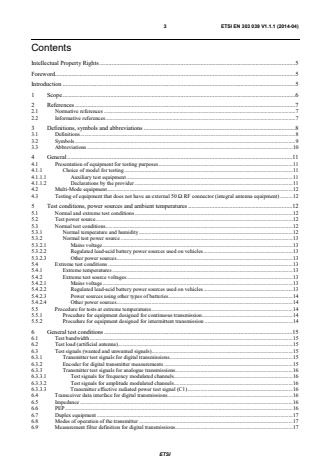
ETSI EN 303 039 V1.1.1 (2014-04) - Electromagnetic compatibility and Radio spectrum Matters (ERM); Land Mobile Service; Multichannel transmitter specification for the PMR Service; Harmonized EN covering the essential requirements of article 3.2 of the R&TTE Directive

Overview
SIST EN 303 039 V1.1.1:2014 is a harmonized European standard developed by the Slovenski inštitut za standardizacijo (SIST) in collaboration with ETSI. It addresses the electromagnetic compatibility (EMC) and radio spectrum matters for multichannel radio transmitters used in the Private Mobile Radio (PMR) service within the land mobile service. The standard ensures that such transmitters meet the essential requirements of Article 3.2 of the R&TTE Directive (1999/5/EC), aiming for effective use of spectrum and prevention of harmful interference. The document covers equipment operating between 30 MHz and 3 GHz, with various channel separations, and applies to both analogue and digital transmission.
Key Topics
Scope of Coverage
The standard specifies technical requirements for multichannel transmitters and amplifiers:- Base stations for fixed locations
- Mobile stations for vehicles or portable use
- Hand-portable stations with either integral or connector-based antennas
- Equipment combinations directly connected for signal amplification across multiple RF channels
Frequency Bands and Channel Separations
Applies to equipment operating in the 30 MHz to 3 GHz range, with channel bandwidths as low as <10 kHz up to 150 kHz.Transmission Modes
Supports both continuous and discontinuous operation, with data and/or speech in digital or analogue formats, and both constant/non-constant envelope modulation types.Regulatory Alignment
Ensures compliance with the R&TTE Directive Article 3.2 by defining requirements to avoid spectrum interference.Exclusions
Does not cover:- Equipment lacking any external, internal, or temporary 50 Ω RF connector
- Devices using passive combining solutions where each transmitter operates a single channel
Applications
- Public Safety Communications
Enables reliable, interference-free operation of PMR systems for police, fire, emergency services, and other mission-critical users. - Industrial and Commercial Operations
Ensures robustness and spectral efficiency for communication networks in utilities, transport, construction, and logistics sectors. - Vehicle and Mobile Installations
Applicable to mobile radio units used in vehicles or on-site portable devices, supporting flexible deployment and mobility. - Fixed Base Stations
Coverage of base station equipment is essential for infrastructure in dispatch centers and repeater sites. - Integration with Amplifiers
Permits use with transmitter amplifiers for enhanced range or multi-channel broadcasting.
By conforming to this standard, manufacturers and system integrators can ensure their PMR equipment is suitable for operation across Europe, complies with regulatory requirements, and minimizes the risk of interference.
Related Standards
- EN 300 086: Radio equipment for analogue speech in land mobile services.
- EN 300 113: Specifications for radio equipment used to transmit data and/or speech with an antenna connector.
- EN 302 561: Specifications for equipment with various channel bandwidths using constant/non-constant envelope modulation.
- EN 300 392-2: Terrestrial Trunked Radio (TETRA) - Voice plus Data Air Interface.
- EN 300 296 / EN 300 341 / EN 300 390 / EN 301 166: Cover technical requirements for various types of land mobile radio equipment, including those with integral antennas and for narrowband communication.
- EG 200 053: Site engineering recommendations for radio equipment.
Practical Value
Adopting SIST EN 303 039 V1.1.1:2014 helps organizations:
- Streamline market entry across the European Economic Area by demonstrating compliance.
- Ensure their PMR solutions are robust, compatible, and safe for diverse operational environments.
- Minimize liability and risk related to electromagnetic interference or regulatory breaches.
- Design and test equipment efficiently by following prescribed technical and compliance requirements.
Keywords: electromagnetic compatibility, PMR, land mobile service, multichannel transmitters, radio spectrum, R&TTE Directive, antenna connectors, mobile radio equipment, harmonized standard, EMC compliance, frequency bands, digital and analogue transmission.
Buy Documents
ETSI EN 303 039 V1.1.0 (2013-04) - Electromagnetic compatibility and Radio spectrum Matters (ERM); Land Mobile Service; Multichannel transmitter specification for the PMR Service; Harmonized EN covering the essential requirements of article 3.2 of the R&TTE Directive
ETSI EN 303 039 V1.1.1 (2014-01) - Electromagnetic compatibility and Radio spectrum Matters (ERM); Land Mobile Service; Multichannel transmitter specification for the PMR Service; Harmonized EN covering the essential requirements of article 3.2 of the R&TTE Directive
ETSI EN 303 039 V1.1.1 (2014-04) - Electromagnetic compatibility and Radio spectrum Matters (ERM); Land Mobile Service; Multichannel transmitter specification for the PMR Service; Harmonized EN covering the essential requirements of article 3.2 of the R&TTE Directive
Get Certified
Connect with accredited certification bodies for this standard

ANCE
Mexican certification and testing association.

Intertek Slovenia
Intertek testing, inspection, and certification services in Slovenia.

LNE (Laboratoire National de Métrologie et d'Essais)
French national laboratory for metrology and testing.
Sponsored listings
Frequently Asked Questions
SIST EN 303 039 V1.1.1:2014 is a standard published by the Slovenian Institute for Standardization (SIST). Its full title is "Electromagnetic compatibility and Radio spectrum Matters (ERM) - Land Mobile Service - Multichannel transmitter specification for the PMR Service - Harmonized EN covering the essential requirements of article 3.2 of the R&TTE Directive". This standard covers: The present document covers the technical requirements for multiple channel radio transmitters used in stations in the Private Mobile Radio (PMR) service. It applies to use in the land mobile service, operating on radio frequencies between 30 MHz and 3 GHz, with channel separations of < 10 kHz, 12,5 kHz, 20 kHz, 25 kHz, 50 kHz, 100 kHz and 150 kHz. It applies to equipment for continuous and/or discontinuous transmission of data and/or digital speech and/or analogue speech and using constant envelope or non-constant envelope modulation. The equipment comprises a transmitter capable of simultaneous amplification or transmission on two or more RF channels, or an amplifier which when operated with transmitter equipment provides simultaneous transmission on two or more RF channels. The types of equipment covered by the present document are as follows: - base station (equipment fitted with an antenna connector, intended for use in a fixed location); - mobile station (equipment fitted with an antenna connector, normally used in a vehicle or as a transportable); - those hand portable stations: a) fitted with an antenna connector; or b) without an external antenna connector (integral antenna equipment), but fitted with a permanent internal or a temporary internal 50 Ω Radio Frequency (RF) connector which allows access to the transmitter output; - and any equipment that may be used in combination with any of the above equipments when directly connected to those equipments for the amplification of the transmitter output signals of two or more individual equipments. Types of equipment not covered by the present document are as follows: - hand portable equipment without an external or internal RF connector and without the possibility of having a temporary internal 50 Ω RF connector is not covered by the present document; - any equipment using passive combining solutions where each transmitter connected to the passive combining system transmits on a single channel, as detailed in EG 200 053 [i.13], clause H.3. These specifications apply to the transmitter or transmitter amplifier only. If a receiver is fitted to the same equipment, the receiver specifications in the relevant specification (references [i.5] to [i.12]) should apply. These specifications do not necessarily include all the characteristics that may be required by a user of equipment, nor do they necessarily represent the optimum performance achievable. The present document is intended to cover the provisions of article 3.2 of Directive 1999/5/EC [i.3] (R&TTE Directive), which states that "… radio equipment shall be so constructed that it effectively uses the spectrum allocated to terrestrial/space radio communications and orbital resources so as to avoid harmful interference". In addition to the present document, other ENs that specify technical requirements in respect of essential requirements under other parts of article 3 of the R&TTE Directive [i.3] may apply to equipment within the scope of the present document.
The present document covers the technical requirements for multiple channel radio transmitters used in stations in the Private Mobile Radio (PMR) service. It applies to use in the land mobile service, operating on radio frequencies between 30 MHz and 3 GHz, with channel separations of < 10 kHz, 12,5 kHz, 20 kHz, 25 kHz, 50 kHz, 100 kHz and 150 kHz. It applies to equipment for continuous and/or discontinuous transmission of data and/or digital speech and/or analogue speech and using constant envelope or non-constant envelope modulation. The equipment comprises a transmitter capable of simultaneous amplification or transmission on two or more RF channels, or an amplifier which when operated with transmitter equipment provides simultaneous transmission on two or more RF channels. The types of equipment covered by the present document are as follows: - base station (equipment fitted with an antenna connector, intended for use in a fixed location); - mobile station (equipment fitted with an antenna connector, normally used in a vehicle or as a transportable); - those hand portable stations: a) fitted with an antenna connector; or b) without an external antenna connector (integral antenna equipment), but fitted with a permanent internal or a temporary internal 50 Ω Radio Frequency (RF) connector which allows access to the transmitter output; - and any equipment that may be used in combination with any of the above equipments when directly connected to those equipments for the amplification of the transmitter output signals of two or more individual equipments. Types of equipment not covered by the present document are as follows: - hand portable equipment without an external or internal RF connector and without the possibility of having a temporary internal 50 Ω RF connector is not covered by the present document; - any equipment using passive combining solutions where each transmitter connected to the passive combining system transmits on a single channel, as detailed in EG 200 053 [i.13], clause H.3. These specifications apply to the transmitter or transmitter amplifier only. If a receiver is fitted to the same equipment, the receiver specifications in the relevant specification (references [i.5] to [i.12]) should apply. These specifications do not necessarily include all the characteristics that may be required by a user of equipment, nor do they necessarily represent the optimum performance achievable. The present document is intended to cover the provisions of article 3.2 of Directive 1999/5/EC [i.3] (R&TTE Directive), which states that "… radio equipment shall be so constructed that it effectively uses the spectrum allocated to terrestrial/space radio communications and orbital resources so as to avoid harmful interference". In addition to the present document, other ENs that specify technical requirements in respect of essential requirements under other parts of article 3 of the R&TTE Directive [i.3] may apply to equipment within the scope of the present document.
SIST EN 303 039 V1.1.1:2014 is classified under the following ICS (International Classification for Standards) categories: 33.060.99 - Other equipment for radiocommunications; 33.070.01 - Mobile services in general; 33.100.01 - Electromagnetic compatibility in general. The ICS classification helps identify the subject area and facilitates finding related standards.
SIST EN 303 039 V1.1.1:2014 is associated with the following European legislation: EU Directives/Regulations: 1999/5/EC; Standardization Mandates: M/284. When a standard is cited in the Official Journal of the European Union, products manufactured in conformity with it benefit from a presumption of conformity with the essential requirements of the corresponding EU directive or regulation.
SIST EN 303 039 V1.1.1:2014 is available in PDF format for immediate download after purchase. The document can be added to your cart and obtained through the secure checkout process. Digital delivery ensures instant access to the complete standard document.
Standards Content (Sample)
Draft ETSI EN 303 039 V1.1.0 (2013-04)
Harmonized European Standard
Electromagnetic compatibility and
Radio spectrum Matters (ERM);
Land Mobile Service; Multichannel transmitter
specification for the PMR Service;
Harmonized EN covering the essential requirements
of article 3.2 of the R&TTE Directive
2 Draft ETSI EN 303 039 V1.1.0 (2013-04)
Reference
DEN/ERM-TGDMR-314
Keywords
data, mobile, PMR, radio
ETSI
650 Route des Lucioles
F-06921 Sophia Antipolis Cedex - FRANCE
Tel.: +33 4 92 94 42 00 Fax: +33 4 93 65 47 16
Siret N° 348 623 562 00017 - NAF 742 C
Association à but non lucratif enregistrée à la
Sous-Préfecture de Grasse (06) N° 7803/88
Important notice
Individual copies of the present document can be downloaded from:
http://www.etsi.org
The present document may be made available in more than one electronic version or in print. In any case of existing or
perceived difference in contents between such versions, the reference version is the Portable Document Format (PDF).
In case of dispute, the reference shall be the printing on ETSI printers of the PDF version kept on a specific network drive
within ETSI Secretariat.
Users of the present document should be aware that the document may be subject to revision or change of status.
Information on the current status of this and other ETSI documents is available at
http://portal.etsi.org/tb/status/status.asp
If you find errors in the present document, please send your comment to one of the following services:
http://portal.etsi.org/chaircor/ETSI_support.asp
Copyright Notification
No part may be reproduced except as authorized by written permission.
The copyright and the foregoing restriction extend to reproduction in all media.
© European Telecommunications Standards Institute 2013.
All rights reserved.
TM TM TM
DECT , PLUGTESTS , UMTS and the ETSI logo are Trade Marks of ETSI registered for the benefit of its Members.
TM
3GPP and LTE™ are Trade Marks of ETSI registered for the benefit of its Members and
of the 3GPP Organizational Partners.
GSM® and the GSM logo are Trade Marks registered and owned by the GSM Association.
ETSI
3 Draft ETSI EN 303 039 V1.1.0 (2013-04)
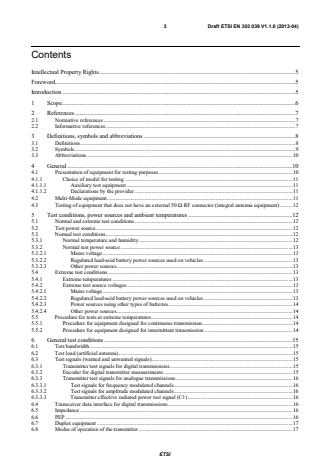
Contents
Intellectual Property Rights . 5
Foreword . 5
Introduction . 5
1 Scope . 6
2 References . 7
2.1 Normative references . 7
2.2 Informative references . 7
3 Definitions, symbols and abbreviations . 8
3.1 Definitions . 8
3.2 Symbols . 9
3.3 Abbreviations . 10
4 General . 10
4.1 Presentation of equipment for testing purposes . 10
4.1.1 Choice of model for testing . 11
4.1.1.1 Auxiliary test equipment . 11
4.1.1.2 Declarations by the provider . 11
4.2 Multi-Mode equipment . 11
4.3 Testing of equipment that does not have an external 50 Ω RF connector (integral antenna equipment) . 12
5 Test conditions, power sources and ambient temperatures . 12
5.1 Normal and extreme test conditions . 12
5.2 Test power source . 12
5.3 Normal test conditions . 12
5.3.1 Normal temperature and humidity . 12
5.3.2 Normal test power source . 13
5.3.2.1 Mains voltage . 13
5.3.2.2 Regulated lead-acid battery power sources used on vehicles . 13
5.3.2.3 Other power sources . 13
5.4 Extreme test conditions . 13
5.4.1 Extreme temperatures . 13
5.4.2 Extreme test source voltages . 13
5.4.2.1 Mains voltage . 13
5.4.2.2 Regulated lead-acid battery power sources used on vehicles . 13
5.4.2.3 Power sources using other types of batteries . 14
5.4.2.4 Other power sources . 14
5.5 Procedure for tests at extreme temperatures . 14
5.5.1 Procedure for equipment designed for continuous transmission. 14
5.5.2 Procedure for equipment designed for intermittent transmission . 14
6 General test conditions . 15
6.1 Test bandwidth . 15
6.2 Test load (artificial antenna) . 15
6.3 Test signals (wanted and unwanted signals) . 15
6.3.1 Transmitter test signals for digital transmissions . 15
6.3.2 Encoder for digital transmitter measurements . 15
6.3.3 Transmitter test signals for analogue transmissions . 16
6.3.3.1 Test signals for frequency modulated channels. 16
6.3.3.2 Test signals for amplitude modulated channels. 16
6.3.3.3 Transmitter effective radiated power test signal (C1) . 16
6.4 Transceiver data interface for digital transmissions . 16
6.5 Impedance . 16
6.6 PEP . 16
6.7 Duplex equipment . 17
6.8 Modes of operation of the transmitter . 17
ETSI
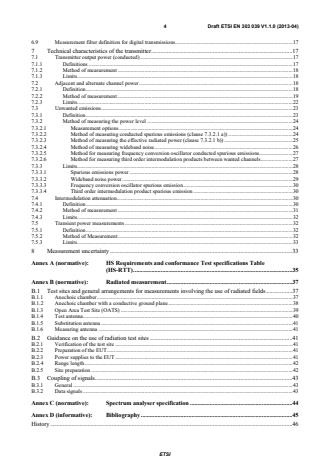
4 Draft ETSI EN 303 039 V1.1.0 (2013-04)
6.9 Measurement filter definition for digital transmissions . 17
7 Technical characteristics of the transmitter . 17
7.1 Transmitter output power (conducted) . 17
7.1.1 Definitions . 17
7.1.2 Method of measurement . 18
7.1.3 Limits . 18
7.2 Adjacent and alternate channel power . 18
7.2.1 Definition . 18
7.2.2 Method of measurement . 19
7.2.3 Limits . 22
7.3 Unwanted emissions . 23
7.3.1 Definition . 23
7.3.2 Method of measuring the power level . 24
7.3.2.1 Measurement options . 24
7.3.2.2 Method of measuring conducted spurious emissions (clause 7.3.2.1 a)) . 24
7.3.2.3 Method of measuring the effective radiated power (clause 7.3.2.1 b)) . 25
7.3.2.4 Method of measuring wideband noise. 26
7.3.2.5 Method for measuring frequency conversion oscillator conducted spurious emissions. 27
7.3.2.6 Method for measuring third order intermodulation products between wanted channels . 27
7.3.3 Limits . 28
7.3.3.1 Spurious emissions power . 28
7.3.3.2 Wideband noise power . 29
7.3.3.3 Frequency conversion oscillator spurious emission . 30
7.3.3.4 Third order intermodulation product spurious emission . 30
7.4 Intermodulation attenuation. 30
7.4.1 Definition . 30
7.4.2 Method of measurement . 31
7.4.3 Limits . 32
7.5 Transient power measurements . 32
7.5.1 Definition . 32
7.5.2 Method of Measurement . 32
7.5.3 Limits . 33
8 Measurement uncertainty . 33
Annex A (normative): HS Requirements and conformance Test specifications Table
(HS-RTT) . 35
Annex B (normative): Radiated measurement . 37
B.1 Test sites and general arrangements for measurements involving the use of radiated fields . 37
B.1.1 Anechoic chamber . 37
B.1.2 Anechoic chamber with a conductive ground plane . 38
B.1.3 Open Area Test Site (OATS) . 39
B.1.4 Test antenna . 40
B.1.5 Substitution antenna . 41
B.1.6 Measuring antenna . 41
B.2 Guidance on the use of radiation test sites . 41
B.2.1 Verification of the test site . 41
B.2.2 Preparation of the EUT . 41
B.2.3 Power supplies to the EUT . 41
B.2.4 Range length . 42
B.2.5 Site preparation . 42
B.3 Coupling of signals . 43
B.3.1 General . 43
B.3.2 Data signals . 43
Annex C (normative): Spectrum analyser specification . 44
Annex D (informative): Bibliography . 45
History . 46
ETSI
5 Draft ETSI EN 303 039 V1.1.0 (2013-04)
Intellectual Property Rights
IPRs essential or potentially essential to the present document may have been declared to ETSI. The information
pertaining to these essential IPRs, if any, is publicly available for ETSI members and non-members, and can be found
in ETSI SR 000 314: "Intellectual Property Rights (IPRs); Essential, or potentially Essential, IPRs notified to ETSI in
respect of ETSI standards", which is available from the ETSI Secretariat. Latest updates are available on the ETSI Web
server (http://ipr.etsi.org).
Pursuant to the ETSI IPR Policy, no investigation, including IPR searches, has been carried out by ETSI. No guarantee
can be given as to the existence of other IPRs not referenced in ETSI SR 000 314 (or the updates on the ETSI Web
server) which are, or may be, or may become, essential to the present document.
Foreword
This draft Harmonized European Standard (EN) has been produced by ETSI Technical Committee Electromagnetic
compatibility and Radio spectrum Matters (ERM), and is now submitted for the combined Public Enquiry and Vote
phase of the ETSI standards EN Approval Procedure.
The present document has been produced by ETSI in response to mandate M/284 from the European Commission
issued under Directive 98/34/EC [i.4] as amended by Directive 98/48/EC [i.14].
The title and reference to the present document are intended to be included in the publication in the Official Journal of
the European Union of titles and references of Harmonized Standard under the Directive 1999/5/EC [i.3].
See article 5.1 of Directive 1999/5/EC for information on presumption of conformity and Harmonised Standards or
parts thereof the references of which have been published in the Official Journal of the European Union.
The requirements relevant to Directive 1999/5/EC [i.3] are summarized in annex A.
Proposed national transposition dates
Date of latest announcement of this EN (doa): 3 months after ETSI publication
Date of latest publication of new National Standard
or endorsement of this EN (dop/e): 6 months after doa
Date of withdrawal of any conflicting National Standard (dow): 18 months after doa
Introduction
The present document is part of a set of standards developed by ETSI and is designed to fit in a modular structure to
cover all radio and telecommunications terminal equipment within the scope of the R&TTE Directive [i.3]. The
modular structure is shown in EG 201 399 [i.2].
ETSI
6 Draft ETSI EN 303 039 V1.1.0 (2013-04)
1 Scope
The present document covers the technical requirements for multiple channel radio transmitters used in stations in the
Private Mobile Radio (PMR) service.
It applies to use in the land mobile service, operating on radio frequencies between 30 MHz and 3 GHz, with channel
separations of <10 kHz, 12,5 kHz, 20 kHz, 25 kHz, 50 kHz, 100 kHz and 150 kHz.
Table 1: Radiocommunications service frequency bands
Radiocommunications service frequency bands
Transmit 30 MHz to 3 000 MHz
It applies to equipment for continuous and/or discontinuous transmission of data and/or digital speech and/or analogue
speech and using constant envelope or non-constant envelope modulation.
The equipment comprises a transmitter capable of simultaneous amplification or transmission on two or more RF
channels, or an amplifier which when operated with transmitter equipment provides simultaneous transmission on two
or more RF channels. The types of equipment covered by the present document are as follows:
• base station (equipment fitted with an antenna connector, intended for use in a fixed location);
• mobile station (equipment fitted with an antenna connector, normally used in a vehicle or as a transportable);
• those hand portable stations:
a) fitted with an antenna connector; or
b) without an external antenna connector (integral antenna equipment), but fitted with a permanent internal
or a temporary internal 50 Ω Radio Frequency (RF) connector which allows access to the transmitter
output.
• and any equipment that may be used in combination with any of the above equipments when directly
connected to those equipments for the amplification of the transmitter output signals of two or more individual
equipments.
Types of equipment not covered by the present document are as follows:
• hand portable equipment without an external or internal RF connector and without the possibility of having a
temporary internal 50 Ω RF connector is not covered by the present document;
• any equipment using passive combining solutions where each transmitter connected to the passive combining
system transmits on a single channel, as detailed in EG 200 053 [i.13], clause H.3.
These specifications apply to the transmitter or transmitter amplifier only. If a receiver is fitted to the same equipment,
the receiver specifications in the relevant specification (references [i.5] to [i.12]) should apply.
These specifications do not necessarily include all the characteristics that may be required by a user of equipment, nor
do they necessarily represent the optimum performance achievable.
The present document is intended to cover the provisions of article 3.2 of Directive 1999/5/EC [i.3] (R&TTE
Directive), which states that "… radio equipment shall be so constructed that it effectively uses the spectrum allocated
to terrestrial/space radio communications and orbital resources so as to avoid harmful interference".
In addition to the present document, other ENs that specify technical requirements in respect of essential requirements
under other parts of article 3 of the R&TTE Directive [i.3] may apply to equipment within the scope of the present
document.
NOTE: A list of such ENs is included on the web site http://www.newapproach.org.
ETSI
7 Draft ETSI EN 303 039 V1.1.0 (2013-04)
2 References
References are either specific (identified by date of publication and/or edition number or version number) or
non-specific. For specific references, only the cited version applies. For non-specific references, the latest version of the
referenced document (including any amendments) applies.
Referenced documents which are not found to be publicly available in the expected location might be found at
http://docbox.etsi.org/Reference.
NOTE: While any hyperlinks included in this clause were valid at the time of publication, ETSI cannot guarantee
their long term validity.
2.1 Normative references
The following referenced documents are necessary for the application of the present document.
[1] Recommendation ITU-T O.153 (1992): "Basic parameters for the measurement of error
performance at bit rates below the primary rate".
[2] ETSI TR 100 028 (V1.4.1) (2001) (all parts): "Electromagnetic compatibility and Radio spectrum
Matters (ERM); Uncertainties in the measurement of mobile radio equipment characteristics".
[3] ETSI TR 102 273 (V1.2.1) (2001) (all parts): "Electromagnetic compatibility and Radio spectrum
Matters (ERM); Improvement on Radiated Methods of Measurement (using test site) and
evaluation of the corresponding measurement uncertainties".
[4] ANSI C63.5 (2004): "American National Standard for Electromagnetic Compatibility-Radiated
Emission Measurements in Electromagnetic Interference (EMI) Control-Calibration of Antennas
(9 kHz to 40 GHz)".
2.2 Informative references
The following referenced documents are not necessary for the application of the present document but they assist the
user with regard to a particular subject area.
[i.1] CEPT/ERC/REC 74-01 (2011): "Unwanted Emissions in the Spurious domain".
[i.2] ETSI EG 201 399 (V2.1.1): "Electromagnetic compatibility and Radio spectrum Matters (ERM);
A guide to the production of candidate Harmonized Standards for application under the R&TTE
Directive".
[i.3] Directive 1999/5/EC of the European Parliament and of the Council of 9 March 1999 on radio
equipment and telecommunications terminal equipment and the mutual recognition of their
conformity (R&TTE Directive).
[i.4] Directive 98/34/EC of the European Parliament and of the Council of 22 June 1998 laying down a
procedure for the provision of information in the field of technical standards and regulations.
[i.5] ETSI EN 300 392-2: "Terrestrial Trunked Radio (TETRA); Voice plus Data (V+D); Part 2: Air
Interface (AI)".
[i.6] ETSI EN 302 561: "Electromagnetic compatibility and Radio spectrum Matters (ERM); Land
Mobile Service; Radio equipment using constant or non-constant envelope modulation operating
in a channel bandwidth of 25 kHz, 50 kHz, 100 kHz or 150 kHz; Harmonized EN covering
essential requirements of article 3.2 of the R&TTE Directive".
[i.7] ETSI EN 300 086: "Radio equipment with an internal or external RF connector intended primarily
for analogue speech".
[i.8] ETSI EN 300 113: "Radio equipment intended for the transmission of data (and/or speech) using
constant or non-constant envelope modulation and having an antenna connector".
ETSI
8 Draft ETSI EN 303 039 V1.1.0 (2013-04)
[i.9] ETSI EN 300 296: "Radio equipment using integral antennas intended primarily for analogue
speech".
[i.10] ETSI EN 300 341: "Radio equipment using an integral antenna transmitting signals to initiate a
specific response in the receiver".
[i.11] ETSI EN 300 390: "Radio equipment intended for the transmission of data (and speech) and using
an integral antenna".
[i.12] ETSI EN 301 166: "Technical characteristics and test conditions for radio equipment for analogue
and/or digital communication (speech and/or data) and operating on narrowband channels and
having an antenna connector".
[i.13] ETSI EG 200 053: "Electromagnetic compatibility and Radio spectrum Matters (ERM); Radio site
engineering for radio equipment and systems".
[i.14] Directive 98/48/EC of the European Parliament and of the Council of 20 July 1998 amending
Directive 98/34/EC laying down a procedure for the provision of information in the field of
technical standards and regulations.
3 Definitions, symbols and abbreviations
3.1 Definitions
For the purposes of the present document, the following terms and definitions apply:
base station: equipment fitted with an antenna connector, for use with an external antenna, and intended for use in a
fixed location
bit: binary digit
block: smallest quantity of information that is sent over the radio channel
NOTE: A constant number of useful bits are always sent together with the corresponding redundancy bits.
burst or transmission (physical): one or several packets transmitted between power on and power off of a particular
transmitter
channel: width of a single frequency band which is just sufficient to ensure the transmission of all necessary
information at the rate and with the quality required under specified conditions to one or more receivers
conducted measurements: measurements which are made using direct 50 Ω connection to the equipment under test
data transmission systems: systems which transmit and/or receive data and/or digitized voice
hand portable station: equipment either fitted with an antenna connector or integral antenna, or both, normally used on
a stand-alone basis, to be carried on a person or held in the hand
integral antenna: antenna designed to be connected to the equipment without the use of a 50 Ω external connector and
considered to be part of the equipment
NOTE: An integral antenna may be fitted internally or externally to the equipment.
message: user data to be transferred in one or more packets
mobile station: mobile equipment fitted with an antenna connector, for use with an external antenna, normally used in
a vehicle or as a transportable station
necessary bandwidth: width of the frequency band covering the envelope of the transmitted channels, which is just
sufficient to ensure the transmission of information at the rate and with the quality required under specified conditions
for all transmitted channels
ETSI
9 Draft ETSI EN 303 039 V1.1.0 (2013-04)
packet: one block or a contiguous stream of blocks sent by one (logical) transmitter to one particular receiver or one
particular group of receivers
radiated measurements: measurements which involve the absolute measurement of a radiated field
receive band: frequency band which is used by one or more receivers paired with the transmitter
spurious emissions: unwanted emissions in the spurious domain
switching range (sr): maximum frequency range, as specified by the manufacturer, over which the receiver or the
transmitter can be operated within the alignment range without reprogramming or realignment
testing laboratory: laboratory that performs tests
transmit band of the equipment: maximum frequency range (declared by the manufacturer) over which the
transmitter can be operated without reprogramming or realignment
useful part of the burst: For digital modulation the period of time between the centre of the first modulation symbol
and centre of the last modulation symbol of a individual transmission; for analogue modulation the period of time over
which modulation is present or as defined by the power vs. time profile in figure 1.
Figure 1: Useful part of the burst shown for analogue transmissions (constant envelope)
wanted bandwidth of a channel: bandwidth required for any single channel within the necessary bandwidth of the
transmitter which is necessary to ensure the transmission of information at the rate and with the quality required under
specified conditions for that channel only
3.2 Symbols
For the purposes of the present document, the following symbols apply:
A1, A2, B1, M1, M2, etc. names of test signals defined in clause 6.3
α filter rolloff factor
B 1 centre frequency of out-of-band domain at higher frequency than transmitter centre
high
frequency
B 2 highest frequency of out-of-band domain
high
B 1 centre frequency of out-of-band domain at lower frequency than transmitter centre
low
frequency
B 2 lowest frequency of out-of-band domain
low
B necessary bandwidth
N
BW bandwidth of a channel
dB decibel
ETSI
10 Draft ETSI EN 303 039 V1.1.0 (2013-04)
dBm dB relative to 1 mW
dBμV dB relative to 1 μV
f transmitter centre frequency
c
f channel centre frequency
ch
f highest frequency of transmitter necessary bandwidth
high
f
LO local Oscillator frequency
f lowest frequency of transmitter necessary bandwidth
low
f the frequency offset corresponding to the near edge of the receive band
rb
I Intermodulation product generated between two wanted channels
i
PR rms power of a single channel
PRX the value of power PR for the channel with the greatest value of PR
PX maximum power of transmitter
T minimum extreme test Temperature
min
T maximum extreme test Temperature
max
V minimum extreme test Voltage
min
V maximum extreme test Voltage
max
λ wavelength
3.3 Abbreviations
For the purposes of the present document, the following abbreviations apply:
ac alternating current
BS Base Station
BW BandWidth
CSP Channel SeParation
CW Continuous Wave
dBc decibels relative to the transmitter power
EUT Equipment Under Test
GMSK Gaussian Minimum Shift Keying
MBW Measurement BandWidth
MS Mobile Station
OATS Open Area Test Site
PEP Peak Envelope Power
PMR Private Mobile Radio
ppm parts per million
RF Radio Frequency
rms root mean square
sr switching range
Tx Transmitter
VSWR Voltage Standing Wave Ratio
4 General
4.1 Presentation of equipment for testing purposes
Each equipment submitted to be tested shall fulfil the requirements of the present document on all frequencies over
which it is intended to operate.
The radio tests shall be performed with the centre frequency of the equipment configured in turn on the lowest, the
highest and the middle radio frequency of the tunable range of the equipment. In each case, tests shall be carried out
using the maximum number of channels of which the equipment is capable, with the greatest bandwidth between
highest and lowest channel frequencies transmitted by the equipment (i.e. with the maximum necessary bandwidth of
the equipment).
ETSI
11 Draft ETSI EN 303 039 V1.1.0 (2013-04)
The provider or manufacturer shall declare the tunable frequency ranges, the maximum necessary bandwidth of the
equipment, the minimum spacing between channels, the maximum number of channels, the modes of operation (e.g.
continuous or intermittent transmission) and if transmission can be intermittent, the burst lengths and repetition
frequencies and the range of operating conditions and power requirements as applicable, to establish the appropriate test
conditions. The manufacture shall also state the frequency range of the receive band intended for use with receivers
paired with the equipment.
Specific parameters required for testing, such as frequency conversion oscillator frequency and tuning range, shall also
be supplied.
Additionally, technical documentation and operating manuals, sufficient to make the test, shall be supplied.
4.1.1 Choice of model for testing
The provider or manufacturer shall provide one or more samples of the equipment, as appropriate for testing.
Stand-alone equipment shall be complete with any ancillary equipment needed for testing.
If an equipment has several optional features, considered not to affect the RF parameters then the tests need only to be
performed on the equipment configured with the combination of features considered to be the most complex. Where
practicable, equipment to be tested shall provide a 50 Ω connector for conducted RF power level measurements.
In the case of integral antenna equipment, if the equipment does not have an internal permanent 50 Ω connector then it
is permissible to supply a second sample of the equipment with a temporary antenna connector fitted to facilitate
testing.
The test connector shall also provide any test signalling data.
The performance of the equipment to be tested shall be representative of the performance of the corresponding
production model.
4.1.1.1 Auxiliary test equipment
All necessary test signal sources, setting up instructions and other product information shall accompany the equipment
to be tested.
4.1.1.2 Declarations by the provider
The provider or manufacturer shall declare the necessary information of the equipment with respect to all technical
requirements set by the present document.
4.2 Multi-Mode equipment
In the case of equipment where channels can be configured to operate with more than one channel bandwidth,
measurements shall be performed at least with the highest and the lowest of each channel bandwidth implemented.
Where the equipment supports different modulation types, or different modulation levels within the same type, a
representative set of modulation types and levels shall be tested. At least the modulation with the highest number of
modulation states per modulation symbol shall be tested.
ETSI
12 Draft ETSI EN 303 039 V1.1.0 (2013-04)
4.3 Testing of equipment that does not have an external 50 Ω
RF connector (integral antenna equipment)
Where equipment has an internal 50 Ω connector it shall be permitted to perform the tests at this connector.
Equipment may also have a temporary internal 50 Ω connector installed for the purposes of testing.
No connection shall be made to any internal permanent or temporary antenna connector during the performance of
radiated emissions measurements, unless such action forms an essential part of the normal intended operation of the
equipment, as declared by the manufacturer.
5 Test conditions, power sources and ambient
temperatures
5.1 Normal and extreme test conditions
Testing shall be performed under normal test conditions, and also, where stated, under extreme test conditions.
The test conditions and procedures shall be as specified in clauses 5.2 to 5.5.
5.2 Test power source
During testing the power source of the equipment shall be replaced by a test power source capable of producing normal
and extreme test voltages as specified in clauses 5.3.2 and 5.4.2. The internal impedance of the test power source shall
be low enough for its effect on the test results to be negligible. For the purpose of tests, the voltage of the power source
shall be measured at the input terminals of the equipment.
For battery operated equipment the battery shall be removed and the test power source shall be applied as close to the
battery terminals as practicable.
During tests of DC powered equipment the power source voltages shall be maintained within a tolerance of < ±1 %
relative to the voltage at the beginning of each test. The value of this tolerance is critical for power measurements, using
a smaller tolerance will provide better measurement uncertainty values.
5.3 Normal test conditions
5.3.1 Normal temperature and humidity
The normal temperature and humidity conditions for tests shall be any convenient combination of temperature and
humidity within the following ranges:
temperature: +15 °C to +35 °C;
relative humidity: 20 % to 75 %.
When it is impracticable to carry out the tests under these conditions, a note to this effect, stating the ambient
temperature and relative humidity during the tests, shall be added to the test report.
ETSI
13 Draft ETSI EN 303 039 V1.1.0 (2013-04)
5.3.2 Normal test power source
5.3.2.1 Mains voltage
The normal test voltage for equipment to be connected to the mains shall be the nominal mains voltage. For the purpose
of the present document, the nominal voltage shall be the declared voltage or any of the declared voltages for which the
equipment was designed.
The frequency of the test power source corresponding to the ac mains shall be between 49 Hz and 51 Hz.
5.3.2.2 Regulated lead-acid battery power sources used on vehicles
When the radio equipment is intended for operation from the usual types of regulated lead-acid battery power source
used on vehicles the normal test voltage shall be 1,1 times the nominal voltage of the battery (for nominal voltages of
6 V and 12 V, these are 6,6 V and 13,2 V respectively).
5.3.2.3 Other power sources
For operation from other power sources or types of battery (primary or secondary), the normal test voltage shall be that
declared by the equipment manufacturer.
5.4 Extreme test conditions
5.4.1 Extreme temperatures
For tests at extreme temperatures, measurements shall be made in accordance with the procedures specified in
clause 5.5, at the upper and lower temperatures of one of the following two ranges:
• -20 °C to +55 °C;
All mobile and hand portable equipment.
Base stations for outdoor/uncontrolled climate conditions.
• 0 °C to +40 °C;
Base stations for indoor/controlled climate conditions.
In the case of base stations equipment, the manufacturer shall declare which conditions the equipment is intended to be
installed in.
5.4.2 Extreme test source voltages
5.4.2.1 Mains voltage
The extreme test voltage for equipment to be connected to an ac mains source shall be the nominal mains
voltage ±10 %.
5.4.2.2 Regulated lead-acid battery power sources used on vehicles
When the equipment is intended for operation from the usual types of regulated lead-acid battery power sources used on
vehicles the extreme test voltages shall be 1,3 and 0,9 times the nominal voltage of the battery (for a nominal voltage of
6 V, these are 7,8 V and 5,4 V respectively and for a nominal voltage of 12 V, these are 15,6 V and 10,8 V
respectively).
ETSI
14 Draft ETSI EN 303 039 V1.1.0 (2013-04)
5.4.2.3 Power sources using other types of batteries
The lower extreme test voltages for equipment with power sources using batteries shall be as follows:
• for the nickel metal-hydride, leclanché or lithium type: 0,85 times the nominal battery voltage;
• for the mercury or nickel-cadmium type: 0,9 times the nominal battery voltage.
No upper extreme test voltages apply.
In the case where no upper extreme test voltage the nominal voltage is applicable, the corresponding four extreme test
conditions are:
• V /T , V /T ;
min min min max
• (V = nominal)/T , (V = nominal)/T .
max min max max
5.4.2.4 Other power sources
For equipment using other power sources, or capable of being operated from a variety of power sources, the extreme test
voltages shall be those declared by the equipment manufacturer.
5.5 Procedure for tests at extreme temperatures
Before measurements are made the equipment shall have reached thermal balance in the test chamber. The equipment
shall be switched off during the temperature stabilizing period.
In the case of equipment containing temperature stabilization circuits designed to operate continuously, the temperature
stabilization circuits may be switched on for 15 minutes after thermal balance has been obtained, and the equipment
shall then meet the specified requirements. For such equipment the manufacturer shall provide for the power source
circuit feeding the crystal oven to be independent of the power source for the rest of the equipment.
If the thermal balance is not checked by measurements, a temperature stabilizing period of at least one hour, or a longer
period as may be decided by the testing laboratory, shall be allowed. The sequence of measurements shall be chosen
...
Final draft ETSI EN 303 039 V1.1.1 (2014-01)
Harmonized European Standard
Electromagnetic compatibility and
Radio spectrum Matters (ERM);
Land Mobile Service; Multichannel transmitter
specification for the PMR Service;
Harmonized EN covering the essential requirements
of article 3.2 of the R&TTE Directive
2 Final draft ETSI EN 303 039 V1.1.1 (2014-01)
Reference
DEN/ERM-TGDMR-314
Keywords
data, mobile, PMR, radio
ETSI
650 Route des Lucioles
F-06921 Sophia Antipolis Cedex - FRANCE
Tel.: +33 4 92 94 42 00 Fax: +33 4 93 65 47 16
Siret N° 348 623 562 00017 - NAF 742 C
Association à but non lucratif enregistrée à la
Sous-Préfecture de Grasse (06) N° 7803/88
Important notice
Individual copies of the present document can be downloaded from:
http://www.etsi.org
The present document may be made available in more than one electronic version or in print. In any case of existing or
perceived difference in contents between such versions, the reference version is the Portable Document Format (PDF).
In case of dispute, the reference shall be the printing on ETSI printers of the PDF version kept on a specific network drive
within ETSI Secretariat.
Users of the present document should be aware that the document may be subject to revision or change of status.
Information on the current status of this and other ETSI documents is available at
http://portal.etsi.org/tb/status/status.asp
If you find errors in the present document, please send your comment to one of the following services:
http://portal.etsi.org/chaircor/ETSI_support.asp
Copyright Notification
No part may be reproduced except as authorized by written permission.
The copyright and the foregoing restriction extend to reproduction in all media.
© European Telecommunications Standards Institute 2014.
All rights reserved.
TM TM TM
DECT , PLUGTESTS , UMTS and the ETSI logo are Trade Marks of ETSI registered for the benefit of its Members.
TM
3GPP and LTE™ are Trade Marks of ETSI registered for the benefit of its Members and
of the 3GPP Organizational Partners.
GSM® and the GSM logo are Trade Marks registered and owned by the GSM Association.
ETSI
3 Final draft ETSI EN 303 039 V1.1.1 (2014-01)
Contents
Intellectual Property Rights . 5
Foreword . 5
Introduction . 5
1 Scope . 6
2 References . 7
2.1 Normative references . 7
2.2 Informative references . 7
3 Definitions, symbols and abbreviations . 8
3.1 Definitions . 8
3.2 Symbols . 9
3.3 Abbreviations . 10
4 General . 11
4.1 Presentation of equipment for testing purposes . 11
4.1.1 Choice of model for testing . 11
4.1.1.1 Auxiliary test equipment . 11
4.1.1.2 Declarations by the provider . 11
4.2 Multi-Mode equipment . 12
4.3 Testing of equipment that does not have an external 50 Ω RF connector (integral antenna equipment) . 12
5 Test conditions, power sources and ambient temperatures . 12
5.1 Normal and extreme test conditions . 12
5.2 Test power source . 12
5.3 Normal test conditions . 12
5.3.1 Normal temperature and humidity . 12
5.3.2 Normal test power source . 13
5.3.2.1 Mains voltage . 13
5.3.2.2 Regulated lead-acid battery power sources used on vehicles . 13
5.3.2.3 Other power sources . 13
5.4 Extreme test conditions . 13
5.4.1 Extreme temperatures . 13
5.4.2 Extreme test source voltages . 13
5.4.2.1 Mains voltage . 13
5.4.2.2 Regulated lead-acid battery power sources used on vehicles . 13
5.4.2.3 Power sources using other types of batteries . 14
5.4.2.4 Other power sources . 14
5.5 Procedure for tests at extreme temperatures . 14
5.5.1 Procedure for equipment designed for continuous transmission. 14
5.5.2 Procedure for equipment designed for intermittent transmission . 14
6 General test conditions . 15
6.1 Test bandwidth . 15
6.2 Test load (artificial antenna) . 15
6.3 Test signals (wanted and unwanted signals) . 15
6.3.1 Transmitter test signals for digital transmissions . 15
6.3.2 Encoder for digital transmitter measurements . 15
6.3.3 Transmitter test signals for analogue transmissions . 16
6.3.3.1 Test signals for frequency modulated channels. 16
6.3.3.2 Test signals for amplitude modulated channels. 16
6.3.3.3 Transmitter effective radiated power test signal (C1) . 16
6.4 Transceiver data interface for digital transmissions . 16
6.5 Impedance . 16
6.6 PEP . 16
6.7 Duplex equipment . 17
6.8 Modes of operation of the transmitter . 17
6.9 Measurement filter definition for digital transmissions . 17
ETSI
4 Final draft ETSI EN 303 039 V1.1.1 (2014-01)
7 Technical characteristics of the transmitter . 17
7.1 Transmitter output power (conducted) . 17
7.1.1 Definitions . 17
7.1.2 Method of measurement . 18
7.1.3 Limits . 18
7.2 Adjacent and alternate channel power . 18
7.2.1 Definition . 18
7.2.2 Method of measurement . 19
7.2.3 Limits . 22
7.3 Unwanted emissions . 23
7.3.1 Definition . 23
7.3.2 Method of measuring the power level . 24
7.3.2.1 Measurement options . 24
7.3.2.2 Method of measuring conducted spurious emissions (clause 7.3.2.1 a)) . 24
7.3.2.3 Method of measuring the effective radiated power (clause 7.3.2.1 b)) . 25
7.3.2.4 Method of measuring wideband noise. 26
7.3.2.5 Method for measuring frequency conversion oscillator conducted spurious emissions. 27
7.3.2.6 Method for measuring third order intermodulation products between wanted channels . 28
7.3.3 Limits . 28
7.3.3.1 Spurious emissions power . 28
7.3.3.2 Wideband noise power . 29
7.3.3.3 Frequency conversion oscillator spurious emission . 30
7.3.3.4 Third order intermodulation product spurious emission . 30
7.4 Intermodulation attenuation. 31
7.4.1 Definition . 31
7.4.2 Method of measurement . 31
7.4.3 Limits . 32
7.5 Transient power measurements . 32
7.5.1 Definition . 32
7.5.2 Method of Measurement . 32
7.5.3 Limits . 33
8 Measurement uncertainty . 33
Annex A (normative): HS Requirements and conformance Test specifications Table
(HS-RTT) . 35
Annex B (normative): Radiated measurement . 37
B.1 Test sites and general arrangements for measurements involving the use of radiated fields . 37
B.1.1 Anechoic chamber . 37
B.1.2 Anechoic chamber with a conductive ground plane . 38
B.1.3 Open Area Test Site (OATS) . 39
B.1.4 Test antenna . 40
B.1.5 Substitution antenna . 41
B.1.6 Measuring antenna . 41
B.2 Guidance on the use of radiation test sites . 41
B.2.1 Verification of the test site . 41
B.2.2 Preparation of the EUT . 41
B.2.3 Power supplies to the EUT . 41
B.2.4 Range length . 42
B.2.5 Site preparation . 42
B.3 Coupling of signals . 43
B.3.1 General . 43
B.3.2 Data signals . 43
Annex C (normative): Spectrum analyser specification . 44
Annex D (informative): Bibliography . 45
History . 46
ETSI
5 Final draft ETSI EN 303 039 V1.1.1 (2014-01)
Intellectual Property Rights
IPRs essential or potentially essential to the present document may have been declared to ETSI. The information
pertaining to these essential IPRs, if any, is publicly available for ETSI members and non-members, and can be found
in ETSI SR 000 314: "Intellectual Property Rights (IPRs); Essential, or potentially Essential, IPRs notified to ETSI in
respect of ETSI standards", which is available from the ETSI Secretariat. Latest updates are available on the ETSI Web
server (http://ipr.etsi.org).
Pursuant to the ETSI IPR Policy, no investigation, including IPR searches, has been carried out by ETSI. No guarantee
can be given as to the existence of other IPRs not referenced in ETSI SR 000 314 (or the updates on the ETSI Web
server) which are, or may be, or may become, essential to the present document.
Foreword
This final draft Harmonized European Standard (EN) has been produced by ETSI Technical Committee
Electromagnetic compatibility and Radio spectrum Matters (ERM), and is now submitted for the Vote phase of the
ETSI standards EN Approval Procedure.
The present document has been produced by ETSI in response to mandate M/284 issued from the European
Commission under Directive 98/34/EC [i.4] as amended by Directive 98/48/EC [i.14].
The title and reference to the present document are intended to be included in the publication in the Official Journal of
the European Union of titles and references of Harmonized Standard under the Directive 1999/5/EC [i.3].
See article 5.1 of Directive 1999/5/EC for information on presumption of conformity and Harmonized Standards or
parts thereof the references of which have been published in the Official Journal of the European Union.
The requirements relevant to Directive 1999/5/EC [i.3] are summarized in annex A.
Proposed national transposition dates
Date of latest announcement of this EN (doa): 3 months after ETSI publication
Date of latest publication of new National Standard
or endorsement of this EN (dop/e): 6 months after doa
Date of withdrawal of any conflicting National Standard (dow): 18 months after doa
Introduction
The present document is part of a set of standards developed by ETSI and is designed to fit in a modular structure to
cover all radio and telecommunications terminal equipment within the scope of the R&TTE Directive [i.3]. The
modular structure is shown in EG 201 399 [i.2].
ETSI
6 Final draft ETSI EN 303 039 V1.1.1 (2014-01)
1 Scope
The present document covers the technical requirements for multiple channel radio transmitters used in stations in the
Private Mobile Radio (PMR) service.
It applies to use in the land mobile service, operating on radio frequencies between 30 MHz and 3 GHz, with channel
separations of < 10 kHz, 12,5 kHz, 20 kHz, 25 kHz, 50 kHz, 100 kHz and 150 kHz.
Table 1: Radiocommunications service frequency bands
Radiocommunications service frequency bands
Transmit 30 MHz to 3 000 MHz
It applies to equipment for continuous and/or discontinuous transmission of data and/or digital speech and/or analogue
speech and using constant envelope or non-constant envelope modulation.
The equipment comprises a transmitter capable of simultaneous amplification or transmission on two or more RF
channels, or an amplifier which when operated with transmitter equipment provides simultaneous transmission on two
or more RF channels. The types of equipment covered by the present document are as follows:
• base station (equipment fitted with an antenna connector, intended for use in a fixed location);
• mobile station (equipment fitted with an antenna connector, normally used in a vehicle or as a transportable);
• those hand portable stations:
a) fitted with an antenna connector; or
b) without an external antenna connector (integral antenna equipment), but fitted with a permanent internal
or a temporary internal 50 Ω Radio Frequency (RF) connector which allows access to the transmitter
output;
• and any equipment that may be used in combination with any of the above equipments when directly
connected to those equipments for the amplification of the transmitter output signals of two or more individual
equipments.
Types of equipment not covered by the present document are as follows:
• hand portable equipment without an external or internal RF connector and without the possibility of having a
temporary internal 50 Ω RF connector is not covered by the present document;
• any equipment using passive combining solutions where each transmitter connected to the passive combining
system transmits on a single channel, as detailed in EG 200 053 [i.13], clause H.3.
These specifications apply to the transmitter or transmitter amplifier only. If a receiver is fitted to the same equipment,
the receiver specifications in the relevant specification (references [i.5] to [i.12]) should apply.
These specifications do not necessarily include all the characteristics that may be required by a user of equipment, nor
do they necessarily represent the optimum performance achievable.
The present document is intended to cover the provisions of article 3.2 of Directive 1999/5/EC [i.3] (R&TTE
Directive), which states that "… radio equipment shall be so constructed that it effectively uses the spectrum allocated
to terrestrial/space radio communications and orbital resources so as to avoid harmful interference".
In addition to the present document, other ENs that specify technical requirements in respect of essential requirements
under other parts of article 3 of the R&TTE Directive [i.3] may apply to equipment within the scope of the present
document.
NOTE: A list of such ENs is included on the web site http://www.newapproach.org.
ETSI
7 Final draft ETSI EN 303 039 V1.1.1 (2014-01)
2 References
References are either specific (identified by date of publication and/or edition number or version number) or
non-specific. For specific references, only the cited version applies. For non-specific references, the latest version of the
referenced document (including any amendments) applies.
Referenced documents which are not found to be publicly available in the expected location might be found at
http://docbox.etsi.org/Reference.
NOTE: While any hyperlinks included in this clause were valid at the time of publication, ETSI cannot guarantee
their long term validity.
2.1 Normative references
The following referenced documents are necessary for the application of the present document.
[1] Recommendation ITU-T O.153 (1992): "Basic parameters for the measurement of error
performance at bit rates below the primary rate".
[2] ETSI TR 100 028 (V1.4.1) (2001) (all parts): "Electromagnetic compatibility and Radio spectrum
Matters (ERM); Uncertainties in the measurement of mobile radio equipment characteristics".
[3] ETSI TR 102 273 (V1.2.1) (2001) (all parts): "Electromagnetic compatibility and Radio spectrum
Matters (ERM); Improvement on Radiated Methods of Measurement (using test site) and
evaluation of the corresponding measurement uncertainties".
[4] ANSI C63.5 (2004): "American National Standard for Electromagnetic Compatibility-Radiated
Emission Measurements in Electromagnetic Interference (EMI) Control-Calibration of Antennas
(9 kHz to 40 GHz)".
2.2 Informative references
The following referenced documents are not necessary for the application of the present document but they assist the
user with regard to a particular subject area.
[i.1] CEPT/ERC/REC 74-01 (2011): "Unwanted Emissions in the Spurious domain".
[i.2] ETSI EG 201 399 (V2.1.1): "Electromagnetic compatibility and Radio spectrum Matters (ERM);
A guide to the production of candidate Harmonized Standards for application under the R&TTE
Directive".
[i.3] Directive 1999/5/EC of the European Parliament and of the Council of 9 March 1999 on radio
equipment and telecommunications terminal equipment and the mutual recognition of their
conformity (R&TTE Directive).
[i.4] Directive 98/34/EC of the European Parliament and of the Council of 22 June 1998 laying down a
procedure for the provision of information in the field of technical standards and regulations.
[i.5] ETSI EN 300 392-2: "Terrestrial Trunked Radio (TETRA); Voice plus Data (V+D); Part 2: Air
Interface (AI)".
[i.6] ETSI EN 302 561: "Electromagnetic compatibility and Radio spectrum Matters (ERM); Land
Mobile Service; Radio equipment using constant or non-constant envelope modulation operating
in a channel bandwidth of 25 kHz, 50 kHz, 100 kHz or 150 kHz; Harmonized EN covering
essential requirements of article 3.2 of the R&TTE Directive".
[i.7] ETSI EN 300 086: "Electromagnetic compatibility and Radio spectrum Matters (ERM); Land
Mobile Service; Radio equipment with an internal or external RF connector intended primarily for
analogue speech".
ETSI
8 Final draft ETSI EN 303 039 V1.1.1 (2014-01)
[i.8] ETSI EN 300 113: "Electromagnetic compatibility and Radio spectrum Matters (ERM); Land
mobile service; Radio equipment intended for the transmission of data (and/or speech) using
constant or non-constant envelope modulation and having an antenna connector".
[i.9] ETSI EN 300 296: "Electromagnetic compatibility and Radio spectrum Matters (ERM); Land
Mobile Service; Radio equipment using integral antennas intended primarily for analogue speech".
[i.10] ETSI EN 300 341: "Electromagnetic compatibility and Radio spectrum Matters (ERM); Land
Mobile Service (RP 02); Radio equipment using an integral antenna transmitting signals to initiate
a specific response in the receiver".
[i.11] ETSI EN 300 390: "Electromagnetic compatibility and Radio spectrum Matters (ERM); Land
Mobile Service; Radio equipment intended for the transmission of data (and speech) and using an
integral antenna".
[i.12] ETSI EN 301 166: "ElectroMagnetic Compatibility and Radio spectrum Matters (ERM); Land
mobile service; Technical characteristics and test conditions for radio equipment for analogue
and/or digital communication (speech and/or data) and operating on narrowband channels and
having an antenna connector".
[i.13] ETSI EG 200 053: "Electromagnetic compatibility and Radio spectrum Matters (ERM); Radio site
engineering for radio equipment and systems".
[i.14] Directive 98/48/EC of the European Parliament and of the Council of 20 July 1998 amending
Directive 98/34/EC laying down a procedure for the provision of information in the field of
technical standards and regulations.
3 Definitions, symbols and abbreviations
3.1 Definitions
For the purposes of the present document, the following terms and definitions apply:
base station: equipment fitted with an antenna connector, for use with an external antenna, and intended for use in a
fixed location
bit: binary digit
block: smallest quantity of information that is sent over the radio channel
NOTE: A constant number of useful bits are always sent together with the corresponding redundancy bits.
burst or transmission (physical): one or several packets transmitted between power on and power off of a particular
transmitter
channel: width of a single frequency band which is just sufficient to ensure the transmission of all necessary
information at the rate and with the quality required under specified conditions to one or more receivers
conducted measurements: measurements which are made using direct 50 Ω connection to the equipment under test
data transmission systems: systems which transmit and/or receive data and/or digitized voice
hand portable station: equipment either fitted with an antenna connector or integral antenna, or both, normally used on
a stand-alone basis, to be carried on a person or held in the hand
integral antenna: antenna designed to be connected to the equipment without the use of a 50 Ω external connector and
considered to be part of the equipment
NOTE: An integral antenna may be fitted internally or externally to the equipment.
message: user data to be transferred in one or more packets
ETSI
9 Final draft ETSI EN 303 039 V1.1.1 (2014-01)
mobile station: mobile equipment fitted with an antenna connector, for use with an external antenna, normally used in
a vehicle or as a transportable station
necessary bandwidth: width of the frequency band covering the envelope of the transmitted channels, which is just
sufficient to ensure the transmission of information at the rate and with the quality required under specified conditions
for all transmitted channels
packet: one block or a contiguous stream of blocks sent by one (logical) transmitter to one particular receiver or one
particular group of receivers
radiated measurements: measurements which involve the absolute measurement of a radiated field
receive band: frequency band which is used by one or more receivers paired with the transmitter
spurious emissions: unwanted emissions in the spurious domain
switching range (sr): maximum frequency range, as specified by the manufacturer, over which the receiver or the
transmitter can be operated within the alignment range without reprogramming or realignment
testing laboratory: laboratory that performs tests
transmit band of the equipment: maximum frequency range (declared by the manufacturer) over which the
transmitter can be operated without reprogramming or realignment
useful part of the burst: For digital modulation the period of time between the centre of the first modulation symbol
and centre of the last modulation symbol of a individual transmission; for analogue modulation the period of time over
which modulation is present or as defined by the power vs. time profile in figure 1.
Figure 1: Useful part of the burst shown for analogue transmissions (constant envelope)
wanted bandwidth of a channel: bandwidth required for any single channel within the necessary bandwidth of the
transmitter which is necessary to ensure the transmission of information at the rate and with the quality required under
specified conditions for that channel only
3.2 Symbols
For the purposes of the present document, the following symbols apply:
A1, A2, B1, M1, M2, etc. names of test signals defined in clause 6.3
α filter rolloff factor
B 1 centre frequency of out-of-band domain at higher frequency than transmitter centre
high
frequency
ETSI
10 Final draft ETSI EN 303 039 V1.1.1 (2014-01)
B 2 highest frequency of out-of-band domain
high
B 1 centre frequency of out-of-band domain at lower frequency than transmitter centre
low
frequency
B 2 lowest frequency of out-of-band domain
low
B necessary bandwidth
N
BW bandwidth of a channel
dB decibel
dBm dB relative to 1 mW
dBμV dB relative to 1 μV
f transmitter centre frequency
c
f channel centre frequency
ch
f highest frequency of transmitter necessary bandwidth
high
f
LO local Oscillator frequency
f lowest frequency of transmitter necessary bandwidth
low
f the frequency offset corresponding to the near edge of the receive band
rb
I Intermodulation product generated between two wanted channels
i
PR rms power of a single channel
PRX the value of power PR for the channel with the greatest value of PR
PX maximum power of transmitter
T minimum extreme test Temperature
min
T maximum extreme test Temperature
max
V minimum extreme test Voltage
min
V maximum extreme test Voltage
max
λ wavelength
3.3 Abbreviations
For the purposes of the present document, the following abbreviations apply:
ac alternating current
BW BandWidth
CSP Channel SeParation
CW Continuous Wave
dBc decibels relative to the transmitter power
DC Direct Current
EUT Equipment Under Test
GMSK Gaussian Minimum Shift Keying
ITU-T International Telecommunication Union - Telecommunication Standardization Sector
MBW Measurement BandWidth
OATS Open Area Test Site
OOB Out-Of-Band
PEP Peak Envelope Power
PMR Private Mobile Radio
RF Radio Frequency
rms root mean square
sr switching range
Tx Transmitter
VSWR Voltage Standing Wave Ratio
ETSI
11 Final draft ETSI EN 303 039 V1.1.1 (2014-01)
4 General
4.1 Presentation of equipment for testing purposes
Each equipment submitted to be tested shall fulfil the requirements of the present document on all frequencies over
which it is intended to operate.
The radio tests shall be performed with the centre frequency of the equipment configured in turn on the lowest, the
highest and the middle radio frequency of the tunable range of the equipment. In each case, tests shall be carried out
using the maximum number of channels of which the equipment is capable, with the greatest bandwidth between
highest and lowest channel frequencies transmitted by the equipment (i.e. with the maximum necessary bandwidth of
the equipment).
The provider or manufacturer shall declare the tunable frequency ranges, the maximum necessary bandwidth of the
equipment, the minimum spacing between channels, the maximum number of channels, the modes of operation
(e.g. continuous or intermittent transmission) and if transmission can be intermittent, the burst lengths and repetition
frequencies and the range of operating conditions and power requirements as applicable, to establish the appropriate test
conditions. The manufacture shall also state the frequency range of the receive band intended for use with receivers
paired with the equipment.
Specific parameters required for testing, such as frequency conversion oscillator frequency and tuning range, shall also
be supplied.
Additionally, technical documentation and operating manuals, sufficient to make the test, shall be supplied.
4.1.1 Choice of model for testing
The provider or manufacturer shall provide one or more samples of the equipment, as appropriate for testing.
Stand-alone equipment shall be complete with any ancillary equipment needed for testing.
If an equipment has several optional features, considered not to affect the RF parameters then the tests need only to be
performed on the equipment configured with the combination of features considered to be the most complex. Where
practicable, equipment to be tested shall provide a 50 Ω connector for conducted RF power level measurements.
In the case of integral antenna equipment, if the equipment does not have an internal permanent 50 Ω connector then it
is permissible to supply a second sample of the equipment with a temporary antenna connector fitted to facilitate
testing.
The test connector shall also provide any test signalling data.
The performance of the equipment to be tested shall be representative of the performance of the corresponding
production model.
4.1.1.1 Auxiliary test equipment
All necessary test signal sources, setting up instructions and other product information shall accompany the equipment
to be tested.
4.1.1.2 Declarations by the provider
The provider or manufacturer shall declare the necessary information of the equipment with respect to all technical
requirements set by the present document.
ETSI
12 Final draft ETSI EN 303 039 V1.1.1 (2014-01)
4.2 Multi-Mode equipment
In the case of equipment where channels can be configured to operate with more than one channel bandwidth,
measurements shall be performed at least with the highest and the lowest of each channel bandwidth implemented.
Where the equipment supports different modulation types, or different modulation levels within the same type, a
representative set of modulation types and levels shall be tested. At least the modulation with the highest number of
modulation states per modulation symbol shall be tested.
4.3 Testing of equipment that does not have an external 50 Ω
RF connector (integral antenna equipment)
Where equipment has an internal 50 Ω connector it shall be permitted to perform the tests at this connector.
Equipment may also have a temporary internal 50 Ω connector installed for the purposes of testing.
No connection shall be made to any internal permanent or temporary antenna connector during the performance of
radiated emissions measurements, unless such action forms an essential part of the normal intended operation of the
equipment, as declared by the manufacturer.
5 Test conditions, power sources and ambient
temperatures
5.1 Normal and extreme test conditions
Testing shall be performed under normal test conditions, and also, where stated, under extreme test conditions.
The test conditions and procedures shall be as specified in clauses 5.2 to 5.5.
5.2 Test power source
During testing the power source of the equipment shall be replaced by a test power source capable of producing normal
and extreme test voltages as specified in clauses 5.3.2 and 5.4.2. The internal impedance of the test power source shall
be low enough for its effect on the test results to be negligible. For the purpose of tests, the voltage of the power source
shall be measured at the input terminals of the equipment.
For battery operated equipment the battery shall be removed and the test power source shall be applied as close to the
battery terminals as practicable.
During tests of DC powered equipment the power source voltages shall be maintained within a tolerance of < ±1 %
relative to the voltage at the beginning of each test. The value of this tolerance is critical for power measurements, using
a smaller tolerance will provide better measurement uncertainty values.
5.3 Normal test conditions
5.3.1 Normal temperature and humidity
The normal temperature and humidity conditions for tests shall be any convenient combination of temperature and
humidity within the following ranges:
temperature: +15 °C to +35 °C;
relative humidity: 20 % to 75 %.
ETSI
13 Final draft ETSI EN 303 039 V1.1.1 (2014-01)
When it is impracticable to carry out the tests under these conditions, a note to this effect, stating the ambient
temperature and relative humidity during the tests, shall be added to the test report.
5.3.2 Normal test power source
5.3.2.1 Mains voltage
The normal test voltage for equipment to be connected to the mains shall be the nominal mains voltage. For the purpose
of the present document, the nominal voltage shall be the declared voltage or any of the declared voltages for which the
equipment was designed.
The frequency of the test power source corresponding to the ac mains shall be between 49 Hz and 51 Hz.
5.3.2.2 Regulated lead-acid battery power sources used on vehicles
When the radio equipment is intended for operation from the usual types of regulated lead-acid battery power source
used on vehicles the normal test voltage shall be 1,1 times the nominal voltage of the battery (for nominal voltages of
6 V and 12 V, these are 6,6 V and 13,2 V respectively).
5.3.2.3 Other power sources
For operation from other power sources or types of battery (primary or secondary), the normal test voltage shall be that
declared by the equipment manufacturer.
5.4 Extreme test conditions
5.4.1 Extreme temperatures
For tests at extreme temperatures, measurements shall be made in accordance with the procedures specified in
clause 5.5, at the upper and lower temperatures of one of the following two ranges:
• -20 °C to +55 °C;
All mobile and hand portable equipment.
Base stations for outdoor/uncontrolled climate conditions.
• 0 °C to +40 °C;
Base stations for indoor/controlled climate conditions.
In the case of base stations equipment, the manufacturer shall declare which conditions the equipment is intended to be
installed in.
5.4.2 Extreme test source voltages
5.4.2.1 Mains voltage
The extreme test voltage for equipment to be connected to an ac mains source shall be the nominal mains
voltage ±10 %.
5.4.2.2 Regulated lead-acid battery power sources used on vehicles
When the equipment is intended for operation from the usual types of regulated lead-acid battery power sources used on
vehicles the extreme test voltages shall be 1,3 and 0,9 times the nominal voltage of the battery (for a nominal voltage of
6 V, these are 7,8 V and 5,4 V respectively and for a nominal voltage of 12 V, these are 15,6 V and 10,8 V
respectively).
ETSI
14 Final draft ETSI EN 303 039 V1.1.1 (2014-01)
5.4.2.3 Power sources using other types of batteries
The lower extreme test voltages for equipment with power sources using batteries shall be as follows:
• for the nickel metal-hydride, leclanché or lithium type: 0,85 times the nominal battery voltage;
• for the mercury or nickel-cadmium type: 0,9 times the nominal battery voltage.
No upper extreme test voltages apply.
In the case where no upper extreme test voltage the nominal voltage is applicable, the corresponding four extreme test
conditions are:
• V /T , V /T ;
min min min max
• (V = nominal)/T , (V = nominal)/T .
max min max max
5.4.2.4 Other power sources
For equipment using other power sources, or capable of being operated from a variety of power sources, the extreme test
voltages shall be those declared by the equipment manufacturer.
5.5 Procedure for tests at extreme temperatures
Before measurements are made the equipment shall have reached thermal balance in the test chamber. The equipment
shall be switched off during the temperature stabilizing period.
In the case of equipment containing temperature stabilizati
...
Harmonized European Standard
Electromagnetic compatibility and
Radio spectrum Matters (ERM);
Land Mobile Service; Multichannel transmitter
specification for the PMR Service;
Harmonized EN covering the essential requirements
of article 3.2 of the R&TTE Directive
2 ETSI EN 303 039 V1.1.1 (2014-04)
Reference
DEN/ERM-TGDMR-314
Keywords
data, mobile, PMR, radio
ETSI
650 Route des Lucioles
F-06921 Sophia Antipolis Cedex - FRANCE
Tel.: +33 4 92 94 42 00 Fax: +33 4 93 65 47 16
Siret N° 348 623 562 00017 - NAF 742 C
Association à but non lucratif enregistrée à la
Sous-Préfecture de Grasse (06) N° 7803/88
Important notice
The present document can be downloaded from:
http://www.etsi.org
The present document may be made available in electronic versions and/or in print. The content of any electronic and/or
print versions of the present document shall not be modified without the prior written authorization of ETSI. In case of any
existing or perceived difference in contents between such versions and/or in print, the only prevailing document is the
print of the Portable Document Format (PDF) version kept on a specific network drive within ETSI Secretariat.
Users of the present document should be aware that the document may be subject to revision or change of status.
Information on the current status of this and other ETSI documents is available at
http://portal.etsi.org/tb/status/status.asp
If you find errors in the present document, please send your comment to one of the following services:
http://portal.etsi.org/chaircor/ETSI_support.asp
Copyright Notification
No part may be reproduced or utilized in any form or by any means, electronic or mechanical, including photocopying
and microfilm except as authorized by written permission of ETSI.
The content of the PDF version shall not be modified without the written authorization of ETSI.
The copyright and the foregoing restriction extend to reproduction in all media.
© European Telecommunications Standards Institute 2014.
All rights reserved.
TM TM TM
DECT , PLUGTESTS , UMTS and the ETSI logo are Trade Marks of ETSI registered for the benefit of its Members.
TM
3GPP and LTE™ are Trade Marks of ETSI registered for the benefit of its Members and
of the 3GPP Organizational Partners.
GSM® and the GSM logo are Trade Marks registered and owned by the GSM Association.
ETSI
3 ETSI EN 303 039 V1.1.1 (2014-04)
Contents
Intellectual Property Rights . 5
Foreword . 5
Introduction . 5
1 Scope . 6
2 References . 7
2.1 Normative references . 7
2.2 Informative references . 7
3 Definitions, symbols and abbreviations . 8
3.1 Definitions . 8
3.2 Symbols . 9
3.3 Abbreviations . 10
4 General . 11
4.1 Presentation of equipment for testing purposes . 11
4.1.1 Choice of model for testing . 11
4.1.1.1 Auxiliary test equipment . 11
4.1.1.2 Declarations by the provider . 11
4.2 Multi-Mode equipment . 12
4.3 Testing of equipment that does not have an external 50 Ω RF connector (integral antenna equipment) . 12
5 Test conditions, power sources and ambient temperatures . 12
5.1 Normal and extreme test conditions . 12
5.2 Test power source . 12
5.3 Normal test conditions . 12
5.3.1 Normal temperature and humidity . 12
5.3.2 Normal test power source . 13
5.3.2.1 Mains voltage . 13
5.3.2.2 Regulated lead-acid battery power sources used on vehicles . 13
5.3.2.3 Other power sources . 13
5.4 Extreme test conditions . 13
5.4.1 Extreme temperatures . 13
5.4.2 Extreme test source voltages . 13
5.4.2.1 Mains voltage . 13
5.4.2.2 Regulated lead-acid battery power sources used on vehicles . 13
5.4.2.3 Power sources using other types of batteries . 14
5.4.2.4 Other power sources . 14
5.5 Procedure for tests at extreme temperatures . 14
5.5.1 Procedure for equipment designed for continuous transmission. 14
5.5.2 Procedure for equipment designed for intermittent transmission . 14
6 General test conditions . 15
6.1 Test bandwidth . 15
6.2 Test load (artificial antenna) . 15
6.3 Test signals (wanted and unwanted signals) . 15
6.3.1 Transmitter test signals for digital transmissions . 15
6.3.2 Encoder for digital transmitter measurements . 15
6.3.3 Transmitter test signals for analogue transmissions . 16
6.3.3.1 Test signals for frequency modulated channels. 16
6.3.3.2 Test signals for amplitude modulated channels. 16
6.3.3.3 Transmitter effective radiated power test signal (C1) . 16
6.4 Transceiver data interface for digital transmissions . 16
6.5 Impedance . 16
6.6 PEP . 16
6.7 Duplex equipment . 17
6.8 Modes of operation of the transmitter . 17
6.9 Measurement filter definition for digital transmissions . 17
ETSI
4 ETSI EN 303 039 V1.1.1 (2014-04)
7 Technical characteristics of the transmitter . 17
7.1 Transmitter output power (conducted) . 17
7.1.1 Definitions . 17
7.1.2 Method of measurement . 18
7.1.3 Limits . 18
7.2 Adjacent and alternate channel power . 18
7.2.1 Definition . 18
7.2.2 Method of measurement . 19
7.2.3 Limits . 22
7.3 Unwanted emissions . 23
7.3.1 Definition . 23
7.3.2 Method of measuring the power level . 24
7.3.2.1 Measurement options . 24
7.3.2.2 Method of measuring conducted spurious emissions (clause 7.3.2.1 a)) . 24
7.3.2.3 Method of measuring the effective radiated power (clause 7.3.2.1 b)) . 25
7.3.2.4 Method of measuring wideband noise. 26
7.3.2.5 Method for measuring frequency conversion oscillator conducted spurious emissions. 27
7.3.2.6 Method for measuring third order intermodulation products between wanted channels . 28
7.3.3 Limits . 28
7.3.3.1 Spurious emissions power . 28
7.3.3.2 Wideband noise power . 29
7.3.3.3 Frequency conversion oscillator spurious emission . 30
7.3.3.4 Third order intermodulation product spurious emission . 30
7.4 Intermodulation attenuation. 31
7.4.1 Definition . 31
7.4.2 Method of measurement . 31
7.4.3 Limits . 32
7.5 Transient power measurements . 32
7.5.1 Definition . 32
7.5.2 Method of Measurement . 32
7.5.3 Limits . 33
8 Measurement uncertainty . 33
Annex A (normative): HS Requirements and conformance Test specifications Table
(HS-RTT) . 35
Annex B (normative): Radiated measurement . 37
B.1 Test sites and general arrangements for measurements involving the use of radiated fields . 37
B.1.1 Anechoic chamber . 37
B.1.2 Anechoic chamber with a conductive ground plane . 38
B.1.3 Open Area Test Site (OATS) . 39
B.1.4 Test antenna . 40
B.1.5 Substitution antenna . 41
B.1.6 Measuring antenna . 41
B.2 Guidance on the use of radiation test sites . 41
B.2.1 Verification of the test site . 41
B.2.2 Preparation of the EUT . 41
B.2.3 Power supplies to the EUT . 41
B.2.4 Range length . 42
B.2.5 Site preparation . 42
B.3 Coupling of signals . 43
B.3.1 General . 43
B.3.2 Data signals . 43
Annex C (normative): Spectrum analyser specification . 44
Annex D (informative): Bibliography . 45
History . 46
ETSI
5 ETSI EN 303 039 V1.1.1 (2014-04)
Intellectual Property Rights
IPRs essential or potentially essential to the present document may have been declared to ETSI. The information
pertaining to these essential IPRs, if any, is publicly available for ETSI members and non-members, and can be found
in ETSI SR 000 314: "Intellectual Property Rights (IPRs); Essential, or potentially Essential, IPRs notified to ETSI in
respect of ETSI standards", which is available from the ETSI Secretariat. Latest updates are available on the ETSI Web
server (http://ipr.etsi.org).
Pursuant to the ETSI IPR Policy, no investigation, including IPR searches, has been carried out by ETSI. No guarantee
can be given as to the existence of other IPRs not referenced in ETSI SR 000 314 (or the updates on the ETSI Web
server) which are, or may be, or may become, essential to the present document.
Foreword
This Harmonized European Standard (EN) has been produced by ETSI Technical Committee Electromagnetic
compatibility and Radio spectrum Matters (ERM).
The present document has been produced by ETSI in response to mandate M/284 issued from the European
Commission under Directive 98/34/EC [i.4] as amended by Directive 98/48/EC [i.14].
The title and reference to the present document are intended to be included in the publication in the Official Journal of
the European Union of titles and references of Harmonized Standard under the Directive 1999/5/EC [i.3].
See article 5.1 of Directive 1999/5/EC for information on presumption of conformity and Harmonized Standards or
parts thereof the references of which have been published in the Official Journal of the European Union.
The requirements relevant to Directive 1999/5/EC [i.3] are summarized in annex A.
National transposition dates
Date of adoption of this EN: 31 March 2014
Date of latest announcement of this EN (doa): 30 June 2014
Date of latest publication of new National Standard
or endorsement of this EN (dop/e): 31 December 2014
Date of withdrawal of any conflicting National Standard (dow): 31 December 2015
Introduction
The present document is part of a set of standards developed by ETSI and is designed to fit in a modular structure to
cover all radio and telecommunications terminal equipment within the scope of the R&TTE Directive [i.3]. The
modular structure is shown in EG 201 399 [i.2].
ETSI
6 ETSI EN 303 039 V1.1.1 (2014-04)
1 Scope
The present document covers the technical requirements for multiple channel radio transmitters used in stations in the
Private Mobile Radio (PMR) service.
It applies to use in the land mobile service, operating on radio frequencies between 30 MHz and 3 GHz, with channel
separations of < 10 kHz, 12,5 kHz, 20 kHz, 25 kHz, 50 kHz, 100 kHz and 150 kHz.
Table 1: Radiocommunications service frequency bands
Radiocommunications service frequency bands
Transmit 30 MHz to 3 000 MHz
It applies to equipment for continuous and/or discontinuous transmission of data and/or digital speech and/or analogue
speech and using constant envelope or non-constant envelope modulation.
The equipment comprises a transmitter capable of simultaneous amplification or transmission on two or more RF
channels, or an amplifier which when operated with transmitter equipment provides simultaneous transmission on two
or more RF channels. The types of equipment covered by the present document are as follows:
• base station (equipment fitted with an antenna connector, intended for use in a fixed location);
• mobile station (equipment fitted with an antenna connector, normally used in a vehicle or as a transportable);
• those hand portable stations:
a) fitted with an antenna connector; or
b) without an external antenna connector (integral antenna equipment), but fitted with a permanent internal
or a temporary internal 50 Ω Radio Frequency (RF) connector which allows access to the transmitter
output;
• and any equipment that may be used in combination with any of the above equipments when directly
connected to those equipments for the amplification of the transmitter output signals of two or more individual
equipments.
Types of equipment not covered by the present document are as follows:
• hand portable equipment without an external or internal RF connector and without the possibility of having a
temporary internal 50 Ω RF connector is not covered by the present document;
• any equipment using passive combining solutions where each transmitter connected to the passive combining
system transmits on a single channel, as detailed in EG 200 053 [i.13], clause H.3.
These specifications apply to the transmitter or transmitter amplifier only. If a receiver is fitted to the same equipment,
the receiver specifications in the relevant specification (references [i.5] to [i.12]) should apply.
These specifications do not necessarily include all the characteristics that may be required by a user of equipment, nor
do they necessarily represent the optimum performance achievable.
The present document is intended to cover the provisions of article 3.2 of Directive 1999/5/EC [i.3] (R&TTE
Directive), which states that "… radio equipment shall be so constructed that it effectively uses the spectrum allocated
to terrestrial/space radio communications and orbital resources so as to avoid harmful interference".
In addition to the present document, other ENs that specify technical requirements in respect of essential requirements
under other parts of article 3 of the R&TTE Directive [i.3] may apply to equipment within the scope of the present
document.
NOTE: A list of such ENs is included on the web site http://www.newapproach.org.
ETSI
7 ETSI EN 303 039 V1.1.1 (2014-04)
2 References
References are either specific (identified by date of publication and/or edition number or version number) or
non-specific. For specific references, only the cited version applies. For non-specific references, the latest version of the
referenced document (including any amendments) applies.
Referenced documents which are not found to be publicly available in the expected location might be found at
http://docbox.etsi.org/Reference.
NOTE: While any hyperlinks included in this clause were valid at the time of publication, ETSI cannot guarantee
their long term validity.
2.1 Normative references
The following referenced documents are necessary for the application of the present document.
[1] Recommendation ITU-T O.153 (1992): "Basic parameters for the measurement of error
performance at bit rates below the primary rate".
[2] ETSI TR 100 028 (V1.4.1) (2001) (all parts): "Electromagnetic compatibility and Radio spectrum
Matters (ERM); Uncertainties in the measurement of mobile radio equipment characteristics".
[3] ETSI TR 102 273 (V1.2.1) (2001) (all parts): "Electromagnetic compatibility and Radio spectrum
Matters (ERM); Improvement on Radiated Methods of Measurement (using test site) and
evaluation of the corresponding measurement uncertainties".
[4] ANSI C63.5 (2004): "American National Standard for Electromagnetic Compatibility-Radiated
Emission Measurements in Electromagnetic Interference (EMI) Control-Calibration of Antennas
(9 kHz to 40 GHz)".
2.2 Informative references
The following referenced documents are not necessary for the application of the present document but they assist the
user with regard to a particular subject area.
[i.1] CEPT/ERC/REC 74-01 (2011): "Unwanted Emissions in the Spurious domain".
[i.2] ETSI EG 201 399 (V2.1.1): "Electromagnetic compatibility and Radio spectrum Matters (ERM);
A guide to the production of candidate Harmonized Standards for application under the R&TTE
Directive".
[i.3] Directive 1999/5/EC of the European Parliament and of the Council of 9 March 1999 on radio
equipment and telecommunications terminal equipment and the mutual recognition of their
conformity (R&TTE Directive).
[i.4] Directive 98/34/EC of the European Parliament and of the Council of 22 June 1998 laying down a
procedure for the provision of information in the field of technical standards and regulations.
[i.5] ETSI EN 300 392-2: "Terrestrial Trunked Radio (TETRA); Voice plus Data (V+D); Part 2: Air
Interface (AI)".
[i.6] ETSI EN 302 561: "Electromagnetic compatibility and Radio spectrum Matters (ERM); Land
Mobile Service; Radio equipment using constant or non-constant envelope modulation operating
in a channel bandwidth of 25 kHz, 50 kHz, 100 kHz or 150 kHz; Harmonized EN covering
essential requirements of article 3.2 of the R&TTE Directive".
[i.7] ETSI EN 300 086: "Electromagnetic compatibility and Radio spectrum Matters (ERM); Land
Mobile Service; Radio equipment with an internal or external RF connector intended primarily for
analogue speech".
ETSI
8 ETSI EN 303 039 V1.1.1 (2014-04)
[i.8] ETSI EN 300 113: "Electromagnetic compatibility and Radio spectrum Matters (ERM); Land
mobile service; Radio equipment intended for the transmission of data (and/or speech) using
constant or non-constant envelope modulation and having an antenna connector".
[i.9] ETSI EN 300 296: "Electromagnetic compatibility and Radio spectrum Matters (ERM); Land
Mobile Service; Radio equipment using integral antennas intended primarily for analogue speech".
[i.10] ETSI EN 300 341: "Electromagnetic compatibility and Radio spectrum Matters (ERM); Land
Mobile Service (RP 02); Radio equipment using an integral antenna transmitting signals to initiate
a specific response in the receiver".
[i.11] ETSI EN 300 390: "Electromagnetic compatibility and Radio spectrum Matters (ERM); Land
Mobile Service; Radio equipment intended for the transmission of data (and speech) and using an
integral antenna".
[i.12] ETSI EN 301 166: "ElectroMagnetic Compatibility and Radio spectrum Matters (ERM); Land
mobile service; Technical characteristics and test conditions for radio equipment for analogue
and/or digital communication (speech and/or data) and operating on narrowband channels and
having an antenna connector".
[i.13] ETSI EG 200 053: "Electromagnetic compatibility and Radio spectrum Matters (ERM); Radio site
engineering for radio equipment and systems".
[i.14] Directive 98/48/EC of the European Parliament and of the Council of 20 July 1998 amending
Directive 98/34/EC laying down a procedure for the provision of information in the field of
technical standards and regulations.
3 Definitions, symbols and abbreviations
3.1 Definitions
For the purposes of the present document, the following terms and definitions apply:
base station: equipment fitted with an antenna connector, for use with an external antenna, and intended for use in a
fixed location
bit: binary digit
block: smallest quantity of information that is sent over the radio channel
NOTE: A constant number of useful bits are always sent together with the corresponding redundancy bits.
burst or transmission (physical): one or several packets transmitted between power on and power off of a particular
transmitter
channel: width of a single frequency band which is just sufficient to ensure the transmission of all necessary
information at the rate and with the quality required under specified conditions to one or more receivers
conducted measurements: measurements which are made using direct 50 Ω connection to the equipment under test
data transmission systems: systems which transmit and/or receive data and/or digitized voice
hand portable station: equipment either fitted with an antenna connector or integral antenna, or both, normally used on
a stand-alone basis, to be carried on a person or held in the hand
integral antenna: antenna designed to be connected to the equipment without the use of a 50 Ω external connector and
considered to be part of the equipment
NOTE: An integral antenna may be fitted internally or externally to the equipment.
message: user data to be transferred in one or more packets
ETSI
9 ETSI EN 303 039 V1.1.1 (2014-04)
mobile station: mobile equipment fitted with an antenna connector, for use with an external antenna, normally used in
a vehicle or as a transportable station
necessary bandwidth: width of the frequency band covering the envelope of the transmitted channels, which is just
sufficient to ensure the transmission of information at the rate and with the quality required under specified conditions
for all transmitted channels
packet: one block or a contiguous stream of blocks sent by one (logical) transmitter to one particular receiver or one
particular group of receivers
radiated measurements: measurements which involve the absolute measurement of a radiated field
receive band: frequency band which is used by one or more receivers paired with the transmitter
spurious emissions: unwanted emissions in the spurious domain
switching range (sr): maximum frequency range, as specified by the manufacturer, over which the receiver or the
transmitter can be operated within the alignment range without reprogramming or realignment
testing laboratory: laboratory that performs tests
transmit band of the equipment: maximum frequency range (declared by the manufacturer) over which the
transmitter can be operated without reprogramming or realignment
useful part of the burst: For digital modulation the period of time between the centre of the first modulation symbol
and centre of the last modulation symbol of a individual transmission; for analogue modulation the period of time over
which modulation is present or as defined by the power vs. time profile in figure 1.
Figure 1: Useful part of the burst shown for analogue transmissions (constant envelope)
wanted bandwidth of a channel: bandwidth required for any single channel within the necessary bandwidth of the
transmitter which is necessary to ensure the transmission of information at the rate and with the quality required under
specified conditions for that channel only
3.2 Symbols
For the purposes of the present document, the following symbols apply:
A1, A2, B1, M1, M2, etc. names of test signals defined in clause 6.3
α filter rolloff factor
B 1 centre frequency of out-of-band domain at higher frequency than transmitter centre
high
frequency
ETSI
10 ETSI EN 303 039 V1.1.1 (2014-04)
B 2 highest frequency of out-of-band domain
high
B 1 centre frequency of out-of-band domain at lower frequency than transmitter centre
low
frequency
B 2 lowest frequency of out-of-band domain
low
B necessary bandwidth
N
BW bandwidth of a channel
dB decibel
dBm dB relative to 1 mW
dBμV dB relative to 1 μV
f transmitter centre frequency
c
f channel centre frequency
ch
f highest frequency of transmitter necessary bandwidth
high
f
LO local Oscillator frequency
f lowest frequency of transmitter necessary bandwidth
low
f the frequency offset corresponding to the near edge of the receive band
rb
I Intermodulation product generated between two wanted channels
i
PR rms power of a single channel
PRX the value of power PR for the channel with the greatest value of PR
PX maximum power of transmitter
T minimum extreme test Temperature
min
T maximum extreme test Temperature
max
V minimum extreme test Voltage
min
V maximum extreme test Voltage
max
λ wavelength
3.3 Abbreviations
For the purposes of the present document, the following abbreviations apply:
ac alternating current
BW BandWidth
CSP Channel SeParation
CW Continuous Wave
dBc decibels relative to the transmitter power
DC Direct Current
EUT Equipment Under Test
GMSK Gaussian Minimum Shift Keying
ITU-T International Telecommunication Union - Telecommunication Standardization Sector
MBW Measurement BandWidth
OATS Open Area Test Site
OOB Out-Of-Band
PEP Peak Envelope Power
PMR Private Mobile Radio
RF Radio Frequency
rms root mean square
sr switching range
Tx Transmitter
VSWR Voltage Standing Wave Ratio
ETSI
11 ETSI EN 303 039 V1.1.1 (2014-04)
4 General
4.1 Presentation of equipment for testing purposes
Each equipment submitted to be tested shall fulfil the requirements of the present document on all frequencies over
which it is intended to operate.
The radio tests shall be performed with the centre frequency of the equipment configured in turn on the lowest, the
highest and the middle radio frequency of the tunable range of the equipment. In each case, tests shall be carried out
using the maximum number of channels of which the equipment is capable, with the greatest bandwidth between
highest and lowest channel frequencies transmitted by the equipment (i.e. with the maximum necessary bandwidth of
the equipment).
The provider or manufacturer shall declare the tunable frequency ranges, the maximum necessary bandwidth of the
equipment, the minimum spacing between channels, the maximum number of channels, the modes of operation
(e.g. continuous or intermittent transmission) and if transmission can be intermittent, the burst lengths and repetition
frequencies and the range of operating conditions and power requirements as applicable, to establish the appropriate test
conditions. The manufacture shall also state the frequency range of the receive band intended for use with receivers
paired with the equipment.
Specific parameters required for testing, such as frequency conversion oscillator frequency and tuning range, shall also
be supplied.
Additionally, technical documentation and operating manuals, sufficient to make the test, shall be supplied.
4.1.1 Choice of model for testing
The provider or manufacturer shall provide one or more samples of the equipment, as appropriate for testing.
Stand-alone equipment shall be complete with any ancillary equipment needed for testing.
If an equipment has several optional features, considered not to affect the RF parameters then the tests need only to be
performed on the equipment configured with the combination of features considered to be the most complex. Where
practicable, equipment to be tested shall provide a 50 Ω connector for conducted RF power level measurements.
In the case of integral antenna equipment, if the equipment does not have an internal permanent 50 Ω connector then it
is permissible to supply a second sample of the equipment with a temporary antenna connector fitted to facilitate
testing.
The test connector shall also provide any test signalling data.
The performance of the equipment to be tested shall be representative of the performance of the corresponding
production model.
4.1.1.1 Auxiliary test equipment
All necessary test signal sources, setting up instructions and other product information shall accompany the equipment
to be tested.
4.1.1.2 Declarations by the provider
The provider or manufacturer shall declare the necessary information of the equipment with respect to all technical
requirements set by the present document.
ETSI
12 ETSI EN 303 039 V1.1.1 (2014-04)
4.2 Multi-Mode equipment
In the case of equipment where channels can be configured to operate with more than one channel bandwidth,
measurements shall be performed at least with the highest and the lowest of each channel bandwidth implemented.
Where the equipment supports different modulation types, or different modulation levels within the same type, a
representative set of modulation types and levels shall be tested. At least the modulation with the highest number of
modulation states per modulation symbol shall be tested.
4.3 Testing of equipment that does not have an external 50 Ω
RF connector (integral antenna equipment)
Where equipment has an internal 50 Ω connector it shall be permitted to perform the tests at this connector.
Equipment may also have a temporary internal 50 Ω connector installed for the purposes of testing.
No connection shall be made to any internal permanent or temporary antenna connector during the performance of
radiated emissions measurements, unless such action forms an essential part of the normal intended operation of the
equipment, as declared by the manufacturer.
5 Test conditions, power sources and ambient
temperatures
5.1 Normal and extreme test conditions
Testing shall be performed under normal test conditions, and also, where stated, under extreme test conditions.
The test conditions and procedures shall be as specified in clauses 5.2 to 5.5.
5.2 Test power source
During testing the power source of the equipment shall be replaced by a test power source capable of producing normal
and extreme test voltages as specified in clauses 5.3.2 and 5.4.2. The internal impedance of the test power source shall
be low enough for its effect on the test results to be negligible. For the purpose of tests, the voltage of the power source
shall be measured at the input terminals of the equipment.
For battery operated equipment the battery shall be removed and the test power source shall be applied as close to the
battery terminals as practicable.
During tests of DC powered equipment the power source voltages shall be maintained within a tolerance of < ±1 %
relative to the voltage at the beginning of each test. The value of this tolerance is critical for power measurements, using
a smaller tolerance will provide better measurement uncertainty values.
5.3 Normal test conditions
5.3.1 Normal temperature and humidity
The normal temperature and humidity conditions for tests shall be any convenient combination of temperature and
humidity within the following ranges:
temperature: +15 °C to +35 °C;
relative humidity: 20 % to 75 %.
ETSI
13 ETSI EN 303 039 V1.1.1 (2014-04)
When it is impracticable to carry out the tests under these conditions, a note to this effect, stating the ambient
temperature and relative humidity during the tests, shall be added to the test report.
5.3.2 Normal test power source
5.3.2.1 Mains voltage
The normal test voltage for equipment to be connected to the mains shall be the nominal mains voltage. For the purpose
of the present document, the nominal voltage shall be the declared voltage or any of the declared voltages for which the
equipment was designed.
The frequency of the test power source corresponding to the ac mains shall be between 49 Hz and 51 Hz.
5.3.2.2 Regulated lead-acid battery power sources used on vehicles
When the radio equipment is intended for operation from the usual types of regulated lead-acid battery power source
used on vehicles the normal test voltage shall be 1,1 times the nominal voltage of the battery (for nominal voltages of
6 V and 12 V, these are 6,6 V and 13,2 V respectively).
5.3.2.3 Other power sources
For operation from other power sources or types of battery (primary or secondary), the normal test voltage shall be that
declared by the equipment manufacturer.
5.4 Extreme test conditions
5.4.1 Extreme temperatures
For tests at extreme temperatures, measurements shall be made in accordance with the procedures specified in
clause 5.5, at the upper and lower temperatures of one of the following two ranges:
• -20 °C to +55 °C;
All mobile and hand portable equipment.
Base stations for outdoor/uncontrolled climate conditions.
• 0 °C to +40 °C;
Base stations for indoor/controlled climate conditions.
In the case of base stations equipment, the manufacturer shall declare which conditions the equipment is intended to be
installed in.
5.4.2 Extreme test source voltages
5.4.2.1 Mains voltage
The extreme test voltage for equipment to be connected to an ac mains source shall be the nominal mains
voltage ±10 %.
5.4.2.2 Regulated lead-acid battery power sources used on vehicles
When the equipment is intended for operation from the usual types of regulated lead-acid battery power sources used on
vehicles the extreme test voltages shall be 1,3 and 0,9 times the nominal voltage of the battery (for a nominal voltage of
6 V, these are 7,8 V and 5,4 V respectively and for a nominal voltage of 12 V, these are 15,6 V and 10,8 V
respectively).
ETSI
14 ETSI EN 303 039 V1.1.1 (2014-04)
5.4.2.3 Power sources using other types of batteries
The lower extreme test voltages for equipment with power sources using batteries shall be as follows:
• for the nickel metal-hydride, leclanché or lithium type: 0,85 times the nominal battery voltage;
• for the mercury or nickel-cadmium type: 0,9 times the nominal battery voltage.
No upper extreme test voltages apply.
In the case where no upper extreme test voltage the nominal voltage is applicable, the corresponding four extreme test
conditions are:
• V /T , V /T ;
min min min max
• (V = nominal)/T , (V = nominal)/T .
max min max max
5.4.2.4 Other power sources
For equipment using other power sources, or capable of being operated from a variety of power sources, the extreme test
voltages shall be those declared by the equipment manufacturer.
5.5 Procedure for tests at extreme temperatures
Before measurements are made the equipment shall have reached thermal balance in the test chamber. The equipment
shall be switched off during the temperature stabilizing period.
In the case of equipmen
...
2003-01.Slovenski inštitut za standardizacijo. Razmnoževanje celote ali delov tega standarda ni dovoljeno.577(Electromagnetic compatibility and Radio spectrum Matters (ERM) - Land Mobile Service - Multichannel transmitter specification for the PMR Service - Harmonized EN covering the essential requirements of article 3.2 of the R&TTE Directive33.100.01Elektromagnetna združljivost na splošnoElectromagnetic compatibility in general33.070.01Mobilni servisi na splošnoMobile services in general33.060.99Druga oprema za radijske komunikacijeOther equipment for radiocommunicationsICS:Ta slovenski standard je istoveten z:EN 303 039 Version 1.1.1SIST EN 303 039 V1.1.1:2014en01-maj-2014SIST EN 303 039 V1.1.1:2014SLOVENSKI
STANDARD
Harmonized European Standard SIST EN 303 039 V1.1.1:2014
ETSI ETSI EN 303 039 V1.1.1 (2014-04) 2
Reference DEN/ERM-TGDMR-314 Keywords data, mobile, PMR, radio ETSI 650 Route des Lucioles F-06921 Sophia Antipolis Cedex - FRANCE
Tel.: +33 4 92 94 42 00
Fax: +33 4 93 65 47 16
Siret N° 348 623 562 00017 - NAF 742 C Association à but non lucratif enregistrée à la Sous-Préfecture de Grasse (06) N° 7803/88
Important notice The present document can be downloaded from: http://www.etsi.org The present document may be made available in electronic versions and/or in print. The content of any electronic and/or print versions of the present document shall not be modified without the prior written authorization of ETSI. In case of any existing or perceived difference in contents between such versions and/or in print, the only prevailing document is the print of the Portable Document Format (PDF) version kept on a specific network drive within ETSI Secretariat. Users of the present document should be aware that the document may be subject to revision or change of status. Information on the current status of this and other ETSI documents is available at http://portal.etsi.org/tb/status/status.asp If you find errors in the present document, please send your comment to one of the following services: http://portal.etsi.org/chaircor/ETSI_support.asp Copyright Notification No part may be reproduced or utilized in any form or by any means, electronic or mechanical, including photocopying and microfilm except as authorized by written permission of ETSI. The content of the PDF version shall not be modified without the written authorization of ETSI. The copyright and the foregoing restriction extend to reproduction in all media.
© European Telecommunications Standards Institute 2014. All rights reserved.
DECTTM, PLUGTESTSTM, UMTSTM and the ETSI logo are Trade Marks of ETSI registered for the benefit of its Members. 3GPPTM and LTE™ are Trade Marks of ETSI registered for the benefit of its Members and of the 3GPP Organizational Partners. GSM® and the GSM logo are Trade Marks registered and owned by the GSM Association. SIST EN 303 039 V1.1.1:2014
ETSI ETSI EN 303 039 V1.1.1 (2014-04) 3 Contents Intellectual Property Rights . 5 Foreword . 5 Introduction . 5 1 Scope . 6 2 References . 7 2.1 Normative references . 7 2.2 Informative references . 7 3 Definitions, symbols and abbreviations . 8 3.1 Definitions . 8 3.2 Symbols . 9 3.3 Abbreviations . 10 4 General . 11 4.1 Presentation of equipment for testing purposes . 11 4.1.1 Choice of model for testing . 11 4.1.1.1 Auxiliary test equipment . 11 4.1.1.2 Declarations by the provider . 11 4.2 Multi-Mode equipment . 12 4.3 Testing of equipment that does not have an external 50 Ω RF connector (integral antenna equipment) . 12 5 Test conditions, power sources and ambient temperatures . 12 5.1 Normal and extreme test conditions . 12 5.2 Test power source . 12 5.3 Normal test conditions . 12 5.3.1 Normal temperature and humidity . 12 5.3.2 Normal test power source . 13 5.3.2.1 Mains voltage . 13 5.3.2.2 Regulated lead-acid battery power sources used on vehicles . 13 5.3.2.3 Other power sources . 13 5.4 Extreme test conditions . 13 5.4.1 Extreme temperatures . 13 5.4.2 Extreme test source voltages . 13 5.4.2.1 Mains voltage . 13 5.4.2.2 Regulated lead-acid battery power sources used on vehicles . 13 5.4.2.3 Power sources using other types of batteries . 14 5.4.2.4 Other power sources . 14 5.5 Procedure for tests at extreme temperatures . 14 5.5.1 Procedure for equipment designed for continuous transmission. 14 5.5.2 Procedure for equipment designed for intermittent transmission . 14 6 General test conditions . 15 6.1 Test bandwidth . 15 6.2 Test load (artificial antenna) . 15 6.3 Test signals (wanted and unwanted signals) . 15 6.3.1 Transmitter test signals for digital transmissions . 15 6.3.2 Encoder for digital transmitter measurements . 15 6.3.3 Transmitter test signals for analogue transmissions . 16 6.3.3.1 Test signals for frequency modulated channels. 16 6.3.3.2 Test signals for amplitude modulated channels. 16 6.3.3.3 Transmitter effective radiated power test signal (C1) . 16 6.4 Transceiver data interface for digital transmissions . 16 6.5 Impedance . 16 6.6 PEP . 16 6.7 Duplex equipment . 17 6.8 Modes of operation of the transmitter . 17 6.9 Measurement filter definition for digital transmissions . 17 SIST EN 303 039 V1.1.1:2014
ETSI ETSI EN 303 039 V1.1.1 (2014-04) 4 7 Technical characteristics of the transmitter . 17 7.1 Transmitter output power (conducted) . 17 7.1.1 Definitions . 17 7.1.2 Method of measurement . 18 7.1.3 Limits . 18 7.2 Adjacent and alternate channel power . 18 7.2.1 Definition . 18 7.2.2 Method of measurement . 19 7.2.3 Limits . 22 7.3 Unwanted emissions . 23 7.3.1 Definition . 23 7.3.2 Method of measuring the power level . 24 7.3.2.1 Measurement options . 24 7.3.2.2 Method of measuring conducted spurious emissions (clause 7.3.2.1 a)) . 24 7.3.2.3 Method of measuring the effective radiated power (clause 7.3.2.1 b)) . 25 7.3.2.4 Method of measuring wideband noise. 26 7.3.2.5 Method for measuring frequency conversion oscillator conducted spurious emissions. 27 7.3.2.6 Method for measuring third order intermodulation products between wanted channels . 28 7.3.3 Limits . 28 7.3.3.1 Spurious emissions power . 28 7.3.3.2 Wideband noise power . 29 7.3.3.3 Frequency conversion oscillator spurious emission . 30 7.3.3.4 Third order intermodulation product spurious emission . 30 7.4 Intermodulation attenuation. 31 7.4.1 Definition . 31 7.4.2 Method of measurement . 31 7.4.3 Limits . 32 7.5 Transient power measurements . 32 7.5.1 Definition . 32 7.5.2 Method of Measurement . 32 7.5.3 Limits . 33 8 Measurement uncertainty . 33 Annex A (normative): HS Requirements and conformance Test specifications Table (HS-RTT) . 35 Annex B (normative): Radiated measurement . 37 B.1 Test sites and general arrangements for measurements involving the use of radiated fields . 37 B.1.1 Anechoic chamber . 37 B.1.2 Anechoic chamber with a conductive ground plane . 38 B.1.3 Open Area Test Site (OATS) . 39 B.1.4 Test antenna . 40 B.1.5 Substitution antenna . 41 B.1.6 Measuring antenna . 41 B.2 Guidance on the use of radiation test sites . 41 B.2.1 Verification of the test site . 41 B.2.2 Preparation of the EUT . 41 B.2.3 Power supplies to the EUT . 41 B.2.4 Range length . 42 B.2.5 Site preparation . 42 B.3 Coupling of signals . 43 B.3.1 General . 43 B.3.2 Data signals . 43 Annex C (normative): Spectrum analyser specification . 44 Annex D (informative): Bibliography . 45 History . 46
ETSI ETSI EN 303 039 V1.1.1 (2014-04) 5 Intellectual Property Rights IPRs essential or potentially essential to the present document may have been declared to ETSI. The information pertaining to these essential IPRs, if any, is publicly available for ETSI members and non-members, and can be found in ETSI SR 000 314: "Intellectual Property Rights (IPRs); Essential, or potentially Essential, IPRs notified to ETSI in respect of ETSI standards", which is available from the ETSI Secretariat. Latest updates are available on the ETSI Web server (http://ipr.etsi.org). Pursuant to the ETSI IPR Policy, no investigation, including IPR searches, has been carried out by ETSI. No guarantee can be given as to the existence of other IPRs not referenced in ETSI SR 000 314 (or the updates on the ETSI Web server) which are, or may be, or may become, essential to the present document. Foreword This Harmonized European Standard (EN) has been produced by ETSI Technical Committee Electromagnetic compatibility and Radio spectrum Matters (ERM). The present document has been produced by ETSI in response to mandate M/284 issued from the European Commission under Directive 98/34/EC [i.4] as amended by Directive 98/48/EC [i.14]. The title and reference to the present document are intended to be included in the publication in the Official Journal of the European Union of titles and references of Harmonized Standard under the Directive 1999/5/EC [i.3]. See article 5.1 of Directive 1999/5/EC for information on presumption of conformity and Harmonized Standards or parts thereof the references of which have been published in the Official Journal of the European Union. The requirements relevant to Directive 1999/5/EC [i.3] are summarized in annex A.
National transposition dates Date of adoption of this EN: 31 March 2014 Date of latest announcement of this EN (doa): 30 June 2014 Date of latest publication of new National Standard or endorsement of this EN (dop/e):
31 December 2014 Date of withdrawal of any conflicting National Standard (dow): 31 December 2015
Introduction The present document is part of a set of standards developed by ETSI and is designed to fit in a modular structure to cover all radio and telecommunications terminal equipment within the scope of the R&TTE Directive [i.3]. The modular structure is shown in EG 201 399 [i.2]. SIST EN 303 039 V1.1.1:2014
ETSI ETSI EN 303 039 V1.1.1 (2014-04) 6 1 Scope The present document covers the technical requirements for multiple channel radio transmitters used in stations in the Private Mobile Radio (PMR) service. It applies to use in the land mobile service, operating on radio frequencies between 30 MHz and 3 GHz, with channel separations of < 10 kHz, 12,5 kHz, 20 kHz, 25 kHz, 50 kHz, 100 kHz and 150 kHz. Table 1: Radiocommunications service frequency bands
Radiocommunications service frequency bands Transmit
30 MHz to 3 000 MHz
It applies to equipment for continuous and/or discontinuous transmission of data and/or digital speech and/or analogue speech and using constant envelope or non-constant envelope modulation.
The equipment comprises a transmitter capable of simultaneous amplification or transmission on two or more RF channels, or an amplifier which when operated with transmitter equipment provides simultaneous transmission on two or more RF channels. The types of equipment covered by the present document are as follows: • base station (equipment fitted with an antenna connector, intended for use in a fixed location); • mobile station (equipment fitted with an antenna connector, normally used in a vehicle or as a transportable); • those hand portable stations: a) fitted with an antenna connector; or b) without an external antenna connector (integral antenna equipment), but fitted with a permanent internal or a temporary internal 50 Ω Radio Frequency (RF) connector which allows access to the transmitter output; • and any equipment that may be used in combination with any of the above equipments when directly connected to those equipments for the amplification of the transmitter output signals of two or more individual equipments.
Types of equipment not covered by the present document are as follows: • hand portable equipment without an external or internal RF connector and without the possibility of having a temporary internal 50 Ω RF connector is not covered by the present document; • any equipment using passive combining solutions where each transmitter connected to the passive combining system transmits on a single channel, as detailed in EG 200 053 [i.13], clause H.3. These specifications apply to the transmitter or transmitter amplifier only. If a receiver is fitted to the same equipment, the receiver specifications in the relevant specification (references [i.5] to [i.12]) should apply. These specifications do not necessarily include all the characteristics that may be required by a user of equipment, nor do they necessarily represent the optimum performance achievable. The present document is intended to cover the provisions of article 3.2 of Directive 1999/5/EC [i.3] (R&TTE Directive), which states that "… radio equipment shall be so constructed that it effectively uses the spectrum allocated to terrestrial/space radio communications and orbital resources so as to avoid harmful interference". In addition to the present document, other ENs that specify technical requirements in respect of essential requirements under other parts of article 3 of the R&TTE Directive [i.3] may apply to equipment within the scope of the present document. NOTE: A list of such ENs is included on the web site http://www.newapproach.org. SIST EN 303 039 V1.1.1:2014
ETSI ETSI EN 303 039 V1.1.1 (2014-04) 7 2 References References are either specific (identified by date of publication and/or edition number or version number) or non-specific. For specific references, only the cited version applies. For non-specific references, the latest version of the referenced document (including any amendments) applies. Referenced documents which are not found to be publicly available in the expected location might be found at http://docbox.etsi.org/Reference. NOTE: While any hyperlinks included in this clause were valid at the time of publication, ETSI cannot guarantee their long term validity. 2.1 Normative references The following referenced documents are necessary for the application of the present document. [1] Recommendation ITU-T O.153 (1992): "Basic parameters for the measurement of error performance at bit rates below the primary rate". [2] ETSI TR 100 028 (V1.4.1) (2001) (all parts): "Electromagnetic compatibility and Radio spectrum Matters (ERM); Uncertainties in the measurement of mobile radio equipment characteristics". [3] ETSI TR 102 273 (V1.2.1) (2001) (all parts): "Electromagnetic compatibility and Radio spectrum Matters (ERM); Improvement on Radiated Methods of Measurement (using test site) and evaluation of the corresponding measurement uncertainties". [4] ANSI C63.5 (2004): "American National Standard for Electromagnetic Compatibility-Radiated Emission Measurements in Electromagnetic Interference (EMI) Control-Calibration of Antennas (9 kHz to 40 GHz)". 2.2 Informative references The following referenced documents are not necessary for the application of the present document but they assist the user with regard to a particular subject area. [i.1] CEPT/ERC/REC 74-01 (2011): "Unwanted Emissions in the Spurious domain". [i.2] ETSI EG 201 399 (V2.1.1): "Electromagnetic compatibility and Radio spectrum Matters (ERM); A guide to the production of candidate Harmonized Standards for application under the R&TTE Directive". [i.3] Directive 1999/5/EC of the European Parliament and of the Council of 9 March 1999 on radio equipment and telecommunications terminal equipment and the mutual recognition of their conformity (R&TTE Directive). [i.4] Directive 98/34/EC of the European Parliament and of the Council of 22 June 1998 laying down a procedure for the provision of information in the field of technical standards and regulations. [i.5] ETSI EN 300 392-2: "Terrestrial Trunked Radio (TETRA); Voice plus Data (V+D); Part 2: Air Interface (AI)". [i.6] ETSI EN 302 561: "Electromagnetic compatibility and Radio spectrum Matters (ERM); Land Mobile Service; Radio equipment using constant or non-constant envelope modulation operating in a channel bandwidth of 25 kHz, 50 kHz, 100 kHz or 150 kHz; Harmonized EN covering essential requirements of article 3.2 of the R&TTE Directive". [i.7] ETSI EN 300 086: "Electromagnetic compatibility and Radio spectrum Matters (ERM); Land Mobile Service; Radio equipment with an internal or external RF connector intended primarily for analogue speech". SIST EN 303 039 V1.1.1:2014
ETSI ETSI EN 303 039 V1.1.1 (2014-04) 8 [i.8] ETSI EN 300 113: "Electromagnetic compatibility and Radio spectrum Matters (ERM); Land mobile service; Radio equipment intended for the transmission of data (and/or speech) using constant or non-constant envelope modulation and having an antenna connector". [i.9] ETSI EN 300 296: "Electromagnetic compatibility and Radio spectrum Matters (ERM); Land Mobile Service; Radio equipment using integral antennas intended primarily for analogue speech". [i.10] ETSI EN 300 341: "Electromagnetic compatibility and Radio spectrum Matters (ERM); Land Mobile Service (RP 02); Radio equipment using an integral antenna transmitting signals to initiate a specific response in the receiver". [i.11] ETSI EN 300 390: "Electromagnetic compatibility and Radio spectrum Matters (ERM); Land Mobile Service; Radio equipment intended for the transmission of data (and speech) and using an integral antenna". [i.12] ETSI EN 301 166: "ElectroMagnetic Compatibility and Radio spectrum Matters (ERM); Land mobile service; Technical characteristics and test conditions for radio equipment for analogue and/or digital communication (speech and/or data) and operating on narrowband channels and having an antenna connector". [i.13] ETSI EG 200 053: "Electromagnetic compatibility and Radio spectrum Matters (ERM); Radio site engineering for radio equipment and systems". [i.14] Directive 98/48/EC of the European Parliament and of the Council of 20 July 1998 amending Directive 98/34/EC laying down a procedure for the provision of information in the field of technical standards and regulations. 3 Definitions, symbols and abbreviations 3.1 Definitions For the purposes of the present document, the following terms and definitions apply: base station: equipment fitted with an antenna connector, for use with an external antenna, and intended for use in a fixed location bit: binary digit block: smallest quantity of information that is sent over the radio channel NOTE: A constant number of useful bits are always sent together with the corresponding redundancy bits. burst or transmission (physical): one or several packets transmitted between power on and power off of a particular transmitter channel: width of a single frequency band which is just sufficient to ensure the transmission of all necessary information at the rate and with the quality required under specified conditions to one or more receivers conducted measurements: measurements which are made using direct 50 Ω connection to the equipment under test data transmission systems: systems which transmit and/or receive data and/or digitized voice hand portable station: equipment either fitted with an antenna connector or integral antenna, or both, normally used on a stand-alone basis, to be carried on a person or held in the hand integral antenna: antenna designed to be connected to the equipment without the use of a 50 Ω external connector and considered to be part of the equipment NOTE: An integral antenna may be fitted internally or externally to the equipment. message: user data to be transferred in one or more packets SIST EN 303 039 V1.1.1:2014
ETSI ETSI EN 303 039 V1.1.1 (2014-04) 9 mobile station: mobile equipment fitted with an antenna connector, for use with an external antenna, normally used in a vehicle or as a transportable station necessary bandwidth: width of the frequency band covering the envelope of the transmitted channels, which is just sufficient to ensure the transmission of information at the rate and with the quality required under specified conditions for all transmitted channels packet: one block or a contiguous stream of blocks sent by one (logical) transmitter to one particular receiver or one particular group of receivers radiated measurements: measurements which involve the absolute measurement of a radiated field receive band: frequency band which is used by one or more receivers paired with the transmitter spurious emissions: unwanted emissions in the spurious domain switching range (sr): maximum frequency range, as specified by the manufacturer, over which the receiver or the transmitter can be operated within the alignment range without reprogramming or realignment testing laboratory: laboratory that performs tests transmit band of the equipment: maximum frequency range (declared by the manufacturer) over which the transmitter can be operated without reprogramming or realignment useful part of the burst: For digital modulation the period of time between the centre of the first modulation symbol and centre of the last modulation symbol of a individual transmission; for analogue modulation the period of time over which modulation is present or as defined by the power vs. time profile in figure 1.
Figure 1: Useful part of the burst shown for analogue transmissions (constant envelope) wanted bandwidth of a channel: bandwidth required for any single channel within the necessary bandwidth of the transmitter which is necessary to ensure the transmission of information at the rate and with the quality required under specified conditions for that channel only 3.2 Symbols For the purposes of the present document, the following symbols apply: A1, A2, B1, M1, M2, etc. names of test signals defined in clause 6.3 α filter rolloff factor Bhigh1 centre frequency of out-of-band domain at higher frequency than transmitter centre frequency SIST EN 303 039 V1.1.1:2014
ETSI ETSI EN 303 039 V1.1.1 (2014-04) 10 Bhigh2 highest frequency of out-of-band domain Blow1 centre frequency of out-of-band domain at lower frequency than transmitter centre frequency Blow2 lowest frequency of out-of-band domain BN necessary bandwidth BW bandwidth of a channel dB decibel dBm dB relative to 1 mW dBμV dB relative to 1 μV fc transmitter centre frequency fch channel centre frequency fhigh highest frequency of transmitter necessary bandwidth fLO local Oscillator frequency flow lowest frequency of transmitter necessary bandwidth frb the frequency offset corresponding to the near edge of the receive band Ii Intermodulation product generated between two wanted channels PR rms power of a single channel PRX the value of power PR for the channel with the greatest value of PR PX maximum power of transmitter
Tmin minimum extreme test Temperature Tmax maximum extreme test Temperature Vmin minimum extreme test Voltage Vmax maximum extreme test Voltage λ wavelength 3.3 Abbreviations For the purposes of the present document, the following abbreviations apply: ac alternating current BW BandWidth CSP Channel SeParation CW Continuous Wave dBc decibels relative to the transmitter power DC Direct Current EUT Equipment Under Test GMSK Gaussian Minimum Shift Keying ITU-T International Telecommunication Union - Telecommunication Standardization Sector MBW Measurement BandWidth OATS Open Area Test Site OOB Out-Of-Band PEP Peak Envelope Power PMR Private Mobile Radio RF Radio Frequency rms root mean square sr switching range Tx Transmitter VSWR Voltage Standing Wave Ratio SIST EN 303 039 V1.1.1:2014
ETSI ETSI EN 303 039 V1.1.1 (2014-04) 11 4 General 4.1 Presentation of equipment for testing purposes Each equipment submitted to be tested shall fulfil the requirements of the present document on all frequencies over which it is intended to operate. The radio tests shall be performed with the centre frequency of the equipment configured in turn on the lowest, the highest and the middle radio frequency of the tunable range of the equipment. In each case, tests shall be carried out using the maximum number of channels of which the equipment is capable, with the greatest bandwidth between highest and lowest channel frequencies transmitted by the equipment (i.e. with the maximum necessary bandwidth of the equipment). The provider or manufacturer shall declare the tunable frequency ranges, the maximum necessary bandwidth of the equipment, the minimum spacing between channels, the maximum number of channels, the modes of operation (e.g. continuous or intermittent transmission) and if transmission can be intermittent, the burst lengths and repetition frequencies and the range of operating conditions and power requirements as applicable, to establish the appropriate test conditions. The manufacture shall also state the frequency range of the receive band intended for use with receivers paired with the equipment. Specific parameters required for testing, such as frequency conversion oscillator frequency and tuning range, shall also be supplied. Additionally, technical documentation and operating manuals, sufficient to make the test, shall be supplied. 4.1.1 Choice of model for testing The provider or manufacturer shall provide one or more samples of the equipment, as appropriate for testing. Stand-alone equipment shall be complete with any ancillary equipment needed for testing. If an equipment has several optional features, considered not to affect the RF parameters then the tests need only to be performed on the equipment configured with the combination of features considered to be the most complex. Where practicable, equipment to be tested shall provide a 50 Ω connector for conducted RF power level measurements. In the case of integral antenna equipment, if the equipment does not have an internal permanent 50 Ω connector then it is permissible to supply a second sample of the equipment with a temporary antenna connector fitted to facilitate testing. The test connector shall also provide any test signalling data. The performance of the equipment to be tested shall be representative of the performance of the corresponding production model. 4.1.1.1 Auxiliary test equipment All necessary test signal sources, setting up instructions and other product information shall accompany the equipment to be tested. 4.1.1.2 Declarations by the provider The provider or manufacturer shall declare the necessary information of the equipment with respect to all technical requirements set by the present document. SIST EN 303 039 V1.1.1:2014
ETSI ETSI EN 303 039 V1.1.1 (2014-04) 12 4.2 Multi-Mode equipment In the case of equipment where channels can be configured to operate with more than one channel bandwidth, measurements shall be performed at least with the highest and the lowest of each channel bandwidth implemented.
Where the equipment supports different modulation types, or different modulation levels within the same type, a representative set of modulation types and levels shall be tested. At least the modulation with the highest number of modulation states per modulation symbol shall be tested. 4.3 Testing of equipment that does not have an external 50 Ω RF connector (integral antenna equipment) Where equipment has an internal 50 Ω connector it shall be permitted to perform the tests at this connector. Equipment may also have a temporary internal 50 Ω connector installed for the purposes of testing. No connection shall be made to any internal permanent or temporary antenna connector during the performance of radiated emissions measurements, unless such action forms an essential part of the normal intended operation of the equipment, as declared by the manufacturer. 5 Test conditions, power sources and ambient temperatures 5.1 Normal and extreme test conditions Testing shall be performed under normal test conditions, and also, where stated, under extreme test conditions. The test conditions and procedures shall be as specified in clauses 5.2 to 5.5. 5.2 Test power source During testing the power source of the equipment shall be replaced by a test power source capable of producing normal and extreme test voltages as specified in clauses 5.3.2 and 5.4.2. The internal impedance of the test power source shall be low enough for its effect on the test results to be negligible. For the purpose of tests, the voltage of the power source shall be measured at the input terminals of the equipment. For battery operated equipment the battery shall be removed and the test power source shall be applied as close to the battery terminals as practicable. During tests of DC powered equipment the power source voltages shall be maintained within a tolerance of < ±1 % relative to the voltage at the beginning of each test. The value of this tolerance is critical for power measurements, using a smaller tolerance will provide better measurement uncertainty values. 5.3 Normal test conditions 5.3.1 Normal temperature and humidity The normal temperature and humidity conditions for tests shall be any convenient combination of temperature and humidity within the following ranges:
temperature: +15 °C to +35 °C;
relative humidity: 20 % to 75 %. SIST EN 303 039 V1.1.1:2014
ETSI ETSI EN 303 039 V1.1.1 (2014-04) 13 When it is impracticable to carry out the tests under these conditions, a note to this effect, stating the ambient temperature and relative humidity during the tests, shall be added to the test report. 5.3.2 Normal test power source 5.3.2.1 Mains voltage The normal test voltage for equipment to be connected to the mains shall be the nominal mains voltage. For the purpose of the present document, the nominal voltage shall be the declared voltage or any of the declared voltages for which the equipment was designed. The frequency of the test power source corresponding to the ac mains shall be between 49 Hz and 51 Hz. 5.3.2.2 Regulated lead-acid battery power sources used on vehicles When the radio equipment is intended for operation from the usual types of regulated lead-acid battery power source used on vehicles the normal test voltage shall be 1,1 times the nominal voltage of the battery (for nominal voltages of 6 V and 12 V, these are 6,6 V and 13,2 V respectively). 5.3.2.3 Other power sources For operation from other power sources or types of battery (primary or secondary), the normal test voltage shall be that declared by the equipment manufacturer. 5.4 Extreme test conditions 5.4.1 Extreme temperatures For tests at extreme temperatures, measurements shall be made in accordance with the procedures specified in clause 5.5, at the upper and lower temperatures of one of the following two ranges: • -20 °C to +55 °C; All mobile and hand portable equipment. Base stations for outdoor/uncontrolled climate conditions. • 0 °C to +40 °C; Base stations for indoor/controlled climate conditions. In the case of base stations equipment, the manufacturer shall declare which conditions the equipment is intended to be installed in.
5.4.2 Extreme test source voltages 5.4.2.1 Mains voltage The extreme test voltage for equipment to be connected to an ac mains source shall be the nominal mains
voltage ±10 %. 5.4.2.2 Regulated lead-acid battery power sources used on vehicles When the equipment is intended for operation from the usual types of regulated lead-acid battery power sources used on vehicles the extreme test voltages shall be 1,3 and 0,9 times the nominal voltage of the battery (for a nominal voltage of 6 V, these are 7,8 V and 5,4 V respectively and for a nominal voltage of 12 V, these are 15,6 V and 10,8 V respectively). SIST EN 303 039 V1.1.1:2014
ETSI ETSI EN 303 039 V1.1.1 (2014-04) 14 5.4.2.3 Power sources using other types of batteries The lower extreme test voltages for equipment with power sources using batteries shall be as follows: • for the nickel metal-hydride, leclanché or lithium type: 0,85 times the nominal battery voltage; • for the mercury or nickel-cadmium type: 0,9 times the nominal battery voltage. No upper extreme test voltages apply. In the case where no upper extreme test voltage the nominal voltage is applicable, the corresponding four extreme test conditions are: • Vmin/Tmin, Vmin/Tmax; • (Vmax = nominal)/Tmin, (Vmax = nominal)/Tmax. 5.4.2.4 Other power sources For equipment using other power sources, or capable of being operated from a variety of power sources, the extreme test voltages shall be those declared by the equipment manufacturer.
5.5 Procedure for tests at extreme temperatures Before measurements are made the equipment shall have reached thermal balance in the test chamber. The equipment shall be switched off during the temperature stabilizing period. In the case of equipment containing temperature stabilization circuits designed to operate continuously, the temperature stabilization circuits may be switched on for 15 minutes after thermal balance has bee
...