

SIST EN 300 296-1 V1.3.1:2010
(Main)Electromagnetic compatibility and Radio spectrum Matters (ERM) - Land Mobile Service - Radio equipment using integral antennas intended primarily for analogue speech - Part 1: Technical characteristics and methods of measurement
- Abstract
Revise LBT definition as decided during ERM#38.
The present document covers the minimum characteristics considered necessary in order to avoid harmful interference and to make acceptable use of the available frequencies. The present document applies to equipment with integral antennas, used in angle modulation systems in the land mobile service, operating on radio frequencies between 30 MHz and 1 000 MHz, with channel separations of 12,5 kHz, 20 kHz and 25 kHz, and is intended primarily for analogue speech. In the present document different requirements are given for the different radio frequency bands, channel separations, environmental conditions and types of equipment, where appropriate. The present document is complementary to EN 300 086 [i.7], which covers radio equipment with an internal or external RF connector, for use in the land mobile service.
- Status
- Published
- Publication Date
- 08-Sep-2010
- Technical Committee
- MOC - Mobile Communications
- Current Stage
- 6060 - National Implementation/Publication (Adopted Project)
- Start Date
- 11-Aug-2010
- Due Date
- 16-Oct-2010
- Completion Date
- 09-Sep-2010
Buy Documents
ETSI EN 300 296-1 V1.3.1 (2010-03) - Electromagnetic compatibility and Radio spectrum Matters (ERM); Land Mobile Service; Radio equipment using integral antennas intended primarily for analogue speech; Part 1: Technical characteristics and methods of measurement
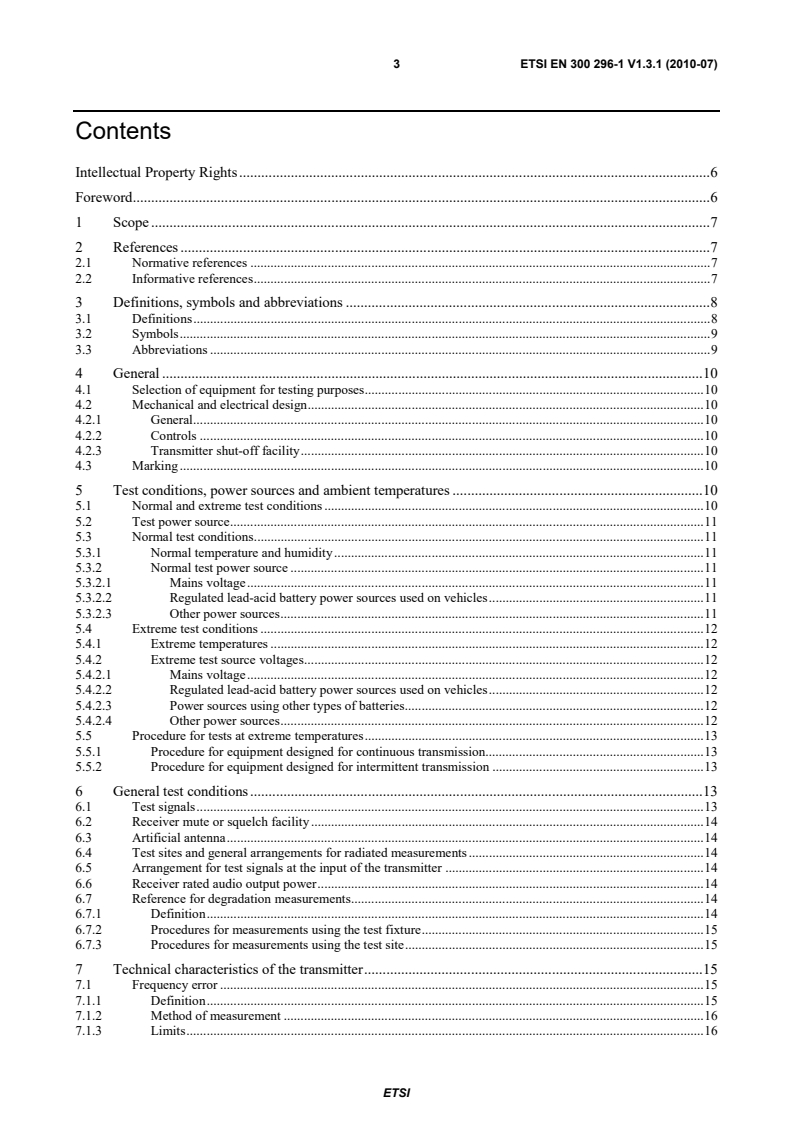
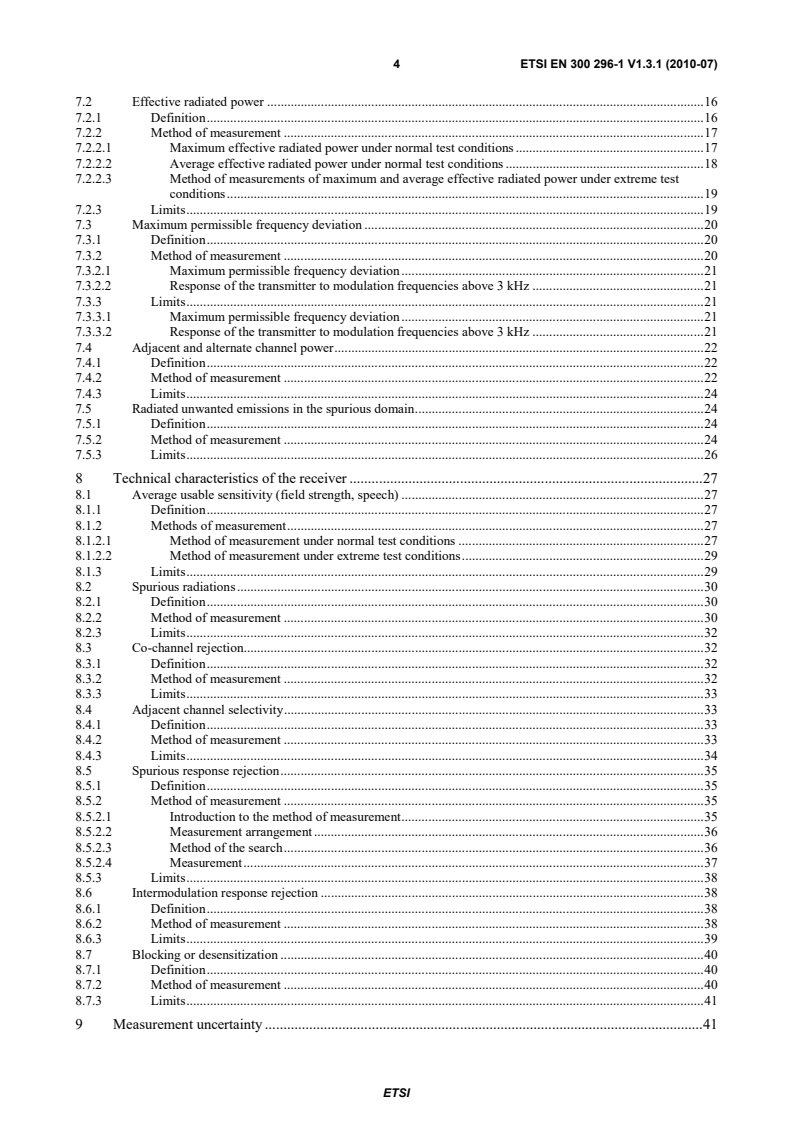
ETSI EN 300 296-1 V1.3.1 (2010-07) - Electromagnetic compatibility and Radio spectrum Matters (ERM); Land Mobile Service; Radio equipment using integral antennas intended primarily for analogue speech; Part 1: Technical characteristics and methods of measurement

SIST EN 300 296-1 V1.3.1:2010 is the Slovene adoption of ETSI EN 300 296-1 V1.3.1, published by SIST for land mobile radio equipment with integral antennas intended primarily for analogue speech. It specifies technical characteristics and measurement methods for transmitters and receivers operating in the 30 MHz to 1 000 MHz range with 12,5 kHz, 20 kHz and 25 kHz channel separations.
What does SIST EN 300 296-1 V1.3.1:2010 specify?
SIST EN 300 296-1 V1.3.1:2010 sets the minimum technical characteristics and test methods used to check whether this type of radio equipment can share spectrum without harmful interference. It applies to integral-antenna equipment in the land mobile service using angle modulation and aimed primarily at analogue speech.
The document is organized into clauses for scope, references, definitions, general conditions, transmitter characteristics, receiver characteristics and measurement uncertainty. It also includes four normative annexes that give the radiated test arrangements, receiver measurement hardware details and the SINAD meter filter used in the receiver tests.
| Annex | What it covers |
|---|---|
| Annex A | Radiated measurement sites and arrangements, including anechoic chamber, chamber with conductive ground plane and OATS |
| Annex B | Specifications for adjacent channel power measurement arrangements |
| Annex C | Spectrum analyzer use for adjacent channel power and unwanted emissions measurements |
| Annex D | Band-stop filter for SINAD meter use |
The scope also states that the document is complementary to EN 300 086, which covers land mobile radio equipment with an internal or external RF connector.
What are the key requirements of SIST EN 300 296-1 V1.3.1:2010?
SIST EN 300 296-1 V1.3.1:2010 requires the equipment to be declared and tested over all intended operating frequencies, with the manufacturer providing the operating ranges, power requirements and technical documentation needed for the tests. In practice, this means the test lab needs the exact variants and operating conditions before measurement starts.
General design and test conditions
The document requires sound engineering practice, user controls that are not easily maladjusted, and a visible, legible, tamperproof and durable marking. It also requires the transmitter shut-off timer to switch off automatically at timeout, and the timer to be inoperative during measurements unless protection needs require otherwise.
Testing is performed under normal and, where stated, extreme conditions. The standard defines temperature, humidity and power-source conditions for mains, vehicle batteries and other supplies, and requires thermal balance before extreme-temperature measurements. This matters because results have to represent real operating conditions, not just ideal bench conditions.
Transmitter measurements
Clause 7 covers transmitter frequency error, effective radiated power, maximum permissible frequency deviation, adjacent and alternate channel power, and radiated unwanted emissions in the spurious domain. The measurements use an artificial antenna, test fixtures or radiated test sites, depending on the parameter.
For modulation, the document defines test signals A-M1, A-M2 and A-M3, and uses a 1 kHz normal test modulation in several tests. For engineering work, this means the lab has to set the modulation level, carrier frequency and measurement setup exactly as specified before comparing results with the limits.
Receiver measurements
Clause 8 covers average usable sensitivity, spurious radiations, co-channel rejection, adjacent channel selectivity, spurious response rejection, intermodulation response rejection and blocking or desensitization. Many of these tests use a SINAD ratio of 20 dB or a 14 dB receiver output criterion with a psophometric filter.
The receiver sensitivity method averages eight field-strength measurements in 45° steps, which reduces dependence on one orientation. The immunity tests then add unwanted signals at defined frequency offsets and adjustment steps, so a buyer or laboratory can see how the receiver behaves near the wanted channel and against off-channel interference.
Measurement uncertainty
Clause 9 requires the test report to include measurement uncertainty for each parameter and says the uncertainty values shall meet the limits given there. The clause points to ETSI TR 100 028 for the uncertainty method, so this standard is intended to be used with a traceable uncertainty calculation.
What terms does SIST EN 300 296-1 V1.3.1:2010 define?
- Integral antenna - an antenna connected without a 50 Ω external connector and treated as part of the equipment.
- Angle modulation - either phase modulation or frequency modulation.
- Listen Before Transmit mode (LBT) - a monitoring mode that checks whether the RF channel is active before transmission starts.
- SINAD - signal quality based on signal plus noise plus distortion compared with noise plus distortion; it is used to judge receiver audio performance.
- OATS - Open Area Test Site, a radiated test site with a ground plane used for free-field measurements.
- RF - Radio Frequency, the range over which the equipment transmits and receives.
- MPFD - Maximum Permissible Frequency Deviation, the largest allowed modulation deviation for the relevant channel separation.
Who uses SIST EN 300 296-1 V1.3.1:2010?
SIST EN 300 296-1 V1.3.1:2010 is used by radio equipment manufacturers, test laboratories and conformity assessment teams working on land mobile service equipment with integral antennas and analogue speech. It is especially relevant when they need to declare transmitter and receiver performance, set up radiated measurements, or prepare test reports for technical review.
Quality managers and buyers use it to understand what performance data should exist for a product before acceptance or procurement. It is also useful when comparing equipment with integral antennas against connector-based equipment covered by EN 300 086.
Which standards are used with SIST EN 300 296-1 V1.3.1:2010?
- ETSI TR 100 028 - gives the method for calculating measurement uncertainty.
- ANSI C63.5 - provides antenna calibration guidance for radiated emission measurements.
- ETSI EN 300 086 - covers land mobile service radio equipment with an internal or external RF connector and is complementary to this standard.
- ETSI EN 300 793 - gives guidance on how to present equipment for type testing.
- ETSI TR 102 273 - gives guidance on radiated methods of measurement and their uncertainties.
- IEC 60489-3 - gives mobile-service receiver measurement methods for A3E or F3E emissions.
- ITU-T Recommendation O.41 - defines the psophometric weighting network used in audio measurements.
- CEPT/ERC/REC 74-01E - provides guidance on unwanted emissions in the spurious domain.
- Part 2 of EN 300 296 - covers the harmonized essential requirements for Article 3.2 of the R&TTE Directive.
What does the SIST EN 300 296-1 V1.3.1:2010 document contain?
The document contains detailed measurement procedures, setup drawings and limit tables for transmitter and receiver characterization. It gives radiated measurement arrangements for free-field sites, including anechoic chambers and OATS, and it shows how to use substitution antennas, combining networks, psophometric filters and SINAD meters.
It also contains worked procedures for 8-position receiver sensitivity measurements, adjacent and alternate channel power measurements, spurious emission searches and blocking tests. Annex B and Annex C describe the receiver and spectrum analyzer arrangements used for channel-power and unwanted-emission measurements, while Annex D defines the band-stop filter used with the SINAD meter.
Buy Documents
ETSI EN 300 296-1 V1.3.1 (2010-03) - Electromagnetic compatibility and Radio spectrum Matters (ERM); Land Mobile Service; Radio equipment using integral antennas intended primarily for analogue speech; Part 1: Technical characteristics and methods of measurement
ETSI EN 300 296-1 V1.3.1 (2010-07) - Electromagnetic compatibility and Radio spectrum Matters (ERM); Land Mobile Service; Radio equipment using integral antennas intended primarily for analogue speech; Part 1: Technical characteristics and methods of measurement
Get Certified
Connect with accredited certification bodies for this standard

ANCE
Mexican certification and testing association.

Intertek Slovenia
Intertek testing, inspection, and certification services in Slovenia.

LNE (Laboratoire National de Métrologie et d'Essais)
French national laboratory for metrology and testing.
Sponsored listings
Frequently Asked Questions
SIST EN 300 296-1 V1.3.1:2010 is a standard published by the Slovenian Institute for Standardization (SIST). Its full title is "Electromagnetic compatibility and Radio spectrum Matters (ERM) - Land Mobile Service - Radio equipment using integral antennas intended primarily for analogue speech - Part 1: Technical characteristics and methods of measurement". This standard covers: Revise LBT definition as decided during ERM#38. The present document covers the minimum characteristics considered necessary in order to avoid harmful interference and to make acceptable use of the available frequencies. The present document applies to equipment with integral antennas, used in angle modulation systems in the land mobile service, operating on radio frequencies between 30 MHz and 1 000 MHz, with channel separations of 12,5 kHz, 20 kHz and 25 kHz, and is intended primarily for analogue speech. In the present document different requirements are given for the different radio frequency bands, channel separations, environmental conditions and types of equipment, where appropriate. The present document is complementary to EN 300 086 [i.7], which covers radio equipment with an internal or external RF connector, for use in the land mobile service.
Revise LBT definition as decided during ERM#38. The present document covers the minimum characteristics considered necessary in order to avoid harmful interference and to make acceptable use of the available frequencies. The present document applies to equipment with integral antennas, used in angle modulation systems in the land mobile service, operating on radio frequencies between 30 MHz and 1 000 MHz, with channel separations of 12,5 kHz, 20 kHz and 25 kHz, and is intended primarily for analogue speech. In the present document different requirements are given for the different radio frequency bands, channel separations, environmental conditions and types of equipment, where appropriate. The present document is complementary to EN 300 086 [i.7], which covers radio equipment with an internal or external RF connector, for use in the land mobile service.
SIST EN 300 296-1 V1.3.1:2010 is classified under the following ICS (International Classification for Standards) categories: 33.060.99 - Other equipment for radiocommunications; 33.070.01 - Mobile services in general; 33.100.01 - Electromagnetic compatibility in general. The ICS classification helps identify the subject area and facilitates finding related standards.
SIST EN 300 296-1 V1.3.1:2010 is available in PDF format for immediate download after purchase. The document can be added to your cart and obtained through the secure checkout process. Digital delivery ensures instant access to the complete standard document.
Standards Content (Sample)
Final draft ETSI EN 300 296-1 V1.3.1 (2010-03)
European Standard (Telecommunications series)
Electromagnetic compatibility
and Radio spectrum Matters (ERM);
Land Mobile Service;
Radio equipment using integral antennas
intended primarily for analogue speech;
Part 1: Technical characteristics and
methods of measurement
2 Final draft ETSI EN 300 296-1 V1.3.1 (2010-03)
Reference
REN/ERM-TGDMR-289-1
Keywords
analogue, mobile, PMR, radio, speech
ETSI
650 Route des Lucioles
F-06921 Sophia Antipolis Cedex - FRANCE
Tel.: +33 4 92 94 42 00 Fax: +33 4 93 65 47 16
Siret N° 348 623 562 00017 - NAF 742 C
Association à but non lucratif enregistrée à la
Sous-Préfecture de Grasse (06) N° 7803/88
Important notice
Individual copies of the present document can be downloaded from:
http://www.etsi.org
The present document may be made available in more than one electronic version or in print. In any case of existing or
perceived difference in contents between such versions, the reference version is the Portable Document Format (PDF).
In case of dispute, the reference shall be the printing on ETSI printers of the PDF version kept on a specific network drive
within ETSI Secretariat.
Users of the present document should be aware that the document may be subject to revision or change of status.
Information on the current status of this and other ETSI documents is available at
http://portal.etsi.org/tb/status/status.asp
If you find errors in the present document, please send your comment to one of the following services:
http://portal.etsi.org/chaircor/ETSI_support.asp
Copyright Notification
No part may be reproduced except as authorized by written permission.
The copyright and the foregoing restriction extend to reproduction in all media.
© European Telecommunications Standards Institute 2010.
All rights reserved.
TM TM TM TM
DECT , PLUGTESTS , UMTS , TIPHON , the TIPHON logo and the ETSI logo are Trade Marks of ETSI registered
for the benefit of its Members.
TM
3GPP is a Trade Mark of ETSI registered for the benefit of its Members and of the 3GPP Organizational Partners.
LTE™ is a Trade Mark of ETSI currently being registered
for the benefit of its Members and of the 3GPP Organizational Partners.
GSM® and the GSM logo are Trade Marks registered and owned by the GSM Association.
ETSI
3 Final draft ETSI EN 300 296-1 V1.3.1 (2010-03)
Contents
Intellectual Property Rights . 6
Foreword . 6
1 Scope . 7
2 References . 7
2.1 Normative references . 7
2.2 Informative references . 7
3 Definitions, symbols and abbreviations . 8
3.1 Definitions . 8
3.2 Symbols . 9
3.3 Abbreviations . 9
4 General . 10
4.1 Selection of equipment for testing purposes . 10
4.2 Mechanical and electrical design . 10
4.2.1 General . 10
4.2.2 Controls . 10
4.2.3 Transmitter shut-off facility . 10
4.3 Marking . 10
5 Test conditions, power sources and ambient temperatures . 10
5.1 Normal and extreme test conditions . 10
5.2 Test power source . 11
5.3 Normal test conditions . 11
5.3.1 Normal temperature and humidity . 11
5.3.2 Normal test power source . 11
5.3.2.1 Mains voltage . 11
5.3.2.2 Regulated lead-acid battery power sources used on vehicles . 11
5.3.2.3 Other power sources . 11
5.4 Extreme test conditions . 12
5.4.1 Extreme temperatures . 12
5.4.2 Extreme test source voltages . 12
5.4.2.1 Mains voltage . 12
5.4.2.2 Regulated lead-acid battery power sources used on vehicles . 12
5.4.2.3 Power sources using other types of batteries . 12
5.4.2.4 Other power sources . 12
5.5 Procedure for tests at extreme temperatures . 13
5.5.1 Procedure for equipment designed for continuous transmission. 13
5.5.2 Procedure for equipment designed for intermittent transmission . 13
6 General test conditions . 13
6.1 Test signals . 13
6.2 Receiver mute or squelch facility . 14
6.3 Artificial antenna . 14
6.4 Test sites and general arrangements for radiated measurements . 14
6.5 Arrangement for test signals at the input of the transmitter . 14
6.6 Receiver rated audio output power . 14
6.7 Reference for degradation measurements . 14
6.7.1 Definition . 14
6.7.2 Procedures for measurements using the test fixture . 15
6.7.3 Procedures for measurements using the test site . 15
7 Technical characteristics of the transmitter . 15
7.1 Frequency error . 15
7.1.1 Definition . 15
7.1.2 Method of measurement . 16
7.1.3 Limits . 16
ETSI
4 Final draft ETSI EN 300 296-1 V1.3.1 (2010-03)
7.2 Effective radiated power . 16
7.2.1 Definition . 16
7.2.2 Method of measurement . 17
7.2.2.1 Maximum effective radiated power under normal test conditions . 17
7.2.2.2 Average effective radiated power under normal test conditions . 18
7.2.2.3 Method of measurements of maximum and average effective radiated power under extreme test
conditions . 19
7.2.3 Limits . 19
7.3 Maximum permissible frequency deviation . 20
7.3.1 Definition . 20
7.3.2 Method of measurement . 20
7.3.2.1 Maximum permissible frequency deviation . 21
7.3.2.2 Response of the transmitter to modulation frequencies above 3 kHz . 21
7.3.3 Limits . 21
7.3.3.1 Maximum permissible frequency deviation . 21
7.3.3.2 Response of the transmitter to modulation frequencies above 3 kHz . 21
7.4 Adjacent and alternate channel power . 22
7.4.1 Definition . 22
7.4.2 Method of measurement . 22
7.4.3 Limits . 24
7.5 Radiated unwanted emissions in the spurious domain . 24
7.5.1 Definition . 24
7.5.2 Method of measurement . 24
7.5.3 Limits . 26
8 Technical characteristics of the receiver . 27
8.1 Average usable sensitivity (field strength, speech) . 27
8.1.1 Definition . 27
8.1.2 Methods of measurement . 27
8.1.2.1 Method of measurement under normal test conditions . 27
8.1.2.2 Method of measurement under extreme test conditions . 29
8.1.3 Limits . 29
8.2 Spurious radiations . 30
8.2.1 Definition . 30
8.2.2 Method of measurement . 30
8.2.3 Limits . 32
8.3 Co-channel rejection. 32
8.3.1 Definition . 32
8.3.2 Method of measurement . 32
8.3.3 Limits . 33
8.4 Adjacent channel selectivity . 33
8.4.1 Definition . 33
8.4.2 Method of measurement . 33
8.4.3 Limits . 34
8.5 Spurious response rejection . 35
8.5.1 Definition . 35
8.5.2 Method of measurement . 35
8.5.2.1 Introduction to the method of measurement . 35
8.5.2.2 Measurement arrangement . 36
8.5.2.3 Method of the search . 36
8.5.2.4 Measurement . 37
8.5.3 Limits . 38
8.6 Intermodulation response rejection . 38
8.6.1 Definition . 38
8.6.2 Method of measurement . 38
8.6.3 Limits . 39
8.7 Blocking or desensitization . 40
8.7.1 Definition . 40
8.7.2 Method of measurement . 40
8.7.3 Limits . 41
9 Measurement uncertainty . 41
ETSI
5 Final draft ETSI EN 300 296-1 V1.3.1 (2010-03)
Annex A (normative): Radiated measurement . 43
A.1 Test sites and general arrangements for measurements involving the use of radiated fields . 43
A.1.1 Anechoic chamber . 43
A.1.2 Anechoic chamber with a conductive ground plane . 44
A.1.3 Open Area Test Site (OATS) . 45
A.1.4 Test antenna . 46
A.1.5 Substitution antenna . 46
A.1.6 Measuring antenna . 47
A.2 Guidance on the use of radiation test sites . 47
A.2.1 Verification of the test site . 47
A.2.2 Preparation of the EUT . 47
A.2.3 Power supplies to the EUT . 47
A.2.4 Volume control setting for analogue speech tests . 47
A.2.5 Range length . 48
A.2.6 Site preparation . 48
A.3 Coupling of signals . 49
A.3.1 General . 49
A.3.2 Data Signals. 49
A.3.3 Speech and analogue signals . 49
A.3.3.1 Acoustic coupler description. 49
A.3.3.2 Calibration . 50
A.4 Test fixture . 50
A.4.1 Description . 50
A.4.2 Calibration . 51
A.4.3 Mode of use . 51
Annex B (normative): Specifications for adjacent channel power measurement
arrangements . 52
B.1 Power measuring receiver specification . 52
B.1.1 General . 52
B.1.2 IF filter . 52
B.1.3 Oscillator and amplifier . 54
B.1.4 Attenuation indicator . 54
B.1.5 Level indicators . 54
B.1.5.1 Rms level indicator . 54
B.1.5.2 Peak level indicator . 54
B.2 Spectrum analyzer for adjacent channel power measurement . 54
Annex C (normative): Spectrum Analyzer . 56
C.1 Adjacent Channel Power Measurement . 56
C.2 Unwanted Emissions Measurement . 56
Annex D (normative): Band–stop filter (for SINAD meter) . 57
History . 58
ETSI
6 Final draft ETSI EN 300 296-1 V1.3.1 (2010-03)
Intellectual Property Rights
IPRs essential or potentially essential to the present document may have been declared to ETSI. The information
pertaining to these essential IPRs, if any, is publicly available for ETSI members and non-members, and can be found
in ETSI SR 000 314: "Intellectual Property Rights (IPRs); Essential, or potentially Essential, IPRs notified to ETSI in
respect of ETSI standards", which is available from the ETSI Secretariat. Latest updates are available on the ETSI Web
server (http://webapp.etsi.org/IPR/home.asp).
Pursuant to the ETSI IPR Policy, no investigation, including IPR searches, has been carried out by ETSI. No guarantee
can be given as to the existence of other IPRs not referenced in ETSI SR 000 314 (or the updates on the ETSI Web
server) which are, or may be, or may become, essential to the present document.
Foreword
This European Standard (Telecommunications series) has been produced by ETSI Technical Committee
Electromagnetic compatibility and Radio spectrum Matters (ERM), and is now submitted for the ETSI standards
One-step Approval Procedure.
The present document is part 1 of a multi-part deliverable covering the Land Mobile Service; Radio equipment using
integral antennas intended primarily for analogue speech, as identified below:
Part 1: "Technical characteristics and methods of measurement";
Part 2: "Harmonized EN covering essential requirements of article 3.2 of the R&TTE Directive".
Proposed national transposition dates
Date of latest announcement of this EN (doa): 3 months after ETSI publication
Date of latest publication of new National Standard
or endorsement of this EN (dop/e): 6 months after doa
Date of withdrawal of any conflicting National Standard (dow): 6 months after doa
ETSI
7 Final draft ETSI EN 300 296-1 V1.3.1 (2010-03)
1 Scope
The present document covers the minimum characteristics considered necessary in order to avoid harmful interference
and to make acceptable use of the available frequencies.
The present document applies to equipment with integral antennas, used in angle modulation systems in the land mobile
service, operating on radio frequencies between 30 MHz and 1 000 MHz, with channel separations of 12,5 kHz, 20 kHz
and 25 kHz, and is intended primarily for analogue speech.
In the present document different requirements are given for the different radio frequency bands, channel separations,
environmental conditions and types of equipment, where appropriate.
The present document is complementary to EN 300 086 [i.7], which covers radio equipment with an internal or external
RF connector, for use in the land mobile service.
2 References
References are either specific (identified by date of publication and/or edition number or version number) or
non-specific.
• For a specific reference, subsequent revisions do not apply.
• Non-specific reference may be made only to a complete document or a part thereof and only in the following
cases:
- if it is accepted that it will be possible to use all future changes of the referenced document for the
purposes of the referring document;
- for informative references.
Referenced documents which are not found to be publicly available in the expected location might be found at
http://docbox.etsi.org/Reference.
NOTE: While any hyperlinks included in this clause were valid at the time of publication ETSI cannot guarantee
their long term validity.
2.1 Normative references
The following referenced documents are indispensable for the application of the present document. For dated
references, only the edition cited applies. For non-specific references, the latest edition of the referenced document
(including any amendments) applies.
[1] ETSI TR 100 028 (V1.4.1) (all parts): "Electromagnetic compatibility and Radio spectrum Matters
(ERM); Uncertainties in the measurement of mobile radio equipment characteristics".
[2] ANSI C63.5 (2006): "American National Standard for Electromagnetic Compatibility - Radiated
Emission Measurements in Electromagnetic Interference (EMI) Control - Calibration of Antennas
(9 kHz to 40 GHz)".
2.2 Informative references
The following referenced documents are not essential to the use of the present document but they assist the user with
regard to a particular subject area. For non-specific references, the latest version of the referenced document (including
any amendments) applies.
[i.1] CEPT/ERC/REC 74-01E: "Unwanted emissions in the spurious domain" (Siófok 1998, Nice 1999,
Sesimbra 2002; Hradec Kralove 2005).
ETSI
8 Final draft ETSI EN 300 296-1 V1.3.1 (2010-03)
[i.2] ETSI EN 300 793 (V1.1.1): "Electromagnetic compatibility and Radio spectrum Matters (ERM);
Land mobile service; Presentation of equipment for type testing".
[i.3] ETSI TR 102 273 (V1.2.1) (all parts): "Electromagnetic compatibility and Radio spectrum Matters
(ERM); Improvement on Radiated Methods of Measurement (using test site) and evaluation of the
corresponding measurement uncertainties".
[i.4] IEC 60489-3 (1988): "Methods of measurement for radio equipment used in the mobile services;
Part 3: Receivers for A3E or F3E emissions".
[i.5] ITU-T Recommendation O.41 (1994): "Psophometer for use on telephone-type circuits".
[i.6] Directive 1999/5/EC of the European Parliament and of the Council of 9 March 1999 on radio
equipment and telecommunications terminal equipment and the mutual recognition of their
conformity (R&TTE Directive).
[i.7] ETSI EN 300 086 (all parts): "Electromagnetic compatibility and Radio spectrum Matters (ERM);
Land Mobile Service; Radio equipment with an internal or external RF connector intended
primarily for analogue speech".
3 Definitions, symbols and abbreviations
3.1 Definitions
For the purposes of the present document, the following terms and definitions apply:
50 Ω: 50 ohm non-reactive impedance
angle modulation: either phase modulation or frequency modulation
adjacent and alternate channels:
• The adjacent channels are those two channels offset from the wanted channel by the channel spacing.
• The alternate channels are those two channels offset from the wanted channel by double the channel spacing.
f
c
Lower Wanted Upper Upper
Lower
Alternate Channel Adjacent Alternate
Adjacent
Figure 1: Adjacent and alternate channel definitions
audio frequency load: resistor, or suitable alternative, having a value equal to the impedance of the audio transducer at
1 000 Hz, as stated by the manufacturer/provider, and of sufficient power rating to accept the maximum audio output
power from the equipment under test
NOTE: In some cases it may be necessary to place an isolating transformer between the output terminals of the
receiver under test and the load.
ETSI
9 Final draft ETSI EN 300 296-1 V1.3.1 (2010-03)
audio frequency termination: any connection other than the audio frequency load which may be required for the
purpose of testing the receiver
NOTE: The termination device should be, as appropriate, either chosen by the manufacturer or agreed between
the manufacturer and the testing laboratory and details included in test reports. If special equipment is
required then it should be provided by the manufacturer.
conducted measurements: measurements which are made using a direct connection to the equipment under test
integral antenna: antenna designed to be connected to the equipment without the use of a 50 Ω external connector and
considered to be part of the equipment
NOTE: An integral antenna may be fitted internally or externally to the equipment.
Listen Before Transmit mode (LBT): monitoring mode in which the RF channel is checked for activity before
transmitting.
psophometric weighting network: psophometric weighting network is described in ITU-T Recommendation
O.41 [i.5]
radiated measurements: measurements which involve the absolute measurement of a radiated field
SINAD Meter: measurement instrument used to measure SND/ND using a band-stop filter
NOTE: As defined in annex D.
3.2 Symbols
For the purposes of the present document, the following symbols apply:
dBc dB relative to the carrier power
st
f 1 intermediate frequency
I1
nd
f 2 intermediate frequency
I2
th
f n intermediate frequency
In
f frequency of the limited frequency range
l
f Local oscillator frequency
LO
V Minimum extreme test voltage
min
V Maximum extreme test voltage
max
T Minimum extreme test temperature
min
T Maximum extreme test temperature
max
3.3 Abbreviations
For the purposes of the present document, the following abbreviations apply:
CSP Channel separation
emf electro-motive force
EUT Equipment Under Test
IF Intermediate Frequency
LBT Listen Before Transmit
MPFD Maximum Permissible Frequency Deviation
OATS Open Area Test Site
RF Radio Frequency
rms root mean squared
Rx Receiver
SINAD Received signal quality based on (Signal + Noise + Distortion) / (Noise + Distortion)
SND/ND (signal + noise + distortion)/(noise + distortion)
SR Switching Range
Tx Transmitter
VSWR Voltage Standing Wave Ratio
ETSI
10 Final draft ETSI EN 300 296-1 V1.3.1 (2010-03)
4 General
4.1 Selection of equipment for testing purposes
Each equipment to be tested shall fulfil the requirements of the present document on all frequencies over which it is
intended to operate.
The provider or manufacturer shall declare the frequency ranges, the range of operating conditions and power
requirements as applicable, to establish the appropriate test conditions.
Additionally, technical documentation and operating manuals, sufficient to make the test, shall be supplied.
Guidance on the presentation of equipment is also given in EN 300 793 [i.2].
4.2 Mechanical and electrical design
4.2.1 General
The equipment shall be designed, constructed and manufactured in accordance with sound engineering practice, and
with the aim of minimizing harmful interference to other equipment and services.
4.2.2 Controls
Those controls which if maladjusted might increase the interfering potentialities of the equipment shall not be easily
accessible to the user.
4.2.3 Transmitter shut-off facility
When a timer for an automatic shut-off facility is operative, at the moment of the time-out the transmitter shall
automatically be switched off. The activation of the transmitter key shall reset the timer.
A shut-off facility shall be inoperative for the duration of the measurements unless it has to remain operative to protect
the equipment. If the shut-off facility is left operative the status of the equipment shall be indicated.
4.3 Marking
The equipment shall be marked in a visible place. This marking shall be legible, tamperproof and durable.
The marking shall be in accordance with EC Directives and/or CEPT decisions or recommendations as appropriate.
5 Test conditions, power sources and ambient
temperatures
5.1 Normal and extreme test conditions
Testing shall be performed under normal test conditions, and also, where stated, under extreme test conditions.
The test conditions and procedures shall be as specified in clauses 5.2 to 5.5.
ETSI
11 Final draft ETSI EN 300 296-1 V1.3.1 (2010-03)
5.2 Test power source
During testing the power source of the equipment shall be replaced by a test power source capable of producing normal
and extreme test voltages as specified in clauses 5.3.2 and 5.4.2. The internal impedance of the test power source shall
be low enough for its effect on the test results to be negligible. For the purpose of tests, the voltage of the power source
shall be measured at the input terminals of the equipment.
For battery operated equipment the battery shall be removed and the test power source shall be applied as close to the
battery terminals as practicable.
During tests of DC powered equipment the power source voltages shall be maintained within a tolerance of < ±1 %
relative to the voltage at the beginning of each test. The value of this tolerance is critical for power measurements.
Using a smaller tolerance will provide better measurement uncertainty values.
5.3 Normal test conditions
5.3.1 Normal temperature and humidity
The normal temperature and humidity conditions for tests shall be any convenient combination of temperature and
humidity within the following ranges:
• temperature: +15 °C to +35 °C;
• relative humidity: 20 % to 75 %.
When it is impracticable to carry out the tests under these conditions, a note to this effect, stating the ambient
temperature and relative humidity during the tests, shall be added to the test report.
5.3.2 Normal test power source
5.3.2.1 Mains voltage
The normal test voltage for equipment to be connected to the mains shall be the nominal mains voltage. For the purpose
of the present document, the nominal voltage shall be the declared voltage or any of the declared voltages for which the
equipment was designed.
The frequency of the test power source corresponding to the ac mains shall be between 49 Hz and 51 Hz.
5.3.2.2 Regulated lead-acid battery power sources used on vehicles
When the radio equipment is intended for operation from the usual types of regulated lead-acid battery power source
used on vehicles the normal test voltage shall be 1,1 times the nominal voltage of the battery (for nominal voltages of
6 V and 12 V, these are 6,6 V and 13,2 V respectively).
5.3.2.3 Other power sources
For operation from other power sources or types of battery (primary or secondary), the normal test voltage shall be that
declared by the equipment manufacturer.
ETSI
12 Final draft ETSI EN 300 296-1 V1.3.1 (2010-03)
5.4 Extreme test conditions
5.4.1 Extreme temperatures
For tests at extreme temperatures, measurements shall be made in accordance with the procedures specified in
clause 5.5, at the upper and lower temperatures of one of the following two ranges:
• -20 °C to +55 °C;
All mobile and handportable equipment.
Base stations for outdoor/uncontrolled climate conditions.
• 0 °C to +40 °C;
Base stations for indoor/controlled climate conditions.
In the case of base station equipment, the manufacturer shall declare which conditions the equipment is intended to be
installed in.
5.4.2 Extreme test source voltages
5.4.2.1 Mains voltage
The extreme test voltage for equipment to be connected to an ac mains source shall be the nominal mains voltage
±10 %.
5.4.2.2 Regulated lead-acid battery power sources used on vehicles
When the equipment is intended for operation from the usual types of regulated lead-acid battery power sources used on
vehicles the extreme test voltages shall be 1,3 and 0,9 times the nominal voltage of the battery (for a nominal voltage of
6 V, these are 7,8 V and 5,4 V respectively and for a nominal voltage of 12 V, these are 15,6 V and 10,8 V
respectively).
5.4.2.3 Power sources using other types of batteries
The lower extreme test voltages for equipment with power sources using batteries shall be as follows:
- for the nickel metal-hydride, leclanché or lithium type: 0,85 times the nominal battery voltage;
- for the mercury or nickel-cadmium type: 0,9 times the nominal battery voltage.
No upper extreme test voltages apply.
In the case where no upper extreme test voltage the nominal voltage is applicable, the corresponding four extreme test
conditions are:
• V /T , V /T ;
min min min max
• (V = nominal)/T , (V = nominal)/T .
max min max max
5.4.2.4 Other power sources
For equipment using other power sources, or capable of being operated from a variety of power sources, the extreme
test voltages shall be those declared by the equipment manufacturer.
ETSI
13 Final draft ETSI EN 300 296-1 V1.3.1 (2010-03)
5.5 Procedure for tests at extreme temperatures
Before measurements are made the equipment shall have reached thermal balance in the test chamber. The equipment
shall be switched off during the temperature stabilizing period.
In the case of equipment containing temperature stabilization circuits designed to operate continuously, the temperature
stabilization circuits may be switched on for 15 minutes after thermal balance has been obtained, and the equipment
shall then meet the specified requirements. For such equipment the manufacturer shall provide for the power source
circuit feeding the crystal oven to be independent of the power source for the rest of the equipment.
If the thermal balance is not checked by measurements, a temperature stabilizing period of at least one hour, or a longer
period as may be decided by the testing laboratory, shall be allowed. The sequence of measurements shall be chosen,
and the humidity content in the test chamber shall be controlled so that excessive condensation does not occur.
5.5.1 Procedure for equipment designed for continuous transmission
If the manufacturer states that the equipment is designed for continuous transmission, the test procedure shall be as
follows.
Before tests at the upper extreme temperature, the equipment shall be placed in the test chamber, and left until thermal
balance is attained. The equipment shall then be switched on in the transmit condition for a period of half an hour, after
which the equipment shall meet the specified requirements.
Before tests at the lower extreme temperature, the equipment shall be left in the test chamber until thermal balance is
attained, then switched to the standby or receive condition for a period of one minute, after which the equipment shall
meet the specified requirements.
5.5.2 Procedure for eq
...
European Standard (Telecommunications series)
Electromagnetic compatibility
and Radio spectrum Matters (ERM);
Land Mobile Service;
Radio equipment using integral antennas
intended primarily for analogue speech;
Part 1: Technical characteristics and
methods of measurement
2 ETSI EN 300 296-1 V1.3.1 (2010-07)
Reference
REN/ERM-TGDMR-289-1
Keywords
analogue, mobile, PMR, radio, speech
ETSI
650 Route des Lucioles
F-06921 Sophia Antipolis Cedex - FRANCE
Tel.: +33 4 92 94 42 00 Fax: +33 4 93 65 47 16
Siret N° 348 623 562 00017 - NAF 742 C
Association à but non lucratif enregistrée à la
Sous-Préfecture de Grasse (06) N° 7803/88
Important notice
Individual copies of the present document can be downloaded from:
http://www.etsi.org
The present document may be made available in more than one electronic version or in print. In any case of existing or
perceived difference in contents between such versions, the reference version is the Portable Document Format (PDF).
In case of dispute, the reference shall be the printing on ETSI printers of the PDF version kept on a specific network drive
within ETSI Secretariat.
Users of the present document should be aware that the document may be subject to revision or change of status.
Information on the current status of this and other ETSI documents is available at
http://portal.etsi.org/tb/status/status.asp
If you find errors in the present document, please send your comment to one of the following services:
http://portal.etsi.org/chaircor/ETSI_support.asp
Copyright Notification
No part may be reproduced except as authorized by written permission.
The copyright and the foregoing restriction extend to reproduction in all media.
© European Telecommunications Standards Institute 2010.
All rights reserved.
TM TM TM TM
DECT , PLUGTESTS , UMTS , TIPHON , the TIPHON logo and the ETSI logo are Trade Marks of ETSI registered
for the benefit of its Members.
TM
3GPP is a Trade Mark of ETSI registered for the benefit of its Members and of the 3GPP Organizational Partners.
LTE™ is a Trade Mark of ETSI currently being registered
for the benefit of its Members and of the 3GPP Organizational Partners.
GSM® and the GSM logo are Trade Marks registered and owned by the GSM Association.
ETSI
3 ETSI EN 300 296-1 V1.3.1 (2010-07)
Contents
Intellectual Property Rights . 6
Foreword . 6
1 Scope . 7
2 References . 7
2.1 Normative references . 7
2.2 Informative references . 7
3 Definitions, symbols and abbreviations . 8
3.1 Definitions . 8
3.2 Symbols . 9
3.3 Abbreviations . 9
4 General . 10
4.1 Selection of equipment for testing purposes . 10
4.2 Mechanical and electrical design . 10
4.2.1 General . 10
4.2.2 Controls . 10
4.2.3 Transmitter shut-off facility . 10
4.3 Marking . 10
5 Test conditions, power sources and ambient temperatures . 10
5.1 Normal and extreme test conditions . 10
5.2 Test power source . 11
5.3 Normal test conditions . 11
5.3.1 Normal temperature and humidity . 11
5.3.2 Normal test power source . 11
5.3.2.1 Mains voltage . 11
5.3.2.2 Regulated lead-acid battery power sources used on vehicles . 11
5.3.2.3 Other power sources . 11
5.4 Extreme test conditions . 12
5.4.1 Extreme temperatures . 12
5.4.2 Extreme test source voltages . 12
5.4.2.1 Mains voltage . 12
5.4.2.2 Regulated lead-acid battery power sources used on vehicles . 12
5.4.2.3 Power sources using other types of batteries . 12
5.4.2.4 Other power sources . 12
5.5 Procedure for tests at extreme temperatures . 13
5.5.1 Procedure for equipment designed for continuous transmission. 13
5.5.2 Procedure for equipment designed for intermittent transmission . 13
6 General test conditions . 13
6.1 Test signals . 13
6.2 Receiver mute or squelch facility . 14
6.3 Artificial antenna . 14
6.4 Test sites and general arrangements for radiated measurements . 14
6.5 Arrangement for test signals at the input of the transmitter . 14
6.6 Receiver rated audio output power . 14
6.7 Reference for degradation measurements . 14
6.7.1 Definition . 14
6.7.2 Procedures for measurements using the test fixture . 15
6.7.3 Procedures for measurements using the test site . 15
7 Technical characteristics of the transmitter . 15
7.1 Frequency error . 15
7.1.1 Definition . 15
7.1.2 Method of measurement . 16
7.1.3 Limits . 16
ETSI
4 ETSI EN 300 296-1 V1.3.1 (2010-07)
7.2 Effective radiated power . 16
7.2.1 Definition . 16
7.2.2 Method of measurement . 17
7.2.2.1 Maximum effective radiated power under normal test conditions . 17
7.2.2.2 Average effective radiated power under normal test conditions . 18
7.2.2.3 Method of measurements of maximum and average effective radiated power under extreme test
conditions . 19
7.2.3 Limits . 19
7.3 Maximum permissible frequency deviation . 20
7.3.1 Definition . 20
7.3.2 Method of measurement . 20
7.3.2.1 Maximum permissible frequency deviation . 21
7.3.2.2 Response of the transmitter to modulation frequencies above 3 kHz . 21
7.3.3 Limits . 21
7.3.3.1 Maximum permissible frequency deviation . 21
7.3.3.2 Response of the transmitter to modulation frequencies above 3 kHz . 21
7.4 Adjacent and alternate channel power . 22
7.4.1 Definition . 22
7.4.2 Method of measurement . 22
7.4.3 Limits . 24
7.5 Radiated unwanted emissions in the spurious domain . 24
7.5.1 Definition . 24
7.5.2 Method of measurement . 24
7.5.3 Limits . 26
8 Technical characteristics of the receiver . 27
8.1 Average usable sensitivity (field strength, speech) . 27
8.1.1 Definition . 27
8.1.2 Methods of measurement . 27
8.1.2.1 Method of measurement under normal test conditions . 27
8.1.2.2 Method of measurement under extreme test conditions . 29
8.1.3 Limits . 29
8.2 Spurious radiations . 30
8.2.1 Definition . 30
8.2.2 Method of measurement . 30
8.2.3 Limits . 32
8.3 Co-channel rejection. 32
8.3.1 Definition . 32
8.3.2 Method of measurement . 32
8.3.3 Limits . 33
8.4 Adjacent channel selectivity . 33
8.4.1 Definition . 33
8.4.2 Method of measurement . 33
8.4.3 Limits . 34
8.5 Spurious response rejection . 35
8.5.1 Definition . 35
8.5.2 Method of measurement . 35
8.5.2.1 Introduction to the method of measurement . 35
8.5.2.2 Measurement arrangement . 36
8.5.2.3 Method of the search . 36
8.5.2.4 Measurement . 37
8.5.3 Limits . 38
8.6 Intermodulation response rejection . 38
8.6.1 Definition . 38
8.6.2 Method of measurement . 38
8.6.3 Limits . 39
8.7 Blocking or desensitization . 40
8.7.1 Definition . 40
8.7.2 Method of measurement . 40
8.7.3 Limits . 41
9 Measurement uncertainty . 41
ETSI
5 ETSI EN 300 296-1 V1.3.1 (2010-07)
Annex A (normative): Radiated measurement . 43
A.1 Test sites and general arrangements for measurements involving the use of radiated fields . 43
A.1.1 Anechoic chamber . 43
A.1.2 Anechoic chamber with a conductive ground plane . 44
A.1.3 Open Area Test Site (OATS) . 45
A.1.4 Test antenna . 46
A.1.5 Substitution antenna . 46
A.1.6 Measuring antenna . 47
A.2 Guidance on the use of radiation test sites . 47
A.2.1 Verification of the test site . 47
A.2.2 Preparation of the EUT . 47
A.2.3 Power supplies to the EUT . 47
A.2.4 Volume control setting for analogue speech tests . 47
A.2.5 Range length . 48
A.2.6 Site preparation . 48
A.3 Coupling of signals . 49
A.3.1 General . 49
A.3.2 Data Signals. 49
A.3.3 Speech and analogue signals . 49
A.3.3.1 Acoustic coupler description. 49
A.3.3.2 Calibration . 50
A.4 Test fixture . 50
A.4.1 Description . 50
A.4.2 Calibration . 51
A.4.3 Mode of use . 51
Annex B (normative): Specifications for adjacent channel power measurement
arrangements . 52
B.1 Power measuring receiver specification . 52
B.1.1 General . 52
B.1.2 IF filter . 52
B.1.3 Oscillator and amplifier . 54
B.1.4 Attenuation indicator . 54
B.1.5 Level indicators . 54
B.1.5.1 Rms level indicator . 54
B.1.5.2 Peak level indicator . 54
B.2 Spectrum analyzer for adjacent channel power measurement . 54
Annex C (normative): Spectrum Analyzer . 56
C.1 Adjacent Channel Power Measurement . 56
C.2 Unwanted Emissions Measurement . 56
Annex D (normative): Band–stop filter (for SINAD meter) . 57
History . 58
ETSI
6 ETSI EN 300 296-1 V1.3.1 (2010-07)
Intellectual Property Rights
IPRs essential or potentially essential to the present document may have been declared to ETSI. The information
pertaining to these essential IPRs, if any, is publicly available for ETSI members and non-members, and can be found
in ETSI SR 000 314: "Intellectual Property Rights (IPRs); Essential, or potentially Essential, IPRs notified to ETSI in
respect of ETSI standards", which is available from the ETSI Secretariat. Latest updates are available on the ETSI Web
server (http://webapp.etsi.org/IPR/home.asp).
Pursuant to the ETSI IPR Policy, no investigation, including IPR searches, has been carried out by ETSI. No guarantee
can be given as to the existence of other IPRs not referenced in ETSI SR 000 314 (or the updates on the ETSI Web
server) which are, or may be, or may become, essential to the present document.
Foreword
This European Standard (Telecommunications series) has been produced by ETSI Technical Committee
Electromagnetic compatibility and Radio spectrum Matters (ERM).
The present document is part 1 of a multi-part deliverable covering the Land Mobile Service; Radio equipment using
integral antennas intended primarily for analogue speech, as identified below:
Part 1: "Technical characteristics and methods of measurement";
Part 2: "Harmonized EN covering the essential requirements of article 3.2 of the R&TTE Directive".
National transposition dates
Date of adoption of this EN: 29 June 2010
Date of latest announcement of this EN (doa): 30 September 2010
Date of latest publication of new National Standard
or endorsement of this EN (dop/e): 31 March 2011
Date of withdrawal of any conflicting National Standard (dow): 31 March 2011
ETSI
7 ETSI EN 300 296-1 V1.3.1 (2010-07)
1 Scope
The present document covers the minimum characteristics considered necessary in order to avoid harmful interference
and to make acceptable use of the available frequencies.
The present document applies to equipment with integral antennas, used in angle modulation systems in the land mobile
service, operating on radio frequencies between 30 MHz and 1 000 MHz, with channel separations of 12,5 kHz, 20 kHz
and 25 kHz, and is intended primarily for analogue speech.
In the present document different requirements are given for the different radio frequency bands, channel separations,
environmental conditions and types of equipment, where appropriate.
The present document is complementary to EN 300 086 [i.7], which covers radio equipment with an internal or external
RF connector, for use in the land mobile service.
2 References
References are either specific (identified by date of publication and/or edition number or version number) or
non-specific. For specific references, only the cited version applies. For non-specific references, the latest version of the
reference document (including any amendments) applies.
Referenced documents which are not found to be publicly available in the expected location might be found at
http://docbox.etsi.org/Reference.
NOTE: While any hyperlinks included in this clause were valid at the time of publication ETSI cannot guarantee
their long term validity.
2.1 Normative references
The following referenced documents are necessary for the application of the present document.
[1] ETSI TR 100 028 (V1.4.1) (all parts): "Electromagnetic compatibility and Radio spectrum Matters
(ERM); Uncertainties in the measurement of mobile radio equipment characteristics".
[2] ANSI C63.5 (2006): "American National Standard for Electromagnetic Compatibility - Radiated
Emission Measurements in Electromagnetic Interference (EMI) Control - Calibration of Antennas
(9 kHz to 40 GHz)".
2.2 Informative references
The following referenced documents are not necessary for the application of the present document but they assist the
user with regard to a particular subject area.
[i.1] CEPT/ERC/REC 74-01E: "Unwanted emissions in the spurious domain" (Siófok 1998, Nice 1999,
Sesimbra 2002; Hradec Kralove 2005).
[i.2] ETSI EN 300 793 (V1.1.1): "Electromagnetic compatibility and Radio spectrum Matters (ERM);
Land mobile service; Presentation of equipment for type testing".
[i.3] ETSI TR 102 273 (V1.2.1) (all parts): "Electromagnetic compatibility and Radio spectrum Matters
(ERM); Improvement on Radiated Methods of Measurement (using test site) and evaluation of the
corresponding measurement uncertainties".
[i.4] IEC 60489-3 (1988): "Methods of measurement for radio equipment used in the mobile services;
Part 3: Receivers for A3E or F3E emissions".
[i.5] ITU-T Recommendation O.41 (1994): "Psophometer for use on telephone-type circuits".
ETSI
8 ETSI EN 300 296-1 V1.3.1 (2010-07)
[i.6] Directive 1999/5/EC of the European Parliament and of the Council of 9 March 1999 on radio
equipment and telecommunications terminal equipment and the mutual recognition of their
conformity (R&TTE Directive).
[i.7] ETSI EN 300 086 (all parts): "Electromagnetic compatibility and Radio spectrum Matters (ERM);
Land Mobile Service; Radio equipment with an internal or external RF connector intended
primarily for analogue speech".
3 Definitions, symbols and abbreviations
3.1 Definitions
For the purposes of the present document, the following terms and definitions apply:
50 Ω: 50 ohm non-reactive impedance
angle modulation: either phase modulation or frequency modulation
adjacent and alternate channels:
• The adjacent channels are those two channels offset from the wanted channel by the channel spacing.
• The alternate channels are those two channels offset from the wanted channel by double the channel spacing.
f
c
Lower Wanted Upper Upper
Lower
Alternate Channel Adjacent Alternate
Adjacent
Figure 1: Adjacent and alternate channel definitions
audio frequency load: resistor, or suitable alternative, having a value equal to the impedance of the audio transducer at
1 000 Hz, as stated by the manufacturer/provider, and of sufficient power rating to accept the maximum audio output
power from the equipment under test
NOTE: In some cases it may be necessary to place an isolating transformer between the output terminals of the
receiver under test and the load.
audio frequency termination: any connection other than the audio frequency load which may be required for the
purpose of testing the receiver
NOTE: The termination device should be, as appropriate, either chosen by the manufacturer or agreed between
the manufacturer and the testing laboratory and details included in test reports. If special equipment is
required then it should be provided by the manufacturer.
conducted measurements: measurements which are made using a direct connection to the equipment under test
ETSI
9 ETSI EN 300 296-1 V1.3.1 (2010-07)
integral antenna: antenna designed to be connected to the equipment without the use of a 50 Ω external connector and
considered to be part of the equipment
NOTE: An integral antenna may be fitted internally or externally to the equipment.
Listen Before Transmit mode (LBT): monitoring mode in which the RF channel is checked for activity before
transmitting.
psophometric weighting network: psophometric weighting network is described in ITU-T Recommendation
O.41 [i.5]
radiated measurements: measurements which involve the absolute measurement of a radiated field
SINAD Meter: measurement instrument used to measure SND/ND using a band-stop filter
NOTE: As defined in annex D.
3.2 Symbols
For the purposes of the present document, the following symbols apply:
dBc dB relative to the carrier power
st
f 1 intermediate frequency
I1
nd
f 2 intermediate frequency
I2
th
f n intermediate frequency
In
f frequency of the limited frequency range
l
f Local oscillator frequency
LO
V Minimum extreme test voltage
min
V Maximum extreme test voltage
max
T Minimum extreme test temperature
min
T Maximum extreme test temperature
max
3.3 Abbreviations
For the purposes of the present document, the following abbreviations apply:
CSP Channel separation
emf electro-motive force
EUT Equipment Under Test
IF Intermediate Frequency
LBT Listen Before Transmit
MPFD Maximum Permissible Frequency Deviation
OATS Open Area Test Site
RF Radio Frequency
rms root mean squared
Rx Receiver
SINAD Received signal quality based on (Signal + Noise + Distortion) / (Noise + Distortion)
SND/ND (signal + noise + distortion)/(noise + distortion)
SR Switching Range
Tx Transmitter
VSWR Voltage Standing Wave Ratio
ETSI
10 ETSI EN 300 296-1 V1.3.1 (2010-07)
4 General
4.1 Selection of equipment for testing purposes
Each equipment to be tested shall fulfil the requirements of the present document on all frequencies over which it is
intended to operate.
The provider or manufacturer shall declare the frequency ranges, the range of operating conditions and power
requirements as applicable, to establish the appropriate test conditions.
Additionally, technical documentation and operating manuals, sufficient to make the test, shall be supplied.
Guidance on the presentation of equipment is also given in EN 300 793 [i.2].
4.2 Mechanical and electrical design
4.2.1 General
The equipment shall be designed, constructed and manufactured in accordance with sound engineering practice, and
with the aim of minimizing harmful interference to other equipment and services.
4.2.2 Controls
Those controls which if maladjusted might increase the interfering potentialities of the equipment shall not be easily
accessible to the user.
4.2.3 Transmitter shut-off facility
When a timer for an automatic shut-off facility is operative, at the moment of the time-out the transmitter shall
automatically be switched off. The activation of the transmitter key shall reset the timer.
A shut-off facility shall be inoperative for the duration of the measurements unless it has to remain operative to protect
the equipment. If the shut-off facility is left operative the status of the equipment shall be indicated.
4.3 Marking
The equipment shall be marked in a visible place. This marking shall be legible, tamperproof and durable.
The marking shall be in accordance with EC Directives and/or CEPT decisions or recommendations as appropriate.
5 Test conditions, power sources and ambient
temperatures
5.1 Normal and extreme test conditions
Testing shall be performed under normal test conditions, and also, where stated, under extreme test conditions.
The test conditions and procedures shall be as specified in clauses 5.2 to 5.5.
ETSI
11 ETSI EN 300 296-1 V1.3.1 (2010-07)
5.2 Test power source
During testing the power source of the equipment shall be replaced by a test power source capable of producing normal
and extreme test voltages as specified in clauses 5.3.2 and 5.4.2. The internal impedance of the test power source shall
be low enough for its effect on the test results to be negligible. For the purpose of tests, the voltage of the power source
shall be measured at the input terminals of the equipment.
For battery operated equipment the battery shall be removed and the test power source shall be applied as close to the
battery terminals as practicable.
During tests of DC powered equipment the power source voltages shall be maintained within a tolerance of < ±1 %
relative to the voltage at the beginning of each test. The value of this tolerance is critical for power measurements.
Using a smaller tolerance will provide better measurement uncertainty values.
5.3 Normal test conditions
5.3.1 Normal temperature and humidity
The normal temperature and humidity conditions for tests shall be any convenient combination of temperature and
humidity within the following ranges:
• temperature: +15 °C to +35 °C;
• relative humidity: 20 % to 75 %.
When it is impracticable to carry out the tests under these conditions, a note to this effect, stating the ambient
temperature and relative humidity during the tests, shall be added to the test report.
5.3.2 Normal test power source
5.3.2.1 Mains voltage
The normal test voltage for equipment to be connected to the mains shall be the nominal mains voltage. For the purpose
of the present document, the nominal voltage shall be the declared voltage or any of the declared voltages for which the
equipment was designed.
The frequency of the test power source corresponding to the ac mains shall be between 49 Hz and 51 Hz.
5.3.2.2 Regulated lead-acid battery power sources used on vehicles
When the radio equipment is intended for operation from the usual types of regulated lead-acid battery power source
used on vehicles the normal test voltage shall be 1,1 times the nominal voltage of the battery (for nominal voltages of
6 V and 12 V, these are 6,6 V and 13,2 V respectively).
5.3.2.3 Other power sources
For operation from other power sources or types of battery (primary or secondary), the normal test voltage shall be that
declared by the equipment manufacturer.
ETSI
12 ETSI EN 300 296-1 V1.3.1 (2010-07)
5.4 Extreme test conditions
5.4.1 Extreme temperatures
For tests at extreme temperatures, measurements shall be made in accordance with the procedures specified in
clause 5.5, at the upper and lower temperatures of one of the following two ranges:
• -20 °C to +55 °C;
All mobile and handportable equipment.
Base stations for outdoor/uncontrolled climate conditions.
• 0 °C to +40 °C;
Base stations for indoor/controlled climate conditions.
In the case of base station equipment, the manufacturer shall declare which conditions the equipment is intended to be
installed in.
5.4.2 Extreme test source voltages
5.4.2.1 Mains voltage
The extreme test voltage for equipment to be connected to an ac mains source shall be the nominal mains voltage
±10 %.
5.4.2.2 Regulated lead-acid battery power sources used on vehicles
When the equipment is intended for operation from the usual types of regulated lead-acid battery power sources used on
vehicles the extreme test voltages shall be 1,3 and 0,9 times the nominal voltage of the battery (for a nominal voltage of
6 V, these are 7,8 V and 5,4 V respectively and for a nominal voltage of 12 V, these are 15,6 V and 10,8 V
respectively).
5.4.2.3 Power sources using other types of batteries
The lower extreme test voltages for equipment with power sources using batteries shall be as follows:
- for the nickel metal-hydride, leclanché or lithium type: 0,85 times the nominal battery voltage;
- for the mercury or nickel-cadmium type: 0,9 times the nominal battery voltage.
No upper extreme test voltages apply.
In the case where no upper extreme test voltage the nominal voltage is applicable, the corresponding four extreme test
conditions are:
• V /T , V /T ;
min min min max
• (V = nominal)/T , (V = nominal)/T .
max min max max
5.4.2.4 Other power sources
For equipment using other power sources, or capable of being operated from a variety of power sources, the extreme
test voltages shall be those declared by the equipment manufacturer.
ETSI
13 ETSI EN 300 296-1 V1.3.1 (2010-07)
5.5 Procedure for tests at extreme temperatures
Before measurements are made the equipment shall have reached thermal balance in the test chamber. The equipment
shall be switched off during the temperature stabilizing period.
In the case of equipment containing temperature stabilization circuits designed to operate continuously, the temperature
stabilization circuits may be switched on for 15 minutes after thermal balance has been obtained, and the equipment
shall then meet the specified requirements. For such equipment the manufacturer shall provide for the power source
circuit feeding the crystal oven to be independent of the power source for the rest of the equipment.
If the thermal balance is not checked by measurements, a temperature stabilizing period of at least one hour, or a longer
period as may be decided by the testing laboratory, shall be allowed. The sequence of measurements shall be chosen,
and the humidity content in the test chamber shall be controlled so that excessive condensation does not occur.
5.5.1 Procedure for equipment designed for continuous transmission
If the manufacturer states that the equipment is designed for continuous transmission, the test procedure shall be as
follows.
Before tests at the upper extreme temperature, the equipment shall be placed in the test chamber, and left until thermal
balance is attained. The equipment shall then be switched on in the transmit condition for a period of half an hour, after
which the equipment shall meet the specified requirements.
Before tests at the lower extreme temperature, the equipment shall be left in the test chamber until thermal balance is
attained, then switched to the standby or receive condition for a period of one minute, after which the equipment shall
meet the specified requirements.
5.5.2 Procedure for equipment designed for intermittent transmission
If the manufacturer states that the equipment is designed for intermittent transmission, the test procedure shall be as
follows.
Before tests at the upper extreme temperature, the equipment shall be placed in the test chamber, and left until thermal
balance is attained. The equipment shall then be switched on for one minute in the transmit condition, followed by four
minutes in the receive condition, after which the equipment shall meet the specified requirements.
For tests at the lower extreme temperature, the equipment shall be left in the test chamber until thermal balance is
attained, then switched to the standby
...
2003-01.Slovenski inštitut za standardizacijo. Razmnoževanje celote ali delov tega standarda ni dovoljeno.Electromagnetic compatibility and Radio spectrum Matters (ERM) - Land Mobile Service - Radio equipment using integral antennas intended primarily for analogue speech - Part 1: Technical characteristics and methods of measurement33.100.01Elektromagnetna združljivost na splošnoElectromagnetic compatibility in general33.070.01Mobilni servisi na splošnoMobile services in general33.060.99Druga oprema za radijske komunikacijeOther equipment for radiocommunicationsICS:Ta slovenski standard je istoveten z:EN 300 296-1 Version 1.3.1SIST EN 300 296-1 V1.3.1:2010en01-oktober-2010SIST EN 300 296-1 V1.3.1:2010SLOVENSKI
STANDARD
ETSI ETSI EN 300 296-1 V1.3.1 (2010-07) 2
Reference REN/ERM-TGDMR-289-1 Keywords analogue, mobile, PMR, radio, speech ETSI 650 Route des Lucioles F-06921 Sophia Antipolis Cedex - FRANCE
Tel.: +33 4 92 94 42 00
Fax: +33 4 93 65 47 16
Siret N° 348 623 562 00017 - NAF 742 C Association à but non lucratif enregistrée à la Sous-Préfecture de Grasse (06) N° 7803/88
Important notice Individual copies of the present document can be downloaded from: http://www.etsi.org The present document may be made available in more than one electronic version or in print. In any case of existing or perceived difference in contents between such versions, the reference version is the Portable Document Format (PDF). In case of dispute, the reference shall be the printing on ETSI printers of the PDF version kept on a specific network drive within ETSI Secretariat. Users of the present document should be aware that the document may be subject to revision or change of status. Information on the current status of this and other ETSI documents is available at http://portal.etsi.org/tb/status/status.asp If you find errors in the present document, please send your comment to one of the following services: http://portal.etsi.org/chaircor/ETSI_support.asp Copyright Notification No part may be reproduced except as authorized by written permission. The copyright and the foregoing restriction extend to reproduction in all media.
© European Telecommunications Standards Institute 2010. All rights reserved.
DECTTM, PLUGTESTSTM, UMTSTM, TIPHONTM, the TIPHON logo and the ETSI logo are Trade Marks of ETSI registered for the benefit of its Members. 3GPPTM is a Trade Mark of ETSI registered for the benefit of its Members and of the 3GPP Organizational Partners. LTE™ is a Trade Mark of ETSI currently being registered for the benefit of its Members and of the 3GPP Organizational Partners. GSM® and the GSM logo are Trade Marks registered and owned by the GSM Association. SIST EN 300 296-1 V1.3.1:2010
ETSI ETSI EN 300 296-1 V1.3.1 (2010-07) 3 Contents Intellectual Property Rights . 6 Foreword . 6 1 Scope . 7 2 References . 7 2.1 Normative references . 7 2.2 Informative references . 7 3 Definitions, symbols and abbreviations . 8 3.1 Definitions . 8 3.2 Symbols . 9 3.3 Abbreviations . 9 4 General . 10 4.1 Selection of equipment for testing purposes . 10 4.2 Mechanical and electrical design . 10 4.2.1 General . 10 4.2.2 Controls . 10 4.2.3 Transmitter shut-off facility . 10 4.3 Marking . 10 5 Test conditions, power sources and ambient temperatures . 10 5.1 Normal and extreme test conditions . 10 5.2 Test power source . 11 5.3 Normal test conditions . 11 5.3.1 Normal temperature and humidity . 11 5.3.2 Normal test power source . 11 5.3.2.1 Mains voltage . 11 5.3.2.2 Regulated lead-acid battery power sources used on vehicles . 11 5.3.2.3 Other power sources . 11 5.4 Extreme test conditions . 12 5.4.1 Extreme temperatures . 12 5.4.2 Extreme test source voltages . 12 5.4.2.1 Mains voltage . 12 5.4.2.2 Regulated lead-acid battery power sources used on vehicles . 12 5.4.2.3 Power sources using other types of batteries . 12 5.4.2.4 Other power sources . 12 5.5 Procedure for tests at extreme temperatures . 13 5.5.1 Procedure for equipment designed for continuous transmission. 13 5.5.2 Procedure for equipment designed for intermittent transmission . 13 6 General test conditions . 13 6.1 Test signals . 13 6.2 Receiver mute or squelch facility . 14 6.3 Artificial antenna . 14 6.4 Test sites and general arrangements for radiated measurements . 14 6.5 Arrangement for test signals at the input of the transmitter . 14 6.6 Receiver rated audio output power . 14 6.7 Reference for degradation measurements . 14 6.7.1 Definition . 14 6.7.2 Procedures for measurements using the test fixture . 15 6.7.3 Procedures for measurements using the test site . 15 7 Technical characteristics of the transmitter . 15 7.1 Frequency error . 15 7.1.1 Definition . 15 7.1.2 Method of measurement . 16 7.1.3 Limits . 16 SIST EN 300 296-1 V1.3.1:2010
ETSI ETSI EN 300 296-1 V1.3.1 (2010-07) 4 7.2 Effective radiated power . 16 7.2.1 Definition . 16 7.2.2 Method of measurement . 17 7.2.2.1 Maximum effective radiated power under normal test conditions . 17 7.2.2.2 Average effective radiated power under normal test conditions . 18 7.2.2.3 Method of measurements of maximum and average effective radiated power under extreme test conditions . 19 7.2.3 Limits . 19 7.3 Maximum permissible frequency deviation . 20 7.3.1 Definition . 20 7.3.2 Method of measurement . 20 7.3.2.1 Maximum permissible frequency deviation . 21 7.3.2.2 Response of the transmitter to modulation frequencies above 3 kHz . 21 7.3.3 Limits . 21 7.3.3.1 Maximum permissible frequency deviation . 21 7.3.3.2 Response of the transmitter to modulation frequencies above 3 kHz . 21 7.4 Adjacent and alternate channel power . 22 7.4.1 Definition . 22 7.4.2 Method of measurement . 22 7.4.3 Limits . 24 7.5 Radiated unwanted emissions in the spurious domain . 24 7.5.1 Definition . 24 7.5.2 Method of measurement . 24 7.5.3 Limits . 26 8 Technical characteristics of the receiver . 27 8.1 Average usable sensitivity (field strength, speech) . 27 8.1.1 Definition . 27 8.1.2 Methods of measurement . 27 8.1.2.1 Method of measurement under normal test conditions . 27 8.1.2.2 Method of measurement under extreme test conditions . 29 8.1.3 Limits . 29 8.2 Spurious radiations . 30 8.2.1 Definition . 30 8.2.2 Method of measurement . 30 8.2.3 Limits . 32 8.3 Co-channel rejection. 32 8.3.1 Definition . 32 8.3.2 Method of measurement . 32 8.3.3 Limits . 33 8.4 Adjacent channel selectivity . 33 8.4.1 Definition . 33 8.4.2 Method of measurement . 33 8.4.3 Limits . 34 8.5 Spurious response rejection . 35 8.5.1 Definition . 35 8.5.2 Method of measurement . 35 8.5.2.1 Introduction to the method of measurement . 35 8.5.2.2 Measurement arrangement . 36 8.5.2.3 Method of the search . 36 8.5.2.4 Measurement . 37 8.5.3 Limits . 38 8.6 Intermodulation response rejection . 38 8.6.1 Definition . 38 8.6.2 Method of measurement . 38 8.6.3 Limits . 39 8.7 Blocking or desensitization . 40 8.7.1 Definition . 40 8.7.2 Method of measurement . 40 8.7.3 Limits . 41 9 Measurement uncertainty . 41 SIST EN 300 296-1 V1.3.1:2010
ETSI ETSI EN 300 296-1 V1.3.1 (2010-07) 5 Annex A (normative): Radiated measurement . 43 A.1 Test sites and general arrangements for measurements involving the use of radiated fields . 43 A.1.1 Anechoic chamber . 43 A.1.2 Anechoic chamber with a conductive ground plane . 44 A.1.3 Open Area Test Site (OATS) . 45 A.1.4 Test antenna . 46 A.1.5 Substitution antenna . 46 A.1.6 Measuring antenna . 47 A.2 Guidance on the use of radiation test sites . 47 A.2.1 Verification of the test site . 47 A.2.2 Preparation of the EUT . 47 A.2.3 Power supplies to the EUT . 47 A.2.4 Volume control setting for analogue speech tests . 47 A.2.5 Range length . 48 A.2.6 Site preparation . 48 A.3 Coupling of signals . 49 A.3.1 General . 49 A.3.2 Data Signals. 49 A.3.3 Speech and analogue signals . 49 A.3.3.1 Acoustic coupler description. 49 A.3.3.2 Calibration . 50 A.4 Test fixture . 50 A.4.1 Description . 50 A.4.2 Calibration . 51 A.4.3 Mode of use . 51 Annex B (normative): Specifications for adjacent channel power measurement arrangements . 52 B.1 Power measuring receiver specification . 52 B.1.1 General . 52 B.1.2 IF filter . 52 B.1.3 Oscillator and amplifier . 54 B.1.4 Attenuation indicator . 54 B.1.5 Level indicators . 54 B.1.5.1 Rms level indicator . 54 B.1.5.2 Peak level indicator . 54 B.2 Spectrum analyzer for adjacent channel power measurement . 54 Annex C (normative): Spectrum Analyzer . 56 C.1 Adjacent Channel Power Measurement . 56 C.2 Unwanted Emissions Measurement . 56 Annex D (normative): Band–stop filter (for SINAD meter) . 57 History . 58
ETSI ETSI EN 300 296-1 V1.3.1 (2010-07) 6 Intellectual Property Rights IPRs essential or potentially essential to the present document may have been declared to ETSI. The information pertaining to these essential IPRs, if any, is publicly available for ETSI members and non-members, and can be found in ETSI SR 000 314: "Intellectual Property Rights (IPRs); Essential, or potentially Essential, IPRs notified to ETSI in respect of ETSI standards", which is available from the ETSI Secretariat. Latest updates are available on the ETSI Web server (http://webapp.etsi.org/IPR/home.asp). Pursuant to the ETSI IPR Policy, no investigation, including IPR searches, has been carried out by ETSI. No guarantee can be given as to the existence of other IPRs not referenced in ETSI SR 000 314 (or the updates on the ETSI Web server) which are, or may be, or may become, essential to the present document. Foreword This European Standard (Telecommunications series) has been produced by ETSI Technical Committee Electromagnetic compatibility and Radio spectrum Matters (ERM). The present document is part 1 of a multi-part deliverable covering the Land Mobile Service; Radio equipment using integral antennas intended primarily for analogue speech, as identified below: Part 1: "Technical characteristics and methods of measurement"; Part 2: "Harmonized EN covering the essential requirements of article 3.2 of the R&TTE Directive".
National transposition dates Date of adoption of this EN: 29 June 2010 Date of latest announcement of this EN (doa): 30 September 2010 Date of latest publication of new National Standard or endorsement of this EN (dop/e):
31 March 2011 Date of withdrawal of any conflicting National Standard (dow): 31 March 2011
ETSI ETSI EN 300 296-1 V1.3.1 (2010-07) 7 1 Scope The present document covers the minimum characteristics considered necessary in order to avoid harmful interference and to make acceptable use of the available frequencies. The present document applies to equipment with integral antennas, used in angle modulation systems in the land mobile service, operating on radio frequencies between 30 MHz and 1 000 MHz, with channel separations of 12,5 kHz, 20 kHz and 25 kHz, and is intended primarily for analogue speech. In the present document different requirements are given for the different radio frequency bands, channel separations, environmental conditions and types of equipment, where appropriate. The present document is complementary to EN 300 086 [i.7], which covers radio equipment with an internal or external RF connector, for use in the land mobile service.
2 References References are either specific (identified by date of publication and/or edition number or version number) or non-specific. For specific references, only the cited version applies. For non-specific references, the latest version of the reference document (including any amendments) applies. Referenced documents which are not found to be publicly available in the expected location might be found at http://docbox.etsi.org/Reference. NOTE: While any hyperlinks included in this clause were valid at the time of publication ETSI cannot guarantee their long term validity. 2.1 Normative references The following referenced documents are necessary for the application of the present document. [1] ETSI TR 100 028 (V1.4.1) (all parts): "Electromagnetic compatibility and Radio spectrum Matters (ERM); Uncertainties in the measurement of mobile radio equipment characteristics". [2] ANSI C63.5 (2006): "American National Standard for Electromagnetic Compatibility - Radiated Emission Measurements in Electromagnetic Interference (EMI) Control - Calibration of Antennas (9 kHz to 40 GHz)". 2.2 Informative references The following referenced documents are not necessary for the application of the present document but they assist the user with regard to a particular subject area. [i.1] CEPT/ERC/REC 74-01E: "Unwanted emissions in the spurious domain" (Siófok 1998, Nice 1999, Sesimbra 2002; Hradec Kralove 2005). [i.2] ETSI EN 300 793 (V1.1.1): "Electromagnetic compatibility and Radio spectrum Matters (ERM); Land mobile service; Presentation of equipment for type testing". [i.3] ETSI TR 102 273 (V1.2.1) (all parts): "Electromagnetic compatibility and Radio spectrum Matters (ERM); Improvement on Radiated Methods of Measurement (using test site) and evaluation of the corresponding measurement uncertainties". [i.4] IEC 60489-3 (1988): "Methods of measurement for radio equipment used in the mobile services; Part 3: Receivers for A3E or F3E emissions". [i.5] ITU-T Recommendation O.41 (1994): "Psophometer for use on telephone-type circuits". SIST EN 300 296-1 V1.3.1:2010
ETSI ETSI EN 300 296-1 V1.3.1 (2010-07) 8 [i.6] Directive 1999/5/EC of the European Parliament and of the Council of 9 March 1999 on radio equipment and telecommunications terminal equipment and the mutual recognition of their conformity (R&TTE Directive). [i.7] ETSI EN 300 086 (all parts): "Electromagnetic compatibility and Radio spectrum Matters (ERM); Land Mobile Service; Radio equipment with an internal or external RF connector intended primarily for analogue speech". 3 Definitions, symbols and abbreviations 3.1 Definitions For the purposes of the present document, the following terms and definitions apply: 50 Ω: 50 ohm non-reactive impedance angle modulation: either phase modulation or frequency modulation adjacent and alternate channels: • The adjacent channels are those two channels offset from the wanted channel by the channel spacing. • The alternate channels are those two channels offset from the wanted channel by double the channel spacing. fcLowerAlternateUpperAlternateLowerAdjacentUpperAdjacentWantedChannel Figure 1: Adjacent and alternate channel definitions audio frequency load: resistor, or suitable alternative, having a value equal to the impedance of the audio transducer at 1 000 Hz, as stated by the manufacturer/provider, and of sufficient power rating to accept the maximum audio output power from the equipment under test NOTE: In some cases it may be necessary to place an isolating transformer between the output terminals of the receiver under test and the load. audio frequency termination: any connection other than the audio frequency load which may be required for the purpose of testing the receiver NOTE: The termination device should be, as appropriate, either chosen by the manufacturer or agreed between the manufacturer and the testing laboratory and details included in test reports. If special equipment is required then it should be provided by the manufacturer. conducted measurements: measurements which are made using a direct connection to the equipment under test SIST EN 300 296-1 V1.3.1:2010
ETSI ETSI EN 300 296-1 V1.3.1 (2010-07) 9 integral antenna: antenna designed to be connected to the equipment without the use of a 50 Ω external connector and considered to be part of the equipment NOTE: An integral antenna may be fitted internally or externally to the equipment. Listen Before Transmit mode (LBT): monitoring mode in which the RF channel is checked for activity before transmitting. psophometric weighting network: psophometric weighting network is described in ITU-T Recommendation O.41 [i.5] radiated measurements: measurements which involve the absolute measurement of a radiated field SINAD Meter: measurement instrument used to measure SND/ND using a band-stop filter NOTE: As defined in annex D. 3.2 Symbols For the purposes of the present document, the following symbols apply: dBc dB relative to the carrier power fI1 1st intermediate frequency fI2 2nd intermediate frequency fIn nth intermediate frequency fl frequency of the limited frequency range fLO Local oscillator frequency Vmin Minimum extreme test voltage Vmax Maximum extreme test voltage Tmin Minimum extreme test temperature Tmax Maximum extreme test temperature 3.3 Abbreviations For the purposes of the present document, the following abbreviations apply: CSP Channel separation emf electro-motive force EUT Equipment Under Test IF Intermediate Frequency LBT Listen Before Transmit MPFD Maximum Permissible Frequency Deviation OATS Open Area Test Site RF Radio Frequency rms root mean squared Rx Receiver SINAD Received signal quality based on (Signal + Noise + Distortion) / (Noise + Distortion) SND/ND (signal + noise + distortion)/(noise + distortion) SR Switching Range Tx Transmitter VSWR Voltage Standing Wave Ratio SIST EN 300 296-1 V1.3.1:2010
ETSI ETSI EN 300 296-1 V1.3.1 (2010-07) 10 4 General 4.1 Selection of equipment for testing purposes Each equipment to be tested shall fulfil the requirements of the present document on all frequencies over which it is intended to operate. The provider or manufacturer shall declare the frequency ranges, the range of operating conditions and power requirements as applicable, to establish the appropriate test conditions. Additionally, technical documentation and operating manuals, sufficient to make the test, shall be supplied. Guidance on the presentation of equipment is also given in EN 300 793 [i.2]. 4.2 Mechanical and electrical design 4.2.1 General The equipment shall be designed, constructed and manufactured in accordance with sound engineering practice, and with the aim of minimizing harmful interference to other equipment and services. 4.2.2 Controls Those controls which if maladjusted might increase the interfering potentialities of the equipment shall not be easily accessible to the user. 4.2.3 Transmitter shut-off facility When a timer for an automatic shut-off facility is operative, at the moment of the time-out the transmitter shall automatically be switched off. The activation of the transmitter key shall reset the timer. A shut-off facility shall be inoperative for the duration of the measurements unless it has to remain operative to protect the equipment. If the shut-off facility is left operative the status of the equipment shall be indicated. 4.3 Marking The equipment shall be marked in a visible place. This marking shall be legible, tamperproof and durable. The marking shall be in accordance with EC Directives and/or CEPT decisions or recommendations as appropriate. 5 Test conditions, power sources and ambient temperatures 5.1 Normal and extreme test conditions Testing shall be performed under normal test conditions, and also, where stated, under extreme test conditions. The test conditions and procedures shall be as specified in clauses 5.2 to 5.5. SIST EN 300 296-1 V1.3.1:2010
ETSI ETSI EN 300 296-1 V1.3.1 (2010-07) 11 5.2 Test power source During testing the power source of the equipment shall be replaced by a test power source capable of producing normal and extreme test voltages as specified in clauses 5.3.2 and 5.4.2. The internal impedance of the test power source shall be low enough for its effect on the test results to be negligible. For the purpose of tests, the voltage of the power source shall be measured at the input terminals of the equipment. For battery operated equipment the battery shall be removed and the test power source shall be applied as close to the battery terminals as practicable. During tests of DC powered equipment the power source voltages shall be maintained within a tolerance of < ±1 % relative to the voltage at the beginning of each test. The value of this tolerance is critical for power measurements. Using a smaller tolerance will provide better measurement uncertainty values. 5.3 Normal test conditions 5.3.1 Normal temperature and humidity The normal temperature and humidity conditions for tests shall be any convenient combination of temperature and humidity within the following ranges: • temperature: +15 °C to +35 °C; • relative humidity: 20 % to 75 %. When it is impracticable to carry out the tests under these conditions, a note to this effect, stating the ambient temperature and relative humidity during the tests, shall be added to the test report. 5.3.2 Normal test power source 5.3.2.1 Mains voltage The normal test voltage for equipment to be connected to the mains shall be the nominal mains voltage. For the purpose of the present document, the nominal voltage shall be the declared voltage or any of the declared voltages for which the equipment was designed. The frequency of the test power source corresponding to the ac mains shall be between 49 Hz and 51 Hz. 5.3.2.2 Regulated lead-acid battery power sources used on vehicles When the radio equipment is intended for operation from the usual types of regulated lead-acid battery power source used on vehicles the normal test voltage shall be 1,1 times the nominal voltage of the battery (for nominal voltages of 6 V and 12 V, these are 6,6 V and 13,2 V respectively). 5.3.2.3 Other power sources For operation from other power sources or types of battery (primary or secondary), the normal test voltage shall be that declared by the equipment manufacturer. SIST EN 300 296-1 V1.3.1:2010
ETSI ETSI EN 300 296-1 V1.3.1 (2010-07) 12 5.4 Extreme test conditions 5.4.1 Extreme temperatures For tests at extreme temperatures, measurements shall be made in accordance with the procedures specified in clause 5.5, at the upper and lower temperatures of one of the following two ranges: • -20 °C to +55 °C; All mobile and handportable equipment. Base stations for outdoor/uncontrolled climate conditions. • 0 °C to +40 °C; Base stations for indoor/controlled climate conditions. In the case of base station equipment, the manufacturer shall declare which conditions the equipment is intended to be installed in. 5.4.2 Extreme test source voltages 5.4.2.1 Mains voltage The extreme test voltage for equipment to be connected to an ac mains source shall be the nominal mains voltage ±10 %. 5.4.2.2 Regulated lead-acid battery power sources used on vehicles When the equipment is intended for operation from the usual types of regulated lead-acid battery power sources used on vehicles the extreme test voltages shall be 1,3 and 0,9 times the nominal voltage of the battery (for a nominal voltage of 6 V, these are 7,8 V and 5,4 V respectively and for a nominal voltage of 12 V, these are 15,6 V and 10,8 V respectively). 5.4.2.3 Power sources using other types of batteries The lower extreme test voltages for equipment with power sources using batteries shall be as follows: - for the nickel metal-hydride, leclanché or lithium type: 0,85 times the nominal battery voltage; - for the mercury or nickel-cadmium type: 0,9 times the nominal battery voltage. No upper extreme test voltages apply. In the case where no upper extreme test voltage the nominal voltage is applicable, the corresponding four extreme test conditions are: • Vmin/Tmin, Vmin/Tmax; • (Vmax = nominal)/Tmin, (Vmax = nominal)/Tmax. 5.4.2.4 Other power sources For equipment using other power sources, or capable of being operated from a variety of power sources, the extreme test voltages shall be those declared by the equipment manufacturer. SIST EN 300 296-1 V1.3.1:2010
ETSI ETSI EN 300 296-1 V1.3.1 (2010-07) 13 5.5 Procedure for tests at extreme temperatures Before measurements are made the equipment shall have reached thermal balance in the test chamber. The equipment shall be switched off during the temperature stabilizing period. In the case of equipment containing temperature stabilization circuits designed to operate continuously, the temperature stabilization circuits may be switched on for 15 minutes after thermal balance has been obtained, and the equipment shall then meet the specified requirements. For such equipment the manufacturer shall provide for the power source circuit feeding the crystal oven to be independent of the power source for the rest of the equipment. If the thermal balance is not checked by measurements, a temperature stabilizing period of at least one hour, or a longer period as may be decided by the testing laboratory, shall be allowed. The sequence of measurements shall be chosen, and the humidity content in the test chamber shall be controlled so that excessive condensation does not occur. 5.5.1 Procedure for equipment designed for continuous transmission If the manufacturer states that the equipment is designed for continuous transmission, the test procedure shall be as follows. Before tests at the upper extreme temperature, the equipment shall be placed in the test chamber, and left until thermal balance is attained. The equipment shall then be switched on in the transmit condition for a period of half an hour, after which the equipment shall meet the specified requirements. Before tests at the lower extreme temperature, the equipment shall be left in the test chamber until thermal balance is attained, then switched to the standby or receive condition for a period of one minute, after which the equipment shall meet the specified requirements. 5.5.2 Procedure for equipment designed for intermittent transmission If the manufacturer states that the equipment is designed for intermittent transmission, the test procedure shall be as follows. Before tests at the upper extreme temperature, the equipment shall be placed in the test chamber, and left until thermal balance is attained. The equipment shall then be switched on for one minute in the transmit condition, followed by four minutes in the receive condition, after which the equipment shall meet the specified requirements. For tests at the lower extreme temperature, the equipment shall be left in the test chamber until thermal balance is attained, then switched to the standby or receive condition for one minute, after which the equipme
...