

SIST EN 302 729-2 V1.1.2:2011
(Main)Electromagnetic compatibility and Radio spectrum Matters (ERM) - Short Range Devices (SRD) - Level Probing Radar (LPR) equipment operating in the frequency ranges 6 GHz to 8,5 GHz, 24,05 GHz to 26,5 GHz, 57 GHz to 64 GHz, 75 GHz to 85 GHz - Part 2: Harmonized EN covering the essential requirements of article 3.2 of the R&TTE Directive
- Abstract
The present document specifies the requirements for Level Probing Radar (LPR) applications based on pulse RF, FMCW, or similar wideband techniques.
LPR radio equipment types are capable of operating in all or part of the frequency bands as specified in table 1.
Table 1 shows a list of the frequency bands as designated to Level Probing Radars in the draft CEPT ECC Decision on harmonised deployment conditions for industrial Level Probing Radars (LPR) [i.3] as known at the date of publication of the present document.
LPRs are used in many industries concerned with process control to measure the amount of various substances (mostly liquids or granulates). LPRs are used for a wide range of applications such as process control, custody transfer measurement (government legal measurements), water and other liquid monitoring, spilling prevention and other industrial applications. The main purposes of using LPRs are:
• to increase reliability by preventing accidents;
• to increase industrial efficiency, quality and process control;
• to improve environmental conditions in production processes.
LPR always consist of a combined transmitter and receiver and are used with an integral or dedicated antenna. The LPR equipment is for professional applications to which installation and maintenance are performed by professionally trained individuals only.
NOTE: LPR antennas are always specific directive antennas and no LPR omnidirectional antennas are used. This is also important in order to limit the illuminated surface area as well as to control and limit the scattering caused by the edges of the surface.
The scope is limited to LPRs operating as Short Range Devices.
The LPR applications in the present document are not intended for communications purposes.
- Status
- Published
- Public Enquiry End Date
- 30-Nov-2010
- Publication Date
- 05-Jun-2011
- Technical Committee
- MOC - Mobile Communications
- Current Stage
- 6060 - National Implementation/Publication (Adopted Project)
- Start Date
- 18-May-2011
- Due Date
- 23-Jul-2011
- Completion Date
- 06-Jun-2011
- Mandate
- M/284
Buy Documents


en_30272902v010101v - Electromagnetic compatibility and Radio spectrum Matters (ERM); Short Range Devices (SRD); Level Probing Radar (LPR) equipment operating in the frequency ranges 6 GHz to 8,5 GHz, 24,05 GHz to 26,5 GHz, 57 GHz to 64 GHz, 75 GHz to 85 GHz; Part 2: Harmonized EN covering the essential requirements of article 3.2 of the R&TTE Directive


en_30272902v010102p - Electromagnetic compatibility and Radio spectrum Matters (ERM); Short Range Devices (SRD); Level Probing Radar (LPR) equipment operating in the frequency ranges 6 GHz to 8,5 GHz, 24,05 GHz to 26,5 GHz, 57 GHz to 64 GHz, 75 GHz to 85 GHz; Part 2: Harmonized EN covering the essential requirements of article 3.2 of the R&TTE Directive


en_30272902v010102v - Electromagnetic compatibility and Radio spectrum Matters (ERM); Short Range Devices (SRD); Level Probing Radar (LPR) equipment operating in the frequency ranges 6 GHz to 8,5 GHz, 24,05 GHz to 26,5 GHz, 57 GHz to 64 GHz, 75 GHz to 85 GHz; Part 2: Harmonized EN covering the essential requirements of article 3.2 of the R&TTE Directive


ETSI EN 302 729-2 V1.1.1 (2010-08) - Electromagnetic compatibility and Radio spectrum Matters (ERM); Short Range Devices (SRD); Level Probing Radar (LPR) equipment operating in the frequency ranges 6 GHz to 8,5 GHz, 24,05 GHz to 26,5 GHz, 57 GHz to 64 GHz, 75 GHz to 85 GHz; Part 2: Harmonized EN covering the essential requirements of article 3.2 of the R&TTE Directive



SIST EN 302 729-2 V1.1.2:2011 is the Slovenian adoption of ETSI EN 302 729-2 V1.1.2, a harmonized European standard for Level Probing Radar (LPR) equipment used as Short Range Devices (SRD). It specifies the radio and electromagnetic compatibility requirements that LPR equipment must meet to address the essential requirements of article 3.2 of the R&TTE Directive for professional, non-communication level-measurement applications.
What does SIST EN 302 729-2 V1.1.2:2011 specify?
SIST EN 302 729-2 V1.1.2:2011 specifies requirements for LPR applications based on pulse RF, FMCW, or similar wideband techniques, operating in the listed frequency ranges from 6 GHz to 8.5 GHz, 24.05 GHz to 26.5 GHz, 57 GHz to 64 GHz, and 75 GHz to 85 GHz. It also states that LPR equipment is for process-control and other industrial uses, not for communications purposes.
The document is organized into:
- Clause 1, Scope
- Clause 2, References
- Clause 3, Definitions, symbols and abbreviations
- Clause 4, Technical requirements specifications
- Clause 5, Testing for compliance with technical requirements
- Annex A, normative HS-RTT
- Annex B, informative title translation
| Annex | What it covers |
|---|---|
| A | HS Requirements and conformance Test specifications Table (HS-RTT) |
| B | The EN title in the official languages |
What are the key requirements of SIST EN 302 729-2 V1.1.2:2011?
SIST EN 302 729-2 V1.1.2:2011 ties each conformance point to the technical limits and tests in ETSI EN 302 729-1. In practice, Part 2 works as the harmonized compliance wrapper, while Part 1 provides the detailed technical values and measurement methods.
Operating band and transmitter limits
Clause 4.2.1.1 requires the frequency band of operation to stay within the limits defined in EN 302 729-1. Clause 4.2.1.2 covers the maximum mean power spectral density within the main beam, and clause 4.2.1.3 covers maximum peak power. For a user, this means the product must be designed and declared for a specific band and power behavior, and these settings are part of the compliance case.
Antenna and modulation characteristics
Clause 4.2.1.4 covers LPR antenna characteristics, and clause 4.2.1.5 covers the range of modulation parameters declared by the provider. Since LPR antennas are specified as directive and not omnidirectional in the scope, antenna choice matters for both measured emissions and how the radar illuminates the target surface.
Other emissions and mitigation
Clause 4.2.1.6 covers other emissions, and clause 4.2.1.7 requires one or more mitigation techniques. The manufacturer must provide enough information to show compliance when mitigation techniques are used, especially for the emission limits linked to mean power spectral density and peak power. In practice, this means the technical file must explain how the product controls emissions, not just state that it does.
Environmental profile and testing
Clause 4.1 requires the supplier to declare the operational environmental profile, and the equipment must comply throughout the declared boundary limits. Clause 5 says testing is performed at representative points within that profile, and with enough environmental variation when performance depends on conditions. This matters because compliance has to hold in the real operating environment, not only in a single laboratory condition.
Conformance test suites
Clause 5.3 sets out the conformance radio test suites, including normal and extreme test conditions, test power source requirements, sample selection, and transmitter test suites. The essential tests cover operating band, mean power spectral density, peak power, antenna characteristics, other emissions, and mitigation techniques. For a buyer or lab, this shows exactly which functions are part of the essential radio test set.
What terms does SIST EN 302 729-2 V1.1.2:2011 define?
- Level Probing Radar (LPR) - Radar equipment used to measure substance level, typically in industrial process control.
- Short Range Devices (SRD) - The radio equipment category covered by the standard’s scope.
- FMCW - Frequency Modulated Continuous Wave, a wideband radar technique used for level measurement.
- R&TTE Directive - The European directive whose article 3.2 essential requirements are addressed by this harmonized standard.
- HS-RTT - Harmonized Standard Requirements and Conformance Test Specifications Table, the annex that links requirements to test clauses.
- APC - Automatic power control, a mitigation technique mentioned for compliance testing.
- ERM - Electromagnetic compatibility and Radio spectrum Matters, the ETSI technical area named in the title.
Who uses SIST EN 302 729-2 V1.1.2:2011?
SIST EN 302 729-2 V1.1.2:2011 is used by LPR manufacturers, compliance engineers, test laboratories, and conformity assessment bodies. It is also relevant to quality managers and buyers in industrial process control, custody transfer measurement, water and liquid monitoring, and spill-prevention applications. The document is written for professionally installed and maintained equipment, so it matters most where trained personnel handle deployment and upkeep.
Which standards are used with SIST EN 302 729-2 V1.1.2:2011?
ETSI EN 302 729-1 (V1.1.2) is the key companion part. It provides the technical characteristics, definitions, limits, and test methods that Part 2 references for band limits, power spectral density, peak power, antenna characteristics, other emissions, mitigation techniques, and measurement interpretation.
ETSI EG 201 399 is cited as the guide for producing candidate harmonized standards under the R&TTE Directive. The R&TTE Directive itself is the regulatory framework that gives Part 2 its harmonized-standard role.
What does the SIST EN 302 729-2 V1.1.2:2011 document contain?
SIST EN 302 729-2 V1.1.2:2011 contains the scope, references, definitions, technical requirements, and compliance test provisions for LPR equipment. Clause 4 gives the requirement areas, and Clause 5 gives the related test approach, including how to handle environmental conditions, test power source, sample choice, and transmitter tests.
Annex A is especially important because it is the HS-RTT cross-reference table. It links each requirement to its clause and to the corresponding test clause, and it marks whether the requirement is unconditional or conditional and whether the test is part of the essential radio test suite. Annex B gives the EN title in official languages through the e-approval application.
Buy Documents
en_30272902v010101v - Electromagnetic compatibility and Radio spectrum Matters (ERM); Short Range Devices (SRD); Level Probing Radar (LPR) equipment operating in the frequency ranges 6 GHz to 8,5 GHz, 24,05 GHz to 26,5 GHz, 57 GHz to 64 GHz, 75 GHz to 85 GHz; Part 2: Harmonized EN covering the essential requirements of article 3.2 of the R&TTE Directive
en_30272902v010102p - Electromagnetic compatibility and Radio spectrum Matters (ERM); Short Range Devices (SRD); Level Probing Radar (LPR) equipment operating in the frequency ranges 6 GHz to 8,5 GHz, 24,05 GHz to 26,5 GHz, 57 GHz to 64 GHz, 75 GHz to 85 GHz; Part 2: Harmonized EN covering the essential requirements of article 3.2 of the R&TTE Directive
en_30272902v010102v - Electromagnetic compatibility and Radio spectrum Matters (ERM); Short Range Devices (SRD); Level Probing Radar (LPR) equipment operating in the frequency ranges 6 GHz to 8,5 GHz, 24,05 GHz to 26,5 GHz, 57 GHz to 64 GHz, 75 GHz to 85 GHz; Part 2: Harmonized EN covering the essential requirements of article 3.2 of the R&TTE Directive
ETSI EN 302 729-2 V1.1.1 (2010-08) - Electromagnetic compatibility and Radio spectrum Matters (ERM); Short Range Devices (SRD); Level Probing Radar (LPR) equipment operating in the frequency ranges 6 GHz to 8,5 GHz, 24,05 GHz to 26,5 GHz, 57 GHz to 64 GHz, 75 GHz to 85 GHz; Part 2: Harmonized EN covering the essential requirements of article 3.2 of the R&TTE Directive
Get Certified
Connect with accredited certification bodies for this standard

ANCE
Mexican certification and testing association.

Intertek Slovenia
Intertek testing, inspection, and certification services in Slovenia.

LNE (Laboratoire National de Métrologie et d'Essais)
French national laboratory for metrology and testing.
Sponsored listings
Frequently Asked Questions
SIST EN 302 729-2 V1.1.2:2011 is a standard published by the Slovenian Institute for Standardization (SIST). Its full title is "Electromagnetic compatibility and Radio spectrum Matters (ERM) - Short Range Devices (SRD) - Level Probing Radar (LPR) equipment operating in the frequency ranges 6 GHz to 8,5 GHz, 24,05 GHz to 26,5 GHz, 57 GHz to 64 GHz, 75 GHz to 85 GHz - Part 2: Harmonized EN covering the essential requirements of article 3.2 of the R&TTE Directive". This standard covers: The present document specifies the requirements for Level Probing Radar (LPR) applications based on pulse RF, FMCW, or similar wideband techniques. LPR radio equipment types are capable of operating in all or part of the frequency bands as specified in table 1. Table 1 shows a list of the frequency bands as designated to Level Probing Radars in the draft CEPT ECC Decision on harmonised deployment conditions for industrial Level Probing Radars (LPR) [i.3] as known at the date of publication of the present document. LPRs are used in many industries concerned with process control to measure the amount of various substances (mostly liquids or granulates). LPRs are used for a wide range of applications such as process control, custody transfer measurement (government legal measurements), water and other liquid monitoring, spilling prevention and other industrial applications. The main purposes of using LPRs are: • to increase reliability by preventing accidents; • to increase industrial efficiency, quality and process control; • to improve environmental conditions in production processes. LPR always consist of a combined transmitter and receiver and are used with an integral or dedicated antenna. The LPR equipment is for professional applications to which installation and maintenance are performed by professionally trained individuals only. NOTE: LPR antennas are always specific directive antennas and no LPR omnidirectional antennas are used. This is also important in order to limit the illuminated surface area as well as to control and limit the scattering caused by the edges of the surface. The scope is limited to LPRs operating as Short Range Devices. The LPR applications in the present document are not intended for communications purposes.
The present document specifies the requirements for Level Probing Radar (LPR) applications based on pulse RF, FMCW, or similar wideband techniques. LPR radio equipment types are capable of operating in all or part of the frequency bands as specified in table 1. Table 1 shows a list of the frequency bands as designated to Level Probing Radars in the draft CEPT ECC Decision on harmonised deployment conditions for industrial Level Probing Radars (LPR) [i.3] as known at the date of publication of the present document. LPRs are used in many industries concerned with process control to measure the amount of various substances (mostly liquids or granulates). LPRs are used for a wide range of applications such as process control, custody transfer measurement (government legal measurements), water and other liquid monitoring, spilling prevention and other industrial applications. The main purposes of using LPRs are: • to increase reliability by preventing accidents; • to increase industrial efficiency, quality and process control; • to improve environmental conditions in production processes. LPR always consist of a combined transmitter and receiver and are used with an integral or dedicated antenna. The LPR equipment is for professional applications to which installation and maintenance are performed by professionally trained individuals only. NOTE: LPR antennas are always specific directive antennas and no LPR omnidirectional antennas are used. This is also important in order to limit the illuminated surface area as well as to control and limit the scattering caused by the edges of the surface. The scope is limited to LPRs operating as Short Range Devices. The LPR applications in the present document are not intended for communications purposes.
SIST EN 302 729-2 V1.1.2:2011 is classified under the following ICS (International Classification for Standards) categories: 33.060.01 - Radiocommunications in general; 33.100.01 - Electromagnetic compatibility in general. The ICS classification helps identify the subject area and facilitates finding related standards.
SIST EN 302 729-2 V1.1.2:2011 is associated with the following European legislation: EU Directives/Regulations: 1999/5/EC, TRRTP124; Standardization Mandates: M/284. When a standard is cited in the Official Journal of the European Union, products manufactured in conformity with it benefit from a presumption of conformity with the essential requirements of the corresponding EU directive or regulation.
SIST EN 302 729-2 V1.1.2:2011 is available in PDF format for immediate download after purchase. The document can be added to your cart and obtained through the secure checkout process. Digital delivery ensures instant access to the complete standard document.
Standards Content (Sample)
Final draft ETSI EN 302 729-2 V1.1.1 (2010-12)
Harmonized European Standard (Telecommunications series)
Electromagnetic compatibility
and Radio spectrum Matters (ERM);
Short Range Devices (SRD);
Level Probing Radar (LPR) equipment operating in the
frequency ranges 6 GHz to 8,5 GHz, 24,05 GHz to 26,5 GHz,
57 GHz to 64 GHz, 75 GHz to 85 GHz;
Part 2: Harmonized EN covering the essential requirements
of article 3.2 of the R&TTE Directive
2 Final draft ETSI EN 302 729-2 V1.1.1 (2010-12)
Reference
DEN/ERM-TGTLPR-0114-2
Keywords
EHF, radar, regulation, SHF, short range, SRD,
testing, UWB
ETSI
650 Route des Lucioles
F-06921 Sophia Antipolis Cedex - FRANCE
Tel.: +33 4 92 94 42 00 Fax: +33 4 93 65 47 16
Siret N° 348 623 562 00017 - NAF 742 C
Association à but non lucratif enregistrée à la
Sous-Préfecture de Grasse (06) N° 7803/88
Important notice
Individual copies of the present document can be downloaded from:
http://www.etsi.org
The present document may be made available in more than one electronic version or in print. In any case of existing or
perceived difference in contents between such versions, the reference version is the Portable Document Format (PDF).
In case of dispute, the reference shall be the printing on ETSI printers of the PDF version kept on a specific network drive
within ETSI Secretariat.
Users of the present document should be aware that the document may be subject to revision or change of status.
Information on the current status of this and other ETSI documents is available at
http://portal.etsi.org/tb/status/status.asp
If you find errors in the present document, please send your comment to one of the following services:
http://portal.etsi.org/chaircor/ETSI_support.asp
Copyright Notification
No part may be reproduced except as authorized by written permission.
The copyright and the foregoing restriction extend to reproduction in all media.
© European Telecommunications Standards Institute 2010.
All rights reserved.
TM TM TM TM
DECT , PLUGTESTS , UMTS , TIPHON , the TIPHON logo and the ETSI logo are Trade Marks of ETSI registered
for the benefit of its Members.
TM
3GPP is a Trade Mark of ETSI registered for the benefit of its Members and of the 3GPP Organizational Partners.
LTE™ is a Trade Mark of ETSI currently being registered
for the benefit of its Members and of the 3GPP Organizational Partners.
GSM® and the GSM logo are Trade Marks registered and owned by the GSM Association.
ETSI
3 Final draft ETSI EN 302 729-2 V1.1.1 (2010-12)
Contents
Intellectual Property Rights . 4
Foreword . 4
Introduction . 4
1 Scope . 5
2 References . 5
2.1 Normative references . 6
2.2 Informative references . 6
3 Definitions, symbols and abbreviations . 6
3.1 Definitions . 6
3.2 Symbols . 6
3.3 Abbreviations . 6
4 Technical requirements specifications . 6
4.1 Environmental profile . 6
4.2 Conformance requirements . 7
4.2.1 Transmitter requirements . 7
4.2.1.1 Frequency band of operation . 7
4.2.1.2 Maximum value of mean power spectral density (within main beam) . 7
4.2.1.3 Maximum value of peak power . 7
4.2.1.4 LPR antenna characteristics . 7
4.2.1.5 Range of modulation parameters . 7
4.2.1.6 Other emissions . 7
4.2.1.7 Mitigation techniques . 7
5 Testing for compliance with technical requirements . 7
5.1 Environmental conditions for testing . 7
5.2 Interpretation of measurement results . 7
5.3 Conformance radio test suites . 8
5.3.1 Normal and extreme test-conditions . 8
5.3.2 Test power source . 8
5.3.3 Choice of samples for test suites . 8
5.3.4 Transmitter test suites . 8
5.3.4.1 Frequency band of operation . 8
5.3.4.2 Maximum value of mean power spectral density (within main beam) . 8
5.3.4.3 Maximum value of peak power . 8
5.3.4.4 LPR antenna characteristics . 8
5.3.4.5 Other emissions . 8
5.3.4.6 Mitigation techniques . 8
Annex A (normative): HS Requirements and conformance Test specifications Table (HS-
RTT) . 9
Annex B (informative): The EN title in the official languages . 11
History . 12
ETSI
4 Final draft ETSI EN 302 729-2 V1.1.1 (2010-12)
Intellectual Property Rights
IPRs essential or potentially essential to the present document may have been declared to ETSI. The information
pertaining to these essential IPRs, if any, is publicly available for ETSI members and non-members, and can be found
in ETSI SR 000 314: "Intellectual Property Rights (IPRs); Essential, or potentially Essential, IPRs notified to ETSI in
respect of ETSI standards", which is available from the ETSI Secretariat. Latest updates are available on the ETSI Web
server (http://webapp.etsi.org/IPR/home.asp).
Pursuant to the ETSI IPR Policy, no investigation, including IPR searches, has been carried out by ETSI. No guarantee
can be given as to the existence of other IPRs not referenced in ETSI SR 000 314 (or the updates on the ETSI Web
server) which are, or may be, or may become, essential to the present document.
Foreword
This Harmonized European Standard (Telecommunications series) has been produced by ETSI Technical Committee
Electromagnetic compatibility and Radio spectrum Matters (ERM), and is now submitted for the Vote phase of the
ETSI standards Two-step Approval Procedure.
The present document has been produced by ETSI in response to a mandate from the European Commission issued
under Council Directive 98/34/EC (as amended) [i.1] laying down a procedure for the provision of information in the
field of technical standards and regulations.
The present document is intended to become a Harmonized Standard, the reference of which will be published in the
Official Journal of the European Communities referencing the Directive 1999/5/EC [i.2] of the European Parliament
and of the Council of 9 March 1999 on radio equipment and telecommunications terminal equipment and the mutual
recognition of their conformity ("the R&TTE Directive").
For non EEA countries the present document may be used for regulatory (type approval) purposes.
The requirements relevant to Directive 1999/5/EC [i.2] are summarised in annex A.
The present document is part 2 of a multi-part deliverable covering Electromagnetic compatibility and Radio spectrum
Matters (ERM); Short Range Devices (SRD); Level Probing Radar (LPR) equipment operating in the frequency ranges
6 GHz to 8,5 GHz, 24,05 GHz to 26,5 GHz, 57 GHz to 64 GHz, 75 GHz to 85 GHz, as identified below:
Part 1: "Technical characteristics and test methods";
Part 2: "Harmonized EN covering the essential requirements of article 3.2 of the R&TTE Directive".
Proposed national transposition dates
Date of latest announcement of this EN (doa): 3 months after ETSI publication
Date of latest publication of new National Standard
or endorsement of this EN (dop/e): 6 months after doa
Date of withdrawal of any conflicting National Standard (dow): 18 months after doa
Introduction
The present document is part of a set of standards developed by ETSI and is designed to fit in a modular structure to
cover all radio and telecommunications terminal equipment within the scope of the R&TTE Directive [i.2]. The
modular structure is shown in EG 201 399 [i.4].
ETSI
5 Final draft ETSI EN 302 729-2 V1.1.1 (2010-12)
1 Scope
The present document specifies the requirements for Level Probing Radar (LPR) applications based on pulse RF,
FMCW, or similar wideband techniques.
LPR radio equipment types are capable of operating in all or part of the frequency bands as specified in table 1.
Table 1: Frequency bands designated to Level Probing Radars (LPR)
Frequency Bands/frequencies
(GHz)
Transmit and Receive 6 to 8,5
Transmit and Receive 24,05 to 26,5
Transmit and Receive 57 to 64
Transmit and Receive 75 to 85
Table 1 shows a list of the frequency bands as designated to Level Probing Radars in the draft CEPT ECC Decision on
harmonised deployment conditions for industrial Level Probing Radars (LPR) [i.3] as known at the date of publication
of the present document.
LPRs are used in many industries concerned with process control to measure the amount of various substances (mostly
liquids or granulates). LPRs are used for a wide range of applications such as process control, custody transfer
measurement (government legal measurements), water and other liquid monitoring, spilling prevention and other
...
Harmonized European Standard
Electromagnetic compatibility
and Radio spectrum Matters (ERM);
Short Range Devices (SRD);
Level Probing Radar (LPR) equipment operating in the
frequency ranges 6 GHz to 8,5 GHz, 24,05 GHz to 26,5 GHz,
57 GHz to 64 GHz, 75 GHz to 85 GHz;
Part 2: Harmonized EN covering the essential requirements
of article 3.2 of the R&TTE Directive
2 ETSI EN 302 729-2 V1.1.2 (2011-05)
Reference
DEN/ERM-TGTLPR-0114-2
Keywords
EHF, radar, regulation, SHF, short range, SRD,
testing, UWB
ETSI
650 Route des Lucioles
F-06921 Sophia Antipolis Cedex - FRANCE
Tel.: +33 4 92 94 42 00 Fax: +33 4 93 65 47 16
Siret N° 348 623 562 00017 - NAF 742 C
Association à but non lucratif enregistrée à la
Sous-Préfecture de Grasse (06) N° 7803/88
Important notice
Individual copies of the present document can be downloaded from:
http://www.etsi.org
The present document may be made available in more than one electronic version or in print. In any case of existing or
perceived difference in contents between such versions, the reference version is the Portable Document Format (PDF).
In case of dispute, the reference shall be the printing on ETSI printers of the PDF version kept on a specific network drive
within ETSI Secretariat.
Users of the present document should be aware that the document may be subject to revision or change of status.
Information on the current status of this and other ETSI documents is available at
http://portal.etsi.org/tb/status/status.asp
If you find errors in the present document, please send your comment to one of the following services:
http://portal.etsi.org/chaircor/ETSI_support.asp
Copyright Notification
No part may be reproduced except as authorized by written permission.
The copyright and the foregoing restriction extend to reproduction in all media.
© European Telecommunications Standards Institute 2011.
All rights reserved.
TM TM TM TM
DECT , PLUGTESTS , UMTS , TIPHON , the TIPHON logo and the ETSI logo are Trade Marks of ETSI registered
for the benefit of its Members.
TM
3GPP is a Trade Mark of ETSI registered for the benefit of its Members and of the 3GPP Organizational Partners.
LTE™ is a Trade Mark of ETSI currently being registered
for the benefit of its Members and of the 3GPP Organizational Partners.
GSM® and the GSM logo are Trade Marks registered and owned by the GSM Association.
ETSI
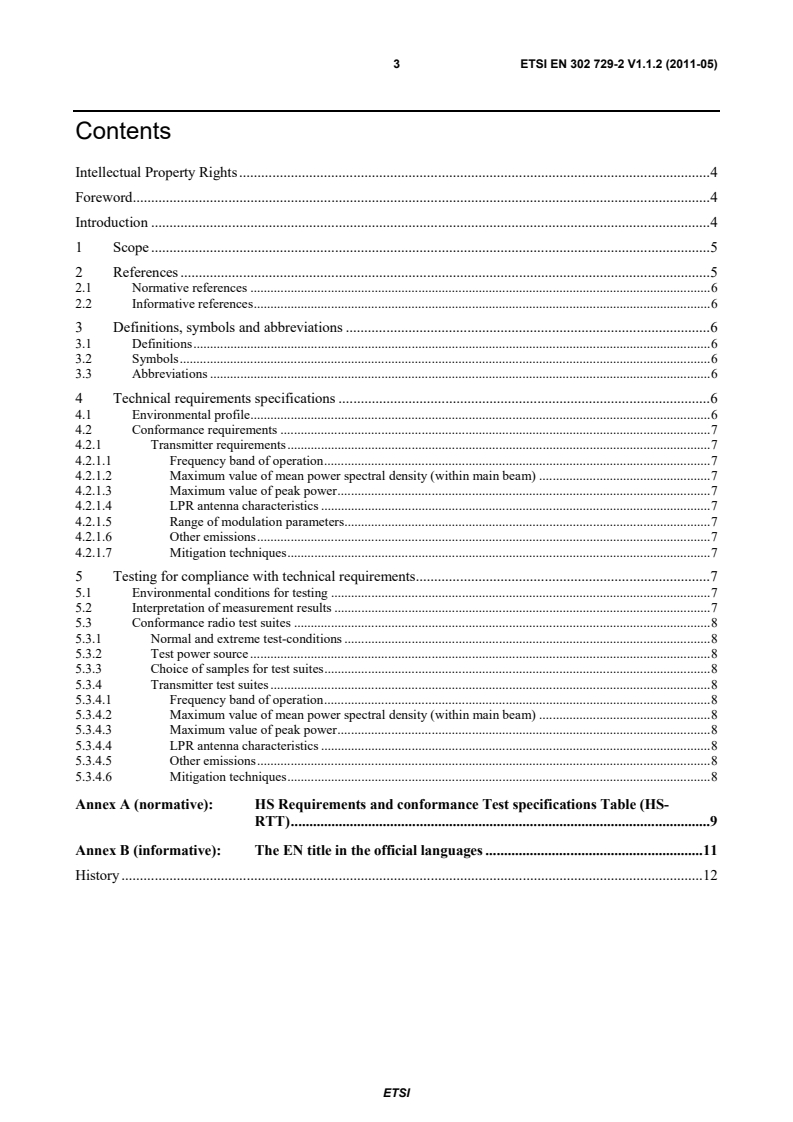
3 ETSI EN 302 729-2 V1.1.2 (2011-05)
Contents
Intellectual Property Rights . 4
Foreword . 4
Introduction . 4
1 Scope . 5
2 References . 5
2.1 Normative references . 6
2.2 Informative references . 6
3 Definitions, symbols and abbreviations . 6
3.1 Definitions . 6
3.2 Symbols . 6
3.3 Abbreviations . 6
4 Technical requirements specifications . 6
4.1 Environmental profile . 6
4.2 Conformance requirements . 7
4.2.1 Transmitter requirements . 7
4.2.1.1 Frequency band of operation . 7
4.2.1.2 Maximum value of mean power spectral density (within main beam) . 7
4.2.1.3 Maximum value of peak power . 7
4.2.1.4 LPR antenna characteristics . 7
4.2.1.5 Range of modulation parameters . 7
4.2.1.6 Other emissions . 7
4.2.1.7 Mitigation techniques . 7
5 Testing for compliance with technical requirements . 7
5.1 Environmental conditions for testing . 7
5.2 Interpretation of measurement results . 7
5.3 Conformance radio test suites . 8
5.3.1 Normal and extreme test-conditions . 8
5.3.2 Test power source . 8
5.3.3 Choice of samples for test suites . 8
5.3.4 Transmitter test suites . 8
5.3.4.1 Frequency band of operation . 8
5.3.4.2 Maximum value of mean power spectral density (within main beam) . 8
5.3.4.3 Maximum value of peak power . 8
5.3.4.4 LPR antenna characteristics . 8
5.3.4.5 Other emissions . 8
5.3.4.6 Mitigation techniques . 8
Annex A (normative): HS Requirements and conformance Test specifications Table (HS-
RTT) . 9
Annex B (informative): The EN title in the official languages . 11
History . 12
ETSI
4 ETSI EN 302 729-2 V1.1.2 (2011-05)
Intellectual Property Rights
IPRs essential or potentially essential to the present document may have been declared to ETSI. The information
pertaining to these essential IPRs, if any, is publicly available for ETSI members and non-members, and can be found
in ETSI SR 000 314: "Intellectual Property Rights (IPRs); Essential, or potentially Essential, IPRs notified to ETSI in
respect of ETSI standards", which is available from the ETSI Secretariat. Latest updates are available on the ETSI Web
server (http://webapp.etsi.org/IPR/home.asp).
Pursuant to the ETSI IPR Policy, no investigation, including IPR searches, has been carried out by ETSI. No guarantee
can be given as to the existence of other IPRs not referenced in ETSI SR 000 314 (or the updates on the ETSI Web
server) which are, or may be, or may become, essential to the present document.
Foreword
This Harmonized European Standard (EN) has been produced by ETSI Technical Committee Electromagnetic
compatibility and Radio spectrum Matters (ERM).
The present document has been produced by ETSI in response to a mandate from the European Commission issued
under Council Directive 98/34/EC (as amended) [i.1] laying down a procedure for the provision of information in the
field of technical standards and regulations.
The title and reference to the present document are intended to included in the publication in the Official Journal of the
European Union of titles and references of Harmonized Standard under the Directive 1999/5/EC [i.2].
See article 5.1 of Directive 1999/5/EC [i.2] for information on presumption of conformity and Harmonised Standards or
parts thereof the references of which have been published in the Official Journal of the European Union.
The requirements relevant to Directive 1999/5/EC [i.2] are summarised in annex A.
For non EEA countries the present document may be used for regulatory (type approval) purposes.
The present document is part 2 of a multi-part deliverable covering Electromagnetic compatibility and Radio spectrum
Matters (ERM); Short Range Devices (SRD); Level Probing Radar (LPR) equipment operating in the frequency ranges
6 GHz to 8,5 GHz, 24,05 GHz to 26,5 GHz, 57 GHz to 64 GHz, 75 GHz to 85 GHz, as identified below:
Part 1: "Technical characteristics and test methods";
Part 2: "Harmonized EN covering the essential requirements of article 3.2 of the R&TTE Directive".
National transposition dates
Date of adoption of this EN: 9 May 2011
Date of latest announcement of this EN (doa): 31 August 2011
Date of latest publication of new National Standard
or endorsement of this EN (dop/e): 29 February 2012
Date of withdrawal of any conflicting National Standard (dow): 28 February 2013
Introduction
The present document is part of a set of standards developed by ETSI and is designed to fit in a modular structure to
cover all radio and telecommunications terminal equipment within the scope of the R&TTE Directive [i.2]. The
modular structure is shown in EG 201 399 [i.4].
ETSI
5 ETSI EN 302 729-2 V1.1.2 (2011-05)
1 Scope
The present document specifies the requirements for Level Probing Radar (LPR) applications based on pulse RF,
FMCW, or similar wideband techniques.
LPR radio equipment types are capable of operating in all or part of the frequency bands as specified in table 1.
Table 1: Frequency bands designated to Level Probing Radars (LPR)
Frequency Bands/frequencies
(GHz)
Transmit and Receive 6 to 8,5
Transmit and Receive 24,05 to 26,5
Transmit and Receive 57 to 64
Transmit and Receive 75 to 85
Table 1 shows a list of the frequency bands as designated to Level Probing Radars in the draft CEPT ECC Decision on
harmonised deployment conditions for industrial Level Probing Radars (LPR) [i.3] as known at the date of publication
of the present document.
LPRs are used in many industries concerned with process control to measure the amount of various substances (mostly
liquids or granulates). LPRs are used for a wide range of applications such as process control, custody transfer
measurement (government legal measurements), water and other liquid monitoring, spilling prevention and other
industrial applications. The main purposes of using LPRs are:
• to in
...
Final draft ETSI EN 302 729-2 V1.1.2 (2011-03)
Harmonized European Standard
Electromagnetic compatibility
and Radio spectrum Matters (ERM);
Short Range Devices (SRD);
Level Probing Radar (LPR) equipment operating in the
frequency ranges 6 GHz to 8,5 GHz, 24,05 GHz to 26,5 GHz,
57 GHz to 64 GHz, 75 GHz to 85 GHz;
Part 2: Harmonized EN covering the essential requirements
of article 3.2 of the R&TTE Directive
2 Final draft ETSI EN 302 729-2 V1.1.2 (2011-03)
Reference
DEN/ERM-TGTLPR-0114-2
Keywords
EHF, radar, regulation, SHF, short range, SRD,
testing, UWB
ETSI
650 Route des Lucioles
F-06921 Sophia Antipolis Cedex - FRANCE
Tel.: +33 4 92 94 42 00 Fax: +33 4 93 65 47 16
Siret N° 348 623 562 00017 - NAF 742 C
Association à but non lucratif enregistrée à la
Sous-Préfecture de Grasse (06) N° 7803/88
Important notice
Individual copies of the present document can be downloaded from:
http://www.etsi.org
The present document may be made available in more than one electronic version or in print. In any case of existing or
perceived difference in contents between such versions, the reference version is the Portable Document Format (PDF).
In case of dispute, the reference shall be the printing on ETSI printers of the PDF version kept on a specific network drive
within ETSI Secretariat.
Users of the present document should be aware that the document may be subject to revision or change of status.
Information on the current status of this and other ETSI documents is available at
http://portal.etsi.org/tb/status/status.asp
If you find errors in the present document, please send your comment to one of the following services:
http://portal.etsi.org/chaircor/ETSI_support.asp
Copyright Notification
No part may be reproduced except as authorized by written permission.
The copyright and the foregoing restriction extend to reproduction in all media.
© European Telecommunications Standards Institute 2011.
All rights reserved.
TM TM TM TM
DECT , PLUGTESTS , UMTS , TIPHON , the TIPHON logo and the ETSI logo are Trade Marks of ETSI registered
for the benefit of its Members.
TM
3GPP is a Trade Mark of ETSI registered for the benefit of its Members and of the 3GPP Organizational Partners.
LTE™ is a Trade Mark of ETSI currently being registered
for the benefit of its Members and of the 3GPP Organizational Partners.
GSM® and the GSM logo are Trade Marks registered and owned by the GSM Association.
ETSI
3 Final draft ETSI EN 302 729-2 V1.1.2 (2011-03)
Contents
Intellectual Property Rights . 4
Foreword . 4
Introduction . 4
1 Scope . 5
2 References . 5
2.1 Normative references . 6
2.2 Informative references . 6
3 Definitions, symbols and abbreviations . 6
3.1 Definitions . 6
3.2 Symbols . 6
3.3 Abbreviations . 6
4 Technical requirements specifications . 6
4.1 Environmental profile . 6
4.2 Conformance requirements . 7
4.2.1 Transmitter requirements . 7
4.2.1.1 Frequency band of operation . 7
4.2.1.2 Maximum value of mean power spectral density (within main beam) . 7
4.2.1.3 Maximum value of peak power . 7
4.2.1.4 LPR antenna characteristics . 7
4.2.1.5 Range of modulation parameters . 7
4.2.1.6 Other emissions . 7
4.2.1.7 Mitigation techniques . 7
5 Testing for compliance with technical requirements . 7
5.1 Environmental conditions for testing . 7
5.2 Interpretation of measurement results . 7
5.3 Conformance radio test suites . 8
5.3.1 Normal and extreme test-conditions . 8
5.3.2 Test power source . 8
5.3.3 Choice of samples for test suites . 8
5.3.4 Transmitter test suites . 8
5.3.4.1 Frequency band of operation . 8
5.3.4.2 Maximum value of mean power spectral density (within main beam) . 8
5.3.4.3 Maximum value of peak power . 8
5.3.4.4 LPR antenna characteristics . 8
5.3.4.5 Other emissions . 8
5.3.4.6 Mitigation techniques . 8
Annex A (normative): HS Requirements and conformance Test specifications Table (HS-
RTT) . 9
Annex B (informative): The EN title in the official languages . 11
History . 12
ETSI
4 Final draft ETSI EN 302 729-2 V1.1.2 (2011-03)
Intellectual Property Rights
IPRs essential or potentially essential to the present document may have been declared to ETSI. The information
pertaining to these essential IPRs, if any, is publicly available for ETSI members and non-members, and can be found
in ETSI SR 000 314: "Intellectual Property Rights (IPRs); Essential, or potentially Essential, IPRs notified to ETSI in
respect of ETSI standards", which is available from the ETSI Secretariat. Latest updates are available on the ETSI Web
server (http://webapp.etsi.org/IPR/home.asp).
Pursuant to the ETSI IPR Policy, no investigation, including IPR searches, has been carried out by ETSI. No guarantee
can be given as to the existence of other IPRs not referenced in ETSI SR 000 314 (or the updates on the ETSI Web
server) which are, or may be, or may become, essential to the present document.
Foreword
This final draft Harmonized European Standard (EN) has been produced by ETSI Technical Committee
Electromagnetic compatibility and Radio spectrum Matters (ERM), and is now submitted for the Vote phase of the
ETSI standards Two-step Approval Procedure.
The present document has been produced by ETSI in response to a mandate from the European Commission issued
under Council Directive 98/34/EC (as amended) [i.1] laying down a procedure for the provision of information in the
field of technical standards and regulations.
The present document is intended to become a Harmonized Standard, the reference of which will be published in the
Official Journal of the European Communities referencing the Directive 1999/5/EC [i.2] of the European Parliament
and of the Council of 9 March 1999 on radio equipment and telecommunications terminal equipment and the mutual
recognition of their conformity ("the R&TTE Directive").
For non EEA countries the present document may be used for regulatory (type approval) purposes.
The requirements relevant to Directive 1999/5/EC [i.2] are summarised in annex A.
The present document is part 2 of a multi-part deliverable covering Electromagnetic compatibility and Radio spectrum
Matters (ERM); Short Range Devices (SRD); Level Probing Radar (LPR) equipment operating in the frequency ranges
6 GHz to 8,5 GHz, 24,05 GHz to 26,5 GHz, 57 GHz to 64 GHz, 75 GHz to 85 GHz, as identified below:
Part 1: "Technical characteristics and test methods";
Part 2: "Harmonized EN covering the essential requirements of article 3.2 of the R&TTE Directive".
Proposed national transposition dates
Date of latest announcement of this EN (doa): 3 months after ETSI publication
Date of latest publication of new National Standard
or endorsement of this EN (dop/e): 6 months after doa
Date of withdrawal of any conflicting National Standard (dow): 18 months after doa
Introduction
The present document is part of a set of standards developed by ETSI and is designed to fit in a modular structure to
cover all radio and telecommunications terminal equipment within the scope of the R&TTE Directive [i.2]. The
modular structure is shown in EG 201 399 [i.4].
ETSI
5 Final draft ETSI EN 302 729-2 V1.1.2 (2011-03)
1 Scope
The present document specifies the requirements for Level Probing Radar (LPR) applications based on pulse RF,
FMCW, or similar wideband techniques.
LPR radio equipment types are capable of operating in all or part of the frequency bands as specified in table 1.
Table 1: Frequency bands designated to Level Probing Radars (LPR)
Frequency Bands/frequencies
(GHz)
Transmit and Receive 6 to 8,5
Transmit and Receive 24,05 to 26,5
Transmit and Receive 57 to 64
Transmit and Receive 75 to 85
Table 1 shows a list of the frequency bands as designated to Level Probing Radars in the draft CEPT ECC Decision on
harmonised deployment conditions for industrial Level Probing Radars (LPR) [i.3] as known at the date of publication
of the present document.
LPRs are used in many industries concerned with process control to measure the amount of various substances (mostly
liquids or granulates). LPRs are used for a wide range of applications such as process control, custody transfer
measurement (government legal measurements), water and other liquid monitoring, spilling prevention and other
industrial applications. The main purposes of
...
Draft ETSI EN 302 729-2 V1.1.1 (2010-08)
Harmonized European Standard (Telecommunications series)
Electromagnetic compatibility
and Radio spectrum Matters (ERM);
Short Range Devices (SRD);
Level Probing Radar (LPR) equipment operating in the
frequency ranges 6 GHz to 8,5 GHz, 24,05 GHz to 26,5 GHz,
57 GHz to 64 GHz, 75 GHz to 85 GHz;
Part 2: Harmonized EN covering the essential requirements
of article 3.2 of the R&TTE Directive
2 Draft ETSI EN 302 729-2 V1.1.1 (2010-08)
Reference
DEN/ERM-TGTLPR-0114-2
Keywords
EHF, radar, regulation, SHF, short range, SRD,
testing, UWB,
ETSI
650 Route des Lucioles
F-06921 Sophia Antipolis Cedex - FRANCE
Tel.: +33 4 92 94 42 00 Fax: +33 4 93 65 47 16
Siret N° 348 623 562 00017 - NAF 742 C
Association à but non lucratif enregistrée à la
Sous-Préfecture de Grasse (06) N° 7803/88
Important notice
Individual copies of the present document can be downloaded from:
http://www.etsi.org
The present document may be made available in more than one electronic version or in print. In any case of existing or
perceived difference in contents between such versions, the reference version is the Portable Document Format (PDF).
In case of dispute, the reference shall be the printing on ETSI printers of the PDF version kept on a specific network drive
within ETSI Secretariat.
Users of the present document should be aware that the document may be subject to revision or change of status.
Information on the current status of this and other ETSI documents is available at
http://portal.etsi.org/tb/status/status.asp
If you find errors in the present document, please send your comment to one of the following services:
http://portal.etsi.org/chaircor/ETSI_support.asp
Copyright Notification
No part may be reproduced except as authorized by written permission.
The copyright and the foregoing restriction extend to reproduction in all media.
© European Telecommunications Standards Institute 2010.
All rights reserved.
TM TM TM TM
DECT , PLUGTESTS , UMTS , TIPHON , the TIPHON logo and the ETSI logo are Trade Marks of ETSI registered
for the benefit of its Members.
TM
3GPP is a Trade Mark of ETSI registered for the benefit of its Members and of the 3GPP Organizational Partners.
LTE™ is a Trade Mark of ETSI currently being registered
for the benefit of its Members and of the 3GPP Organizational Partners.
GSM® and the GSM logo are Trade Marks registered and owned by the GSM Association.
ETSI
3 Draft ETSI EN 302 729-2 V1.1.1 (2010-08)
Contents
Intellectual Property Rights . 4
Foreword . 4
Introduction . 4
1 Scope . 5
2 References . 5
2.1 Normative references . 6
2.2 Informative references . 6
3 Definitions, symbols and abbreviations . 6
3.1 Definitions . 6
3.2 Symbols . 6
3.3 Abbreviations . 6
4 Technical requirements specifications . 6
4.1 Environmental profile . 6
4.2 Conformance requirements . 7
4.2.1 Transmitter requirements . 7
4.2.1.1 Frequency band of operation . 7
4.2.1.2 Maximum value of mean power spectral density (within main beam) . 7
4.2.1.3 Maximum value of peak power . 7
4.2.1.4 LPR antenna characteristics . 7
4.2.1.5 Range of modulation parameters . 7
4.2.1.6 Other emissions . 7
4.2.1.7 Mitigation techniques . 7
5 Testing for compliance with technical requirements . 7
5.1 Environmental conditions for testing . 7
5.2 Interpretation of measurement results . 7
5.3 Conformance radio test suites . 8
5.3.1 Normal and extreme test-conditions . 8
5.3.2 Test power source . 8
5.3.3 Choice of samples for test suites . 8
5.3.4 Transmitter test suites . 8
5.3.4.1 Frequency band of operation . 8
5.3.4.2 Maximum value of mean power spectral density (within main beam) . 8
5.3.4.3 Maximum value of peak power . 8
5.3.4.4 LPR antenna characteristics . 8
5.3.4.5 Other emissions . 8
5.3.4.6 Mitigation techniques . 8
Annex A (normative): HS Requirements and conformance Test specifications Table (HS-
RTT) . 9
Annex B (informative): The EN title in the official languages . 11
History . 12
ETSI
4 Draft ETSI EN 302 729-2 V1.1.1 (2010-08)
Intellectual Property Rights
IPRs essential or potentially essential to the present document may have been declared to ETSI. The information
pertaining to these essential IPRs, if any, is publicly available for ETSI members and non-members, and can be found
in ETSI SR 000 314: "Intellectual Property Rights (IPRs); Essential, or potentially Essential, IPRs notified to ETSI in
respect of ETSI standards", which is available from the ETSI Secretariat. Latest updates are available on the ETSI Web
server (http://webapp.etsi.org/IPR/home.asp).
Pursuant to the ETSI IPR Policy, no investigation, including IPR searches, has been carried out by ETSI. No guarantee
can be given as to the existence of other IPRs not referenced in ETSI SR 000 314 (or the updates on the ETSI Web
server) which are, or may be, or may become, essential to the present document.
Foreword
This Harmonized European Standard (Telecommunications series) has been produced by ETSI Technical Committee
Electromagnetic compatibility and Radio spectrum Matters (ERM), and is now submitted for the Public Enquiry phase
of the ETSI standards Two-step Approval Procedure.
The present document has been produced by ETSI in response to a mandate from the European Commission issued
under Council Directive 98/34/EC (as amended) [i.1] laying down a procedure for the provision of information in the
field of technical standards and regulations.
The present document is intended to become a Harmonized Standard, the reference of which will be published in the
Official Journal of the European Communities referencing the Directive 1999/5/EC [i.2] of the European Parliament
and of the Council of 9 March 1999 on radio equipment and telecommunications terminal equipment and the mutual
recognition of their conformity ("the R&TTE Directive").
For non EEA countries the present document may be used for regulatory (type approval) purposes.
The requirements relevant to Directive 1999/5/EC [i.2] are summarised in annex A.
The present document is part 2 of a multi-part deliverable covering Electromagnetic compatibility and Radio spectrum
Matters (ERM); Short Range Devices (SRD); Level Probing Radar (LPR) equipment operating in the frequency ranges
6 GHz to 8,5 GHz, 24,05 GHz to 26,5 GHz, 57 GHz to 64 GHz, 75 GHz to 85 GHz, as identified below:
Part 1: "Technical characteristics and test methods";
Part 2: "Harmonized EN covering the essential requirements of article 3.2 of the R&TTE Directive".
Proposed national transposition dates
Date of latest announcement of this EN (doa): 3 months after ETSI publication
Date of latest publication of new National Standard
or endorsement of this EN (dop/e): 6 months after doa
Date of withdrawal of any conflicting National Standard (dow): 18 months after doa
Introduction
The present document is part of a set of standards developed by ETSI and is designed to fit in a modular structure to
cover all radio and telecommunications terminal equipment within the scope of the R&TTE Directive [i.2]. The
modular structure is shown in EG 201 399 [i.4].
ETSI
5 Draft ETSI EN 302 729-2 V1.1.1 (2010-08)
1 Scope
The present document specifies the requirements for Level Probing Radar (LPR) applications based on pulse RF,
FMCW, or similar wideband techniques.
LPR radio equipment types are capable of operating in all or part of the frequency bands as specified in table 1.
Table 1: Frequency bands designated to Level Probing Radars (LPR)
Frequency Bands/frequencies
(GHz)
Transmit and Receive 6 to 8,5
Transmit and Receive 24,05 to 26,5
Transmit and Receive 57 to 64
Transmit and Receive 75 to 85
Table 1 shows a list of the frequency bands as designated to Level Probing Radars in the draft CEPT ECC Decision on
harmonised deployment conditions for industrial Level Probing Radars (LPR) [i.3] as known at the date of publication
of the present document.
LPRs are used in many industries concerned with process control to measure the amount of various substances (mostly
liquids or granulates). LPRs are used for a wide range of applications such as process control, custody transfer
measurement (government legal measurements), water and other liquid m
...
2003-01.Slovenski inštitut za standardizacijo. Razmnoževanje celote ali delov tega standarda ni dovoljeno.Electromagnetic compatibility and Radio spectrum Matters (ERM) - Short Range Devices (SRD) - Level Probing Radar (LPR) equipment operating in the frequency ranges 6 GHz to 8,5 GHz, 24,05 GHz to 26,5 GHz, 57 GHz to 64 GHz, 75 GHz to 85 GHz - Part 2: Harmonized EN covering the essential requirements of article 3.2 of the R&TTE Directive33.100.01Elektromagnetna združljivost na splošnoElectromagnetic compatibility in general33.060.01Radijske komunikacije na splošnoRadiocommunications in generalICS:Ta slovenski standard je istoveten z:EN 302 729-2 Version 1.1.2SIST EN 302 729-2 V1.1.2:2011en01-julij-2011SIST EN 302 729-2 V1.1.2:2011SLOVENSKI
STANDARD
ETSI ETSI EN 302 729-2 V1.1.2 (2011-05) 2
Reference DEN/ERM-TGTLPR-0114-2 Keywords EHF, radar, regulation, SHF, short range, SRD, testing, UWB ETSI 650 Route des Lucioles F-06921 Sophia Antipolis Cedex - FRANCE
Tel.: +33 4 92 94 42 00
Fax: +33 4 93 65 47 16
Siret N° 348 623 562 00017 - NAF 742 C Association à but non lucratif enregistrée à la Sous-Préfecture de Grasse (06) N° 7803/88
Important notice Individual copies of the present document can be downloaded from: http://www.etsi.org The present document may be made available in more than one electronic version or in print. In any case of existing or perceived difference in contents between such versions, the reference version is the Portable Document Format (PDF). In case of dispute, the reference shall be the printing on ETSI printers of the PDF version kept on a specific network drive within ETSI Secretariat. Users of the present document should be aware that the document may be subject to revision or change of status. Information on the current status of this and other ETSI documents is available at http://portal.etsi.org/tb/status/status.asp If you find errors in the present document, please send your comment to one of the following services: http://portal.etsi.org/chaircor/ETSI_support.asp Copyright Notification No part may be reproduced except as authorized by written permission. The copyright and the foregoing restriction extend to reproduction in all media.
© European Telecommunications Standards Institute 2011. All rights reserved.
DECTTM, PLUGTESTSTM, UMTSTM, TIPHONTM, the TIPHON logo and the ETSI logo are Trade Marks of ETSI registered for the benefit of its Members. 3GPPTM is a Trade Mark of ETSI registered for the benefit of its Members and of the 3GPP Organizational Partners. LTE™ is a Trade Mark of ETSI currently being registered for the benefit of its Members and of the 3GPP Organizational Partners. GSM® and the GSM logo are Trade Marks registered and owned by the GSM Association. SIST EN 302 729-2 V1.1.2:2011
ETSI ETSI EN 302 729-2 V1.1.2 (2011-05) 3 Contents Intellectual Property Rights . 4 Foreword . 4 Introduction . 4 1 Scope . 5 2 References . 5 2.1 Normative references . 6 2.2 Informative references . 6 3 Definitions, symbols and abbreviations . 6 3.1 Definitions . 6 3.2 Symbols . 6 3.3 Abbreviations . 6 4 Technical requirements specifications . 6 4.1 Environmental profile . 6 4.2 Conformance requirements . 7 4.2.1 Transmitter requirements . 7 4.2.1.1 Frequency band of operation . 7 4.2.1.2 Maximum value of mean power spectral density (within main beam) . 7 4.2.1.3 Maximum value of peak power . 7 4.2.1.4 LPR antenna characteristics . 7 4.2.1.5 Range of modulation parameters . 7 4.2.1.6 Other emissions . 7 4.2.1.7 Mitigation techniques . 7 5 Testing for compliance with technical requirements . 7 5.1 Environmental conditions for testing . 7 5.2 Interpretation of measurement results . 7 5.3 Conformance radio test suites . 8 5.3.1 Normal and extreme test-conditions . 8 5.3.2 Test power source . 8 5.3.3 Choice of samples for test suites . 8 5.3.4 Transmitter test suites . 8 5.3.4.1 Frequency band of operation . 8 5.3.4.2 Maximum value of mean power spectral density (within main beam) . 8 5.3.4.3 Maximum value of peak power . 8 5.3.4.4 LPR antenna characteristics . 8 5.3.4.5 Other emissions . 8 5.3.4.6 Mitigation techniques . 8 Annex A (normative): HS Requirements and conformance Test specifications Table (HS-RTT) . 9 Annex B (informative): The EN title in the official languages . 11 History . 12
ETSI ETSI EN 302 729-2 V1.1.2 (2011-05) 4 Intellectual Property Rights IPRs essential or potentially essential to the present document may have been declared to ETSI. The information pertaining to these essential IPRs, if any, is publicly available for ETSI members and non-members, and can be found in ETSI SR 000 314: "Intellectual Property Rights (IPRs); Essential, or potentially Essential, IPRs notified to ETSI in respect of ETSI standards", which is available from the ETSI Secretariat. Latest updates are available on the ETSI Web server (http://webapp.etsi.org/IPR/home.asp). Pursuant to the ETSI IPR Policy, no investigation, including IPR searches, has been carried out by ETSI. No guarantee can be given as to the existence of other IPRs not referenced in ETSI SR 000 314 (or the updates on the ETSI Web server) which are, or may be, or may become, essential to the present document. Foreword This Harmonized European Standard (EN) has been produced by ETSI Technical Committee Electromagnetic compatibility and Radio spectrum Matters (ERM). The present document has been produced by ETSI in response to a mandate from the European Commission issued under Council Directive 98/34/EC (as amended) [i.1] laying down a procedure for the provision of information in the field of technical standards and regulations. The title and reference to the present document are intended to included in the publication in the Official Journal of the European Union of titles and references of Harmonized Standard under the Directive 1999/5/EC [i.2]. See article 5.1 of Directive 1999/5/EC [i.2] for information on presumption of conformity and Harmonised Standards or parts thereof the references of which have been published in the Official Journal of the European Union. The requirements relevant to Directive 1999/5/EC [i.2] are summarised in annex A. For non EEA countries the present document may be used for regulatory (type approval) purposes. The present document is part 2 of a multi-part deliverable covering Electromagnetic compatibility and Radio spectrum Matters (ERM); Short Range Devices (SRD); Level Probing Radar (LPR) equipment operating in the frequency ranges 6 GHz to 8,5 GHz, 24,05 GHz to 26,5 GHz, 57 GHz to 64 GHz, 75 GHz to 85 GHz, as identified below: Part 1: "Technical characteristics and test methods"; Part 2: "Harmonized EN covering the essential requirements of article 3.2 of the R&TTE Directive".
National transposition dates Date of adoption of this EN: 9 May 2011 Date of latest announcement of this EN (doa): 31 August 2011 Date of latest publication of new National Standard or endorsement of this EN (dop/e):
29 February 2012 Date of withdrawal of any conflicting National Standard (dow): 28 February 2013
Introduction The present document is part of a set of standards developed by ETSI and is designed to fit in a modular structure to cover all radio and telecommunications terminal equipment within the scope of the R&TTE Directive [i.2]. The modular structure is shown in EG 201 399 [i.4]. SIST EN 302 729-2 V1.1.2:2011
ETSI ETSI EN 302 729-2 V1.1.2 (2011-05) 5 1 Scope The present document specifies the requirements for Level Probing Radar (LPR) applications based on pulse RF, FMCW, or similar wideband techniques. LPR radio equipment types are capable of operating in all or part of the frequency bands as specified in table 1. Table 1: Frequency bands designated to Level Probing Radars (LPR)
Frequency Bands/frequencies (GHz) Transmit and Receive 6 to 8,5
Transmit and Receive 24,05 to 26,5
Transmit and Receive 57 to 64 Transmit and Receive 75 to 85
Table 1 shows a list of the frequency bands as designated to Level Probing Radars in the draft CEPT ECC Decision on harmonised deployment conditions for industrial Level Probing Radars (LPR) [i
...