

oSIST prEN 304 627 V1.0.1:2026
(Main)Cyber Security (CYBER) - CRA - Cybersecurity requirements for routers, modems intended for the connection to the internet, and switches
- Abstract
DEN/CYBER-EUS-0013
- Status
- Not Published
- Public Enquiry End Date
- 29-Sep-2026
- Technical Committee
- SPN - Services and Protocols for Networks
- Current Stage
- 4020 - Public enquire (PE) (Adopted Project)
- Start Date
- 03-Aug-2026
- Due Date
- 21-Dec-2026
- Completion Date
- 15-Sep-2026

oSIST prEN 304 627 V1.0.1:2026 is the Slovenian version of ETSI EN 304 627 V1.0.1 (2026-07), published by SIST as an identical standard. It specifies cybersecurity requirements, vulnerability handling activities, and assessment criteria for routers, modems intended for the connection to the internet, and switches. The document is written for manufacturers, suppliers, and conformity assessors that need a harmonised European cybersecurity baseline for these network products with digital elements.
What does oSIST prEN 304 627 V1.0.1:2026 specify?
oSIST prEN 304 627 V1.0.1:2026 covers cybersecurity for routers, modems intended for connection to the internet, and switches. The scope includes the product context, the technical requirements, and the criteria used to assess whether those requirements are met.
Clause 1 says the standard applies to products with digital elements in the product category described in Commission Implementing Regulation (EU) 2025/2392. It covers consumer, enterprise, and virtual routers; modems using wired, wireless, and cellular access technologies; and managed, smart, multilayer, virtual, and programmable switches, including bridges such as wireless access points.
Clause 4 sets out the product context: functions, architecture, operational environment, users, and use cases. That matters because the security controls are tied to how the product is used in practice, not just to the hardware type.
The document is organised as follows:
| Annex | What it covers |
|---|---|
| Annex A | Mapping of the technical requirements to the corresponding cybersecurity requirements of the CRA |
| Annex B | Threat landscape and risk assessment methodology, including risk factors and mitigation |
| Annex K | Cryptographic assessment criteria, CRY-SOTA classification, and crypto-agility assessment |
Clause 5 contains the technical requirements for products, and clause 6 contains the assessment criteria used to check conformity with those requirements.
What are the key requirements of oSIST prEN 304 627 V1.0.1:2026?
oSIST prEN 304 627 V1.0.1:2026 requires secure behaviour across the whole product life cycle - from factory default state and setup, through management and update operations, to boot integrity and data transfer. The main idea is that the product must be secure by default, remain controlled during operation, and expose enough evidence for assessment.
Product context and applicability
Clause 5.1 says the technical requirements apply in the product context described in clause 4 and according to intended use. Clause 5.2 links the controls to the actual risk profile, supported by the use cases and threat analysis in Annex B.
In practice, this means the manufacturer has to decide which controls apply based on deployment context, such as residential, enterprise, data centre, service provider, carrier network, critical infrastructure, or special-protection use cases. The standard also says the security functions must be integrated so that one control does not bypass or weaken another.
Secure defaults, updates, and factory reset
Clause 5.3 requires no known exploitable vulnerabilities, and the assessment criteria show that this is tied to a machine-readable software bill of materials (SBOM) and checks against vulnerability databases for third-party components. In practice, each product version needs traceable component information and vulnerability screening.
Clause 5.4 requires secure by default configuration. The product factory default state must restrict management access, disable diagnostic interfaces, require authentication and authorisation for management actions that enable diagnostics, and generate audit events. Factory reset must keep the installed firmware version and security updates, while removing non-default configuration, user data, and user-instantiated or modified critical security parameters.
Clause 5.5 covers security updates. The update path must support authenticated and authorised installation, cryptographic integrity verification, version reporting after installation, and audit events for update availability, download, and installation outcomes. For a buyer or operator, this means patching is part of the security design, not an afterthought.
Authentication, authorisation, and management access
Clause 5.6 sets the rules for authentication and access control. Management interfaces must require authentication, valid credentials must work, invalid credentials must be rejected, and session state must be maintained without repeated logins during the session.
The assessments also show requirements for minimum credential entropy, protection against authentication failures through progressive delays and temporary account lockout, and password history controls. Management access must respect privilege levels, and command execution must be authorised before the command runs.
The document also expects management protocols to use state of the art cryptography in factory default state and in operational state. Where risk factors are present, it adds protections against unauthenticated request floods and DoS attacks on management and control plane interfaces. Where legacy protocols exist, the document requires them to be disabled in default state and clearly indicated when used.
Confidentiality, logging, and data handling
Clause 5.7 protects confidentiality. Management communications and control plane traffic must use state of the art cryptography, configuration and firmware must not be modified without authorisation, and stored data must be limited to what is necessary for the intended routing, switching, modem functions, and any additional capabilities.
The same clause requires explicit opt-in for diagnostic or telemetry collection beyond the product’s intended purpose. In practice, the product should not silently collect extra data.
Clause 5.10 covers monitoring and logging, and the assessment criteria show audit events for authentication attempts, configuration changes, product errors, security updates, booting, and resource utilisation thresholds. Clause 5.11 requires secure data export and transfer over channels protected by state of the art cryptography, with management access required for import and export operations.
Integrity, resilience, and attack surface
Clause 5.8 addresses availability and resilience. Clause 5.9 focuses on attack surface and mitigation, including system integrity, boot process protection, default packet disposition, and exposure minimisation.
The assessments make the practical expectations clear: boot components must be verified with state of the art cryptography, boot results must be logged, modified boot components must be rejected, and the product must enter a predefined failure state if verification fails. The standard also expects rate limiting, connection throttling, and automatic recovery after DoS conditions cease, so essential forwarding and management functions can resume without manual intervention.
What terms does oSIST prEN 304 627 V1.0.1:2026 define?
- CRA - the Cyber Resilience Act, the EU regulation that Annex A maps the standard to.
- audit event - a timestamped, structured record of actions such as authentication attempts, configuration changes, and product errors.
- critical security parameter - confidential information whose disclosure or modification can compromise security, such as secret keys, passwords, PINs, or private certificate components.
- legacy system - a system that operates using at least one legacy protocol.
- network interface - a physical interface used to access product functionality over a network.
- private network - a closed network within a home or organisation that is not directly accessible to the public and is controlled by or on behalf of the user.
- product factory default state - the state after manufacturing, reflecting the manufacturer’s default configuration, and the state the product returns to after a factory reset.
Who uses oSIST prEN 304 627 V1.0.1:2026?
Manufacturers of routers, internet modems, and switches use this standard to design secure defaults, update handling, access control, logging, and boot protection. It is also relevant to teams that build virtual network functions or products with integrated modem or wireless functions.
Network operators, enterprise IT staff, service providers, and carrier network teams use it when selecting, configuring, and maintaining equipment in residential, small enterprise, medium enterprise, large enterprise, data centre, critical infrastructure, and service provider environments. The document is especially relevant where management access, remote administration, or continuous operation matters.
Conformity assessors, quality managers, and buyers use it to check whether a product has the required technical controls and whether the supplier can show documentation, test results, and audit evidence. For procurement, the standard helps turn “cybersecure router/switch” into a testable requirement set.
Which standards are used with oSIST prEN 304 627 V1.0.1:2026?
| Reference | Contribution |
|---|---|
| Regulation (EU) 2024/2847 (CRA) | Legal basis for the cybersecurity requirements and the mapping in Annex A |
| Commission Implementing Regulation (EU) 2025/2392 | Technical description of the product categories in scope |
| prEN 40000-1-1 | Terms used alongside the CRA framework |
| ENISA Report 1747792503 | Cryptographic mechanisms reference used in the normative references |
| Canadian Centre for Cyber Security ITSP.40.062 | Guidance on securely configuring network protocols |
| prEN 50770-5 | Companion security profile for routers, internet modems, and switches |
| ENISA European Vulnerability Database (EUVD) | Source used in vulnerability checks for product versions and components |
| ENISA Single Reporting Platform (SRP) | Reporting platform referenced for CRA-related processes |
| IEEE 802.3-2022 and IEEE 802.11-2024 | Ethernet and wireless LAN technology references used in product context |
| Broadband Forum TR-069 and TR-369 | Management protocol references relevant to network equipment administration |
| IETF RFC 5709, 7166, 5310, 5925, 8915 | Protocol-specific authentication and time-security references used in the normative list |
| USB specifications and other interface standards listed in clause 2 | Interface and technology context for products that expose those connectivity options |
What does the oSIST prEN 304 627 V1.0.1:2026 document contain?
The document contains a full product-context model in clause 4, including functions, architecture, environments, users, and use cases. That material is used to decide which cybersecurity controls apply to a given device or deployment.
Clause 6 turns the technical requirements into assessment criteria. It relies on documentation review, product inspection, traffic capture, configuration checks, and functional testing to show whether the required controls are present and effective.
Annex B provides the threat landscape and the risk-factor framework that supports applicability decisions. Annex K provides the cryptographic assessment structure, including the classification of algorithms as CRY-SOTA and the assessment approach for symmetric and asymmetric primitives, protocols, and crypto-agility.
For implementers and assessors, the most useful content is the set of requirement assessments that specify what evidence to collect and what behaviour to verify for defaults, authentication, updates, logging, boot integrity, availability, and secure data transfer.
Get Certified
Connect with accredited certification bodies for this standard

BSI Group
BSI (British Standards Institution) is the business standards company that helps organizations make excellence a habit.

Bureau Veritas
Bureau Veritas is a world leader in laboratory testing, inspection and certification services.

DNV
DNV is an independent assurance and risk management provider.
Sponsored listings
Frequently Asked Questions
oSIST prEN 304 627 V1.0.1:2026 is a standard published by the Slovenian Institute for Standardization (SIST). Its full title is "Cyber Security (CYBER) - CRA - Cybersecurity requirements for routers, modems intended for the connection to the internet, and switches". This standard covers: DEN/CYBER-EUS-0013
DEN/CYBER-EUS-0013
oSIST prEN 304 627 V1.0.1:2026 is classified under the following ICS (International Classification for Standards) categories: 35.030 - IT Security. The ICS classification helps identify the subject area and facilitates finding related standards.
oSIST prEN 304 627 V1.0.1:2026 is available in PDF format for immediate download after purchase. The document can be added to your cart and obtained through the secure checkout process. Digital delivery ensures instant access to the complete standard document.
Standards Content (Sample)
Draft ETSI EN 304 627 V1.0.1 (2026-07)
HARMONISED EUROPEAN STANDARD
Cyber Security (CYBER);
CRA;
Cybersecurity requirements for routers, modems intended for
the connection to the internet and switches
2 Draft ETSI EN 304 627 V1.0.1 (2026-07)
Reference
DEN/CYBER-EUS-0013
Keywords
CRA, cybersecurity, modem, router, switch
ETSI
650 Route des Lucioles
F-06921 Sophia Antipolis Cedex - FRANCE
Tel.: +33 4 92 94 42 00 Fax: +33 4 93 65 47 16
Siret N° 348 623 562 00017 - APE 7112B
Association à but non lucratif enregistrée à la
Sous-Préfecture de Grasse (06) N° w061004871
Important notice
The present document can be downloaded from the
ETSI Search & Browse Standards application.
The present document may be made available in electronic versions and/or in print. The content of any electronic and/or
print versions of the present document shall not be modified without the prior written authorisation of ETSI. In case of any
existing or perceived difference in contents between such versions and/or in print, the prevailing version of an ETSI
deliverable is the one made publicly available in PDF format on ETSI deliver repository.
Users should be aware that the present document may be revised or have its status changed,
this information is available in the Milestones listing.
If you find errors in the present document, please send your comments to
the relevant service listed under Committee Support Staff.
If you find a security vulnerability in the present document, please report it through our
Coordinated Vulnerability Disclosure (CVD) program.
Notice of disclaimer & limitation of liability
The information provided in the present deliverable is directed solely to professionals who have the appropriate degree of
experience to understand and interpret its content in accordance with generally accepted engineering or
other professional standard and applicable regulations.
No recommendation as to products and services or vendors is made or should be implied.
In no event shall ETSI be held liable for loss of profits or any other incidental or consequential damages.
Any software contained in this deliverable is provided "AS IS" with no warranties, express or implied, including but not
limited to, the warranties of merchantability, fitness for a particular purpose and non-infringement of intellectual property
rights and ETSI shall not be held liable in any event for any damages whatsoever (including, without limitation, damages
for loss of profits, business interruption, loss of information, or any other pecuniary loss) arising out of or related to the use
of or inability to use the software.
Copyright Notification
No part of this document may be reproduced in any form, by any means and in any media, without the prior written
authorization of ETSI and except as expressly permitted below.
By way of exception and when the document is a normative deliverable (European Standard (EN),
Technical Specification (TS), Group Specification (GS) or ETSI Standard (ES)), ETSI authorizes to reproduce
and incorporate into products, services and technical documentation only those extracts (e.g. templates) that are strictly
necessary for the technical implementation of the normative deliverable, to ensure compliance with the latter.
Nothing in this notice shall be construed as limiting any mandatory exceptions to copyright provided by applicable law
© ETSI 2026.
All rights reserved.
ETSI
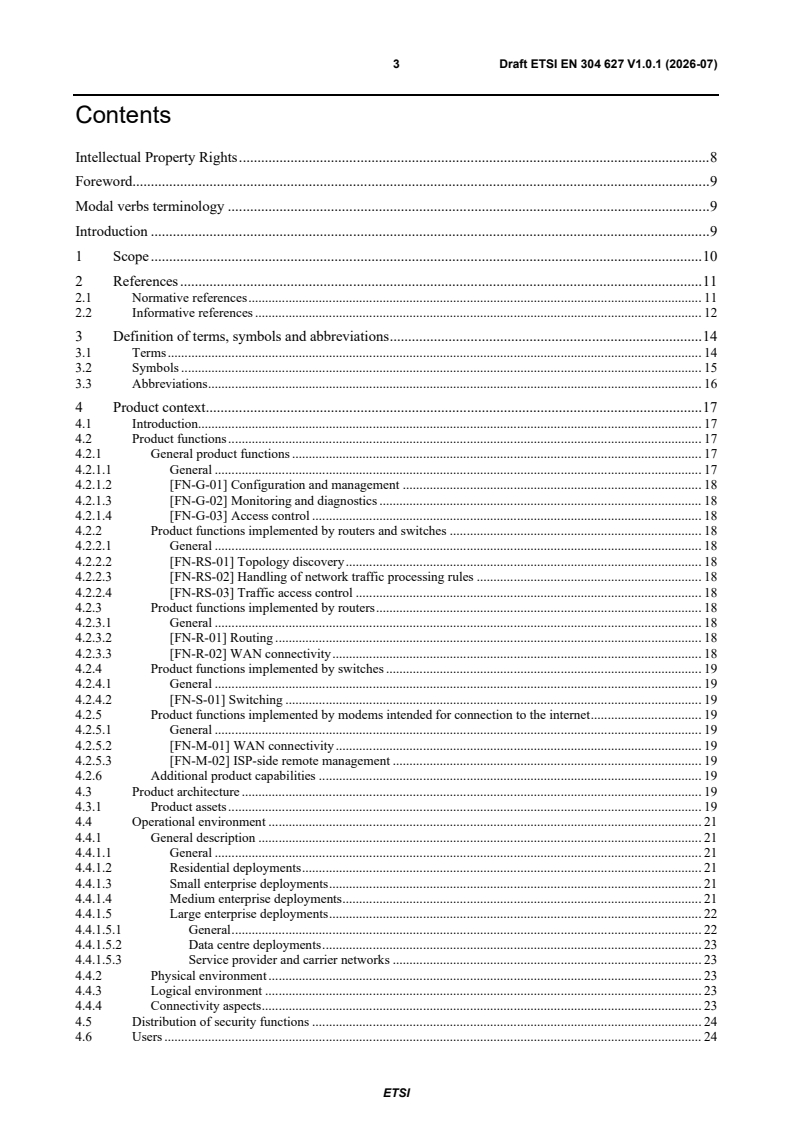
3 Draft ETSI EN 304 627 V1.0.1 (2026-07)
Contents
Intellectual Property Rights . 8
Foreword. 9
Modal verbs terminology . 9
Introduction . 9
1 Scope . 10
2 References . 11
2.1 Normative references . 11
2.2 Informative references . 12
3 Definition of terms, symbols and abbreviations . 14
3.1 Terms . 14
3.2 Symbols . 15
3.3 Abbreviations . 16
4 Product context . 17
4.1 Introduction. 17
4.2 Product functions . 17
4.2.1 General product functions . 17
4.2.1.1 General . 17
4.2.1.2 [FN-G-01] Configuration and management . 18
4.2.1.3 [FN-G-02] Monitoring and diagnostics . 18
4.2.1.4 [FN-G-03] Access control . 18
4.2.2 Product functions implemented by routers and switches . 18
4.2.2.1 General . 18
4.2.2.2 [FN-RS-01] Topology discovery . 18
4.2.2.3 [FN-RS-02] Handling of network traffic processing rules . 18
4.2.2.4 [FN-RS-03] Traffic access control . 18
4.2.3 Product functions implemented by routers . 18
4.2.3.1 General . 18
4.2.3.2 [FN-R-01] Routing . 18
4.2.3.3 [FN-R-02] WAN connectivity . 18
4.2.4 Product functions implemented by switches . 19
4.2.4.1 General . 19
4.2.4.2 [FN-S-01] Switching . 19
4.2.5 Product functions implemented by modems intended for connection to the internet . 19
4.2.5.1 General . 19
4.2.5.2 [FN-M-01] WAN connectivity . 19
4.2.5.3 [FN-M-02] ISP-side remote management . 19
4.2.6 Additional product capabilities . 19
4.3 Product architecture . 19
4.3.1 Product assets . 19
4.4 Operational environment . 21
4.4.1 General description . 21
4.4.1.1 General . 21
4.4.1.2 Residential deployments . 21
4.4.1.3 Small enterprise deployments . 21
4.4.1.4 Medium enterprise deployments. 21
4.4.1.5 Large enterprise deployments . 22
4.4.1.5.1 General . 22
4.4.1.5.2 Data centre deployments . 23
4.4.1.5.3 Service provider and carrier networks . 23
4.4.2 Physical environment . 23
4.4.3 Logical environment . 23
4.4.4 Connectivity aspects . 23
4.5 Distribution of security functions . 24
4.6 Users . 24
ETSI
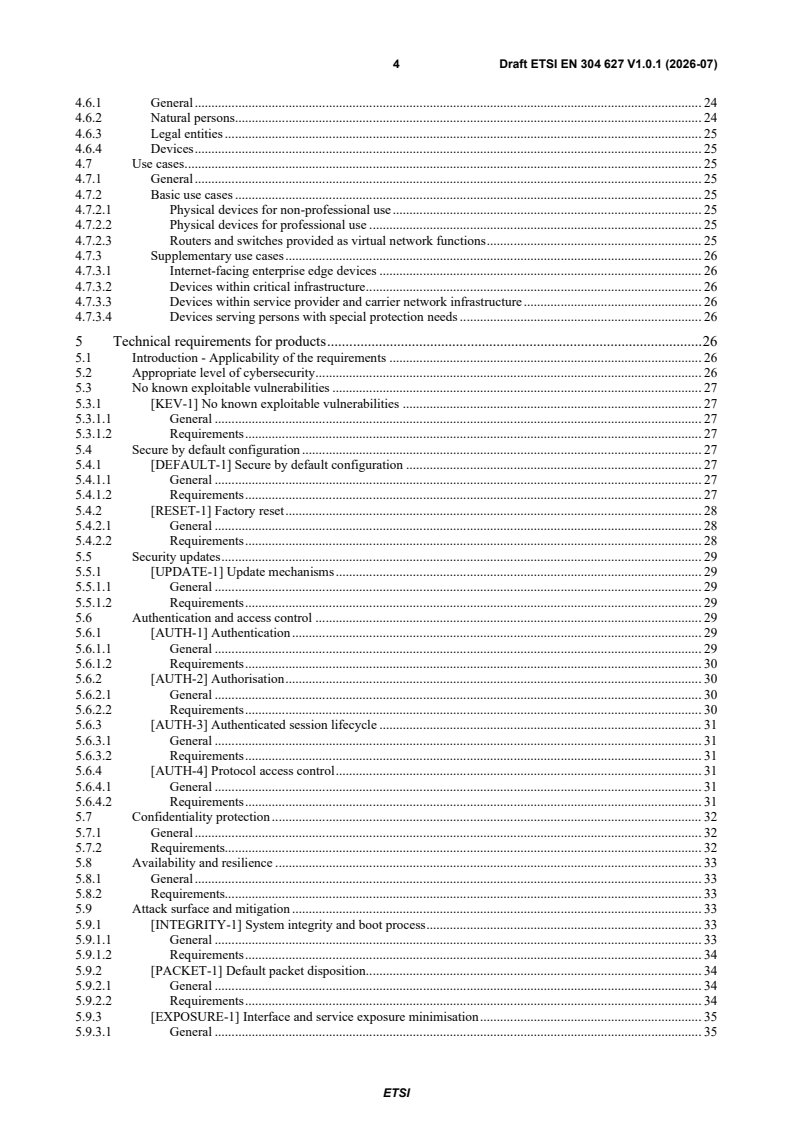
4 Draft ETSI EN 304 627 V1.0.1 (2026-07)
4.6.1 General . 24
4.6.2 Natural persons . 24
4.6.3 Legal entities . 25
4.6.4 Devices . 25
4.7 Use cases . 25
4.7.1 General . 25
4.7.2 Basic use cases . 25
4.7.2.1 Physical devices for non-professional use . 25
4.7.2.2 Physical devices for professional use . 25
4.7.2.3 Routers and switches provided as virtual network functions . 25
4.7.3 Supplementary use cases . 26
4.7.3.1 Internet-facing enterprise edge devices . 26
4.7.3.2 Devices within critical infrastructure . 26
4.7.3.3 Devices within service provider and carrier network infrastructure . 26
4.7.3.4 Devices serving persons with special protection needs . 26
5 Technical requirements for products . 26
5.1 Introduction - Applicability of the requirements . 26
5.2 Appropriate level of cybersecurity . 26
5.3 No known exploitable vulnerabilities . 27
5.3.1 [KEV-1] No known exploitable vulnerabilities . 27
5.3.1.1 General . 27
5.3.1.2 Requirements . 27
5.4 Secure by default configuration . 27
5.4.1 [DEFAULT-1] Secure by default configuration . 27
5.4.1.1 General . 27
5.4.1.2 Requirements . 27
5.4.2 [RESET-1] Factory reset . 28
5.4.2.1 General . 28
5.4.2.2 Requirements . 28
5.5 Security updates . 29
5.5.1 [UPDATE-1] Update mechanisms . 29
5.5.1.1 General . 29
5.5.1.2 Requirements . 29
5.6 Authentication and access control . 29
5.6.1 [AUTH-1] Authentication . 29
5.6.1.1 General . 29
5.6.1.2 Requirements . 30
5.6.2 [AUTH-2] Authorisation . 30
5.6.2.1 General . 30
5.6.2.2 Requirements . 30
5.6.3 [AUTH-3] Authenticated session lifecycle . 31
5.6.3.1 General . 31
5.6.3.2 Requirements . 31
5.6.4 [AUTH-4] Protocol access control . 31
5.6.4.1 General . 31
5.6.4.2 Requirements . 31
5.7 Confidentiality protection . 32
5.7.1 General . 32
5.7.2 Requirements. 32
5.8 Availability and resilience . 33
5.8.1 General . 33
5.8.2 Requirements. 33
5.9 Attack surface and mitigation . 33
5.9.1 [INTEGRITY-1] System integrity and boot process . 33
5.9.1.1 General . 33
5.9.1.2 Requirements . 34
5.9.2 [PACKET-1] Default packet disposition. 34
5.9.2.1 General . 34
5.9.2.2 Requirements . 34
5.9.3 [EXPOSURE-1] Interface and service exposure minimisation . 35
5.9.3.1 General . 35
ETSI
5 Draft ETSI EN 304 627 V1.0.1 (2026-07)
5.9.3.2 Requirements . 35
5.10 Monitoring and logging . 35
5.10.1 General . 35
5.10.2 Requirements. 35
5.11 Data management . 35
5.11.1 [TRANSFER-1] Secure data export and transfer . 35
5.11.1.1 General . 35
5.11.1.2 Requirements . 35
6 Assessment criteria for compliance with technical requirements . 36
6.1 Introduction to the assessment and compliance criteria . 36
6.2 No known exploitable vulnerabilities . 36
6.2.1 [KEV-1] No known exploitable vulnerabilities . 36
6.2.1.1 Requirement assessments . 36
6.3 Secure by default configuration . 39
6.3.1 [DEFAULT-1] Secure by default configuration . 39
6.3.1.1 Requirement assessments . 39
6.3.2 [RESET-1] Factory reset . 52
6.3.2.1 Requirement assessments . 52
6.4 Security updates . 55
6.4.1 [UPDATE-1] Update mechanisms . 55
6.4.1.1 Requirement assessments . 55
6.5 Authentication and access control . 62
6.5.1 [AUTH-1] Authentication . 62
6.5.1.1 Requirement assessments . 62
6.5.2 [AUTH-2] Authorisation . 70
6.5.2.1 Requirement assessments . 70
6.5.3 [AUTH-3] Authenticated session lifecycle . 74
6.5.3.1 Requirement assessments . 74
6.5.4 [AUTH-4] Protocol access control . 80
6.5.4.1 Requirement assessments . 80
6.6 Confidentiality protection . 85
6.6.1 Requirement assessments . 85
6.7 Availability and resilience . 91
6.7.1 Requirement assessments . 91
6.8 Attack surface and mitigation . 96
6.8.1 [INTEGRITY-1] System integrity and boot process . 96
6.8.1.1 Requirement assessments . 96
6.8.2 [PACKET-1] Default packet disposition. 100
6.8.2.1 Requirement assessments . 100
6.8.3 [EXPOSURE-1] Interface and service exposure minimisation . 102
6.8.3.1 Requirement assessments . 102
6.9 Monitoring and logging . 104
6.9.1 Requirement assessments . 104
6.10 Data management . 108
6.10.1 [TRANSFER-1] Secure data export and transfer . 108
6.10.1.1 Requirement assessments . 108
Annex A (informative): Relationship between the present document and the essential
cybersecurity requirements of EU Regulation (EU) 2024/2847 . 113
Annex B (informative): Security analysis. 116
B.1 General . 116
B.2 Threat landscape . 117
B.2.1 Threats related to vulnerability handling . 117
B.2.2 Threats related to packet processing and availability of services . 118
B.2.3 Threats related to access control and authentication . 120
B.2.4 Threats related to tampering and data processing . 120
B.3 Threat assessment framework . 122
B.3.1 Introduction. 122
ETSI
6 Draft ETSI EN 304 627 V1.0.1 (2026-07)
B.3.2 Risk factors . 123
B.3.2.0 Introduction . 123
B.3.2.1 Baseline risk factors . 123
B.3.2.2 Management risk factors . 124
B.3.2.3 Protocol implementation risk factors . 124
B.3.2.4 Data operations risk factors . 125
B.3.3 Threat justification and mitigation . 125
Annexes C to J: Void . 129
Annex K (normative): Generic requirements and assessment criteria for the use of state of
the art cryptography . 130
K.1 General . 130
K.1.0 Introduction. 130
K.1.1 Classification of cryptographic algorithms as CRY-SOTA . 130
K.2 Assessment criteria for compliance with cryptographic requirements . 131
K.2.0 Assessment objective . 131
K.2.1 Assessment preparation . 131
K.2.2 Assessment activities . 131
K.2.3 Assessment evidence . 132
K.2.4 Assessment verdict . 133
K.3 Symmetric atomic primitives . 133
K.3.0 Block ciphers . 133
K.3.1 Stream ciphers . 134
K.3.2 Hash functions . 134
K.4 Symmetric constructions . 134
K.4.0 Confidentiality modes of operation: encryption/decryption modes . 134
K.4.1 Specific confidentiality modes: disk encryption . 134
K.4.2 Integrity modes: message authentication codes . 134
K.4.3 Symmetric entity authentication schemes . 135
K.4.4 Authenticated encryption . 135
K.4.5 Key protection . 135
K.4.6 Key derivation functions . 135
K.4.7 Password protection/password hashing mechanisms . 135
K.4.8 Key combiners . 136
K.5 Asymmetric atomic primitives . 136
K.5.0 RSA/Integer factorization . 136
K.5.1 Discrete logarithm in finite fields . 136
K.5.2 Discrete logarithm in elliptic curves . 136
K.5.3 Learning with errors in (structured) lattices . 136
K.5.4 Hash function preimage resistance . 137
K.5.5 Other intractable problems . 137
K.6 Asymmetric constructions . 137
K.6.0 Asymmetric encryption scheme . 137
K.6.1 Digital signature . 137
K.6.2 Asymmetric entity authentication schemes . 137
K.6.3 Key establishment and key encapsulation . 138
K.7 Cryptographic protocols . 138
K.7.0 QUIC . 138
K.7.1 MACSec . 138
K.7.2 SNMP . 139
K.7.3 Routing protocols . 139
K.7.4 Secure device identity . 139
K.7.5 Time Protocols . 140
K.8 Cryptographic industry standards . 140
K.9 Crypto agility . 141
ETSI
7 Draft ETSI EN 304 627 V1.0.1 (2026-07)
K.9.0 Requirement . 141
K.9.1 Assessment of crypto-agility. 141
K.9.1.1 Assessment objective . 141
K.9.1.2 Assessment preparation . 141
K.9.1.3 Assessment activities. 142
K.9.1.4 Assessment evidence . 142
K.9.1.5 Assessment verdict . 142
History . 143
ETSI
8 Draft ETSI EN 304 627 V1.0.1 (2026-07)
Intellectual Property Rights
Essential patents
IPRs essential or potentially essential to normative deliverables (European Standard (EN), Technical Specification (TS),
Group Specification (GS) or ETSI Standard (ES)) may have been declared to ETSI. The declarations pertaining to these
essential IPRs, if any, are publicly available for ETSI members and non-members, and can be found in
ETSI SR 000 314: "Intellectual Property Rights (IPRs); Essential, or potentially Essential, IPRs notified to ETSI in
respect of ETSI standards", which is available from the ETSI Secretariat. Latest updates are available on the ETSI IPR
online database.
Pursuant to the ETSI Directives including the ETSI IPR Policy, no investigation regarding the essentiality of IPRs,
including IPR searches, has been carried out by ETSI. No guarantee can be given as to the existence of other IPRs not
referenced in ETSI SR 000 314 (or the updates on the ETSI Web server) which are, or may be, or may become,
essential to the present document.
Trademarks
The present document may include trademarks and/or tradenames which are asserted and/or registered by their owners.
ETSI claims no ownership of these except for any which are indicated as being the property of ETSI, and conveys no
right to use or reproduce any trademark and/or tradename. Mention of those trademarks in the present document does
not constitute an endorsement by ETSI of products, services or organizations associated with those trademarks.
DECT™, PLUGTESTS™, UMTS™ and the ETSI logo are trademarks of ETSI registered for the benefit of its
Members. 3GPP™ and LTE™ are trademarks of ETSI registered for the benefit of its Members and of the 3GPP
Organizational Partners. oneM2M™ logo is a trademark of ETSI registered for the benefit of its Members and of the ®
oneM2M Partners. GSM and the GSM logo are trademarks registered and owned by the GSM Association.
ETSI
9 Draft ETSI EN 304 627 V1.0.1 (2026-07)
Foreword
This draft Harmonised European Standard (EN) has been produced by ETSI Technical Committee Cyber Security
(CYBER), and is now submitted for the combined Public Enquiry and Vote phase of the ETSI Standardisation Request
deliverable Approval Procedure (SRdAP).
The present document has been prepared under the Commission's standardisation request C(2025) 618 final [i.3] to
provide one voluntary means of conforming to the requirements of Regulation (EU) 2024/2847 of the European
Parliament and of the Council of 23 October 2024 on horizontal cybersecurity requirements for products with digital
elements and amending Regulations (EU) No 168/2013 and (EU) 2019/1020 and Directive (EU) 2020/1828 (Cyber
Resilience Act) (CRA) [i.1].
Once the present document is cited in the Official Journal of the European Union under that Regulation, compliance
with the normative clauses of the present document given in Table A.1 confers, within the limits of the scope of the
present document, a presumption of conformity with the corresponding requirements of that Regulation and associated
EFTA regulations.
Proposed national transposition dates
Date of latest announcement of this EN (doa): 3 months after ETSI publication
Date of latest publication of new National Standard
or endorsement of this EN (dop/e): 6 months after doa
Date of withdrawal of any conflicting National Standard (dow): 18 months after doa
Modal verbs terminology
In the present document "shall", "shall not", "should", "should not", "may", "need not", "will", "will not", "can" and
"cannot" are to be interpreted as described in clause 3.2 of the ETSI Drafting Rules (Verbal forms for the expression of
provisions).
"must" and "must not" are NOT allowed in ETSI deliverables except when used in direct citation.
Introduction
The present document covers cybersecurity for routers, modems intended for connection to the internet, and switches.
These products are identified in Annex III, Class I, point 12 of Regulation (EU) 2024/2847 [i.1], known as the Cyber
Resi
...
SLOVENSKI STANDARD
01-september-2026
Kibernetska varnost (CYBER) - CRA - Zahteve za kibernetsko varnost za
usmerjevalnike, modeme, namenjene za povezavo z internetom, in stikala
Cyber Security (CYBER) - CRA - Cybersecurity requirements for routers, modems
intended for the connection to the internet, and switches
Ta slovenski standard je istoveten z: ETSI EN 304 627 V1.0.1 (2026-07)
ICS:
35.030 Informacijska varnost IT Security
2003-01.Slovenski inštitut za standardizacijo. Razmnoževanje celote ali delov tega standarda ni dovoljeno.
Draft ETSI EN 304 627 V1.0.1 (2026-07)
HARMONISED EUROPEAN STANDARD
Cyber Security (CYBER);
CRA;
Cybersecurity requirements for routers, modems intended for
the connection to the internet and switches
2 Draft ETSI EN 304 627 V1.0.1 (2026-07)
Reference
DEN/CYBER-EUS-0013
Keywords
CRA, cybersecurity, modem, router, switch
ETSI
650 Route des Lucioles
F-06921 Sophia Antipolis Cedex - FRANCE
Tel.: +33 4 92 94 42 00 Fax: +33 4 93 65 47 16
Siret N° 348 623 562 00017 - APE 7112B
Association à but non lucratif enregistrée à la
Sous-Préfecture de Grasse (06) N° w061004871
Important notice
The present document can be downloaded from the
ETSI Search & Browse Standards application.
The present document may be made available in electronic versions and/or in print. The content of any electronic and/or
print versions of the present document shall not be modified without the prior written authorisation of ETSI. In case of any
existing or perceived difference in contents between such versions and/or in print, the prevailing version of an ETSI
deliverable is the one made publicly available in PDF format on ETSI deliver repository.
Users should be aware that the present document may be revised or have its status changed,
this information is available in the Milestones listing.
If you find errors in the present document, please send your comments to
the relevant service listed under Committee Support Staff.
If you find a security vulnerability in the present document, please report it through our
Coordinated Vulnerability Disclosure (CVD) program.
Notice of disclaimer & limitation of liability
The information provided in the present deliverable is directed solely to professionals who have the appropriate degree of
experience to understand and interpret its content in accordance with generally accepted engineering or
other professional standard and applicable regulations.
No recommendation as to products and services or vendors is made or should be implied.
In no event shall ETSI be held liable for loss of profits or any other incidental or consequential damages.
Any software contained in this deliverable is provided "AS IS" with no warranties, express or implied, including but not
limited to, the warranties of merchantability, fitness for a particular purpose and non-infringement of intellectual property
rights and ETSI shall not be held liable in any event for any damages whatsoever (including, without limitation, damages
for loss of profits, business interruption, loss of information, or any other pecuniary loss) arising out of or related to the use
of or inability to use the software.
Copyright Notification
No part of this document may be reproduced in any form, by any means and in any media, without the prior written
authorization of ETSI and except as expressly permitted below.
By way of exception and when the document is a normative deliverable (European Standard (EN),
Technical Specification (TS), Group Specification (GS) or ETSI Standard (ES)), ETSI authorizes to reproduce
and incorporate into products, services and technical documentation only those extracts (e.g. templates) that are strictly
necessary for the technical implementation of the normative deliverable, to ensure compliance with the latter.
Nothing in this notice shall be construed as limiting any mandatory exceptions to copyright provided by applicable law
© ETSI 2026.
All rights reserved.
ETSI
3 Draft ETSI EN 304 627 V1.0.1 (2026-07)
Contents
Intellectual Property Rights . 8
Foreword. 9
Modal verbs terminology . 9
Introduction . 9
1 Scope . 10
2 References . 11
2.1 Normative references . 11
2.2 Informative references . 12
3 Definition of terms, symbols and abbreviations . 14
3.1 Terms . 14
3.2 Symbols . 15
3.3 Abbreviations . 16
4 Product context . 17
4.1 Introduction. 17
4.2 Product functions . 17
4.2.1 General product functions . 17
4.2.1.1 General . 17
4.2.1.2 [FN-G-01] Configuration and management . 18
4.2.1.3 [FN-G-02] Monitoring and diagnostics . 18
4.2.1.4 [FN-G-03] Access control . 18
4.2.2 Product functions implemented by routers and switches . 18
4.2.2.1 General . 18
4.2.2.2 [FN-RS-01] Topology discovery . 18
4.2.2.3 [FN-RS-02] Handling of network traffic processing rules . 18
4.2.2.4 [FN-RS-03] Traffic access control . 18
4.2.3 Product functions implemented by routers . 18
4.2.3.1 General . 18
4.2.3.2 [FN-R-01] Routing . 18
4.2.3.3 [FN-R-02] WAN connectivity . 18
4.2.4 Product functions implemented by switches . 19
4.2.4.1 General . 19
4.2.4.2 [FN-S-01] Switching . 19
4.2.5 Product functions implemented by modems intended for connection to the internet . 19
4.2.5.1 General . 19
4.2.5.2 [FN-M-01] WAN connectivity . 19
4.2.5.3 [FN-M-02] ISP-side remote management . 19
4.2.6 Additional product capabilities . 19
4.3 Product architecture . 19
4.3.1 Product assets . 19
4.4 Operational environment . 21
4.4.1 General description . 21
4.4.1.1 General . 21
4.4.1.2 Residential deployments . 21
4.4.1.3 Small enterprise deployments . 21
4.4.1.4 Medium enterprise deployments. 21
4.4.1.5 Large enterprise deployments . 22
4.4.1.5.1 General . 22
4.4.1.5.2 Data centre deployments . 23
4.4.1.5.3 Service provider and carrier networks . 23
4.4.2 Physical environment . 23
4.4.3 Logical environment . 23
4.4.4 Connectivity aspects . 23
4.5 Distribution of security functions . 24
4.6 Users . 24
ETSI
4 Draft ETSI EN 304 627 V1.0.1 (2026-07)
4.6.1 General . 24
4.6.2 Natural persons . 24
4.6.3 Legal entities . 25
4.6.4 Devices . 25
4.7 Use cases . 25
4.7.1 General . 25
4.7.2 Basic use cases . 25
4.7.2.1 Physical devices for non-professional use . 25
4.7.2.2 Physical devices for professional use . 25
4.7.2.3 Routers and switches provided as virtual network functions . 25
4.7.3 Supplementary use cases . 26
4.7.3.1 Internet-facing enterprise edge devices . 26
4.7.3.2 Devices within critical infrastructure . 26
4.7.3.3 Devices within service provider and carrier network infrastructure . 26
4.7.3.4 Devices serving persons with special protection needs . 26
5 Technical requirements for products . 26
5.1 Introduction - Applicability of the requirements . 26
5.2 Appropriate level of cybersecurity . 26
5.3 No known exploitable vulnerabilities . 27
5.3.1 [KEV-1] No known exploitable vulnerabilities . 27
5.3.1.1 General . 27
5.3.1.2 Requirements . 27
5.4 Secure by default configuration . 27
5.4.1 [DEFAULT-1] Secure by default configuration . 27
5.4.1.1 General . 27
5.4.1.2 Requirements . 27
5.4.2 [RESET-1] Factory reset . 28
5.4.2.1 General . 28
5.4.2.2 Requirements . 28
5.5 Security updates . 29
5.5.1 [UPDATE-1] Update mechanisms . 29
5.5.1.1 General . 29
5.5.1.2 Requirements . 29
5.6 Authentication and access control . 29
5.6.1 [AUTH-1] Authentication . 29
5.6.1.1 General . 29
5.6.1.2 Requirements . 30
5.6.2 [AUTH-2] Authorisation . 30
5.6.2.1 General . 30
5.6.2.2 Requirements . 30
5.6.3 [AUTH-3] Authenticated session lifecycle . 31
5.6.3.1 General . 31
5.6.3.2 Requirements . 31
5.6.4 [AUTH-4] Protocol access control . 31
5.6.4.1 General . 31
5.6.4.2 Requirements . 31
5.7 Confidentiality protection . 32
5.7.1 General . 32
5.7.2 Requirements. 32
5.8 Availability and resilience . 33
5.8.1 General . 33
5.8.2 Requirements. 33
5.9 Attack surface and mitigation . 33
5.9.1 [INTEGRITY-1] System integrity and boot process . 33
5.9.1.1 General . 33
5.9.1.2 Requirements . 34
5.9.2 [PACKET-1] Default packet disposition. 34
5.9.2.1 General . 34
5.9.2.2 Requirements . 34
5.9.3 [EXPOSURE-1] Interface and service exposure minimisation . 35
5.9.3.1 General . 35
ETSI
5 Draft ETSI EN 304 627 V1.0.1 (2026-07)
5.9.3.2 Requirements . 35
5.10 Monitoring and logging . 35
5.10.1 General . 35
5.10.2 Requirements. 35
5.11 Data management . 35
5.11.1 [TRANSFER-1] Secure data export and transfer . 35
5.11.1.1 General . 35
5.11.1.2 Requirements . 35
6 Assessment criteria for compliance with technical requirements . 36
6.1 Introduction to the assessment and compliance criteria . 36
6.2 No known exploitable vulnerabilities . 36
6.2.1 [KEV-1] No known exploitable vulnerabilities . 36
6.2.1.1 Requirement assessments . 36
6.3 Secure by default configuration . 39
6.3.1 [DEFAULT-1] Secure by default configuration . 39
6.3.1.1 Requirement assessments . 39
6.3.2 [RESET-1] Factory reset . 52
6.3.2.1 Requirement assessments . 52
6.4 Security updates . 55
6.4.1 [UPDATE-1] Update mechanisms . 55
6.4.1.1 Requirement assessments . 55
6.5 Authentication and access control . 62
6.5.1 [AUTH-1] Authentication . 62
6.5.1.1 Requirement assessments . 62
6.5.2 [AUTH-2] Authorisation . 70
6.5.2.1 Requirement assessments . 70
6.5.3 [AUTH-3] Authenticated session lifecycle . 74
6.5.3.1 Requirement assessments . 74
6.5.4 [AUTH-4] Protocol access control . 80
6.5.4.1 Requirement assessments . 80
6.6 Confidentiality protection . 85
6.6.1 Requirement assessments . 85
6.7 Availability and resilience . 91
6.7.1 Requirement assessments . 91
6.8 Attack surface and mitigation . 96
6.8.1 [INTEGRITY-1] System integrity and boot process . 96
6.8.1.1 Requirement assessments . 96
6.8.2 [PACKET-1] Default packet disposition. 100
6.8.2.1 Requirement assessments . 100
6.8.3 [EXPOSURE-1] Interface and service exposure minimisation . 102
6.8.3.1 Requirement assessments . 102
6.9 Monitoring and logging . 104
6.9.1 Requirement assessments . 104
6.10 Data management . 108
6.10.1 [TRANSFER-1] Secure data export and transfer . 108
6.10.1.1 Requirement assessments . 108
Annex A (informative): Relationship between the present document and the essential
cybersecurity requirements of EU Regulation (EU) 2024/2847 . 113
Annex B (informative): Security analysis. 116
B.1 General . 116
B.2 Threat landscape . 117
B.2.1 Threats related to vulnerability handling . 117
B.2.2 Threats related to packet processing and availability of services . 118
B.2.3 Threats related to access control and authentication . 120
B.2.4 Threats related to tampering and data processing . 120
B.3 Threat assessment framework . 122
B.3.1 Introduction. 122
ETSI
6 Draft ETSI EN 304 627 V1.0.1 (2026-07)
B.3.2 Risk factors . 123
B.3.2.0 Introduction . 123
B.3.2.1 Baseline risk factors . 123
B.3.2.2 Management risk factors . 124
B.3.2.3 Protocol implementation risk factors . 124
B.3.2.4 Data operations risk factors . 125
B.3.3 Threat justification and mitigation . 125
Annexes C to J: Void . 129
Annex K (normative): Generic requirements and assessment criteria for the use of state of
the art cryptography . 130
K.1 General . 130
K.1.0 Introduction. 130
K.1.1 Classification of cryptographic algorithms as CRY-SOTA . 130
K.2 Assessment criteria for compliance with cryptographic requirements . 131
K.2.0 Assessment objective . 131
K.2.1 Assessment preparation . 131
K.2.2 Assessment activities . 131
K.2.3 Assessment evidence . 132
K.2.4 Assessment verdict . 133
K.3 Symmetric atomic primitives . 133
K.3.0 Block ciphers . 133
K.3.1 Stream ciphers . 134
K.3.2 Hash functions . 134
K.4 Symmetric constructions . 134
K.4.0 Confidentiality modes of operation: encryption/decryption modes . 134
K.4.1 Specific confidentiality modes: disk encryption . 134
K.4.2 Integrity modes: message authentication codes . 134
K.4.3 Symmetric entity authentication schemes . 135
K.4.4 Authenticated encryption . 135
K.4.5 Key protection . 135
K.4.6 Key derivation functions . 135
K.4.7 Password protection/password hashing mechanisms . 135
K.4.8 Key combiners . 136
K.5 Asymmetric atomic primitives . 136
K.5.0 RSA/Integer factorization . 136
K.5.1 Discrete logarithm in finite fields . 136
K.5.2 Discrete logarithm in elliptic curves . 136
K.5.3 Learning with errors in (structured) lattices . 136
K.5.4 Hash function preimage resistance . 137
K.5.5 Other intractable problems . 137
K.6 Asymmetric constructions . 137
K.6.0 Asymmetric encryption scheme . 137
K.6.1 Digital signature . 137
K.6.2 Asymmetric entity authentication schemes . 137
K.6.3 Key establishment and key encapsulation . 138
K.7 Cryptographic protocols . 138
K.7.0 QUIC . 138
K.7.1 MACSec . 138
K.7.2 SNMP . 139
K.7.3 Routing protocols . 139
K.7.4 Secure device identity . 139
K.7.5 Time Protocols . 140
K.8 Cryptographic industry standards . 140
K.9 Crypto agility . 141
ETSI
7 Draft ETSI EN 304 627 V1.0.1 (2026-07)
K.9.0 Requirement . 141
K.9.1 Assessment of crypto-agility. 141
K.9.1.1 Assessment objective . 141
K.9.1.2 Assessment preparation . 141
K.9.1.3 Assessment activities. 142
K.9.1.4 Assessment evidence . 142
K.9.1.5 Assessment verdict . 142
History . 143
ETSI
8 Draft ETSI EN 304 627 V1.0.1 (2026-07)
Intellectual Property Rights
Essential patents
IPRs essential or potentially essential to normative deliverables (European Standard (EN), Technical Specification (TS),
Group Specification (GS) or ETSI Standard (ES)) may have been declared to ETSI. The declarations pertaining to these
essential IPRs, if any, are publicly available for ETSI members and non-members, and can be found in
ETSI SR 000 314: "Intellectual Property Rights (IPRs); Essential, or potentially Essential, IPRs notified to ETSI in
respect of ETSI standards", which is available from the ETSI Secretariat. Latest updates are available on the ETSI IPR
online database.
Pursuant to the ETSI Directives including the ETSI IPR Policy, no investigation regarding the essentiality of IPRs,
including IPR searches, has been carried out by ETSI. No guarantee can be given as to the existence of other IPRs not
referenced in ETSI SR 000 314 (or the updates on the ETSI Web server) which are, or may be, or may become,
essential to the present document.
Trademarks
The present document may include trademarks and/or tradenames which are asserted and/or registered by their owners.
ETSI claims no ownership of these except for any which are indicated as being the property of ETSI, and conveys no
right to use or reproduce any trademark and/or tradename. Mention of those trademarks in the present document does
not constitute an endorsement by ETSI of products, services or organizations associated with those trademarks.
DECT™, PLUGTESTS™, UMTS™ and the ETSI logo are trademarks of ETSI registered for the benefit of its
Members. 3GPP™ and LTE™ are trademarks of ETSI registered for the benefit of its Members and of the 3GPP
Organizational Partners. oneM2M™ logo is a trademark of ETSI registered for the benefit of its Members and of the ®
oneM2M Partners. GSM and the GSM logo are trademarks registered and owned by the GSM Association.
ETSI
9 Draft ETSI EN 304 627 V1.0.1 (2026-07)
Foreword
This draft Harmonised European Standard (EN) has been produced by ETSI Technical Committee Cyber Security
(CYBER), and is now submitted for the combined Public Enquiry and Vote phase of the ETSI Standardisation Request
deliverable Approval Procedure (SRdAP).
The present document has been prepared under the Commission's standardisation request C(2025) 618 final [i.3] to
provide one voluntary means of conforming to the requirements of Regulation (EU) 2024/2847 of the European
Parliament and of the Council of 23 October 2024 on horizontal cybersecurity requirements for products with digital
elements and amending Regulations (EU) No 168/2013 and (EU) 2019/1020 and Directive (EU) 2020/1828 (Cyber
Resilience Act) (CRA) [i.1].
Once the present document is cited in the Official Journal of the European Union under that Regulation, compliance
with the normative clauses of the present document given in Table A.1 confers, within the limits of the scope of the
present document, a presumption
...