

SIST EN 300 330-1 V1.8.1:2016
(Main)Electromagnetic compatibility and Radio spectrum Matters (ERM) - Short Range Devices (SRD) - Radio equipment in the frequency range 9 kHz to 25 MHz and inductive loop systems in the frequency range 9 kHz to 30 MHz - Part 1: Technical characteristics and test methods
General Information
- Abstract
The present document applies to the following Short Range Device major equipment types:
1) Generic Short range Devices including transmitters operating in the range from 9 kHz to 25 MHz; and
2) inductive loop transmitters operating from 9 kHz to 30 MHz including Radio Frequency Identification (RFID)
and EAS operating in LF and HF ranges and for radio equipment including wireless power transfer (WPT)
function in the same frequency range;
3) receivers of systems as defined by bullets 1 and 2.
These radio equipment types are capable of operating in the permitted frequency bands within the 9 kHz to 30 MHz
range as specified in table 1:
• either with a Radio Frequency (RF) output connection and dedicated antenna or with an integral antenna;
• for all types of modulation;
• receivers of systems as defined by bullets 1 and 2.
Table 1 shows a list of the frequency bands as designated to Short Range Devices and the CEPT/ERC/REC 70-03 [i.1]
as known at the date of publication of the present document.
When selecting parameters for new SRDs, which may have inherent safety of human life implications, manufacturers
and users should pay particular attention to the potential for interference from other systems operating in the same or
adjacent bands.
The present document covers fixed stations, mobile stations and portable stations. If a system includes transponders,
these are measured together with the transmitter.
All types of modulation for radio devices are covered by the present document, provided the requirements of clause 7.3
are met.
The radio equipment, covered by the classification SRD is divided into several classes based on the maximum radiated
magnetic field strength. The field strength designation in the present document is based on CEPT/ERC/REC 70-03 [i.1]
and National SRD-frequency designations.
Three types of measuring methods are defined in the present document due to the varied nature of the antenna types for
equipment used in this band. One method measures the RF carrier current, another measures the radiated H-field and
the third conducted power.
The present document covers requirements for radiated emissions below as well as above 30 MHz.
Additional standards or specifications may be required for equipment such as that intended for connection to the
Public Switched Telephone Network (PSTN).
- Status
- Published
- Public Enquiry End Date
- 30-Sep-2014
- Publication Date
- 21-Jan-2016
- Technical Committee
- MOC - Mobile Communications
- Current Stage
- 6060 - National Implementation/Publication (Adopted Project)
- Start Date
- 14-Jan-2016
- Due Date
- 20-Mar-2016
- Completion Date
- 22-Jan-2016
Buy Documents
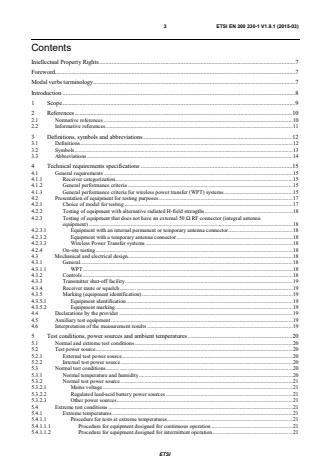
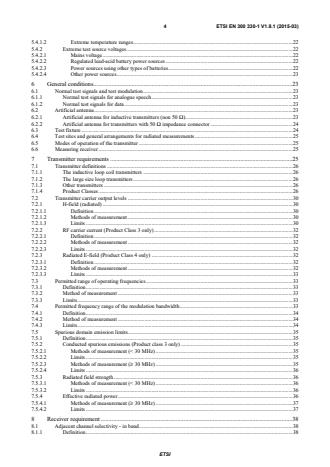
ETSI EN 300 330-1 V1.8.1 (2015-03) - Electromagnetic compatibility and Radio spectrum Matters (ERM); Short Range Devices (SRD); Radio equipment in the frequency range 9 kHz to 25 MHz and inductive loop systems in the frequency range 9 kHz to 30 MHz; Part 1: Technical characteristics and test methods
ETSI EN 300 330-1 V1.8.0 (2014-06) - Electromagnetic compatibility and Radio spectrum Matters (ERM); Short Range Devices (SRD); Radio equipment in the frequency range 9 kHz to 25 MHz and inductive loop systems in the frequency range 9 kHz to 30 MHz; Part 1: Technical characteristics and test methods
ETSI EN 300 330-1 V1.8.1 (2014-12) - Electromagnetic compatibility and Radio spectrum Matters (ERM); Short Range Devices (SRD); Radio equipment in the frequency range 9 kHz to 25 MHz and inductive loop systems in the frequency range 9 kHz to 30 MHz; Part 1: Technical characteristics and test methods

Overview
SIST EN 300 330-1 V1.8.1:2016 (ETSI EN 300 330-1 V1.8.1) defines electromagnetic compatibility (EMC) and radio spectrum requirements for Short Range Devices (SRD) operating in the low-frequency bands. It covers radio equipment with transmitters and receivers in the 9 kHz to 25 MHz band and inductive loop systems up to 30 MHz, including RFID, EAS (electronic article surveillance), and systems with wireless power transfer (WPT) functionality. The standard applies to fixed, mobile and portable stations and addresses both radiated and conducted emissions, test methods and technical characteristics.
Key topics and technical requirements
- Scope of equipment: Generic SRDs, inductive loop transmitters, receivers and transponders; radio equipment with external or integral antennas; all modulation types subject to clause compliance.
- Frequency ranges: Permitted SRD bands listed (see Table 1) and referenced to CEPT/ERC/REC 70-03.
- Product classes: Classification based on maximum radiated magnetic field strength (field-strength designations follow CEPT/ERC guidance).
- Measurement methods: Three principal methods to accommodate antenna/loop diversity:
- RF carrier current measurement,
- Radiated H‑field (magnetic field) measurement,
- Conducted power measurement.
- Transmitter requirements: Carrier output levels (H‑field, RF current, radiated E‑field where applicable), permitted operating frequencies and modulation bandwidth, spurious emissions and limits.
- Receiver requirements: Receiver categorization, performance criteria, and immunity considerations.
- Test conditions & setups: Normal and extreme temperature/power conditions, artificial antennas, test fixtures, test sites and measurement arrangements.
- Design and documentation: Marking, equipment presentation for testing, provider declarations, and auxiliary test equipment requirements.
- Special cases: Wireless Power Transfer (WPT) requirements, on‑site testing and measurement interpretation; spurious emissions measurements below and above 30 MHz.
- Safety & interference guidance: Advises attention to potential interference in adjacent bands, especially for SRDs with safety implications.
Practical applications and who uses this standard
- Manufacturers and designers of RFID, EAS, inductive loop transmitters, low‑frequency SRDs, and WPT systems for product development and compliance testing.
- Test laboratories and EMC engineers performing radiated H‑field, conducted power or RF carrier current measurements.
- Regulatory bodies and spectrum managers referencing CEPT frequency allocations and field strength limits.
- Integrators and purchasers ensuring equipment meets CE marking/EMC requirements and minimizing interference risk in LF/HF SRD bands.
Related standards and notes
- References CEPT/ERC/REC 70-03 for SRD frequency designations.
- ETSI copyright and distribution conditions apply; additional sector standards (e.g., PSTN connection rules) may be required for certain equipment types.
Keywords: SRD, electromagnetic compatibility, EMC, RFID, inductive loop, wireless power transfer, WPT, radiated H-field, RF carrier current, spurious emissions, 9 kHz to 30 MHz, testing, ETSI.
Buy Documents
ETSI EN 300 330-1 V1.8.1 (2015-03) - Electromagnetic compatibility and Radio spectrum Matters (ERM); Short Range Devices (SRD); Radio equipment in the frequency range 9 kHz to 25 MHz and inductive loop systems in the frequency range 9 kHz to 30 MHz; Part 1: Technical characteristics and test methods
ETSI EN 300 330-1 V1.8.0 (2014-06) - Electromagnetic compatibility and Radio spectrum Matters (ERM); Short Range Devices (SRD); Radio equipment in the frequency range 9 kHz to 25 MHz and inductive loop systems in the frequency range 9 kHz to 30 MHz; Part 1: Technical characteristics and test methods
ETSI EN 300 330-1 V1.8.1 (2014-12) - Electromagnetic compatibility and Radio spectrum Matters (ERM); Short Range Devices (SRD); Radio equipment in the frequency range 9 kHz to 25 MHz and inductive loop systems in the frequency range 9 kHz to 30 MHz; Part 1: Technical characteristics and test methods
Get Certified
Connect with accredited certification bodies for this standard

ANCE
Mexican certification and testing association.

Intertek Slovenia
Intertek testing, inspection, and certification services in Slovenia.

LNE (Laboratoire National de Métrologie et d'Essais)
French national laboratory for metrology and testing.
Sponsored listings
Frequently Asked Questions
SIST EN 300 330-1 V1.8.1:2016 is a standard published by the Slovenian Institute for Standardization (SIST). Its full title is "Electromagnetic compatibility and Radio spectrum Matters (ERM) - Short Range Devices (SRD) - Radio equipment in the frequency range 9 kHz to 25 MHz and inductive loop systems in the frequency range 9 kHz to 30 MHz - Part 1: Technical characteristics and test methods". This standard covers: The present document applies to the following Short Range Device major equipment types: 1) Generic Short range Devices including transmitters operating in the range from 9 kHz to 25 MHz; and 2) inductive loop transmitters operating from 9 kHz to 30 MHz including Radio Frequency Identification (RFID) and EAS operating in LF and HF ranges and for radio equipment including wireless power transfer (WPT) function in the same frequency range; 3) receivers of systems as defined by bullets 1 and 2. These radio equipment types are capable of operating in the permitted frequency bands within the 9 kHz to 30 MHz range as specified in table 1: • either with a Radio Frequency (RF) output connection and dedicated antenna or with an integral antenna; • for all types of modulation; • receivers of systems as defined by bullets 1 and 2. Table 1 shows a list of the frequency bands as designated to Short Range Devices and the CEPT/ERC/REC 70-03 [i.1] as known at the date of publication of the present document. When selecting parameters for new SRDs, which may have inherent safety of human life implications, manufacturers and users should pay particular attention to the potential for interference from other systems operating in the same or adjacent bands. The present document covers fixed stations, mobile stations and portable stations. If a system includes transponders, these are measured together with the transmitter. All types of modulation for radio devices are covered by the present document, provided the requirements of clause 7.3 are met. The radio equipment, covered by the classification SRD is divided into several classes based on the maximum radiated magnetic field strength. The field strength designation in the present document is based on CEPT/ERC/REC 70-03 [i.1] and National SRD-frequency designations. Three types of measuring methods are defined in the present document due to the varied nature of the antenna types for equipment used in this band. One method measures the RF carrier current, another measures the radiated H-field and the third conducted power. The present document covers requirements for radiated emissions below as well as above 30 MHz. Additional standards or specifications may be required for equipment such as that intended for connection to the Public Switched Telephone Network (PSTN).
The present document applies to the following Short Range Device major equipment types: 1) Generic Short range Devices including transmitters operating in the range from 9 kHz to 25 MHz; and 2) inductive loop transmitters operating from 9 kHz to 30 MHz including Radio Frequency Identification (RFID) and EAS operating in LF and HF ranges and for radio equipment including wireless power transfer (WPT) function in the same frequency range; 3) receivers of systems as defined by bullets 1 and 2. These radio equipment types are capable of operating in the permitted frequency bands within the 9 kHz to 30 MHz range as specified in table 1: • either with a Radio Frequency (RF) output connection and dedicated antenna or with an integral antenna; • for all types of modulation; • receivers of systems as defined by bullets 1 and 2. Table 1 shows a list of the frequency bands as designated to Short Range Devices and the CEPT/ERC/REC 70-03 [i.1] as known at the date of publication of the present document. When selecting parameters for new SRDs, which may have inherent safety of human life implications, manufacturers and users should pay particular attention to the potential for interference from other systems operating in the same or adjacent bands. The present document covers fixed stations, mobile stations and portable stations. If a system includes transponders, these are measured together with the transmitter. All types of modulation for radio devices are covered by the present document, provided the requirements of clause 7.3 are met. The radio equipment, covered by the classification SRD is divided into several classes based on the maximum radiated magnetic field strength. The field strength designation in the present document is based on CEPT/ERC/REC 70-03 [i.1] and National SRD-frequency designations. Three types of measuring methods are defined in the present document due to the varied nature of the antenna types for equipment used in this band. One method measures the RF carrier current, another measures the radiated H-field and the third conducted power. The present document covers requirements for radiated emissions below as well as above 30 MHz. Additional standards or specifications may be required for equipment such as that intended for connection to the Public Switched Telephone Network (PSTN).
SIST EN 300 330-1 V1.8.1:2016 is classified under the following ICS (International Classification for Standards) categories: 33.060.20 - Receiving and transmitting equipment; 33.100.01 - Electromagnetic compatibility in general. The ICS classification helps identify the subject area and facilitates finding related standards.
SIST EN 300 330-1 V1.8.1:2016 is available in PDF format for immediate download after purchase. The document can be added to your cart and obtained through the secure checkout process. Digital delivery ensures instant access to the complete standard document.
Standards Content (Sample)
EUROPEAN STANDARD
Electromagnetic compatibility
and Radio spectrum Matters (ERM);
Short Range Devices (SRD);
Radio equipment in the frequency range
9 kHz to 25 MHz and inductive loop systems
in the frequency range 9 kHz to 30 MHz;
Part 1: Technical characteristics and test methods
2 ETSI EN 300 330-1 V1.8.1 (2015-03)
Reference
REN/ERM-TG28-0436
Keywords
radio, RFID, SRD, testing
ETSI
650 Route des Lucioles
F-06921 Sophia Antipolis Cedex - FRANCE
Tel.: +33 4 92 94 42 00 Fax: +33 4 93 65 47 16
Siret N° 348 623 562 00017 - NAF 742 C
Association à but non lucratif enregistrée à la
Sous-Préfecture de Grasse (06) N° 7803/88
Important notice
The present document can be downloaded from:
http://www.etsi.org/standards-search
The present document may be made available in electronic versions and/or in print. The content of any electronic and/or
print versions of the present document shall not be modified without the prior written authorization of ETSI. In case of any
existing or perceived difference in contents between such versions and/or in print, the only prevailing document is the
print of the Portable Document Format (PDF) version kept on a specific network drive within ETSI Secretariat.
Users of the present document should be aware that the document may be subject to revision or change of status.
Information on the current status of this and other ETSI documents is available at
http://portal.etsi.org/tb/status/status.asp
If you find errors in the present document, please send your comment to one of the following services:
https://portal.etsi.org/People/CommiteeSupportStaff.aspx
Copyright Notification
No part may be reproduced or utilized in any form or by any means, electronic or mechanical, including photocopying
and microfilm except as authorized by written permission of ETSI.
The content of the PDF version shall not be modified without the written authorization of ETSI.
The copyright and the foregoing restriction extend to reproduction in all media.
© European Telecommunications Standards Institute 2015.
All rights reserved.
TM TM TM
DECT , PLUGTESTS , UMTS and the ETSI logo are Trade Marks of ETSI registered for the benefit of its Members.
TM
3GPP and LTE™ are Trade Marks of ETSI registered for the benefit of its Members and
of the 3GPP Organizational Partners.
GSM® and the GSM logo are Trade Marks registered and owned by the GSM Association.
ETSI
3 ETSI EN 300 330-1 V1.8.1 (2015-03)
Contents
Intellectual Property Rights . 7
Foreword . 7
Modal verbs terminology . 7
Introduction . 8
1 Scope . 9
2 References . 10
2.1 Normative references . 10
2.2 Informative references . 11
3 Definitions, symbols and abbreviations . 12
3.1 Definitions . 12
3.2 Symbols . 13
3.3 Abbreviations . 14
4 Technical requirements specifications . 15
4.1 General requirements . 15
4.1.1 Receiver categorization . 15
4.1.2 General performance criteria . 15
4.1.3 General performance criteria for wireless power transfer (WPT) systems . 15
4.2 Presentation of equipment for testing purposes . 17
4.2.1 Choice of model for testing . 17
4.2.2 Testing of equipment with alternative radiated H-field strengths . 18
4.2.3 Testing of equipment that does not have an external 50 Ω RF connector (integral antenna
equipment) . 18
4.2.3.1 Equipment with an internal permanent or temporary antenna connector . 18
4.2.3.2 Equipment with a temporary antenna connector . 18
4.2.3.3 Wireless Power Transfer systems . 18
4.2.4 On-site testing . 18
4.3 Mechanical and electrical design . 18
4.3.1 General . 18
4.3.1.1 WPT . 18
4.3.2 Controls . 18
4.3.3 Transmitter shut-off facility . 19
4.3.4 Receiver mute or squelch . 19
4.3.5 Marking (equipment identification) . 19
4.3.5.1 Equipment identification . 19
4.3.5.2 Equipment marking . 19
4.4 Declarations by the provider . 19
4.5 Auxiliary test equipment . 19
4.6 Interpretation of the measurement results . 19
5 Test conditions, power sources and ambient temperatures . 20
5.1 Normal and extreme test conditions . 20
5.2 Test power source . 20
5.2.1 External test power source . 20
5.2.2 Internal test power source . 20
5.3 Normal test conditions . 20
5.3.1 Normal temperature and humidity . 20
5.3.2 Normal test power source . 21
5.3.2.1 Mains voltage . 21
5.3.2.2 Regulated lead-acid battery power sources . 21
5.3.2.3 Other power sources . 21
5.4 Extreme test conditions . 21
5.4.1 Extreme temperatures . 21
5.4.1.1 Procedure for tests at extreme temperatures . 21
5.4.1.1.1 Procedure for equipment designed for continuous operation . 21
5.4.1.1.2 Procedure for equipment designed for intermittent operation . 21
ETSI
4 ETSI EN 300 330-1 V1.8.1 (2015-03)
5.4.1.2 Extreme temperature ranges . 22
5.4.2 Extreme test source voltages . 22
5.4.2.1 Mains voltage . 22
5.4.2.2 Regulated lead-acid battery power sources . 22
5.4.2.3 Power sources using other types of batteries . 22
5.4.2.4 Other power sources . 23
6 General conditions . 23
6.1 Normal test signals and test modulation . 23
6.1.1 Normal test signals for analogue speech . 23
6.1.2 Normal test signals for data . 23
6.2 Artificial antenna . 23
6.2.1 Artificial antenna for inductive transmitters (non 50 Ω) . 23
6.2.2 Artificial antenna for transmitters with 50 Ω impedance connector . 24
6.3 Test fixture . 24
6.4 Test sites and general arrangements for radiated measurements . 25
6.5 Modes of operation of the transmitter . 25
6.6 Measuring receiver . 25
7 Transmitter requirements . 25
7.1 Transmitter definitions . 26
7.1.1 The inductive loop coil transmitters . 26
7.1.2 The large size loop transmitters . 26
7.1.3 Other transmitters . 26
7.1.4 Product Classes . 26
7.2 Transmitter carrier output levels . 30
7.2.1 H-field (radiated) . 30
7.2.1.1 Definition . 30
7.2.1.2 Methods of measurement . 30
7.2.1.3 Limits . 30
7.2.2 RF carrier current (Product Class 3 only) . 32
7.2.2.1 Definition . 32
7.2.2.2 Methods of measurement . 32
7.2.2.3 Limits . 32
7.2.3 Radiated E-field (Product Class 4 only) . 32
7.2.3.1 Definition . 32
7.2.3.2 Methods of measurement . 32
7.2.3.3 Limits . 33
7.3 Permitted range of operating frequencies . 33
7.3.1 Definition . 33
7.3.2 Method of measurement . 33
7.3.3 Limits . 33
7.4 Permitted frequency range of the modulation bandwidth . 33
7.4.1 Definition . 34
7.4.2 Method of measurement . 34
7.4.3 Limits . 34
7.5 Spurious domain emission limits . 35
7.5.1 Definition . 35
7.5.2 Conducted spurious emissions (Product class 3 only) . 35
7.5.2.1 Methods of measurement (< 30 MHz) . 35
7.5.2.2 Limits . 35
7.5.2.3 Methods of measurement (≥ 30 MHz) . 35
7.5.2.4 Limits . 36
7.5.3 Radiated field strength . 36
7.5.3.1 Methods of measurement (< 30 MHz) . 36
7.5.3.2 Limits . 36
7.5.4 Effective radiated power . 36
7.5.4.1 Methods of measurement (≥ 30 MHz) . 37
7.5.4.2 Limits . 37
8 Receiver requirement . 38
8.1 Adjacent channel selectivity - in band . 38
8.1.1 Definition . 38
ETSI
5 ETSI EN 300 330-1 V1.8.1 (2015-03)
8.1.2 Method of measurement . 38
8.1.3 Limits . 39
8.2 Blocking or desensitization (Receiver category 1 and 2 only) . 39
8.2.1 Definition . 39
8.2.2 Methods of measurement . 39
8.2.3 Limits . 40
8.3 Receiver spurious radiation . 40
8.3.1 Definition . 41
8.3.2 Methods of measurement . 41
8.3.3 Limits . 41
8.3.3.1 Radiated emissions below 30 MHz . 41
8.3.3.2 Radiated emissions above 30 MHz . 41
9 Measurement uncertainty . 41
10 Interpretation of results . 42
10.1 Measurement uncertainty is equal to or less than maximum acceptable uncertainty . 42
Annex A (normative): Radiated measurement . 43
A.1 Test sites and general arrangements for measurements involving the use of radiated fields . 43
A.1.1 Anechoic chamber . 43
A.1.2 Anechoic chamber with a conductive ground plane . 44
A.1.3 Open Area Test Site (OATS) . 45
A.1.3.1 Measurements below 30 MHz . 46
A.1.3.2 Measurements above 30 MHz . 46
A.1.4 Test antenna . 47
A.1.5 Substitution antenna . 48
A.1.6 Measuring antenna . 48
A.2 Guidance on the use of radiation test sites . 48
A.2.1 Verification of the test site . 48
A.2.2 Preparation of the EUT . 48
A.2.3 Power supplies to the EUT . 48
A.2.4 Range length . 49
A.2.4.1 Far-field length above 30 MHz . 49
A.2.4.2 Near-field and Far-field length below 30 MHz . 49
A.2.5 Site preparation . 50
A.3 Coupling of signals . 50
A.3.1 General . 50
A.3.2 Data signals . 50
A.4 Standard test position . 50
A.5 Test fixture . 51
A.5.1 Description . 51
A.5.2 Calibration . 52
A.5.3 Mode of use . 52
A.6 Technical performance of the spectrum analyser . 53
Annex B (normative): H-field limit correction factor for generated E-fields . 54
Annex C (normative): Customized loop antennas . 55
C.1 Product classes related to the antenna loop . 55
C.1.1 Antenna loops below 1 MHz . 55
C.1.2 Antenna loops above 1 MHz . 56
Annex D (informative): Test fixture for measuring inductive transmitter carrier and
harmonic currents by use of an artificial antenna (Product Class 3
only) . 58
Annex E (informative): E-fields in the near field at low frequencies . 60
ETSI
6 ETSI EN 300 330-1 V1.8.1 (2015-03)
Annex F (normative): H-field measurements and limits at 3 m and 30 m . 61
F.1 Limits for measurements at 30 m distance . 61
F.2 Limits for measurements at 3 m distance . 62
Annex G (normative): Transmitter emission levels and spectrum mask measurements . 63
Annex H (normative): Generic inductive loop limits in the frequency range
148,5 kHz to 30 MHz . 66
H.1 Introduction . 66
H.2 Radiated H-field strength . 66
H.2.1 Methods of measurements . 66
H.2.2 Radiated H-field strength limit . 66
H.2.2.1 Radiated total H-field and H-field density limits according to the measurements in clause H.2.1
indent a) . 66
H.2.2.2 Radiated bandwidth and H-field density limits according to the measurements in clause H.2.1
indent b) . 67
H.3 Other requirements . 67
Annex I (informative): Determination and use of the measurement bandwidth . 68
Annex J (informative): Other limits . 69
Annex K (informative): Bibliography . 70
History . 71
ETSI
7 ETSI EN 300 330-1 V1.8.1 (2015-03)
Intellectual Property Rights
IPRs essential or potentially essential to the present document may have been declared to ETSI. The information
pertaining to these essential IPRs, if any, is publicly available for ETSI members and non-members, and can be found
in ETSI SR 000 314: "Intellectual Property Rights (IPRs); Essential, or potentially Essential, IPRs notified to ETSI in
respect of ETSI standards", which is available from the ETSI Secretariat. Latest updates are available on the ETSI Web
server (http://ipr.etsi.org).
Pursuant to the ETSI IPR Policy, no investigation, including IPR searches, has been carried out by ETSI. No guarantee
can be given as to the existence of other IPRs not referenced in ETSI SR 000 314 (or the updates on the ETSI Web
server) which are, or may be, or may become, essential to the present document.
Foreword
This European Standard (EN) has been produced by ETSI Technical Committee Electromagnetic compatibility and
Radio spectrum Matters (ERM).
The present document includes improvements to the previous version of the standard that take advantage of technical
developments within the SRD industry.
The present document is part 1 of a multi-part deliverable covering Electromagnetic compatibility and Radio spectrum
Matters (ERM); Short Range Devices (SRD); Radio equipment in the frequency range 9 kHz to 25 MHz and inductive
loop systems in the frequency range 9 kHz to 30 MHz, as identified below:
Part 1: "Technical characteristics and test methods";
Part 2: "Harmonized EN covering the essential requirements of article 3.2 of the R&TTE Directive".
National transposition dates
Date of adoption of this EN: 20 February 2015
Date of latest announcement of this EN (doa): 31 May 2015
Date of latest publication of new National Standard
or endorsement of this EN (dop/e): 30 November 2015
Date of withdrawal of any conflicting National Standard (dow): 30 November 2015
Modal verbs terminology
In the present document "shall", "shall not", "should", "should not", "may", "need not", "will", "will not", "can" and
"cannot" are to be interpreted as described in clause 3.2 of the ETSI Drafting Rules (Verbal forms for the expression of
provisions).
"must" and "must not" are NOT allowed in ETSI deliverables except when used in direct citation.
Introduction
The present document has been prepared to:
• Enhance operating conditions for RFIDs in the 13,56 MHz Band with regard to high datarate wideband low
level systems up to ±7 MHz for ISO 14443 [i.9] type applications including NFC and secondly for higher
operating range, narrowband high level modulation for ISO 15693 [i.10] and ISO 18000-3 [i.11] type systems.
• Include wireless inductive power transfer (WPT) systems.
ETSI
8 ETSI EN 300 330-1 V1.8.1 (2015-03)
1 Scope
The present document applies to the following Short Range Device major equipment types:
1) Generic Short range Devices including transmitters operating in the range from 9 kHz to 25 MHz; and
2) inductive loop transmitters operating from 9 kHz to 30 MHz including Radio Frequency Identification (RFID)
and EAS operating in LF and HF ranges and for radio equipment including wireless power transfer (WPT)
function in the same frequency range;
3) receivers of systems as defined by bullets 1 and 2.
These radio equipment types are capable of operating in the permitted frequency bands within the 9 kHz to 30 MHz
range as specified in table 1:
• either with a Radio Frequency (RF) output connection and dedicated antenna or with an integral antenna;
• for all types of modulation;
• receivers of systems as defined by bullets 1 and 2.
Table 1 shows a list of the frequency bands as designated to Short Range Devices and the CEPT/ERC/REC 70-03 [i.1]
as known at the date of publication of the present document.
When selecting parameters for new SRDs, which may have inherent safety of human life implications, manufacturers
and users should pay particular attention to the potential for interference from other systems operating in the same or
adjacent bands.
The present document covers fixed stations, mobile stations and portable stations. If a system includes transponders,
these are measured together with the transmitter.
All types of modulation for radio devices are covered by the present document, provided the requirements of clause 7.3
are met.
The radio equipment, covered by the classification SRD is divided into several classes based on the maximum radiated
magnetic field strength. The field strength designation in the present document is based on CEPT/ERC/REC 70-03 [i.1]
and National SRD-frequency designations.
Three types of measuring methods are defined in the present document due to the varied nature of the antenna types for
equipment used in this band. One method measures the RF carrier current, another measures the radiated H-field and
the third conducted power.
The present document covers requirements for radiated emissions below as well as above 30 MHz.
Additional standards or specifications may be required for equipment such as that intended for connection to the
Public Switched Telephone Network (PSTN).
Table 1: Short Range Devices within the 9 kHz to 30 MHz permitted frequency bands
Frequency Bands/frequencies Applications
Transmit and Receive 9 kHz to 90 kHz Inductive devices, Generic use
Transmit and Receive 90 kHz to 119 kHz Inductive devices, Generic use
Transmit and Receive 119 kHz to 140 kHz Inductive devices, Generic use
Transmit and Receive 140 kHz to 148,5 kHz Inductive devices, Generic use
Transmit and Receive 148,5 kHz to 5 MHz Inductive devices, Generic use
Transmit and Receive 400 kHz to 600 kHz RFID only
Transmit and Receive 5 kHz to 30 MHz Inductive devices, Generic use
Transmit and Receive 3 155 kHz to 3 400 kHz Inductive devices, Generic use
Transmit and Receive 4 234 kHz Inductive devices, Railway applications
Transmit and Receive 4 516 kHz Inductive devices, Railway applications
Transmit and Receive 6 765 kHz to 6 795 kHz Inductive devices, Generic use
Transmit and Receive 7 400 kHz to 8 800 kHz Inductive devices, Generic use
Transmit and Receive 10 200 kHz to 11,000 MHz Inductive devices, Generic use
Transmit and Receive 11,810 MHz to 15,310 MHz RFID only
Transmit and Receive 12,5 MHz to 20 MHz Inductive devices, Wireless healthcare
ETSI
9 ETSI EN 300 330-1 V1.8.1 (2015-03)
Frequency Bands/frequencies Applications
Transmit and Receive 13,553 MHz to 13,567 MHz Inductive devices, Generic use
Transmit and Receive 26,957 MHz to 27,283 MHz Inductive devices, Generic use
Transmit and Receive 27,095 MHz Inductive devices, Railway applications
NOTE 1: It should be noted that table 1 represents the most widely implemented position within the European
Union and the CEPT countries, but it should not be assumed that all designated bands are available in all
countries.
NOTE 2: In addition, it should be noted that other frequency bands may be available in a country within the
frequency range 9 kHz to 30 MHz covered by the present document.
NOTE 3: On non-harmonized parameters, national administrations may impose certain conditions such as the type
of modulation, frequency, channel/frequency separations, maximum transmitter radiated power, duty
cycle, and the inclusion of an automatic transmitter shut-off facility, as a condition for the issue of an
Individual Rights for use of spectrum or General Authorization, or as a condition for use under "licence
exemption" as it is in most cases for Short Range Devices.
The present document covers fixed stations, mobile stations and portable stations.
Applications using Ultra-WideBand (UWB) technology are not covered by the present document.
2 References
2.1 Normative references
References are either specific (identified by date of publication and/or edition number or version number) or
non-specific. For specific references, only the cited version applies. For non-specific references, the latest version of the
reference document (including any amendments) applies.
Referenced documents which are not found to be publicly available in the expected location might be found at
http://docbox.etsi.org/Reference.
NOTE: While any hyperlinks included in this clause were valid at the time of publication, ETSI cannot guarantee
their long term validity.
The following referenced documents are necessary for the application of the present document.
[1] ETSI TR 100 028 (all parts) (V1.4.1): "Electromagnetic compatibility and Radio spectrum Matters
(ERM); Uncertainties in the measurement of mobile radio equipment characteristics".
[2] CISPR 16-1-4: "Specification for radio disturbance and immunity measuring apparatus and
methods - Part 1-4: Radio disturbance and immunity measuring apparatus - Antennas and test sites
for radiated disturbance measurements".
2.2 Informative references
References are either specific (identified by date of publication and/or edition number or version number) or
non-specific. For specific references, only the cited version applies. For non-specific references, the latest version of the
reference document (including any amendments) applies.
NOTE: While any hyperlinks included in this clause were valid at the time of publication, ETSI cannot guarantee
their long term validity.
The following referenced documents are not necessary for the application of the present document but they assist the
user with regard to a particular subject area.
[i.1] CEPT/ERC/REC 70-03: "Relating to the use of Short Range Devices (SRD)".
[i.2] Recommendation ITU-T O.153: "Basic parameters for the measurement of error performance at
bit rates below the primary rate".
ETSI
10 ETSI EN 300 330-1 V1.8.1 (2015-03)
[i.3] ANSI C63.5: "American National Standard for Electromagnetic Compatibility-Radiated Emission
Measurements in Electromagnetic Interference (EMI) Control-Calibration of Antennas (9 kHz to
40 GHz)".
[i.4] Directive 1999/5/EC of the European Parliament and of the Council of 9 March 1999 on radio
equipment and telecommunications terminal equipment and the mutual recognition of their
conformity (R&TTE Directive).
[i.5] ETSI TR 102 273-2: "Electromagnetic compatibility and Radio spectrum Matters (ERM);
Improvement on Radiated Methods of Measurement (using test site) and evaluation of the
corresponding measurement uncertainties; Part 2: Anechoic chamber".
[i.6] ETSI TR 102 273-3: "Electromagnetic compatibility and Radio spectrum Matters (ERM);
Improvement on Radiated Methods of Measurement (using test site) and evaluation of the
corresponding measurement uncertainties; Part 3: Anechoic chamber with a ground plane".
[i.7] ETSI TR 102 273-4: "Electromagnetic compatibility and Radio spectrum Matters (ERM);
Improvement on Radiated Methods of Measurement (using test site) and evaluation of the
corresponding measurement uncertainties; Part 4: Open area test site".
[i.8] ECC report 208: "Impact of RFID devices on radio services in the band 13.56 MHz".
[i.9] ISO 14443: "Identification cards -- Contactless integrated circuit cards -- Proximity cards".
[i.10] ISO 15693: "Information technology -- Radio frequency identification for item management --
Unique identification for RF tags".
[i.11] ISO 18000-3: "Information technology -- Radio frequency identification for item management --
Part 3: Parameters for air interface communications at 13,56 MHz".
[i.12] Void.
[i.13] CENELEC EN 62311: "Assessment of electronic and electrical equipment related to human
exposure restrictions for electromagnetic fields (0 Hz - 300 GHz)".
[i.14] CENELEC EN 62479: "Assessment of the compliance of low power electronic and electrical
equipment with the basic restrictions related to human exposure to electromagnetic fields (10 MHz
to 300 GHz)".
[i.15] CENELEC EN 55011: "Industrial, scientific and medical equipment - Radio-frequency
disturbance characteristics - Limits and methods of measurement".
[i.16] Void.
[i.17] ETSI EN 300 220 (all parts):"Electromagnetic compatibility and Radio spectrum Matters (ERM);
Short Range Devices (SRD); Radio equipment to be used in the 25 MHz to 1 000 MHz frequency
range with power levels ranging up to 500 mW".
[i.18] ETSI EN 300 440 (all parts): "Electromagnetic compatibility and Radio spectrum Matters (ERM);
Short range devices; Radio equipment to be used in the 1 GHz to 40 GHz frequency range".
[i.19] ETSI EN 301 489-1: "Electromagnetic compatibility and Radio spectrum Matters (ERM);
ElectroMagnetic Compatibility (EMC) standard for radio equipment and services;
Part 1: Common technical requirements".
[i.20] ETSI EN 301 489-3: "Electromagnetic compatibility and Radio spectrum Matters (ERM);
ElectroMagnetic Compatibility (EMC) standard for radio equipment and services; Part 3: Specific
conditions for Short-Range Devices (SRD) operating on frequencies between 9 kHz and
246 GHz".
[i.21] ETSI EN 301 489-17: "Electromagnetic compatibility and Radio spectrum Matters (ERM);
ElectroMagnetic Compatibility (EMC) standard for radio equipment; Part 17: Specific conditions
for Broadband Data Transmission Systems".
ETSI
11 ETSI EN 300 330-1 V1.8.1 (2015-03)
[i.22] ETSI EN 300 328: "Electromagnetic compatibility and Radio spectrum Matters (ERM); Wideband
transmission systems; Data transmission equipment
...
Draft ETSI EN 300 330-1 V1.8.0 (2014-06)
European Standard
Electromagnetic compatibility
and Radio spectrum Matters (ERM);
Short Range Devices (SRD);
Radio equipment in the frequency range
9 kHz to 25 MHz and inductive loop systems
in the frequency range 9 kHz to 30 MHz;
Part 1: Technical characteristics and test methods
2 Draft ETSI EN 300 330-1 V1.8.0 (2014-06)
Reference
REN/ERM-TG28-0436
Keywords
Radio, RFID, SRD, testing
ETSI
650 Route des Lucioles
F-06921 Sophia Antipolis Cedex - FRANCE
Tel.: +33 4 92 94 42 00 Fax: +33 4 93 65 47 16
Siret N° 348 623 562 00017 - NAF 742 C
Association à but non lucratif enregistrée à la
Sous-Préfecture de Grasse (06) N° 7803/88
Important notice
The present document can be downloaded from:
http://www.etsi.org
The present document may be made available in electronic versions and/or in print. The content of any electronic and/or
print versions of the present document shall not be modified without the prior written authorization of ETSI. In case of any
existing or perceived difference in contents between such versions and/or in print, the only prevailing document is the
print of the Portable Document Format (PDF) version kept on a specific network drive within ETSI Secretariat.
Users of the present document should be aware that the document may be subject to revision or change of status.
Information on the current status of this and other ETSI documents is available at
http://portal.etsi.org/tb/status/status.asp
If you find errors in the present document, please send your comment to one of the following services:
http://portal.etsi.org/chaircor/ETSI_support.asp
Copyright Notification
No part may be reproduced or utilized in any form or by any means, electronic or mechanical, including photocopying
and microfilm except as authorized by written permission of ETSI.
The content of the PDF version shall not be modified without the written authorization of ETSI.
The copyright and the foregoing restriction extend to reproduction in all media.
© European Telecommunications Standards Institute 2014.
All rights reserved.
TM TM TM
DECT , PLUGTESTS , UMTS and the ETSI logo are Trade Marks of ETSI registered for the benefit of its Members.
TM
3GPP and LTE™ are Trade Marks of ETSI registered for the benefit of its Members and
of the 3GPP Organizational Partners.
GSM® and the GSM logo are Trade Marks registered and owned by the GSM Association.
ETSI
3 Draft ETSI EN 300 330-1 V1.8.0 (2014-06)
Contents
Intellectual Property Rights . 7
Foreword . 7
Modal verbs terminology . 7
Introduction . 7
1 Scope . 9
2 References . 10
2.1 Normative references . 10
2.2 Informative references . 11
3 Definitions, symbols and abbreviations . 12
3.1 Definitions . 12
3.2 Symbols . 13
3.3 Abbreviations . 13
4 Technical requirements specifications . 14
4.1 General requirements . 14
4.1.1 Receiver categorization . 14
4.1.2 General performance criteria . 15
4.1.3 General performance criteria for wireless power transfer (WPT) systems . 15
4.2 Presentation of equipment for testing purposes . 16
4.2.1 Choice of model for testing . 17
4.2.2 Testing of equipment with alternative radiated H-field strengths . 17
4.2.3 Testing of equipment that does not have an external 50 Ω RF connector (integral antenna
equipment) . 17
4.2.3.1 Equipment with an internal permanent or temporary antenna connector . 17
4.2.3.2 Equipment with a temporary antenna connector . 17
4.2.3.3 Wireless Power Transfer systems . 18
4.2.4 On-site testing . 18
4.3 Mechanical and electrical design . 18
4.3.1 General . 18
4.3.1.1 WPT . 18
4.3.2 Controls . 18
4.3.3 Transmitter shut-off facility . 18
4.3.4 Receiver mute or squelch . 18
4.3.5 Marking (equipment identification) . 18
4.3.5.1 Equipment identification . 18
4.3.5.2 Equipment marking . 19
4.4 Declarations by the provider . 19
4.5 Auxiliary test equipment . 19
4.6 Interpretation of the measurement results . 19
5 Test conditions, power sources and ambient temperatures . 19
5.1 Normal and extreme test conditions . 19
5.2 Test power source . 19
5.2.1 External test power source . 19
5.2.2 Internal test power source . 20
5.3 Normal test conditions . 20
5.3.1 Normal temperature and humidity . 20
5.3.2 Normal test power source . 20
5.3.2.1 Mains voltage . 20
5.3.2.2 Regulated lead-acid battery power sources . 20
5.3.2.3 Other power sources . 20
5.4 Extreme test conditions . 20
5.4.1 Extreme temperatures . 20
5.4.1.1 Procedure for tests at extreme temperatures . 20
ETSI
4 Draft ETSI EN 300 330-1 V1.8.0 (2014-06)
5.4.1.1.1 Procedure for equipment designed for continuous operation . 21
5.4.1.1.2 Procedure for equipment designed for intermittent operation . 21
5.4.1.2 Extreme temperature ranges . 21
5.4.2 Extreme test source voltages . 21
5.4.2.1 Mains voltage . 21
5.4.2.2 Regulated lead-acid battery power sources . 22
5.4.2.3 Power sources using other types of batteries . 22
5.4.2.4 Other power sources . 22
6 General conditions . 22
6.1 Normal test signals and test modulation . 22
6.1.1 Normal test signals for analogue speech . 22
6.1.2 Normal test signals for data . 23
6.2 Artificial antenna . 23
6.2.1 Artificial antenna for inductive transmitters (non 50 Ω) . 23
6.2.2 Artificial antenna for transmitters with 50 Ω impedance connector . 23
6.3 Test fixture . 24
6.4 Test sites and general arrangements for radiated measurements . 24
6.5 Modes of operation of the transmitter . 24
6.6 Measuring receiver . 25
7 Transmitter requirements . 25
7.1 Transmitter definitions . 25
7.1.1 The inductive loop coil transmitters . 25
7.1.2 The large size loop transmitters . 26
7.1.3 Other transmitters . 26
7.1.4 Product Classes . 26
7.2 Transmitter carrier output levels . 30
7.2.1 H-field (radiated) . 30
7.2.1.1 Definition . 30
7.2.1.2 Methods of measurement . 30
7.2.1.3 Limits . 30
7.2.2 RF carrier current (Product Class 3 only) . 31
7.2.2.1 Definition . 31
7.2.2.2 Methods of measurement . 32
7.2.2.3 Limits . 32
7.2.3 Radiated E-field (Product Class 4 only) . 32
7.2.3.1 Definition . 32
7.2.3.2 Methods of measurement . 32
7.2.3.3 Limits . 33
7.3 Permitted range of operating frequencies . 33
7.3.1 Definition . 33
7.3.2 Method of measurement . 33
7.3.3 Limits . 33
7.4 Permitted frequency range of the modulation bandwidth . 34
7.4.1 Definition . 34
7.4.2 Method of measurement . 34
7.4.3 Limits . 34
7.5 Spurious domain emission limits . 35
7.5.1 Definition . 35
7.5.2 Conducted spurious emissions (Product class 3 only) . 35
7.5.2.1 Methods of measurement (< 30 MHz) . 35
7.5.2.2 Limits . 35
7.5.2.3 Methods of measurement (≥ 30 MHz) . 35
7.5.2.4 Limits . 36
7.5.3 Radiated field strength . 36
7.5.3.1 Methods of measurement (< 30 MHz) . 36
7.5.3.2 Limits . 36
7.5.4 Effective radiated power . 36
7.5.4.1 Methods of measurement (≥ 30 MHz) . 37
7.5.4.2 Limits . 37
8 Receiver requirement . 38
ETSI
5 Draft ETSI EN 300 330-1 V1.8.0 (2014-06)
8.1 Adjacent channel selectivity - in band . 38
8.1.1 Definition . 38
8.1.2 Method of measurement . 38
8.1.3 Limits . 39
8.2 Blocking or desensitization (Receiver category 1 and 2 only) . 39
8.2.1 Definition . 39
8.2.2 Methods of measurement . 39
8.2.3 Limits . 40
8.3 Receiver spurious radiation . 40
8.3.1 Definition . 41
8.3.2 Methods of measurement . 41
8.3.3 Limits . 41
8.3.3.1 Radiated emissions below 30 MHz . 41
8.3.3.2 Radiated emissions above 30 MHz . 41
9 Measurement uncertainty . 41
10 Interpretation of results . 42
10.1 Measurement uncertainty is equal to or less than maximum acceptable uncertainty . 42
Annex A (normative): Radiated measurement . 43
A.1 Test sites and general arrangements for measurements involving the use of radiated fields . 43
A.1.1 Anechoic chamber . 43
A.1.2 Anechoic chamber with a conductive ground plane . 44
A.1.3 Open Area Test Site (OATS) . 45
A.1.3.1 Measurements below 30 MHz . 46
A.1.3.2 Measurements above 30 MHz . 46
A.1.4 Test antenna . 47
A.1.5 Substitution antenna . 48
A.1.6 Measuring antenna . 48
A.2 Guidance on the use of radiation test sites . 48
A.2.1 Verification of the test site . 48
A.2.2 Preparation of the EUT . 48
A.2.3 Power supplies to the EUT . 48
A.2.4 Range length . 49
A.2.4.1 Far-field length above 30 MHz . 49
A.2.4.2 Near-field and Far-field length below 30 MHz . 49
A.2.5 Site preparation . 50
A.3 Coupling of signals . 50
A.3.1 General . 50
A.3.2 Data signals . 50
A.4 Standard test position . 50
A.5 Test fixture . 51
A.5.1 Description . 51
A.5.2 Calibration . 52
A.5.3 Mode of use . 52
A.6 Technical performance of the spectrum analyser . 53
Annex B (normative): H-field limit correction factor for generated E-fields . 54
Annex C (normative): Customized loop antennas . 55
C.1 Product classes related to the antenna loop . 55
C.1.1 Antenna loops below 1 MHz . 55
C.1.2 Antenna loops above 1 MHz . 56
Annex D (informative): Test fixture for measuring inductive transmitter carrier and
harmonic currents by use of an artificial antenna (Product Class 3
only) . 58
ETSI
6 Draft ETSI EN 300 330-1 V1.8.0 (2014-06)
Annex E (informative): E-fields in the near field at low frequencies . 60
Annex F (normative): H-field measurements and limits at 3 m and 30 m . 61
F.1 Limits for measurements at 30 m distance . 61
F.2 Limits for measurements at 3 m distance . 62
Annex G (normative): Transmitter emission levels and spectrum mask measurements . 63
Annex H (normative): Generic inductive loop limits in the frequency range
148,5 kHz to 30 MHz . 66
H.1 Introduction . 66
H.2 Radiated H-field strength . 66
H.2.1 Methods of measurements . 66
H.2.2 Radiated H-field strength limit . 66
H.2.2.1 Radiated total H-field and H-field density limits according to the measurements in clause H.2.1
indent a) . 66
H.2.2.2 Radiated bandwidth and H-field density limits according to the measurements in clause H.2.1 indent
b) . 67
H.3 Other requirements . 67
Annex I (informative): Determination and use of the measurement bandwidth . 68
Annex J (informative): Other limits . 69
Annex K (informative): Bibliography . 70
History . 71
ETSI
7 Draft ETSI EN 300 330-1 V1.8.0 (2014-06)
Intellectual Property Rights
IPRs essential or potentially essential to the present document may have been declared to ETSI. The information
pertaining to these essential IPRs, if any, is publicly available for ETSI members and non-members, and can be found
in ETSI SR 000 314: "Intellectual Property Rights (IPRs); Essential, or potentially Essential, IPRs notified to ETSI in
respect of ETSI standards", which is available from the ETSI Secretariat. Latest updates are available on the ETSI Web
server (http://ipr.etsi.org).
Pursuant to the ETSI IPR Policy, no investigation, including IPR searches, has been carried out by ETSI. No guarantee
can be given as to the existence of other IPRs not referenced in ETSI SR 000 314 (or the updates on the ETSI Web
server) which are, or may be, or may become, essential to the present document.
Foreword
This draft European Standard (EN) has been produced by ETSI Technical Committee Electromagnetic compatibility
and Radio spectrum Matters (ERM), and is now submitted for the combined Public Enquiry and Vote phase of the ETSI
standards EN Approval Procedure.
The present document includes improvements to the previous version of the standard that take advantage of technical
developments within the SRD industry.
The present document is part 1 of a multi-part deliverable covering Electromagnetic compatibility and Radio spectrum
Matters (ERM); Short Range Devices (SRD); Radio equipment in the frequency range 9 kHz to 25 MHz and inductive
loop systems in the frequency range 9 kHz to 30 MHz, as identified below:
Part 1: "Technical characteristics and test methods";
Part 2: "Harmonized EN covering the essential requirements of article 3.2 of the R&TTE Directive".
Proposed national transposition dates
Date of latest announcement of this EN (doa): 3 months after ETSI publication
Date of latest publication of new National Standard
or endorsement of this EN (dop/e): 6 months after doa
Date of withdrawal of any conflicting National Standard (dow): 6 months after doa
Modal verbs terminology
In the present document "shall", "shall not", "should", "should not", "may", "may not", "need", "need not", "will",
"will not", "can" and "cannot" are to be interpreted as described in clause 3.2 of the ETSI Drafting Rules (Verbal forms
for the expression of provisions).
"must" and "must not" are NOT allowed in ETSI deliverables except when used in direct citation.
Introduction
The present document has been prepared to:
• Enhance operating conditions for RFIDs in the 13,56 MHz Band with regard to high datarate wideband low
level systems up to ±7 MHz for ISO 14443 [i.9] type applications including NFC and secondly for higher
operating range, narrowband high level modulation for ISO 15693 [i.10] and ISO 18000-3 [i.11] type systems.
ETSI
8 Draft ETSI EN 300 330-1 V1.8.0 (2014-06)
• Include wireless inductive power transfer (WPT) systems.
ETSI
9 Draft ETSI EN 300 330-1 V1.8.0 (2014-06)
1 Scope
The present document applies to the following Short Range Device major equipment types:
1) Generic Short range Devices including transmitters operating in the range from 9 kHz to 25 MHz; and
2) inductive loop transmitters operating from 9 kHz to 30 MHz including Radio Frequency Identification (RFID)
and EAS operating in LF and HF ranges and for inductive wireless power transfer (WPT) equipments;
3) receivers operating from 9 kHz to 30 MHz.
These radio equipment types are capable of operating in the permitted frequency bands within the 9 kHz to 30 MHz
range as specified in table 1:
• either with a Radio Frequency (RF) output connection and dedicated antenna or with an integral antenna;
• for all types of modulation;
• with or without speech.
Table 1 shows a list of the frequency bands as designated to Short Range Devices and the CEPT/ERC/REC 70-03 [i.1]
as known at the date of publication of the present document.
When selecting parameters for new SRDs, which may have inherent safety of human life implications, manufacturers
and users should pay particular attention to the potential for interference from other systems operating in the same or
adjacent bands.
The present document covers fixed stations, mobile stations and portable stations. If a system includes transponders,
these are measured together with the transmitter.
All types of modulation for radio devices are covered by the present document, provided the requirements of clause 7.3
are met.
The radio equipment, covered by the classification SRD is divided into several classes based on the maximum radiated
magnetic field strength. The field strength designation in the present document is based on CEPT/ERC/REC 70-03 [i.1]
and National SRD-frequency designations.
Three types of measuring methods are defined in the present document due to the varied nature of the antenna types for
equipment used in this band. One method measures the RF carrier current, another measures the radiated H-field and
the third conducted power.
The present document covers requirements for radiated emissions below as well as above 30 MHz.
Additional standards or specifications may be required for equipment such as that intended for connection to the
Public Switched Telephone Network (PSTN).
ETSI
10 Draft ETSI EN 300 330-1 V1.8.0 (2014-06)
Table 1: Short Range Devices within the 9 kHz to 30 MHz permitted frequency bands
Frequency Bands/frequencies Applications
Transmit and Receive 9 kHz to 90 kHz Inductive devices, Generic use
Transmit and Receive 90 kHz to 119 kHz Inductive devices, Generic use
Transmit and Receive 119 kHz to 140 kHz Inductive devices, Generic use
Transmit and Receive 140 kHz to 148,5 kHz Inductive devices, Generic use
Transmit and Receive 148,5 kHz to 5 MHz Inductive devices, Generic use
Transmit and Receive 400 kHz to 600 kHz RFID only
Transmit and Receive 5 kHz to 30 MHz Inductive devices, Generic use
Transmit and Receive 3 155 kHz to 3 400 kHz Inductive devices, Generic use
Transmit and Receive 4 234 kHz Inductive devices, Railway applications
Transmit and Receive 4 516 kHz Inductive devices, Railway applications
Transmit and Receive 6 765 kHz to 6 795 kHz Inductive devices, Generic use
Transmit and Receive 7 400 kHz to 8 800 kHz Inductive devices, Generic use
Transmit and Receive 10 200 kHz to 11,000 MHz Inductive devices, Generic use
Transmit and Receive 11,810 MHz to 15,310 MHz RFID only
Transmit and Receive 12,5 MHz to 20 MHz Inductive devices, Wireless healthcare
Transmit and Receive 13,553 MHz to 13,567 MHz Inductive devices, Generic use
Transmit and Receive 26,957 MHz to 27,283 MHz Inductive devices, Generic use
Transmit and Receive 27,095 MHz Inductive devices, Railway applications
NOTE 1: It should be noted that table 1 represents the most widely implemented position within the European
Union and the CEPT countries, but it should not be assumed that all designated bands are available in all
countries.
NOTE 2: In addition, it should be noted that other frequency bands may be available in a country within the
frequency range 9 kHz to 30 MHz covered by the present document.
NOTE 3: On non-harmonized parameters, national administrations may impose certain conditions such as the type
of modulation, frequency, channel/frequency separations, maximum transmitter radiated power, duty
cycle, and the inclusion of an automatic transmitter shut-off facility, as a condition for the issue of an
Individual Rights for use of spectrum or General Authorization, or as a condition for use under "licence
exemption" as it is in most cases for Short Range Devices.
The present document covers fixed stations, mobile stations and portable stations.
Applications using Ultra-WideBand (UWB) technology are not covered by the present document.
2 References
References are either specific (identified by date of publication and/or edition number or version number) or
non-specific. For specific references, only the cited version applies. For non-specific references, the latest version of the
reference document (including any amendments) applies.
Referenced documents which are not found to be publicly available in the expected location might be found at
http://docbox.etsi.org/Reference.
NOTE: While any hyperlinks included in this clause were valid at the time of publication, ETSI cannot guarantee
their long term validity.
2.1 Normative references
The following referenced documents are necessary for the application of the present document.
[1] Void.
[2] Directive 1999/5/EC of the European Parliament and of the Council of 9 March 1999 on radio
equipment and telecommunications terminal equipment and the mutual recognition of their
conformity (R&TTE Directive).
ETSI
11 Draft ETSI EN 300 330-1 V1.8.0 (2014-06)
[3] ETSI TR 100 028 (all parts): "Electromagnetic compatibility and Radio spectrum Matters (ERM);
Uncertainties in the measurement of mobile radio equipment characteristics".
[4] Recommendation ITU-T O.41: "Psophometer for use on telephone-type circuits".
[5] CISPR 16-2-3: "Specification for radio disturbance and immunity measuring apparatus and
methods - Part 2-3: Methods of measurement of disturbances and immunity - Radiated disturbance
measurements".
2.2 Informative references
The following referenced documents are not necessary for the application of the present document but they assist the
user with regard to a particular subject area.
[i.1] CEPT/ERC/REC 70-03: "Relating to the use of Short Range Devices (SRD)".
[i.2] Recommendation ITU-T O.153: "Basic parameters for the measurement of error performance at
bit rates below the primary rate".
[i.3] ANSI C63.5: "American National Standard for Electromagnetic Compatibility-Radiated Emission
Measurements in Electromagnetic Interference (EMI) Control-Calibration of Antennas (9 kHz to
40 GHz)".
[i.4] Void.
[i.5] ETSI TR 102 273-2: "Electromagnetic compatibility and Radio spectrum Matters (ERM);
Improvement on Radiated Methods of Measurement (using test site) and evaluation of the
corresponding measurement uncertainties; Part 2: Anechoic chamber".
[i.6] ETSI TR 102 273-3: "Electromagnetic compatibility and Radio spectrum Matters (ERM);
Improvement on Radiated Methods of Measurement (using test site) and evaluation of the
corresponding measurement uncertainties; Part 3: Anechoic chamber with a ground plane".
[i.7] ETSI TR 102 273-4: "Electromagnetic compatibility and Radio spectrum Matters (ERM);
Improvement on Radiated Methods of Measurement (using test site) and evaluation of the
corresponding measurement uncertainties; Part 4: Open area test site".
[i.8] ECC report 208: Impact of RFID devices on radio services in the band 13.56 MHz.
[i.9] ISO 14443: "Identification cards -- Contactless integrated circuit cards -- Proximity cards".
[i.10] ISO 15693: "Information technology -- Radio frequency identification for item management --
Unique identification for RF tags".
[i.11] ISO 18000-3: "Information technology -- Radio frequency identification for item management --
Part 3: Parameters for air interface communications at 13,56 MHz".
[i.12] Document ETSI(12)000003: "Liaison Statement; ETSI Response to TCAM relating to Wireless
Charger Applications".
[i.13] CENELEC EN 62311: "Assessment of electronic and electrical equipment related to human
exposure restrictions for electromagnetic fields (0 Hz - 300 GHz)".
[i.14] CENELEC EN 62479: "Assessment of the compliance of low power electronic and electrical
equipment with the basic restrictions related to human exposure to electromagnetic fields (10 MHz
to 300 GHz)".
[i.15] CENELEC EN 55011: "Industrial, scientific and medical equipment - Radio-frequency
disturbance characteristics - Limits and methods of measurement".
[i.16] CENELEC EN 55022: "Information technology equipment - Radio disturbance characteristics -
Limits and methods of measurement".
ETSI
12 Draft ETSI EN 300 330-1 V1.8.0 (2014-06)
[i.17] ETSI EN 300 220 (all parts):"Electromagnetic compatibility and Radio spectrum Matters (ERM);
Short Range Devices (SRD); Radio equipment to be used in the 25 MHz to 1 000 MHz frequency
range with power levels ranging up to 500 mW".
[i.18] ETSI EN 300 440 (all parts): " Electromagnetic compatibility and Radio spectrum Matters (ERM);
Short range devices; Radio equipment to be used in the 1 GHz to 40 GHz frequency range". .
[i.19] ETSI EN 301 489-1: " Electromagnetic compatibility and Radio spectrum Matters (ERM);
ElectroMagnetic Compatibility (EMC) standard for radio equipment and services; Part 1:
Common technical requirements".
[i.20] ETSI EN 301 489-3: "Electromagnetic compatibility and Radio spectrum Matters (ERM);
ElectroMagnetic Compatibility (EMC) standard for radio equipment and services; Part 3: Specific
conditions for Short-Range Devices (SRD) operating on frequencies between 9 kHz and 246
GHz".
[i.21] ETSI EN 301 489-17: "Electromagnetic compatibility and Radio spectrum Matters (ERM);
ElectroMagnetic Compatibility (EMC) standard for radio equipment; Part 17: Specific conditions
for Broadband Data Transmission Systems".
[i.22] ETSI EN 300 328: "Electromagnetic compatibility and Radio spectrum Matters (ERM); Wideband
transmission systems; Data transmiss
...
Final draft ETSI EN 300 330-1 V1.8.1 (2014-12)
EUROPEAN STANDARD
Electromagnetic compatibility
and Radio spectrum Matters (ERM);
Short Range Devices (SRD);
Radio equipment in the frequency range
9 kHz to 25 MHz and inductive loop systems
in the frequency range 9 kHz to 30 MHz;
Part 1: Technical characteristics and test methods
2 Final draft ETSI EN 300 330-1 V1.8.1 (2014-12)
Reference
REN/ERM-TG28-0436
Keywords
radio, RFID, SRD, testing
ETSI
650 Route des Lucioles
F-06921 Sophia Antipolis Cedex - FRANCE
Tel.: +33 4 92 94 42 00 Fax: +33 4 93 65 47 16
Siret N° 348 623 562 00017 - NAF 742 C
Association à but non lucratif enregistrée à la
Sous-Préfecture de Grasse (06) N° 7803/88
Important notice
The present document can be downloaded from:
http://www.etsi.org
The present document may be made available in electronic versions and/or in print. The content of any electronic and/or
print versions of the present document shall not be modified without the prior written authorization of ETSI. In case of any
existing or perceived difference in contents between such versions and/or in print, the only prevailing document is the
print of the Portable Document Format (PDF) version kept on a specific network drive within ETSI Secretariat.
Users of the present document should be aware that the document may be subject to revision or change of status.
Information on the current status of this and other ETSI documents is available at
http://portal.etsi.org/tb/status/status.asp
If you find errors in the present document, please send your comment to one of the following services:
http://portal.etsi.org/chaircor/ETSI_support.asp
Copyright Notification
No part may be reproduced or utilized in any form or by any means, electronic or mechanical, including photocopying
and microfilm except as authorized by written permission of ETSI.
The content of the PDF version shall not be modified without the written authorization of ETSI.
The copyright and the foregoing restriction extend to reproduction in all media.
© European Telecommunications Standards Institute 2014.
All rights reserved.
TM TM TM
DECT , PLUGTESTS , UMTS and the ETSI logo are Trade Marks of ETSI registered for the benefit of its Members.
TM
3GPP and LTE™ are Trade Marks of ETSI registered for the benefit of its Members and
of the 3GPP Organizational Partners.
GSM® and the GSM logo are Trade Marks registered and owned by the GSM Association.
ETSI
3 Final draft ETSI EN 300 330-1 V1.8.1 (2014-12)
Contents
Intellectual Property Rights . 7
Foreword . 7
Modal verbs terminology . 7
Introduction . 8
1 Scope . 9
2 References . 10
2.1 Normative references . 10
2.2 Informative references . 11
3 Definitions, symbols and abbreviations . 12
3.1 Definitions . 12
3.2 Symbols . 13
3.3 Abbreviations . 14
4 Technical requirements specifications . 15
4.1 General requirements . 15
4.1.1 Receiver categorization . 15
4.1.2 General performance criteria . 15
4.1.3 General performance criteria for wireless power transfer (WPT) systems . 15
4.2 Presentation of equipment for testing purposes . 17
4.2.1 Choice of model for testing . 17
4.2.2 Testing of equipment with alternative radiated H-field strengths . 18
4.2.3 Testing of equipment that does not have an external 50 Ω RF connector (integral antenna
equipment) . 18
4.2.3.1 Equipment with an internal permanent or temporary antenna connector . 18
4.2.3.2 Equipment with a temporary antenna connector . 18
4.2.3.3 Wireless Power Transfer systems . 18
4.2.4 On-site testing . 18
4.3 Mechanical and electrical design . 18
4.3.1 General . 18
4.3.1.1 WPT . 18
4.3.2 Controls . 18
4.3.3 Transmitter shut-off facility . 19
4.3.4 Receiver mute or squelch . 19
4.3.5 Marking (equipment identification) . 19
4.3.5.1 Equipment identification . 19
4.3.5.2 Equipment marking . 19
4.4 Declarations by the provider . 19
4.5 Auxiliary test equipment . 19
4.6 Interpretation of the measurement results . 19
5 Test conditions, power sources and ambient temperatures . 20
5.1 Normal and extreme test conditions . 20
5.2 Test power source . 20
5.2.1 External test power source . 20
5.2.2 Internal test power source . 20
5.3 Normal test conditions . 20
5.3.1 Normal temperature and humidity . 20
5.3.2 Normal test power source . 21
5.3.2.1 Mains voltage . 21
5.3.2.2 Regulated lead-acid battery power sources . 21
5.3.2.3 Other power sources . 21
5.4 Extreme test conditions . 21
5.4.1 Extreme temperatures . 21
5.4.1.1 Procedure for tests at extreme temperatures . 21
ETSI
4 Final draft ETSI EN 300 330-1 V1.8.1 (2014-12)
5.4.1.1.1 Procedure for equipment designed for continuous operation . 21
5.4.1.1.2 Procedure for equipment designed for intermittent operation . 21
5.4.1.2 Extreme temperature ranges . 22
5.4.2 Extreme test source voltages . 22
5.4.2.1 Mains voltage . 22
5.4.2.2 Regulated lead-acid battery power sources . 22
5.4.2.3 Power sources using other types of batteries . 22
5.4.2.4 Other power sources . 23
6 General conditions . 23
6.1 Normal test signals and test modulation . 23
6.1.1 Normal test signals for analogue speech . 23
6.1.2 Normal test signals for data . 23
6.2 Artificial antenna . 23
6.2.1 Artificial antenna for inductive transmitters (non 50 Ω) . 23
6.2.2 Artificial antenna for transmitters with 50 Ω impedance connector . 24
6.3 Test fixture . 24
6.4 Test sites and general arrangements for radiated measurements . 25
6.5 Modes of operation of the transmitter . 25
6.6 Measuring receiver . 25
7 Transmitter requirements . 25
7.1 Transmitter definitions . 26
7.1.1 The inductive loop coil transmitters . 26
7.1.2 The large size loop transmitters . 26
7.1.3 Other transmitters . 26
7.1.4 Product Classes . 26
7.2 Transmitter carrier output levels . 30
7.2.1 H-field (radiated) . 30
7.2.1.1 Definition . 30
7.2.1.2 Methods of measurement . 30
7.2.1.3 Limits . 30
7.2.2 RF carrier current (Product Class 3 only) . 32
7.2.2.1 Definition . 32
7.2.2.2 Methods of measurement . 32
7.2.2.3 Limits . 32
7.2.3 Radiated E-field (Product Class 4 only) . 32
7.2.3.1 Definition . 32
7.2.3.2 Methods of measurement . 32
7.2.3.3 Limits . 33
7.3 Permitted range of operating frequencies . 33
7.3.1 Definition . 33
7.3.2 Method of measurement . 33
7.3.3 Limits . 33
7.4 Permitted frequency range of the modulation bandwidth . 33
7.4.1 Definition . 34
7.4.2 Method of measurement . 34
7.4.3 Limits . 34
7.5 Spurious domain emission limits . 35
7.5.1 Definition . 35
7.5.2 Conducted spurious emissions (Product class 3 only) . 35
7.5.2.1 Methods of measurement (< 30 MHz) . 35
7.5.2.2 Limits . 35
7.5.2.3 Methods of measurement (≥ 30 MHz) . 35
7.5.2.4 Limits . 36
7.5.3 Radiated field strength . 36
7.5.3.1 Methods of measurement (< 30 MHz) . 36
7.5.3.2 Limits . 36
7.5.4 Effective radiated power . 36
7.5.4.1 Methods of measurement (≥ 30 MHz) . 37
7.5.4.2 Limits . 37
8 Receiver requirement . 38
ETSI
5 Final draft ETSI EN 300 330-1 V1.8.1 (2014-12)
8.1 Adjacent channel selectivity - in band . 38
8.1.1 Definition . 38
8.1.2 Method of measurement . 38
8.1.3 Limits . 39
8.2 Blocking or desensitization (Receiver category 1 and 2 only) . 39
8.2.1 Definition . 39
8.2.2 Methods of measurement . 39
8.2.3 Limits . 40
8.3 Receiver spurious radiation . 40
8.3.1 Definition . 41
8.3.2 Methods of measurement . 41
8.3.3 Limits . 41
8.3.3.1 Radiated emissions below 30 MHz . 41
8.3.3.2 Radiated emissions above 30 MHz . 41
9 Measurement uncertainty . 41
10 Interpretation of results . 42
10.1 Measurement uncertainty is equal to or less than maximum acceptable uncertainty . 42
Annex A (normative): Radiated measurement . 43
A.1 Test sites and general arrangements for measurements involving the use of radiated fields . 43
A.1.1 Anechoic chamber . 43
A.1.2 Anechoic chamber with a conductive ground plane . 44
A.1.3 Open Area Test Site (OATS) . 45
A.1.3.1 Measurements below 30 MHz . 46
A.1.3.2 Measurements above 30 MHz . 46
A.1.4 Test antenna . 47
A.1.5 Substitution antenna . 48
A.1.6 Measuring antenna . 48
A.2 Guidance on the use of radiation test sites . 48
A.2.1 Verification of the test site . 48
A.2.2 Preparation of the EUT . 48
A.2.3 Power supplies to the EUT . 48
A.2.4 Range length . 49
A.2.4.1 Far-field length above 30 MHz . 49
A.2.4.2 Near-field and Far-field length below 30 MHz . 49
A.2.5 Site preparation . 50
A.3 Coupling of signals . 50
A.3.1 General . 50
A.3.2 Data signals . 50
A.4 Standard test position . 50
A.5 Test fixture . 51
A.5.1 Description . 51
A.5.2 Calibration . 52
A.5.3 Mode of use . 52
A.6 Technical performance of the spectrum analyser . 53
Annex B (normative): H-field limit correction factor for generated E-fields . 54
Annex C (normative): Customized loop antennas . 55
C.1 Product classes related to the antenna loop . 55
C.1.1 Antenna loops below 1 MHz . 55
C.1.2 Antenna loops above 1 MHz . 56
Annex D (informative): Test fixture for measuring inductive transmitter carrier and
harmonic currents by use of an artificial antenna (Product Class 3
only) . 58
ETSI
6 Final draft ETSI EN 300 330-1 V1.8.1 (2014-12)
Annex E (informative): E-fields in the near field at low frequencies . 60
Annex F (normative): H-field measurements and limits at 3 m and 30 m . 61
F.1 Limits for measurements at 30 m distance . 61
F.2 Limits for measurements at 3 m distance . 62
Annex G (normative): Transmitter emission levels and spectrum mask measurements . 63
Annex H (normative): Generic inductive loop limits in the frequency range
148,5 kHz to 30 MHz . 66
H.1 Introduction . 66
H.2 Radiated H-field strength . 66
H.2.1 Methods of measurements . 66
H.2.2 Radiated H-field strength limit . 66
H.2.2.1 Radiated total H-field and H-field density limits according to the measurements in clause H.2.1
indent a) . 66
H.2.2.2 Radiated bandwidth and H-field density limits according to the measurements in clause H.2.1
indent b) . 67
H.3 Other requirements . 67
Annex I (informative): Determination and use of the measurement bandwidth . 68
Annex J (informative): Other limits . 69
Annex K (informative): Bibliography . 70
History . 71
ETSI
7 Final draft ETSI EN 300 330-1 V1.8.1 (2014-12)
Intellectual Property Rights
IPRs essential or potentially essential to the present document may have been declared to ETSI. The information
pertaining to these essential IPRs, if any, is publicly available for ETSI members and non-members, and can be found
in ETSI SR 000 314: "Intellectual Property Rights (IPRs); Essential, or potentially Essential, IPRs notified to ETSI in
respect of ETSI standards", which is available from the ETSI Secretariat. Latest updates are available on the ETSI Web
server (http://ipr.etsi.org).
Pursuant to the ETSI IPR Policy, no investigation, including IPR searches, has been carried out by ETSI. No guarantee
can be given as to the existence of other IPRs not referenced in ETSI SR 000 314 (or the updates on the ETSI Web
server) which are, or may be, or may become, essential to the present document.
Foreword
This final draft European Standard (EN) has been produced by ETSI Technical Committee Electromagnetic
compatibility and Radio spectrum Matters (ERM), and is now submitted for the Vote phase of the ETSI standards EN
Approval Procedure.
The present document includes improvements to the previous version of the standard that take advantage of technical
developments within the SRD industry.
The present document is part 1 of a multi-part deliverable covering Electromagnetic compatibility and Radio spectrum
Matters (ERM); Short Range Devices (SRD); Radio equipment in the frequency range 9 kHz to 25 MHz and inductive
loop systems in the frequency range 9 kHz to 30 MHz, as identified below:
Part 1: "Technical characteristics and test methods";
Part 2: "Harmonized EN covering the essential requirements of article 3.2 of the R&TTE Directive".
Proposed national transposition dates
Date of latest announcement of this EN (doa): 3 months after ETSI publication
Date of latest publication of new National Standard
or endorsement of this EN (dop/e): 6 months after doa
Date of withdrawal of any conflicting National Standard (dow): 6 months after doa
Modal verbs terminology
In the present document "shall", "shall not", "should", "should not", "may", "may not", "need", "need not", "will",
"will not", "can" and "cannot" are to be interpreted as described in clause 3.2 of the ETSI Drafting Rules (Verbal forms
for the expression of provisions).
"must" and "must not" are NOT allowed in ETSI deliverables except when used in direct citation.
ETSI
8 Final draft ETSI EN 300 330-1 V1.8.1 (2014-12)
Introduction
The present document has been prepared to:
• Enhance operating conditions for RFIDs in the 13,56 MHz Band with regard to high datarate wideband low
level systems up to ±7 MHz for ISO 14443 [i.9] type applications including NFC and secondly for higher
operating range, narrowband high level modulation for ISO 15693 [i.10] and ISO 18000-3 [i.11] type systems.
• Include wireless inductive power transfer (WPT) systems.
ETSI
9 Final draft ETSI EN 300 330-1 V1.8.1 (2014-12)
1 Scope
The present document applies to the following Short Range Device major equipment types:
1) Generic Short range Devices including transmitters operating in the range from 9 kHz to 25 MHz; and
2) inductive loop transmitters operating from 9 kHz to 30 MHz including Radio Frequency Identification (RFID)
and EAS operating in LF and HF ranges and for radio equipment including wireless power transfer (WPT)
function in the same frequency range;
3) receivers of systems as defined by bullets 1 and 2.
These radio equipment types are capable of operating in the permitted frequency bands within the 9 kHz to 30 MHz
range as specified in table 1:
• either with a Radio Frequency (RF) output connection and dedicated antenna or with an integral antenna;
• for all types of modulation;
• receivers of systems as defined by bullets 1 and 2.
Table 1 shows a list of the frequency bands as designated to Short Range Devices and the CEPT/ERC/REC 70-03 [i.1]
as known at the date of publication of the present document.
When selecting parameters for new SRDs, which may have inherent safety of human life implications, manufacturers
and users should pay particular attention to the potential for interference from other systems operating in the same or
adjacent bands.
The present document covers fixed stations, mobile stations and portable stations. If a system includes transponders,
these are measured together with the transmitter.
All types of modulation for radio devices are covered by the present document, provided the requirements of clause 7.3
are met.
The radio equipment, covered by the classification SRD is divided into several classes based on the maximum radiated
magnetic field strength. The field strength designation in the present document is based on CEPT/ERC/REC 70-03 [i.1]
and National SRD-frequency designations.
Three types of measuring methods are defined in the present document due to the varied nature of the antenna types for
equipment used in this band. One method measures the RF carrier current, another measures the radiated H-field and
the third conducted power.
The present document covers requirements for radiated emissions below as well as above 30 MHz.
Additional standards or specifications may be required for equipment such as that intended for connection to the
Public Switched Telephone Network (PSTN).
ETSI
10 Final draft ETSI EN 300 330-1 V1.8.1 (2014-12)
Table 1: Short Range Devices within the 9 kHz to 30 MHz permitted frequency bands
Frequency Bands/frequencies Applications
Transmit and Receive 9 kHz to 90 kHz Inductive devices, Generic use
Transmit and Receive 90 kHz to 119 kHz Inductive devices, Generic use
Transmit and Receive 119 kHz to 140 kHz Inductive devices, Generic use
Transmit and Receive 140 kHz to 148,5 kHz Inductive devices, Generic use
Transmit and Receive 148,5 kHz to 5 MHz Inductive devices, Generic use
Transmit and Receive 400 kHz to 600 kHz RFID only
Transmit and Receive 5 kHz to 30 MHz Inductive devices, Generic use
Transmit and Receive 3 155 kHz to 3 400 kHz Inductive devices, Generic use
Transmit and Receive 4 234 kHz Inductive devices, Railway applications
Transmit and Receive 4 516 kHz Inductive devices, Railway applications
Transmit and Receive 6 765 kHz to 6 795 kHz Inductive devices, Generic use
Transmit and Receive 7 400 kHz to 8 800 kHz Inductive devices, Generic use
Transmit and Receive 10 200 kHz to 11,000 MHz Inductive devices, Generic use
Transmit and Receive 11,810 MHz to 15,310 MHz RFID only
Transmit and Receive 12,5 MHz to 20 MHz Inductive devices, Wireless healthcare
Transmit and Receive 13,553 MHz to 13,567 MHz Inductive devices, Generic use
Transmit and Receive 26,957 MHz to 27,283 MHz Inductive devices, Generic use
Transmit and Receive 27,095 MHz Inductive devices, Railway applications
NOTE 1: It should be noted that table 1 represents the most widely implemented position within the European
Union and the CEPT countries, but it should not be assumed that all designated bands are available in all
countries.
NOTE 2: In addition, it should be noted that other frequency bands may be available in a country within the
frequency range 9 kHz to 30 MHz covered by the present document.
NOTE 3: On non-harmonized parameters, national administrations may impose certain conditions such as the type
of modulation, frequency, channel/frequency separations, maximum transmitter radiated power, duty
cycle, and the inclusion of an automatic transmitter shut-off facility, as a condition for the issue of an
Individual Rights for use of spectrum or General Authorization, or as a condition for use under "licence
exemption" as it is in most cases for Short Range Devices.
The present document covers fixed stations, mobile stations and portable stations.
Applications using Ultra-WideBand (UWB) technology are not covered by the present document.
2 References
References are either specific (identified by date of publication and/or edition number or version number) or
non-specific. For specific references, only the cited version applies. For non-specific references, the latest version of the
reference document (including any amendments) applies.
Referenced documents which are not found to be publicly available in the expected location might be found at
http://docbox.etsi.org/Reference.
NOTE: While any hyperlinks included in this clause were valid at the time of publication, ETSI cannot guarantee
their long term validity.
2.1 Normative references
The following referenced documents are necessary for the application of the present document.
[1] ETSI TR 100 028 (all parts) (V1.4.1): "Electromagnetic compatibility and Radio spectrum Matters
(ERM); Uncertainties in the measurement of mobile radio equipment characteristics".
ETSI
11 Final draft ETSI EN 300 330-1 V1.8.1 (2014-12)
2.2 Informative references
The following referenced documents are not necessary for the application of the present document but they assist the
user with regard to a particular subject area.
[i.1] CEPT/ERC/REC 70-03: "Relating to the use of Short Range Devices (SRD)".
[i.2] Recommendation ITU-T O.153: "Basic parameters for the measurement of error performance at
bit rates below the primary rate".
[i.3] ANSI C63.5: "American National Standard for Electromagnetic Compatibility-Radiated Emission
Measurements in Electromagnetic Interference (EMI) Control-Calibration of Antennas (9 kHz to
40 GHz)".
[i.4] Directive 1999/5/EC of the European Parliament and of the Council of 9 March 1999 on radio
equipment and telecommunications terminal equipment and the mutual recognition of their
conformity (R&TTE Directive).
[i.5] ETSI TR 102 273-2: "Electromagnetic compatibility and Radio spectrum Matters (ERM);
Improvement on Radiated Methods of Measurement (using test site) and evaluation of the
corresponding measurement uncertainties; Part 2: Anechoic chamber".
[i.6] ETSI TR 102 273-3: "Electromagnetic compatibility and Radio spectrum Matters (ERM);
Improvement on Radiated Methods of Measurement (using test site) and evaluation of the
corresponding measurement uncertainties; Part 3: Anechoic chamber with a ground plane".
[i.7] ETSI TR 102 273-4: "Electromagnetic compatibility and Radio spectrum Matters (ERM);
Improvement on Radiated Methods of Measurement (using test site) and evaluation of the
corresponding measurement uncertainties; Part 4: Open area test site".
[i.8] ECC report 208: "Impact of RFID devices on radio services in the band 13.56 MHz".
[i.9] ISO 14443: "Identification cards -- Contactless integrated circuit cards -- Proximity cards".
[i.10] ISO 15693: "Information technology -- Radio frequency identification for item management --
Unique identification for RF tags".
[i.11] ISO 18000-3: "Information technology -- Radio frequency identification for item management --
Part 3: Parameters for air interface communications at 13,56 MHz".
[i.12] CISPR 16-2-3: "Specification for radio disturbance and immunity measuring apparatus and
methods - Part 2-3: Methods of measurement of disturbances and immunity - Radiated disturbance
measurements".
[i.13] CENELEC EN 62311: "Assessment of electronic and electrical equipment related to human
exposure restrictions for electromagnetic fields (0 Hz - 300 GHz)".
[i.14] CENELEC EN 62479: "Assessment of the compliance of low power electronic and electrical
equipment with the basic restrictions related to human exposure to electromagnetic fields (10 MHz
to 300 GHz)".
[i.15] CENELEC EN 55011: "Industrial, scientific and medical equipment - Radio-frequency
disturbance characteristics - Limits and methods of measurement".
[i.16] Void.
[i.17] ETSI EN 300 220 (all parts):"Electromagnetic compatibility and Radio spectrum Matters (ERM);
Short Range Devices (SRD); Radio equipment to be used in the 25 MHz to 1 000 MHz frequency
range with power levels ranging up to 500 mW".
[i.18] ETSI EN 300 440 (all parts): "Electromagnetic compatibility and Radio spectrum Matters (ERM);
Short range devices; Radio equipment to be used in the 1 GHz to 40 GHz frequency range".
ETSI
12 Final draft ETSI EN 300 330-1 V1.8.1 (2014-12)
[i.19] ETSI EN 301 489-1: "Electromagnetic compatibility and Radio spectrum Matters (ERM);
ElectroMagnetic Compatibility (EMC) standard for radio equipment and services;
Part 1: Common technical requirements".
[i.20] ETSI EN 301 489-3: "Electromagnetic compatibility and Radio spectrum Matters (ERM);
ElectroMagnetic Compatibility (EMC) standard for radio equipment and services; Part 3: Specific
conditions for Short-Range Devices (SRD) operating on frequencies between 9 kHz and
246 GHz".
[i.21] ETSI EN 301 489-17: "Electromagnetic compatibility and Radio spectrum Matters (ERM);
ElectroMagnetic Compatibility (EMC) standard for radio equipment; Part 17: Specific conditions
for Broadband Data Transmission Systems".
[i.22] ETSI EN 300 328: "Electromagnetic compatibility and Radio spectrum Matters (ERM); Wideband
transmission systems; Data transmission equipment operating in the 2,4 GHz ISM band and using
wide band modulation techniques; Harmonized EN covering the essential requirements of
article 3.2 of the R&TTE Directive".
[i.23] ETSI EN 300 3
...
2003-01.Slovenski inštitut za standardizacijo. Razmnoževanje celote ali delov tega standarda ni dovoljeno.Electromagnetic compatibility and Radio spectrum Matters (ERM) - Short Range Devices (SRD) - Radio equipment in the frequency range 9 kHz to 25 MHz and inductive loop systems in the frequency range 9 kHz to 30 MHz - Part 1: Technical characteristics and test methods33.100.01Elektromagnetna združljivost na splošnoElectromagnetic compatibility in general33.060.20Sprejemna in oddajna opremaReceiving and transmitting equipmentICS:Ta slovenski standard je istoveten z:EN 300 330-1 V 1.8.1SIST EN 300 330-1 V1.8.1:2016en01-marec-2016SIST EN 300 330-1 V1.8.1:2016SLOVENSKI
STANDARD
EUROPEAN STANDARD SIST EN 300 330-1 V1.8.1:2016
ETSI ETSI EN 300 330-1 V1.8.1 (2015-03) 2
Reference REN/ERM-TG28-0436 Keywords radio, RFID, SRD, testing ETSI 650 Route des Lucioles F-06921 Sophia Antipolis Cedex - FRANCE
Tel.: +33 4 92 94 42 00
Fax: +33 4 93 65 47 16
Siret N° 348 623 562 00017 - NAF 742 C Association à but non lucratif enregistrée à la Sous-Préfecture de Grasse (06) N° 7803/88
Important notice The present document can be downloaded from: http://www.etsi.org/standards-search The present document may be made available in electronic versions and/or in print. The content of any electronic and/or print versions of the present document shall not be modified without the prior written authorization of ETSI. In case of any existing or perceived difference in contents between such versions and/or in print, the only prevailing document is the print of the Portable Document Format (PDF) version kept on a specific network drive within ETSI Secretariat. Users of the present document should be aware that the document may be subject to revision or change of status. Information on the current status of this and other ETSI documents is available at http://portal.etsi.org/tb/status/status.asp If you find errors in the present document, please send your comment to one of the following services: https://portal.etsi.org/People/CommiteeSupportStaff.aspx Copyright Notification No part may be reproduced or utilized in any form or by any means, electronic or mechanical, including photocopying and microfilm except as authorized by written permission of ETSI. The content of the PDF version shall not be modified without the written authorization of ETSI. The copyright and the foregoing restriction extend to reproduction in all media.
© European Telecommunications Standards Institute 2015. All rights reserved.
DECTTM, PLUGTESTSTM, UMTSTM and the ETSI logo are Trade Marks of ETSI registered for the benefit of its Members. 3GPPTM and LTE™ are Trade Marks of ETSI registered for the benefit of its Members and of the 3GPP Organizational Partners. GSM® and the GSM logo are Trade Marks registered and owned by the GSM Association. SIST EN 300 330-1 V1.8.1:2016
ETSI ETSI EN 300 330-1 V1.8.1 (2015-03) 3 Contents Intellectual Property Rights . 7 Foreword . 7 Modal verbs terminology . 7 Introduction . 8 1 Scope . 9 2 References . 10 2.1 Normative references . 10 2.2 Informative references . 11 3 Definitions, symbols and abbreviations . 12 3.1 Definitions . 12 3.2 Symbols . 13 3.3 Abbreviations . 14 4 Technical requirements specifications . 15 4.1 General requirements . 15 4.1.1 Receiver categorization . 15 4.1.2 General performance criteria . 15 4.1.3 General performance criteria for wireless power transfer (WPT) systems . 15 4.2 Presentation of equipment for testing purposes . 17 4.2.1 Choice of model for testing . 17 4.2.2 Testing of equipment with alternative radiated H-field strengths . 18 4.2.3 Testing of equipment that does not have an external 50 Ω RF connector (integral antenna equipment) . 18 4.2.3.1 Equipment with an internal permanent or temporary antenna connector . 18 4.2.3.2 Equipment with a temporary antenna connector . 18 4.2.3.3 Wireless Power Transfer systems . 18 4.2.4 On-site testing . 18 4.3 Mechanical and electrical design . 18 4.3.1 General . 18 4.3.1.1 WPT . 18 4.3.2 Controls . 18 4.3.3 Transmitter shut-off facility . 19 4.3.4 Receiver mute or squelch . 19 4.3.5 Marking (equipment identification) . 19 4.3.5.1 Equipment identification . 19 4.3.5.2 Equipment marking . 19 4.4 Declarations by the provider . 19 4.5 Auxiliary test equipment . 19 4.6 Interpretation of the measurement results . 19 5 Test conditions, power sources and ambient temperatures . 20 5.1 Normal and extreme test conditions . 20 5.2 Test power source . 20 5.2.1 External test power source . 20 5.2.2 Internal test power source . 20 5.3 Normal test conditions . 20 5.3.1 Normal temperature and humidity . 20 5.3.2 Normal test power source . 21 5.3.2.1 Mains voltage . 21 5.3.2.2 Regulated lead-acid battery power sources . 21 5.3.2.3 Other power sources . 21 5.4 Extreme test conditions . 21 5.4.1 Extreme temperatures . 21 5.4.1.1 Procedure for tests at extreme temperatures . 21 5.4.1.1.1 Procedure for equipment designed for continuous operation . 21 5.4.1.1.2 Procedure for equipment designed for intermittent operation . 21 SIST EN 300 330-1 V1.8.1:2016
ETSI ETSI EN 300 330-1 V1.8.1 (2015-03) 4 5.4.1.2 Extreme temperature ranges . 22 5.4.2 Extreme test source voltages . 22 5.4.2.1 Mains voltage . 22 5.4.2.2 Regulated lead-acid battery power sources . 22 5.4.2.3 Power sources using other types of batteries . 22 5.4.2.4 Other power sources . 23 6 General conditions . 23 6.1 Normal test signals and test modulation . 23 6.1.1 Normal test signals for analogue speech . 23 6.1.2 Normal test signals for data . 23 6.2 Artificial antenna . 23 6.2.1 Artificial antenna for inductive transmitters (non 50 Ω) . 23 6.2.2 Artificial antenna for transmitters with 50 Ω impedance connector . 24 6.3 Test fixture . 24 6.4 Test sites and general arrangements for radiated measurements . 25 6.5 Modes of operation of the transmitter . 25 6.6 Measuring receiver . 25 7 Transmitter requirements . 25 7.1 Transmitter definitions . 26 7.1.1 The inductive loop coil transmitters . 26 7.1.2 The large size loop transmitters . 26 7.1.3 Other transmitters . 26 7.1.4 Product Classes . 26 7.2 Transmitter carrier output levels . 30 7.2.1 H-field (radiated) . 30 7.2.1.1 Definition . 30 7.2.1.2 Methods of measurement . 30 7.2.1.3 Limits . 30 7.2.2 RF carrier current (Product Class 3 only) . 32 7.2.2.1 Definition . 32 7.2.2.2 Methods of measurement . 32 7.2.2.3 Limits . 32 7.2.3 Radiated E-field (Product Class 4 only) . 32 7.2.3.1 Definition . 32 7.2.3.2 Methods of measurement . 32 7.2.3.3 Limits . 33 7.3 Permitted range of operating frequencies . 33 7.3.1 Definition . 33 7.3.2 Method of measurement . 33 7.3.3 Limits . 33 7.4 Permitted frequency range of the modulation bandwidth . 33 7.4.1 Definition . 34 7.4.2 Method of measurement . 34 7.4.3 Limits . 34 7.5 Spurious domain emission limits . 35 7.5.1 Definition . 35 7.5.2 Conducted spurious emissions (Product class 3 only) . 35 7.5.2.1 Methods of measurement (< 30 MHz) . 35 7.5.2.2 Limits . 35 7.5.2.3 Methods of measurement (≥ 30 MHz) . 35 7.5.2.4 Limits . 36 7.5.3 Radiated field strength . 36 7.5.3.1 Methods of measurement (< 30 MHz) . 36 7.5.3.2 Limits . 36 7.5.4 Effective radiated power . 36 7.5.4.1 Methods of measurement (≥ 30 MHz) . 37 7.5.4.2 Limits . 37 8 Receiver requirement . 38 8.1 Adjacent channel selectivity - in band . 38 8.1.1 Definition . 38 SIST EN 300 330-1 V1.8.1:2016
ETSI ETSI EN 300 330-1 V1.8.1 (2015-03) 5 8.1.2 Method of measurement . 38 8.1.3 Limits . 39 8.2 Blocking or desensitization (Receiver category 1 and 2 only) . 39 8.2.1 Definition . 39 8.2.2 Methods of measurement . 39 8.2.3 Limits . 40 8.3 Receiver spurious radiation . 40 8.3.1 Definition . 41 8.3.2 Methods of measurement . 41 8.3.3 Limits . 41 8.3.3.1 Radiated emissions below 30 MHz . 41 8.3.3.2 Radiated emissions above 30 MHz . 41 9 Measurement uncertainty . 41 10 Interpretation of results . 42 10.1 Measurement uncertainty is equal to or less than maximum acceptable uncertainty . 42 Annex A (normative): Radiated measurement . 43 A.1 Test sites and general arrangements for measurements involving the use of radiated fields . 43 A.1.1 Anechoic chamber . 43 A.1.2 Anechoic chamber with a conductive ground plane . 44 A.1.3 Open Area Test Site (OATS) . 45 A.1.3.1 Measurements below 30 MHz . 46 A.1.3.2 Measurements above 30 MHz . 46 A.1.4 Test antenna . 47 A.1.5 Substitution antenna . 48 A.1.6 Measuring antenna . 48 A.2 Guidance on the use of radiation test sites . 48 A.2.1 Verification of the test site . 48 A.2.2 Preparation of the EUT . 48 A.2.3 Power supplies to the EUT . 48 A.2.4 Range length . 49 A.2.4.1 Far-field length above 30 MHz . 49 A.2.4.2 Near-field and Far-field length below 30 MHz . 49 A.2.5 Site preparation . 50 A.3 Coupling of signals . 50 A.3.1 General . 50 A.3.2 Data signals . 50 A.4 Standard test position . 50 A.5 Test fixture . 51 A.5.1 Description . 51 A.5.2 Calibration . 52 A.5.3 Mode of use . 52 A.6 Technical performance of the spectrum analyser . 53 Annex B (normative): H-field limit correction factor for generated E-fields . 54 Annex C (normative): Customized loop antennas . 55 C.1 Product classes related to the antenna loop . 55 C.1.1 Antenna loops below 1 MHz . 55 C.1.2 Antenna loops above 1 MHz . 56 Annex D (informative): Test fixture for measuring inductive transmitter carrier and harmonic currents by use of an artificial antenna (Product Class 3 only) . 58 Annex E (informative): E-fields in the near field at low frequencies . 60 SIST EN 300 330-1 V1.8.1:2016
ETSI ETSI EN 300 330-1 V1.8.1 (2015-03) 6 Annex F (normative): H-field measurements and limits at 3 m and 30 m . 61 F.1 Limits for measurements at 30 m distance . 61 F.2 Limits for measurements at 3 m distance . 62 Annex G (normative): Transmitter emission levels and spectrum mask measurements . 63 Annex H (normative): Generic inductive loop limits in the frequency range 148,5 kHz to 30 MHz . 66 H.1 Introduction . 66 H.2 Radiated H-field strength . 66 H.2.1 Methods of measurements . 66 H.2.2 Radiated H-field strength limit . 66 H.2.2.1 Radiated total H-field and H-field density limits according to the measurements in clause H.2.1 indent a) . 66 H.2.2.2 Radiated bandwidth and H-field density limits according to the measurements in clause H.2.1 indent b) . 67 H.3 Other requirements . 67 Annex I (informative): Determination and use of the measurement bandwidth . 68 Annex J (informative): Other limits . 69 Annex K (informative): Bibliography . 70 History . 71
ETSI ETSI EN 300 330-1 V1.8.1 (2015-03) 7 Intellectual Property Rights IPRs essential or potentially essential to the present document may have been declared to ETSI. The information pertaining to these essential IPRs, if any, is publicly available for ETSI members and non-members, and can be found in ETSI SR 000 314: "Intellectual Property Rights (IPRs); Essential, or potentially Essential, IPRs notified to ETSI in respect of ETSI standards", which is available from the ETSI Secretariat. Latest updates are available on the ETSI Web server (http://ipr.etsi.org). Pursuant to the ETSI IPR Policy, no investigation, including IPR searches, has been carried out by ETSI. No guarantee can be given as to the existence of other IPRs not referenced in ETSI SR 000 314 (or the updates on the ETSI Web server) which are, or may be, or may become, essential to the present document. Foreword This European Standard (EN) has been produced by ETSI Technical Committee Electromagnetic compatibility and Radio spectrum Matters (ERM). The present document includes improvements to the previous version of the standard that take advantage of technical developments within the SRD industry.
The present document is part 1 of a multi-part deliverable covering Electromagnetic compatibility and Radio spectrum Matters (ERM); Short Range Devices (SRD); Radio equipment in the frequency range 9 kHz to 25 MHz and inductive loop systems in the frequency range 9 kHz to 30 MHz, as identified below: Part 1: "Technical characteristics and test methods"; Part 2: "Harmonized EN covering the essential requirements of article 3.2 of the R&TTE Directive".
National transposition dates Date of adoption of this EN: 20 February 2015 Date of latest announcement of this EN (doa): 31 May 2015 Date of latest publication of new National Standard or endorsement of this EN (dop/e):
30 November 2015 Date of withdrawal of any conflicting National Standard (dow): 30 November 2015
Modal verbs terminology In the present document "shall", "shall not", "should", "should not", "may", "need not", "will", "will not", "can" and "cannot" are to be interpreted as described in clause 3.2 of the ETSI Drafting Rules (Verbal forms for the expression of provisions). "must" and "must not" are NOT allowed in ETSI deliverables except when used in direct citation. Introduction The present document has been prepared to: • Enhance operating conditions for RFIDs in the 13,56 MHz Band with regard to high datarate wideband low level systems up to ±7 MHz for ISO 14443 [i.9] type applications including NFC and secondly for higher operating range, narrowband high level modulation for ISO 15693 [i.10] and ISO 18000-3 [i.11] type systems. • Include wireless inductive power transfer (WPT) systems. SIST EN 300 330-1 V1.8.1:2016
ETSI ETSI EN 300 330-1 V1.8.1 (2015-03) 8 1 Scope The present document applies to the following Short Range Device major equipment types: 1) Generic Short range Devices including transmitters operating in the range from 9 kHz to 25 MHz; and 2) inductive loop transmitters operating from 9 kHz to 30 MHz including Radio Frequency Identification (RFID) and EAS operating in LF and HF ranges and for radio equipment including wireless power transfer (WPT) function in the same frequency range; 3) receivers of systems as defined by bullets 1 and 2. These radio equipment types are capable of operating in the permitted frequency bands within the 9 kHz to 30 MHz range as specified in table 1: • either with a Radio Frequency (RF) output connection and dedicated antenna or with an integral antenna; • for all types of modulation; • receivers of systems as defined by bullets 1 and 2. Table 1 shows a list of the frequency bands as designated to Short Range Devices and the CEPT/ERC/REC 70-03 [i.1] as known at the date of publication of the present document. When selecting parameters for new SRDs, which may have inherent safety of human life implications, manufacturers and users should pay particular attention to the potential for interference from other systems operating in the same or adjacent bands. The present document covers fixed stations, mobile stations and portable stations. If a system includes transponders, these are measured together with the transmitter. All types of modulation for radio devices are covered by the present document, provided the requirements of clause 7.3 are met. The radio equipment, covered by the classification SRD is divided into several classes based on the maximum radiated magnetic field strength. The field strength designation in the present document is based on CEPT/ERC/REC 70-03 [i.1] and National SRD-frequency designations. Three types of measuring methods are defined in the present document due to the varied nature of the antenna types for equipment used in this band. One method measures the RF carrier current, another measures the radiated H-field and the third conducted power. The present document covers requirements for radiated emissions below as well as above 30 MHz. Additional standards or specifications may be required for equipment such as that intended for connection to the Public Switched Telephone Network (PSTN). Table 1: Short Range Devices within the 9 kHz to 30 MHz permitted frequency bands
Frequency Bands/frequencies Applications Transmit and Receive 9 kHz to 90 kHz Inductive devices, Generic use Transmit and Receive 90 kHz to 119 kHz Inductive devices, Generic use Transmit and Receive 119 kHz to 140 kHz Inductive devices, Generic use Transmit and Receive 140 kHz to 148,5 kHz Inductive devices, Generic use Transmit and Receive 148,5 kHz to 5 MHz Inductive devices, Generic use Transmit and Receive 400 kHz to 600 kHz RFID only Transmit and Receive 5 kHz to 30 MHz Inductive devices, Generic use Transmit and Receive 3 155 kHz to 3 400 kHz Inductive devices, Generic use Transmit and Receive 4 234 kHz
Inductive devices, Railway applications Transmit and Receive 4 516 kHz Inductive devices, Railway applications Transmit and Receive 6 765 kHz to 6 795 kHz Inductive devices, Generic use Transmit and Receive 7 400 kHz to 8 800 kHz Inductive devices, Generic use Transmit and Receive 10 200 kHz to 11,000 MHz Inductive devices, Generic use Transmit and Receive 11,810 MHz to 15,310 MHz RFID only Transmit and Receive 12,5 MHz to 20 MHz Inductive devices, Wireless healthcare SIST EN 300 330-1 V1.8.1:2016
ETSI ETSI EN 300 330-1 V1.8.1 (2015-03) 9
Frequency Bands/frequencies Applications Transmit and Receive 13,553 MHz to 13,567 MHz Inductive devices, Generic use Transmit and Receive 26,957 MHz to 27,283 MHz Inductive devices, Generic use Transmit and Receive 27,095 MHz Inductive devices, Railway applications
NOTE 1: It should be noted that table 1 represents the most widely implemented position within the European Union and the CEPT countries, but it should not be assumed that all designated bands are available in all countries. NOTE 2: In addition, it should be noted that other frequency bands may be available in a country within the frequency range 9 kHz to 30 MHz covered by the present document. NOTE 3: On non-harmonized parameters, national administrations may impose certain conditions such as the type of modulation, frequency, channel/frequency separations, maximum transmitter radiated power, duty cycle, and the inclusion of an automatic transmitter shut-off facility, as a condition for the issue of an Individual Rights for use of spectrum or General Authorization, or as a condition for use under "licence exemption" as it is in most cases for Short Range Devices. The present document covers fixed stations, mobile stations and portable stations. Applications using Ultra-WideBand (UWB) technology are not covered by the present document. 2 References 2.1 Normative references References are either specific (identified by date of publication and/or edition number or version number) or non-specific. For specific references, only the cited version applies. For non-specific references, the latest version of the reference document (including any amendments) applies. Referenced documents which are not found to be publicly available in the expected location might be found at http://docbox.etsi.org/Reference. NOTE: While any hyperlinks included in this clause were valid at the time of publication, ETSI cannot guarantee their long term validity. The following referenced documents are necessary for the application of the present document. [1] ETSI TR 100 028 (all parts) (V1.4.1): "Electromagnetic compatibility and Radio spectrum Matters (ERM); Uncertainties in the measurement of mobile radio equipment characteristics". [2] CISPR 16-1-4: "Specification for radio disturbance and immunity measuring apparatus and methods - Part 1-4: Radio disturbance and immunity measuring apparatus - Antennas and test sites for radiated disturbance measurements". 2.2 Informative references References are either specific (identified by date of publication and/or edition number or version number) or non-specific. For specific references, only the cited version applies. For non-specific references, the latest version of the reference document (including any amendments) applies. NOTE: While any hyperlinks included in this clause were valid at the time of publication, ETSI cannot guarantee their long term validity. The following referenced documents are not necessary for the application of the present document but they assist the user with regard to a particular subject area. [i.1] CEPT/ERC/REC 70-03: "Relating to the use of Short Range Devices (SRD)". [i.2] Recommendation ITU-T O.153: "Basic parameters for the measurement of error performance at bit rates below the primary rate". SIST EN 300 330-1 V1.8.1:2016
ETSI ETSI EN 300 330-1 V1.8.1 (2015-03) 10 [i.3] ANSI C63.5: "American National Standard for Electromagnetic Compatibility-Radiated Emission Measurements in Electromagnetic Interference (EMI) Control-Calibration of Antennas (9 kHz to 40 GHz)". [i.4] Directive 1999/5/EC of the European Parliament and of the Council of 9 March 1999 on radio equipment and telecommunications terminal equipment and the mutual recognition of their conformity (R&TTE Directive). [i.5] ETSI TR 102 273-2: "Electromagnetic compatibility and Radio spectrum Matters (ERM); Improvement on Radiated Methods of Measurement (using test site) and evaluation of the corresponding measurement uncertainties; Part 2: Anechoic chamber". [i.6] ETSI TR 102 273-3: "Electromagnetic compatibility and Radio spectrum Matters (ERM); Improvement on Radiated Methods of Measurement (using test site) and evaluation of the corresponding measurement uncertainties; Part 3: Anechoic chamber with a ground plane". [i.7] ETSI TR 102 273-4: "Electromagnetic compatibility and Radio spectrum Matters (ERM); Improvement on Radiated Methods of Measurement (using test site) and evaluation of the corresponding measurement uncertainties; Part 4: Open area test site". [i.8] ECC report 208: "Impact of RFID devices on radio services in the band 13.56 MHz". [i.9] ISO 14443: "Identification cards -- Contactless integrated circuit cards -- Proximity cards". [i.10] ISO 15693: "Information technology -- Radio frequency identification for item management -- Unique identification for RF tags". [i.11] ISO 18000-3: "Information technology -- Radio frequency identification for item management -- Part 3: Parameters for air interface communications at 13,56 MHz". [i.12] Void. [i.13] CENELEC EN 62311: "Assessment of electronic and electrical equipment related to human exposure restrictions for electromagnetic fields (0 Hz - 300 GHz)". [i.14] CENELEC EN 62479: "Assessment of the compliance of low power electronic and electrical equipment with the basic restrictions related to human exposure to electromagnetic fields (10 MHz to 300 GHz)". [i.15] CENELEC EN 55011: "Industrial, scientific and medical equipment - Radio-frequency disturbance characteristics - Limits and methods of measurement". [i.16] Void. [i.17] ETSI EN 300 220 (all parts):"Electromagnetic compatibility and Radio spectrum Matters (ERM); Short Range Devices (SRD); Radio equipment to be used in the 25 MHz to 1 000 MHz frequency range with power levels ranging up to 500 mW". [i.18] ETSI EN 300 440 (all parts): "Electromagnetic compatibility and Radio spectrum Matters (ERM); Short range devices; Radio equipment to be used in the 1 GHz to 40 GHz frequency range". [i.19] ETSI EN 301 489-1: "Electromagnetic compatibility and Radio spectrum Matters (ERM); ElectroMagnetic Compatibility (EMC) standard for radio equipment and services; Part 1: Common technical requirements". [i.20] ETSI EN 301 489-3: "Electromagnetic compatibility and Radio spectrum Matters (ERM); ElectroMagnetic Compatibility (EMC) standard for radio equipment and services; Part 3: Specific conditions for Short-Range Devices (SRD) operating on frequencies between 9 kHz and 246 GHz". [i.21] ETSI EN 301 489-17: "Electromagnetic compatibility and Radio spectrum Matters (ERM); ElectroMagnetic Compatibility (EMC) standard for radio equipment; Part 17: Specific conditions for Broadband Data Transmission Systems". SIST EN 300 330-1 V1.8.1:2016
ETSI ETSI EN 300 330-1 V1.8.1 (2015-03) 11 [i.22] ETSI EN 300 328: "Electromagnetic compatibility and Radio spectrum Matters (ERM); Wideband transmission systems; Data transmi
...