

SIST EN ISO 19932-1:2025
(Main)Equipment for crop protection - Knapsack sprayers - Part 1: Safety and environmental requirements (ISO 19932-1:2025)
General Information
- Abstract
This document specifies the safety and environmental requirements and their means of verification for the design and construction of knapsack sprayers carried on the back or shoulder of the operator for use with plant protection products. It also specifies the type of information on safe working practices (including residual risks) to be provided by the manufacturer.
This document is applicable to lever-operated knapsack sprayers, knapsack compression sprayers and knapsack sprayers driven by an engine or electric motor using hydraulic pressure atomisation of the spray liquid intended to be used primarily in agriculture, forestry and horticulture with a nominal volume of more than 6,0 l.
This document is not applicable to knapsack sprayers which are manufactured before the date of publication of this document.
It does not apply to knapsack combustion engine-driven air-blast sprayers according to ISO 28139: 2019+A1:2024.
This document deals with all significant hazards, hazardous situations and hazardous events relevant to knapsack sprayers when they are used as intended and under conditions of misuse which are reasonably foreseeable by the manufacturer (see Annex A), excepting the hazards arising from:
— static electricity;
— explosion or fire from chemicals for spraying; and
— insufficient structural integrity.
Noise is not considered to be a relevant hazard for:
— lever operated knapsack sprayers;
— electric motor driven knapsack sprayers.
This document does not cover electromagnetic compatibility (EMC) requirements.
This document is intended to be applied in conjunction with ISO 19932-2:2025.
- Status
- Published
- Public Enquiry End Date
- 11-Sep-2022
- Publication Date
- 07-Sep-2025
- Technical Committee
- IMKG - Machinery for agriculture and forestry
- Current Stage
- 6060 - National Implementation/Publication (Adopted Project)
- Start Date
- 03-Sep-2025
- Due Date
- 08-Nov-2025
- Completion Date
- 08-Sep-2025
- Directive
- 2006/42/EC - Directive 2006/42/EC of the European Parliament and of the Council of 17 May 2006 on machinery, and amending Directive 95/16/EC (recast)OJ Ref: L 7.9.2026 OJ Date: 07-Sep-2026

Overview
EN ISO 19932-1:2025 - Equipment for crop protection - Knapsack sprayers - Part 1: Safety and environmental requirements (ISO 19932-1:2025) is the updated CEN/ISO standard that defines safety and environmental requirements and means of verification for knapsack sprayers carried on the operator’s back or shoulder and intended for use with plant protection products. It applies to lever-operated, compression and engine/electric motor-driven knapsack sprayers that use hydraulic atomisation and have a nominal volume > 6.0 L, for use primarily in agriculture, forestry and horticulture. This edition supersedes EN ISO 19932-1:2013 and is intended to be used together with ISO 19932-2:2025.
Key topics
- Scope & exclusions: Covers design, construction, verification and user information for foreseeable misuse (see Annex A). Does not cover static electricity, chemical explosion/fire hazards, insufficient structural integrity, EMC, or knapsack combustion engine-driven air‑blast sprayers (ISO 28139).
- General requirements: Ergonomics, materials, marking, instructions and warnings, harness design and carrying systems.
- Spray system components: Requirements for spray tanks, fittings, hoses, filters, spray lances and nozzles, including filling/emptying and loss prevention.
- Controls & safety: Layout, control devices, start/stop functions, pressure control and motor/engine shut‑off provisions.
- Engine/electric specific: Requirements for power‑driven components, fuel tanks, hot parts, exhaust systems, electrical and ignition safety, plus vibration and noise considerations (noise not treated as a relevant hazard for lever‑operated and electric motor‑driven sprayers).
- Verification & testing: Means of verification for safety and environmental clauses and references to test methods.
- Information for users: Manufacturer obligations on safe working practices, residual risk warnings and instructions.
Applications
- Product design and development of knapsack sprayers that meet current safety and environmental regulatory expectations.
- Type testing and conformity assessment for manufacturers and notified bodies to demonstrate compliance with EU machinery legislation (presumption of conformity when cited).
- Preparation of user manuals, safety labels and training materials focused on safe operation, filling/cleaning and maintenance.
- Procurement specifications for agricultural contractors, extension services and equipment suppliers seeking compliant knapsack sprayers.
Who uses this standard
- Manufacturers and designers of knapsack sprayers
- Test laboratories and conformity assessors
- Regulatory and standards bodies
- Agricultural, forestry and horticultural safety managers and procurement teams
- Technical trainers and maintenance personnel
Related standards
- ISO 19932-2:2025 (to be applied in conjunction with Part 1)
- ISO 28139 (combustion engine-driven air-blast sprayers) - excluded from this document
Keywords: knapsack sprayers, EN ISO 19932-1:2025, safety requirements, environmental requirements, sprayer design, agricultural sprayers, nozzle/filters, engine-driven sprayers, lever-operated sprayers.
Relations
- Effective Date
- 01-Oct-2025
- Effective Date
- 04-Mar-2026
- Effective Date
- 04-Mar-2026
- Effective Date
- 09-Feb-2026
- Effective Date
- 09-Feb-2026
- Effective Date
- 28-Jan-2026
- Effective Date
- 28-Jan-2026
- Effective Date
- 28-Jan-2026
- Effective Date
- 28-Jan-2026
- Effective Date
- 28-Jan-2026
- Effective Date
- 28-Jan-2026
- Effective Date
- 28-Jan-2026
- Effective Date
- 28-Jan-2026
- Effective Date
- 28-Jan-2026
Get Certified
Connect with accredited certification bodies for this standard

Control Union Certifications
Global certification for agriculture and sustainability.

ECOCERT
Organic and sustainability certification.

FSC International
Forest Stewardship Council certification.
Sponsored listings
Frequently Asked Questions
SIST EN ISO 19932-1:2025 is a standard published by the Slovenian Institute for Standardization (SIST). Its full title is "Equipment for crop protection - Knapsack sprayers - Part 1: Safety and environmental requirements (ISO 19932-1:2025)". This standard covers: This document specifies the safety and environmental requirements and their means of verification for the design and construction of knapsack sprayers carried on the back or shoulder of the operator for use with plant protection products. It also specifies the type of information on safe working practices (including residual risks) to be provided by the manufacturer. This document is applicable to lever-operated knapsack sprayers, knapsack compression sprayers and knapsack sprayers driven by an engine or electric motor using hydraulic pressure atomisation of the spray liquid intended to be used primarily in agriculture, forestry and horticulture with a nominal volume of more than 6,0 l. This document is not applicable to knapsack sprayers which are manufactured before the date of publication of this document. It does not apply to knapsack combustion engine-driven air-blast sprayers according to ISO 28139: 2019+A1:2024. This document deals with all significant hazards, hazardous situations and hazardous events relevant to knapsack sprayers when they are used as intended and under conditions of misuse which are reasonably foreseeable by the manufacturer (see Annex A), excepting the hazards arising from: — static electricity; — explosion or fire from chemicals for spraying; and — insufficient structural integrity. Noise is not considered to be a relevant hazard for: — lever operated knapsack sprayers; — electric motor driven knapsack sprayers. This document does not cover electromagnetic compatibility (EMC) requirements. This document is intended to be applied in conjunction with ISO 19932-2:2025.
This document specifies the safety and environmental requirements and their means of verification for the design and construction of knapsack sprayers carried on the back or shoulder of the operator for use with plant protection products. It also specifies the type of information on safe working practices (including residual risks) to be provided by the manufacturer. This document is applicable to lever-operated knapsack sprayers, knapsack compression sprayers and knapsack sprayers driven by an engine or electric motor using hydraulic pressure atomisation of the spray liquid intended to be used primarily in agriculture, forestry and horticulture with a nominal volume of more than 6,0 l. This document is not applicable to knapsack sprayers which are manufactured before the date of publication of this document. It does not apply to knapsack combustion engine-driven air-blast sprayers according to ISO 28139: 2019+A1:2024. This document deals with all significant hazards, hazardous situations and hazardous events relevant to knapsack sprayers when they are used as intended and under conditions of misuse which are reasonably foreseeable by the manufacturer (see Annex A), excepting the hazards arising from: — static electricity; — explosion or fire from chemicals for spraying; and — insufficient structural integrity. Noise is not considered to be a relevant hazard for: — lever operated knapsack sprayers; — electric motor driven knapsack sprayers. This document does not cover electromagnetic compatibility (EMC) requirements. This document is intended to be applied in conjunction with ISO 19932-2:2025.
SIST EN ISO 19932-1:2025 is classified under the following ICS (International Classification for Standards) categories: 65.060.40 - Plant care equipment. The ICS classification helps identify the subject area and facilitates finding related standards.
SIST EN ISO 19932-1:2025 has the following relationships with other standards: It is inter standard links to SIST EN ISO 19932-1:2013, SIST ISO 8169:1996, SIST ISO 5682-2:2018, SIST ISO 10626:1999, SIST ISO 3864-1:2012, SIST EN 378-3:2017+A1:2021, SIST EN 232:2003, SIST EN ISO 25649-5:2017, SIST EN ISO 14971:2001/A1:2003, SIST EN 16122:2012/AC:2015, SIST EN 16286-2:2024, SIST EN ISO 9241-971:2022, SIST EN 417:2004, SIST EN ISO 5395-2:2014/A2:2017. Understanding these relationships helps ensure you are using the most current and applicable version of the standard.
SIST EN ISO 19932-1:2025 is associated with the following European legislation: EU Directives/Regulations: 2006/42/EC; Standardization Mandates: M/396, M/471. When a standard is cited in the Official Journal of the European Union, products manufactured in conformity with it benefit from a presumption of conformity with the essential requirements of the corresponding EU directive or regulation.
SIST EN ISO 19932-1:2025 is available in PDF format for immediate download after purchase. The document can be added to your cart and obtained through the secure checkout process. Digital delivery ensures instant access to the complete standard document.
Standards Content (Sample)
SLOVENSKI STANDARD
01-oktober-2025
Nadomešča:
SIST EN ISO 19932-1:2013
Oprema za zaščito poljščin - Nahrbtni škropilniki - 1. del: Varnostnotehnične in
okoljevarstvene zahteve (ISO 19932-1:2025)
Equipment for crop protection - Knapsack sprayers - Part 1: Safety and environmental
requirements (ISO 19932-1:2025)
Pflanzenschutzgeräte - Tragbare Geräte - Teil 1: Sicherheitstechnische und
umweltrelevante Anforderungen (ISO 19932-1:2025)
Matériel de protection des cultures - Pulvérisateurs à dos - Partie 1: Exigences
environnementales et de sécurité (ISO 19932-1:2025)
Ta slovenski standard je istoveten z: EN ISO 19932-1:2025
ICS:
65.060.40 Oprema za nego rastlin Plant care equipment
2003-01.Slovenski inštitut za standardizacijo. Razmnoževanje celote ali delov tega standarda ni dovoljeno.
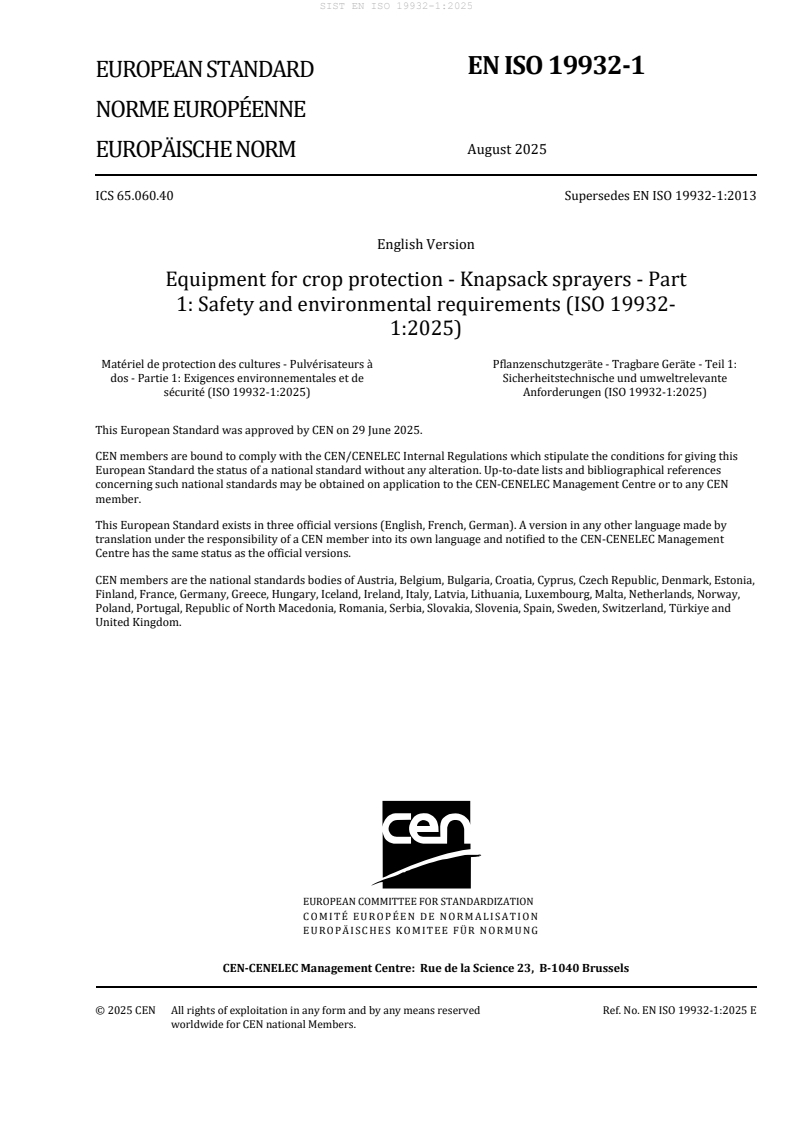
EN ISO 19932-1
EUROPEAN STANDARD
NORME EUROPÉENNE
August 2025
EUROPÄISCHE NORM
ICS 65.060.40 Supersedes EN ISO 19932-1:2013
English Version
Equipment for crop protection - Knapsack sprayers - Part
1: Safety and environmental requirements (ISO 19932-
1:2025)
Matériel de protection des cultures - Pulvérisateurs à Pflanzenschutzgeräte - Tragbare Geräte - Teil 1:
dos - Partie 1: Exigences environnementales et de Sicherheitstechnische und umweltrelevante
sécurité (ISO 19932-1:2025) Anforderungen (ISO 19932-1:2025)
This European Standard was approved by CEN on 29 June 2025.
CEN members are bound to comply with the CEN/CENELEC Internal Regulations which stipulate the conditions for giving this
European Standard the status of a national standard without any alteration. Up-to-date lists and bibliographical references
concerning such national standards may be obtained on application to the CEN-CENELEC Management Centre or to any CEN
member.
This European Standard exists in three official versions (English, French, German). A version in any other language made by
translation under the responsibility of a CEN member into its own language and notified to the CEN-CENELEC Management
Centre has the same status as the official versions.
CEN members are the national standards bodies of Austria, Belgium, Bulgaria, Croatia, Cyprus, Czech Republic, Denmark, Estonia,
Finland, France, Germany, Greece, Hungary, Iceland, Ireland, Italy, Latvia, Lithuania, Luxembourg, Malta, Netherlands, Norway,
Poland, Portugal, Republic of North Macedonia, Romania, Serbia, Slovakia, Slovenia, Spain, Sweden, Switzerland, Türkiye and
United Kingdom.
EUROPEAN COMMITTEE FOR STANDARDIZATION
COMITÉ EUROPÉEN DE NORMALISATION
EUROPÄISCHES KOMITEE FÜR NORMUNG
CEN-CENELEC Management Centre: Rue de la Science 23, B-1040 Brussels
© 2025 CEN All rights of exploitation in any form and by any means reserved Ref. No. EN ISO 19932-1:2025 E
worldwide for CEN national Members.
Contents Page
European foreword . 3
Annex ZA (informative) Relationship between this European Standard and the Essential
Requirements of EU Directive 2006/42/EC amended by Directive 2009/127/EC
aimed to be covered . 4
European foreword
This document (EN ISO 19932-1:2025) has been prepared by Technical Committee ISO/TC 23 "Tractors
and machinery for agriculture and forestry" in collaboration with Technical Committee CEN/TC 144
“Tractors and machinery for agriculture and forestry” the secretariat of which is held by AFNOR.
This European Standard shall be given the status of a national standard, either by publication of an
identical text or by endorsement, at the latest by February 2026, and conflicting national standards
shall be withdrawn at the latest by February 2026.
Attention is drawn to the possibility that some of the elements of this document may be the subject of
patent rights. CEN shall not be held responsible for identifying any or all such patent rights.
This document supersedes EN ISO 19932-1:2013.
This document has been prepared under a standardization request addressed to CEN by the European
Commission. The Standing Committee of the EFTA States subsequently approves these requests for its
Member States.
For the relationship with EU Legislation, see informative Annex ZA, which is an integral part of this
document.
Any feedback and questions on this document should be directed to the users’ national standards
body/national committee. A complete listing of these bodies can be found on the CEN website.
According to the CEN-CENELEC Internal Regulations, the national standards organizations of the
following countries are bound to implement this European Standard: Austria, Belgium, Bulgaria,
Croatia, Cyprus, Czech Republic, Denmark, Estonia, Finland, France, Germany, Greece, Hungary, Iceland,
Ireland, Italy, Latvia, Lithuania, Luxembourg, Malta, Netherlands, Norway, Poland, Portugal, Republic of
North Macedonia, Romania, Serbia, Slovakia, Slovenia, Spain, Sweden, Switzerland, Türkiye and the
United Kingdom.
Endorsement notice
The text of ISO 19932-1:2025 has been approved by CEN as EN ISO 19932-1:2025 without any
modification.
Annex ZA
(informative)
Relationship between this European Standard and the Essential
Requirements of EU Directive 2006/42/EC amended by Directive
2009/127/EC aimed to be covered
This European Standard has been prepared under a Commission’s standardization request “M/396
Mandate to CEN and CENELEC for Standardisation in the field of machinery" and "M/471 Mandate to
CEN for standardisation in the field of machinery for pesticide application" to provide one voluntary
means of conforming to essential requirements of Directive 2006/42/EC of the European Parliament
and of the Council of 17 May 2006 on machinery, and amending Directive 2009/127/EC.
Once this standard is cited in the Official Journal of the European Union under that Directive,
compliance with the normative clauses of this standard given in Table ZA.1 confers, within the limits of
the scope of this standard, a presumption of conformity with the corresponding essential requirements
of that Directive, and associated EFTA regulations.
Table ZA.1 — Correspondence between this European Standard and Annex I of Directive
2006/42/EC amended by Directive 2009/127/EC
The relevant Essential Clause(s)/sub-clause(s) of this Remarks/Notes
Requirements of Directive EN
2006/42/EC amended by
Directive 2009/127/EC
1. ESSENTIAL HEALTH AND
SAFETY REQUIREMENTS
1.1.2. (a) 4, 5, 6, 7, 8
1.1.2. (c) 4, 5, 6, 7, 8
1.1.2. (d) 4, 8
1.1.2. (e) 4, 7, 8
1.1.3. Materials and products 8.1.1.
1.1.5. Design of machinery to 4.1.5.
facilitate its handling
1.1.6. Ergonomics 4.1.1, 4.1.2, 4.1.4, 4.1.12, 4.2.1,
4.2.3, 4.2.4, 4.4.1, 4.4.2, 4.5.1,
6.2.5, 6.10, 6.11, 7.2.
1.2. CONTROL SYSTEMS
1.2.1. Safety and reliability of 4.5.1, 4.5.3, 4.5.4, 4.5.5, 4.5.6.
control systems
1.2.2. Control devices 4.4, 6.3.
1.2.3. Starting 4.4.2.
The relevant Essential Clause(s)/sub-clause(s) of this Remarks/Notes
Requirements of Directive EN
2006/42/EC amended by
Directive 2009/127/EC
1.2.4. Stopping 4.4.2, 6.3
1.2.4.1. Normal stop 4.4.2, 6.3
1.2.4.2. Operational stop 4.4.2, 6.3
1.2.4.3. Emergency stop Not covered
1.2.4.4. Assembly of machinery 8.1.1.
1.2.5. Selection of control or Not covered
operating modes
1.2.6. Failure of the power Not covered
supply
1.3. PROTECTION AGAINST
MECHANICAL HAZARDS
1.3.1. Risk of loss of stability 4.1.6.
1.3.2. Risk of break-up during Not covered
operation
1.3.3. Risks due to falling or 4.2.5, 5.1.1, 7.1.1.
ejected objects
1.3.4. Risks due to surfaces, 4.1.11
edges or angles
1.3.7. Risks related to moving 6.4.
parts
1.4. REQUIRED
CHARACTERISTICS OF GUARDS
AND PROTECTIVE DEVICES
1.4.1. General requirements 6.3, 6.4.
1.4.2.1. Fixed guards 6.4.
1.4.2.2. Interlocking movable Not covered
guards
1.4.2.3. Adjustable guards Not covered
restricting access
1.4.3. Special requirements for Not covered
protective devices
1.5. RISKS DUE TO OTHER
HAZARDS
1.5.1. Electricity supply 6.8, 6.11
1.5.3. Energy supply other than 6.5
electricity
1.5.5. Extreme temperatures 6.6.
The relevant Essential Clause(s)/sub-clause(s) of this Remarks/Notes
Requirements of Directive EN
2006/42/EC amended by
Directive 2009/127/EC
1.5.6. Fire 6.5
1.5.8. Noise 6.9
1.5.9. Vibrations 6.10
1.5.13. Emissions of hazardous 4.1.6, 4.1.7, 4.1.9, 4.1.10, 4.7,
materials and substances 5.1.2, 6.1.1, 6.3, 6.5.3, 7.1.2, 7.3.3.
1.6. MAINTENANCE
1.6.1. Machinery maintenance 8.1.1.
1.6.3. Isolation of energy sources 6.8.2.1, 6.11
1.6.4. Operator intervention 4.4.2, 6.8.2.1
1.6.5. Cleaning of internal parts 4.6.2.
1.7. INFORMATION
1.7.1. Information and warnings 8.1, 8.2, 8.3.
on the machinery
1.7.1.1. Information and 8.1, 8.2, 8.3.
information devices
1.7.1.2. Warning devices 8.3.
1.7.2. Warning of residual risks 8.3
1.7.3. Marking of machinery 8.2
1.7.4. Instructions 8.1
1.7.4.1. General principles for the 8.1.
drafting of instructions
1.7.4.2. Contents of the 8.1.
instructions
2.4. MACHINERY FOR PESTICIDE 4.1, 4.2, 4.3, 4.4, 4.5, 4.6, 4.7, 5.1,
APPLICATION 5.2, 6.1, 6.2, 6.3, 6.4, 6.5, 6.6, 6.7,
6.8, 6.9, 6.10, 6.11, 7.1, 7.2, 7.3.
2.4.2. General 4.1, 5.1, 6.1, 7.1.
2.4.3. Controls and monitoring 4.3.2, 4.4, 6.3.
2.4.4. Filling and emptying 4.1.9, 4.3.1, 4.3.2, 4.3.4, 4.3.5,
4.3.6, 5.2.2, 5.2.3, 5.2.4, 5.2.5,
6.2.2, 6.2.3, 6.2.4, 6.2.5, 6.2.6, 7.3.
2.4.5. Applications of pesticides 4, 5, 6, 8
2.4.5.1. Application rate 4.1.3, 4.4.4, 5.2.1, 6.2.1, 8.1.1.
2.4.5.2. Distribution, deposition 4.7.1, 4.7.3, 4.7.4, 5.2, 8.1.1.
and drift of pesticide
The relevant Essential Clause(s)/sub-clause(s) of this Remarks/Notes
Requirements of Directive EN
2006/42/EC amended by
Directive 2009/127/EC
2.4.5.3. Tests Not covered
2.4.5.4. Losses during stoppage 4.1.7
2.4.6. Maintenance 8.1.1
2.4.6.1. Cleaning 8.1.1
2.4.6.2. Servicing 8.1.1
2.4.7. Inspections 8.1.1
2.4.8. Marking of nozzles, 4.6.1, 4.7.4.
strainers and filters
2.4.10. Instructions 8.1.
WARNING 1 Presumption of conformity stays valid only as long as a reference to this European
Standard is maintained in the list published in the Official Journal of the European Union. Users of this
standard should consult frequently the latest list published in the Official Journal of the European
Union.
WARNING 2 Other Union legislation may be applicable to the product(s) falling within the scope of
this standard.
International
Standard
ISO 19932-1
Third edition
Equipment for crop protection —
2025-06
Knapsack sprayers —
Part 1:
Safety and environmental
requirements
Matériel de protection des cultures — Pulvérisateurs à dos —
Partie 1: Exigences environnementales et de sécurité
Reference number
ISO 19932-1:2025(en) © ISO 2025
ISO 19932-1:2025(en)
© ISO 2025
All rights reserved. Unless otherwise specified, or required in the context of its implementation, no part of this publication may
be reproduced or utilized otherwise in any form or by any means, electronic or mechanical, including photocopying, or posting on
the internet or an intranet, without prior written permission. Permission can be requested from either ISO at the address below
or ISO’s member body in the country of the requester.
ISO copyright office
CP 401 • Ch. de Blandonnet 8
CH-1214 Vernier, Geneva
Phone: +41 22 749 01 11
Email: copyright@iso.org
Website: www.iso.org
Published in Switzerland
ii
ISO 19932-1:2025(en)
Contents Page
Foreword .iv
Introduction .v
1 Scope . 1
2 Normative references . 1
3 Terms and definitions . 2
4 General requirements . 3
4.1 General .3
4.2 Harness . .4
4.3 Spray tank .5
4.4 Controls .5
4.5 Hoses .6
4.6 Filters .6
4.7 Spray lance and nozzles .6
5 Specific requirements for lever-operated knapsack sprayers . 7
5.1 General .7
5.2 Spray tank .7
6 Specific requirements for engine- or motor-driven knapsack sprayers . 8
6.1 General .8
6.2 Spray tank .8
6.3 Controls .9
6.3.1 Motor/engine shut-off control .9
6.3.2 Pressure control .9
6.4 Power-driven components .9
6.5 Fuel tank for engine-driven knapsack sprayers .9
6.6 Hot parts for engine-driven knapsack sprayers .9
6.7 Exhaust system for engine-driven knapsack sprayers .10
6.8 Electrical requirements for engine-driven knapsack sprayers .10
6.8.1 General .10
6.8.2 Ignition circuit .10
6.9 Noise .11
6.9.1 General .11
6.9.2 Test method for engine-driven knapsack sprayers .11
6.10 Vibration .11
6.10.1 Reduction by design at source and by protective measures .11
6.10.2 Vibration measurement .11
6.11 Battery safety .11
7 Specific requirements for compression sprayers .11
7.1 General .11
7.2 Harness . . 12
7.3 Spray tank . 12
8 Information for use .12
8.1 Instruction handbook. 12
8.1.1 General . 12
8.1.2 Technical data . 15
8.2 Marking . 15
8.3 Warnings .16
Annex A (informative) List of significant hazards associated with knapsack sprayers . 17
Bibliography .21
iii
ISO 19932-1:2025(en)
Foreword
ISO (the International Organization for Standardization) is a worldwide federation of national standards
bodies (ISO member bodies). The work of preparing International Standards is normally carried out through
ISO technical committees. Each member body interested in a subject for which a technical committee
has been established has the right to be represented on that committee. International organizations,
governmental and non-governmental, in liaison with ISO, also take part in the work. ISO collaborates closely
with the International Electrotechnical Commission (IEC) on all matters of electrotechnical standardization.
The procedures used to develop this document and those intended for its further maintenance are described
in the ISO/IEC Directives, Part 1. In particular, the different approval criteria needed for the different types
of ISO document should be noted. This document was drafted in accordance with the editorial rules of the
ISO/IEC Directives, Part 2 (see www.iso.org/directives).
ISO draws attention to the possibility that the implementation of this document may involve the use of (a)
patent(s). ISO takes no position concerning the evidence, validity or applicability of any claimed patent
rights in respect thereof. As of the date of publication of this document, ISO had not received notice of (a)
patent(s) which may be required to implement this document. However, implementers are cautioned that
this may not represent the latest information, which may be obtained from the patent database available at
www.iso.org/patents. ISO shall not be held responsible for identifying any or all such patent rights.
Any trade name used in this document is information given for the convenience of users and does not
constitute an endorsement.
For an explanation of the voluntary nature of standards, the meaning of ISO specific terms and expressions
related to conformity assessment, as well as information about ISO's adherence to the World Trade
Organization (WTO) principles in the Technical Barriers to Trade (TBT), see www.iso.org/iso/foreword.html.
This document was prepared by Technical Committee ISO/TC 23, Tractors and machinery for agriculture and
forestry, Subcommittee SC 6, Equipment for crop protection,in collaboration with the European Committee for
Standardization (CEN) Technical Committee CEN/TC 144, Tractors and machinery for agriculture and forestry,
in accordance with the Agreement on technical cooperation between ISO and CEN (Vienna Agreement).
This third edition cancels and replaces the second edition (ISO 19932-1:2013), which has been technically
revised.
The main changes are as follows:
— the scope has been changed to include sprayers with a nominal volume of more than 6 l in order to
address sprayers in professional use only;
— cancellation and modification of requirements.
A list of all parts in the ISO 19932 series can be found on the ISO website.
Any feedback or questions on this document should be directed to the user’s national standards body. A
complete listing of these bodies can be found at www.iso.org/members.html.
iv
ISO 19932-1:2025(en)
Introduction
The application of plant protection products with knapsack sprayers should take into consideration
biological, economic, environmental and operator issues.
The aim of this document is to specify safety and environmental requirements for equipment.
Implementation of ISO 19932-1:2025 and ISO 19932-2:2025 will achieve an appropriate level of operator
safety and avoid unnecessary dispersal of plant protection products into the environment.
This document is a type-C standard as stated in ISO 12100:2010.
This document is of relevance, in particular, for the following stakeholder groups representing the market
players with regard to machinery safety:
— machine manufacturers (small, medium and large enterprises);
— health and safety bodies (regulators, accident prevention organizations, market surveillance, etc.)
Others can be affected by the level of machinery safety achieved with the means of the document by the
above-mentioned stakeholder groups:
— machine users/employers (small, medium and large enterprises);
— machine users/employees (e.g. trade unions, organizations for people with special needs);
— service providers, e.g. for maintenance (small, medium and large enterprises);
— consumers (in case of machinery intended for use by consumers).
The above-mentioned stakeholder groups have been given the possibility to participate at the drafting
process of this document.
The machinery concerned and the extent to which hazards, hazardous situations or hazardous events are
covered are indicated in the Scope of this document.
When requirements of this type-C standard are different from those which are stated in type-A or type-B
standards, the requirements of this type-C standard take precedence over the requirements of the other
standards for machines that have been designed and built according to the requirements of this type-C
standard.
v
International Standard ISO 19932-1:2025(en)
Equipment for crop protection — Knapsack sprayers —
Part 1:
Safety and environmental requirements
1 Scope
This document specifies the safety and environmental requirements and their means of verification for the
design and construction of knapsack sprayers carried on the back or shoulder of the operator for use with
plant protection products. It also specifies the type of information on safe working practices (including
residual risks) to be provided by the manufacturer.
This document is applicable to lever-operated knapsack sprayers, knapsack compression sprayers and
knapsack sprayers driven by an engine or electric motor using hydraulic pressure atomisation of the spray
liquid intended to be used primarily in agriculture, forestry and horticulture with a nominal volume of more
than 6,0 l.
This document is not applicable to knapsack sprayers which are manufactured before the date of publication
of this document.
It does not apply to knapsack combustion engine-driven air-blast sprayers according to ISO 28139:
2019+A1:2024.
This document deals with all significant hazards, hazardous situations and hazardous events relevant to
knapsack sprayers when they are used as intended and under conditions of misuse which are reasonably
foreseeable by the manufacturer (see Annex A), excepting the hazards arising from:
— static electricity;
— explosion or fire from chemicals for spraying; and
— insufficient structural integrity.
Noise is not considered to be a relevant hazard for:
— lever operated knapsack sprayers;
— electric motor driven knapsack sprayers.
This document does not cover electromagnetic compatibility (EMC) requirements.
This document is intended to be applied in conjunction with ISO 19932-2:2025.
2 Normative references
The following documents are referred to in the text in such a way that some or all of their content constitutes
requirements of this document. For dated references, only the edition cited applies. For undated references,
the latest edition of the referenced document (including any amendments) applies.
ISO 3767-5:2016, Tractors, machinery for agriculture and forestry, powered lawn and garden equipment —
Symbols for operator controls and other displays — Part 5: Symbols for manual portable forestry machines
ISO 3864-1:2011, Graphical symbols — Safety colours and safety signs — Part 1: Design principles for safety
signs and safety markings
ISO 19932-1:2025(en)
ISO 5681:2020, Equipment for crop protection — Vocabulary
ISO 5682-2:2017, Equipment for crop protection — Spraying equipment — Part 2: Test methods to assess the
horizontal transverse distribution for hydraulic sprayers
ISO 6385:2016, Ergonomics principles in the design of work systems
ISO 8169:1984, Equipment for crop protection — Sprayers — Connecting dimensions for nozzles and manometers
ISO 10626:1991, Equipment for crop protection — Sprayers — Connecting dimensions for nozzles with bayonet fixing
ISO 11684:2023, Tractors, machinery for agriculture and forestry, powered lawn and garden equipment —
Safety labels — General principles
ISO 12100:2010, Safety of machinery — General principles for design — Risk assessment and risk reduction
ISO 13857:2019, Safety of machinery — Safety distances to prevent hazard zones being reached by upper and
lower limbs
ISO 14120:2015, Safety of machinery — Guards — General requirements for the design and construction of fixed
and movable guards
ISO 19732:2007, Equipment for crop protection — Sprayer filters — Colour coding for identification
ISO 19932-2:2025, Equipment for crop protection — Knapsack sprayers — Part 2: Test methods
ISO 20599:2024, Manually portable (hand-held) powered lawn and garden equipment and forest machinery —
Engine performance and fuel consumption
ISO 22867:2021, Forestry and gardening machinery — Vibration test code for portable hand-held machines
with internal combustion engine — Vibration at the handles
ISO 22868:2021, Forestry and gardening machinery — Noise test code for portable hand-held machines with
internal combustion engine — Engineering method (Grade 2 accuracy)
IEC 61032:1997, Protection of persons and equipment by enclosures — Probes for verification
IEC 62133-1:2017, Secondary cells and batteries containing alkaline or other non-acid electrolytes - Safety
requirements for portable sealed secondary cells, and for batteries made from them, for use in portable
applications — Part 1: Nickel systems
IEC 62133-2:2017, Secondary cells and batteries containing alkaline or other non-acid electrolytes - Safety
requirements for portable sealed secondary cells, and for batteries made from them, for use in portable
applications — Part 2: Lithium systems
IEC/EN 62841-1:2014, Electric motor-operated hand-held tools, transportable tools and lawn and garden
machinery — Safety — Part 1: General requirements
3 Terms and definitions
For the purposes of this document, the terms and definitions given in ISO 5681:2020, ISO 12100:2010 and
the following apply.
ISO and IEC maintain terminological databases for use in standardization at the following addresses:
— ISO Online browsing platform: available at https:// www .iso .org/ obp
— IEC Electropedia: available at https:// www .electropedia .org/
3.1
knapsack sprayer
self-contained sprayer carried on the operator’s back or shoulder by means of straps or a strap
ISO 19932-1:2025(en)
3.2
nominal volume
tank volume at the maximum filling level specified by the manufacturer
Note 1 to entry: The maximum filling level can be marked by the upper value of the contents gauge scale or at a lower
level by a dedicated mark.
3.3
maximum working pressure
maximum pressure allowed at any part of the sprayer
4 General requirements
4.1 General
4.1.1 The sprayer shall comply with the safety and environmental requirements and/or protective
measures of this clause, as well as the additional requirements for particular types of knapsack sprayer
specified in Clauses 5, 6, and 7.
In addition, the sprayer shall be designed according to the principles of ISO 6385:2016 and ISO 12100:2010
for relevant but not significant hazards which are not dealt with by this document.
All spray functions including spraying, filling, emptying and cleaning (including cleaning nozzles and filters)
shall be possible for an operator wearing appropriate protective gloves.
Compliance shall be checked by inspection and function test.
4.1.2 The centre of gravity of the upright sprayer shall not be located at a horizontal distance greater than
150 mm from the back support of the harness with fuel and spray tanks filled to their nominal value and
with the equipment ready for use.
Compliance shall be tested according to ISO 19932-2:2025, 5.6.
4.1.3 The sprayer shall have an adjustable spray liquid output which does not deviate by more than ±15 %
of the values specified in the instruction handbook for each setting.
Compliance shall be tested according to ISO 19932-2:2025, 5.3.2.
4.1.4 Wearing parts (such as nozzles, filters, anti-drip valves, valves, diaphragms) specified in the
instruction handbook shall be changeable without special tools, unless provided with the sprayer, by
an operator wearing appropriate protective gloves and without contamination of the operator and the
environment.
Compliance shall be checked by inspection and function test.
4.1.5 The sprayer shall be equipped with a means for lifting and carrying the filled sprayer (e.g. a handle)
in an upright position.
Compliance shall be checked by inspection and function test.
4.1.6 In order to guarantee the stability of the sprayer during filling operations, the sprayer shall remain
stable on an incline of 8,5° (±0,2°) in any direction, irrespective of the amount of liquid in the spray tank.
Compliance shall be tested according to ISO 19932-2:2025, 5.3.4.
ISO 19932-1:2025(en)
4.1.7 The sprayer shall be designed so that the loss of liquid during stoppage of spraying is minimized.
The volume emitted within 5 s after spray shut-off shall not be more than 5 ml.
Compliance shall be checked by measurement.
4.1.8 For sprayers with a nominal volume of up to 17 l, the residual volume of liquid shall not exceed
250 ml. For those that exceed 17 l, this volume shall not exceed 1,5 % of the nominal spray-tank volume.
Compliance shall be tested according to ISO 19932-2:2025, 6.3 for lever-operated sprayers, according to
ISO 19932-2:2025, 7.2 for engine- or motor-driven sprayers or according to ISO 19932-2:2025, 8.1.2 for
compression sprayers.
4.1.9 The sprayer shall be designed to avoid accumulation of liquid in case of accidental overfilling.
External deposit, with all carrying and waist straps removed from the sprayer, shall not exceed 70 ml.
Compliance shall be tested according to ISO 19932-2:2025, 6.2 for lever-operated sprayers, according
to ISO 19932-2:2025, 7.1 for engine- or motor-driven sprayers or according to ISO 19932-2:2025, 8.1.1 for
compression sprayers.
4.1.10 Parts of the sprayer that can be pressurized during normal operation shall withstand twice the
maximum working pressure specified by the manufacturer in the instruction handbook, except for engine-
or motor driven sprayers which shall withstand 120 % of the maximum working pressure specified by the
manufacturer in the instruction handbook.
Compliance shall be tested according to ISO 19932-2:2025, 5.4.
4.1.11 Insofar as their purpose allows, accessible parts of the sprayer shall have no sharp edges and angles
and no rough surfaces likely to cause injury.
Compliance shall be checked by inspection.
4.2 Harness
4.2.1 A harness shall be provided to carry the sprayer. It shall be adjustable to the size of the operator
so that one person shall be able to pick up and put down the sprayer and to position the sprayer on the
back so that it can be carried safely. A double shoulder harness shall be designed so that pressure is evenly
distributed on both shoulders of the operator. The design of the double shoulder harness shall prevent
slipping in any direction.
All double shoulder harnesses shall be designed so that the sprayer can be released quickly from the operator
in case of emergency, e.g. by providing a means for quick-release. If a decoupling mechanism is provided, it
shall be possible to open it under load using only one hand.
Compliance shall be checked by inspection and function test.
4.2.2 The harness shall be made of non-absorbent material. The increase in mass of the harness having
a mass lower than 100 g shall not exceed 35 g after defined immersion in water. Otherwise, the increase in
mass shall not exceed 35 % of the dry mass.
Compliance shall be tested according to ISO 19932-2:2025, 5.3.8.
4.2.3 Each shoulder strap shall have a load-bearing part of a length of at least 100 mm and of a minimum
comfort width of:
a) 25 mm in case of (filled) sprayer masses up to 10 kg;
b) 50 mm in case of (filled) sprayer masses higher than 10 kg.
The load shall be distributed over the whole width.
ISO 19932-1:2025(en)
Compliance shall be checked by measurement.
4.2.4 If the load-bearing area is formed by a pad, this shall not slip from its position unintentionally.
Compliance shall be checked by inspection and function test.
4.2.5 There shall be no damage on load-bearing straps and their fixation points that reduces their
functionality as a consequence of the specified strap drop test.
Compliance shall be tested according to ISO 19932-2:2025, 5.3.3.
4.3 Spray tank
4.3.1 The nominal volume shall be specified in whole litres (l). It shall be possible to determine the spray
tank filling level of the sprayer with a minimum resolution of 1 l. If the nominal volume of the sprayer is at
least 10 l, it is accepted to have the first marking at maximum 20 % of the nominal volume.
Compliance shall be checked by inspection.
4.3.2 The volumetric contents gauge scale shall have a maximum error of the reading of ±10 % up to a
filling level of 5 l and ±5 % above.
Compliance shall be tested according to ISO 19932-2:2025, 5.3.5.
4.3.3 It shall be possible to fill the spray tank to its nominal volume within 60 s. The total volume of all
liquid spillage during filling shall not exceed 5 ml.
Compliance shall be tested according to ISO 19932-2:2025, 5.3.6.
4.3.4 It shall be possible to fully empty the spray tank. The amount of liquid remaining in the spray tank
shall not exceed 50 g.
Compliance shall be tested according to ISO 19932-2:2025, 5.3.7.
4.3.5 The operator shall be protected from coming into contact with the plant protection product when
emptying the spray tank. Emptying shall be possible without the use of a tool while wearing appropriate
protective gloves and with the flow being directed away from the operator so that it can be collected in a
suitable container.
Compliance shall be checked by inspection and function test.
4.4 Controls
4.4.1 It shall be possible to operate all controls by an operator wearing appropriate protective gloves.
Compliance shall be checked by inspection and function test.
4.4.2 The pressure line shall be equipped with a quick-acting shut-off device positioned so that it can be
easily reached by the operator in normal operating position. Unintentional opening of the shut-off device
shall be minimized by the application of a force, for example by means of a spring or a locking device. If the
device is lockable in the open position, it shall be locked by two independent and dissimilar actions and shall
be unlocked easily by one action. After unlocking, the device shall shut-off automatically when released.
Compliance shall be checked by inspection and function test.
ISO 19932-1:2025(en)
4.4.3 Any mechanical shut-off device shall be designed to work reliably. It shall properly open and close, it
shall not leak after 25 000 duty cycles.
Compliance shall be tested according to ISO 19932-2:2025, 5.3.1.
4.4.4 Sprayers shall have technical means to control and adjust the application rate of the sprayer. This
requirement is fulfilled for example, if the sprayer has a device for pressure control (pressure regulator) set
at a pre-determined value, a pressure indicator, etc.
If the device for pressure control is changeable or adjustable, it shall be possible without contamination of
the operator or environment. If the spray pressure is adjustable, the sprayer manufacturer shall provide
information on application rate at certain pressure settings. If the sprayer is fitted with a pressure indicator,
it shall be clearly readable and visible when the sprayer is being operated. Pressure indication shall be
stable. The resolution of indication shall be 20 kPa (0,2 bar). The error of indication shall not exceed 2,5 % of
the full scale value.
Compliance shall be checked by inspection and function test.
4.5 Hoses
4.5.1 The length of the hose shall allow safe, comfortable and ergonomic operation of the spray lance.
Compliance shall be checked by functional test.
4.5.2 Flexible hoses shall be attached so there are no sharp bends in all normal working positions.
Compliance shall be checked by inspection and function test.
4.5.3 The maximum working pressure of hoses and the maximum working pressure of connecting devices
shall be at least equal to two times the maximum working pressure of the sprayer.
Compliance shall be checked by inspection and function test.
4.6 Filters
4.6.1 Spray liquid going to the nozzles shall be filtered on the pressure side. The mesh width of these
filters shall correspond with the size of nozzle fitted by the sprayer manufacturer.
Filters shall be marked in such a way that they can be identified. Identification can be achieved directly or
from information given in the instruction handbook, e.g. by marking of filters with:
— the mesh width; or
— colour coding according to ISO 19732:2007.
Comp
...