

SIST EN 1993-1-7:2007
(Main)Eurocode 3 - Design of steel structures - Part 1-7: Plated structures subject to out of plane loading
General Information
- Abstract
(1)P EN 1993-1-7 provides basic design rules for the structural design of unstiffened and stiffened plates which form part of plated structures such as silos, tanks or containers, that are loaded by out of plane actions. It is intended to be used in conjunction with EN 1993-1-1 and the relevant application standards.
(2) This document defines the design values of the resistances: the partial factor for resistances may be taken from National Annexes of the relevant application standards. Recommended values are given in the relevant application standards.
(3) This Standard is concerned with the requirements for design against the ultimate limit state of:
– plastic collapse;
– cyclic plasticity;
– buckling;
– fatigue.
(4) Overall equilibrium of the structure (sliding, uplifting, overturning) is not included in this Standard, but is treated in EN 1993-1-1. Special considerations for specific applications may be found in the relevant applications parts of EN 1993.
(5) The rules in this Standard refer to plate segments in plated structures which may be stiffened or unstiffened. These plate segments may be individual plates or parts of a plated structure. They are loaded by out of plane actions.
(6) For the verification of unstiffened and stiffened plated structures loaded only by in-plane effects see EN 1993-1-5. In EN 1993-1-7 rules for the interaction between the effects of inplane and out of plane loading are given.
(7) For the design rules for cold formed members and sheeting see EN 1993-1-3.
(8) The temperature range within which the rules of this Standard are allowed to be applied are defined in the relevant application parts of EN 1993.
(9) The rules in this Standard refer to structures constructed in compliance with the execution specification of EN 1090-2.
(10) (...)
- Status
- Published
- Publication Date
- 29-May-2007
- Technical Committee
- KON - Structures
- Current Stage
- 6060 - National Implementation/Publication (Adopted Project)
- Start Date
- 23-Apr-2007
- Due Date
- 28-Jun-2007
- Completion Date
- 30-May-2007

Overview
SIST EN 1993-1-7:2007 is part of the Eurocode 3 suite and specifies the essential design rules for plated steel structures subjected to out of plane loading. Developed by SIST in alignment with CEN, this standard addresses the structural design of both unstiffened and stiffened plates that are integral to broader constructions such as silos, tanks, and containers. It is intended for use in conjunction with EN 1993-1-1 and relevant application standards.
This Eurocode ensures the safety and reliability of steel structures by defining requirements to prevent structural failures such as plastic collapse, cyclic plasticity, buckling, and fatigue under out of plane loading. Importantly, the standard outlines partial safety factors for resistance, which may be tailored by national annexes, thus allowing flexibility for local practices and regulations.
Key Topics
- Design Models: Guidance on structural analysis for plate segments and entire plated structures, including appropriate models for predicting limit states.
- Limit State Design: Focus on the ultimate limit states of plastic collapse, cyclic plasticity, buckling, and fatigue, ensuring robust performance under critical load scenarios.
- Interaction of Loads: Rules covering both in-plane and out of plane loading effects, including their interactions and verification.
- Boundary Conditions and Material Properties: Selection of appropriate boundary conditions and material properties from referenced standards, required for accurate and safe design calculations.
- Analysis Methods: A range of analysis techniques from linear elastic to geometrically and materially nonlinear analysis, incorporating imperfections as needed.
- Design Assisted by Testing: Utilization of testing data to validate or refine design models where applicable.
Applications
SIST EN 1993-1-7:2007 is highly relevant in the design and assessment of various steel structures where plate elements are subject to loads perpendicular to their plane, such as:
- Silos and Storage Tanks: Ensuring the structural reliability of cylindrical and rectangular storage vessels, often loaded by stored materials or external pressures.
- Containers: Structural design considering external and internal load combinations, applicable to shipping or industrial containers.
- Industrial Buildings: Any steel building incorporating large plate elements in roofs, walls, or floors subjected to out of plane wind or equipment loads.
- Infrastructure Projects: Bridges, culverts, and other civil engineering works often include plated elements requiring verification against buckling and fatigue as defined in this standard.
By addressing failure modes like plastic collapse and buckling, the standard supports engineers in delivering safe, durable, and economical steel structures. Design in accordance with this Eurocode often means higher reliability and extended service life for critical infrastructure and industrial assets.
Related Standards
For comprehensive and compliant design, SIST EN 1993-1-7:2007 should be used in conjunction with related standards, including:
- EN 1993-1-1: General rules for steel structures
- EN 1993-1-3: Cold-formed members and sheeting
- EN 1993-1-5: Plated structural elements under in-plane loading
- EN 1993-1-6: Strength and stability of shell structures
- EN 1993-1-8: Design of joints in steel structures
- EN 1090-2: Execution of steel structures
- EN 1993-1-9: Fatigue strength
- EN 1991 series: Actions on structures (loading assumptions and combinations)
Adherence to these associated standards ensures thorough coverage from materials selection and structural analysis through to fabrication and performance in demanding environments.
By following SIST EN 1993-1-7:2007, engineers and designers can be confident their plated steel structures will meet European and national regulatory requirements for safety and performance, particularly regarding out of plane loading effects. This supports the development of resilient infrastructure across a wide range of industries.
Relations
- Effective Date
- 01-Sep-2007
- Effective Date
- 25-Mar-2026
- Effective Date
- 25-Mar-2026
- Effective Date
- 28-Jan-2026
- Effective Date
- 28-Jan-2026
- Effective Date
- 28-Jan-2026
- Effective Date
- 28-Jan-2026
- Effective Date
- 28-Jan-2026
- Effective Date
- 28-Jan-2026
- Effective Date
- 28-Jan-2026
- Effective Date
- 28-Jan-2026
- Effective Date
- 28-Jan-2026
- Effective Date
- 28-Jan-2026
- Effective Date
- 28-Jan-2026
- Effective Date
- 19-May-2026
Get Certified
Connect with accredited certification bodies for this standard

DIBt (Deutsches Institut für Bautechnik)
German Institute for Building Technology.
DIN CERTCO
DIN Group product certification.

Aboma Certification B.V.
Specialized in construction, metal, and transport sectors.
Sponsored listings
Frequently Asked Questions
SIST EN 1993-1-7:2007 is a standard published by the Slovenian Institute for Standardization (SIST). Its full title is "Eurocode 3 - Design of steel structures - Part 1-7: Plated structures subject to out of plane loading". This standard covers: (1)P EN 1993-1-7 provides basic design rules for the structural design of unstiffened and stiffened plates which form part of plated structures such as silos, tanks or containers, that are loaded by out of plane actions. It is intended to be used in conjunction with EN 1993-1-1 and the relevant application standards. (2) This document defines the design values of the resistances: the partial factor for resistances may be taken from National Annexes of the relevant application standards. Recommended values are given in the relevant application standards. (3) This Standard is concerned with the requirements for design against the ultimate limit state of: – plastic collapse; – cyclic plasticity; – buckling; – fatigue. (4) Overall equilibrium of the structure (sliding, uplifting, overturning) is not included in this Standard, but is treated in EN 1993-1-1. Special considerations for specific applications may be found in the relevant applications parts of EN 1993. (5) The rules in this Standard refer to plate segments in plated structures which may be stiffened or unstiffened. These plate segments may be individual plates or parts of a plated structure. They are loaded by out of plane actions. (6) For the verification of unstiffened and stiffened plated structures loaded only by in-plane effects see EN 1993-1-5. In EN 1993-1-7 rules for the interaction between the effects of inplane and out of plane loading are given. (7) For the design rules for cold formed members and sheeting see EN 1993-1-3. (8) The temperature range within which the rules of this Standard are allowed to be applied are defined in the relevant application parts of EN 1993. (9) The rules in this Standard refer to structures constructed in compliance with the execution specification of EN 1090-2. (10) (...)
(1)P EN 1993-1-7 provides basic design rules for the structural design of unstiffened and stiffened plates which form part of plated structures such as silos, tanks or containers, that are loaded by out of plane actions. It is intended to be used in conjunction with EN 1993-1-1 and the relevant application standards. (2) This document defines the design values of the resistances: the partial factor for resistances may be taken from National Annexes of the relevant application standards. Recommended values are given in the relevant application standards. (3) This Standard is concerned with the requirements for design against the ultimate limit state of: – plastic collapse; – cyclic plasticity; – buckling; – fatigue. (4) Overall equilibrium of the structure (sliding, uplifting, overturning) is not included in this Standard, but is treated in EN 1993-1-1. Special considerations for specific applications may be found in the relevant applications parts of EN 1993. (5) The rules in this Standard refer to plate segments in plated structures which may be stiffened or unstiffened. These plate segments may be individual plates or parts of a plated structure. They are loaded by out of plane actions. (6) For the verification of unstiffened and stiffened plated structures loaded only by in-plane effects see EN 1993-1-5. In EN 1993-1-7 rules for the interaction between the effects of inplane and out of plane loading are given. (7) For the design rules for cold formed members and sheeting see EN 1993-1-3. (8) The temperature range within which the rules of this Standard are allowed to be applied are defined in the relevant application parts of EN 1993. (9) The rules in this Standard refer to structures constructed in compliance with the execution specification of EN 1090-2. (10) (...)
SIST EN 1993-1-7:2007 is classified under the following ICS (International Classification for Standards) categories: 91.010.30 - Technical aspects; 91.080.13 - Steel structures. The ICS classification helps identify the subject area and facilitates finding related standards.
SIST EN 1993-1-7:2007 has the following relationships with other standards: It is inter standard links to SIST ENV 1993-1-7:2001, kSIST FprEN 1993-4-2:2025, kSIST FprEN 1993-4-1:2025, kSIST FprEN 1993-1-6:2024, SIST EN 1993-4-1:2007, kSIST FprEN 1993-1-3:2023, kSIST FprEN 1993-1-1:2022, kSIST FprEN 1993-1-5:2023, kSIST FprEN 1993-1-4:2024, kSIST FprEN 1993-1-10:2024, kSIST FprEN 1993-1-9:2024, SIST EN 1993-1-12:2007, SIST EN 1993-4-2:2007, kSIST FprEN 1993-1-8:2023, SIST-TS CLC/TS 50711:2026. Understanding these relationships helps ensure you are using the most current and applicable version of the standard.
SIST EN 1993-1-7:2007 is associated with the following European legislation: EU Directives/Regulations: 2005-01-4408, 305/2011, 89/106/EEC; Standardization Mandates: M/265, M/BC/CEN/89/11. When a standard is cited in the Official Journal of the European Union, products manufactured in conformity with it benefit from a presumption of conformity with the essential requirements of the corresponding EU directive or regulation.
SIST EN 1993-1-7:2007 is available in PDF format for immediate download after purchase. The document can be added to your cart and obtained through the secure checkout process. Digital delivery ensures instant access to the complete standard document.
Standards Content (Sample)
2003-01.Slovenski inštitut za standardizacijo. Razmnoževanje celote ali delov tega standarda ni dovoljeno.Eurocode 3 - Design of steel structures - Part 1-7: Plated structures subject to out of plane loadingSORþHYLQDVWHEurocode 3 - Calcul des structures en acier - Partie 1-7: Résistance et stabilité des structures en plaques planes chargées hors de leur planEurocode 3 - Bemessung und Konstruktion von Stahlbauten - Teil 1-7: Plattenförmige Bauteile mit QuerbelastungTa slovenski standard je istoveten z:EN 1993-1-7:2007SIST EN 1993-1-7:2007en;fr;de91.080.10Kovinske konstrukcijeMetal structures91.010.30Technical aspectsICS:SIST ENV 1993-1-7:20011DGRPHãþDSLOVENSKI
STANDARDSIST EN 1993-1-7:200701-julij-2007
EUROPEAN STANDARDNORME EUROPÉENNEEUROPÄISCHE NORMEN 1993-1-7April 2007ICS 91.010.30; 91.080.10Supersedes ENV 1993-1-7:1999
English VersionEurocode 3 - Design of steel structures - Part 1-7: Platedstructures subject to out of plane loadingEurocode 3 - Calcul des structures en acier - Partie 1-7:Résistance et stabilité des structures en plaques planeschargées hors de leur planEurocode 3 - Bemessung und Konstruktion vonStahlbauten - Teil 1-7: Plattenförmige Bauteile mitQuerbelastungThis European Standard was approved by CEN on 12 June 2006.CEN members are bound to comply with the CEN/CENELEC Internal Regulations which stipulate the conditions for giving this EuropeanStandard the status of a national standard without any alteration. Up-to-date lists and bibliographical references concerning such nationalstandards may be obtained on application to the CEN Management Centre or to any CEN member.This European Standard exists in three official versions (English, French, German). A version in any other language made by translationunder the responsibility of a CEN member into its own language and notified to the CEN Management Centre has the same status as theofficial versions.CEN members are the national standards bodies of Austria, Belgium, Bulgaria, Cyprus, Czech Republic, Denmark, Estonia, Finland,France, Germany, Greece, Hungary, Iceland, Ireland, Italy, Latvia, Lithuania, Luxembourg, Malta, Netherlands, Norway, Poland, Portugal,Romania, Slovakia, Slovenia, Spain, Sweden, Switzerland and United Kingdom.EUROPEAN COMMITTEE FOR STANDARDIZATIONCOMITÉ EUROPÉEN DE NORMALISATIONEUROPÄISCHES KOMITEE FÜR NORMUNGManagement Centre: rue de Stassart, 36
B-1050 Brussels© 2007 CENAll rights of exploitation in any form and by any means reservedworldwide for CEN national Members.Ref. No. EN 1993-1-7:2007: E
EN 1993-1-7: 2007 (E)
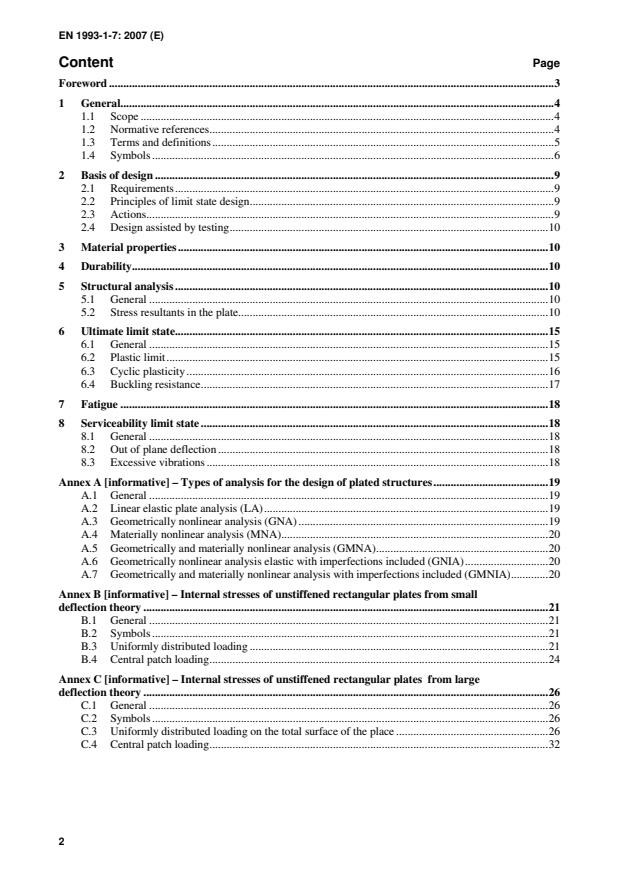
2 Content Page Foreword.3 1 General.4 1.1 Scope.4 1.2 Normative references.4 1.3 Terms and definitions.5 1.4 Symbols.6 2 Basis of design.9 2.1 Requirements.9 2.2 Principles of limit state design.9 2.3 Actions.9 2.4 Design assisted by testing.10 3 Material properties.10 4 Durability.10 5 Structural analysis.10 5.1 General.10 5.2 Stress resultants in the plate.10 6 Ultimate limit state.15 6.1 General.15 6.2 Plastic limit.15 6.3 Cyclic plasticity.16 6.4 Buckling resistance.17 7 Fatigue.18 8 Serviceability limit state.18 8.1 General.18 8.2 Out of plane deflection.18 8.3 Excessive vibrations.18 Annex A [informative] – Types of analysis for the design of plated structures.19 A.1 General.19 A.2 Linear elastic plate analysis (LA).19 A.3 Geometrically nonlinear analysis (GNA).19 A.4 Materially nonlinear analysis (MNA).20 A.5 Geometrically and materially nonlinear analysis (GMNA).20 A.6 Geometrically nonlinear analysis elastic with imperfections included (GNIA).20 A.7 Geometrically and materially nonlinear analysis with imperfections included (GMNIA).20 Annex B [informative] – Internal stresses of unstiffened rectangular plates from small deflection theory.21 B.1 General.21 B.2 Symbols.21 B.3 Uniformly distributed loading.21 B.4 Central patch loading.24 Annex C [informative] – Internal stresses of unstiffened rectangular plates
from large deflection theory.26 C.1 General.26 C.2 Symbols.26 C.3 Uniformly distributed loading on the total surface of the place.26 C.4 Central patch loading.32
EN 1993-1-7: 2007 (E)
3 Foreword
Foreword This European Standard EN 1993-1-7, Eurocode 3: Design of steel structures: Part 1-7 Plated structures subject to out of plane loading, has been prepared by Technical Committee CEN/TC250 « Structural Eurocodes », the Secretariat of which is held by BSI. CEN/TC250 is responsible for all Structural Eurocodes.
This European Standard shall be given the status of a National Standard, either by publication of an identical text or by endorsement, at the latest by October 2007, and conflicting National Standards shall be withdrawn at latest by March 2010.
This Eurocode supersedes ENV 1993-1-7.
According to the CEN-CENELEC Internal Regulations, the National Standard Organizations of the following countries are bound to implement this European Standard: Austria, Belgium, Bulgaria Cyprus, Czech Republic, Denmark, Estonia, Finland, France, Germany, Greece, Hungary, Iceland, Ireland, Italy, Latvia, Lithuania, Luxembourg, Malta, Netherlands, Norway, Poland, Portugal, Romania, Slovakia, Slovenia, Spain, Sweden, Switzerland and United Kingdom.
National annex for EN 1993-1-7
This standard gives alternative procedures, values and recommendations with notes indicating where national choices may have to be made. The National Standard implementing EN 1993-1-7 should have a National Annex containing all Nationally Determined Parameters to be used for the design of steel structures to be constructed in the relevant country.
National choice is allowed in EN 1993-1-7 through: – 6.3.2(4)
EN 1993-1-7: 2007 (E)
4 1 General 1.1 Scope (1)P EN 1993-1-7 provides basic design rules for the structural design of unstiffened and stiffened plates which form part of plated structures such as silos, tanks or containers, that are loaded by out of plane actions. It is intended to be used in conjunction with EN 1993-1-1 and the relevant application standards.
(2) This document defines the design values of the resistances: the partial factor for resistances may be taken from National Annexes of the relevant application standards. Recommended values are given in the relevant application standards.
(3) This Standard is concerned with the requirements for design against the ultimate limit state of: – plastic collapse; – cyclic plasticity; – buckling; – fatigue.
(4) Overall equilibrium of the structure (sliding, uplifting, overturning) is not included in this Standard, but is treated in EN 1993-1-1. Special considerations for specific applications may be found in the relevant applications parts of EN 1993. (5) The rules in this Standard refer to plate segments in plated structures which may be stiffened or unstiffened. These plate segments may be individual plates or parts of a plated structure. They are loaded by out of plane actions. (6) For the verification of unstiffened and stiffened plated structures loaded only by in-plane effects see EN 1993-1-5. In EN 1993-1-7 rules for the interaction between the effects of inplane and out of plane loading are given. (7)
For the design rules for cold formed members and sheeting see EN 1993-1-3. (8) The temperature range within which the rules of this Standard are allowed to be applied are defined in the relevant application parts of EN 1993. (9) The rules in this Standard refer to structures constructed in compliance with the execution specification of EN 1090-2. (10) Wind loading and bulk solids flow should be treated as quasi-static actions. For fatigue, the dynamic effects must be taken into account according to EN 1993-1-9. The stress resultants arising from the dynamic behaviour are treated in this part as quasi-static. 1.2 Normative references (1) This European Standard incorporates, by dated or undated reference, provisions from other publications. These normative references are cited at the appropriate places in the text and the publications are listed hereafter. For dated references, subsequent amendments to or revisions of any of these publications apply to this European Standard only when incorporated in it by amendment or revision. For undated references the latest edition of the publication referred to applies. EN 1993 Eurocode 3: Design of steel structures:
Part 1.1: General rules and rules for buildings
Part 1.3:
Cold-formed members and sheeting
Part 1.4:
Stainless steels
Part 1.5:
Plated structural elements
EN 1993-1-7: 2007 (E)
Part 1.6:
Strength and stability of shell structures
Part 1.8: Design of joints
Part 1.9:
Fatigue strength of steel structures
Part 1.10:
Selection of steel for fracture toughness and through-thickness properties
Part 1.12:
Additional rules for the extension of EN 1993 up to steel grades S700
Part 4.1: Silos
Part 4.2: Tanks 1.3 Terms and definitions (1) The rules in EN 1990, clause 1.5 apply. (2) The following terms and definitions are supplementary to those used in EN 1993-1-1: 1.3.1 Structural forms and geometry 1.3.1.1 Plated structure A structure that is built up from nominally flat plates which are joined together. The plates may be stiffened or unstiffened, see Figure 1.1.
Plated structure Subpanels Transverse stiffener (trough or closed) Longitudinal stiffeners (open or closed) Plate segment
Figure 1.1:
Components of a plated structure 1.3.1.2 Plate segment A plate segment is a flat plate which may be unstiffened or stiffened. A plate segment should be regarded as an individual part of a plated structure. 1.3.1.3 Stiffener A plate or a section attached to the plate with the purpose of preventing buckling of the plate or reinforcing it against local loads. A stiffener is denoted:
– longitudinal if its longitudinal direction is in the main direction of load transfer of the member of which it forms a part.
– transverse if its longitudinal direction is perpendicular to the main direction of load transfer of the member of which it forms a part.
EN 1993-1-7: 2007 (E)
6 1.3.1.4 Stiffened plate Plate with transverse and/or longitudinal stiffeners. 1.3.1.5 Sub-panel Unstiffened plate surrounded by stiffeners or, on a web, by flanges and/or stiffeners or, on a flange, by webs and/or stiffeners. 1.3.2 Terminology 1.3.2.1 Plastic collapse A failure mode at the ultimate limit state where the structure loses its ability to resist increased loading due to the development of a plastic mechanism. 1.3.2.2 Tensile rupture A failure mode in the ultimate limit state where failure of the plate occurs due to tension. 1.3.2.3 Cyclic plasticity Where repeated yielding is caused by cycles of loading and unloading. 1.3.2.4 Buckling Where the structure looses its stability under compression and/or shear.
1.3.2.5 Fatigue Where cyclic loading causes cracking or failure. 1.3.3 Actions
1.3.3.1 Out of plane loading The load applied normal to the middle surface of a plate segment.
1.3.3.2 In-plane forces Forces applied parallel to the surface of the plate segment. They are induced by in-plane effects (for example temperature and friction effects) or by global loads applied at the plated structure. 1.4 Symbols (1) In addition to those given in EN 1990 and EN 1993-1-1, the following symbols are used: (2) Membrane stresses in rectangular plate, see Figure 1.2: mx is
the membrane normal stress in the x-direction due to membrane normal stress resultant per unit width nx; my
is
the membrane normal stress in the y-direction due to membrane normal stress resultant per unit width ny; mxy
is
the membrane shear stress due to membrane shear stress resultant per unit width nxy.
EN 1993-1-7: 2007 (E)
Figure 1.2:
Membrane stresses (3) Bending and shear stresses in rectangular plates due to bending, see Figure 1.3: bx is
the stress in the x-direction due to bending moment per unit width mx; by
is
the stress in the y-direction due to bending moment
per unit width my; bxy is
the shear stress due to the twisting moment
per unit width mxy; bxz is
the shear stress due to transverse shear forces per unit width qx associated with bending; byz is
the shear stress due to transverse shear forces qy associated with bending.
Figure 1.3:
Normal and shear stresses due to bending NOTE:
In general, there are eight stress resultants in a plate at any point. The shear stresses bxz and byz due to qx and qy are in most practical cases insignificant compared to the other components of stress, and therefore they may normally be disregarded for the design.
(4) Greek lower case letters:
aspect ratio of a plate segment (a/b);
strain;
R
load amplification factor;
reduction factor for plate buckling;
i
Normal stress in the direction i, see Figure 1.2 and Figure 1.3;
mx y t t my x d y d x s my mx y s mx n x n y q y m x y b x y t t b x z b y z t t b y x q x y x m d y d x s b y s b x m y m x
EN 1993-1-7: 2007 (E)
Shear stress, see Figure 1.2 and Figure 1.3;
Poisson's ratio; M
partial factor.
(5) Latin upper case letter: E Modulus of elasticity
(6) Latin lower case letters: a length of a plate segment, see Figure 1.4 and Figure 1.5; b width of a plate segment, see Figure 1.4 and Figure 1.5; fyk yield stress or 0,2% proof stress for material with non linear stress-strain curve; ni membrane normal force in the direction i [kN/m]; nxy membrane shear force [kN/m} m bending moment [kNm/m]; qz transverse shear force in the z direction [kN/m]; t thickness of a plate segment, see figure 1.4 and 1.5.
NOTE:
Symbols and notations which are not listed above are explained in the text where they first appear.
Figure 1.4:
Dimensions and axes of unstiffened plate segments
Figure 1.5:
Dimensions and axes of stiffened plate segments; stiffeners may be open or closed stiffeners
EN 1993-1-7: 2007 (E)
9 2 Basis of design
2.1 Requirements
(1)P The basis of design shall be in accordance with EN 1990.
(2)P The following ultimate limit states shall be checked for a plated structure: – plastic collapse, see 2.2.2; – cyclic plasticity, see 2.2.3; – buckling, see 2.2.4; – fatigue, see 2.2.5.
(3) The design of a plated structure should satisfy the serviceability requirements set out in the appropriate application standards. 2.2 Principles of limit state design 2.2.1 General (1)P The principles for ultimate limit state given in section 2 of EN 1993-1-1 and EN 1993-1-6 shall also be applied to plated structures. 2.2.2 Plastic collapse (1) Plastic collapse is defined as the condition in which a part of the structure develops excessive plastic deformations, associated with development of a plastic mechanism. The plastic collapse load is usually derived from a mechanism based on small deflection theory. 2.2.3 Cyclic plasticity (1) Cyclic plasticity should be taken as the limit condition for repeated cycles of loading and unloading produce yielding in tension or in compression or both at the same point, thus causing plastic work to be repeatedly done on the structure. This alternative yielding may lead to local cracking by exhaustion of the material's energy absorption capacity, and is thus a low cycle fatigue restriction. The stresses which are associated with this limit state develop under a combination of all actions and the compatibility conditions for the structure. 2.2.4 Buckling (1) Buckling should be taken as the condition in which all or parts of the structure develop large displacements, caused by instability under compressive and/or shear stresses in the plate. It leads eventually to inability to sustain an increase in the stress resultants. (2)
Local plate buckling, see EN 1993-1-5. (3) For flexural, lateral torsional and distortional stability of stiffeners, see EN 1993-1-5 2.2.5 Fatigue (1) Fatigue should be taken as the limit condition caused by the development and / or growth of cracks by repeated cycles of increasing and decreasing stresses. 2.3 Actions (1) The characteristic values of actions should be determined from the appropriate parts of EN 1991.
EN 1993-1-7: 2007 (E)
10 2.4 Design assisted by testing (1) For design assisted by testing reference should be made to section 2.5 of EN 1993-1-1 and where relevant, Section 9 of EN 1993-1-3.
3 Material properties (1) This Standard covers the design of plated structures fabricated from steel material conforming to the product standards listed in EN 1993-1-1 and EN 1993-1-12. (2) The material properties of cold formed members and sheeting should be obtained from EN 1993-1-3. (3) The material properties of stainless steels should be obtained from EN 1993-1-4.
4 Durability (1) For durability see section 4 of EN 1993-1-1.
5 Structural analysis
5.1 General (1)P
The models used for calculations shall be appropriate for predicting the structural behaviour and the limit states considered. (2) If the boundary conditions can be conservatively defined, i.e. restrained or unrestrained, a plated structure may be subdivided into individual plate segments that may be analysed independently. (3)P The overall stability of the complete structure shall be checked following the relevant parts of EN 1993.
5.2 Stress resultants in the plate 5.2.1 General (1) The calculation model and basic assumptions for determining internal stresses or stress resultants should correspond to the assumed structural response for the ultimate limit state loading. (2) Structural models may be simplified such that it can be shown that the simplifications used will give conservative estimates of the effects of actions. (3) Elastic global analysis should generally be used for plated structures. Where fatigue is likely to occur, plastic global analysis should not be used. (4) Possible deviations from the assumed directions or positions of actions should be considered. (5) Yield line analysis may be used in the ultimate limit state when inplane compression or shear is less than 10% of the corresponding resistance. The bending resistance in a yield line should be taken as 0225,0MyRdtfmg××= 5.2.2 Plate boundary conditions (1) Boundary conditions assumed in analyses should be appropriate to the limit states considered.
EN 1993-1-7: 2007 (E)
11 (2)P If a plated structure is subdivided into individual plate segments the boundary conditions assumed for stiffeners in individual plate segments in the design calculations shall be recorded in the drawings and project specification. 5.2.3 Design models for plated structures
5.2.3.1 General (1) The internal stresses of a plate segment should be determined as follows: – standard formulae, see 5.2.3.2; – global analysis, see 5.2.3.3; – simplified models, see 5.2.3.4.
(2) The design methods given in (1) should take into account a linear or non linear bending theory for plates as appropriate.
(3) A linear bending theory is based on small-deflection assumptions and relates loads to deformations in a proportional manner. This may be used if inplane compression or shear is less than 10% of the corresponding resistance. (4) A non-linear bending theory is based on large-deflection assumptions and the effects of deformation on equilibrium are taken into account. (5)
The design models given in (1) may be based on the types of analysis given in Table 5.1.
Table 5.1:
Types of analysis Type of analysis Bending theory Material law Plate geometry Linear elastic plate analysis (LA) linear linear perfect Geometrically non-linear elastic analysis (GNA) non-linear linear perfect Materially non-linear analysis (MNA) linear non-linear perfect Geometrically and materially non-linear analysis (GMNA) non-linear non-linear perfect Geometrically non-linear elastic analysis
with imperfections (GNIA)
non-linear linear imperfect Geometrically and materially non-linear analysis with imperfections (GMNIA)
non-linear non-linear imperfect
NOTE 1:
A definition of the different types of analysis is given in Annex A. NOTE 2: The type of analysis appropriate to a structure should be stated in the project specification. NOTE 3: The use of a model with perfect geometry implies that geometrical imperfections are either not relevant or included through other design provisions. NOTE 4: Amplitudes for geometrical imperfections for imperfect geometries are chosen such that in comparisons with results from tests using test specimens fabricated with tolerances according to EN 1090-2 the calculative results are reliable, therefore these amplitudes in general differ from the tolerances given in EN 1090-2. 5.2.3.2 Use of standard formulas (1)
For an individual plate segment of a plated structure the internal stresses may be calculated for the relevant combination of design actions with appropriate design formulae based on the types of analysis given in 5.2.3.1.
EN 1993-1-7: 2007 (E)
12 NOTE: Annex B and Annex C provide tabulated values for rectangular unstiffened plates which are loaded transversely. For circular plates design formulas are given in EN 1993-1-6. Further design formulas may be used, if the reliability of the design formulas is in accordance with the requirements given in EN 1991-1.
(2) In case of a two dimensional stress field resulting from a membrane theory analysis the equivalent Von Mises stress eq,Ed may be determined by
n3 + n n - n + n t12dxy,dy,dx,2dy,2dx,,EEEEEEdeq=s (5.1) (3) In case of a two dimensional stress field resulting from an elastic plate theory the equivalent Von Mises stress eq,Ed may be determined, as follows:
tsssss2dxy,dy,dx,2dy,2dx,,3 +
-
+ EEEEEEdeq= (5.2) where 4 /tm
tn = 2dx,dx,dx,EEE±s
4 /tm
tn = 2Edy,Edy,Edy,±s
4 /tm
tn = 2Edxy,Edxy,Edxy,±t and nx,Ed, ny,Ed, nxy,Ed, mx,Ed, my,Ed and mxy,Ed are defined in 1.4(1) and (2).
NOTE: The above expressions give a simplified conservative equivalent stress for design
5.2.3.3 Use of a global analysis: numerical analysis (1)
If the internal stresses of a plated structure are determined by a numerical analysis which is based on a materially linear analysis, the maximum equivalent Von Mises stress eq,Ed of
the plated structure should be calculated for the relevant combination of design actions. (2) The equivalent Von Mises stress eq,Ed is defined by the stress components which occurred at one point in the plated structure.
222,,,,,, ++ 3eqEdxEdyEdxEdyEdxyEdssssst=-× (5.3) where x,Ed and y,Ed are positive in case of tension.
(3) If a numerical analysis is used for the verification of buckling, the effects of imperfections should be taken into account. These imperfections may be: (a) geometrical imperfections:
– deviations from the nominal geometric shape of the plate (initial deformation, out of plane deflections); – irregularities of welds (minor eccentricities); – deviations from nominal thickness. (b) material imperfections: – residual stresses because of rolling, pressing , welding, straightening; – non-homogeneities and anisotropies.
EN 1993-1-7: 2007 (E)
(4) The geometrical and material imperfections should be taken into account by an initial equivalent geometric imperfection of the perfect plate. The shape of the initial equivalent geometric imperfection should be derived from the relevant buckling mode.
(5) The amplitude of the initial equivalent geometric imperfection e0 of a rectangular plate segment may be derived by numerical calibrations with test results from test pieces that may be considered as representative for fabrication from the plate buckling curve of EN 1993-1-5, as follows:
zrrlr )
- 1 ( )
- (1 = 2pe0 (5.4) where )b + at ()a + b (b2222226 = z and
< 2
is the reduction factor for plate buckling as defined in 4.4 of EN 1993-1-5;
a,b
are geometric properties of the plate, see Figure 5.1;
t
is the thickness of the plate;
is the aspect ratio a/b < 2 ;
`lp is the relative slenderness of the plate, see EN 1993-1-5.
Figure 5.1:
Initial equivalent geometric bow imperfection e0 of a plate segment (6) As a conservative assumption the amplitude may be taken as e0 = a/200 where b £ a.
(7) The pattern of the equivalent geometric imperfections should, if relevant, be adapted to the constructional detailing and to imperfections expected from fabricating or manufacturing. (8)P
In all cases the reliability of a numerical analysis shall be checked with known results from tests or compared analysis. 5.2.3.4 Use of simplified design methods 5.2.3.4.1 General (1) The internal forces or stresses of a plated structure loaded by out of plane loads and in-plane loads may be determined using a simplified design model that gives conservative estimates.
(2) Therefore the plated structure may be subdivided into individual plate segments, which may be stiffened or unstiffened.
5.2.3.4.2 Unstiffened plate segments (1) An unstiffened rectangular plate under out of plane loads may be modeled as an equivalent beam in the direction of the dominant load transfer, if the following conditions are fulfilled: – the aspect ratio a/b of the plate is greater than 2; – the plate is subjected to out of plane distributed loads which may be either linear or vary linearly; – the strength, stability and stiffness of the frame or beam on which the plate segment is supported fulfil the assumed boundary conditions of the equivalent beam. ba e0
EN 1993-1-7: 2007 (E)
14 (2) The internal forces and moments of the equivalent beam should be determined using an elastic or plastic analysis as defined in EN 1993-1-1. (3)
If the first order deflections due to the out of plane loads is similar to the (plate) buckling mode due to the in plane compression forces, the interaction between both phenomena need to be taken into account. (4) In cases where the situation as described in (3) is present the interaction formula specified in EN 1993-1-1, section 6.3.3 may be applied to the equivalent beam. 5.2.3.4.3 Stiffened plate segments (1) A stiffened plate or a stiffened plate segment may be modeled as a grillage if it is regularly stiffened in the transverse and longitudinal direction. (2)
In determining the cross-sectional area Ai of the cooperating plate of an individual member i of the grillage the effects of shear lag should be taken into account by the reduction factor
according to EN 1993-1-5.
(3) For a member i of the grillage which is arranged in parallel to the direction of inplane compression forces, the cross-sectional area Ai should also be determined taking account of the effective width of the adjacent subpanels due to plate buckling according to EN 1993-1-5.
(4) The interaction between shear lag effects and plate buckling effects, see Figure 5.2, should be considered by the effective area Ai from the following equation:
Ai = [c ( AL,eff +
pan,i bpan,i tpan,i
)]
(5.5) where AL,eff is the effective area of the stiffener considering to local plate buckling of the stiffener;
c
is the reduction factor due to global plate buckling of the stiffened plate segment, as defined in 4.5.4(1) of EN 1993-1-5;
pan,i
is the reduction factor due to local plate buckling of the subpanel i, as defined in 4.4(1) of EN 1993-1-5;
bpan,i is the width of the subpanel i, as defined in 4.5.1(3) of EN 1993-1-5;
tpan,i
is the thickness of the subpanel i;
is the effective width factor for the effect of shear lag, see 3.2.1 of EN 1993-1-5;
is the ratio defined in 3.3 of EN 1993-1-5.
Figure 5.2:
Definition of the cross-section Ai (5) The verification of a member i of the grillage may be performed using the interaction formula in EN 1993-1-1, section 6.3.3 taking into account the following loading conditions:
– effects of out of plane loadings; – equivalent axial force in the cross section Ai due to normal stresses in the plate;
Transverse stiffener q q EdEdEd Ed EdEda N N N N - -s s x,Ed x,Ed e e 1 1 iA
EN 1993-1-7: 2007 (E)
15 – eccentricity e of the equivalent axial force NEd with respect to the centre of gravity of the cross-sectional area Ai.
(6) If the stiffeners of a plate or a plate segment are only arranged in parallel to the direction of inplane compression forces, the stiffened plate may be modeled as an equivalent beam on elastic springs, see EN 1993-1-5.
(7) If the stiffeners of a stiffened plate segment are positioned in the transverse direction to the compression forces, the interaction between the compression forces and bending moments in the unstiffened plate segments between the stiffeners should be verified according to 5.2.3.4.2(4). (8) The longitudinal stiffeners should fulfill the requirements given in section 9 of EN 1993-1-5. (9) The transverse stiffeners should fulfill the requirements given in section 9 of EN 1993-1-5.
6 Ultimate limit state 6.1 General (1)P All parts of a plated structure shall be so proportioned that the basic design requirements for ultimate limit states given in section 2 are satisfied.
(2) For the partial factor M for resistance of plated structures see the relevant application parts of EN 1993. (3) For partial factor M of connections of plated structures see EN 1993-1-8. 6.2 Plastic limit 6.2.1 General (1) At every point in a plated structure the design stress eq,Ed should satisfy the condition:
eq,Ed £ eq,Rd (6.1) where eq,Ed is the largest value of Von Mises equivalent stress as defined in 5.2.3. (2) In an elastic design the resistance of a plate segment against plastic collapse or tensile rupture under combined axial forces and bending is defined by the Von Mises equivalent stress eq,Rd as:
eq,Rd = fyk / M0
(6.2) NOTE: For the numerical value of gM0 see 1.1(2). 6.2.2 Supplementary rules for the design by global analysis (1) If a numerical analysis is based on materially linear analysis the resistance against plastic collapse or tensile rupture should be checked for the requirement given in 6.2.1.
(2) If a materially nonlinear analysis is based on a design stress-strain relationship with fyd, (=fy/M0) the plated structure
should be subject to a load arrangement FEd that is taken from the design values of actions, and the load may be incrementally increased to determine the load amplification factor R of the plastic limit state FRd.
(3) The result of the numerical analysis should satisfy the condition:
FEd £ FRd (6.3) where FRd = R FEd
EN 1993-1-7: 2007 (E)
R
is the load amplification factor for the loads FEd for reaching the ultimate limit state. 6.2.3 Supplementary rules for the design by simplified design methods 6.2.3.1 Unstiffened plates (1) If an unstiffened plate is designed as an equivalent beam, its cross-sectional resistance should be checked for the combination of inplane loading and out of plane loading effects with the design rules given in EN 1993-1-1. 6.2.3.2 Stiffened plates (1) If a stiffened plate segment is modeled as a grillage as described in section 5.2.3.4 the cross-section resistance and the buckling resistance of the individual members i of the grillage should be checked for the combination of inplane and out of plane loading effects using the interaction formula in EN 1993-1-1, section 6.3.3. (2) If a stiffened plate segment is designed as an equivalent beam as described in section 5.2.3.4 the cross-section resistance and the buckling resistance of the equivalent beam should be checked for the combination of inplane and out of plane loading effects using the interaction formula in EN 1993-1-1, section 6.3.3. (3) The stress resultants or stresses of a subpanel should be verified against tensile rupture or plastic collapse with the design rules given in 5.2.3.2, 5.2.3.3 or 5.2.3.4. 6.3 Cyclic plasticity 6.3.1 General (1) At every point in a plated structure the design stress range Ed should satisfy the condition:
Ed £ Rd (6.4) where Ed is the largest value of the Von Mises equivalent stress range
tDsDsDsDsDsD2EdEdy,Edx,2Edy,2Edx,Edeq,3 +
-
+ =
at the relevant point of the plate segment due to the relevant combination of design actions. (2) In a materially linear design the resistance of a plate segment against cyclic plasticity / low cycle fatigue may be verified by the Von Mises stress range limitation Rd.
Rd = 2,0 fyk / M0 (6.5) NOTE: For the numerical value of gM0 see 1.1(2). 6.3.2 Supplementary rules for the design by global analysis (1) Where a materially nonlinear computer analysis is carried out, the plate should be subject to the design values of the actions. (2) The total accumulated Von Mises equivalent strain eeq,Ed at the end of the design life of the structure should be assessed using an analysis that models all cycles of loading. (3) Unless a more refined analysis is carried out the total accumulated Von Mises equivalent plastic strain eeq,Ed may be determined from:
eeq,Ed = m eeq,Ed (6.6) where: m is the number of cycles in the design life;
eeq,Ed is the largest increment in the Von Mises plastic strain during one complete load cycle at any point in the structure occurring after the third cycle.
EN 1993-1-7: 2007 (E)
17 (4) Unless a more sophisticated low cycle fatigue assessment is undertaken, the design value of the total accumulated Von Mises equivalent plastic strain eeq,Ed should satisfy the condition
M0ykeqeq.Edp,geEfn£ (6.7) NOTE 1: The National Annex may choose the value of neq. The value neq = 25 is recommended. NOTE 2: For the numerical value of gM0 see 1.1(2) 6.4 Buckling resistance 6.4.1 General (1) If a plate segment of a plated structure is loaded by in-plane compression or shear, its resistance to plate buckling should be verified with the design rules given in EN 1993-1-5. (2) Flexural, lateral torsional or distortional stability of the stiffness should be verified according to EN 1993-1-5, see also 5.2.3.4 (8) and (9) (3)
For the interaction between the effects of in-plane and out of plane loading, see section 5. 6.4.2 Supplementary rules for the design by global analysis. (1) If the plate buckling resistance for combined in plane and out of plane loading is checked by a numerical analysis, the design actions FEd should satisfy the condition:
FEd £ FRd (6.8) (2) The plate buckling resistance FRd of a plated structure is defined as:
FRd = k FRk/M1 (6.9) where FRk is the characteristic buckling resistance of the plated structure
k is the calibration factor, see (6). NOTE: For the numerical value of gM1 see 1.1(2).
(3) The characteristic buckling resistance FRk should be derived from a load-deformation curve which is calculated for the relevant point of the structure taking into account the relevant combination of design actions FEd. In addition, the analysis should take into account the imperfections as described in 5.2.3.2. (4) The characteristic buckling resistance FRk is defined by either of the two following criterion: – maximum load of the load-deformation-curve (limit load); – maximum tolerable deformation in the load deformation curve before reaching the bifurcation load or the limit load, if relevant. (5) The reliability of the numerically determined critical buckling resistance should be checked:
(a) either by calculating other plate buckling cases, for which characteristic buckling resistance values FRk,known are known, with the same basically similar imperfection assumptions. The check cases should be similar in their buckling controlling parameters (e.g. non-dimensional plate slenderness, post buckling behaviour, imperfection-sensitivity, material behaviour); (b) or by comparison of calculated values with test results FRk,known.
(6) Depending on the results of the reliability checks a calibration factor k should be evaluated from:
k = FRk,known,check / FRk.check (6.10)
EN 1993-1-7: 2007 (E)
18 where
FRk,known,check
as follows from prior knowledge;
FRk.check
are the results of the numerical calculations.
6.4.3 Supplementary rules for the design by simplified design methods (1) If a stiffened plate segment is subdivided into subpanels and equivalent effective stiffeners as described in section 5.2.3.4 the buckling resistance of the stiffened plate segment may be checked with the design rules given in EN 1993-1-5. Lateral buckling of free stiffener-flanges may be checked according to EN 1993-1-1, section 6.3.3. (2) The buckling resistance of the equivalent effective stiffener which is defined in section 5.2.3.4 of the plate may be checked with the design rules given in EN 1993-1-1.
7 Fatigue (1) For plated structures the requirements for fatigue should be obtained from the relevant application standard of EN 1993. (2) The fatigue assessment should be carried out according to the procedure given in EN 1993-1-9.
8 Serviceability limit state 8.1 General (1) The principles for serviceability limit state given in section 7 of EN 1993-1-1 should also be applied to plated structures. (2) For plated structures especially the limit state criteria given in 8.2 and 8.3 should be verified. 8.2 Out of plane deflection (1) The limit of the out of plane deflection w should be defined as the condition in which the effective use of a plate segment is ended.
NOTE For limiting values of out of plane deflection w see application standard. 8.3 Excessive vibrations (1) Excessive vibrations should be defined as the limit condition in which either the failure of a plated structure occurs by fatigue caused by excessive vibrations of the plate or serviceability limits apply. NOTE: For limiting values of slenderness to prevent excessive vibrations see application standard.
EN 1993-1-7: 2007 (E)
19 Annex A [informative] – Types of analysis for the design of plated structures A.1 General (1) The internal stresses of stiffened and unstiffened plates may be determined with the following types of analysis: – LA: Linear elastic analysis; – GNA: Geometrically nonlinear analysis; – MNA: Materially nonlinear analysis; – GMNA: Geometrically and materially nonlinear analysis; – GNIA:
Geometrically nonlinear analysis elastic with imperfections included;
– GMNIA: Geometrically and materially nonlinear analysis with imperfections included.
A.2 Linear elastic plate analysis (LA) (1) The linear elastic analysis models the behaviour of thin plate structures on the basis of the plate bending theory, related to the perfect geometry of the plate. The linearity of the theory results from the assumptions of the linear elastic material law and the linear small deflection theory. (2) The LA analysis satisfies the equilibrium as well as the compatibility of the deflections. The stresses and deformations vary linear with the out of plane loading. (3) As an example for the LA analysis the following fourth-order partial differential equation is given for an isotropic thin plate that subject only to a out of plane load p(x,y):
4442442wwwp(x,y) + 2 +
= D yyxx¶¶¶×¶¶¶¶ (A.1) where
)12 ( 1 - E tD = 23
A.3 Geometrically nonlinear analysis (GNA) (1) The geometrically nonlinear elastic analysis is based on the principles of the plate bending theory of the perfect structure using the linear elastic material law and the nonlinear, large deflection theory. (2) The GNA analysis satisfies the equilibrium as well as the compatibility of the deflections under consideration of the deformation of the structure. (3) The large deflection theory takes into account the interaction between flexural and membrane actions. The deflections and stresses vary in a non linear manner with the magnitude of the out of plane pressure. (4)
As an example for the GNA analysis the following fourth-order partial differential equation system is given for an isotropic thin plate subjected only to a out of plane load p(x,y).
44422222224224222wwwtfwfwfwp(x,y) + 2 +
-
- 2
+
= Dx yx yD yyyyxxxx¶¶¶¶¶¶¶¶¶×¶¶¶¶¶¶¶¶¶¶¶¶ (A.2a)
2444222242422fffwww + 2 +
= E
-
x y yyyxxx¶¶¶¶¶¶×¶¶¶¶¶¶¶¶ (A.2b)
EN 1993-1-7: 2007 (E)
20 where f is the Airy´s stress function
D = )
- 1 ( 12t E 23u.
A.4 Materially nonlinear analysis (MNA) (1) The materially nonlinear analysis is based on the plate bending theory of the perfect structure with the assumption of small deflections - like in A.2 -, however, it takes into account the nonlinear behaviour of the material. A.5 Geometrically and materially nonlinear analysis (GMNA) (1) The geometrically and materially nonlinear analysis is based on the plate bending theory of the perfect structure with the a
...