

SIST EN 15063-2:2007
(Main)Copper and copper alloys - Determination of main constituents and impurities by wavelength dispersive X-ray fluorescence spectrometry (XRF) - Part 2: Routine method
General Information
- Abstract
This part of this European Standard specifies a routine method for analysing copper and copper alloys by wavelength dispersive X-ray fluorescence.
The method is applicable to:
all elements detectable by XRF; impurities, minor and main constituents;
analysis of either unwrought, including chill-cast or wrought products.
- Status
- Published
- Publication Date
- 31-Dec-2006
- Withdrawal Date
- 31-Dec-2006
- Technical Committee
- INEK - Nonferrous metals
- Current Stage
- 6060 - National Implementation/Publication (Adopted Project)
- Start Date
- 01-Jan-2007
- Due Date
- 01-Jan-2007
- Completion Date
- 01-Jan-2007



Overview
EN 15063-2:2006 - "Copper and copper alloys - Determination of main constituents and impurities by wavelength dispersive X-ray fluorescence spectrometry (XRF) - Part 2: Routine method" (CEN) specifies a practical, routine XRF procedure for analysing copper and copper alloys. The standard covers routine laboratory practice for detecting main constituents, minor elements and impurities in unwrought and wrought copper products using wavelength-dispersive XRF.
Key topics and requirements
- Scope and principle
- Routine wavelength dispersive XRF (WDXRF) for all elements detectable by XRF in copper matrices.
- Concentrations determined by comparing measured secondary X-ray intensities with calibration curves from certified reference materials (CRMs) or reference materials (RMs).
- Sampling and sample preparation
- Sampling per ISO 1811‑1 / ISO 1811‑2 as appropriate.
- Surface preparation by turning, milling or grinding to a flat, clean surface; avoid contamination and undue heating.
- Use of a sample spinner or consistent orientation to minimize surface striation effects.
- Apparatus and operating conditions
- Wavelength-dispersive spectrometer (simultaneous or sequential).
- X‑ray tube anode: rhodium recommended for copper alloys.
- Detectors: scintillation counter (SC) for high-Z elements and gas-flow proportional counter (FC) for low-Z elements; P10 gas for FC where applicable.
- Vacuum system capable of maintaining pressure ≤ 13 Pa.
- Crystals: LiF, PET, Ge and others as required (see Annex A for typical crystal/channel settings).
- Calibration, recalibration and control
- Initial calibration on installation or after major repairs; verify with CRMs/RMs.
- Recalibration or drift control at regular intervals (typical checks every 6–8 hours or per workload).
- Use of control charts and drift control samples to monitor instrument stability.
- Expression of results, precision and reporting
- Report the mean of measurements; precision assessed from ≥25 values for calibration points.
- Test report must identify sample, method, results, unusual observations and responsible signatory.
Applications and users
- Routine quality control and production testing in:
- Copper smelters, foundries and casting operations
- Metallurgical and heat‑treatment shops
- Materials testing and analytical laboratories
- Scrap sorting, alloy verification and incoming QC for manufacturing
- Useful for regulatory compliance, material certification and process control where rapid, non-destructive multi-element screening is required.
Related standards
- EN 15063-1:2006 - Guidelines to the routine method (companion guidance)
- ISO 1811-1 / ISO 1811-2 - Sampling and sample preparation for copper alloys
- ISO 5725 and other accuracy/precision guidance (referenced in bibliography)
Keywords: EN 15063-2:2006, copper and copper alloys, wavelength dispersive XRF, routine method, XRF calibration, sample preparation, CRMs, drift control.
Relations
- Effective Date
- 28-Jan-2026
- Effective Date
- 28-Jan-2026
- Effective Date
- 28-Jan-2026
Get Certified
Connect with accredited certification bodies for this standard

Element Materials Technology
Materials testing and product certification.

Inštitut za kovinske materiale in tehnologije
Institute of Metals and Technology. Materials testing, metallurgical analysis, NDT.
Sponsored listings
Frequently Asked Questions
SIST EN 15063-2:2007 is a standard published by the Slovenian Institute for Standardization (SIST). Its full title is "Copper and copper alloys - Determination of main constituents and impurities by wavelength dispersive X-ray fluorescence spectrometry (XRF) - Part 2: Routine method". This standard covers: This part of this European Standard specifies a routine method for analysing copper and copper alloys by wavelength dispersive X-ray fluorescence. The method is applicable to: all elements detectable by XRF; impurities, minor and main constituents; analysis of either unwrought, including chill-cast or wrought products.
This part of this European Standard specifies a routine method for analysing copper and copper alloys by wavelength dispersive X-ray fluorescence. The method is applicable to: all elements detectable by XRF; impurities, minor and main constituents; analysis of either unwrought, including chill-cast or wrought products.
SIST EN 15063-2:2007 is classified under the following ICS (International Classification for Standards) categories: 77.120.30 - Copper and copper alloys. The ICS classification helps identify the subject area and facilitates finding related standards.
SIST EN 15063-2:2007 has the following relationships with other standards: It is inter standard links to SIST EN 12492:2000, SIST EN 960:1996, SIST EN 15063-1:2015. Understanding these relationships helps ensure you are using the most current and applicable version of the standard.
SIST EN 15063-2:2007 is available in PDF format for immediate download after purchase. The document can be added to your cart and obtained through the secure checkout process. Digital delivery ensures instant access to the complete standard document.
Standards Content (Sample)
2003-01.Slovenski inštitut za standardizacijo. Razmnoževanje celote ali delov tega standarda ni dovoljeno.Copper and copper alloys - Determination of main constituents and impurities by wavelength dispersive X-ray fluorescence spectrometry (XRF) - Part 2: Routine methodCuivre et alliages de cuivre - Détermination des éléments principaux et des impuretés par analyse spectrométrique de fluorescence X a dispersion en longueur d'onde (XRF) - Partie 2 : Méthode de routineKupfer und Kupferlegierungen - Bestimmung von Hauptbestandteilen und Verunreinigungen durch wellenlängendispersive Röntgenfluoreszenzanalyse (RFA) - Teil 2: RoutineverfahrenTa slovenski standard je istoveten z:EN 15063-2:2006SIST EN 15063-2:2007en77.120.30Baker in bakrove zlitineCopper and copper alloysICS:SLOVENSKI
STANDARDSIST EN 15063-2:200701-januar-2007
EUROPEAN STANDARDNORME EUROPÉENNEEUROPÄISCHE NORMEN 15063-2November 2006ICS 77.120.30 English VersionCopper and copper alloys - Determination of main constituentsand impurities by wavelength dispersive X-ray fluorescencespectrometry (XRF) - Part 2: Routine methodCuivre et alliages de cuivre - Détermination des élémentsprincipaux et des impuretés par analyse spectrométriquede fluorescence X à dispersion en longueur d'onde (XRF) -Partie 2 : Méthode de routineKupfer und Kupferlegierungen - Bestimmung vonHauptbestandteilen und Verunreinigungen durchwellenlängendispersive Röntgenfluoreszenzanalyse (RFA) -Teil 2: RoutineverfahrenThis European Standard was approved by CEN on 22 September 2006.CEN members are bound to comply with the CEN/CENELEC Internal Regulations which stipulate the conditions for giving this EuropeanStandard the status of a national standard without any alteration. Up-to-date lists and bibliographical references concerning such nationalstandards may be obtained on application to the Central Secretariat or to any CEN member.This European Standard exists in three official versions (English, French, German). A version in any other language made by translationunder the responsibility of a CEN member into its own language and notified to the Central Secretariat has the same status as the officialversions.CEN members are the national standards bodies of Austria, Belgium, Cyprus, Czech Republic, Denmark, Estonia, Finland, France,Germany, Greece, Hungary, Iceland, Ireland, Italy, Latvia, Lithuania, Luxembourg, Malta, Netherlands, Norway, Poland, Portugal, Romania,Slovakia, Slovenia, Spain, Sweden, Switzerland and United Kingdom.EUROPEAN COMMITTEE FOR STANDARDIZATIONCOMITÉ EUROPÉEN DE NORMALISATIONEUROPÄISCHES KOMITEE FÜR NORMUNGManagement Centre: rue de Stassart, 36
B-1050 Brussels© 2006 CENAll rights of exploitation in any form and by any means reservedworldwide for CEN national Members.Ref. No. EN 15063-2:2006: E
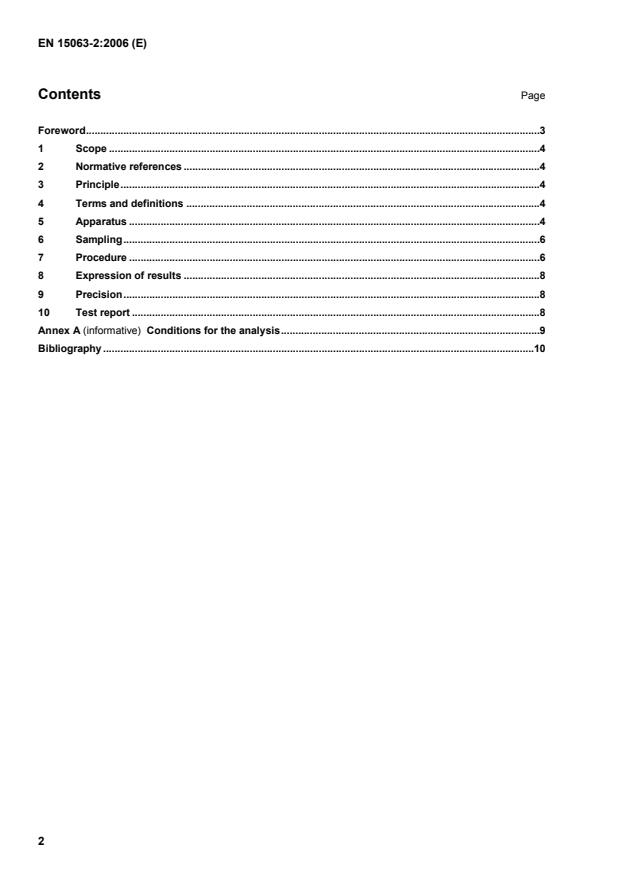
Contents Page Foreword.3 1 Scope.4 2 Normative references.4 3 Principle.4 4 Terms and definitions.4 5 Apparatus.4 6 Sampling.6 7 Procedure.6 8 Expression of results.8 9 Precision.8 10 Test report.8 Annex A (informative)
Conditions for the analysis.9 Bibliography.10
3 Foreword This document (EN 15063-2:2006) has been prepared by Technical Committee CEN/TC 133 “Copper and copper alloys”, the secretariat of which is held by DIN. This European Standard shall be given the status of a national standard, either by publication of an identical text or by endorsement, at the latest by May 2007, and conflicting national standards shall be withdrawn at the latest by May 2007. Within its programme of work, Technical Committee CEN/TC 133 requested CEN/TC 133/WG 10 "Methods of analysis" to prepare the following standard: EN 15063-2, Copper and copper alloys — Determination of main constituents and impurities by wavelength dispersive X-ray fluorescence spectrometry (XRF) — Part 2: Routine method This is one of two parts of the standard for the determination of main constituents and impurities in copper and copper alloys. The other part is: EN 15063-1, Copper and copper alloys — Determination of main constituents and impurities by wavelength dispersive X-ray fluorescence spectrometry (XRF) — Part 1: Guidelines to the routine method According to the CEN/CENELEC Internal Regulations, the national standards organizations of the following countries are bound to implement this European Standard: Austria, Belgium, Cyprus, Czech Republic, Den-mark, Estonia, Finland, France, Germany, Greece, Hungary, Iceland, Ireland, Italy, Latvia, Lithuania, Luxem-bourg, Malta, Netherlands, Norway, Poland, Portugal, Romania, Slovakia, Slovenia, Spain, Sweden, Switzer-land and United Kingdom.
1 Scope This part of this European Standard specifies a routine method for analysing copper and copper alloys by wavelength dispersive X-ray fluorescence spectrometry. The method is applicable to: all elements detectable by XRF: impurities, minor and main constituents; analysis of either unwrought, including chill-cast or wrought products. 2 Normative references The following referenced documents are indispensable for the application of this European Standard. For dated references, only the edition cited applies. For undated references, the latest edition of the referenced document (including any amendments) applies. EN 15063-1:2006, Copper and copper alloys — Determination of main constituents and impurities by wave-length dispersive X-ray fluorescence spectrometry (XRF) — Part 1: Guidelines to the routine method ISO 1811-1, Copper and copper alloys — Selection and preparation of samples for chemical analysis — Part 1: Sampling of cast unwrought products ISO 1811-2, Copper and copper alloys — Selection and preparation of samples for chemical analysis — Part 2: Sampling of wrought products and castings 3 Principle An appropriately cleaned test specimen is irradiated by an X-ray-beam of high energy. The secondary X-rays produced are dispersed by means of crystals and the intensities are measured by detectors, usually counters at selected characteristics wavelengths. Concentration of the elements is determined by relating the measured intensities from the sample under test to analytical curves prepared from certified reference materials (CRMs) or reference materials (RMs). Fixed channels or a sequential system are used to provide simultaneous or sequential determinations of element concentrations. 4 Terms and definitions For the purposes of this European Standard, the terms and definitions given in EN 15063-1:2006 apply. 5 Apparatus 5.1 Sample preparation equipment Suitable machine; lathe, milling or grinding machine. NOTE Surface contamination should be avoided.
5 5.2 X-ray fluorescence spectrometer Simultaneous or sequential wavelength dispersive spectrometer. NOTE This test method is written for use with commercially-available instruments. 5.3 X-ray tube Tube with an anode made of a high-purity element. NOTE 1 Rhodium is recommended as the material of the anode for analysis of copper and copper alloys. NOTE 2 Considering a list of elements to be analysed in a copper matrix, it is advisable to check the tube power supply in order to set the right voltage in accordance with the manufacturer's instructions. The Voltage shall be adjusted to produce secondary fluorescence, according to the following equation: Uf = 12396/λabs
(1) where Uf
is the minimum voltage required for exciting the line of interest; λabs is the wavelength of the absorption edge of the fluorescent element. If a K line is used, the K absorption edge is used. If an L line is used, the L absorption edge is used. Ideally, the operating voltage should approximate to or exceed 3 Uf. 5.4 Analysing crystal To cover all elements specified in this method, flat or curved crystals, made of LiF and PET (for elements with a low atomic number), are required. Crystals of other materials, optimized for individual elements, can also be used (see Table A.1).
...