

SIST EN 2881:2009
(Main)Aerospace series - Nuts, anchor, self-locking, fuel resistant, sealing, floating, two lug, with counterbore, in corrosion resisting steel, passivated, MoS2 lubricated, metric series - Classification: 900 MPa (at ambient temperature)/120 °C
- Abstract
This standard specifies the characteristics of self-locking, fuel resistant, sealing, floating, two lug anchor nuts, with counterbore, in corrosion resisting steel, passivated, MoS2 lubricated.
Classification: 900 MPa / 120 °C
- Status
- Published
- Publication Date
- 09-Sep-2009
- Technical Committee
- I13 - Imaginarni 13
- Current Stage
- 6060 - National Implementation/Publication (Adopted Project)
- Start Date
- 29-Apr-2009
- Due Date
- 04-Jul-2009
- Completion Date
- 10-Sep-2009
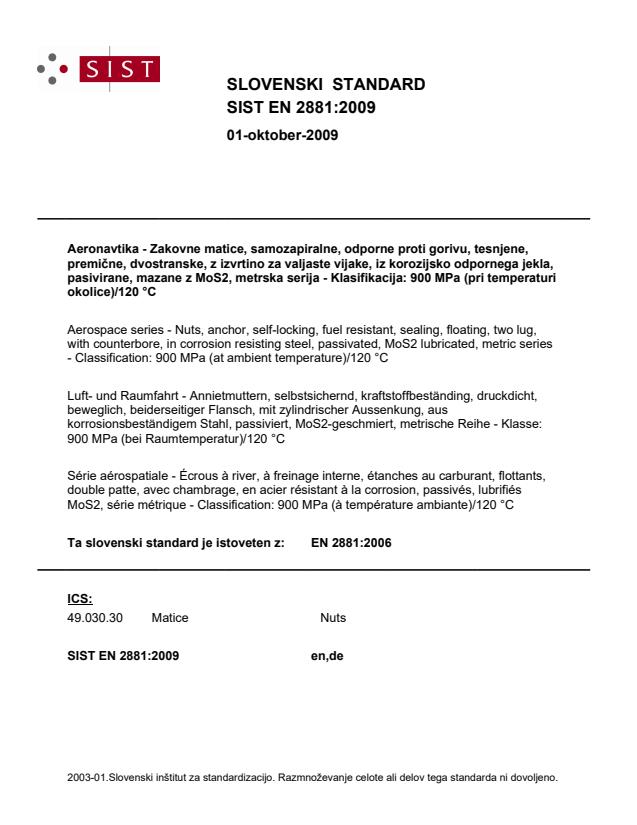

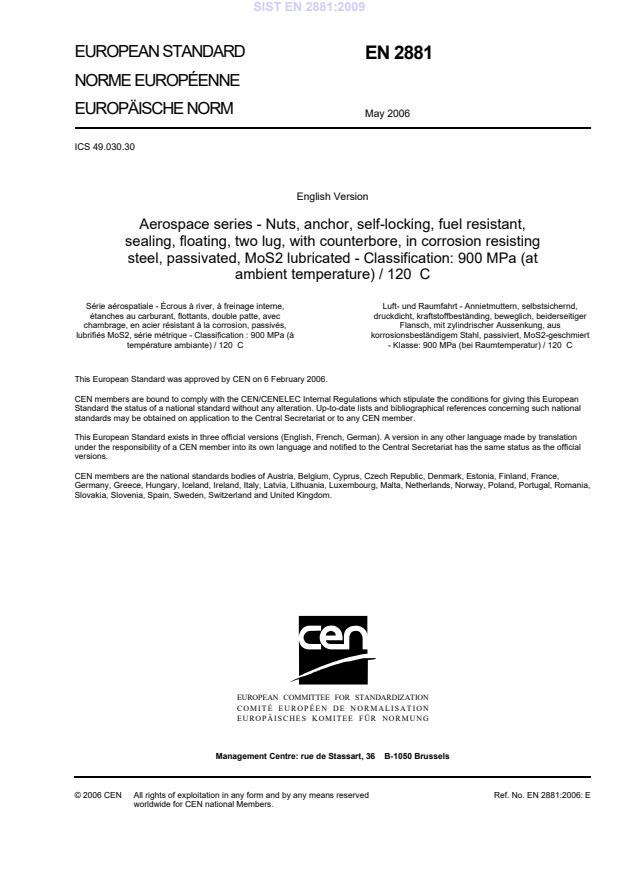
SIST EN 2881:2009 is the Slovenian adoption of the European standard EN 2881:2006, published by the Slovenian Institute for Standardization (SIST). It specifies the characteristics of self-locking, fuel resistant, sealing, floating, two lug anchor nuts with counterbore in corrosion-resisting steel, passivated and molybdenum disulphide (MoS2) lubricated, in the metric series, for a 900 MPa classification at ambient temperature and 120 °C. In practice, it is the reference for selecting, making, marking and qualifying this aerospace fastener.
What does SIST EN 2881:2009 specify?
SIST EN 2881:2009 specifies one defined aerospace nut type and the requirements needed to identify and control it. The scope is limited to the self-locking, fuel resistant, sealing, floating, two lug anchor nut with counterbore, so the document is used for a specific part family rather than for general-purpose nuts.
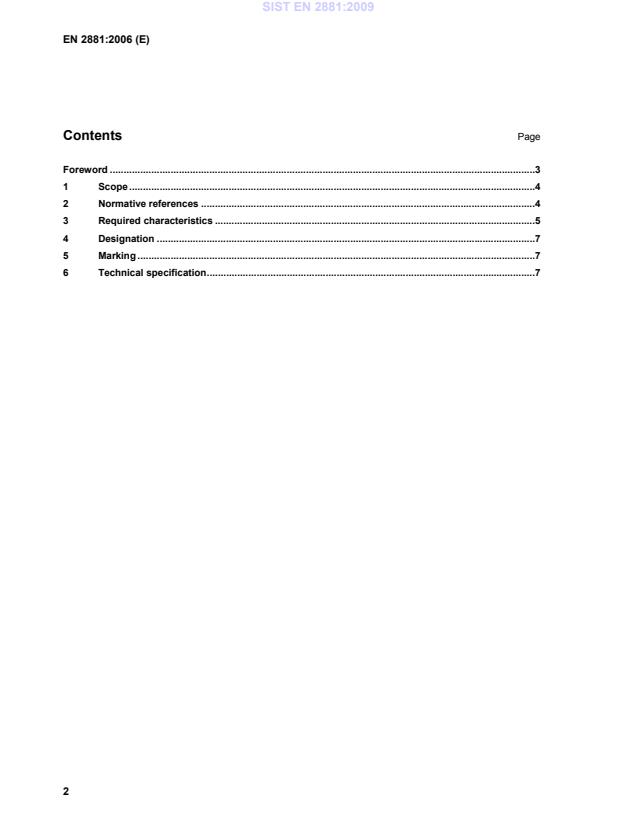
The document is organized into six main clauses:
- Clause 1 - Scope
- Clause 2 - Normative references
- Clause 3 - Required characteristics
- Clause 4 - Designation
- Clause 5 - Marking
- Clause 6 - Technical specification
This structure matters in practice because the reader can move from product definition, to referenced methods, to the data needed for ordering, inspection and qualification.
What are the key requirements of SIST EN 2881:2009?
SIST EN 2881:2009 sets the product classification at 900 MPa at ambient temperature and 120 °C. The footnotes explain that the strength class refers to the minimum tensile stress the nut can withstand at ambient temperature, and the temperature class is limited by the seal material. For buyers and engineers, that means the nut must match both load and service-temperature needs.
Geometry, dimensions and tolerances
Clause 3.1 says the configuration, dimensions and masses are given by Figure 1 and Table 1. The dimensions and tolerances follow ISO 8940, are stated in millimetres, and apply after surface treatment but before MoS2 lubrication. In practice, that tells manufacturers when to measure and how to judge conformance.
Clause 3.2 sends form and position tolerances to ISO 8788. Clause 3.1 also notes that unspecified form details are left to the manufacturer. This gives design freedom only where the standard does not fix the shape.
Materials and surface treatment
Clause 3.3 assigns the cage, seal retainer and nut element to TR 3791, and the sealing ring to fuel resistant rubber to MIL-R-6855, class 1, grade 60 or equivalent. Clause 3.4 requires passivation of the cage and seal retainer to EN 2516, and MoS2 coating of the nut element to EN 2491, mandatory on threads and optional elsewhere. In practice, these rules control corrosion resistance, sealing and thread friction.
Functional details shown in the figure
Figure 1 gives the part layout and the features that matter for function, including the threaded element anti-rotational device, the two holes, the seal, the seal retainer and the nut element. It also shows the minimum radial float of the nut element and the out-of-round area used to achieve the self-locking torque requirement. This is important because assembly, locking action and alignment depend on these details.
Identification and product control
Clause 4 gives the designation format, using a description block, the standard number and a diameter code from Table 1. It also notes the optional code I9005. Clause 5 requires marking to EN 2424, style N. Clause 6 makes ISO 5858 the technical base, with manufacturer approval through EN 9100 and product qualification through EN 9133.
What terms does SIST EN 2881:2009 define?
- Self-locking - The nut resists loosening after tightening, so the thread must keep its locking torque in service.
- Floating - The nut element can move radially within the cage, which helps alignment during assembly.
- Two lug - The anchor nut has two lugs for fastening and load transfer in the installation.
- Counterbore - The nut includes a recessed opening that forms part of the mounting geometry.
- Passivated - The corrosion-resisting steel has been passivated to improve surface condition and corrosion performance.
- MoS2 lubricated - The threads or selected surfaces are coated with molybdenum disulphide to control friction.
- Classification 900 MPa / 120 °C - The part is assigned to a strength and temperature class defined for ambient-temperature strength and maximum operating temperature.
Who uses SIST EN 2881:2009?
SIST EN 2881:2009 is used by aerospace design engineers, fastener manufacturers, procurement teams, quality managers and inspection staff. They use it to specify the nut on drawings and orders, check dimensions and marking, select approved materials and coatings, and qualify or accept standard parts for aircraft assemblies.
What changed in SIST EN 2881:2009 from the previous edition?
SIST EN 2881:2009 is the Slovenian adoption of EN 2881:2006 and is stated to be identical to it.
Which standards are used with SIST EN 2881:2009?
- ISO 5855-2 - gives MJ thread limit dimensions for bolts and nuts.
- ISO 5858 - provides the procurement specification for self-locking nuts.
- ISO 8788 - sets form and position tolerances for metric aerospace nuts.
- ISO 8940 - gives the dimensional basis for anchor, self-locking, sealing, floating, two-lug nuts with MJ threads.
- EN 2424 - defines aerospace product marking.
- EN 2491 - covers molybdenum disulphide dry lubricant coating methods.
- EN 2516 - covers passivation of corrosion-resisting steels.
- EN 9100 - provides the quality management basis for manufacturer approval.
- EN 9133 - gives the qualification procedure for aerospace standard parts.
- MIL-R-6855E - specifies the fuel resistant rubber used for the sealing ring.
- TR 3791 - gives material guidance for self-locking nuts and related threaded inserts.
What does the SIST EN 2881:2009 document contain?
The document contains a configuration figure, a dimensional table, a designation example and a marking requirement. Figure 1 identifies the nut parts and functional features, including the floating element and the self-locking area. Table 1 lists the diameter codes, MJ thread designations, principal dimensions and approximate mass. The text also gives the surface-treatment conditions, material references and the technical specification route used for product qualification.
Relations
- Effective Date
- 28-Jan-2026
- Effective Date
- 28-Jan-2026
- Effective Date
- 28-Jan-2026
- Effective Date
- 28-Jan-2026
- Effective Date
- 28-Jan-2026
- Effective Date
- 28-Jan-2026
- Effective Date
- 28-Jan-2026
- Effective Date
- 28-Jan-2026
Get Certified
Connect with accredited certification bodies for this standard

BUREAU VERITAS Certification Germany
Bureau Veritas certification in Germany.

Element Materials Technology
Materials testing and product certification.

AQMS Ltd.
AQMS provides ISO certification to SMEs across the UK.
Sponsored listings
Frequently Asked Questions
SIST EN 2881:2009 is a standard published by the Slovenian Institute for Standardization (SIST). Its full title is "Aerospace series - Nuts, anchor, self-locking, fuel resistant, sealing, floating, two lug, with counterbore, in corrosion resisting steel, passivated, MoS2 lubricated, metric series - Classification: 900 MPa (at ambient temperature)/120 °C". This standard covers: This standard specifies the characteristics of self-locking, fuel resistant, sealing, floating, two lug anchor nuts, with counterbore, in corrosion resisting steel, passivated, MoS2 lubricated. Classification: 900 MPa / 120 °C
This standard specifies the characteristics of self-locking, fuel resistant, sealing, floating, two lug anchor nuts, with counterbore, in corrosion resisting steel, passivated, MoS2 lubricated. Classification: 900 MPa / 120 °C
SIST EN 2881:2009 is classified under the following ICS (International Classification for Standards) categories: 49.030.30 - Nuts. The ICS classification helps identify the subject area and facilitates finding related standards.
SIST EN 2881:2009 has the following relationships with other standards: It is inter standard links to SIST EN ISO 4628-8:2014, SIST EN 9100:2018, SIST EN 9133:2018, SIST EN ISO 15792-1:2008, SIST EN 2491:2011, SIST EN 840-6:2004+A1:2008, SIST EN 2516:2024, SIST EN 2424:2008. Understanding these relationships helps ensure you are using the most current and applicable version of the standard.
SIST EN 2881:2009 is available in PDF format for immediate download after purchase. The document can be added to your cart and obtained through the secure checkout process. Digital delivery ensures instant access to the complete standard document.
Standards Content (Sample)
2003-01.Slovenski inštitut za standardizacijo. Razmnoževanje celote ali delov tega standarda ni dovoljeno.Luft- und Raumfahrt - Annietmuttern, selbstsichernd, kraftstoffbeständing, druckdicht, beweglich, beiderseitiger Flansch, mit zylindrischer Aussenkung, aus korrosionsbeständigem Stahl, passiviert, MoS2-geschmiert, metrische Reihe - Klasse: 900 MPa (bei Raumtemperatur)/120 °CSérie aérospatiale - Écrous à river, à freinage interne, étanches au carburant, flottants, double patte, avec chambrage, en acier résistant à la corrosion, passivés, lubrifiés MoS2, série métrique - Classification: 900 MPa (à température ambiante)/120 °CAerospace series - Nuts, anchor, self-locking, fuel resistant, sealing, floating, two lug, with counterbore, in corrosion resisting steel, passivated, MoS2 lubricated, metric series - Classification: 900 MPa (at ambient temperature)/120 °C49.030.30MaticeNutsICS:Ta slovenski standard je istoveten z:EN 2881:2006SIST EN 2881:2009en,de01-oktober-2009SIST EN 2881:2009SLOVENSKI
STANDARD
EUROPEAN STANDARDNORME EUROPÉENNEEUROPÄISCHE NORMEN 2881May 2006ICS 49.030.30 English VersionAerospace series - Nuts, anchor, self-locking, fuel resistant,sealing, floating, two lug, with counterbore, in corrosion resistingsteel, passivated, MoS2 lubricated - Classification: 900 MPa (atambient temperature) / 120
CSérie aérospatiale - Écrous à river, à freinage interne,étanches au carburant, flottants, double patte, avecchambrage, en acier résistant à la corrosion, passivés,lubrifiés MoS2, série métrique - Classification : 900 MPa (àtempérature ambiante) / 120
CLuft- und Raumfahrt - Annietmuttern, selbstsichernd,druckdicht, kraftstoffbeständing, beweglich, beiderseitigerFlansch, mit zylindrischer Aussenkung, auskorrosionsbeständigem Stahl, passiviert, MoS2-geschmiert- Klasse: 900 MPa (bei Raumtemperatur) / 120
CThis European Standard was approved by CEN on 6 February 2006.CEN members are bound to comply with the CEN/CENELEC Internal Regulations which stipulate the conditions for giving this EuropeanStandard the status of a national standard without any alteration. Up-to-date lists and bibliographical references concerning such nationalstandards may be obtained on application to the Central Secretariat or to any CEN member.This European Standard exists in three official versions (English, French, German). A version in any other language made by translationunder the responsibility of a CEN member into its own language and notified to the Central Secretariat has the same status as the officialversions.CEN members are the national standards bodies of Austria, Belgium, Cyprus, Czech Republic, Denmark, Estonia, Finland, France,Germany, Greece, Hungary, Iceland, Ireland, Italy, Latvia, Lithuania, Luxembourg, Malta, Netherlands, Norway, Poland, Portugal, Romania,Slovakia, Slovenia, Spain, Sweden, Switzerland and United Kingdom.EUROPEAN COMMITTEE FOR STANDARDIZATIONCOMITÉ EUROPÉEN DE NORMALISATIONEUROPÄISCHES KOMITEE FÜR NORMUNGManagement Centre: rue de Stassart, 36
B-1050 Brussels© 2006 CENAll rights of exploitation in any form and by any means reservedworldwide for CEN national Members.Ref. No. EN 2881:2006: ESIST EN 2881:2009
...