

SIST EN 15624:2021+A1:2024
(Main + Amendment)Railway applications - Braking - Empty-loaded changeover devices
General Information
- Abstract
This document is applicable to empty-loaded changeover devices. The purpose of such devices is the generation of a load-related signal which causes the brake performance to be adjusted to the current vehicle mass.
The manually operated empty-loaded changeover devices change their output signal according to the position of the handles which together with the associated changeover plates serve as interfaces. The changeover plates read the required information for the operation of the empty-loaded changeover devices, i.e. brake weights for each position and the relevant changeover mass of the vehicle.
Automatic empty-loaded changeover devices sense a certain load threshold of the vehicle to automatically adjust the output signal when the mass of a vehicle reaches a defined value. This threshold is the changeover mass. Below this mass the vehicle’s brake system provides a reduced brake force. For the changeover mass or more the high brake force applies.
This document specifies the requirements for the design, testing and quality assurance of empty-loaded changeover devices.
- Status
- Published
- Publication Date
- 06-Oct-2024
- Technical Committee
- IŽNP - Reilway applications
- Current Stage
- 6060 - National Implementation/Publication (Adopted Project)
- Start Date
- 02-Oct-2024
- Due Date
- 07-Dec-2024
- Completion Date
- 07-Oct-2024
- Directive
- 2016/797/EU - Directive (EU) 2016/797 of the European Parliament and of the Council of 11 May 2016 on the interoperability of the rail system within the European Union (Text with EEA relevance)OJ Ref: 2025/424, L 6.3.2025, OJ L OJ Date: 06-Mar-2025



Overview
EN 15624:2021+A1:2024 (CEN) specifies requirements for empty‑loaded changeover devices used in railway braking systems. These devices generate a load‑related signal that adjusts brake performance according to vehicle mass (the changeover mass). The standard covers both manually operated devices (handle + changeover plate interfaces) and automatic devices that sense a mass threshold and switch the brake force between reduced (below changeover mass) and high (at or above changeover mass). EN 15624:2021+A1:2024 includes Amendment A1 (approved August 2024) and updates design, testing and quality‑assurance requirements.
Key topics and technical requirements
- Design & manufacture: functional requirements for manual and automatic devices, interfaces (handles and plates), pneumatic interfaces and converters (hydraulic→pneumatic, elastomeric→pneumatic).
- Pneumatic characteristics: behaviour of positive/zero load signal pressure devices and air consumption considerations.
- Environmental & mechanical resilience: shock and vibration (per EN 61373), ambient temperature, altitude, humidity, rain, snow/ice, solar radiation and pollution classes.
- Compressed air quality: conformity with ISO 8573‑1 purity classes and related installation considerations.
- Pressure stress, tightness & service life: requirements to ensure safe operation and acceptable leakage over lifetime.
- Fire behaviour, colours and external appearance: material and marking guidelines (including fire‑behaviour references).
- Type tests & in‑service assessment: detailed procedures for bench testing, sampling, changeover operation (empty↔loaded), response times, tightness, extreme temperature testing, and on‑vehicle assessment (Annex A & E).
- Identification, marking & designation: requirements for device labelling, changeover plates and handles; includes guidance for the G/P changeover device (Annex C).
- Quality assurance: production and testing standards, and laboratory competence references.
Applications and users
Who benefits from EN 15624:
- Brake system designers and vehicle manufacturers specifying load‑sensitive braking behaviour.
- Component suppliers (manual/automatic changeover devices, converters, pneumatic components).
- Test laboratories and certification bodies performing type and in‑service tests.
- Maintenance teams and vehicle acceptance engineers ensuring conformity and safe operation.
- Regulators and procurement teams requiring harmonized, interoperable braking components across fleets.
Practical value:
- Ensures consistent brake performance tied to vehicle mass, improving safety and braking efficiency.
- Provides standardized test and acceptance criteria to support interoperability and regulatory compliance.
- Guides selection and installation of devices for diverse environmental and operational conditions.
Related standards
Normative references in EN 15624 include: EN 14478, EN 15625, EN 15877‑1, EN 61373, ISO 8573‑1, and relevant fire‑behaviour standards (see Annex ZA for EU legislation linkage).
Relations
- Effective Date
- 01-Nov-2024
- Merged From
SIST EN 15624:2021/kFprA1:2024 - Railway applications - Braking - Empty-loaded changeover devices - Effective Date
- 01-Nov-2024
- Effective Date
- 09-Feb-2026
- Effective Date
- 09-Feb-2026
- Effective Date
- 09-Feb-2026
- Effective Date
- 28-Jan-2026
- Effective Date
- 28-Jan-2026
- Effective Date
- 28-Jan-2026
- Effective Date
- 28-Jan-2026
- Effective Date
- 28-Jan-2026
- Effective Date
- 28-Jan-2026
- Effective Date
- 28-Jan-2026
- Effective Date
- 28-Jan-2026
Get Certified
Connect with accredited certification bodies for this standard

IRIS Certification (UNIFE)
International Railway Industry Standard certification.

TÜV SÜD Rail GmbH
TÜV SÜD railway certification services.

Bureau Veritas Railway Certification
Railway and transportation certification.
Sponsored listings
Frequently Asked Questions
SIST EN 15624:2021+A1:2024 is a standard published by the Slovenian Institute for Standardization (SIST). Its full title is "Railway applications - Braking - Empty-loaded changeover devices". This standard covers: This document is applicable to empty-loaded changeover devices. The purpose of such devices is the generation of a load-related signal which causes the brake performance to be adjusted to the current vehicle mass. The manually operated empty-loaded changeover devices change their output signal according to the position of the handles which together with the associated changeover plates serve as interfaces. The changeover plates read the required information for the operation of the empty-loaded changeover devices, i.e. brake weights for each position and the relevant changeover mass of the vehicle. Automatic empty-loaded changeover devices sense a certain load threshold of the vehicle to automatically adjust the output signal when the mass of a vehicle reaches a defined value. This threshold is the changeover mass. Below this mass the vehicle’s brake system provides a reduced brake force. For the changeover mass or more the high brake force applies. This document specifies the requirements for the design, testing and quality assurance of empty-loaded changeover devices.
This document is applicable to empty-loaded changeover devices. The purpose of such devices is the generation of a load-related signal which causes the brake performance to be adjusted to the current vehicle mass. The manually operated empty-loaded changeover devices change their output signal according to the position of the handles which together with the associated changeover plates serve as interfaces. The changeover plates read the required information for the operation of the empty-loaded changeover devices, i.e. brake weights for each position and the relevant changeover mass of the vehicle. Automatic empty-loaded changeover devices sense a certain load threshold of the vehicle to automatically adjust the output signal when the mass of a vehicle reaches a defined value. This threshold is the changeover mass. Below this mass the vehicle’s brake system provides a reduced brake force. For the changeover mass or more the high brake force applies. This document specifies the requirements for the design, testing and quality assurance of empty-loaded changeover devices.
SIST EN 15624:2021+A1:2024 is classified under the following ICS (International Classification for Standards) categories: 45.040 - Materials and components for railway engineering. The ICS classification helps identify the subject area and facilitates finding related standards.
SIST EN 15624:2021+A1:2024 has the following relationships with other standards: It is inter standard links to SIST EN 15624:2021, SIST EN 15624:2021/kFprA1:2024, SIST EN 60721-3-5:2001, SIST ISO 8573-1:2023, SIST EN 61373:2010, SIST EN ISO 228-1:2003, SIST EN 14478:2018, SIST EN 15877-1:2012+A1:2019, SIST EN ISO/IEC 17025:2017, SIST EN 45545-2:2020+A1:2023, SIST EN 15625:2021, SIST EN 14033-1:2011, SIST EN 14033-1:2017. Understanding these relationships helps ensure you are using the most current and applicable version of the standard.
SIST EN 15624:2021+A1:2024 is associated with the following European legislation: EU Directives/Regulations: 2016/797/EU; Standardization Mandates: M/483, M/591. When a standard is cited in the Official Journal of the European Union, products manufactured in conformity with it benefit from a presumption of conformity with the essential requirements of the corresponding EU directive or regulation.
SIST EN 15624:2021+A1:2024 is available in PDF format for immediate download after purchase. The document can be added to your cart and obtained through the secure checkout process. Digital delivery ensures instant access to the complete standard document.
Standards Content (Sample)
SLOVENSKI STANDARD
01-november-2024
Železniške naprave - Zavore - Avtomatsko menjalo "naloženo-prazno" (vključno z
dopolnilom A1)
Railway applications - Braking - Empty-loaded changeover devices
Bahnanwendungen - Bremse - Leer-Beladen-Umstellvorrichtungen
Applications ferroviaires - Freinage - Dispositifs de changement de régime vide-chargé
Ta slovenski standard je istoveten z: EN 15624:2021+A1:2024
ICS:
45.040 Materiali in deli za železniško Materials and components
tehniko for railway engineering
2003-01.Slovenski inštitut za standardizacijo. Razmnoževanje celote ali delov tega standarda ni dovoljeno.
EN 15624:2021+A1
EUROPEAN STANDARD
NORME EUROPÉENNE
September 2024
EUROPÄISCHE NORM
ICS 45.040 Supersedes EN 15624:2021
English Version
Railway applications - Braking - Empty-loaded changeover
devices
Applications ferroviaires - Freinage - Dispositifs de Bahnanwendungen - Bremse - Leer-Beladen-
changement de régime vide-chargé Umstellvorrichtungen
This European Standard was approved by CEN on 20 December 2020 and includes Amendment approved by CEN on 1 August
2024.
CEN members are bound to comply with the CEN/CENELEC Internal Regulations which stipulate the conditions for giving this
European Standard the status of a national standard without any alteration. Up-to-date lists and bibliographical references
concerning such national standards may be obtained on application to the CEN-CENELEC Management Centre or to any CEN
member.
This European Standard exists in three official versions (English, French, German). A version in any other language made by
translation under the responsibility of a CEN member into its own language and notified to the CEN-CENELEC Management
Centre has the same status as the official versions.
CEN members are the national standards bodies of Austria, Belgium, Bulgaria, Croatia, Cyprus, Czech Republic, Denmark, Estonia,
Finland, France, Germany, Greece, Hungary, Iceland, Ireland, Italy, Latvia, Lithuania, Luxembourg, Malta, Netherlands, Norway,
Poland, Portugal, Republic of North Macedonia, Romania, Serbia, Slovakia, Slovenia, Spain, Sweden, Switzerland, Türkiye and
United Kingdom.
EUROPEAN COMMITTEE FOR STANDARDIZATION
COMITÉ EUROPÉEN DE NORMALISATION
EUROPÄISCHES KOMITEE FÜR NORMUNG
CEN-CENELEC Management Centre: Rue de la Science 23, B-1040 Brussels
© 2024 CEN All rights of exploitation in any form and by any means reserved Ref. No. EN 15624:2021+A1:2024 E
worldwide for CEN national Members.
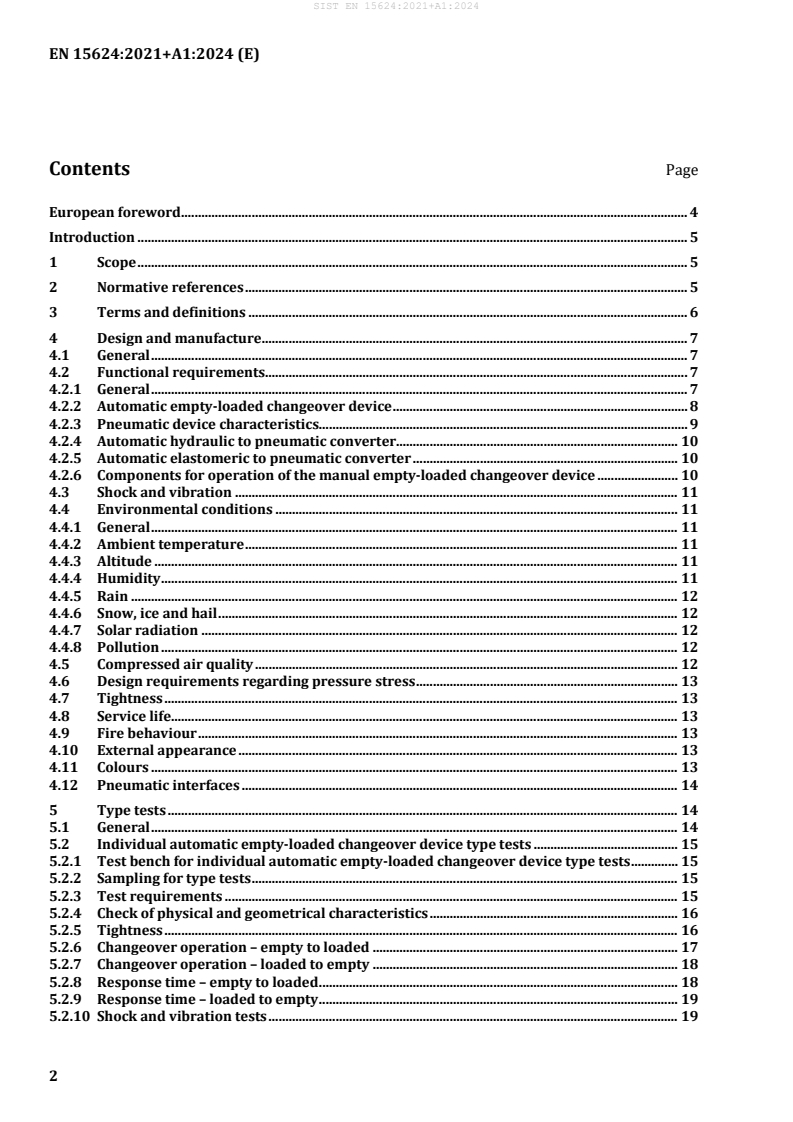
Contents Page
European foreword . 4
Introduction . 5
1 Scope . 5
2 Normative references . 5
3 Terms and definitions . 6
4 Design and manufacture . 7
4.1 General . 7
4.2 Functional requirements. 7
4.2.1 General . 7
4.2.2 Automatic empty-loaded changeover device . 8
4.2.3 Pneumatic device characteristics. 9
4.2.4 Automatic hydraulic to pneumatic converter. 10
4.2.5 Automatic elastomeric to pneumatic converter . 10
4.2.6 Components for operation of the manual empty-loaded changeover device . 10
4.3 Shock and vibration . 11
4.4 Environmental conditions . 11
4.4.1 General . 11
4.4.2 Ambient temperature . 11
4.4.3 Altitude . 11
4.4.4 Humidity . 11
4.4.5 Rain . 12
4.4.6 Snow, ice and hail . 12
4.4.7 Solar radiation . 12
4.4.8 Pollution . 12
4.5 Compressed air quality . 12
4.6 Design requirements regarding pressure stress . 13
4.7 Tightness . 13
4.8 Service life . 13
4.9 Fire behaviour . 13
4.10 External appearance . 13
4.11 Colours . 13
4.12 Pneumatic interfaces . 14
5 Type tests . 14
5.1 General . 14
5.2 Individual automatic empty-loaded changeover device type tests . 15
5.2.1 Test bench for individual automatic empty-loaded changeover device type tests . 15
5.2.2 Sampling for type tests . 15
5.2.3 Test requirements . 15
5.2.4 Check of physical and geometrical characteristics . 16
5.2.5 Tightness . 16
5.2.6 Changeover operation – empty to loaded . 17
5.2.7 Changeover operation – loaded to empty . 18
5.2.8 Response time – empty to loaded . 18
5.2.9 Response time – loaded to empty . 19
5.2.10 Shock and vibration tests . 19
5.2.11 Operation at extreme temperatures . 19
6 In-service assessment . 20
7 Designation . 21
8 Identification and marking . 21
8.1 Identification . 21
8.2 Changeover plate for the manual empty-loaded changeover device . 21
Annex A (informative) Assessment of an empty-loaded changeover device when fitted to a
vehicle . 22
A.1 General . 22
A.2 Design acceptance testing set-up . 22
A.3 Static testing . 22
A.3.1 Vehicle requirements . 22
A.3.2 Test procedures . 22
A.4 Running tests . 23
A.4.1 General . 23
A.4.2 Pneumatic empty-loaded changeover device – Air consumption . 23
A.4.3 Pneumatic empty-loaded changeover device – Impact of vibrations on the output
signal . 24
Annex B (normative) Manual empty-loaded changeover device handles and changeover
plates . 25
Annex C (informative) G/P changeover device . 32
Annex D (informative) Test bench diagram . 34
Annex E (normative) In-service assessment . 35
Annex ZA (informative) Relationship between this European Standard and the Essential
Requirements of EU Directive (EU) 2016/797 aimed to be covered . 36
Bibliography . 38
European foreword
This document (EN 15624:2021+A1:2024) has been prepared by Technical Committee CEN/TC 256
“Railway applications”, the secretariat of which is held by DIN.
This European Standard shall be given the status of a national standard, either by publication of an
identical text or by endorsement, at the latest by March 2025, and conflicting national standards shall be
withdrawn at the latest by March 2025.
Attention is drawn to the possibility that some of the elements of this document may be the subject of
patent rights. CEN shall not be held responsible for identifying any or all such patent rights.
This document includes Amendment 1 approved by CEN on 1 August 2024.
This document supersedes !EN 15624:2021".
The start and finish of text introduced or altered by amendment is indicated in the text by tags !".
!deleted text"
This document has been prepared under a standardization request addressed to CEN by the European
Commission. The Standing Committee of the EFTA States subsequently approves these requests for its
Member States.
For the relationship with EU Legislation, see informative Annex ZA, which is an integral part of this
document.
Any feedback and questions on this document should be directed to the users’ national standards body.
A complete listing of these bodies can be found on the CEN website.
According to the CEN-CENELEC Internal Regulations, the national standards organisations of the
following countries are bound to implement this European Standard: Austria, Belgium, Bulgaria, Croatia,
Cyprus, Czech Republic, Denmark, Estonia, Finland, France, Germany, Greece, Hungary, Iceland, Ireland,
Italy, Latvia, Lithuania, Luxembourg, Malta, Netherlands, Norway, Poland, Portugal, Republic of North
Macedonia, Romania, Serbia, Slovakia, Slovenia, Spain, Sweden, Switzerland, Türkiye and the United
Kingdom.
!
Introduction
The purpose of empty-loaded changeover devices is the generation of a load-related signal which causes
the brake performance to be adjusted to the current vehicle mass.
The manually operated empty-loaded changeover devices change their output signal according to the
position of the handles which together with the associated changeover plates serve as interfaces. The
changeover plates display the required information for the operation of the empty-loaded changeover
devices, i.e. brake weights for each position and the relevant changeover mass of the vehicle.
Automatic empty-loaded changeover devices sense a certain load threshold of the vehicle to
automatically adjust the output signal when the mass of a vehicle reaches a defined value. This threshold
is the changeover mass. Below this mass the vehicle’s brake system provides a reduced brake force. For
the changeover mass or more the high brake force applies.
In addition, Annex C of this document contains information on the G/P changeover device, which was
originally covered by EN 15877-1 but is about to be removed from that document. It is intended to
develop a new standard for brake position change over devices, which will adopt these requirements."
1 Scope
!This document specifies the requirements for the design, testing and quality assurance of empty-
loaded changeover devices.
This document is applicable to empty-loaded changeover devices.
This document provides recommendations for the shape and measures of the G/P changeover device’s
plate and handle in Annex C."
2 Normative references
The following documents are referred to in the text in such a way that some or all of their content
constitutes requirements of this document. For dated references, only the edition cited applies. For
undated references, the latest edition of the referenced document (including any amendments) applies.
EN 14478:2017, Railway applications — Braking — Generic vocabulary
EN 15625:2021, Railway applications — Braking — Automatic variable load sensing devices
EN 15877-1:2012+A1:2018, Railway applications — Marking on railway vehicles — Part 1: Freight
wagons
!EN 45545-2:2020+A1:2023", Railway applications — Fire protection on railway vehicles — Part 2:
Requirements for fire behavior of materials and components
EN 60721-3-5:1997, Classification of environmental conditions — Part 3: Classification of groups of
environmental parameters and their severities — Section 5: Ground vehicle installations
(IEC 60721-3-5:1997)
EN 61373:2010, Railway applications — Rolling stock equipment — Shock and vibration tests
(IEC 61373:2010)
EN ISO 228-1:2003, Pipe threads where pressure-tight joints are not made on the threads — Part 1:
Dimensions, tolerances and designation (ISO 228-1:2000)
!EN ISO/IEC 17025:2017, General requirements for the competence of testing and calibration
laboratories (ISO/IEC 17025:2017)"
ISO 8573-1:2010, Compressed air — Part 1: Contaminants and purity classes
3 Terms and definitions
For the purposes of this document, the terms and definitions given in EN 14478:2017, EN 15625:2021
and the following apply.
ISO and IEC maintain terminological databases for use in standardization at the following addresses:
— IEC Electropedia: available at http://www.electropedia.org/
— ISO Online browsing platform: available at https://www.iso.org/obp
3.1
empty-loaded changeover device
device connected to the vehicle, which is either manually operated or responds automatically to a change
of vehicle load, thereby providing a load-related signal which changes at a certain vehicle mass threshold
(changeover mass) when the load is increased or when the load is decreased
3.2
positive load signal pressure device
empty-loaded changeover device that provides a positive output pressure in the loaded state
3.3
zero load signal pressure device
empty-loaded changeover device that exhausts the output pressure to nominally 0 bar in the loaded state
3.4
changeover mass
lowest value of vehicle mass at which it is deemed to be in the loaded state, thereby requiring the
adjustment of brake force to achieve the required brake performance
3.5
automatic variable load sensing device
weighing valve
device connected to the vehicle, which responds to the loading of that vehicle to provide a continuous
load proportional signal to the brake control device
Note 1 to entry: The load input is normally a share of the wagon’s mass because of the devices position in the
vehicle suspension system. The result is a pneumatic output signal pressure that can be any value between a
minimum at tare mass and a maximum at maximum mass. Most of the existing self-adjusting load-dependant brakes
generate the load signal using a weighing valve.
[SOURCE: EN 15625:2021, 3.1]
3.6
mechanically operated pneumatic device
device or mechanism which responds to a mechanical input by a change of the output pressure
[SOURCE: EN 15625:2021, 3.2]
3.7
hydraulic to pneumatic converter
device or mechanism which transforms a hydraulic pressure into a pneumatic pressure with a defined
transmission ratio
[SOURCE: EN 15625:2021, 3.3]
3.8
elastomeric to pneumatic converter
device or mechanism having both elastomeric and pneumatic components which transforms a pressure
in the elastomer into a pneumatic pressure with a defined transmission ratio
[SOURCE: EN 15625:2021, 3.4]
3.9
output signal pressure
load signal pressure
LSP
output pressure delivered by the empty-loaded changeover device, which signals the load state (either
empty or loaded) of the vehicle to the brake control device
3.10
supply pressure
input pressure to a pneumatic empty-loaded changeover device
3.11
normal litre
Nl
unit of amount of a gas equal to the amount of 1 l at a pressure of 1,0 bar and at a standard temperature,
at 20 °C
Note 1 to entry: Air flow is often stated in normal litres per minute (Nl/min).
4 Design and manufacture
4.1 General
The design and manufacture of the empty-loaded changeover device shall take the requirements of this
clause into account for all intended operating conditions.
4.2 Functional requirements
4.2.1 General
4.2.1.1 The empty-loaded changeover device shall supply a signal indicating the variation in vehicle
load (empty or loaded) to the braking control system; this shall be mechanical or pneumatic. The method
of producing the pneumatic signal shall be a mechanically operated pneumatic device, hydraulic to
pneumatic converter device or an elastomeric to pneumatic converter device.
4.2.1.2 The empty-loaded changeover device shall, in all cases, supply an output signal, which is a
function of the load.
4.2.1.3 The empty-loaded changeover device shall not alter any of the characteristics of the
distributor and/or any associated relay device, when fitted to a vehicle, thereby not altering the
characteristics of the brake system, other than to signal the load change and thereby cause the brake
cylinder pressure to change from one state to another.
4.2.1.4 The design of the empty-loaded changeover device shall either provide a positive output
pressure (positive load signal pressure device) or exhaust the output pressure to nominally 0 bar (zero
load signal pressure device) in the loaded state dependant on the applicable design requirements.
4.2.1.5 The air consumption of a pneumatic empty-loaded changeover device shall, during running
of the vehicle, be minimal and shall not interfere with the normal braking performance of that vehicle. A
test which can be used to confirm this is described in A.4.2.
4.2.2 Automatic empty-loaded changeover device
4.2.2.1 General
4.2.2.1.1 An automatic empty-loaded changeover device shall change from the empty to a loaded state
or vice versa, when the vehicle mass exceeds or falls below the changeover mass.
4.2.2.1.2 The automatic empty-loaded changeover device shall comply with the changeover values
specified in its technical specification.
Once fitted on the vehicle the changeover shall take place within ± 5 % of the defined changeover mass
of the vehicle.
For vehicles that operate only in empty or fully loaded states, this tolerance is in the range of ± 20 %.
NOTE A test which can be used to confirm this is described in A.3.2.1.
4.2.2.1.3 An automatic empty-loaded changeover device may have a damping facility within its
mechanism to prevent the effects of transient suspension movement from causing a change of the load
signal.
4.2.2.1.4 An automatic empty-loaded changeover device shall be designed to fit to a vehicle in a
position to sense the load change of that vehicle, causing a change of state/output signal of the changeover
device.
4.2.2.2 Changeover response
Where the empty-loaded changeover device does not include integral damping the response of the output
pressure shall be immediate, i.e. the pressure shall fall or increase dependent on the particular design of
the device, as soon as the device is moved from one state to another. Where the empty-loaded changeover
device has integral damping a delay in the LSP response shall be apparent.
4.2.2.3 Empty to loaded changeover
4.2.2.3.1 Integrally damped device supplied with air from the distributor auxiliary reservoir or
main reservoir pipe
Not earlier than 3 s after the operating mechanism was moved to the loaded position and remains there
the output pressure shall change to the loaded state for the particular design of the device as defined in
4.2.3. This shall be tested in accordance with 5.2.8.2.
When the operating mechanism is moved to the loaded position and kept there for less than 3 s the output
pressure shall not reach a value that causes a changeover to occur.
4.2.2.3.2 Device supplied with air from the distributor output pressure
When the operating mechanism is in the loaded position the output pressure shall remain in or change
to the loaded state during braking for the particular design of the device as defined in 4.2.3. This shall be
tested in accordance with 5.2.8.
When the brake is released there is no output pressure provided by the empty-loaded changeover device
regardless the position of the operating mechanism.
4.2.2.4 Loaded to empty changeover
4.2.2.4.1 Integrally damped device supplied with air from the auxiliary reservoir or main
reservoir pipe
Not earlier than 3 s after the operating mechanism was moved to the empty position and remains there
the output pressure shall change to the empty state for the particular design of the device as defined in
4.2.3. This shall be tested in accordance with 5.2.9.2.
When the operating mechanism is moved to the empty position and kept there for less than 3 s the output
pressure shall not reach a value that causes a changeover to occur.
4.2.2.4.2 Device supplied with air from the distributor output pressure
When the operating mechanism is in the empty position the output pressure shall remain in or change to
the empty state during braking for the particular design of the device as defined in 4.2.3. This shall be
tested in accordance with 5.2.9.
When the brake is released there is no output pressure provided by the empty-loaded changeover device
regardless the position of the operating mechanism.
4.2.3 Pneumatic device characteristics
4.2.3.1 The device shall be designed to accept a supply pressure directly from the vehicle’s auxiliary
reservoir or from the distributor output/brake cylinder pressure.
4.2.3.2 When the load signal is pneumatically transmitted to the brake control device, the changeover
device shall produce a step in LSP at a defined value of input signal representing the changeover mass
between the empty and loaded states.
4.2.3.3 Where the supply pressure to the empty-loaded changeover device is supplied from the
auxiliary reservoir the following shall apply.
a) For a positive load signal pressure device:
1) all values of the LSP of ≤ 0,5 bar shall indicate a vehicle load that is less than the changeover mass
with the purpose of causing the brake control device to output its lower ratio,
2) all values of the LSP of ≥ 3,0 bar shall indicate a vehicle load greater than the changeover mass
with the purpose of causing the brake control device to output its higher ratio. An LSP lower than
3,0 bar is acceptable to signal a vehicle load greater than the changeover mass, when an
automatic variable load sensing device is used as an automatic empty-loaded changeover device.
b) For a zero load signal pressure device:
1) all values of the LSP of ≥ 3,0 bar shall indicate a vehicle load that is less than the changeover mass
with the purpose of causing the brake control device to output its lower ratio,
2) all values of the LSP of ≤ 0,5 bar shall indicate a vehicle load greater than the changeover mass
with the purpose of causing the brake control device to output its higher ratio.
4.2.3.4 Where the supply pressure is supplied from the distributor output/brake cylinder pressure
system the following shall apply.
a) For a positive load signal pressure device:
1) the value of the LSP indicating a vehicle mass greater than the changeover mass, shall be
equivalent to the distributor output/brake cylinder pressure,
2) the value of the LSP indicating a vehicle mass lower than the changeover mass, shall be 0 bar.
b) For a zero load signal pressure device:
1) the value of the LSP indicating a vehicle mass greater than the changeover mass, shall be 0 bar,
2) the value of the LSP indicating a vehicle mass lower than the changeover mass, shall be
equivalent to the distributor output/brake cylinder pressure.
4.2.4 Automatic hydraulic to pneumatic converter
4.2.4.1 The load from the vehicle suspension applied mechanically to the empty-loaded changeover
device shall result in a change in state of the device as a consequence of a change in hydraulic pressure
within the device. This change of state shall occur at a value to be defined by the technical specification
of the component considered and result in a step change in the pneumatic LSP as in 4.2.3.
4.2.4.2 The design shall incorporate a method of ensuring that normal transient movements of the
vehicle suspension do not affect the state of the empty-loaded changeover device. This may be for
example achieved by incorporating a damping restriction in the hydraulic circuit of the device.
4.2.5 Automatic elastomeric to pneumatic converter
4.2.5.1 The load from the vehicle suspension applied mechanically to the empty-loaded changeover
device shall result in a change in state of the device as a consequence of a change in load on the
elastomeric element within the device. This change of state shall occur at a value to be defined by the
technical specification of the component considered and result in a step change in the pneumatic LSP as
in 4.2.3.2.
4.2.5.2 The design shall incorporate a method of ensuring that normal transient movements of the
vehicle suspension do not affect the state of the empty-loaded changeover device. This can be for example
achieved by a special elastomeric characteristic of the device.
4.2.6 Components for operation of the manual empty-loaded changeover device
4.2.6.1 When a vehicle is fitted with a brake system with one “empty” state and one or several
“loaded” states, changeover from one state to another shall be made by means of a cranked lever actuated
from both sides of the vehicle. !The manual empty-loaded changeover device handles and changeover
plates shall be in accordance with Annex B."
4.2.6.2 Operation of the manual empty-loaded changeover lever shall either cause a change of the
rigging’s lever ratio, or provide a signal which then causes a changeover of brake cylinder output
pressure.
4.2.6.3 For the “loaded” brake state corresponding to the maximum vehicle mass the lever shall be
inclined towards the top on the right, making an angle of 90 ° ± 10 ° with the “empty” position.
4.2.6.4 For the “empty” brake state, the changeover lever shall be inclined towards the top on the left
and occupy its extreme position on the left.
4.2.6.5 The lever positions corresponding to defined intermediate states between “empty” and
“loaded” shall be between those positions and increasing in brake power as moved to the right.
4.2.6.6 !When the vehicle is fitted with one empty-loaded changeover device only, the cranked
lever shall be in accordance with Figure B.1, key 5."
4.2.6.7 !When the vehicle is fitted with two or more separate empty-loaded changeover devices,
the levers shall be cranked and feature an oblong hole in the handle in accordance with Figure B.1, key
6."
4.3 Shock and vibration
The design of the empty-loaded changeover device shall consider outside influences, e.g. impacts and
vibrations, and protect the device appropriately.
The empty-loaded changeover device shall be able to operate without restriction under shock and
vibration conditions as specified in EN 61373:2010. The class and category of test severity shall be
declared by design documentation. These requirements shall be tested in accordance with 5.2.10.
4.4 Environmental conditions
4.4.1 General
All the environmental requirements listed shall be taken into account within the design concept of the
components. However only the assessment tests listed in Clause 5 shall be performed. The remaining
proofs shall be presented in the declarations of conformity.
4.4.2 Ambient temperature
The empty-loaded changeover device covered by this document shall be able to operate from −40 °C to
+70 °C in accordance with the requirements of this document.
4.4.3 Altitude
The empty-loaded changeover device shall be able to operate without restrictions up to an altitude of
2 000 m above sea level.
4.4.4 Humidity
The following external humidity levels shall be considered:
— yearly average: ≤ 75 % relative humidity;
— on 30 days in the year continuously: between 75 % and 95 % relative humidity;
— on the other days occasionally: between 95 % and 100 % relative humidity;
— maximum absolute humidity: 30 g/m occurring in tunnels.
An operationally caused infrequent and slight moisture condensation shall not lead to any malfunction
or failure.
At cooled surfaces, 100 % relative humidity may occur, causing condensation on parts of equipment; this
shall not lead to any malfunction or failure.
Sudden lowering of the air temperature local to the vehicle may cause condensation of water on parts of
equipment with rate of 3 K/s and maximum fall in temperature of 40 K.
These conditions particularly occurring when entering or leaving a tunnel shall not lead to any
malfunction or failure of the equipment.
4.4.5 Rain
Rain rate of 6 mm/min shall be taken into account. The effect of rain shall be considered depending on
the possible equipment installation together with wind and vehicle movement.
4.4.6 Snow, ice and hail
Consideration shall be given to the effect of all kinds of snow, ice and/or hail. The maximum diameter of
hailstones shall be taken as 15 mm, exceptionally, larger diameters can occur.
The effect of snow, ice and hail shall be considered depending on the equipment installation together with
wind and vehicle movement.
4.4.7 Solar radiation
Equipment design shall allow for direct exposure to solar radiation at the rate of 1 120 W/m for a
maximum duration of 8 h.
4.4.8 Pollution
The effects of pollution shall be considered in the design of equipment and components. The severity of
pollution will depend upon the location of the equipment. Means may be provided to reduce the effect of
pollution. The effects of the following kinds of pollution shall be considered as given in Table 1.
Table 1 — Pollution requirements
Pollution Requirements
Chemically active substances Class 5C2 of EN 60721-3-5:1997
Class 5F2 (electrical engine) of EN 60721-3-5:1997
Contaminating fluids
Class 5F3 (thermal engine) of EN 60721-3-5:1997
Biologically active substances Class 5B2 of EN 60721-3-5:1997
Dust Class 5S2 of EN 60721-3-5:1997
Stone and other objects Objects of max. 15 mm diameter and ballast
Sand Class 5S2 of EN 60721-3-5:1997
Sea spray Class 5C2 of EN 60721-3-5:1997
!
4.5 Compressed air quality
It shall be possible to operate the empty-loaded changeover device without restrictions with at least the
compressed air quality in accordance with the following classes defined in ISO 8573-1:2010:
— class 3 — for the maximum particle size and the maximum concentration of solid contaminants;
— class 4 — for the water dewpoint;
— class 4 — for the maximum total (droplets, aerosols and vapours) oil concentration."
4.6 Design requirements regarding pressure stress
The empty-loaded changeover device shall be able to withstand a supply pressure of (10,00 ± 0,50) bar
where applicable.
4.7 Tightness
Where applicable tightness of the empty-loaded changeover device shall be such that technical
performance as specified by this European Standard is met without restrictions.
This requirement is tested in accordance with 5.2.11.2.
4.8 Service life
No specific requirements for the empty-loaded changeover device to attain a particular service life are
contained in this document.
Any testing to estimate the service life of an empty-loaded changeover device should be conducted as
part of the product development.
NOTE The service life of the empty-loaded changeover device is a function of the environment/operating
conditions in which the device will function, and the requirements for the device to achieve a serviceable life in
accordance with the maintenance requirements of the vehicle to which it is fitted.
4.9 Fire behaviour
The fire behaviour of the empty-loaded changeover device shall correspond to the requirements of
!EN 45545-2:2020+A1:2023".
4.10 External appearance
The dimensions and the coordinates and threads of the ports and fixing points of the empty-loaded
changeover device shall comply with the details given by the relevant drawing.
The design of the empty-loaded changeover device shall ensure that the exterior surfaces of the empty-
loaded changeover device are free of sharp edges and corners that could be dangerous to those people
handling the empty-loaded changeover device or, when installed on a vehicle, working on adjacent
equipment. This requirement shall be checked in accordance with 5.2.4.
!
4.11 Colours
The empty-loaded changeover devices of new vehicles shall have the following colours (see Figure 1):
— white background of the changeover plate;
— red frame covering the edges of the changeover plate;
— braked weights, the changeover mass and their symbols or describing texts, limit stops and handle
in red.
Deliberately there is no reference to the RAL colour chart to define the colour exactly. Any white or red
may be used.
The empty-loaded changeover plate should contrast from its background and surroundings. This is best
with direct surroundings and background other than white or red. If the vehicle is in these colours a
darker contrasting frame may be useful.
Key
1 white
2 red
Figure 1 — Colours of the empty-loaded changeover device"
4.12 Pneumatic interfaces
Where applicable the connection of the pneumatic supply input to the empty-loaded changeover device
and the LSP from the empty-loaded changeover device, to the vehicle pipework, shall be achieved using
a threaded connection of size G 1/4 or G 1/2 in accordance with EN ISO 228-1:2003.
5 Type tests
5.1 General
!The party performing the test shall follow the requirements of EN ISO/IEC 17025:2017."
The following type tests shall be carried out in order to assess the performance of the empty-loaded
changeover device against the requirements of this document.
The type tests shall be conducted and the records shall be kept as evidence of the compliance with this
document.
The type tests shall be conducted on individual empty-loaded changeover devices.
All the test requirements shall be achieved to obtain type test compliance.
For manual empty-loaded changeover devices the type test in 5.2.4 shall be carried out. Further
functional type testing of manually operated changeover devices is not required as these devices operate
on the associated vehicle installation and their operation is subject to that installation. The correct
operation of manually operated empty-loaded changeover devices shall be tested on the vehicle.
Annex A contains tests that can be conducted as part of the type certification of a new empty-loaded
changeover device type.
5.2 Individual automatic empty-loaded changeover device type tests
5.2.1 Test bench for individual automatic empty-loaded changeover device type tests
The type tests shall be performed on a test bench designed so that all the requirements given by this
document for the testing of an empty-loaded changeover device can be performed and to confirm
compliance with the requirements of 4.2.
The test bench arrangement shall include:
1) precision pressure reducing device;
2) supply pressure isolating cock;
3) supply pressure vent cock;
4) supply pressure test gauge;
5) automatic empty-loaded changeover device;
6) LSP isolating cock;
7) LSP vent cock;
8) LSP test gauge;
9) reservoir.
A diagram of a typical test bench arrangement consisting of the above constituent parts which should be
used is shown in !Annex D".
The capability of the test bench arrangement to meet the requirements of the type test procedure shall
be verified by the manufacturer.
The pipe volumes of the test bench shall be known in order to allow calculation of the leakage rates.
A suitable air supply shall be provided with a maximum supply pressure of 10 bar.
The test bench leakage rate shall not be greater than 0,001 Nl/min.
5.2.2 Sampling for type tests
A sample of three (3) empty-loaded changeover devices shall be taken from the production (see Table 2).
5.2.3 Test requirements
All the type tests except the type tests of 5.2.11, shall be performed at ambient temperature (20 ± 5) °C.
All type tests shall be performed with a minimum air quality of the compressed air of class 3-4-4 specified
in ISO 8573-1:2010.
It is acceptable for the tests to be conducted with a varying force amplitude with a peak-to-peak value of
up to ± 15 % of the nominal value at a frequency of 3 Hz
The tests on the sample of three (3) automatic empty-loaded changeover devices shall be carried out in
the order shown in Table 2.
Table 2 — Sample testing
Tested empty-loaded
Corresponding
changeover device
Tests subclauses of this
number
document
1 2 3
Physical and geometrical characteristics 5.2.4 X X X
Tightness 5.2.5 X X X
Operation empty to loaded 5.2.6 X X X
Operation loaded to empty 5.2.7 X X X
Response empty to loaded 5.2.8 X X X
Response loaded to empty 5.2.9 X X X
Shock and vibration 5.2.10 X
Extreme temperatures 5.2.11 X X
5.2.4 Check of physical and geometrical characteristics
5.2.4.1 Procedure
In accordance with the particular technical documentation, dimensional accuracy shall be verified by
means of appropriate measuring instruments and form gauges e.g. threaded connections may be checked
using GO/NO GO gauges in accordance with EN ISO 228-2. The external surfaces shall be checked for
sharp edges and corners.
5.2.4.2 Pass/fail criteria
The results are satisfactory if all the specified characteristics are met and no sharp edges and corners are
present on the external surfaces.
5.2.5 Tightness
5.2.5.1 Positive load signal pressure devices
5.2.5.1.1 Procedure
Mount the empty-loaded changeover device to the test bench positioned to receive th
...