

oSIST prEN 304 634 V1.0.0:2026
(Main)Cyber Security (CYBER) - CRA - Cybersecurity requirements for personal wearable
- Abstract
DEN/CYBER-EUS-003
- Status
- Not Published
- Public Enquiry End Date
- 30-Sep-2026
- Technical Committee
- SPN - Services and Protocols for Networks
- Current Stage
- 4020 - Public enquire (PE) (Adopted Project)
- Start Date
- 03-Aug-2026
- Due Date
- 21-Dec-2026
- Completion Date
- 29-Sep-2026

oSIST prEN 304 634 V1.0.0:2026 is a SIST draft Slovene standard identical to ETSI EN 304 634 V1.0.0 (2026-07). It specifies cybersecurity requirements and assessment criteria for personal wearable products with a health monitoring purpose or intended for use by and for children. The document is aimed at manufacturers and anyone checking whether such wearables meet the cybersecurity profile expected in the CRA context.
What does oSIST prEN 304 634 V1.0.0:2026 specify?
oSIST prEN 304 634 V1.0.0:2026 defines the cybersecurity scope for a specific class of personal wearables and explains how the requirements are assessed. The standard ties the requirements to the product context in clause 4, then gives technical requirements in clause 5 and objective assessment criteria in clause 6.
| Annex | What it covers |
|---|---|
| Annex B | Security analysis, assets, risk factors, threat scenarios, and the relationship between covered and remaining risks |
| Annex D | Mapping of specific data assets and function assets to impact classes |
| Annex E | Strength levels and assessment criteria for authentication, integrity protection, and confidentiality protection |
| Annex K | Use of state-of-the-art cryptography, crypto agility, and cryptographic mechanism selection |
The scope covers personal wearable products with digital elements that are worn on or placed on a human body and fall into the health monitoring or child-use categories described in the document. Clause 4 organizes the product context into functions, data assets, architecture, operational environment, users, and use cases, so the applicability of later requirements depends on what the product actually does.
What are the key requirements of oSIST prEN 304 634 V1.0.0:2026?
The standard uses a risk-based model: the product context in clause 4 determines which requirements apply, and the impact classes in Annex D determine how strong the controls need to be. In practice, a manufacturer has to describe the product’s functions and data, then show that the security measures match the product’s use, users, interfaces, and exposure.
Product context drives applicability
Clause 4 defines the product functions, data assets, physical and logical operational environments, users, and use cases that the rest of the standard builds on. That matters because the document does not treat every wearable the same way - the applicable requirements depend on whether the product is for health monitoring, children, local or public communications, and whether a function can cause harm.
Clause 4.4 also distinguishes between requirements the personal wearable shall use itself and security functions that may be provided by other products in the same context. For a manufacturer, that means the security design may be shared across a wearable, phone app, or remote service, but the overall product context still has to satisfy the requirement.
Secure defaults and user-visible security handling
Clause 5.2 and the related assessment criteria cover user notification when expected security functions are unavailable, clear security-related notifications, security-related configuration GUIs, and backup or export of loss sensitive data. In practice, the product must communicate security limitations clearly and offer mechanisms to move important data when needed.
Clause 5.4 sets secure-by-default expectations. For parental control, the default configuration must restrict children from security-relevant configuration, trusted-content access, and communication with only trusted entities. The same clause also covers password complexity for preinstalled, generated, and user-chosen passwords, which means the product should not ship with weak credentials or easy-to-guess defaults.
Security updates must be supported and controlled
Clause 5.5 requires software update mechanisms and, where the device can connect to a public network and automatic installation does not create an unacceptable availability or safety risk, automated security updates within an appropriate time frame. The assessment criteria also cover whether update mechanisms can be disabled or postponed and whether users are notified.
This matters in practice because wearable devices often sit on the body and may support time-sensitive functions. The standard therefore allows trade-offs where automatic updates could interfere with emergency use, child location, or health alarms, but it still expects a documented update path and controlled update behavior.
Authentication and access control are tied to risk
Clause 5.6 uses impact classes and attack surface to decide how access control and authentication should be applied. Table 2 assigns access control mechanisms to functions whose use can cause harm, while Table 3 assigns authentication strength levels such as AUTH.Basic, AUTH.Medium, and AUTH.Enhanced.
For a buyer or engineer, this means the product must not use a single generic login model for everything. The required protection depends on the function, the communication path, and the operational environment. Parental control functions also need an authorisation policy that distinguishes guardian and child and prevents a child from using parental control.
Confidentiality, integrity, availability, and attack surface reduction
Clause 5.7 protects confidential data in storage and in communication, with strength levels chosen according to impact and communication conditions. Clause 5.8 does the same for integrity relevant data and software package verification. Annex E expands these topics with detailed mechanism-strength assessment criteria.
Clause 5.10 addresses availability. The wearable must reconnect cleanly after loss of power or network connectivity, notify when time-sensitive functions become unavailable, and schedule updates where updates could affect medium-or-higher time-sensitive functions. Clause 5.12 reduces attack surface by keeping only necessary logical interfaces active by default and, where relevant, requiring secure boot for hardware components that support high-harm functions.
Clause 5.14 requires monitoring. Depending on the risk level, the product must create audit event data for events such as abnormal shutdowns, core software errors, and unsuccessful authentication attempts, and it must store logs for defined periods or event counts before rotation or deletion. Clause 5.15 requires a deletion mechanism that can permanently remove user-related data, user-installed applications, and subsets of them.
What terms does oSIST prEN 304 634 V1.0.0:2026 define?
- Access control mechanism - a personal wearable function that enforces an authorisation policy.
- Authorisation policy - the policy that describes access rights for entities on the wearable’s data and functions.
- Authentication mechanism - a personal wearable function that verifies a claim about an entity’s identity.
- Child - a human entity under 14 years of age.
- Data asset - data processed or stored by the personal wearable.
- Function asset - a function of the personal wearable.
- Factory reset function - a function that removes all user data and returns the main product to a factory default state, possibly keeping software updates.
- Software update mechanism - a function that receives and installs software updates.
Who uses oSIST prEN 304 634 V1.0.0:2026?
The standard names end-users and manufacturers as the main user roles. Manufacturers use it to design the wearable, document its security functions, and choose the right protections for health monitoring or child-oriented use cases.
It is also used by product security and verification teams who need reproducible assessment criteria. Clause 6 is written so that a reviewer can check documentation, inspect interfaces, and run functional or security tests against a sample product in default configuration.
Which standards are used with oSIST prEN 304 634 V1.0.0:2026?
| Standard or reference | What it contributes |
|---|---|
| ENISA Report 1747792503 | Agreed cryptographic mechanisms used in Annex K |
| Regulation (EU) 2024/2847 | The CRA framework that the document supports |
| Standardisation request M/606 - C(2025)618 | The standardisation context for products with digital elements |
| prEN 40000-1-1 | Vocabulary for cybersecurity requirements for products with digital elements |
| ETSI EN 304 623 [i.7] | The note on secure boot says the requirement corresponds to its verified boot capability |
What does the oSIST prEN 304 634 V1.0.0:2026 document contain?
The standard contains the full clause structure for a cybersecurity requirements document: scope, references, definitions, product context, technical requirements, and assessment criteria. Clause 4 describes the relevant functions, data assets, architecture, operational environment, and use cases for health-monitoring and child-use wearables.
Clause 6 is especially practical because it spells out how conformity is checked. It uses documentation review, interface inspection, and test setups for update mechanisms, notifications, access control, storage protection, communication protection, logging, and deletion behavior.
The annexes add the technical depth that the main clauses rely on. Annex D classifies data and function assets by impact class, Annex E breaks down protection-strength assessment for authentication, integrity, and confidentiality, Annex K covers cryptographic configuration and crypto agility, and Annex B explains the threat and risk analysis behind the requirements.
Get Certified
Connect with accredited certification bodies for this standard

BSI Group
BSI (British Standards Institution) is the business standards company that helps organizations make excellence a habit.

Bureau Veritas
Bureau Veritas is a world leader in laboratory testing, inspection and certification services.

DNV
DNV is an independent assurance and risk management provider.
Sponsored listings
Frequently Asked Questions
oSIST prEN 304 634 V1.0.0:2026 is a standard published by the Slovenian Institute for Standardization (SIST). Its full title is "Cyber Security (CYBER) - CRA - Cybersecurity requirements for personal wearable". This standard covers: DEN/CYBER-EUS-003
DEN/CYBER-EUS-003
oSIST prEN 304 634 V1.0.0:2026 is classified under the following ICS (International Classification for Standards) categories: 35.030 - IT Security. The ICS classification helps identify the subject area and facilitates finding related standards.
oSIST prEN 304 634 V1.0.0:2026 is available in PDF format for immediate download after purchase. The document can be added to your cart and obtained through the secure checkout process. Digital delivery ensures instant access to the complete standard document.
Standards Content (Sample)
Draft ETSI EN 304 634 V1.0.0 (2026-07)
HARMONISED EUROPEAN STANDARD
Cyber Security (CYBER);
CRA;
Cybersecurity requirements for personal wearable
2 Draft ETSI EN 304 634 V1.0.0 (2026-07)
Reference
DEN/CYBER-EUS-003
Keywords
CRA, cybersecurity, wearable
ETSI
650 Route des Lucioles
F-06921 Sophia Antipolis Cedex - FRANCE
Tel.: +33 4 92 94 42 00 Fax: +33 4 93 65 47 16
Siret N° 348 623 562 00017 - APE 7112B
Association à but non lucratif enregistrée à la
Sous-Préfecture de Grasse (06) N° w061004871
Important notice
The present document can be downloaded from the
ETSI Search & Browse Standards application.
The present document may be made available in electronic versions and/or in print. The content of any electronic and/or
print versions of the present document shall not be modified without the prior written authorization of ETSI. In case of any
existing or perceived difference in contents between such versions and/or in print, the prevailing version of an ETSI
deliverable is the one made publicly available in PDF format on ETSI deliver repository.
Users should be aware that the present document may be revised or have its status changed,
this information is available in the Milestones listing.
If you find errors in the present document, please send your comments to
the relevant service listed under Committee Support Staff.
If you find a security vulnerability in the present document, please report it through our
Coordinated Vulnerability Disclosure (CVD) program.
Notice of disclaimer & limitation of liability
The information provided in the present deliverable is directed solely to professionals who have the appropriate degree of
experience to understand and interpret its content in accordance with generally accepted engineering or
other professional standard and applicable regulations.
No recommendation as to products and services or vendors is made or should be implied.
In no event shall ETSI be held liable for loss of profits or any other incidental or consequential damages.
Any software contained in this deliverable is provided "AS IS" with no warranties, express or implied, including but not
limited to, the warranties of merchantability, fitness for a particular purpose and non-infringement of intellectual property
rights and ETSI shall not be held liable in any event for any damages whatsoever (including, without limitation, damages
for loss of profits, business interruption, loss of information, or any other pecuniary loss) arising out of or related to the use
of or inability to use the software.
Copyright Notification
No part of this document may be reproduced in any form, by any means and in any media, without the prior written
authorization of ETSI and except as expressly permitted below.
By way of exception and when the document is a normative deliverable (European Standard (EN),
Technical Specification (TS), Group Specification (GS) or ETSI Standard (ES)), ETSI authorizes to reproduce
and incorporate into products, services and technical documentation only those extracts (e.g. templates) that are strictly
necessary for the technical implementation of the normative deliverable, to ensure compliance with the latter.
Nothing in this notice shall be construed as limiting any mandatory exceptions to copyright provided by applicable law.
© ETSI 2026.
All rights reserved.
ETSI
3 Draft ETSI EN 304 634 V1.0.0 (2026-07)
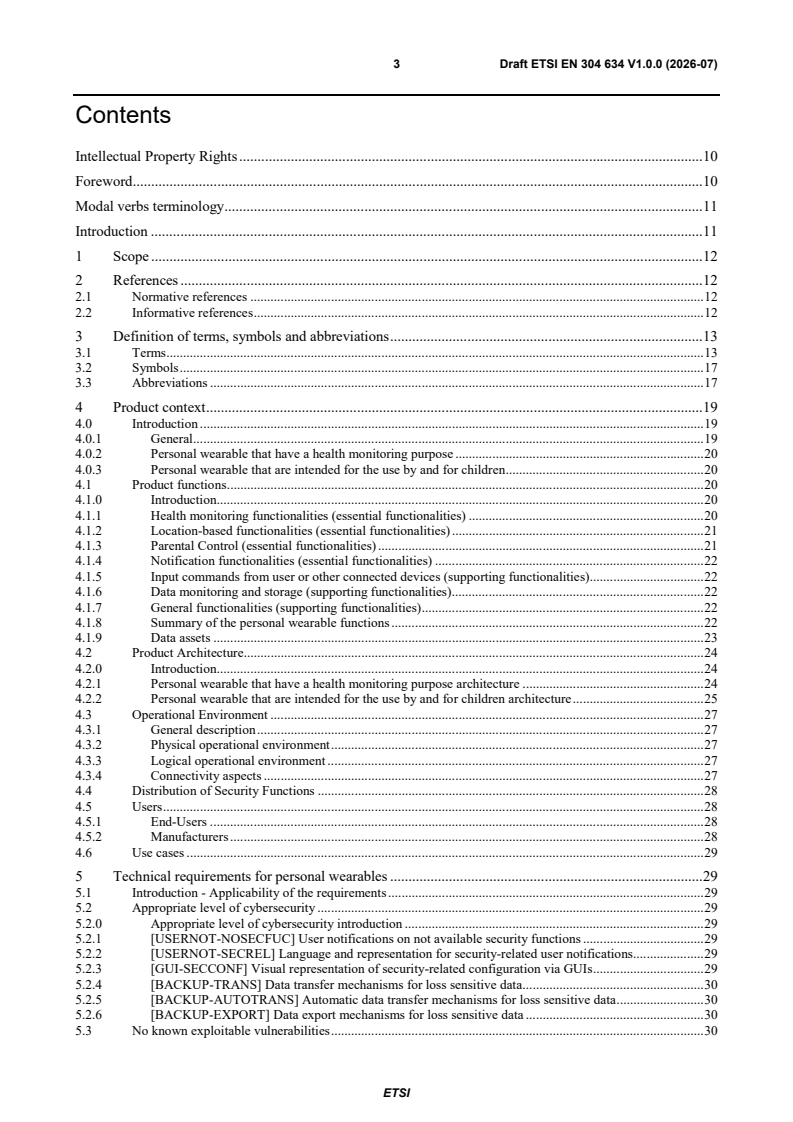
Contents
Intellectual Property Rights . 10
Foreword . 10
Modal verbs terminology . 11
Introduction . 11
1 Scope . 12
2 References . 12
2.1 Normative references . 12
2.2 Informative references . 12
3 Definition of terms, symbols and abbreviations . 13
3.1 Terms . 13
3.2 Symbols . 17
3.3 Abbreviations . 17
4 Product context . 19
4.0 Introduction . 19
4.0.1 General . 19
4.0.2 Personal wearable that have a health monitoring purpose . 20
4.0.3 Personal wearable that are intended for the use by and for children . 20
4.1 Product functions . 20
4.1.0 Introduction. 20
4.1.1 Health monitoring functionalities (essential functionalities) . 20
4.1.2 Location-based functionalities (essential functionalities) . 21
4.1.3 Parental Control (essential functionalities) . 21
4.1.4 Notification functionalities (essential functionalities) . 22
4.1.5 Input commands from user or other connected devices (supporting functionalitie s) . 22
4.1.6 Data monitoring and storage (supporting functionalities). 22
4.1.7 General functionalities (supporting functionalities) . 22
4.1.8 Summary of the personal wearable functions . 22
4.1.9 Data assets . 23
4.2 Product Architecture. 24
4.2.0 Introduction. 24
4.2.1 Personal wearable that have a health monitoring purpose architecture . 24
4.2.2 Personal wearable that are intended for the use by and for children architecture . 25
4.3 Operational Environment . 27
4.3.1 General description . 27
4.3.2 Physical operational environment . 27
4.3.3 Logical operational environment . 27
4.3.4 Connectivity aspects . 27
4.4 Distribution of Security Functions . 28
4.5 Users . 28
4.5.1 End-Users . 28
4.5.2 Manufacturers . 28
4.6 Use cases . 29
5 Technical requirements for personal wearables . 29
5.1 Introduction - Applicability of the requirements . 29
5.2 Appropriate level of cybersecurity . 29
5.2.0 Appropriate level of cybersecurity introduction . 29
5.2.1 [USERNOT-NOSECFUC] User notifications on not available security functions . 29
5.2.2 [USERNOT-SECREL] Language and representation for security-related user notifications. 29
5.2.3 [GUI-SECCONF] Visual representation of security-related configuration via GUIs . 29
5.2.4 [BACKUP-TRANS] Data transfer mechanisms for loss sensitive data . 30
5.2.5 [BACKUP-AUTOTRANS] Automatic data transfer mechanisms for loss sensitive data . 30
5.2.6 [BACKUP-EXPORT] Data export mechanisms for loss sensitive data . 30
5.3 No known exploitable vulnerabilities . 30
ETSI
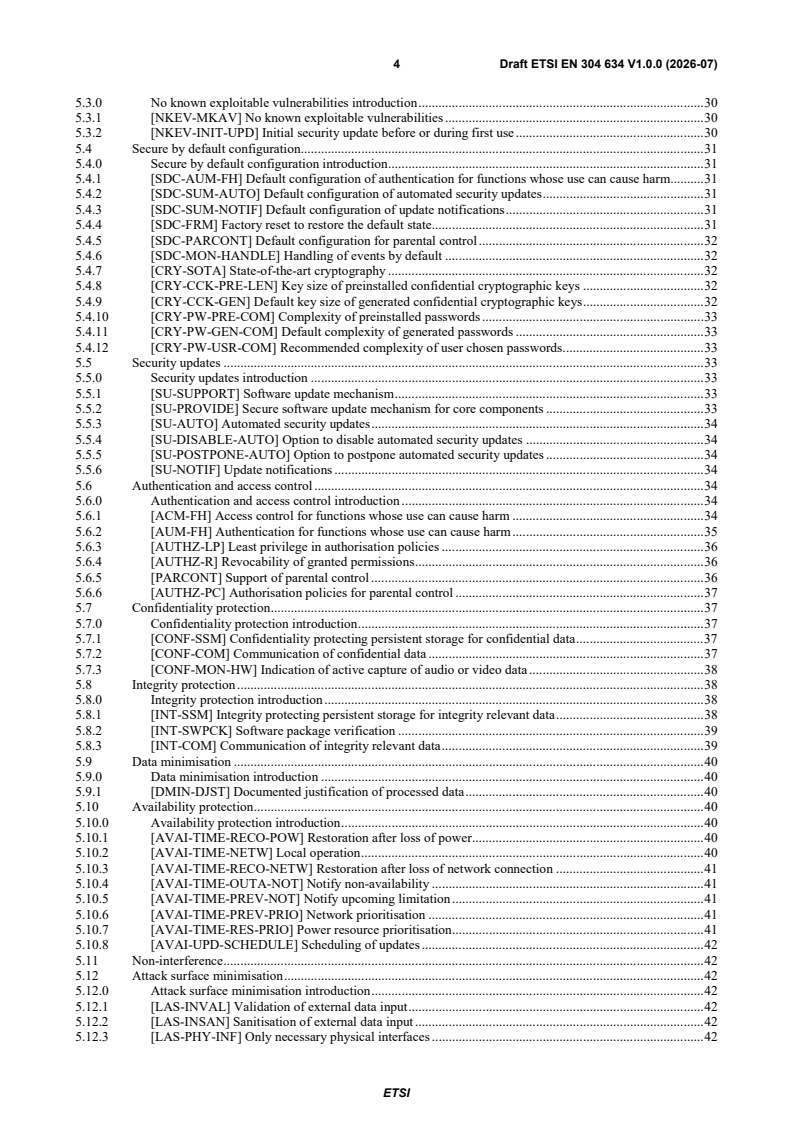
4 Draft ETSI EN 304 634 V1.0.0 (2026-07)
5.3.0 No known exploitable vulnerabilities introduction . 30
5.3.1 [NKEV-MKAV] No known exploitable vulnerabilities . 30
5.3.2 [NKEV-INIT-UPD] Initial security update before or during first use . 30
5.4 Secure by default configuration . 31
5.4.0 Secure by default configuration introduction . 31
5.4.1 [SDC-AUM-FH] Default configuration of authentication for functions whose use can cause harm. 31
5.4.2 [SDC-SUM-AUTO] Default configuration of automated security updates . 31
5.4.3 [SDC-SUM-NOTIF] Default configuration of update notifications . 31
5.4.4 [SDC-FRM] Factory reset to restore the default state. 31
5.4.5 [SDC-PARCONT] Default configuration for parental control . 32
5.4.6 [SDC-MON-HANDLE] Handling of events by default . 32
5.4.7 [CRY-SOTA] State-of-the-art cryptography . 32
5.4.8 [CRY-CCK-PRE-LEN] Key size of preinstalled confidential cryptographic keys . 32
5.4.9 [CRY-CCK-GEN] Default key size of generated confidential cryptographic keys . 32
5.4.10 [CRY-PW-PRE-COM] Complexity of preinstalled passwords . 33
5.4.11 [CRY-PW-GEN-COM] Default complexity of generated passwords . 33
5.4.12 [CRY-PW-USR-COM] Recommended complexity of user chosen passwords . 33
5.5 Security updates . 33
5.5.0 Security updates introduction . 33
5.5.1 [SU-SUPPORT] Software update mechanism . 33
5.5.2 [SU-PROVIDE] Secure software update mechanism for core components . 33
5.5.3 [SU-AUTO] Automated security updates . 34
5.5.4 [SU-DISABLE-AUTO] Option to disable automated security updates . 34
5.5.5 [SU-POSTPONE-AUTO] Option to postpone automated security updates . 34
5.5.6 [SU-NOTIF] Update notifications . 34
5.6 Authentication and access control . 34
5.6.0 Authentication and access control introduction . 34
5.6.1 [ACM-FH] Access control for functions whose use can cause harm . 34
5.6.2 [AUM-FH] Authentication for functions whose use can cause harm . 35
5.6.3 [AUTHZ-LP] Least privilege in authorisation policies . 36
5.6.4 [AUTHZ-R] Revocability of granted permissions . 36
5.6.5 [PARCONT] Support of parental control . 36
5.6.6 [AUTHZ-PC] Authorisation policies for parental control . 37
5.7 Confidentiality protection . 37
5.7.0 Confidentiality protection introduction . 37
5.7.1 [CONF-SSM] Confidentiality protecting persistent storage for confidential data . 37
5.7.2 [CONF-COM] Communication of confidential data . 37
5.7.3 [CONF-MON-HW] Indication of active capture of audio or video data . 38
5.8 Integrity protection . 38
5.8.0 Integrity protection introduction . 38
5.8.1 [INT-SSM] Integrity protecting persistent storage for integrity relevant data . 38
5.8.2 [INT-SWPCK] Software package verification . 39
5.8.3 [INT-COM] Communication of integrity relevant data . 39
5.9 Data minimisation . 40
5.9.0 Data minimisation introduction . 40
5.9.1 [DMIN-DJST] Documented justification of processed data . 40
5.10 Availability protection . 40
5.10.0 Availability protection introduction . 40
5.10.1 [AVAI-TIME-RECO-POW] Restoration after loss of power . 40
5.10.2 [AVAI-TIME-NETW] Local operation . 40
5.10.3 [AVAI-TIME-RECO-NETW] Restoration after loss of network connection . 41
5.10.4 [AVAI-TIME-OUTA-NOT] Notify non-availability . 41
5.10.5 [AVAI-TIME-PREV-NOT] Notify upcoming limitation . 41
5.10.6 [AVAI-TIME-PREV-PRIO] Network prioritisation . 41
5.10.7 [AVAI-TIME-RES-PRIO] Power resource prioritisation . 41
5.10.8 [AVAI-UPD-SCHEDULE] Scheduling of updates . 42
5.11 Non-interference . 42
5.12 Attack surface minimisation . 42
5.12.0 Attack surface minimisation introduction . 42
5.12.1 [LAS-INVAL] Validation of external data input . 42
5.12.2 [LAS-INSAN] Sanitisation of external data input . 42
5.12.3 [LAS-PHY-INF] Only necessary physical interfaces . 42
ETSI
5 Draft ETSI EN 304 634 V1.0.0 (2026-07)
5.12.4 [LAS-LOGIC-INF] Only necessary logical interfaces active by default . 43
5.12.5 [LAS-SBOOT] Secure boot . 43
5.13 Exploit mitigation . 43
5.13.0 Exploit mitigation introduction . 43
5.13.1 [PRIV-DATA-HIGH] Privileged access on impact class high data assets . 43
5.13.2 [PRIV-FUNC-HIGH] Privileged access on impact class high function assets . 43
5.14 Monitoring . 43
5.14.0 Monitoring introduction . 43
5.14.1 [MON-LOW] Events to log for low risk personal wearable . 44
5.14.2 [MON-MEDIUM] Events to log for medium risk personal wearable . 44
5.14.3 [MON-HIGH] Events to log for high risk personal wearable . 44
5.14.4 [MON-HANDLE] Handling of events . 44
5.14.5 [LOG-TIME] Timestamps for logs . 44
5.14.6 [LOG-TIME-HIGH] Real-time timestamps for logs . 44
5.14.7 [LOG-STORE-MEDIUM] Logfile persistence for medium risk personal wearable . 45
5.14.8 [LOG-STORE-HIGH] Logfile persistence for high risk personal wearable. 45
5.14.9 [LOG-CONFIG] Configuration of logging mechanisms . 45
5.15 Factory reset and data portability . 45
5.15.0 Factory reset and data portability introduction . 45
5.15.1 [DLM-PERM] Permanent removal of user-related data . 46
6 Assessment criteria for compliance with technical requirements . 46
6.1 Introduction to the assessment and compliance criteria . 46
6.2 Appropriate level of cybersecurity . 47
6.2.1 Assessment criteria for [USERNOT-NOSE CFU C] . 47
6.2.2 Assessment criteria for [USERNOT-SECREL]. 48
6.2.3 Assessment criteria for [GUI-SECCONF] . 49
6.2.4 Assessment criteria for [BACKUP-TRANS]. 50
6.2.5 Assessment criteria for [BACKUP-AUTOTRANS] . 51
6.2.6 Assessment criteria for [BACKUP-EXPORT] . 52
6.3 No known exploitable vulnerabilities . 54
6.3.1 Assessment criteria for [NKEV-MKAV] . 54
6.3.2 Assessment criteria for [NKEV-INIT-UPD] . 55
6.4 Secure by default configuration . 56
6.4.1 Assessment criteria for [SDC-AUM-FH] . 56
6.4.2 Assessment criteria for [SDC-SUM-AUTO] . 57
6.4.3 Assessment criteria for [SDC-SUM-NOTIF] . 58
6.4.4 Assessment criteria for [SDC-FRM] . 59
6.4.5 Assessment criteria for [SDC-PARCONT] . 60
6.4.6 Assessment criteria for [SDC-MON-HANDLE] . 61
6.4.7 Assessment criteria for [CRY-SOTA] . 62
6.4.8 Assessment criteria for [CRY-CCK-PRE-LEN] . 62
6.4.9 Assessment criteria for [CRY-CCK-GEN] . 63
6.4.10 Assessment criteria for [CRY-PW-PRE-COM]. 64
6.4.11 Assessment criteria for [CRY-PW-GEN-COM] . 65
6.4.12 Assessment criteria for [CRY-PW-USR-COM] . 66
6.5 Security updates . 67
6.5.1 Assessment criteria for [SU-SUPPORT] . 67
6.5.2 Assessment criteria for [SU-PROVIDE] . 68
6.5.3 Assessment criteria for [SU-AUTO]. 69
6.5.4 Assessment criteria for [SU-DISABLE-AUTO] . 70
6.5.5 Assessment criteria for [SU-POSTPONE-AUTO] . 71
6.5.6 Assessment criteria for [SU-NOTIF] . 72
6.6 Authentication and access control . 73
6.6.1 Assessment criteria for [ACM-FH] . 73
6.6.2 Assessment criteria for [AUM-FH] . 75
6.6.3 Assessment criteria for [AUTHZ-LP]. 76
6.6.4 Assessment criteria for [AUTHZ-R]. 76
6.6.5 Assessment criteria for [PARCONT] . 77
6.6.6 Assessment criteria for [AUTHZ-PC] . 78
6.7 Confidentiality protection . 79
6.7.1 Assessment criteria for [CONF-SSM] . 79
ETSI
6 Draft ETSI EN 304 634 V1.0.0 (2026-07)
6.7.2 Assessment criteria for [CONF-COM] . 80
6.7.3 Assessment criteria for [CONF-MON-HW] . 82
6.8 Integrity protection . 83
6.8.1 Assessment criteria for [INT-SSM] . 83
6.8.2 Assessment criteria for [INT-SWPCK] . 84
6.8.3 Assessment criteria for [INT-COM] . 85
6.9 Data minimisation . 87
6.9.1 Assessment criteria for [DMIN-DJST] . 87
6.10 Availability protection . 87
6.10.1 Assessment criteria for [AVAI-TIME-RECO-POW] . 87
6.10.2 Assessment criteria for [AVAI-TIME-NETW] . 89
6.10.3 Assessment criteria for [AVAI-TIME-RECO-NETW] . 90
6.10.4 Assessment criteria for [AVAI-TIME-OUTA-NOT] . 92
6.10.5 Assessment criteria for [AVAI-TIME-PREV-NOT] . 93
6.10.6 Assessment criteria for [AVAI-TIME-RES-PRIO] . 95
6.10.7 Assessment criteria for [AVAI-TIME-RES-PRIO] . 96
6.10.8 Assessment criteria for [AVAI-SUM-SCHEDULE] . 97
6.11 Non-interference . 98
6.12 Attack surface minimisation . 98
6.12.1 Assessment criteria for [LAS-INVAL] . 98
6.12.2 Assessment criteria for [LAS-INSAN] . 99
6.12.3 Assessment criteria for [LAS-PHY-INF] . 100
6.12.4 Assessment criteria for [LAS-LOGIC-INF] . 101
6.12.5 Assessment criteria for [LAS-SBOOT] . 102
6.13 Exploit mitigation . 103
6.13.1 Assessment criteria for [PRIV-DATA-HIGH] . 103
6.13.2 Assessment criteria for [PRIV-FUNC-HIGH] . 104
6.14 Monitoring . 105
6.14.1 Assessment criteria for [MON-LOW] . 105
6.14.2 Assessment criteria for [MON-MEDIUM] . 106
6.14.3 Assessment criteria for [MON-HIGH] . 106
6.14.4 Assessment criteria for [MON-HANDLE] . 107
6.14.5 Assessment criteria for [LOG-TIME] . 108
6.14.6 Assessment criteria for [LOG-TIME-HIGH]. 109
6.14.7 Assessment criteria for [LOG-STORE-MEDIUM] . 110
6.14.8 Assessment criteria for [LOG-STORE-HIGH] . 111
6.14.9 Assessment criteria for [LOG-CONFIG] . 112
6.15 Factory reset and data portability . 114
6.15.1 Assessment criteria for [DLM-PERM] . 114
Annex A (informative): Relationship between the present document and the requirements of
EU Regulation 2024/2847 . 116
Annex B (informative): Security analysis . 121
B.1 General . 121
B.2 Assets . 121
B.3 Risk factors . 121
B.4 Assumptions . 121
B.5 Threats . 122
B.6 Relationship between the present document and the covered/not covered cybersecurity risks . 122
B.7 Guidance for determining impact classes . 126
B.7.1 General . 126
B.7.2 Confidential data . 126
B.7.3 loss sensitive data . 127
B.7.4 time sensitive data and time sensitive function . 127
B.7.5 integrity relevant data and integrity relevant function . 127
Annex C: Void . 129
ETSI
7 Draft ETSI EN 304 634 V1.0.0 (2026-07)
Annex D (normative): Relationship between specific data and functions assets covered by
the present document to impact classes for generic asset categories. 130
D.1 Data assets . 130
D.2 Function assets . 131
D.2.1 Functions . 131
D.2.2 Functions whose use can cause harm . 131
Annex E (normative): Protection measures . 133
E.1 authentication mechanism strength . 133
E.1.1 [AUM-FH] Authentication for functions whose use can cause harm . 133
E.1.1.1 General . 133
E.1.1.2 [AUM-E-I-Basic] AUTH.Basic inherence based SFA . 133
E.1.1.3 [AUM-E-K-Basic] AUTH.Basic knowledge based SFA . 133
E.1.1.4 [AUM-E-I-Medium] AUTH.Medium inherence based SFA . 133
E.1.1.5 [AUM-E-K-Medium] AUTH.Medium knowledge based SFA . 133
E.1.1.6 [AUM-E-P-Medium] AUTH.Medium possession based SFA . 133
E.1.1.7 [AUM-E-MFA-Medium] AUTH.Medium MFA . 134
E.1.1.8 [AUM-E-I-Enhanced] AUTH.Enhanced inherence based SFA. 134
E.1.1.9 [AUM-E-K-Enhanced] AUTH.Enhanced knowledge based SFA . 134
E.1.1.10 [AUM-E-P-Enhanced] AUTH.Enhanced possession based SFA . 134
E.1.1.11 [AUM-E-MFA-Enhanced] AUTH.Enhanced MFA . 135
E.1.1.12 [AUM-E-I-Strong] AUTH.Strong inherence based SFA . 135
E.1.1.13 [AUM-E-P-Strong] AUTH.Strong possession based SFA . 135
E.1.1.14 [AUM-E-MFA-Strong] AUTH.Strong MFA . 135
E.1.1.15 [AUM-E-Replay] AUTH.Medium, AUTH.Enhanced and AUTH.Strong replay protection . 135
E.1.1.16 [AUM-E-PitM] AUTH.Medium, AUTH.Enhanced and AUTH.Strong person in the middle
protection . 136
E.1.2 Assessment for [AUM-FH] authentication mechanism strength . 136
E.1.2.1 General . 136
E.1.2.2 Assessment criteria for [AUM-E-I-Basic] . 136
E.1.2.3 Assessment criteria for [AUM-E-K-Basic] . 137
E.1.2.4 Assessment criteria for [AUM-E-I-Medium]. 138
E.1.2.5 Assessment criteria for [AUM-E-K-Medium] . 138
E.1.2.6 Assessment criteria for [AUM-E-P-Medium] . 139
E.1.2.7 Assessment criteria for [AUM-E-MFA-Medium] . 140
E.1.2.8 Assessment criteria for [AUM-E-I-Enhanced] . 141
E.1.2.9 Assessment criteria for [AUM-E-K-Enhanced] . 142
E.1.2.10 Assessment criteria for [AUM-E-P-Enhanced] . 143
E.1.2.11 Assessment criteria for [AUM-E-MFA-Enhanced] . 145
E.1.2.12 Assessment criteria for [AUM-E-I-Strong] . 146
E.1.2.13 Assessment criteria for [AUM-E-P-Strong] . 147
E.1.2.14 Assessment criteria for [AUM-E-MFA-Strong] . 148
E.1.2.15 Assessment criteria for [AUM-E-Replay] . 149
E.1.2.16 Assessment criteria for [AUM-E-PitM] . 150
E.2 integrity protection strength . 151
E.2.1 [INT-SSM] Integrity protecting persistent storage for integrity relevant data . 151
E.2.1.1 General . 151
E.2.1.2 [INT-SSM-E-Basic] INT.SSM.Basic integrity protecting secure storage mechanism . 151
E.2.1.3 [INT-SSM-E-Medium] INT.SSM.Medium integrity protecting secure storage mechanism . 152
E.2.1.4 [INT-SSM-E-Enhanced] INT.SSM.Enhanced integrity protecting secure storage mechanism . 152
E.2.1.5 [INT-SSM-E-Strong] INT.SSM.Strong integrity
...
SLOVENSKI STANDARD
01-september-2026
Kibernetska varnost (CYBER) - CRA - Zahteve za kibernetsko varnost za osebne
nosljive naprave
Cyber Security (CYBER) - CRA - Cybersecurity requirements for personal wearable
Ta slovenski standard je istoveten z: ETSI EN 304 634 V1.0.0 (2026-07)
ICS:
35.030 Informacijska varnost IT Security
2003-01.Slovenski inštitut za standardizacijo. Razmnoževanje celote ali delov tega standarda ni dovoljeno.
Draft ETSI EN 304 634 V1.0.0 (2026-07)
HARMONISED EUROPEAN STANDARD
Cyber Security (CYBER);
CRA;
Cybersecurity requirements for personal wearable
2 Draft ETSI EN 304 634 V1.0.0 (2026-07)
Reference
DEN/CYBER-EUS-003
Keywords
CRA, cybersecurity, wearable
ETSI
650 Route des Lucioles
F-06921 Sophia Antipolis Cedex - FRANCE
Tel.: +33 4 92 94 42 00 Fax: +33 4 93 65 47 16
Siret N° 348 623 562 00017 - APE 7112B
Association à but non lucratif enregistrée à la
Sous-Préfecture de Grasse (06) N° w061004871
Important notice
The present document can be downloaded from the
ETSI Search & Browse Standards application.
The present document may be made available in electronic versions and/or in print. The content of any electronic and/or
print versions of the present document shall not be modified without the prior written authorization of ETSI. In case of any
existing or perceived difference in contents between such versions and/or in print, the prevailing version of an ETSI
deliverable is the one made publicly available in PDF format on ETSI deliver repository.
Users should be aware that the present document may be revised or have its status changed,
this information is available in the Milestones listing.
If you find errors in the present document, please send your comments to
the relevant service listed under Committee Support Staff.
If you find a security vulnerability in the present document, please report it through our
Coordinated Vulnerability Disclosure (CVD) program.
Notice of disclaimer & limitation of liability
The information provided in the present deliverable is directed solely to professionals who have the appropriate degree of
experience to understand and interpret its content in accordance with generally accepted engineering or
other professional standard and applicable regulations.
No recommendation as to products and services or vendors is made or should be implied.
In no event shall ETSI be held liable for loss of profits or any other incidental or consequential damages.
Any software contained in this deliverable is provided "AS IS" with no warranties, express or implied, including but not
limited to, the warranties of merchantability, fitness for a particular purpose and non-infringement of intellectual property
rights and ETSI shall not be held liable in any event for any damages whatsoever (including, without limitation, damages
for loss of profits, business interruption, loss of information, or any other pecuniary loss) arising out of or related to the use
of or inability to use the software.
Copyright Notification
No part of this document may be reproduced in any form, by any means and in any media, without the prior written
authorization of ETSI and except as expressly permitted below.
By way of exception and when the document is a normative deliverable (European Standard (EN),
Technical Specification (TS), Group Specification (GS) or ETSI Standard (ES)), ETSI authorizes to reproduce
and incorporate into products, services and technical documentation only those extracts (e.g. templates) that are strictly
necessary for the technical implementation of the normative deliverable, to ensure compliance with the latter.
Nothing in this notice shall be construed as limiting any mandatory exceptions to copyright provided by applicable law.
© ETSI 2026.
All rights reserved.
ETSI
3 Draft ETSI EN 304 634 V1.0.0 (2026-07)
Contents
Intellectual Property Rights . 10
Foreword . 10
Modal verbs terminology . 11
Introduction . 11
1 Scope . 12
2 References . 12
2.1 Normative references . 12
2.2 Informative references . 12
3 Definition of terms, symbols and abbreviations . 13
3.1 Terms . 13
3.2 Symbols . 17
3.3 Abbreviations . 17
4 Product context . 19
4.0 Introduction . 19
4.0.1 General . 19
4.0.2 Personal wearable that have a health monitoring purpose . 20
4.0.3 Personal wearable that are intended for the use by and for children . 20
4.1 Product functions . 20
4.1.0 Introduction. 20
4.1.1 Health monitoring functionalities (essential functionalities) . 20
4.1.2 Location-based functionalities (essential functionalities) . 21
4.1.3 Parental Control (essential functionalities) . 21
4.1.4 Notification functionalities (essential functionalities) . 22
4.1.5 Input commands from user or other connected devices (supporting functionalitie s) . 22
4.1.6 Data monitoring and storage (supporting functionalities). 22
4.1.7 General functionalities (supporting functionalities) . 22
4.1.8 Summary of the personal wearable functions . 22
4.1.9 Data assets . 23
4.2 Product Architecture. 24
4.2.0 Introduction. 24
4.2.1 Personal wearable that have a health monitoring purpose architecture . 24
4.2.2 Personal wearable that are intended for the use by and for children architecture . 25
4.3 Operational Environment . 27
4.3.1 General description . 27
4.3.2 Physical operational environment . 27
4.3.3 Logical operational environment . 27
4.3.4 Connectivity aspects . 27
4.4 Distribution of Security Functions . 28
4.5 Users . 28
4.5.1 End-Users . 28
4.5.2 Manufacturers . 28
4.6 Use cases . 29
5 Technical requirements for personal wearables . 29
5.1 Introduction - Applicability of the requirements . 29
5.2 Appropriate level of cybersecurity . 29
5.2.0 Appropriate level of cybersecurity introduction . 29
5.2.1 [USERNOT-NOSECFUC] User notifications on not available security functions . 29
5.2.2 [USERNOT-SECREL] Language and representation for security-related user notifications. 29
5.2.3 [GUI-SECCONF] Visual representation of security-related configuration via GUIs . 29
5.2.4 [BACKUP-TRANS] Data transfer mechanisms for loss sensitive data . 30
5.2.5 [BACKUP-AUTOTRANS] Automatic data transfer mechanisms for loss sensitive data . 30
5.2.6 [BACKUP-EXPORT] Data export mechanisms for loss sensitive data . 30
5.3 No known exploitable vulnerabilities . 30
ETSI
4 Draft ETSI EN 304 634 V1.0.0 (2026-07)
5.3.0 No known exploitable vulnerabilities introduction . 30
5.3.1 [NKEV-MKAV] No known exploitable vulnerabilities . 30
5.3.2 [NKEV-INIT-UPD] Initial security update before or during first use . 30
5.4 Secure by default configuration . 31
5.4.0 Secure by default configuration introduction . 31
5.4.1 [SDC-AUM-FH] Default configuration of authentication for functions whose use can cause harm. 31
5.4.2 [SDC-SUM-AUTO] Default configuration of automated security updates . 31
5.4.3 [SDC-SUM-NOTIF] Default configuration of update notifications . 31
5.4.4 [SDC-FRM] Factory reset to restore the default state. 31
5.4.5 [SDC-PARCONT] Default configuration for parental control . 32
5.4.6 [SDC-MON-HANDLE] Handling of events by default . 32
5.4.7 [CRY-SOTA] State-of-the-art cryptography . 32
5.4.8 [CRY-CCK-PRE-LEN] Key size of preinstalled confidential cryptographic keys . 32
5.4.9 [CRY-CCK-GEN] Default key size of generated confidential cryptographic keys . 32
5.4.10 [CRY-PW-PRE-COM] Complexity of preinstalled passwords . 33
5.4.11 [CRY-PW-GEN-COM] Default complexity of generated passwords . 33
5.4.12 [CRY-PW-USR-COM] Recommended complexity of user chosen passwords . 33
5.5 Security updates . 33
5.5.0 Security updates introduction . 33
5.5.1 [SU-SUPPORT] Software update mechanism . 33
5.5.2 [SU-PROVIDE] Secure software update mechanism for core components . 33
5.5.3 [SU-AUTO] Automated security updates . 34
5.5.4 [SU-DISABLE-AUTO] Option to disable automated security updates . 34
5.5.5 [SU-POSTPONE-AUTO] Option to postpone automated security updates . 34
5.5.6 [SU-NOTIF] Update notifications . 34
5.6 Authentication and access control . 34
5.6.0 Authentication and access control introduction . 34
5.6.1 [ACM-FH] Access control for functions whose use can cause harm . 34
5.6.2 [AUM-FH] Authentication for functions whose use can cause harm . 35
5.6.3 [AUTHZ-LP] Least privilege in authorisation policies . 36
5.6.4 [AUTHZ-R] Revocability of granted permissions . 36
5.6.5 [PARCONT] Support of parental control . 36
5.6.6 [AUTHZ-PC] Authorisation policies for parental control . 37
5.7 Confidentiality protection . 37
5.7.0 Confidentiality protection introduction . 37
5.7.1 [CONF-SSM] Confidentiality protecting persistent storage for confidential data . 37
5.7.2 [CONF-COM] Communication of confidential data . 37
5.7.3 [CONF-MON-HW] Indication of active capture of audio or video data . 38
5.8 Integrity protection . 38
5.8.0 Integrity protection introduction . 38
5.8.1 [INT-SSM] Integrity protecting persistent storage for integrity relevant data . 38
5.8.2 [INT-SWPCK] Software package verification . 39
5.8.3 [INT-COM] Communication of integrity relevant data . 39
5.9 Data minimisation . 40
5.9.0 Data minimisation introduction . 40
5.9.1 [DMIN-DJST] Documented justification of processed data . 40
5.10 Availability protection . 40
5.10.0 Availability protection introduction . 40
5.10.1 [AVAI-TIME-RECO-POW] Restoration after loss of power . 40
5.10.2 [AVAI-TIME-NETW] Local operation . 40
5.10.3 [AVAI-TIME-RECO-NETW] Restoration after loss of network connection . 41
5.10.4 [AVAI-TIME-OUTA-NOT] Notify non-availability . 41
5.10.5 [AVAI-TIME-PREV-NOT] Notify upcoming limitation . 41
5.10.6 [AVAI-TIME-PREV-PRIO] Network prioritisation . 41
5.10.7 [AVAI-TIME-RES-PRIO] Power resource prioritisation . 41
5.10.8 [AVAI-UPD-SCHEDULE] Scheduling of updates . 42
5.11 Non-interference . 42
5.12 Attack surface minimisation . 42
5.12.0 Attack surface minimisation introduction . 42
5.12.1 [LAS-INVAL] Validation of external data input . 42
5.12.2 [LAS-INSAN] Sanitisation of external data input . 42
5.12.3 [LAS-PHY-INF] Only necessary physical interfaces . 42
ETSI
5 Draft ETSI EN 304 634 V1.0.0 (2026-07)
5.12.4 [LAS-LOGIC-INF] Only necessary logical interfaces active by default . 43
5.12.5 [LAS-SBOOT] Secure boot . 43
5.13 Exploit mitigation . 43
5.13.0 Exploit mitigation introduction . 43
5.13.1 [PRIV-DATA-HIGH] Privileged access on impact class high data assets . 43
5.13.2 [PRIV-FUNC-HIGH] Privileged access on impact class high function assets . 43
5.14 Monitoring . 43
5.14.0 Monitoring introduction . 43
5.14.1 [MON-LOW] Events to log for low risk personal wearable . 44
5.14.2 [MON-MEDIUM] Events to log for medium risk personal wearable . 44
5.14.3 [MON-HIGH] Events to log for high risk personal wearable . 44
5.14.4 [MON-HANDLE] Handling of events . 44
5.14.5 [LOG-TIME] Timestamps for logs . 44
5.14.6 [LOG-TIME-HIGH] Real-time timestamps for logs . 44
5.14.7 [LOG-STORE-MEDIUM] Logfile persistence for medium risk personal wearable . 45
5.14.8 [LOG-STORE-HIGH] Logfile persistence for high risk personal wearable. 45
5.14.9 [LOG-CONFIG] Configuration of logging mechanisms . 45
5.15 Factory reset and data portability . 45
5.15.0 Factory reset and data portability introduction . 45
5.15.1 [DLM-PERM] Permanent removal of user-related data . 46
6 Assessment criteria for compliance with technical requirements . 46
6.1 Introduction to the assessment and compliance criteria . 46
6.2 Appropriate level of cybersecurity . 47
6.2.1 Assessment criteria for [USERNOT-NOSE CFU C] . 47
6.2.2 Assessment criteria for [USERNOT-SECREL]. 48
6.2.3 Assessment criteria for [GUI-SECCONF] . 49
6.2.4 Assessment criteria for [BACKUP-TRANS]. 50
6.2.5 Assessment criteria for [BACKUP-AUTOTRANS] . 51
6.2.6 Assessment criteria for [BACKUP-EXPORT] . 52
6.3 No known exploitable vulnerabilities . 54
6.3.1 Assessment criteria for [NKEV-MKAV] . 54
6.3.2 Assessment criteria for [NKEV-INIT-UPD] . 55
6.4 Secure by default configuration . 56
6.4.1 Assessment criteria for [SDC-AUM-FH] . 56
6.4.2 Assessment criteria for [SDC-SUM-AUTO] . 57
6.4.3 Assessment criteria for [SDC-SUM-NOTIF] . 58
6.4.4 Assessment criteria for [SDC-FRM] . 59
6.4.5 Assessment criteria for [SDC-PARCONT] . 60
6.4.6 Assessment criteria for [SDC-MON-HANDLE] . 61
6.4.7 Assessment criteria for [CRY-SOTA] . 62
6.4.8 Assessment criteria for [CRY-CCK-PRE-LEN] . 62
6.4.9 Assessment criteria for [CRY-CCK-GEN] . 63
6.4.10 Assessment criteria for [CRY-PW-PRE-COM]. 64
6.4.11 Assessment criteria for [CRY-PW-GEN-COM] . 65
6.4.12 Assessment criteria for [CRY-PW-USR-COM] . 66
6.5 Security updates . 67
6.5.1 Assessment criteria for [SU-SUPPORT] . 67
6.5.2 Assessment criteria for [SU-PROVIDE] . 68
6.5.3 Assessment criteria for [SU-AUTO]. 69
6.5.4 Assessment criteria for [SU-DISABLE-AUTO] . 70
6.5.5 Assessment criteria for [SU-POSTPONE-AUTO] . 71
6.5.6 Assessment criteria for [SU-NOTIF] . 72
6.6 Authentication and access control . 73
6.6.1 Assessment criteria for [ACM-FH] . 73
6.6.2 Assessment criteria for [AUM-FH] . 75
6.6.3 Assessment criteria for [AUTHZ-LP]. 76
6.6.4 Assessment criteria for [AUTHZ-R]. 76
6.6.5 Assessment criteria for [PARCONT] . 77
6.6.6 Assessment criteria for [AUTHZ-PC] . 78
6.7 Confidentiality protection . 79
6.7.1 Assessment criteria for [CONF-SSM] . 79
ETSI
6 Draft ETSI EN 304 634 V1.0.0 (2026-07)
6.7.2 Assessment criteria for [CONF-COM] . 80
6.7.3 Assessment criteria for [CONF-MON-HW] . 82
6.8 Integrity protection . 83
6.8.1 Assessment criteria for [INT-SSM] . 83
6.8.2 Assessment criteria for [INT-SWPCK] . 84
6.8.3 Assessment criteria for [INT-COM] . 85
6.9 Data minimisation . 87
6.9.1 Assessment criteria for [DMIN-DJST] . 87
6.10 Availability protection . 87
6.10.1 Assessment criteria for [AVAI-TIME-RECO-POW] . 87
6.10.2 Assessment criteria for [AVAI-TIME-NETW] . 89
6.10.3 Assessment criteria for [AVAI-TIME-RECO-NETW] . 90
6.10.4 Assessment criteria for [AVAI-TIME-OUTA-NOT] . 92
6.10.5 Assessment criteria for [AVAI-TIME-PREV-NOT] . 93
6.10.6 Assessment criteria for [AVAI-TIME-RES-PRIO] . 95
6.10.7 Assessment criteria for [AVAI-TIME-RES-PRIO] . 96
6.10.8 Assessment criteria for [AVAI-SUM-SCHEDULE] . 97
6.11 Non-interference . 98
6.12 Attack surface minimisation . 98
6.12.1 Assessment criteria for [LAS-INVAL] . 98
6.12.2 Assessment criteria for [LAS-INSAN] . 99
6.12.3 Assessment criteria for [LAS-PHY-INF] . 100
6.12.4 Assessment criteria for [LAS-LOGIC-INF] . 101
6.12.5 Assessment criteria for [LAS-SBOOT] . 102
6.13 Exploit mitigation . 103
6.13.1 Assessment criteria for [PRIV-DATA-HIGH] . 103
6.13.2 Assessment criteria for [PRIV-FUNC-HIGH] . 104
6.14 Monitoring . 105
6.14.1 Assessment criteria for [MON-LOW] . 105
6.14.2 Assessment criteria for [MON-MEDIUM] . 106
6.14.3 Assessment criteria for [MON-HIGH] . 106
6.14.4 Assessment criteria for [MON-HANDLE] . 107
6.14.5 Assessment criteria for [LOG-TIME] . 108
6.14.6 Assessment criteria for [LOG-TIME-HIGH]. 109
6.14.7 Assessment criteria for [LOG-STORE-MEDIUM] . 110
6.14.8 Assessment criteria for [LOG-STORE-HIGH] . 111
6.14.9 Assessment criteria for [LOG-CONFIG] . 112
6.15 Factory reset and data portability . 114
6.15.1 Assessment criteria for [DLM-PERM] . 114
Annex A (informative): Relationship between the present document and the requirements of
EU Regulation 2024/2847 . 116
Annex B (informative): Security analysis . 121
B.1 General . 121
B.2 Assets . 121
B.3 Risk factors . 121
B.4 Assumptions . 121
B.5 Threats . 122
B.6 Relationship between the present document and the covered/not covered cybersecurity risks . 122
B.7 Guidance for determining impact classes . 126
B.7.1 General . 126
B.7.2 Confidential data . 126
B.7.3 loss sensitive data . 127
B.7.4 time sensitive data and time sensitive function . 127
B.7.5 integrity relevant data and integrity relevant function . 127
Annex C: Void . 129
ETSI
7 Draft ETSI EN 304 634 V1.0.0 (2026-07)
Annex D (normative): Relationship between specific data and functions assets covered by
the present document to impact classes for generic asset categories. 130
D.1 Data assets . 130
D.2 Function assets . 131
D.2.1 Functions . 131
D.2.2 Functions whose use can cause harm . 131
Annex E (normative): Protection measures . 133
E.1 authentication mechanism strength . 133
E.1.1 [AUM-FH] Authentication for functions whose use can cause harm . 133
E.1.1.1 General . 133
E.1.1.2 [AUM-E-I-Basic] AUTH.Basic inherence based SFA . 133
E.1.1.3 [AUM-E-K-Basic] AUTH.Basic knowledge based SFA . 133
E.1.1.4 [AUM-E-I-Medium] AUTH.Medium inherence based SFA . 133
E.1.1.5 [AUM-E-K-Medium] AUTH.Medium knowledge based SFA . 133
E.1.1.6 [AUM-E-P-Medium] AUTH.Medium possession based SFA . 133
E.1.1.7 [AUM-E-MFA-Medium] AUTH.Medium MFA . 134
E.1.1.8 [AUM-E-I-Enhanced] AUTH.Enhanced inherence based SFA. 134
E.1.1.9 [AUM-E-K-Enhanced] AUTH.Enhanced knowledge based SFA . 134
E.1.1.10 [AUM-E-P-Enhanced] AUTH.Enhanced possession based SFA . 134
E.1.1.11 [AUM-E-MFA-Enhanced] AUTH.Enhanced MFA . 135
E.1.1.12 [AUM-E-I-Strong] AUTH.Strong inherence based SFA . 135
E.1.1.13 [AUM-E-P-Strong] AUTH.Strong possession based SFA . 135
E.1.1.14 [AUM-E-MFA-Strong] AUTH.Strong MFA . 135
E.1.1.15 [AUM-E-Replay] AUTH.Medium, AUTH.Enhanced and AUTH.Strong replay protection . 135
E.1.1.16 [AUM-E-PitM] AUTH.Medium, AUTH.Enhanced and AUTH.Strong person in the middle
protection . 136
E.1.2 Assessment for [AUM-FH] authentication mechanism strength . 136
E.1.2.1 General . 136
E.1.2.2 Assessment criteria for [AUM-E-I-Basic] . 136
E.1.2.3 Assessment criteria for [AUM-E-K-Basic] . 137
E.1.2.4 Assessment criteria for [AUM-E-I-Medium]. 138
E.1.2.5 Assessment criteria for [AUM-E-K-Medium] . 138
E.1.2.6 Assessment criteria for [AUM-E-P-Medium] . 139
E.1.2.7 Assessment criteria for [AUM-E-MFA-Medium] . 140
E.1.2.8 Assessment criteria for [AUM-E-I-Enhanced] . 141
E.1.2.9 Assessment criteria for [AUM-E-K-Enhanced] . 142
E.1.2.10 Assessment criteria for [AUM-E-P-Enhanced] . 143
E.1.2.11 Assessment criteria for [AUM-E-MFA-Enhanced] . 145
E.1.2.12 Assessment criteria for [AUM-E-I-Strong] . 146
E.1.2.13 Assessment criteria for [AUM-E-P-Strong] . 147
E.1.2.14 Assessment criteria for [AUM-E-MFA-Strong] . 148
E.1.2.15 Assessment criteria for [AUM-E-Replay] . 149
E.1.2.16 Assessment criteria for [AUM-E-PitM] .
...