

SIST EN 1876-1:1999
(Main)Rubber- or plastics-coated fabrics - Low-temperature tests - Part 1: Bending test
- Abstract
This standard describes a means of determining the ability of coated fabrics to resist the effect of low temperatures when subjected to bending at specified temperatures after defined periods of exposure. It is applicable to coated fabrics that fall within the thickness range 0,10 mm to 2,20 mm.
- Status
- Published
- Publication Date
- 28-Feb-1999
- Technical Committee
- ITEK - Textile and textile products
- Current Stage
- 6060 - National Implementation/Publication (Adopted Project)
- Start Date
- 01-Mar-1999
- Due Date
- 01-Mar-1999
- Completion Date
- 01-Mar-1999
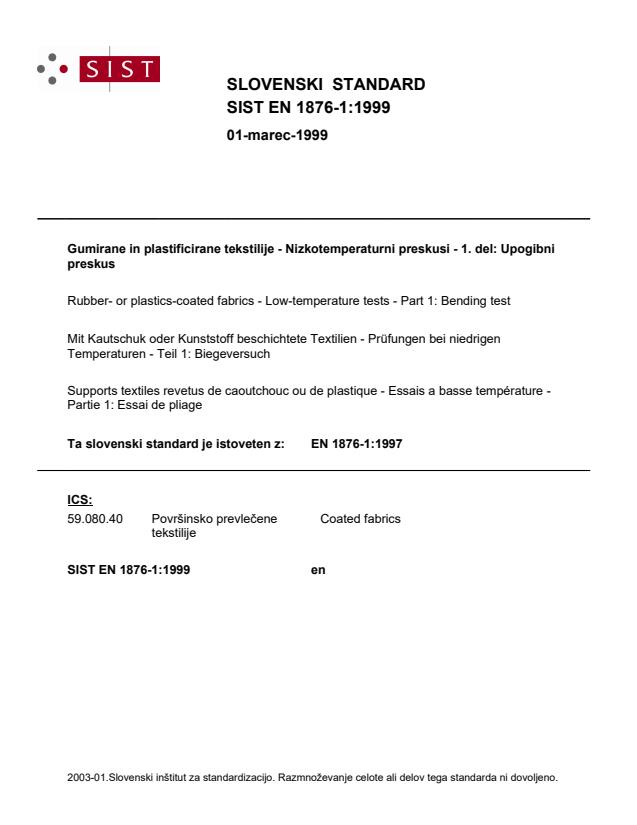

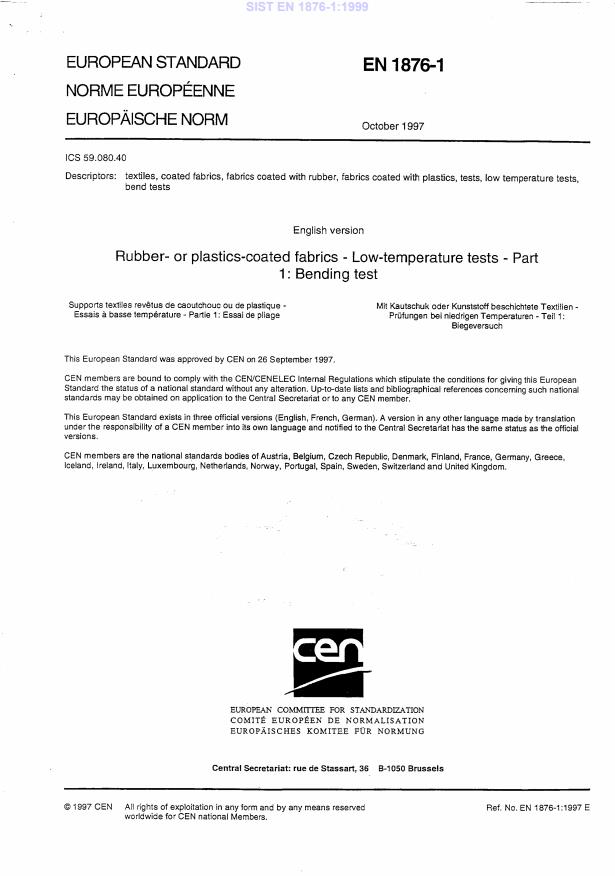
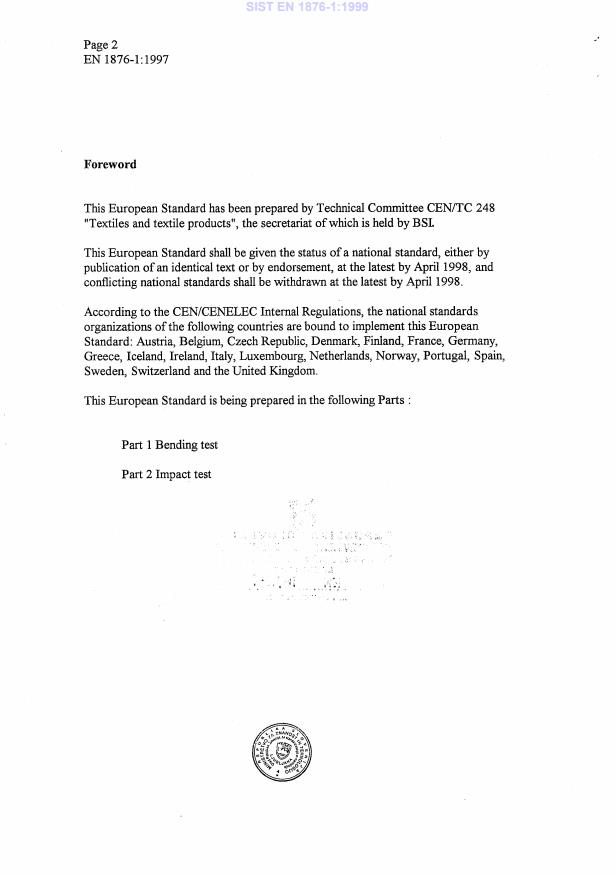
SIST EN 1876-1:1999 is a standard published by Slovenski inštitut za standardizacijo (SIST) for rubber- or plastics-coated fabrics. It specifies a low-temperature bending test used to determine how coated fabrics resist the effect of cold after exposure at specified temperatures. The method applies to coated fabrics with a thickness from 0,10 mm to 2,20 mm.
What does SIST EN 1876-1:1999 specify?
SIST EN 1876-1:1999 specifies a bending test for rubber- or plastics-coated fabrics after low-temperature exposure. In practice, it gives a common way to judge whether a coated fabric remains suitable when it has been cold-conditioned and then bent.
The scope is limited to coated fabrics in the thickness range 0,10 mm to 2,20 mm. That matters because users should check material thickness before applying the method.
The title shows that SIST EN 1876-1:1999 is Part 1 of the low-temperature tests series and that this part is the bending test. That helps users identify the method quickly when they need one specific low-temperature test rather than another type of evaluation.
What are the key requirements of SIST EN 1876-1:1999?
SIST EN 1876-1:1999 centers on one main requirement: expose the coated fabric to low temperature, then bend it under specified conditions. This is the core of the method, and it matters because the result reflects how the material behaves after cold storage or cold service.
- The test looks at the effect of low temperatures on coated fabrics. In practice, the question is whether the coating and fabric structure still tolerate bending after cooling.
- The method uses specified temperatures. That means users need controlled temperature conditions, not an informal cold-room check.
- The method uses defined periods of exposure. In practice, the exposure time has to be controlled so results from different labs can be compared.
- The specimen is bent after exposure. This matters because cold damage often shows up only when the material is flexed, not while it is sitting still.
- The standard applies only within the thickness range 0,10 mm to 2,20 mm. Users should confirm thickness before using the method on a product.
- The test is aimed at coated fabrics, not uncoated textiles. That matters because the coating is part of the low-temperature behavior being assessed.
- The method supports assessment of resistance to low-temperature effects. In practice, it gives manufacturers, laboratories, and buyers a shared test basis for cold-flex performance.
What terms does SIST EN 1876-1:1999 define?
Coated fabrics are textiles with a rubber or plastics coating, and the standard applies to this product type.
Low-temperature tests are tests carried out under cold conditions to see how the material behaves after exposure.
Bending test is the test method used here, where the specimen is flexed after cold exposure.
Specified temperatures are the set temperatures used for the test, so the method is repeatable.
Defined periods of exposure are controlled cold-conditioning times before bending, so results are comparable.
Thickness range is the allowed material thickness window, 0,10 mm to 2,20 mm, within which the method applies.
Who uses SIST EN 1876-1:1999?
SIST EN 1876-1:1999 is used by test laboratories, manufacturers of coated fabrics, quality managers, and buyers who need a standard way to assess low-temperature flexibility. It is relevant wherever rubber- or plastics-coated fabrics may be used in cold environments.
In practice, users apply it when they need to compare materials, qualify a product for cold service, or document that a coated fabric has been checked under a recognized bending test method.
What changed in SIST EN 1876-1:1999 from the previous edition?
SIST EN 1876-1:1999 is identical to EN 1876-1:1997.
What does the SIST EN 1876-1:1999 document contain?
SIST EN 1876-1:1999 contains multilingual front matter, the standard identification data, the ICS classification 59.080.40 for coated fabrics, and the technical scope for the low-temperature bending test. The document is structured as a part standard focused on one test method rather than a general product specification.
Its technical content is centered on assessing coated fabrics after low-temperature exposure by bending them under specified conditions. That makes the document useful for laboratory testing and product evaluation where cold-flex behavior matters.
Relations
- Effective Date
- 28-Jan-2026
- Effective Date
- 28-Jan-2026
Get Certified
Connect with accredited certification bodies for this standard

Control Union Certifications
Global certification for agriculture and sustainability.

Hohenstein Institut
Textile testing and certification.

Bureau Veritas Bangladesh
Bureau Veritas certification services in Bangladesh.
Sponsored listings
Frequently Asked Questions
SIST EN 1876-1:1999 is a standard published by the Slovenian Institute for Standardization (SIST). Its full title is "Rubber- or plastics-coated fabrics - Low-temperature tests - Part 1: Bending test". This standard covers: This standard describes a means of determining the ability of coated fabrics to resist the effect of low temperatures when subjected to bending at specified temperatures after defined periods of exposure. It is applicable to coated fabrics that fall within the thickness range 0,10 mm to 2,20 mm.
This standard describes a means of determining the ability of coated fabrics to resist the effect of low temperatures when subjected to bending at specified temperatures after defined periods of exposure. It is applicable to coated fabrics that fall within the thickness range 0,10 mm to 2,20 mm.
SIST EN 1876-1:1999 is classified under the following ICS (International Classification for Standards) categories: 59.080.40 - Coated fabrics. The ICS classification helps identify the subject area and facilitates finding related standards.
SIST EN 1876-1:1999 has the following relationships with other standards: It is inter standard links to SIST EN ISO 2231:1999, SIST EN 22286:1999. Understanding these relationships helps ensure you are using the most current and applicable version of the standard.
SIST EN 1876-1:1999 is available in PDF format for immediate download after purchase. The document can be added to your cart and obtained through the secure checkout process. Digital delivery ensures instant access to the complete standard document.
Standards Content (Sample)
2003-01.Slovenski inštitut za standardizacijo. Razmnoževanje celote ali delov tega standarda ni dovoljeno.Gumirane in plastificirane tekstilije - Nizkotemperaturni preskusi - 1. del: Upogibni preskusMit Kautschuk oder Kunststoff beschichtete Textilien - Prüfungen bei niedrigen Temperaturen - Teil 1: BiegeversuchSupports textiles revetus de caoutchouc ou de plastique - Essais a basse température - Partie 1: Essai de pliageRubber- or plastics-c
...