

SIST-TS CEN/TS 17459:2023
(Main)Construction products - Assessment of release of dangerous substances - Determination of ecotoxicity of construction product eluates
General Information
- Abstract
1) This document specifies a test procedure that combines horizontal leaching tests with ecotoxicity tests for the assessment of eluates of the construction products specified in this scope subjected to wet conditions in outdoor use.
2) The method specified in this document is intended for the determination of the potential ecotoxicity of eluates extracted out of construction products containing constitutional organic components of main categories of product matrices P (plastics and rubbers), A (sealants and adhesives) or C (paints and coatings) according to CEN/TR 16045.
3) Construction products mainly made of inorganic materials: main categories of product matrices S (silica-based and calcareous products) and M (metals) according to CEN/TR 16045 are excluded, unless:
- the liquid or paste product hardens in direct contact with soil or groundwater; and
- the used binder contains > 50 % organics by mass.
NOTE 1 This exception mainly refers to products used for soil injection and stabilization, e.g. grouts.
Also, the method is not intended for construction products made of treated or untreated solid wood in main category of product matrix W (wood-based products) according to CEN/TR 16045. For engineered bio-based products the test procedure can be of interest.
4) This document is not applicable for the assessment of terrestrial ecotoxicity of construction products.
NOTE 2 Terrestrial ecotoxicity tests for construction products are described in CEN/TR 17105.
- Status
- Published
- Public Enquiry End Date
- 19-Sep-2022
- Publication Date
- 19-Jan-2023
- Technical Committee
- NES - Dangerous substances
- Current Stage
- 6060 - National Implementation/Publication (Adopted Project)
- Start Date
- 15-Dec-2022
- Due Date
- 19-Feb-2023
- Completion Date
- 20-Jan-2023

Overview
CEN/TS 17459:2022 - "Construction products: Assessment of release of dangerous substances - Determination of ecotoxicity of construction product eluates" is a CEN Technical Specification that defines a combined leaching + ecotoxicity test procedure for assessing the potential aquatic ecotoxicity of eluates from construction products exposed to wet outdoor conditions. It applies primarily to products with organic matrices (plastics, rubbers, sealants, adhesives, paints and coatings) and provides guidance for laboratories, product committees and regulators on when and how to carry out ecotoxicity testing of eluates.
Key topics and technical requirements
- Scope and applicability
- Targets construction products with constitutional organic components (product matrices P, A, C per CEN/TR 16045).
- Excludes mainly inorganic products (S, M) unless specific organic-binder criteria are met; excludes untreated/treated solid wood.
- Not intended for terrestrial ecotoxicity (see CEN/TR 17105 for terrestrial tests).
- Leaching procedures
- Recommends horizontal leaching tests as the leaching step, with DSLT (CEN/TS 16637‑2) and horizontal up‑flow percolation (CEN/TS 16637‑3) as suitable defaults.
- Selection of leaching method guided by CEN/TS 16637‑1.
- Eluate handling
- Detailed instructions on sampling, transport, storage and pre‑treatment of eluates to preserve test integrity.
- Aquatic ecotoxicity testing
- Defines purpose, test selection and a minimum test battery approach.
- References standard aquatic assays (e.g., Daphnia, algal growth, Vibrio fischeri, duckweed, zebrafish eggs) and genotoxicity/biodegradability methods where relevant.
- Addresses testing strategy: blanks, pH adjustment, handling of colour/turbidity, unstable eluates, expression of test concentrations and dilution factors.
- Assessment, QA and reporting
- Requirements for test reporting, quality assurance and interpretation; Annexes provide validation data and evaluation guidance.
Applications and who uses it
- Product manufacturers and formulators assessing environmental performance of coatings, sealants, adhesives, plastics and related construction products.
- Independent testing laboratories performing regulatory or voluntary ecotoxicity screening of product eluates.
- Standards/technical committees and notified bodies (including EOTA) integrating ecotoxicity requirements into product standards or assessment dossiers.
- Environmental consultants and regulators evaluating the potential impact of product releases to water and groundwater from outdoor, wet uses.
Related standards and keywords
- Related: CEN/TS 16637‑1/2/3, CEN/TR 16045, CEN/TR 17105 (terrestrial ecotoxicity).
- SEO keywords: CEN/TS 17459:2022, ecotoxicity of eluates, construction products, leaching tests, DSLT, horizontal percolation test, aquatic ecotoxicity testing, biodegradability, environmental assessment.
This specification offers a harmonized, practical approach for assessing aquatic ecotoxic risks from construction product eluates and supports consistent environmental evaluation across product types covered by the CEN modular testing framework.
Relations
- Effective Date
- 10-Jun-2026
- Effective Date
- 09-Feb-2026
- Effective Date
- 28-Jan-2026
- Effective Date
- 28-Jan-2026
- Effective Date
- 28-Jan-2026
- Effective Date
- 28-Jan-2026
- Effective Date
- 28-Jan-2026
- Effective Date
- 28-Jan-2026
- Effective Date
- 28-Jan-2026
- Effective Date
- 28-Jan-2026
- Effective Date
- 28-Jan-2026
- Effective Date
- 28-Jan-2026
- Effective Date
- 28-Jan-2026
- Effective Date
- 28-Jan-2026
- Effective Date
- 28-Jan-2026
Get Certified
Connect with accredited certification bodies for this standard

BSI Group
BSI (British Standards Institution) is the business standards company that helps organizations make excellence a habit.

Bureau Veritas
Bureau Veritas is a world leader in laboratory testing, inspection and certification services.

DNV
DNV is an independent assurance and risk management provider.
Sponsored listings
Frequently Asked Questions
SIST-TS CEN/TS 17459:2023 is a technical specification published by the Slovenian Institute for Standardization (SIST). Its full title is "Construction products - Assessment of release of dangerous substances - Determination of ecotoxicity of construction product eluates". This standard covers: 1) This document specifies a test procedure that combines horizontal leaching tests with ecotoxicity tests for the assessment of eluates of the construction products specified in this scope subjected to wet conditions in outdoor use. 2) The method specified in this document is intended for the determination of the potential ecotoxicity of eluates extracted out of construction products containing constitutional organic components of main categories of product matrices P (plastics and rubbers), A (sealants and adhesives) or C (paints and coatings) according to CEN/TR 16045. 3) Construction products mainly made of inorganic materials: main categories of product matrices S (silica-based and calcareous products) and M (metals) according to CEN/TR 16045 are excluded, unless: - the liquid or paste product hardens in direct contact with soil or groundwater; and - the used binder contains > 50 % organics by mass. NOTE 1 This exception mainly refers to products used for soil injection and stabilization, e.g. grouts. Also, the method is not intended for construction products made of treated or untreated solid wood in main category of product matrix W (wood-based products) according to CEN/TR 16045. For engineered bio-based products the test procedure can be of interest. 4) This document is not applicable for the assessment of terrestrial ecotoxicity of construction products. NOTE 2 Terrestrial ecotoxicity tests for construction products are described in CEN/TR 17105.
1) This document specifies a test procedure that combines horizontal leaching tests with ecotoxicity tests for the assessment of eluates of the construction products specified in this scope subjected to wet conditions in outdoor use. 2) The method specified in this document is intended for the determination of the potential ecotoxicity of eluates extracted out of construction products containing constitutional organic components of main categories of product matrices P (plastics and rubbers), A (sealants and adhesives) or C (paints and coatings) according to CEN/TR 16045. 3) Construction products mainly made of inorganic materials: main categories of product matrices S (silica-based and calcareous products) and M (metals) according to CEN/TR 16045 are excluded, unless: - the liquid or paste product hardens in direct contact with soil or groundwater; and - the used binder contains > 50 % organics by mass. NOTE 1 This exception mainly refers to products used for soil injection and stabilization, e.g. grouts. Also, the method is not intended for construction products made of treated or untreated solid wood in main category of product matrix W (wood-based products) according to CEN/TR 16045. For engineered bio-based products the test procedure can be of interest. 4) This document is not applicable for the assessment of terrestrial ecotoxicity of construction products. NOTE 2 Terrestrial ecotoxicity tests for construction products are described in CEN/TR 17105.
SIST-TS CEN/TS 17459:2023 is classified under the following ICS (International Classification for Standards) categories: 13.020.99 - Other standards related to environmental protection; 91.100.01 - Construction materials in general. The ICS classification helps identify the subject area and facilitates finding related standards.
SIST-TS CEN/TS 17459:2023 has the following relationships with other standards: It is inter standard links to SIST ISO 13829:2010, SIST ISO 11350:2013, SIST EN 16637-3:2024, SIST EN ISO 20079:2007, SIST EN 14771:2005, SIST EN ISO 9408:2000, SIST EN ISO 6341:2013, SIST EN 16637-2:2024, SIST EN 1484:1998, SIST EN ISO 11348-1:2009, SIST EN ISO 8692:2012, SIST EN ISO 5667-16:2017, SIST EN 12457-1:2004, SIST EN ISO 15088:2009, SIST-TS CEN/TS 16637-1:2019. Understanding these relationships helps ensure you are using the most current and applicable version of the standard.
SIST-TS CEN/TS 17459:2023 is associated with the following European legislation: EU Directives/Regulations: 305/2011; Standardization Mandates: M/366. When a standard is cited in the Official Journal of the European Union, products manufactured in conformity with it benefit from a presumption of conformity with the essential requirements of the corresponding EU directive or regulation.
SIST-TS CEN/TS 17459:2023 is available in PDF format for immediate download after purchase. The document can be added to your cart and obtained through the secure checkout process. Digital delivery ensures instant access to the complete standard document.
Standards Content (Sample)
SLOVENSKI STANDARD
01-marec-2023
Gradbeni proizvodi - Ocenjevanje sproščanja nevarnih snovi - Določanje
ekotoksičnosti izlužkov gradbenih proizvodov
Construction products - Assessment of release of dangerous substances - Determination
of ecotoxicity of construction product eluates
Bauprodukte - Bewertung der Freisetzung von gefährlichen Stoffen - Bestimmung der
Ökotoxizität von Eluaten aus Bauprodukten
Produits de construction : évaluation de l'émission de substances dangereuses -
Détermination de l'écotoxicité des éluats de produits de construction
Ta slovenski standard je istoveten z: CEN/TS 17459:2022
ICS:
13.020.99 Drugi standardi v zvezi z Other standards related to
varstvom okolja environmental protection
91.100.01 Gradbeni materiali na Construction materials in
splošno general
2003-01.Slovenski inštitut za standardizacijo. Razmnoževanje celote ali delov tega standarda ni dovoljeno.
CEN/TS 17459
TECHNICAL SPECIFICATION
SPÉCIFICATION TECHNIQUE
December 2022
TECHNISCHE SPEZIFIKATION
ICS 13.020.99; 19.040; 91.100
English Version
Construction products: Assessment of release of
dangerous substances - Determination of ecotoxicity of
construction product eluates
Produits de construction : évaluation de l'émission de Bauprodukte: Bewertung der Freisetzung von
substances dangereuses - Détermination de gefährlichen Stoffen - Bestimmung der Ökotoxizität
l'écotoxicité des éluats de produits de construction von Eluaten aus Bauprodukten
This Technical Specification (CEN/TS) was approved by CEN on 23 October 2022 for provisional application.
The period of validity of this CEN/TS is limited initially to three years. After two years the members of CEN will be requested to
submit their comments, particularly on the question whether the CEN/TS can be converted into a European Standard.
CEN members are required to announce the existence of this CEN/TS in the same way as for an EN and to make the CEN/TS
available promptly at national level in an appropriate form. It is permissible to keep conflicting national standards in force (in
parallel to the CEN/TS) until the final decision about the possible conversion of the CEN/TS into an EN is reached.
CEN members are the national standards bodies of Austria, Belgium, Bulgaria, Croatia, Cyprus, Czech Republic, Denmark, Estonia,
Finland, France, Germany, Greece, Hungary, Iceland, Ireland, Italy, Latvia, Lithuania, Luxembourg, Malta, Netherlands, Norway,
Poland, Portugal, Republic of North Macedonia, Romania, Serbia, Slovakia, Slovenia, Spain, Sweden, Switzerland, Türkiye and
United Kingdom.
EUROPEAN COMMITTEE FOR STANDARDIZATION
COMITÉ EUROPÉEN DE NORMALISATION
EUROPÄISCHES KOMITEE FÜR NORMUNG
CEN-CENELEC Management Centre: Rue de la Science 23, B-1040 Brussels
© 2022 CEN All rights of exploitation in any form and by any means reserved Ref. No. CEN/TS 17459:2022 E
worldwide for CEN national Members.
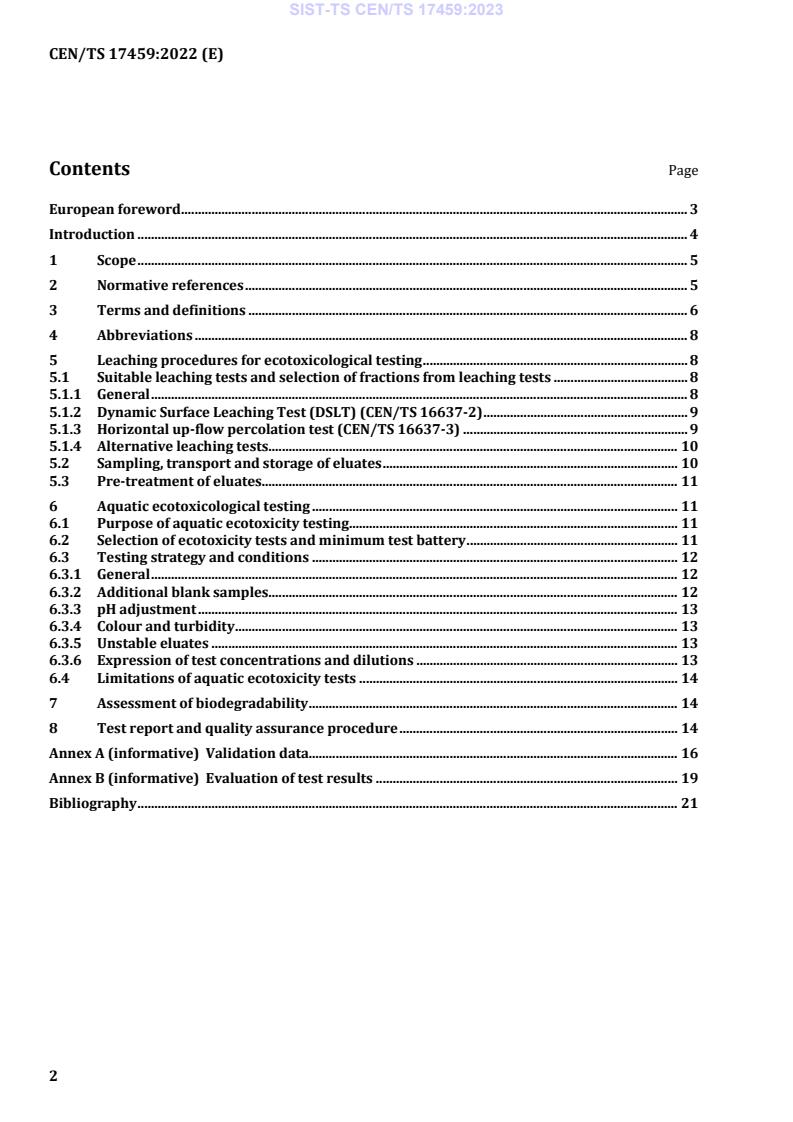
Contents Page
European foreword . 3
Introduction . 4
1 Scope . 5
2 Normative references . 5
3 Terms and definitions . 6
4 Abbreviations . 8
5 Leaching procedures for ecotoxicological testing . 8
5.1 Suitable leaching tests and selection of fractions from leaching tests . 8
5.1.1 General . 8
5.1.2 Dynamic Surface Leaching Test (DSLT) (CEN/TS 16637-2) . 9
5.1.3 Horizontal up-flow percolation test (CEN/TS 16637-3) . 9
5.1.4 Alternative leaching tests. 10
5.2 Sampling, transport and storage of eluates . 10
5.3 Pre-treatment of eluates. 11
6 Aquatic ecotoxicological testing . 11
6.1 Purpose of aquatic ecotoxicity testing . 11
6.2 Selection of ecotoxicity tests and minimum test battery . 11
6.3 Testing strategy and conditions . 12
6.3.1 General . 12
6.3.2 Additional blank samples. 12
6.3.3 pH adjustment . 13
6.3.4 Colour and turbidity . 13
6.3.5 Unstable eluates . 13
6.3.6 Expression of test concentrations and dilutions . 13
6.4 Limitations of aquatic ecotoxicity tests . 14
7 Assessment of biodegradability . 14
8 Test report and quality assurance procedure . 14
Annex A (informative) Validation data. 16
Annex B (informative) Evaluation of test results . 19
Bibliography . 21
European foreword
This document (CEN/TS 17459:2022) has been prepared by Technical Committee CEN/TC 351
“Construction products: Assessment of release of dangerous substances”, the secretariat of which is held
by NEN.
Attention is drawn to the possibility that some of the elements of this document may be the subject of
patent rights. CEN shall not be held responsible for identifying any or all such patent rights.
This document has been prepared under a Standardization Request given to CEN by the European
Commission and the European Free Trade Association.
Any feedback and questions on this document should be directed to the users’ national standards body.
A complete listing of these bodies can be found on the CEN website.
According to the CEN/CENELEC Internal Regulations, the national standards organisations of the
following countries are bound to announce this Technical Specification: Austria, Belgium, Bulgaria,
Croatia, Cyprus, Czech Republic, Denmark, Estonia, Finland, France, Germany, Greece, Hungary, Iceland,
Ireland, Italy, Latvia, Lithuania, Luxembourg, Malta, Netherlands, Norway, Poland, Portugal, Republic of
North Macedonia, Romania, Serbia, Slovakia, Slovenia, Spain, Sweden, Switzerland, Türkiye and the
United Kingdom.
Introduction
The regulatory and technical background for this document is explained in CEN/TR 17105 [1]. General
information on ecotoxicity assessment is also provided there. This document describes the assessment
of ecotoxicological properties of eluates of construction products received from horizontal leaching tests
harmonized by CEN/TC 351.
Aquatic ecotoxicity tests can be applied to eluates of construction products which come into contact with
soil or water in their intended use as described in CEN/TR 16098:2010, 3.2.2.2 Products relevant for soil,
surface water or groundwater [3] and in CEN/TS 16637-1. The test procedure specified in this document
covers construction products defined in the scope. Validation data are provided in Annex A.
This document is recommended to Technical Committees for construction products (product TCs), if they
have been mandated to address ecotoxicity in their product standards or if they are interested to include
ecotoxicity in a dossier prepared in the context of qualifications for a “without testing” status. This
document is also recommended to EOTA in case there is a wish to include ecotoxicity testing in European
Assessment Documents.
1 Scope
1) This document specifies a test procedure that combines horizontal leaching tests with ecotoxicity
tests for the assessment of eluates of the construction products specified in this scope subjected to
wet conditions in outdoor use.
2) The method specified in this document is intended for the determination of the potential ecotoxicity
of eluates extracted out of construction products containing constitutional organic components of
main categories of product matrices P (plastics and rubbers), A (sealants and adhesives) or C (paints
and coatings) according to CEN/TR 16045.
3) Construction products mainly made of inorganic materials: main categories of product matrices S
(silica-based and calcareous products) and M (metals) according to CEN/TR 16045 are excluded,
unless:
— the liquid or paste product hardens in direct contact with soil or groundwater; and
— the used binder contains > 50 % organics by mass.
NOTE 1 This exception mainly refers to products used for soil injection and stabilization, e.g. grouts.
Also, the method is not intended for construction products made of treated or untreated solid wood
in main category of product matrix W (wood-based products) according to CEN/TR 16045. For
engineered bio-based products the test procedure can be of interest.
4) This document is not applicable for the assessment of terrestrial ecotoxicity of construction products.
NOTE 2 Terrestrial ecotoxicity tests for construction products are described in CEN/TR 17105.
2 Normative references
The following documents are referred to in the text in such a way that some or all of their content
constitutes requirements of this document. For dated references, only the edition cited applies. For
undated references, the latest edition of the referenced document (including any amendments) applies.
CEN/TS 16637-1:2018, Construction products - Assessment of release of dangerous substances - Part 1:
Guidance for the determination of leaching tests and additional testing steps
CEN/TS 16637-2, Construction products - Assessment of release of dangerous substances - Part 2:
Horizontal dynamic surface leaching test
CEN/TS 16637-3, Construction products - Assessment of release of dangerous substances - Part 3:
Horizontal up-flow percolation test
EN 1484, Water analysis - Guidelines for the determination of total organic carbon (TOC) and dissolved
organic carbon (DOC)
EN 12457-1, Characterisation of waste - Leaching - Compliance test for leaching of granular waste
materials and sludges - Part 1: One stage batch test at a liquid to solid ratio of 2 l/kg for materials with high
solid content and with particle size below 4 mm (without or with size reduction)
EN ISO 5667-16, Water quality - Sampling - Part 16: Guidance on biotesting of samples (ISO 5667-16)
EN ISO 6341, Water quality - Determination of the inhibition of the mobility of Daphnia magna Straus
(Cladocera, Crustacea) - Acute toxicity test (ISO 6341)
EN ISO 8692, Water quality - Fresh water algal growth inhibition test with unicellular green algae
(ISO 8692)
EN ISO 9408, Water quality - Evaluation of ultimate aerobic biodegradability of organic compounds in
aqueous medium by determination of oxygen demand in a closed respirometer (ISO 9408)
EN ISO 9439, Water quality - Evaluation of ultimate aerobic biodegradability of organic compounds in
aqueous medium - Carbon dioxide evolution test (ISO 9439)
EN ISO 11348-1, Water quality - Determination of the inhibitory effect of water samples on the light
emission of Vibrio fischeri (Luminescent bacteria test) - Part 1: Method using freshly prepared bacteria
(ISO 11348-1)
EN ISO 15088, Water quality - Determination of the acute toxicity of waste water to zebrafish eggs (Danio
rerio) (ISO 15088)
EN ISO 20079, Water quality - Determination of the toxic effect of water constituents and waste water on
duckweed (Lemna minor) - Duckweed growth inhibition test (ISO 20079)
ISO 11350, Water quality — Determination of the genotoxicity of water and waste water —
Salmonella/microsome fluctuation test (Ames fluctuation test)
ISO 13829, Water quality — Determination of the genotoxicity of water and waste water using the umu-
test
3 Terms and definitions
For the purposes of this document, the following terms and definitions apply.
ISO and IEC maintain terminology databases for use in standardization at the following addresses:
— ISO Online browsing platform: available at https://www.iso.org/obp
— IEC Electropedia: available at https://www.electropedia.org
3.1
biotesting
technique for evaluating the biological effect, either qualitatively or quantitatively, of various substances
in water by means of changes in a specified biological activity
Note 1 to entry: Biotesting is a broader term than ecotoxicity test and covers also for instance biodegradability
tests.
[SOURCE: ISO 6107:2021, 3.65]
3.2
biodegradation
mineralization of organic compounds by bacteria and fungi to carbon dioxide, water and inorganic
compounds
3.3
control
mixture of control medium and organisms used in the test without test sample
3.4
control medium
combination of dilution water and/or nutrient medium used in the test
[SOURCE: EN ISO 20079:2006, 3.6]
3.5
dilution level
D
reciprocal value of the volume fraction of test sample in dilution water in which the test is conducted
EXAMPLE 250 ml of test sample in a total volume of 1 000 ml (volume fraction of 25 %) represents dilution
level D = 4.
[SOURCE: EN ISO 15088:2008, 3.2, modified — “waste water” replaced by “test sample”]
3.6
dilution water
water added to the test sample to prepare a series of defined dilutions
Note 1 to entry: The composition of the water is specified in the specific test.
[SOURCE: EN ISO 20079:2006, 3.7]
3.7
ecotoxicity test
method for determining potential adverse effects to biological systems which a sample has an inherent
capacity to cause
3.8
effective concentration
EC
x
concentration of the test sample at which an effect of x % is measured, if compared to the control
[SOURCE: ISO 20227:2017, 3.1]
3.9
eluate
aqueous solution recovered from a leaching test
[SOURCE: CEN/TR 16110:2010, 3.2]
3.10
leaching test
laboratory test during which a construction product is put into contact with a leachant under strictly
defined conditions for the determination of the release of substances into water
3.11
lowest ineffective dilution
dilution factor
LID
lowest ineffective dilution tested, expressed as dilution level D (3.5), at which no inhibition, or only effects
not exceeding the test-specific variability, are observed
[SOURCE: EN ISO 15088:2008, 3.5]
3.12
storage time
period of time between filling of the sample container and further treatment of the sample in the
laboratory, if stored under predefined conditions
[SOURCE: EN ISO 5667-3:2018, 3.4]
3.13
test material
material to be tested
[SOURCE: ISO 17126:2005, 3.3]
4 Abbreviations
For the purposes of this document, the following abbreviations apply.
CEN/TC Technical Committee in CEN
CEN/TR Technical Report adopted by CEN
CEN/TS Technical Specification adopted by CEN
CI confidence interval
DOC dissolved organic carbon
DSLT dynamic surface leaching test
EC effective concentration
EOTA European Organization for Technical Assessment
LID lowest ineffective dilution
n.d. not determined
PI prediction interval
TOC total organic carbon
5 Leaching procedures for ecotoxicological testing
5.1 Suitable leaching tests and selection of fractions from leaching tests
5.1.1 General
This document is part of a modular horizontal approach and belongs to the analytical step
(CEN/TS 16637-1:2018, Figure 2, number 6). This approach was adopted in CEN/TC 351. “Horizontal”
means that the methods can be used for products with certain properties as described in
CEN/TS 16637-1. “Modular” means that a test standard developed in this approach concerns a specific
step in assessing a property and not the whole “chain of measurement” (from sampling to analyses).
Differing from the modules for chemical analyses this document also contains limited modifications to
the leaching step (CEN/TS 16637-1:2018, Figure 2, number 5) as detailed below.
A leaching method shall be selected using guidance given in CEN/TS 16637-1. Eluates from the DSLT
according to CEN/TS 16637-2 and column test according to CEN/TS 16637-3 are suitable for ecotoxicity
tests on the basis of current experience and shall be respectively chosen as the default option, where
allowed according to CEN/TS 16637-1.
The selection of fractions from leaching tests for ecotoxicity tests depends on the purpose of the testing
approach. Generally, for many construction products the maximum effect is expected to occur with the
first elution steps. It is often also practicable to test the first two fractions, because organic substances
are not always stable during long immersion periods.
An alternative option for the selection of fractions is to define an indicative parameter (e.g. substances of
interest) which is analysed in each eluate fraction. The two fractions with the highest amount of the
indicative parameter are combined and tested.
For construction products with continuously releasing compounds, those fractions with the longest
contact time from an advanced stage of the leaching procedure can exhibit higher effects. By comparison
of effects from different fractions, the longer-term behaviour of the construction products can be
assessed. The use of this option should be justified with an indicative parameter.
NOTE For declaration purposes the default options specified in this document are considered adequate.
The results of ecotoxicity tests with the same product, but using a different leaching test are not
comparable due to the different test conditions.
5.1.2 Dynamic Surface Leaching Test (DSLT) (CEN/TS 16637-2)
CEN/TS 16637-2 describes a tank test for monolithic construction products of > 40 mm edge length in all
directions and for plates or sheets with a surface area of > 100 cm exposed to the eluate. In the standard
procedure, this test is carried out for 64 days, while the eluate water is replaced at distinct time intervals
(after 6 h, 24 h, 2,25 d, 4 d, 9 d, 16 d, 36 d and 64 d).
In order to generate suitable eluates for ecotoxicity testing the DSLT according to CEN/TS 16637-2 shall
be performed as follows:
— only the first two elution steps after 6 h and additional 18 h are carried out and both eluates are
unified for ecotoxicity testing;
2 2
(2 ml/cm ), is
— the lower limit of the liquid / surface area relation (L/A), corresponding to 20 l/m
applied in order to maximize the concentration level in the eluates (smallest liquid to surface area).
NOTE These adjustments have been applied in the European round robin tests for the ecotoxicological
characterization of construction products [9] [25].
It is recommended to investigate eluates that represent other elution steps, if information on later stages
of leaching processes is desired.
5.1.3 Horizontal up-flow percolation test (CEN/TS 16637-3)
The horizontal up-flow percolation test is a method to determine the leaching behaviour of non-volatile
inorganic and organic substances from granular construction products (without or with size reduction).
The construction products are subjected to percolation with water as a function of liquid to solid ratio
under specified percolation conditions. The method is a once-through column leaching test.
Eluates from up-flow percolation tests according to CEN/TS 16637-3 shall be collected for ecotoxicity
testing until an L/S ratio of 2 l/kg is reached. Mass of test material and dimension of the applied columns
shall be adapted to obtain sufficient eluate volume for testing. Furthermore, the relationship between
maximum grain size and minimal column dimension as specified in CEN/TS 16637-3 shall be fulfilled.
It is recommended to investigate eluates that represent higher L/S ratios, if information on later stages
of leaching processes is desired.
5.1.4 Alternative leaching tests
The conditions for using other leaching tests (indirect tests) are defined in CEN/TS 16637-1:2018,
Clause 7. From the alternative methods referred to in CEN/TS 16637-1 especially EN 12457-1 and
EN 16105 are known to generate suitable eluates for ecotoxicity tests on the basis of experience with
construction products.
EN 12457-1 is a one stage batch test with a liquid to solid ratio of 2 l/kg for materials with high solid
content and with particle size below 4 mm (without or with size reduction). Where CEN/TS 16637-3 is
used as the reference method, EN 12457-1 shall be used for quality assurance where applicable.
Products that come into contact with water only occasionally in their intended use may not be stable in a
test set up with long time immersion in water as foreseen in the reference method CEN/TS 16637-2. For
these products a leaching test with short immersion phases according to EN 16105 is recommended
instead. In this test the construction products are exposed to cycles of wetting and drying.
5.2 Sampling, transport and storage of eluates
The goal of sampling is to obtain a representative eluate and to supply it to the laboratory in the correct
manner. The eluates may be susceptible to changes as a result of physical, chemical or biological
reactions. The eluates should be preferably tested immediately after sampling to avoid changes in the
original composition as a result of physical and chemical reactions and/or biological processes. If this is
not possible, e.g. because several biotests are intended to be applied, samples shall be cooled down for
transport and storage in closed, dark glass bottles to temperatures between 2 °C and 8 °C and kept in the
dark or frozen down to ≤ −18 °C. The transport shall be realized in cool boxes with ice, frozen gel packs
or cooling elements. The time span between sampling and ecotoxicity tests (storage time) shall remain
within 48 h (cooled samples) or 2 months (frozen samples). For further information see EN ISO 5667-16
and related standards referred to there.
Eluates are not suitable for biotesting if they have been treated to prevent biodegradation processes
during the leaching test. Preservatives such as biocides, acids or basic solutions that retard chemical and
biological activity shall not be added to the test samples. If samples are frozen, the DOC shall be
determined according to EN 1484 both before freezing and after thawing the sample.
The amount of eluates and number of replicate vessels depends on the test battery chosen and the test
design and should be decided beforehand. It is practicable to split the total volume of the eluate into
appropriate flasks. In this way, the different tests can be carried out independently from each other and
suitable test portions are available for potential repetitions. As a rough estimate about 100 ml to 200 ml
are needed for one test with one organism. For the algae test up to about 500 ml are required depending
on the size of the incubation vessels. Additional replicate samples for retesting the eluates in cases, where
the toxicity range has not been met, are required.
Frozen samples shall be thawed on the day of testing before use or overnight. When thawing on the day
of testing a warm water bath at a temperature not exceeding 25 °C, together with gentle shaking, shall be
used to avoid local overheating. When thawing overnight the sample shall be kept in the dark at a
temperature between 2 °C and 8 °C. A once thawed sample shall not be frozen again for subsequent
testing, but a replicate sample shall be used. An even distribution of all solub
...