

SIST EN 12608-3:2026
(Main)Unplasticized poly(vinyl chloride) (PVC-U) profiles for the fabrication of windows and doors - Classification, requirements and test methods - Part 3: PVC-U profiles covered with paint.
- Abstract
This document specifies the classifications, requirements and test methods for unplasticized poly(vinyl chloride) (PVC-U) profiles covered with paint designed for external uses which are intended to be used for the fabrication of windows and doors.
NOTE 1 The terms lacquer, varnish and coating are used as synonyms for paint.
NOTE 2 For editorial reasons in this document the term “window” is used for window/door.
NOTE 3 For the purpose of production control, test methods other than those specified in this document can be used.
- Status
- Published
- Public Enquiry End Date
- 15-Oct-2025
- Publication Date
- 27-Oct-2026
- Technical Committee
- IPMA - Polimer materials and products
- Current Stage
- 6060 - National Implementation/Publication (Adopted Project)
- Start Date
- 26-Oct-2026
- Due Date
- 31-Dec-2026
- Completion Date
- 28-Oct-2026

SIST EN 12608-3:2026 is a Slovenian standard for unplasticized poly(vinyl chloride) (PVC-U) profiles covered with paint for windows and doors. It specifies how these external-use profiles are classified, what they must meet, and which test methods are used to check the base profile, the paint and the finished painted profile.
What does SIST EN 12608-3:2026 specify?
SIST EN 12608-3:2026 applies to PVC-U profiles covered with paint that are intended for fabrication of windows and doors for external use. It also gives the structure of the document, with classifications in Clause 4, requirements in Clauses 5 to 7, test methods in Clause 8, traceability in Clause 9, and a normative Annex A.
| Annex | What it covers |
|---|---|
| Annex A | Determination of the reflection behaviour of paints by spectral analysis |
The scope notes that lacquer, varnish and coating are used as synonyms for paint. It also notes that the term “window” is used for window/door for editorial reasons, and that other test methods may be used for production control.
What are the key requirements of SIST EN 12608-3:2026?
SIST EN 12608-3:2026 builds on the base profile rules in prEN 12608-1:2025 and adds requirements for paint and the finished painted profile. In practice, that means the document is not only about appearance - it also covers weathering resistance, adhesion, colour stability, weldability and traceability.
Classification and base profile requirements
Clause 4 classifies main base profiles by external wall thickness, falling-mass impact resistance, base profile material weathering resistance, and paint weathering resistance. For the base profile itself, Clause 5 says that if the base profile already conforms to EN 12608-1, no extra base-profile requirements apply.
If other base profiles are used, Clause 5 requires suitable material selection, smooth surfaces, clean edges, dimensions and tolerances aligned with Part 1, linear weight, heat reversion and impact resistance. This matters because the paint layer cannot compensate for a weak or poorly made PVC-U profile.
Requirements for paints
Clause 6 says the paint must be defined for PVC-U window profiles and suitable for external use. Weathering is checked by exposure in EN 513, Method 1 or Method 2, for a duration matched to the class in Table 1, and every colour in the paint range must be tested.
After weathering, the paint must retain colour and surface integrity. Clause 6 also requires solar direct reflectance testing for the darkest paint or the paint with the most carbon black pigment, using Annex A and EN 410. For the reader, this means dark external colours need special attention because they are part of the performance assessment.
Requirements for painted profiles
Clause 7 covers the finished painted profile. Appearance must be uniform, with no cracks, blisters, holes or other defects, and visible surfaces must keep sufficient covering power. Colour is checked by colorimetric measurement or, for some cases, by grey-scale visual assessment.
Clause 7 also limits deviation from straightness, requires Class 0 in the cross-cut test, and limits layer thickness to the paint manufacturer’s or applier’s tolerance. Welded corners and T-joints must meet the same strength requirements as the base profiles, and after artificial weathering the painted profile must still pass cross cut and keep Charpy impact strength within the stated reduction limit. This is the practical evidence that the paint system survives fabrication and ageing.
Traceability
Clause 9 requires traceability information such as the responsible company names, the relevant classes, production codes for extrusion and paint process, the document reference, and special markings for recovered PVC (rPVC) and fibre reinforced PVC material (FR). Main profiles must be marked at least every 2 m, which helps factories and installers link a profile back to the right material and coating batch.
What terms does SIST EN 12608-3:2026 define?
- PVC-U - unplasticized poly(vinyl chloride), the rigid plastic used for the profiles in this document.
- Base profile - a profile without paint that is intended to be painted.
- Painted profile - a profile that has been covered with paint.
- Paint - one or more layers of lacquer or varnish that cover a base profile.
- rPVC - recovered PVC, identified in the traceability requirements.
- FR - fibre reinforced PVC material, also identified for traceability.
Who uses SIST EN 12608-3:2026?
SIST EN 12608-3:2026 is used by profile extruders, paint suppliers, coating applicators, window and door fabricators, test laboratories, and quality managers. It helps them select classes, verify coating performance, run weathering and adhesion tests, and keep product traceability records for external-use window and door profiles.
Which standards are used with SIST EN 12608-3:2026?
- prEN 12608-1:2025 - provides the shared base-profile classification and requirements used throughout this part.
- EN 410 - used for determining solar direct reflectance.
- EN 513 - gives the artificial weathering exposure methods for painted specimens.
- EN 514 - used for strength testing of welded corners and T-joints.
- EN 17508 - supplies terminology for PVC-based materials.
- EN 20105-A02 - provides the grey scale used for visual colour assessment.
- EN ISO 179-1 - used for Charpy impact testing after ageing.
- EN ISO 2409 - gives the cross-cut adhesion test.
- EN ISO 4892-2:2013 - used for specimen holder conditions during weathering exposure.
- EN ISO 16474-1 - gives general guidance for laboratory light exposure.
- EN ISO/CIE 11664-4 - defines CIE 1976 Lab* colour space and colour differences.
- EN ISO/CIE 11664-6 - gives the CIEDE2000 colour-difference formula used as an alternative for uniform colours.
What does the SIST EN 12608-3:2026 document contain?
The document contains classification tables for wall thickness, impact resistance and weathering resistance, plus material-use rules for visible and non-visible surfaces. It also contains requirement clauses for base profiles, paints and painted profiles, including colour, straightness, adhesion, layer thickness, welded-joint strength and artificial weathering.
Clause 8 gives the visual inspection method and the method for determining colorimetric coordinates. Annex A provides a full spectral-analysis method for measuring the reflection behaviour of paints, including specimen preparation, the required spectrophotometer setup, the calculation of solar direct reflectance and the contents of the test report.
Get Certified
Connect with accredited certification bodies for this standard

DIN CERTCO
DIN Group product certification.
DIBt (Deutsches Institut für Bautechnik)
German Institute for Building Technology.

Aboma Certification B.V.
Specialized in construction, metal, and transport sectors.
Sponsored listings
Frequently Asked Questions
SIST EN 12608-3:2026 is a standard published by the Slovenian Institute for Standardization (SIST). Its full title is "Unplasticized poly(vinyl chloride) (PVC-U) profiles for the fabrication of windows and doors - Classification, requirements and test methods - Part 3: PVC-U profiles covered with paint.". This standard covers: This document specifies the classifications, requirements and test methods for unplasticized poly(vinyl chloride) (PVC-U) profiles covered with paint designed for external uses which are intended to be used for the fabrication of windows and doors. NOTE 1 The terms lacquer, varnish and coating are used as synonyms for paint. NOTE 2 For editorial reasons in this document the term “window” is used for window/door. NOTE 3 For the purpose of production control, test methods other than those specified in this document can be used.
This document specifies the classifications, requirements and test methods for unplasticized poly(vinyl chloride) (PVC-U) profiles covered with paint designed for external uses which are intended to be used for the fabrication of windows and doors. NOTE 1 The terms lacquer, varnish and coating are used as synonyms for paint. NOTE 2 For editorial reasons in this document the term “window” is used for window/door. NOTE 3 For the purpose of production control, test methods other than those specified in this document can be used.
SIST EN 12608-3:2026 is classified under the following ICS (International Classification for Standards) categories: 83.140.99 - Other rubber and plastics products; 91.060.50 - Doors and windows. The ICS classification helps identify the subject area and facilitates finding related standards.
SIST EN 12608-3:2026 is available in PDF format for immediate download after purchase. The document can be added to your cart and obtained through the secure checkout process. Digital delivery ensures instant access to the complete standard document.
Standards Content (Sample)
SLOVENSKI STANDARD
01-december-2026
Profili iz nemehčanega polivinilklorida (PVC-U) za izdelavo oken in vrat -
Razvrščanje, zahteve in preskusne metode - 3. del: Profili PVC-U, prevlečeni z
barvo
Unplasticized poly(vinyl chloride) (PVC-U) profiles for the fabrication of windows and
doors - Classification, requirements and test methods - Part 3: PVC-U profiles covered
with paint.
Profile aus weichmacherfreiem Polyvinylchlorid (PVC-U) zur Herstellung von Fenstern
und Türen - Klassifizierung, Anforderungen und Prüfverfahren - Teil3: PVC-U-Profile mit
Lackierung
Profilés de poly(chlorure de vinyle) non plastifié (PVC‐U) pour la fabrication des
fenêtres et des portes - Classification, exigences et méthodes d’essai - Partie 3 : Profilés
en PVC‐U avec un revêtement laqué
Ta slovenski standard je istoveten z: EN 12608-3:2026
ICS:
83.140.99 Drugi izdelki iz gume in Other rubber and plastics
polimernih materialov products
91.060.50 Vrata in okna Doors and windows
2003-01.Slovenski inštitut za standardizacijo. Razmnoževanje celote ali delov tega standarda ni dovoljeno.
EN 12608-3
EUROPEAN STANDARD
NORME EUROPÉENNE
October 2026
EUROPÄISCHE NORM
ICS 83.140.99; 91.060.50
English Version
Unplasticized poly(vinyl chloride) (PVC-U) profiles for the
fabrication of windows and doors - Classification,
requirements and test methods - Part 3: PVC-U profiles
covered with paint.
Profilés de poly(chlorure de vinyle) non plastifié (PVC- Profile aus weichmacherfreiem Polyvinylchlorid (PVC-
U) pour la fabrication des fenêtres et des portes - U) zur Herstellung von Fenstern und Türen -
Classification, exigences et méthodes d'essai - Partie 3 Klassifizierung, Anforderungen und Prüfverfahren -
:Profilés en PVC-U revêtus de peinture (laque) Teil3: PVC-U-Profile mit Lackierung
This European Standard was approved by CEN on 24 August 2026.
CEN members are bound to comply with the CEN/CENELEC Internal Regulations which stipulate the conditions for giving this
European Standard the status of a national standard without any alteration. Up-to-date lists and bibliographical references
concerning such national standards may be obtained on application to the CEN-CENELEC Management Centre or to any CEN
member.
This European Standard exists in three official versions (English, French, German). A version in any other language made by
translation under the responsibility of a CEN member into its own language and notified to the CEN-CENELEC Management
Centre has the same status as the official versions.
CEN members are the national standards bodies of Austria, Belgium, Bulgaria, Croatia, Cyprus, Czech Republic, Denmark, Estonia,
Finland, France, Germany, Greece, Hungary, Iceland, Ireland, Italy, Latvia, Lithuania, Luxembourg, Malta, Netherlands, Norway,
Poland, Portugal, Republic of North Macedonia, Romania, Serbia, Slovakia, Slovenia, Spain, Sweden, Switzerland, Türkiye and
United Kingdom.
EUROPEAN COMMITTEE FOR STANDARDIZATION
COMITÉ EUROPÉEN DE NORMALISATION
EUROPÄISCHES KOMITEE FÜR NORMUNG
CEN-CENELEC Management Centre: Rue de la Science 23, B-1040 Brussels
© 2026 CEN All rights of exploitation in any form and by any means reserved Ref. No. EN 12608-3:2026 E
worldwide for CEN national Members.
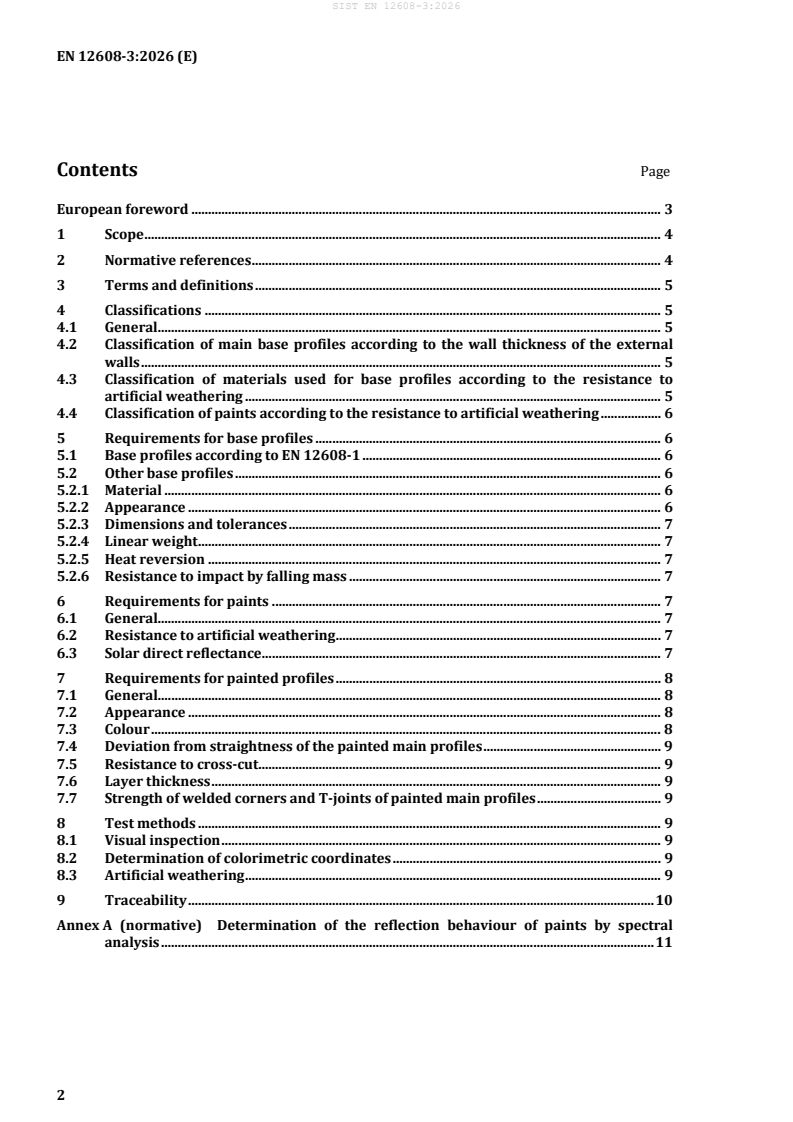
Contents Page
European foreword . 3
1 Scope . 4
2 Normative references . 4
3 Terms and definitions . 5
4 Classifications . 5
4.1 General. 5
4.2 Classification of main base profiles according to the wall thickness of the external
walls . 5
4.3 Classification of materials used for base profiles according to the resistance to
artificial weathering . 5
4.4 Classification of paints according to the resistance to artificial weathering . 6
5 Requirements for base profiles . 6
5.1 Base profiles according to EN 12608-1 . 6
5.2 Other base profiles . 6
5.2.1 Material . 6
5.2.2 Appearance . 6
5.2.3 Dimensions and tolerances . 7
5.2.4 Linear weight . 7
5.2.5 Heat reversion . 7
5.2.6 Resistance to impact by falling mass . 7
6 Requirements for paints . 7
6.1 General. 7
6.2 Resistance to artificial weathering . 7
6.3 Solar direct reflectance . 7
7 Requirements for painted profiles . 8
7.1 General. 8
7.2 Appearance . 8
7.3 Colour . 8
7.4 Deviation from straightness of the painted main profiles . 9
7.5 Resistance to cross-cut. 9
7.6 Layer thickness . 9
7.7 Strength of welded corners and T-joints of painted main profiles . 9
8 Test methods . 9
8.1 Visual inspection . 9
8.2 Determination of colorimetric coordinates . 9
8.3 Artificial weathering . 9
9 Traceability . 10
Annex A (normative) Determination of the reflection behaviour of paints by spectral
analysis . 11
European foreword
This document (EN 12608-3:2026) has been prepared by Technical Committee CEN/TC 249 “Plastics”,
the secretariat of which is held by SIS.
This European Standard shall be given the status of a national standard, either by publication of an
identical text or by endorsement, at the latest by April 2027, and conflicting national standards shall be
withdrawn at the latest by April 2027.
Attention is drawn to the possibility that some of the elements of this document may be the subject of
patent rights. CEN shall not be held responsible for identifying any or all such patent rights.
EN 12608, Unplasticized poly(vinyl chloride) (PVC-U) profiles for the fabrication of windows and doors —
Classification, requirements and test methods, currently consists of the following parts:
— Part 1: Non-covered PVC-U profiles
— Part 2: PVC-U profiles covered with foils bonded with adhesives
— Part 3: PVC-U profiles covered with paint
— Part 4: PVC-U profiles with thermo-laminated foils
— Part 5: PVC-U profiles with coextruded coloured top-layer (in preparation)
Any feedback and questions on this document should be directed to the users’ national standards body.
A complete listing of these bodies can be found on the CEN website.
According to the CEN-CENELEC Internal Regulations, the national standards organisations of the
following countries are bound to implement this European Standard: Austria, Belgium, Bulgaria, Croatia,
Cyprus, Czech Republic, Denmark, Estonia, Finland, France, Germany, Greece, Hungary, Iceland, Ireland,
Italy, Latvia, Lithuania, Luxembourg, Malta, Netherlands, Norway, Poland, Portugal, Republic of North
Macedonia, Romania, Serbia, Slovakia, Slovenia, Spain, Sweden, Switzerland, Türkiye and the United
Kingdom
1 Scope
This document specifies the classifications, requirements and test methods for unplasticized poly(vinyl
chloride) (PVC-U) profiles covered with paint designed for external uses which are intended to be used
for the fabrication of windows and doors.
NOTE 1 The terms lacquer, varnish and coating are used as synonyms for paint.
NOTE 2 For editorial reasons in this document the term “window” is used for window/door.
NOTE 3 For the purpose of production control, test methods other than those specified in this document can be
used.
2 Normative references
The following documents are referred to in the text in such a way that some or all of their content
constitutes requirements of this document. For dated references, only the edition cited applies. For
undated references, the latest edition of the referenced document (including any amendments) applies.
EN 410, Glass in building - Determination of luminous and solar characteristics of glazing
EN 513:2026, Plastics - Poly(vinyl chloride) (PVC) based profiles - Determination of the resistance to
artificial weathering
EN 12608-1:2026, Unplasticized poly(vinyl chloride) (PVC-U) profiles for the fabrication of windows and
doors - Classification, requirements and test methods - Part 1: Non-covered PVC-U profiles
EN 17508, Plastics - Unplasticized poly(vinyl chloride) (PVC-U) profiles for the fabrication of windows and
doors - Terminology of PVC based materials
EN 20105-A02, Textiles - Tests for colour fastness - Part A02: Grey scale for assessing change in colour (ISO
105-A02)
EN ISO 2409, Paints and varnishes - Cross-cut test (ISO 2409)
EN ISO 4892-2:2013, Plastics - Methods of exposure to laboratory light sources - Part 2: Xenon-arc lamps
(ISO 4892-2:2013)
EN ISO 16474-1, Paints and varnishes - Methods of exposure to laboratory light sources - Part 1: General
guidance (ISO 16474-1)
EN ISO/CIE 11664-4, Colorimetry — Part 4: CIE 1976 L*a*b* colour space (ISO/CIE 11664-4)
EN ISO/CIE 11664-6, Colorimetry — Part 6: CIEDE2000 colour-difference formula (ISO/CIE 11664-6)
3 Terms and definitions
For the purposes of this document, the terms and definitions given in EN 12608-1, EN 17508 and the
following apply.
ISO and IEC maintain terminology databases for use in standardization at the following addresses:
— ISO Online browsing platform: available at https://www.iso.org/obp/
— IEC Electropedia: available at https://www.electropedia.org/
3.1
base profile
profile without covering paint intended for painting
3.2
painted profile
profile covered with paint
Note 1 to entry: Not all surfaces of the profile need to be covered with paint.
3.3 Paint
3.3.1
paint with lacquer
continuous layer of a pigmented coating material which forms an opaque dried film with a defined colour
having protective, decorative or specific technical properties, with an optional top coat
3.3.2
paint with direct digital printing
localized application of primary colour inks (typically CMYK) in closely spaced dots, creating a visual
colour impression through optical blending, with an optional top coat
3.3.3
top coat
layer which can be applied directly on the base profile or afterwards on the painted surface to enhance
durability, gloss, or other surface properties
4 Classifications
4.1 General
The selection of appropriate classes necessary to fulfil national requirements may be given in the national
foreword of this document.
4.2 Classification of main base profiles according to th
...