

SIST EN 14579:2004
(Main)Natural stone test methods - Determination of sound speed propagation
General Information
- Abstract
This document specifies a method for the determination of the velocity of propagation of pulses of ultrasonic longitudinal waves in natural stone, both in laboratory and in situ.
- Status
- Published
- Publication Date
- 30-Nov-2004
- Technical Committee
- KAM - Natural stone
- Current Stage
- 6060 - National Implementation/Publication (Adopted Project)
- Start Date
- 01-Dec-2004
- Due Date
- 01-Dec-2004
- Completion Date
- 01-Dec-2004

Overview
SIST EN 14579:2004 is a European standard developed by CEN that specifies the test method for determining the velocity of propagation of ultrasonic longitudinal wave pulses in natural stone. This method applies both to laboratory testing and in situ conditions, providing a precise means to assess the sound speed through natural stone materials. Measuring sound speed is crucial for evaluating the quality, integrity, and characteristics of natural stones used in construction and other applications.
Key Topics
Scope
The standard covers the measurement of ultrasonic pulse velocity in natural stones to determine their sound propagation velocity.Test Principle
Ultrasonic longitudinal vibrations are generated by a transmitter transducer and passed through the stone sample. A receiving transducer captures the pulse after traversing a known path length, and electronic timing circuits measure the pulse transit time.Required Apparatus
Includes an electrical pulse generator, transducers with frequencies typically between 20 kHz and 150 kHz, an electronic timing device (oscilloscope or digital timer), and accessories like weighing instruments and drying ovens.Specimen Preparation
Test specimens are typically prisms with dimensions 300 mm x 75 mm x 50 mm, dried to constant mass at 70 ± 5 °C. The orientation of natural anisotropies such as bedding planes must be considered.Test Procedure
Transducers can be arranged for direct, semi-direct, or indirect transmission depending on accessibility and test objectives. Adequate acoustic coupling is ensured using coupling media and surface preparation techniques. Transit time is measured accurately, and pulse velocity is calculated accordingly.Result Expression
Pulse velocity (V) is calculated as the path length (L) divided by the transit time (T), expressed in km/s to two decimal places.Test Report Contents
The report should include detailed information such as sample identification, specimen dimensions, test conditions, apparatus used, and relevant stone characteristics.
Applications
Material Quality Assessment
Ultrasonic pulse velocity testing helps evaluate the homogeneity, porosity, and condition of natural stones, assisting manufacturers and construction professionals in quality control.In Situ Structural Evaluation
Enables non-destructive testing of stone structures or monuments to detect internal flaws, fissures, or areas of weakness without damaging the material.Research and Development
Supports scientific studies on stone properties and behaviors under various environmental conditions, aiding in the development of improved stone products.Correlating Mechanical Properties
Pulse velocity data can be correlated with compressive strength and other mechanical properties following supplementary standards (e.g. EN 12504-4), helping to predict performance characteristics.
Related Standards
- EN 1925 – Determination of water absorption coefficient by capillarity in natural stone.
- EN 1926 – Determination of compressive strength of natural stone.
- EN 1936 – Determination of real density, apparent density, and porosity of natural stones.
- EN 12370 – Determination of resistance to salt crystallization.
- EN 14157:2004 – Determination of abrasion resistance.
- EN 12504-4 – Concrete tests – Determination of ultrasonic pulse velocity – Methods for concrete, relevant for correlating stone test results.
These standards form a comprehensive suite for natural stone testing, ensuring consistent methodology and reliable results across rock material evaluations.
Keywords: EN 14579, natural stone test methods, ultrasonic pulse velocity, sound speed in stone, non-destructive testing, stone quality assessment, ultrasonic longitudinal waves, in situ stone testing, stone specimen preparation, ultrasonic transducers, pulse transit time measurement, acoustic coupling, natural stone standards.
Relations
- Effective Date
- 28-Jan-2026
- Effective Date
- 28-Jan-2026
- Effective Date
- 28-Jan-2026
- Effective Date
- 28-Jan-2026
- Effective Date
- 28-Jan-2026
- Effective Date
- 28-Jan-2026
- Effective Date
- 28-Jan-2026
- Revised
oSIST prEN 14579:2026 - Natural stone test methods - Determination of sound speed propagation - Effective Date
- 31-Jul-2024
Get Certified
Connect with accredited certification bodies for this standard

DIBt (Deutsches Institut für Bautechnik)
German Institute for Building Technology.
DIN CERTCO
DIN Group product certification.

Aboma Certification B.V.
Specialized in construction, metal, and transport sectors.
Sponsored listings
Frequently Asked Questions
SIST EN 14579:2004 is a standard published by the Slovenian Institute for Standardization (SIST). Its full title is "Natural stone test methods - Determination of sound speed propagation". This standard covers: This document specifies a method for the determination of the velocity of propagation of pulses of ultrasonic longitudinal waves in natural stone, both in laboratory and in situ.
This document specifies a method for the determination of the velocity of propagation of pulses of ultrasonic longitudinal waves in natural stone, both in laboratory and in situ.
SIST EN 14579:2004 is classified under the following ICS (International Classification for Standards) categories: 73.020 - Mining and quarrying; 91.100.15 - Mineral materials and products. The ICS classification helps identify the subject area and facilitates finding related standards.
SIST EN 14579:2004 has the following relationships with other standards: It is inter standard links to SIST EN 14066:2013, SIST EN 12174:2022, SIST-TP CEN/TR 17024:2017, SIST EN 12174:2006, SIST EN 16515:2015, SIST EN 16306:2013, SIST EN 12174:2014, oSIST prEN 14579:2026. Understanding these relationships helps ensure you are using the most current and applicable version of the standard.
SIST EN 14579:2004 is associated with the following European legislation: EU Directives/Regulations: 305/2011, 89/106/EEC. When a standard is cited in the Official Journal of the European Union, products manufactured in conformity with it benefit from a presumption of conformity with the essential requirements of the corresponding EU directive or regulation.
SIST EN 14579:2004 is available in PDF format for immediate download after purchase. The document can be added to your cart and obtained through the secure checkout process. Digital delivery ensures instant access to the complete standard document.
Standards Content (Sample)
2003-01.Slovenski inštitut za standardizacijo. Razmnoževanje celote ali delov tega standarda ni dovoljeno.Preskušanje naravnega kamna – Ugotavljanje hitrosti širjenja zvokaPrüfverfahren für Naturstein - Bestimmung der Geschwindigkeit der SchallausbreitungMéthodes d'essai pour pierres naturelles - Détermination de la vitesse et propagation du sonNatural stone test methods - Determination of sound speed propagation91.100.15Mineralni materiali in izdelkiMineral materials and products73.020Rudarstvo in kamnolomsko izkopavanjeMining and quarryingICS:Ta slovenski standard je istoveten z:EN 14579:2004SIST EN 14579:2004en01-december-2004SIST EN 14579:2004SLOVENSKI
STANDARD
EUROPEAN STANDARDNORME EUROPÉENNEEUROPÄISCHE NORMEN 14579October 2004ICS 73.020; 91.100.15 English versionNatural stone test methods - Determination of sound speedpropagationMéthodes d'essai pour pierres naturelles - Déterminationde la vitesse de propagation du sonPrüfverfahren für Naturstein - Bestimmung derGeschwindigkeit der SchallausbreitungThis European Standard was approved by CEN on 23 August 2004.CEN members are bound to comply with the CEN/CENELEC Internal Regulations which stipulate the conditions for giving this EuropeanStandard the status of a national standard without any alteration. Up-to-date lists and bibliographical references concerning such nationalstandards may be obtained on application to the Central Secretariat or to any CEN member.This European Standard exists in three official versions (English, French, German). A version in any other language made by translationunder the responsibility of a CEN member into its own language and notified to the Central Secretariat has the same status as the officialversions.CEN members are the national standards bodies of Austria, Belgium, Cyprus, Czech Republic, Denmark, Estonia, Finland, France,Germany, Greece, Hungary, Iceland, Ireland, Italy, Latvia, Lithuania, Luxembourg, Malta, Netherlands, Norway, Poland, Portugal, Slovakia,Slovenia, Spain, Sweden, Switzerland and United Kingdom.EUROPEAN COMMITTEE FOR STANDARDIZATIONCOMITÉ EUROPÉEN DE NORMALISATIONEUROPÄISCHES KOMITEE FÜR NORMUNGManagement Centre: rue de Stassart, 36
B-1050 Brussels© 2004 CENAll rights of exploitation in any form and by any means reservedworldwide for CEN national Members.Ref. No. EN 14579:2004: ESIST EN 14579:2004
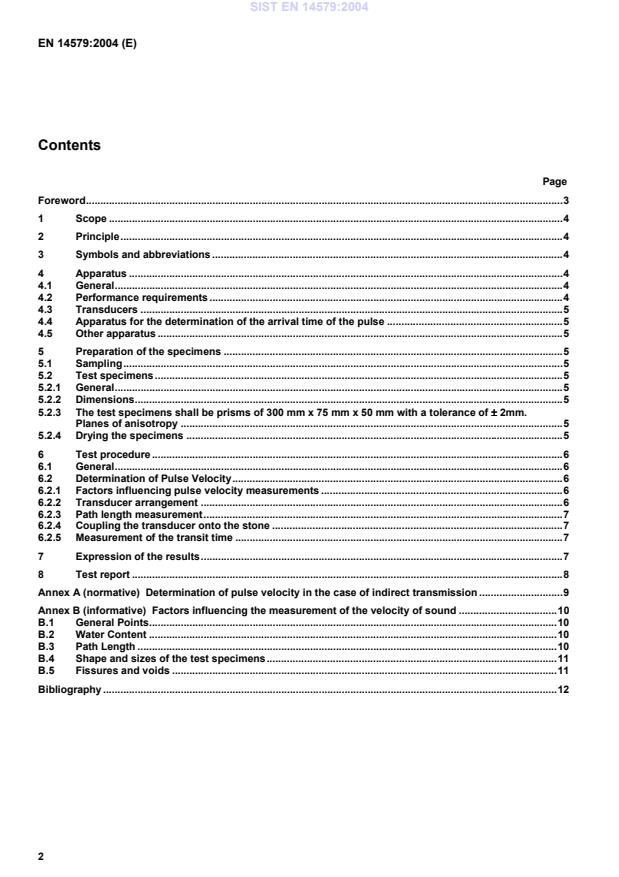
Determination of pulse velocity in the case of indirect transmission.9 Annex B (informative)
Factors influencing the measurement of the velocity of sound.10 B.1 General Points.10 B.2 Water Content.10 B.3 Path Length.10 B.4 Shape and sizes of the test specimens.11 B.5 Fissures and voids.11 Bibliography.12
Test methods for natural stone consist of the following parts: EN 1925, Natural stone test methods – Determination of water absorption coefficient by capillarity EN 1926, Natural stone test methods – Determination of compressive strength
EN 1936, Natural stone test methods – Determination of real density and apparent density, and of total and open porosity EN 12370, Natural stone test methods – Determination of resistance to salt crystallisation
EN 12372, Natural stone test methods – Determination of flexural strength under concentrated load
EN 12407, Natural stone test methods – Petrographic examination
EN 13161, Natural stone test methods – Determination of flexural strength under constant moment EN 13364, Natural stone test methods - Determination of the breaking load at dowel hole EN 13373, Natural stone test methods – Determination of geometric characteristics on units EN 13755, Natural stone test methods – Determination of water absorption at atmospheric pressure EN 13919, Natural stone test methods – Determination of resistance to ageing by SO2 action in the presence of humidity EN 14066, Natural stone test methods – Determination of resistance to ageing by thermal shock
EN 14147, Natural stone test methods – Determination of resistance to ageing by salt mist
EN 14205, Natural stone test methods - Determination of Knoop hardness EN 14231, Natural stone test methods – Determination of the slip resistance by means of the pendulum tester EN 14157:2004, Natural stone test methods – Determination of abrasion resistance
EN 14158:2004, Natural stone test methods – Determination of rupture energy
prEN 14580:2002, Natural stone test methods – Determination of the static elastic modulus
prEN 14581:2002, Natural stone test methods – Determination of linear thermal expansion coefficient
According to the CEN/CENELEC Internal Regulations, the national standards organizations of the following countries are bound to implement this European Standard: Austria, Belgium, Cyprus, Czech Republic, Denmark, Estonia, Finland, France, Germany, Greece, Hungary, Iceland, Ireland, Italy, Latvia, Lithuania, Luxembourg, Malta, Netherlands, Norway, Poland, Portugal, Slovakia, Slovenia, Spain, Sweden, Switzerland and United Kingdom.SIST EN 14579:2004
1 Scope This document specifies a method for the determination of the velocity of propagation of pulses of ultrasonic longitudinal waves in natural stone, both in laboratory and in situ. 2 Principle A pulse of longitudinal vibrations is produced by an electro-acoustical transducer held in contact with one surface of the stone under test. After traversing a known path length in the stone, the pulse of vibrations is converted into an electrical signal by a second transducer and electronic timing circuits enable the transit time of the pulse to be measured. 3 Symbols and abbreviations V
pulse velocity, in km/s L
path length, in mm T
time taken by the pulse to transverse the length, in µs 4 Apparatus 4.1 General 4.1.1 The apparatus consists essentially of an electrical pulse generator, a pair of transducers, an amplifier and an electronic timing device for measuring the time interval elapsing between the onset of a pulse generated at the transmitting transducer and the onset of its arrival at the receiving transducer. 4.1.2 Two forms of electronic timing apparatus are available: a) an oscilloscope on which the first front of the pulse is displayed in relation to a suitable time scale; b) an interval timer with a direct reading digital display. NOTE An oscilloscope provides the facility for examining the wave form, which can be advantageous in complex situations. 4.2 Performance requirements The apparatus shall comply with the following performance requirements:
- to measure transit times in the calibration bar to an accuracy of ± 0,1 µs;
- to ensure a sharp pulse onset, that is the electronic excitation pulse applied to the transmitting transducer shall have a rise time of not greater than one-quarter of its natural period;
- the pulse repetition frequency shall be low enough to ensure that the onset of the received signal is free from interference by reverberations. SIST EN 14579:2004
...