

SIST EN 62314:2008
(Main)Solid-state relays
General Information
- Abstract
States the characteristics of solid-state relays; the requirements with respect to their operation and behaviour; their dielectric properties; the degrees of protection provided by their enclosures; the tests verifying that the requirements have been met, and the test methods to be adopted.
- Status
- Published
- Publication Date
- 26-Nov-2007
- Technical Committee
- ISS EIT.ERE - All-or-nothing electrical relays
- Current Stage
- 6060 - National Implementation/Publication (Adopted Project)
- Start Date
- 25-Oct-2007
- Due Date
- 30-Dec-2007
- Completion Date
- 27-Nov-2007
- Ref Project
EN 62314:2006 - Solid-state relays

Overview
EN 62314:2006 (CLC adoption of IEC 62314:2006) is the European standard that defines the characteristics, performance requirements and test methods for solid‑state relays (SSRs) intended as components for incorporation in equipment. It specifies functional and safety-related requirements for SSRs with rated voltages up to 750 V and a.c. output currents up to 160 A. The standard covers operational behaviour, dielectric and insulation properties, enclosure protection (IP), marking/documentation and the tests required to verify compliance.
Key Topics
- Scope and applicability
- SSRs as components (not standalone devices); DC output SSRs are noted as under consideration.
- No EMC requirements included (SSR EMC is assessed in end‑product/application standards).
- Characteristics and ratings
- Rated/limiting values for load and control circuits, and prescribed load categories.
- Construction and safety
- Materials, clearance and creepage distances, terminals and heat/fire resistance.
- Insulation coordination requirements (Annex A).
- Performance and tests
- Temperature‑rise, overload, endurance, insulation and impact tests.
- OFF‑state leakage current and ON‑state voltage drop measurements.
- Ball pressure and glow‑wire (fire hazard) tests (Annex B).
- Test conditions and type‑test procedures to verify compliance.
- Marking and documentation
- Required data, installation/maintenance instructions and labelling.
- Environmental & mechanical
- Normal service, transport/storage and mounting conditions; referenced environmental tests (IEC 60068 series).
Applications and Users
EN 62314:2006 is intended for:
- Manufacturers of solid‑state relays and relay modules (component specification and type testing).
- Design engineers integrating SSRs into industrial equipment, building automation, lighting control, medical devices, telecommunications, transportation and vehicle systems.
- Test laboratories and conformity assessment bodies performing safety and dielectric testing.
- Compliance and safety teams specifying component requirements to meet product‑level standards (note: additional product/application standards may impose EMC or overcurrent requirements).
Practical value: using EN 62314 helps ensure SSRs meet standardized safety, dielectric and performance benchmarks-reducing integration risk and simplifying product certification when SSRs are incorporated into larger systems.
Related Standards
EN 62314 references several IEC standards for test methods and coordination, for example:
- IEC/EN 60529 (IP Code – degrees of protection)
- IEC/EN 60664‑1 (insulation coordination)
- IEC 60068 series (environmental testing)
- IEC/EN 60695 (glow‑wire and ball pressure tests)
- IEC 60112 (proof and comparative tracking indices)
Keywords: EN 62314:2006, solid‑state relays, SSR standard, dielectric properties, insulation coordination, ON‑state voltage drop, OFF‑state leakage, clearance creepage, glow‑wire test, ball pressure test.
Relations
- Effective Date
- 06-May-2014
- Effective Date
- 09-Feb-2026
- Effective Date
- 09-Feb-2026
- Effective Date
- 09-Feb-2026
- Effective Date
- 09-Feb-2026
- Effective Date
- 03-Feb-2026
- Effective Date
- 03-Feb-2026
- Refers
SIST EN 60695-10-2:2004 - Fire hazard testing -- Part 10-2: Abnormal heat - Ball pressure test - Effective Date
- 03-Feb-2026
- Effective Date
- 03-Feb-2026
- Refers
SIST EN 60068-2-14:2002 - Environmental testing -- Part 2: Tests - Test N: Change of temperature - Effective Date
- 03-Feb-2026
- Effective Date
- 03-Feb-2026
- Effective Date
- 03-Feb-2026
- Effective Date
- 03-Feb-2026
- Effective Date
- 03-Feb-2026
- Effective Date
- 03-Feb-2026
Get Certified
Connect with accredited certification bodies for this standard

IMQ S.p.A. (Certification)
Italian electrical product certification.

SLG Prüf- und Zertifizierungs GmbH
German testing and certification body.

UL Solutions
Global safety science company with testing, inspection and certification.
Sponsored listings
Frequently Asked Questions
SIST EN 62314:2008 is a standard published by the Slovenian Institute for Standardization (SIST). Its full title is "Solid-state relays". This standard covers: States the characteristics of solid-state relays; the requirements with respect to their operation and behaviour; their dielectric properties; the degrees of protection provided by their enclosures; the tests verifying that the requirements have been met, and the test methods to be adopted.
States the characteristics of solid-state relays; the requirements with respect to their operation and behaviour; their dielectric properties; the degrees of protection provided by their enclosures; the tests verifying that the requirements have been met, and the test methods to be adopted.
SIST EN 62314:2008 is classified under the following ICS (International Classification for Standards) categories: 29.120.70 - Relays. The ICS classification helps identify the subject area and facilitates finding related standards.
SIST EN 62314:2008 has the following relationships with other standards: It is inter standard links to SIST EN 117000:2002, SIST EN 12607-2:2000, SIST EN 1527:2000, SIST-TS CEN/TS 13126-8:2005, SIST EN ISO 6743-4:2002, SIST HD 472 S1:1996, SIST EN 61210:1999, SIST EN 60695-10-2:2004, SIST EN 61760-1:2001, SIST EN 60068-2-14:2002, SIST EN 60695-2-10:2002, SIST EN 60695-11-10:2000/A1:2004, SIST EN 60112:2004, SIST EN 60068-2-78:2002, SIST EN 60664-1:2004. Understanding these relationships helps ensure you are using the most current and applicable version of the standard.
SIST EN 62314:2008 is available in PDF format for immediate download after purchase. The document can be added to your cart and obtained through the secure checkout process. Digital delivery ensures instant access to the complete standard document.
Standards Content (Sample)
SLOVENSKI STANDARD
01-januar-2008
Polprevodniški releji (IEC 62314:2006)
Solid-state relays
Halbleiterrelais
Relais statiques
Ta slovenski standard je istoveten z: EN 62314:2006
ICS:
29.120.70 Releji Relays
2003-01.Slovenski inštitut za standardizacijo. Razmnoževanje celote ali delov tega standarda ni dovoljeno.
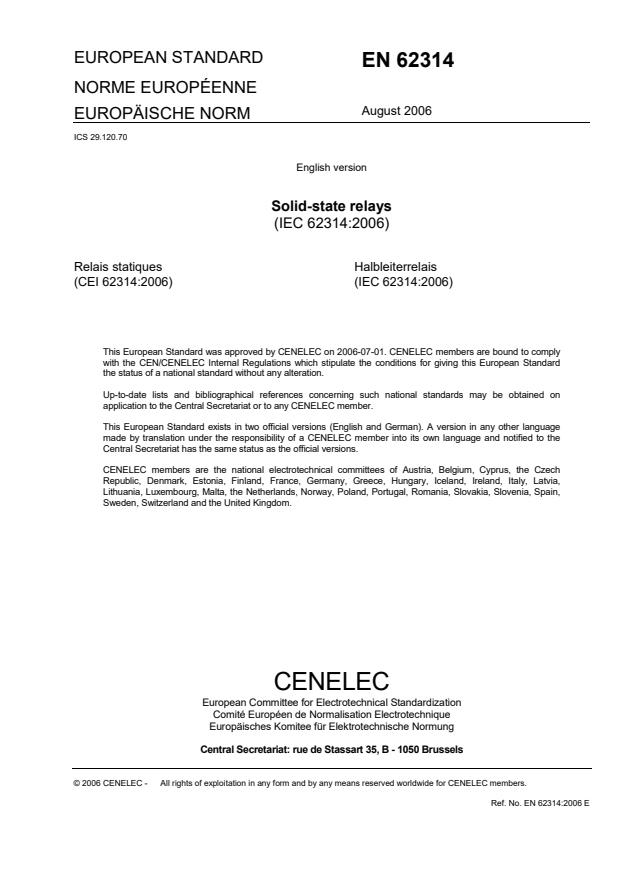
EUROPEAN STANDARD
EN 62314
NORME EUROPÉENNE
August 2006
EUROPÄISCHE NORM
ICS 29.120.70
English version
Solid-state relays
(IEC 62314:2006)
Relais statiques Halbleiterrelais
(CEI 62314:2006) (IEC 62314:2006)
This European Standard was approved by CENELEC on 2006-07-01. CENELEC members are bound to comply
with the CEN/CENELEC Internal Regulations which stipulate the conditions for giving this European Standard
the status of a national standard without any alteration.
Up-to-date lists and bibliographical references concerning such national standards may be obtained on
application to the Central Secretariat or to any CENELEC member.
This European Standard exists in two official versions (English and German). A version in any other language
made by translation under the responsibility of a CENELEC member into its own language and notified to the
Central Secretariat has the same status as the official versions.
CENELEC members are the national electrotechnical committees of Austria, Belgium, Cyprus, the Czech
Republic, Denmark, Estonia, Finland, France, Germany, Greece, Hungary, Iceland, Ireland, Italy, Latvia,
Lithuania, Luxembourg, Malta, the Netherlands, Norway, Poland, Portugal, Romania, Slovakia, Slovenia, Spain,
Sweden, Switzerland and the United Kingdom.
CENELEC
European Committee for Electrotechnical Standardization
Comité Européen de Normalisation Electrotechnique
Europäisches Komitee für Elektrotechnische Normung
Central Secretariat: rue de Stassart 35, B - 1050 Brussels
© 2006 CENELEC - All rights of exploitation in any form and by any means reserved worldwide for CENELEC members.
Ref. No. EN 62314:2006 E
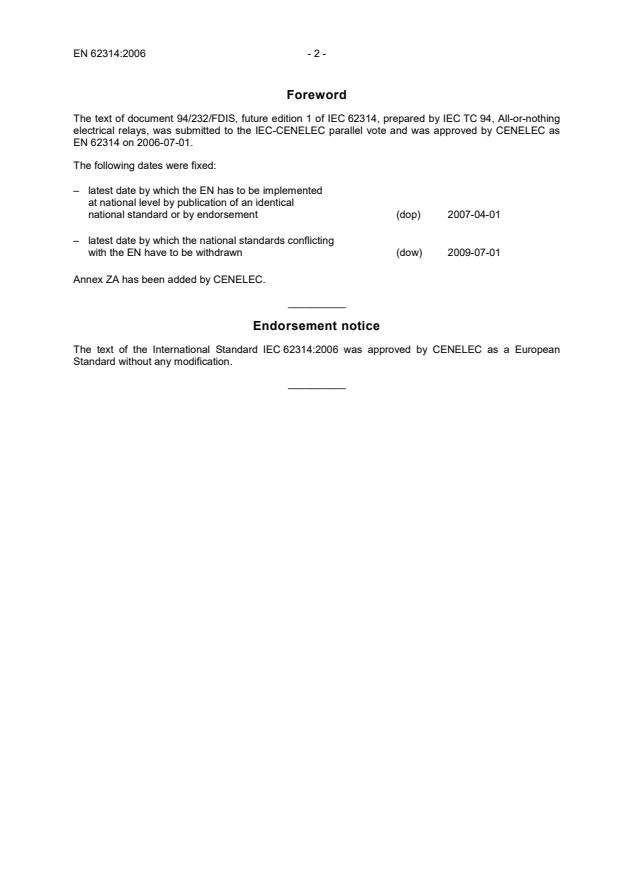
Foreword
The text of document 94/232/FDIS, future edition 1 of IEC 62314, prepared by IEC TC 94, All-or-nothing
electrical relays, was submitted to the IEC-CENELEC parallel vote and was approved by CENELEC as
EN 62314 on 2006-07-01.
The following dates were fixed:
– latest date by which the EN has to be implemented
at national level by publication of an identical
national standard or by endorsement (dop) 2007-04-01
– latest date by which the national standards conflicting
with the EN have to be withdrawn (dow) 2009-07-01
Annex ZA has been added by CENELEC.
__________
Endorsement notice
The text of the International Standard IEC 62314:2006 was approved by CENELEC as a European
Standard without any modification.
__________
- 3 - EN 62314:2006
Annex ZA
(normative)
Normative references to international publications
with their corresponding European publications
The following referenced documents are indispensable for the application of this document. For dated
references, only the edition cited applies. For undated references, the latest edition of the referenced
document (including any amendments) applies.
NOTE When an international publication has been modified by common modifications, indicated by (mod), the relevant EN/HD
applies.
Publication Year Title EN/HD Year
1)
IEC 60038 (mod) 1983 IEC standard voltages HD 472 S1 1989
- + corr. February 2002
- A1 1995
A1 1994 - -
A2 1997 - -
IEC 60050-195 1998 International Electrotechnical Vocabulary - -
(IEV)
Chapter 195: Earthing and protection against
electric shock
IEC 60050-444 2002 International Electrotechnical Vocabulary - -
Part 444: Elementary relays
IEC 60068-2-1 1990 Environmental testing EN 60068-2-1 1993
Part 2: Tests - Tests A: Cold
2)
IEC 60068-2-2 1974 Environmental testing EN 60068-2-2 1993
Part 2: Tests - Tests B: Dry heat
IEC 60068-2-14 1984 Environmental testing
+ A1 1986 Part 2: Tests - Test N: Change of EN 60068-2-14 1999
temperature
IEC 60068-2-20 1979 Environmental testing
+ A2 1987 Part 2: Tests - Test T: Soldering HD 323.2.20 S3 1988
IEC 60068-2-78 2001 Environmental testing EN 60068-2-78 2001
Part 2-78: Tests - Test Cab: Damp heat,
steady state
IEC 60112 2003 Method for the determination of the proof EN 60112 2003
and the comparative tracking indices of
solid insulating materials
3) 4)
IEC 60529 - Degrees of protection provided by EN 60529 1991
enclosures (IP Code) + corr. May 1993
1)
The title of HD 472 S1 is: Nominal voltages for low-voltage public electricity supply systems.
2)
EN 60068-2-2 includes supplement A:1976 to IEC 60068-2-2.
3)
Undated reference.
4)
Valid edition at date of issue.
Publication Year Title EN/HD Year
3) 4)
IEC 60664-1 (mod) - Insulation coordination for equipment within EN 60664-1 2003
low-voltage systems
Part 1: Principles, requirements and tests
IEC 60664-3 2003 Insulation coordination for equipment within EN 60664-3 2003
low-voltage systems
Part 3: Use of coating, potting or moulding for
protection against pollution
IEC 60695-2-10 2000 Fire hazard testing EN 60695-2-10 2001
Part 2-10: Glowing/hot-wire based test
methods - Glow-wire apparatus and common
test procedure
IEC 60695-10-2 2003 Fire hazard testing EN 60695-10-2 2003
Part 10-2: Abnormal heat - Ball pressure test
IEC 60695-11-10 1999 Fire hazard testing EN 60695-11-10 1999
A1 2003 Part 11-10: Test flames - 50 W horizontal A1 2003
and vertical flame test methods
IEC 60999-1 1999 Connecting devices - Electrical copper EN 60999-1 2000
conductors - Safety requirements for
screw-type and screwless-type clamping units
Part 1: General requirements and particular
requirements for clamping units for
conductors from 0,2 mm² up to 35 mm²
(included)
IEC 61210 (mod) 1993 Connecting devices - Flat quick-connect EN 61210 1995
terminations for electrical copper
conductors - Safety requirements
5)
IEC 61760-1 1998 Surface mounting technology EN 61760-1 1998
Part 1: Standard method for the specification
of surface mounting components (SMDs)
5)
EN 61760-1 is superseded by EN 61760-1:2006, which is based on IEC 61760-1:2006.
INTERNATIONAL IEC
STANDARD 62314
First edition
2006-05
Solid-state relays
IEC 2006 Copyright - all rights reserved
No part of this publication may be reproduced or utilized in any form or by any means, electronic or
mechanical, including photocopying and microfilm, without permission in writing from the publisher.
International Electrotechnical Commission, 3, rue de Varembé, PO Box 131, CH-1211 Geneva 20, Switzerland
Telephone: +41 22 919 02 11 Telefax: +41 22 919 03 00 E-mail: inmail@iec.ch Web: www.iec.ch
PRICE CODE
Commission Electrotechnique Internationale W
International Electrotechnical Commission
МеждународнаяЭлектротехническаяКомиссия
For price, see current catalogue
– 2 – 62314 IEC:2006(E)
CONTENTS
FOREWORD.4
1 Scope and object.6
2 Normative references .7
3 Terms and definitions .8
4 Characteristics of solid-state relays .12
4.1 Summary of characteristics .12
4.2 Type of solid-state relay .12
4.3 Rated and limiting values for load circuits.12
4.4 Load category .13
4.5 Rated and limiting values for control circuits.14
5 Marking and documentation.14
5.1 Marking .14
5.2 Data .15
5.3 Instructions for installation, operation and maintenance .15
6 Normal conditions.15
6.1 Normal service, transport and storage conditions .15
6.2 Normal mounting conditions .16
7 Constructional requirements .16
7.1 Materials .16
7.2 Clearances and creepage distances .16
7.3 Heat and fire resistance .16
7.4 Terminals .16
8 Performance requirements .17
8.1 Temperature-rise.17
8.2 Overload test.18
8.3 Endurance test .20
8.4 Insulation tests .21
8.5 Impact test .21
8.6 Ball pressure test .21
8.7 OFF-state leakage current measurement.21
8.8 ON-state voltage drop measurement .21
9 Type test .22
Annex A (normative) Insulation coordination .23
Annex B (normative) Glow-wire test .34
Annex C (normative) Quick-connect terminations.37
Figure B.1 – Glow-wire and position of the thermocouple.35
Figure B.2 – Glow-wire test apparatus (example).36
62314 IEC:2006(E) – 3 –
Table 1 – Load categories.13
Table 2 – Required data .15
Table 3 – Test conditions for test Tb .17
Table 4 – Minimum requirements for overload capability test conditions .19
Table 5 – Endurance test .20
Table A.1 – Rated impulse withstand voltages (waveform: 1,2/50 µs) for solid-state
relays connected directly to the mains .24
Table A.2 – Minimum clearances .26
Table A.3 – Minimum creepage distances for solid-state relays .27
Table A.4 – Preconditioning .29
Table C.1 – Cross-sectional areas for conductors depending on the resistive current
carried by the terminal .38
– 4 – 62314 IEC:2006(E)
INTERNATIONAL ELECTROTECHNICAL COMMISSION
____________
SOLID-STATE RELAYS
FOREWORD
1) The International Electrotechnical Commission (IEC) is a worldwide organization for standardization comprising
all national electrotechnical committees (IEC National Committees). The object of IEC is to promote
international co-operation on all questions concerning standardization in the electrical and electronic fields. To
this end and in addition to other activities, IEC publishes International Standards, Technical Specifications,
Technical Reports, Publicly Available Specifications (PAS) and Guides (hereafter referred to as “IEC
Publication(s)”). Their preparation is entrusted to technical committees; any IEC National Committee interested
in the subject dealt with may participate in this preparatory work. International, governmental and non-
governmental organizations liaising with the IEC also participate in this preparation. IEC collaborates closely
with the International Organization for Standardization (ISO) in accordance with conditions determined by
agreement between the two organizations.
2) The formal decisions or agreements of IEC on technical matters express, as nearly as possible, an international
consensus of opinion on the relevant subjects since each technical committee has representation from all
interested IEC National Committees.
3) IEC Publications have the form of recommendations for international use and are accepted by IEC National
Committees in that sense. While all reasonable efforts are made to ensure that the technical content of IEC
Publications is accurate, IEC cannot be held responsible for the way in which they are used or for any
misinterpretation by any end user.
4) In order to promote international uniformity, IEC National Committees undertake to apply IEC Publications
transparently to the maximum extent possible in their national and regional publications. Any divergence
between any IEC Publication and the corresponding national or regional publication shall be clearly indicated in
the latter.
5) IEC provides no marking procedure to indicate its approval and cannot be rendered responsible for any
equipment declared to be in conformity with an IEC Publication.
6) All users should ensure that they have the latest edition of this publication.
7) No liability shall attach to IEC or its directors, employees, servants or agents including individual experts and
members of its technical committees and IEC National Committees for any personal injury, property damage or
other damage of any nature whatsoever, whether direct or indirect, or for costs (including legal fees) and
expenses arising out of the publication, use of, or reliance upon, this IEC Publication or any other IEC
Publications.
8) Attention is drawn to the Normative references cited in this publication. Use of the referenced publications is
indispensable for the correct application of this publication.
9) Attention is drawn to the possibility that some of the elements of this IEC Publication may be the subject of
patent rights. IEC shall not be held responsible for identifying any or all such patent rights.
International Standard IEC 62314 has been prepared by technical committee 94: All-or-
nothing electrical relays.
The text of this standard is based on the following documents:
FDIS Report on voting
94/232/FDIS 94/235/RVD
Full information on the voting for the approval of this standard can be found in the report on
voting indicated in the above table.
This publication has been drafted in accordance with the ISO/IEC Directives, Part 2.
62314 IEC:2006(E) – 5 –
The committee has decided that the contents of this publication will remain unchanged until
the maintenance result date indicated on the IEC web site under "http://webstore.iec.ch" in
the data related to the specific publication. At this date, the publication will be
• reconfirmed;
• withdrawn;
• replaced by a revised edition, or
• amended.
A bilingual version of this publication may be issued at a later date.
– 6 – 62314 IEC:2006(E)
SOLID-STATE RELAYS
1 Scope and object
This International Standard applies to particular all-or-nothing electrical relays denominated
solid-state relays intended for performing electrical operations by single step function
changes to the state of electric circuits between the OFF-state and the ON-state and vice
versa. It is applicable to solid-state relays with rated voltages up to 750 V and with a.c. output
current up to 160 A.
NOTE Requirements for solid-state relays with d.c. output circuits are under consideration.
This standard deals with solid-state relays which are intended for incorporation in other
products or equipment. As such, solid state relays are considered to be components and this
standard defines the basic safety-related and functional requirements for solid-state relays as
stand-alone components.
Such solid-state relays are incorporated in products or equipment which themselves have to
comply with the relevant product and/or application standard(s) to meet their intended
application. The following are examples of such applications:
– general industrial equipment;
– electrical facilities;
– electrical machines;
– electrical appliances;
– office communications;
– building automation and environmental control;
– automation and process control;
– electrical installation engineering;
– medical engineering;
– telecommunications;
– vehicle engineering;
– transportation engineering;
– lighting control.
Solid state relays are components (not stand alone devices) and as such do not perform a
direct function. Therefore, no EMC requirements are included in this standard.
NOTE This is in line with the European EMC Directive.
Where the application of a solid-state relay determines additional requirements such as EMC
and overcurrent protection, the solid-state relay shall be assessed in accordance with the
relevant IEC standard(s).
Solid-state switching devices with monolithic structures fall within the scope of IEC sub-
committee 47E and are not covered in this standard.
Semiconductor controllers and contactors fall within the scope of the IEC 60947 series of
standards – Low-voltage switchgear and controlgear – developed by IEC subcommittee 17B
and are not covered in this standard.
Compliance with the requirements of this standard is verified by the type tests indicated.
62314 IEC:2006(E) – 7 –
The object of this standard is to state:
– the characteristics of solid-state relays;
– the requirements which solid-state relays shall comply with reference to
a) their operation and behaviour;
b) their dielectric properties;
c) the degrees of protection provided by their enclosures, where applicable;
– the tests verifying that the requirements have been met, and the test methods to be
adopted;
– the information to be given with the solid-state relay or in the manufacturer’s documentation.
2 Normative references
The following referenced documents are indispensable for the application of this document.
For dated references, only the edition cited applies. For undated references, the latest edition
of the referenced document (including any amendments) applies.
IEC 60038:1983, IEC standard voltages
Amendment 1 (1994)
Amendment 2 (1997)
IEC 60050-195:1998, International Electrotechnical Vocabulary (IEV) – Part 195: Earthing and
protection against electric shock
IEC 60050-444:2002, International Electrotechnical Vocabulary (IEV) – Part 444: Elementary
relays
IEC 60068-2-1:1990, Environmental testing – Part 2: Tests. Tests A: Cold
IEC 60068-2-2:1974, Environmental testing – Part 2: Tests. Tests B: Dry heat
IEC 60068-2-14:1984, Environmental testing – Part 2: Tests. Test N: Change of temperature
Amendment 1 (1986)
IEC 60068-2-20:1979, Environmental testing – Part 2: Tests. Test T: Soldering
Amendment 2 (1987)
IEC 60068-2-78:2001, Environmental testing – Part 2-78: Tests – Test Cab: Damp heat,
steady state
IEC 60112:2003, Method for the determination of the proof and the comparative tracking
indices of solid insulating materials
IEC 60529, Degrees of protection provided by enclosures (IP Code)
IEC 60664-1, Insulation coordination for equipment within low-voltage systems – Part 1:
Principles, requirements and tests
IEC 60664-3:2003, Insulation coordination for equipment within low-voltage systems – Part 3:
Use of coating, potting or moulding for protection against pollution
IEC 60695-2-10:2000, Fire hazard testing – Part 2-10: Glowing/hot-wire based test methods –
Glow-wire apparatus and common test procedure
– 8 – 62314 IEC:2006(E)
IEC 60695-10-2:2003, Fire hazard testing – Part 10-2: Abnormal heat – Ball pressure test
IEC 60695-11-10:2003, Fire hazard testing – Part 11-10: Test flames – 50 W horizontal and
vertical flame test methods
IEC 60999-1:1999, Connecting devices – Electrical copper conductors – Safety requirements
for screw-type and screwless-type clamping units – Part 1: General requirements and
2 2
particular requirements for clamping units for conductors from 0,2 mm up to 35 mm
(included)
IEC 61210:1993, Connecting devices – Flat quick-connect terminations for electrical copper
conductors – Safety requirements
IEC 61760-1:1998, Surface mounting technology – Part 1: Standard method for the
specification of surface mounting components (SMDs)
3 Terms and definitions
For the purposes of this document the terms and definitions given in IEC 60050(444) and the
following apply. .
3.1 Terms and definitions related to relays
3.1.1
solid-state relay
electrical relay in which the intended response is produced by electronic, magnetic, optical or
other components without mechanical motion
[IEV 444-01-06]
3.1.2
electrical relay
device designed to produce sudden and predetermined changes in one or more output circuits
when certain conditions are fulfilled in the electrical input circuits controlling the device
[IEV 444-01-01]
3.1.3
rated operational voltage
U
e
value of voltage which determines the application of the solid-state relay and to which the
relevant tests and the load categories are referred
3.1.4
rated insulation voltage
U
i
value of voltage to which dielectric tests and creepage distances are referred
3.1.5
rated impulse withstand voltage
U
imp
peak value of an impulse voltage of prescribed form and polarity which the solid-state relay is
capable of withstanding without failure under specified conditions of test and to which the
values of the clearances are referred
62314 IEC:2006(E) – 9 –
3.1.6
rated operational current
I
e
normal operating current when the solid-state relay is in the ON-state and takes into account
the rated operating voltage, the rated frequency (see 4.3), the load category (see 4.4) and the
overload characteristics at 40 °C ambient temperature unless otherwise specified
3.1.7
rated uninterrupted current
I
u
value of current, stated by the manufacturer, which the solid-state relay can carry in
uninterrupted duty
3.1.8
rated frequency
supply frequency for which a solid-state relay is designed and to which the other character-
istic values correspond
NOTE The same solid-state relay may be assigned a number or a range of rated frequencies or be rated for both
a.c. and d.c.
3.1.9
overload current profile
gives the current/time coordinates for the controlled overload current
3.1.10
operating capability
represents the combined capabilities of
– current-commutation and current-carrying in the ON-state, and
– establishing and sustaining the OFF-state (blocking),
at maximum rated voltage under specified load and overload conditions in accordance with
load category, overload current profile and specified duty cycles
3.1.11
rated conditional short-circuit current
value of prospective current, stated by the manufacturer, which the solid-state relay,
protected by a short-circuit protective device specified by the manufacturer, can withstand
satisfactorily for the operating time of this device under the test conditions specified in the
relevant product standard
3.1.12
leakage current
I
l
r.m.s. value of maximum current, stated by the manufacturer, which the solid-state relay can
carry in OFF-state condition
3.1.13
ON-state voltage drop
U
d
peak value of voltage, stated by the manufacturer, between solid-state relay terminals in the
ON-state condition
– 10 – 62314 IEC:2006(E)
3.2 Terms and definitions related to insulation coordination (see Annex A)
3.2.1
clearance
shortest distance in air between two conductive parts
(IEC 60664-1, 1.3.2)
3.2.2
creepage distance
shortest distance along the surface of the insulating material between two conductive parts
(IEC 60664-1, 1.3.3)
3.2.3
functional insulation
insulation between conductive parts which is necessary only for the proper functioning of the
equipment
(IEC 60664-1, 1.3.17.1)
3.2.4
solid insulation
solid insulating material interposed between two conductive parts
(IEC 60664-1, 1.3.4)
3.2.5
basic insulation
insulation applied to live parts to provide basic protection against electric shock
NOTE Basic insulation does not necessarily include insulation used exclusively for functional purposes.
(IEC 60664-1, 1.3.17.2)
3.2.6
supplementary insulation
independent insulation applied in addition to basic insulation, in order to provide protection
against electric shock in the event of a failure of basic insulation
(IEC 60664-1, 1.3.17.3)
3.2.7
double insulation
insulation comprising both basic insulation and supplementary
(IEC 60664-1, 1.3.17.4)
3.2.8
reinforced insulation
single insulation system applied to live parts, which provides a degree of protection against
electric shock equivalent to double insulation under the conditions specified in the relevant
IEC standard
NOTE A single insulation system does not imply that the insulation must be one homogeneous piece. It may
comprise several layers which cannot be tested singly as basic or supplementary insulation.
(IEC 60664-1, 1.3.17.5)
62314 IEC:2006(E) – 11 –
3.2.9
overvoltage
any voltage having a peak value exceeding the corresponding peak value of the steady-state
voltage at normal operating conditions
(IEC 60664-1, 1.3.7)
3.2.10
overvoltage category
numeral defining a transient overvoltage condition
NOTE Overvoltage categories I, II, III and IV are used, see 2.2.2.1 of IEC 60664-1.
(IEC 60664-1, 1.3.10)
3.2.11
pollution
any addition of foreign matter, solid, liquid or gaseous that can result in a reduction of electric
strength or surface resistivity of the insulation
(IEC 60664-1, 1.3.11)
3.2.12
micro-environment
immediate environment of the insulation which particularly influences the dimensioning of the
creepage distances
(IEC 60664-1, 1.3.12.2)
3.2.13
macro-environment
environment of the room or other location in which the equipment is installed or used
(IEC 60664-1, 1.3.12.1)
3.2.14
pollution degree
numeral characterising the expected pollution of the micro-environment
NOTE Pollution degrees 1, 2, 3 and 4 are used, see 2.5.1 of IEC 60664-1.
(IEC 60664-1, 1.3.13)
3.2.15
type 1 protection
protection against pollution by the use of coating, potting or moulding assuming Pollution
degree 1 under the protection
NOTE 1 Requirements and tests are given in IEC 60664-3.
NOTE 2 Pollution degree 1 is specified in A.2.3.
– 12 – 62314 IEC:2006(E)
4 Characteristics of solid-state relays
4.1 Summary of characteristics
The characteristics of solid-state relays shall be stated with the following terms, where such
terms are applicable:
– type of solid-state relay (see 4.2);
– rated and limiting values for load circuits (see 4.3);
– load category (see 4.4);
– rated and limiting values for control circuits (see 4.5).
4.2 Type of solid-state relay
The following shall be stated:
– number of poles;
– type of poles.
4.3 Rated and limiting values for load circuits
The rated and limiting values established for solid-state relays shall be stated in accordance
with the following, but it need not to be performed to establish all applicable values by tests.
Rated voltages
– rated operational voltage (U );
e
– ON-state voltage drop (U );
d
– rated insulation voltage (U ).
i
In no case shall the maximum value of the rated operational voltage exceed that of the
rated insulation voltage.
NOTE Where no rated insulation voltage is specified for a solid-state relay, the highest value of the rated
operational voltage is considered to be the rated insulation voltage.
– rated impulse withstand voltage (U ).
imp
The rated impulse withstand voltage of a solid-state relay shall be equal to or higher than
the values stated for the transient overvoltages occurring in the circuit in which the solid-
state relay is incorporated.
Rated currents
– rated operational current (I );
e
– rated uninterrupted current (I );
u
– leakage current (I ).
l
The requirements shall be given by the manufacturer.
62314 IEC:2006(E) – 13 –
Rated frequency
Normal load and overload characteristics
– overload current profile
The overload current as a multiple of I (see Table 4) and represents the maximum value
e
of operating current under operational overload conditions.
Deliberate overcurrents not exceeding ten cycles of the power-line frequency which may
exceed the stated values of Table 4 are disregarded for the overload current profile.
– operating capability
Operating capability is characterized by
– rated operational voltage;
– rated operational current;
– overload current profile;
– load category.
Requirements are given in Clause 8.
Rated conditional short-circuit current
4.4 Load category
The load categories as given in Table 1 are considered standard. Any other type of load shall
be based on agreement between manufacturer and user, but information given in the
manufacturer’s catalogue or tender may constitute such an agreement.
Each load category (see Table 1) is characterized by the values of the currents, voltages,
power factors and other data of Tables 4 and 5 and by the test conditions specified in this
standard.
A designated solid-state relay with a rating for one load category which has been verified by
testing can be assigned other load categories without testing provided that
– the rated operational current and voltage that are verified by testing shall be not less than
the ratings that are to be assigned without testing;
– the load category and duty cycle requirements for the tested rating shall be equal to or
more severe than the rating that is to be assigned without testing;
– the overload current profile for the tested rating shall be equal to or more severe than the
rating that is to be assigned without testing.
Table 1 – Load categories
Load Typical application
category
LC A Resistive or slightly inductive loads
LC B Motor loads
LC C Electric discharge lamps
LC D Incandescent lamps
LC E Transformers
LC F Capacitive loads
– 14 – 62314 IEC:2006(E)
4.5 Rated and limiting values for control circuits
The characteristics of electronic control circuits are:
– kind of current;
– power consumption;
– rated frequency;
– rated control circuit voltage, U ;
c
– rated control supply voltage, U ;
s
– switch-off voltage;
– switch-on voltage.
The rated control circuit voltage and rated frequency, if any, are the values on which the
operating and temperature-rise characteristics of the control circuit are based. The
manufacturer shall state the absolute minimum and the maximum operating values of the
control circuit voltage U and the control supply voltage U .
c s
NOTE 1 The manufacturer should be prepared to state the value or values of the current taken by the control
circuit(s) at the rated control supply voltage.
NOTE 2 A distinction is made between control circuit voltage, U , which is the controlling input signal, and control
c
supply voltage, U , which is the voltage applied to energize the power supply terminals of the control circuit
s
equipment and may be different from U due to built-in transformers, rectifiers, etc.
c
5 Marking and documentation
5.1 Marking
Data 1a) and 1b) in Table 2 shall be marked on the solid-state relay so that they are legible
and durable. If there is enough space on the solid-state relay 2a), 2b) and 2c) as well as the
rated control supply voltage and terminal identification shall be marked additionally on the
solid-state relay.
The test indicated below is carried out when only additional material(s) are used for marking
(e.g. inkjet or pad printing).
Compliance with the durability requirements of for the marking is checked by inspection and
by rubbing the marking by hand as follows:
a) 15 back-and-forth movements in about 15 s with a piece of cloth soaked with distilled
water, followed by
b) 15 back-and-forth movements in about 15 s with a piece of cloth soaked with petroleum
spirit.
During the tests, the soaked piece of cloth shall be pressed on the marking with a pressure of
about 2 N/cm .
After these tests, the marking shall still be legible.
NOTE The petroleum spirit used is defined as an aliphatic solvent hexane with a content of aromatics of
maximum 0,1 volume %, a kauributanol-value of 29, initial boiling point approximately 65 °C, dry point
approximately 69 °C and specific gravity of 0,68 g/cm .
62314 IEC:2006(E) – 15 –
5.2 Data
The manufacturer shall have available the data listed in Table 2:
Table 2 – Required data
N° Data Place of indication
1 Identification
1a The manufacturer’s name or trademark Solid-state relay
1b Type designation or part number Solid-state relay
1c Number of this standard Catalogue or instruction sheet
2 Characteristics, basic rated values and load
2a Rated operational voltages Solid-state relay or catalogue or instruction
sheet
2b Rated operational currents Solid-state relay or catalogue or instruction
sheet
2c Conditions for rated current Solid-state relay or catalogue or instruction
sheet
2d ON-state voltage drop Catalogue or instruction sheet
2e Leakage current Catalogue or instruction sheet
2f Load category Catalogue or instruction sheet
2g Overload current profile Catalogue or instruction sheet
2h Value of the rated frequency/frequencies Catalogue or instruction sheet
3 Safety and installation
3a Rated insulation voltage Catalogue or instruction sheet
3b Rated impulse withstand voltage Catalogue or instruction sheet
3c Pollution degree Catalogue or instruction sheet
3d Safety maximum load integral l t between 1 ms and 10 ms Catalogue or instruction sheet
3e Degree of protection according to IEC 60529 Catalogue or instruction sheet
4 Control circuits
4a Rated control circuit voltage, U , nature of current and rated frequency, Solid-state relay or catalogue or instruction
c
and, if necessary, rated control supply voltage, U , nature of current
s sheet
and rated frequency and any other information (for example impedance
matching requirements) necessary to ensure satisfactory operation of
the control circuits
5.3 Instructions for installation, operation and maintenance
The manufacturer shall provide instructions for installation, operation and maintenance.
6 Normal conditions
6.1 Normal service, transport and storage conditions
6.1.1 Ambient temperature
The preferred ambient temperature range is –5 °C to +40 °C for operation and –25 °C to
+85 °C for transport and storage of the solid-state relay, unless otherwise specified.
For operation outside this range see the manufacturer's specifications.
– 16 – 62314 IEC:2006(E)
6.1.2 Atmospheric conditions
6.1.2.1 Humidity and altitude
The manufacturer shall state the maximum relative humidity and altitude for storage, transport
and operation.
6.1.2.2 Degree of pollution
Unless otherwise stated by the manufacturer, solid-state relays are intended for use in
pollution degree 2 environmental conditions, as defined in Annex A.
6.2 Normal mounting conditions
The manufacturer shall specify the method of mounting.
7 Constructional requirements
7.1 Materials
The maximum permissible temperature of incorporated materials used in solid-state relays
shall not exceed their safe operating limits, which shall be verified by testing according to 7.3
by at least one of the following means:
a) testing of the fully assembled device; or
b) testing of individual parts, or group of parts forming a subassembly, taken from the device;
or
c) samples of identical material with a representative cross-section.
7.2 Clearances and creepage distances
See Clause A.3.
7.3 Heat and fire resistance
If an identical material with representative cross-sections has already satisfied the
requirements of any of the tests in 7.3, then these tests need not be repeated.
The manufacturer may provide data from the insulating material supplier to demonstrate
compliance with this requirement.
7.3.1 Glow wire test
The glow wire test shall be made in accordance with Annex B.
7.3.2 Flammability test
The flammability test shall be made in accordance with IEC 60695-11-10.
7.4 Terminals
7.4.1 Quick-connect terminations
See Annex C.
62314 IEC:2006(E) – 17 –
7.4.2 Screw-type and screwless-type clamping-units
See IEC 60999-1.
7.4.3 Solder terminals
7.4.3.1 Resistance to soldering heat
Solder terminals and their supports shall have a sufficient resistance to soldering heat.
After the test of the resistance to soldering heat and subsequent cooling to room temperature,
the solid-state relays shall fulfil their normal operation.
7.4.3.1.1 Solder pins
The test is carried out according to test Tb of IEC 60068-2-20 as given in Table 3 for method
1A.
Terminals for mounting on printed circuit boards shall be fitted with a thermal screen
(simulating a printed board) of (1,5 ± 0,1) mm thickness. During the test, immersion shall be
effectuated only up to the lower surface of this screen.
Table 3 – Test conditions for test Tb
Subclauses of IEC 60068-2-20 Conditions
5.3 No initial measurement
5.4 Method 1A: Solder bath at 260 °C (see Note)
5.4.3 Duration of immersion: (5 ± 1) s
5.6 Method 2: Soldering iron at 350 °C (see Note)
5.6.1 Soldering iron of size B
5.6.3 No cooling device
5.6.3 Duration of application of the soldering iron: (10 ± 1) s
NOTE Current practice, for example lead free solder may require a higher test temperature, in which case, this
should be stated in the applicable detail specification.
7.4.3.1.2 Terminals for surface mounting (SMD)
This test shall be carried out according to the procedure of 7.2.2 of IEC 61760-1 as stated by
the manufacturer.
7.4.3.1.3 Other solder terminations (e.g. soldering lugs)
This test shall be carried out as indicated by the manufacturer in accordance with test Tb of
IEC 60068-2-20 as given in Table 3.
The test shall be carried out as specified by the manufacturer according to Method 1A or
Method 2.
8 Performance requirements
8.1 Temperature-rise
8.1.1 General
Solid-state relays are considered non-accessible during normal operation. In those
applications requiring or permitting accessibility, the temperature-rise limitations of solid-state
relays shall be determined in accordance with the relevant application requirements by the
end user.
– 18 – 62314 IEC:2006(E)
The solid-state relays rated operational current rating shall be derated in accordance with the
manufacturer's specification for operation at ambient temperatures above 40 °C.
8.1.2 Test conditions
The temperature measurements shall be carried out in air as undisturbed as possible.
Therefore, the specimen shall be mounted in an enclosure which protects the immediate
environment from external movements of air. The enclosure should be made of a non-heat-
reflective material.
The sides of the enclosure may be movable to accommodate different specimen sizes. The
sides shall not be closer than 200 mm from the edges of the specimen. The enclosure may
have a lid, any such lid shall be provided with ventilation apertures to minimize any rise in
ambient temperature caused by the heating effect of the specimen under test.
The specimen is to be arranged in the enclosure in a horizontal plane, 50 mm above the
bottom of the enclosure and at least 150 mm below the top and equidistant from the sides. As
far as possible, the specimen shall be in free suspension. If this is not possible, a thermal
insulating material with a thermal conductivity 2 W/mK may be used, provided that not more
than 20 % of the surface of the specimen is in contact with the insulating material.
If temperatures are measured with temperature probes, the probe leads shall pass through
the insulation walls of the enclosure. Other methods of temperature measurement are
permissible.
The point at which the ambient temperature is measured shall be located in a horizontal plane
passing through the lowest vertical point of the specimen. It shall be located 100 mm to
150 mm from the mid-point of the edge of the longest side of the specimen. Care shall be
taken to protect the probe against radiant heat.
The point for measuring the temperature of the specimen shall be as near as practicable to
the output semiconductor of each specimen.
A current at a certain ambient temperature according to the manufacturer’s specification (e. g.
derating curve) shall be maintained until thermal stability is achieved. This is defined as when
three consecutive values of temperature-rise, taken at 5 min intervals, do not differ by more
than 2 K from each other.
8.2 Overload test
Solid-state relays shall be required to establish an ON-state, to commutate, to carry
designated levels of load and, if applicable, overload currents, and to establish and sustain an
OFF-state condition without failure or any type of damage, when tested in accordance with
8.2.1.
For solid-state relays designated for the load categories LC A, LC B, LC C, LC D, LC E, LC F
are intended for use without a bypass.
Ratings shall be verified under the conditions stated in Table 4.
Where test current I is greater than 1 000 A, verification of the overload capability shall be
c
subject to agreement between manufacturer and user
...