

SIST EN 50632-2-6:2015/A1:2020
(Amendment)Electric motor-operated tools - dust measurement procedure - Part 2-6: Particular requirements for hammers
General Information
- Abstract
This European Standard specifies general requirements for the dust measurement of electric motor-operated hammers supplied from mains or from batteries. This European Standard applies to those tools with and without dust extraction unit where dust such as mineral dust containing silica or wood dust is expected.
- Status
- Published
- Public Enquiry End Date
- 31-Jan-2019
- Publication Date
- 04-Dec-2019
- Technical Committee
- I09 - Imaginarni 09
- Current Stage
- 6060 - National Implementation/Publication (Adopted Project)
- Start Date
- 29-Nov-2019
- Due Date
- 03-Feb-2020
- Completion Date
- 05-Dec-2019


Overview
SIST EN 50632-2-6:2015/A1:2020 is a European standard developed by the Slovenski inštitut za standardizacijo (SIST). It specifies requirements and procedures for the dust measurement of electric motor-operated hammers, whether powered by mains electricity or batteries. This standard is applicable to hammers used with and without integrated dust extraction units, especially where exposure to mineral dust containing silica or wood dust is expected. Proper dust measurement is critical in safeguarding occupational health, ensuring compliance, and improving workplace safety during hammer operation.
Key Topics
- Scope and Applicability: The standard covers all types of electric hammers, including those with built-in dust extraction systems. It addresses both professional and industrial contexts, with a focus on minimizing health risks from dust exposure.
- Dust Measurement Procedure: Detailed instructions are provided for performing accurate dust emissions tests, ensuring reliable and repeatable results essential for health and safety compliance.
- Material and Tool Specifications: The document defines how to select the appropriate concrete block, the preparation process (including curing and storage), and the drill bits required for testing.
- Test Conditions: Clear criteria are outlined regarding the operating conditions, feed force, speed settings, and the handling of different tool masses during the dust measurement process.
- Tool Mass Determination: Requirements clarify which parts of the tool are included when measuring mass to ensure consistency, especially when dust extraction units are involved.
Applications
- Product Safety Testing: Manufacturers of electric motor-operated hammers use this standard to design and certify products that comply with EU safety regulations, particularly around dust emissions.
- Occupational Health and Safety: The standard supports workplace safety by offering a consistent methodology for measuring and controlling dust emitted from power tools, protecting workers from hazardous substances like silica dust.
- Compliance and Certification: Organizations seeking CE marking for electric hammers benefit from adherence to this standard, as it aligns with EU Directives related to machinery and workplace exposure limits.
- Research and Development: R&D teams leverage these procedures when creating new power tool models to accurately evaluate and minimize dust emissions throughout the design and prototyping stages.
- Quality Assurance: Companies in the construction, manufacturing, and woodworking sectors utilize this standard to regularly assess tool performance and ensure ongoing compliance with occupational exposure limits.
Related Standards
- EN 50632-1: General requirements for dust measurement procedures for electric motor-operated tools.
- EN 50632-2-1 to EN 50632-2-5: Additional parts covering particular requirements for other tool types (e.g., drills, grinders, saws).
- Directive 2006/42/EC (Machinery Directive): The governing EU regulation for the safety of machinery, including power tools.
- EN 62841 series: Standards for safety of electrical motor-operated hand-held tools, transportable tools, and lawn and garden machinery.
By following SIST EN 50632-2-6:2015/A1:2020, manufacturers and employers can reliably measure, report, and reduce dust exposure generated by electric hammers. This ensures safer work environments and facilitates hassle-free market access for compliant products in the European Economic Area. For those involved in tool design, manufacturing, or workplace health and safety, understanding and applying this dust measurement standard is a crucial step towards operational excellence and regulatory alignment.
Relations
- Effective Date
- 30-Jan-2018
Get Certified
Connect with accredited certification bodies for this standard

DVS-ZERT GmbH
German welding certification society.
CARES (UK Certification Authority for Reinforcing Steels)
UK certification for reinforcing steels and construction.
EWF/IIW (European/International Welding Federation)
International welding personnel certification.
Sponsored listings
Frequently Asked Questions
SIST EN 50632-2-6:2015/A1:2020 is a amendment published by the Slovenian Institute for Standardization (SIST). Its full title is "Electric motor-operated tools - dust measurement procedure - Part 2-6: Particular requirements for hammers". This standard covers: This European Standard specifies general requirements for the dust measurement of electric motor-operated hammers supplied from mains or from batteries. This European Standard applies to those tools with and without dust extraction unit where dust such as mineral dust containing silica or wood dust is expected.
This European Standard specifies general requirements for the dust measurement of electric motor-operated hammers supplied from mains or from batteries. This European Standard applies to those tools with and without dust extraction unit where dust such as mineral dust containing silica or wood dust is expected.
SIST EN 50632-2-6:2015/A1:2020 is classified under the following ICS (International Classification for Standards) categories: 25.140.20 - Electric tools. The ICS classification helps identify the subject area and facilitates finding related standards.
SIST EN 50632-2-6:2015/A1:2020 has the following relationships with other standards: It is inter standard links to SIST EN 50632-2-6:2015. Understanding these relationships helps ensure you are using the most current and applicable version of the standard.
SIST EN 50632-2-6:2015/A1:2020 is available in PDF format for immediate download after purchase. The document can be added to your cart and obtained through the secure checkout process. Digital delivery ensures instant access to the complete standard document.
Standards Content (Sample)
SLOVENSKI STANDARD
01-januar-2020
Elektromotorna orodja - Postopek meritve prahu - 2-6. del: Posebne zahteve za
kladiva - Dopolnilo A1
Electric motor-operated tools - dust measurement procedure - Part 2-6: Particular
requirements for hammers
Motorbetriebene Elektrowerkzeuge - Staubmessverfahren - Teil 2-6: Besondere
Anforderungen für Hämmer
Outils électriques à moteur - Procédure de mesure de la poussière - Partie 2-6:
Exigences particulières pour les marteaux
Ta slovenski standard je istoveten z: EN 50632-2-6:2015/A1:2019
ICS:
25.140.20 Električna orodja Electric tools
2003-01.Slovenski inštitut za standardizacijo. Razmnoževanje celote ali delov tega standarda ni dovoljeno.
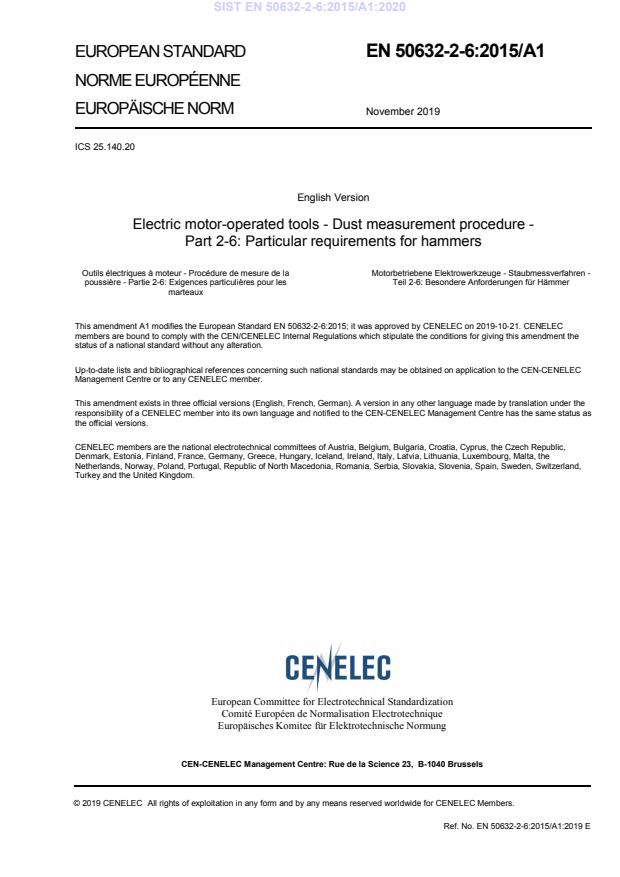
EUROPEAN STANDARD EN 50632-2-6:2015/A1
NORME EUROPÉENNE
EUROPÄISCHE NORM
November 2019
ICS 25.140.20
English Version
Electric motor-operated tools - Dust measurement procedure -
Part 2-6: Particular requirements for hammers
Outils électriques à moteur - Procédure de mesure de la Motorbetriebene Elektrowerkzeuge - Staubmessverfahren -
poussière - Partie 2-6: Exigences particulières pour les Teil 2-6: Besondere Anforderungen für Hämmer
marteaux
This amendment A1 modifies the European Standard EN 50632-2-6:2015; it was approved by CENELEC on 2019-10-21. CENELEC
members are bound to comply with the CEN/CENELEC Internal Regulations which stipulate the conditions for giving this amendment the
status of a national standard without any alteration.
Up-to-date lists and bibliographical references concerning such national standards may be obtained on application to the CEN-CENELEC
Management Centre or to any CENELEC member.
This amendment exists in three official versions (English, French, German). A version in any other language made by translation under the
responsibility of a CENELEC member into its own language and notified to the CEN-CENELEC Management Centre has the same status as
the official versions.
CENELEC members are the national electrotechnical committees of Austria, Belgium, Bulgaria, Croatia, Cyprus, the Czech Republic,
Denmark, Estonia, Finland, France, Germany, Greece, Hungary, Iceland, Ireland, Italy, Latvia, Lithuania, Luxembourg, Malta, the
Netherlands, Norway, Poland, Portugal, Republic of North Macedonia, Romania, Serbia, Slovakia, Slovenia, Spain, Sweden, Switzerland,
Turkey and the United Kingdom.
European Committee for Electrotechnical Standardization
Comité Européen de Normalisation Electrotechnique
Europäisches Komitee für Elektrotechnische Normung
CEN-CENELEC Management Centre: Rue de la Science 23, B-1040 Brussels
© 2019 CENELEC All rights of exploitation in any form and by any means reserved worldwide for CENELEC Members.
Ref. No. EN 50632-2-6:2015/A1:2019 E
Contents Page
European foreword . 3
1 Modifications to 4.3 . 4
European foreword
This document (EN 50632-2-6:2015/A1:2019) has been prepared by CLC/TC 116 “Safety of motor-
operated electric tools”.
This amendment was developed to specify how the mass of the tool and the concrete formulation is
determined.
The following dates are fixed:
• latest date by which the amendment has to be implemented (dop) 2020-10-21
at national level by publication of an identical
national standard or by endorsement
• latest date by which the national standards conflicting (dow) 2021-10-21
with the amendment have to be withdr
...