

SIST EN 1486:2007
(Main)Protective clothing for fire-fighters - Test methods and requirements for reflective clothing for specialised fire-fighting
General Information
- Abstract
This European Standard considers requirements for the protection of the whole body including head, hands and feet. Clothing for head and feet according to this European Standard, however, may only provide sufficient protection when worn together with such basic PPE specified in the relevant standards as noted in paragraphs 4.2 and 4.4 of this European Standard.
This European Standard specifies test methods and minimum performance requirements for reflective protective clothing used in specialised fire-fighting.
This clothing provides protection against flame lick and intense radiant heat and is worn for short periods only, to enable the fire-fighter to enter specific high-risk fire-fighting and fire rescue situations which also require the use of breathing apparatus.
This European Standard only covers protective clothing that relies upon the ability of the outer material to reflect intense radiant heat. This type of reflective clothing may also be used for industrial applications involving high levels of radiant heat.
The reflective clothing specified in this European Standard is not covered in EN 469.
- Status
- Published
- Publication Date
- 06-Nov-2007
- Technical Committee
- OVP - Personal protecting equipment
- Current Stage
- 6060 - National Implementation/Publication (Adopted Project)
- Start Date
- 24-Oct-2007
- Due Date
- 29-Dec-2007
- Completion Date
- 07-Nov-2007
2016/425 - Regulation (EU) 2016/425 of the European Parliament and of the Council of 9 March 2016 on personal protective equipment and repealing Council Directive 89/686/EECOJ Ref: C 113 OJ Date: 27-Mar-2018
89/686/EEC - Personal protective equipment (PPE)OJ Ref: C 63 OJ Date: 08-Mar-2008 Conflicting Date: 30-Apr-2008



Overview
EN 1486:2007 (CEN) specifies test methods and minimum performance requirements for reflective protective clothing for specialised fire-fighting. The standard covers whole-body protection (including head, hands and feet) where the outer material’s ability to reflect intense radiant heat is the primary protection mechanism. It is intended for short-duration entry into high‑risk fire or rescue situations (usually with breathing apparatus) and can also apply to industrial tasks with high radiant heat exposure. This reflective clothing is distinct from EN 469 garments.
Key topics and technical requirements
EN 1486:2007 defines a structured test and performance framework, including:
Thermal requirements
- Limited flame spread
- Heat transfer by radiant heat (evaluation of outer reflective systems)
- Convective heat resistance
- Contact heat and general heat resistance
Mechanical requirements
- Dimensional change (after cleaning/ageing)
- Tensile, burst and tear strength
- Seam strength and integrity
Other technical areas
- Sampling, pre-treatment and ageing of materials (to simulate use and maintenance)
- Surface wetting resistance
- Optional whole‑garment testing
- Marking and information that manufacturers must supply (usage limits, care, limitations)
Design and ergonomics
- Guidance on garment design, pockets, closures, hoods and compatibility with basic PPE (helmets, boots, gloves)
Practical applications and users
EN 1486:2007 is used by:
- Manufacturers of reflective fire‑fighting garments to design and certify products that reflect intense radiant heat.
- Testing laboratories to perform standardized thermal and mechanical tests.
- Fire and rescue services and procurement officers when selecting PPE for specialised fire-fighting tactics (short‑term, high‑radiant‑heat entries).
- Safety managers and industry where high radiant heat hazards exist (petrochemical, steel mills) as an option for short‑duration protection.
- Regulatory bodies and certifiers implementing CEN harmonized standards across EU countries.
Practical notes:
- Clothing conforming to EN 1486 is intended for short-term use and must be paired with appropriate respiratory and basic PPE where required.
- A formal risk assessment and training in use, care and limitations are essential before deployment.
Related standards
Important referenced standards include:
- EN 469 - Protective clothing for firefighters (non‑reflective, general purpose)
- EN ISO 6942 - Radiant heat evaluation
- EN ISO 15025 - Limited flame spread
- EN 443, EN 15090, EN 136 - Helmets, footwear and respiratory protection interfaces
Keywords: EN 1486:2007, reflective clothing, specialised fire‑fighting, radiant heat, test methods, protective clothing, CEN, firefighter PPE.
Relations
- Effective Date
- 01-Dec-2007
- Effective Date
- 25-Aug-2026
- Effective Date
- 06-May-2026
- Effective Date
- 28-Jan-2026
- Effective Date
- 28-Jan-2026
- Refers
SIST EN 136:1998 - Respiratory protective devices - Full face masks - Requirements, testing, marking - Effective Date
- 28-Jan-2026
- Effective Date
- 28-Jan-2026
- Effective Date
- 28-Jan-2026
- Effective Date
- 28-Jan-2026
- Effective Date
- 28-Jan-2026
- Effective Date
- 28-Jan-2026
- Effective Date
- 28-Jan-2026
- Effective Date
- 28-Jan-2026
- Effective Date
- 28-Jan-2026
- Effective Date
- 28-Jan-2026
Get Certified
Connect with accredited certification bodies for this standard

CIS Institut d.o.o.
Personal Protective Equipment (PPE) certification body. Notified Body NB-2890 for EU Regulation 2016/425 PPE.

Kiwa BDA Testing
Building and construction product certification.
Kmetijski inštitut Slovenije
Agricultural Institute of Slovenia. Soil testing, plant health, agricultural product analysis.
Sponsored listings
Frequently Asked Questions
SIST EN 1486:2007 is a standard published by the Slovenian Institute for Standardization (SIST). Its full title is "Protective clothing for fire-fighters - Test methods and requirements for reflective clothing for specialised fire-fighting". This standard covers: This European Standard considers requirements for the protection of the whole body including head, hands and feet. Clothing for head and feet according to this European Standard, however, may only provide sufficient protection when worn together with such basic PPE specified in the relevant standards as noted in paragraphs 4.2 and 4.4 of this European Standard. This European Standard specifies test methods and minimum performance requirements for reflective protective clothing used in specialised fire-fighting. This clothing provides protection against flame lick and intense radiant heat and is worn for short periods only, to enable the fire-fighter to enter specific high-risk fire-fighting and fire rescue situations which also require the use of breathing apparatus. This European Standard only covers protective clothing that relies upon the ability of the outer material to reflect intense radiant heat. This type of reflective clothing may also be used for industrial applications involving high levels of radiant heat. The reflective clothing specified in this European Standard is not covered in EN 469.
This European Standard considers requirements for the protection of the whole body including head, hands and feet. Clothing for head and feet according to this European Standard, however, may only provide sufficient protection when worn together with such basic PPE specified in the relevant standards as noted in paragraphs 4.2 and 4.4 of this European Standard. This European Standard specifies test methods and minimum performance requirements for reflective protective clothing used in specialised fire-fighting. This clothing provides protection against flame lick and intense radiant heat and is worn for short periods only, to enable the fire-fighter to enter specific high-risk fire-fighting and fire rescue situations which also require the use of breathing apparatus. This European Standard only covers protective clothing that relies upon the ability of the outer material to reflect intense radiant heat. This type of reflective clothing may also be used for industrial applications involving high levels of radiant heat. The reflective clothing specified in this European Standard is not covered in EN 469.
SIST EN 1486:2007 is classified under the following ICS (International Classification for Standards) categories: 13.220.10 - Fire-fighting; 13.340.10 - Protective clothing. The ICS classification helps identify the subject area and facilitates finding related standards.
SIST EN 1486:2007 has the following relationships with other standards: It is inter standard links to SIST EN 1486:1996, SIST ISO 7000:2004, SIST EN ISO 13935-2:2026, SIST EN ISO 6942:2022, SIST EN ISO 15025:2017, SIST EN 136:1998, SIST EN ISO 13688:2013, SIST EN ISO 12127-1:2016, SIST EN ISO 4674-1:2003, SIST EN 14052:2012+A1:2012, SIST EN ISO 12402-8:2006/A1:2011, SIST EN ISO 13934-2:2014, SIST EN ISO 20345:2022, SIST EN 397:2025, SIST EN 443:2008. Understanding these relationships helps ensure you are using the most current and applicable version of the standard.
SIST EN 1486:2007 is associated with the following European legislation: EU Directives/Regulations: 2014/90/EU, 2016/425, 89/686/EEC, 96/98/EC; Standardization Mandates: M/031. When a standard is cited in the Official Journal of the European Union, products manufactured in conformity with it benefit from a presumption of conformity with the essential requirements of the corresponding EU directive or regulation.
SIST EN 1486:2007 is available in PDF format for immediate download after purchase. The document can be added to your cart and obtained through the secure checkout process. Digital delivery ensures instant access to the complete standard document.
Standards Content (Sample)
2003-01.Slovenski inštitut za standardizacijo. Razmnoževanje celote ali delov tega standarda ni dovoljeno.Schutzkleidung für die Feuerwehr - Prüfverfahren und Anforderungen für reflektierende Kleidung für die spezielle BrandbekämpfungVetements de protection pour sapeurs-pompiers - Méthodes d'essai et exigences relatives aux vetements réfléchissants pour opérations spéciales de lutte contre l'incendieProtective clothing for fire-fighters - Test methods and requirements for reflective clothing for specialised fire-fighting13.340.10Varovalna oblekaProtective clothing13.220.10Gašenje požaraFire-fightingICS:Ta slovenski standard je istoveten z:EN 1486:2007SIST EN 1486:2007en,fr,de01-december-2007SIST EN 1486:2007SLOVENSKI
STANDARDSIST EN 1486:19961DGRPHãþD
EUROPEAN STANDARDNORME EUROPÉENNEEUROPÄISCHE NORMEN 1486October 2007ICS 13.340.10 English VersionProtective clothing for fire-fighters - Test methods andrequirements for reflective clothing for specialised fire-fightingVêtements de protection pour sapeurs-pompiers -Méthodes d'essai et exigences relatives aux vêtementsréfléchissants pour opérations spéciales de lutte contrel'incendieSchutzkleidung für die Feuerwehr - Prüfverfahren undAnforderungen für reflektierende Kleidung für die spezielleBrandbekämpfungThis European Standard was approved by CEN on 26 August 2007.CEN members are bound to comply with the CEN/CENELEC Internal Regulations which stipulate the conditions for giving this EuropeanStandard the status of a national standard without any alteration. Up-to-date lists and bibliographical references concerning such nationalstandards may be obtained on application to the CEN Management Centre or to any CEN member.This European Standard exists in three official versions (English, French, German). A version in any other language made by translationunder the responsibility of a CEN member into its own language and notified to the CEN Management Centre has the same status as theofficial versions.CEN members are the national standards bodies of Austria, Belgium, Bulgaria, Cyprus, Czech Republic, Denmark, Estonia, Finland,France, Germany, Greece, Hungary, Iceland, Ireland, Italy, Latvia, Lithuania, Luxembourg, Malta, Netherlands, Norway, Poland, Portugal,Romania, Slovakia, Slovenia, Spain, Sweden, Switzerland and United Kingdom.EUROPEAN COMMITTEE FOR STANDARDIZATIONCOMITÉ EUROPÉEN DE NORMALISATIONEUROPÄISCHES KOMITEE FÜR NORMUNGManagement Centre: rue de Stassart, 36
B-1050 Brussels© 2007 CENAll rights of exploitation in any form and by any means reservedworldwide for CEN national Members.Ref. No. EN 1486:2007: ESIST EN 1486:2007
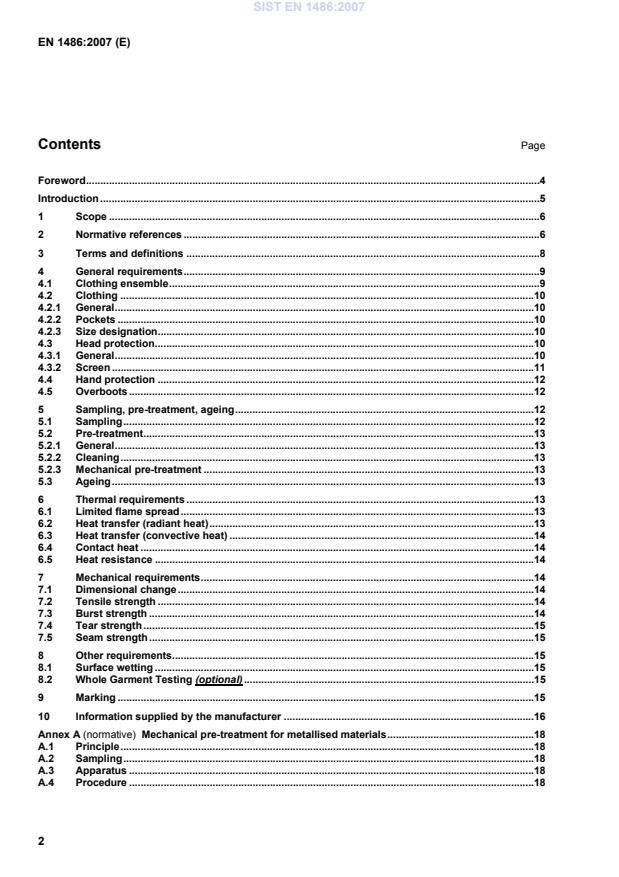
Mechanical pre-treatment for metallised materials.18 A.1 Principle.18 A.2 Sampling.18 A.3 Apparatus.18 A.4 Procedure.18 SIST EN 1486:2007
Warning – flame engulfment.20 Annex C (informative)
Guidelines for clothing design.21 Annex D (informative)
Checking of basic ergonomic features of protective clothing – practical performance tests.22 Annex E.24 Annex F (informative)
Significant technical changes between this document and the previous edition EN 1486:1996.26 Annex ZA (informative)
Relationship between this European Standard and the Essential Requirements of EU Directive 89/686/EEC.27 Bibliography.29
EN 24920, Textiles — Determination of resistance to surface wetting (spray test) of fabrics EN 25077, Textiles — Determination of dimensional change in washing and drying (ISO 5077:1984) SIST EN 1486:2007
EN 166:2001. 4.3.2.10 IR-transmission and transmittance to Vis When tested in accordance with Clause 4 of EN 171:2002, the IR-transmission scale number and the transmittance shall be in the range of 4-2,5 and 4-5. 4.3.2.11 Flammability Flammability shall be tested analogous to 8.5.2 of EN 136:1998. 4.3.2.12 Marking Screens shall be marked in accordance with 9.2 of EN 166:2001. 4.4 Hand protection Hand protection shall meet the requirements of this European Standard as specified in Clauses 6, 7 and 8. The general requirements of EN 420 shall be applied; for dexterity according to 5.2 of EN 420:2003 at least level 1 shall be achieved. The sizes of the gloves shall be designated in accordance with EN 420, except that the minimum length shall be 350 mm. Dimension of cuff measured on the wrist line shall be compatible to the width of jacket (coat, coverall) sleeves end either to be worn over or under the sleeves as specified by the manufacturer. The assessment shall be made with the clothing being worn and used by an appropriately sized wearer. 4.5 Overboots The size of the overboots shall be designated in accordance to the footwear. Overboots shall meet the requirements of Clauses 6, 7 and 8. It shall be designed to be worn over designated footwear providing additional protection in accordance with EN 15090 and EN ISO 20345, and fixed to it by adjustable means. The footwear with which compatibility is claimed shall be identified in the information supplied by the manufacturer. Dimension of shaft measured on the ankle line shall be compatible to the width of trousers (coverall) legs and either to be worn over or under the trouser legs as specified by the manufacturer. The assessment shall be made with the clothing being worn and used by an appropriately sized wearer. 5 Sampling, pre-treatment, ageing 5.1 Sampling Test specimens shall be taken from the material or materials as used in the component assembly. They may also be cut from the original garment, and shall not include construction features, such as seams, closure systems, or hardware except the test described in 6.1 and 7.5. Number and dimensions of the test specimen are given in the standards describing the test methods in Clauses 6, 7 and 8. SIS
...