

SIST EN 13130-1:2004
(Main)Materials and articles in contact with foodstuffs - Plastics substances subject to limitation - Part 1: Guide to test methods for the specific migration of substances from plastics to foods and food simulants and the determination of substances in plastics and the selection of conditions of exposure to food simulants
General Information
- Abstract
This part of this European Standard provides a guide to the selection of the appropriate conditions of contact of food simulants with the test article before the determination of specific migration of those substances subject to a migration limit.
NOTE According to Directive 90/128/EEC[2] the determination of the migration of specified components in foodstuffs instead of the use of simulants is permitted. However, in that situation there is no need to give guidance on the test conditions of time and temperature as contact conditions shall be equal to conditions applied in real.
Also general guidance is given for the determination of the amount of the substance in the final plastics material or article.
- Status
- Published
- Publication Date
- 31-Aug-2004
- Technical Committee
- EPO - Packaging - sales and grouped
- Current Stage
- 6060 - National Implementation/Publication (Adopted Project)
- Start Date
- 01-Sep-2004
- Due Date
- 01-Sep-2004
- Completion Date
- 01-Sep-2004

Overview
EN 13130-1:2004 - published by CEN - is a European Standard providing a practical guide to test methods for assessing the specific migration of substances from plastics into foods and food simulants. The standard explains how to select appropriate contact conditions (time, temperature, simulant) before performing migration tests, and gives general guidance for determining the residual amount of controlled substances in the final plastic material or article. It also notes that, under Directive 90/128/EEC, testing directly with real foods is permitted where appropriate.
Key topics and technical requirements
- Selection of food simulants and test media: guidance on aqueous and fatty simulants (e.g., water, 3% acetic acid, 10% ethanol, olive oil) and substitute/alternative test media for fatty foods.
- Migration test types: procedures for conventional migration tests, substitute fat tests, alternative volatile-media tests, and extraction tests.
- Selection of contact conditions: rules for choosing time/temperature profiles, including special cases such as microwave heating, low- and high-temperature exposure, and short-term high-temperature contact.
- Sample geometry and surface-to-volume ratio: instructions for specimen preparation, single vs. double surface testing, pouch and cell testing, and considerations for large or irregular articles.
- Determination in plastics and residual content: guidance for analysing substances in plastics (residual content tests such as “QM” and “QMA” concepts referenced).
- Analytical and reporting guidance: outlines for expression of results, reduction factors for fatty simulants, precision, validity, confirmation of results and required test report elements.
- Special materials: notes on multilayer materials, caps, seals, tubing, fibres and articles intended for repeated use.
Practical applications and users
EN 13130-1:2004 is essential for stakeholders involved in food-contact plastics compliance, including:
- Manufacturers of food packaging and plastic articles - to design compliant materials and set test programs.
- Laboratories and testing facilities - to select validated migration methods, simulants and exposure conditions.
- Regulatory authorities and conformity assessors - to evaluate test reports and verify compliance with migration limits.
- Material scientists and product developers - to assess residual substance levels and choose safer formulations.
Using EN 13130-1 helps ensure reliable migration testing, consistent interpretation of results, and defensible compliance decisions for food-contact plastics.
Related standards
- Directive 90/128/EEC (use of real foodstuffs vs. simulants) is referenced.
- Other parts of the EN 13130 series address additional specifics of plastics and migration testing (consult national standards bodies or CEN for the complete series).
Relations
- Effective Date
- 01-Sep-2004
- Effective Date
- 25-Aug-2026
- Effective Date
- 25-Aug-2026
- Effective Date
- 25-Aug-2026
- Effective Date
- 25-Aug-2026
- Effective Date
- 25-Aug-2026
- Effective Date
- 25-Aug-2026
- Effective Date
- 25-Aug-2026
- Effective Date
- 25-Aug-2026
- Effective Date
- 28-Jan-2026
- Effective Date
- 28-Jan-2026
- Refers
SIST EN 1414:2000/A1:2000 - Touch and close fasteners - Cycling procedure for subsequent testing - Effective Date
- 28-Jan-2026
- Effective Date
- 28-Jan-2026
- Effective Date
- 28-Jan-2026
- Effective Date
- 28-Jan-2026
Get Certified
Connect with accredited certification bodies for this standard

BSI Group
BSI (British Standards Institution) is the business standards company that helps organizations make excellence a habit.

Bureau Veritas
Bureau Veritas is a world leader in laboratory testing, inspection and certification services.

DNV
DNV is an independent assurance and risk management provider.
Sponsored listings
Frequently Asked Questions
SIST EN 13130-1:2004 is a standard published by the Slovenian Institute for Standardization (SIST). Its full title is "Materials and articles in contact with foodstuffs - Plastics substances subject to limitation - Part 1: Guide to test methods for the specific migration of substances from plastics to foods and food simulants and the determination of substances in plastics and the selection of conditions of exposure to food simulants". This standard covers: This part of this European Standard provides a guide to the selection of the appropriate conditions of contact of food simulants with the test article before the determination of specific migration of those substances subject to a migration limit. NOTE According to Directive 90/128/EEC[2] the determination of the migration of specified components in foodstuffs instead of the use of simulants is permitted. However, in that situation there is no need to give guidance on the test conditions of time and temperature as contact conditions shall be equal to conditions applied in real. Also general guidance is given for the determination of the amount of the substance in the final plastics material or article.
This part of this European Standard provides a guide to the selection of the appropriate conditions of contact of food simulants with the test article before the determination of specific migration of those substances subject to a migration limit. NOTE According to Directive 90/128/EEC[2] the determination of the migration of specified components in foodstuffs instead of the use of simulants is permitted. However, in that situation there is no need to give guidance on the test conditions of time and temperature as contact conditions shall be equal to conditions applied in real. Also general guidance is given for the determination of the amount of the substance in the final plastics material or article.
SIST EN 13130-1:2004 is classified under the following ICS (International Classification for Standards) categories: 67.250 - Materials and articles in contact with foodstuffs. The ICS classification helps identify the subject area and facilitates finding related standards.
SIST EN 13130-1:2004 has the following relationships with other standards: It is inter standard links to SIST ENV 13130-1:2000, SIST ISO 5725-5:2003, SIST ISO 5725-1:2003, SIST ISO 5725-2:2003, SIST ISO 5725-6:2003, SIST ISO 4788:1995, SIST ISO 5725-3:2003, SIST ISO 648:1995, SIST ISO 5725-4:2003, SIST EN ISO 9934-1:2002, SIST EN 24049:2000, SIST EN 1414:2000/A1:2000, SIST ENV 14237:2002, SIST EN ISO 8442-2:1998, SIST EN 10088-1:2024. Understanding these relationships helps ensure you are using the most current and applicable version of the standard.
SIST EN 13130-1:2004 is associated with the following European legislation: EU Directives/Regulations: 89/109/EEC; Standardization Mandates: M/052. When a standard is cited in the Official Journal of the European Union, products manufactured in conformity with it benefit from a presumption of conformity with the essential requirements of the corresponding EU directive or regulation.
SIST EN 13130-1:2004 is available in PDF format for immediate download after purchase. The document can be added to your cart and obtained through the secure checkout process. Digital delivery ensures instant access to the complete standard document.
Standards Content (Sample)
2003-01.Slovenski inštitut za standardizacijo. Razmnoževanje celote ali delov tega standarda ni dovoljeno.VSHFLILþQRSRVWDYOMDQMDWerkstoffe und Gegenstände in Kontakt mit Lebensmitteln - Substanzen in Kunststoffen, die Beschränkungen unterliegen - Teil 1: Leitfaden für die Prüfverfahren für die spezifische Migration von Substanzen aus Kunststoffen in Lebensmittel und Prüflebensmittel, die Bestimmung von Substanzen in Kunststoffen und die Auswahl von Kontaktbedingungen mit PrüflebensmittelnMatériaux et objets en contact avec des denrées alimentaires - Substances dans les matieres plastiques soumises a des limitations - Partie 1 : Guide des méthodes d'essai pour la migration spécifique dans les denrées alimentaires et les simulants d'aliments de substances contenues dans les matieres plastiques, détermination des substances dans les matieres plastiques et choix des conditions d'exposition aux simulants d'alimentsMaterials and articles in contact with foodstuffs - Plastics substances subject to limitation - Part 1: Guide to test methods for the specific migration of substances from plastics to foods and food simulants and the determination of substances in plastics and the selection of conditions of exposure to food simulants67.250Materiali in predmeti v stiku z živiliMaterials and articles in contact with foodstuffsICS:Ta slovenski standard je istoveten z:EN 13130-1:2004SIST EN 13130-1:2004en,fr,de01-september-2004SIST EN 13130-1:2004SLOVENSKI
STANDARDSIST ENV 13130-1:20001DGRPHãþD
EUROPEAN STANDARDNORME EUROPÉENNEEUROPÄISCHE NORMEN 13130-1May 2004ICS 67.250English versionMaterials and articles in contact with foodstuffs - Plasticssubstances subject to limitation - Part 1: Guide to test methodsfor the specific migration of substances from plastics to foodsand food simulants and the determination of substances inplastics and the selection of conditions of exposure to foodsimulantsMatériaux et objets en contact avec des denréesalimentaires - Substances dans les matières plastiquessoumises à des limitations - Partie 1 : Guide des méthodesd'essai pour la migration spécifique dans les denréesalimentaires et les simulants d'aliments de substancescontenues dans les matières plastiques, détermination dessubstances dans les matières plastiques et choix desconditions d'exposition aux simulants d'alimentsWerkstoffe und Gegenstände in Kontakt mit Lebensmitteln- Substanzen in Kunststoffen, die Beschränkungenunterliegen - Teil 1: Anleitung für Testmethoden für diespezifische Migration von Substanzen aus Kunststoffen inLebensmitteln und Lebensmitteln-Simulantien, Bestimmungder Substanzen in Kunststoffen und Auswahl vonExpositions bedingungen für Lebensmitteln-Simulantien.This European Standard was approved by CEN on 24 March 2004.CEN members are bound to comply with the CEN/CENELEC Internal Regulations which stipulate the conditions for giving this EuropeanStandard the status of a national standard without any alteration. Up-to-date lists and bibliographical references concerning such nationalstandards may be obtained on application to the Central Secretariat or to any CEN member.This European Standard exists in three official versions (English, French, German). A version in any other language made by translationunder the responsibility of a CEN member into its own language and notified to the Central Secretariat has the same status as the officialversions.CEN members are the national standards bodies of Austria, Belgium, Cyprus, Czech Republic, Denmark, Estonia, Finland, France,Germany, Greece, Hungary, Iceland, Ireland, Italy, Latvia, Lithuania, Luxembourg, Malta, Netherlands, Norway, Poland, Portugal, Slovakia,Slovenia, Spain, Sweden, Switzerland and United Kingdom.EUROPEAN COMMITTEE FOR STANDARDIZATIONCOMITÉ EUROPÉEN DE NORMALISATIONEUROPÄISCHES KOMITEE FÜR NORMUNGManagement Centre: rue de Stassart, 36
B-1050 Brussels© 2004 CENAll rights of exploitation in any form and by any means reservedworldwide for CEN national Members.Ref. No. EN 13130-1:2004: ESIST EN 13130-1:2004
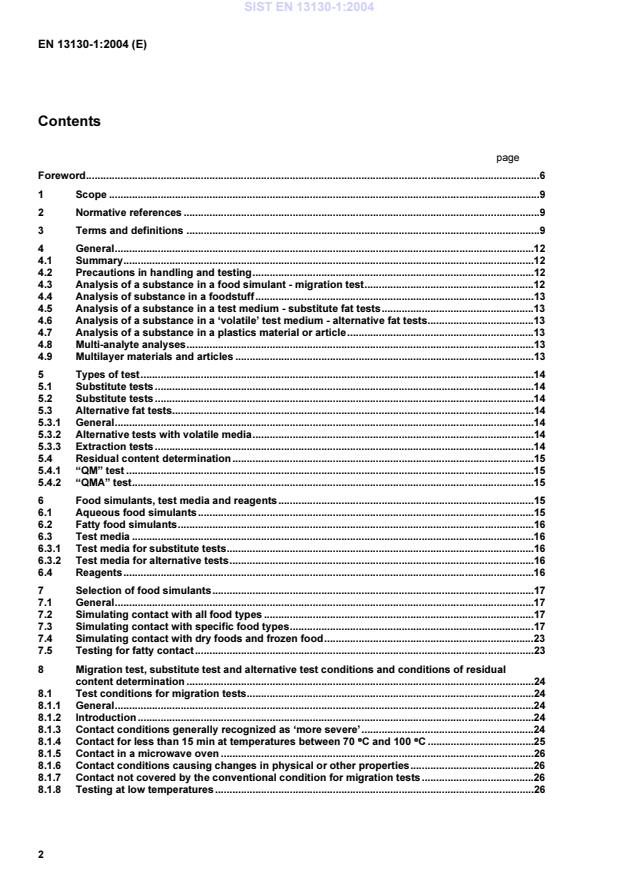
page Foreword.6 1 Scope.9 2 Normative references.9 3 Terms and definitions.9 4 General.12 4.1 Summary.12 4.2 Precautions in handling and testing.12 4.3 Analysis of a substance in a food simulant - migration test.12 4.4 Analysis of substance in a foodstuff.13 4.5 Analysis of a substance in a test medium - substitute fat tests.13 4.6 Analysis of a substance in a ‘volatile’ test medium - alternative fat tests.13 4.7 Analysis of a substance in a plastics material or article.13 4.8 Multi-analyte analyses.13 4.9 Multilayer materials and articles.13 5 Types of test.14 5.1 Substitute tests.14 5.2 Substitute tests.14 5.3 Alternative fat tests.14 5.3.1 General.14 5.3.2 Alternative tests with volatile media.14 5.3.3 Extraction tests.14 5.4 Residual content determination.15 5.4.1 “QM” test.15 5.4.2 “QMA” test.15 6 Food simulants, test media and reagents.15 6.1 Aqueous food simulants.15 6.2 Fatty food simulants.16 6.3 Test media.16 6.3.1 Test media for substitute tests.16 6.3.2 Test media for alternative tests.16 6.4 Reagents.16 7 Selection of food simulants.17 7.1 General.17 7.2 Simulating contact with all food types.17 7.3 Simulating contact with specific food types.17 7.4 Simulating contact with dry foods and frozen food.23 7.5 Testing for fatty contact.23 8 Migration test, substitute test and alternative test conditions and conditions of residual content determination.24 8.1 Test conditions for migration tests.24 8.1.1 General.24 8.1.2 Introduction.24 8.1.3 Contact conditions generally recognized as ‘more severe’.24 8.1.4 Contact for less than 15 min at temperatures between 70 °°°°C and 100 °°°°C.25 8.1.5 Contact in a microwave oven.26 8.1.6 Contact conditions causing changes in physical or other properties.26 8.1.7 Contact not covered by the conventional condition for migration tests.26 8.1.8 Testing at low temperatures.26 SIST EN 13130-1:2004
Criteria for classification of non-volatility.49 A.1 Volatile substances.49 A.2 Criteria for conventional classification of non-volatility.49 Annex B (normative)
Characteristics of fatty food simulants and test media.50 Characteristics of rectified olive oil, reference simulant D.50 Composition of the mixture of synthetic triglycerides, simulant D.50 Characteristics of sunflower oil, simulant D.51 Characteristics of corn oil, simulant D.51 Characteristics of modified polyphenylene oxide (MPPO).51 Annex C (normative)
Tolerances on contact times and contact temperatures applicable to all parts of this standard.52 Annex D (informative)
Supports and cells.54 SIST EN 13130-1:2004
Relationship of this European Standard with Council Directive 89/109/EEC and Commission Directive 2002/72/EC and associated Directives.63 Bibliography.65 SIST EN 13130-1:2004
Further Directives and amendments to existing Directives are expected which could change the legislative requirements which this standard supports.
It is therefore strongly recommended that users of this standard refer to the latest relevant published Directive(s) before commencement of a test or tests described in this standard. Further parts of EN 13130, under the general title Materials and articles in contact with foodstuffs - Plastics substances subject to limitation, have been prepared, and others are in preparation, concerned with the determination of specific migration from plastics materials into foodstuffs and food simulants and the determination of specific monomers and additives in plastics. The other parts of
EN 13130 are as follows.
Part 2: Determination of terephthalic acid in food simulants Part 3: Determination of acrylonitrile in food and food simulants Part 4: Determination of 1,3-butadiene in plastics
Part 5: Determination of vinylidene chloride in food simulants Part 6: Determination of vinylidene chloride in plastics Part 7:
Determination of monoethylene glycol and diethylene glycol in food simulants Part 8: Determination of isocyanates in plastics
Part 9: Determination of acetic acid, vinyl ester in food simulants
Part 10: Determination of acrylamide in food simulants
Part 11: Determination of 11-aminoundecanoic acid in food simulants
Part 12: Determination of 1,3-benzenedimethanamine in food simulants
Part 13: Determination of 2,2-bis(4-hydroxyphenyl)propane (Bisphenol A) in food simulants SIST EN 13130-1:2004
Determination of 3,3-bis(3-methyl-4-hydroxyphenyl)-2-indoline in food simulants
Part 15: Determination of 1,3-butadiene in food simulants
Part 16: Determination of caprolactam and caprolactam salt in food simulants
Part 17: Determination of carbonyl chloride in plastics
Part 18: Determination of 1,2-dihydroxybenzene, 1,3- dihydroxybenzene, 1,4- dihydroxybenzene, 4,4’-dihydroxybenzophenone and 4,4’dihydroxybiphenyl in food simulants
Part 19:
Determination of dimethylaminoethanol in food simulants
Part 20:
Determination of epichlorohydrin in plastics
Part 21:
Determination of ethylenediamine and hexamethylenediamine in food simulants
Part 22:
Determination of ethylene oxide and propylene oxide in plastics
Part 23:
Determination of formaldehyde and hexamethylenetetramine in food simulants
Part 24:
Determination of maleic acid and maleic anhydride in food simulants
Part 25: Determination of 4-methyl-pentene in food simulants
Part 26: Determination of 1-octene and tetrahydrofuran in food simulants
Part 27:
Determination of 2,4,6-triamino-1,3,5-triazine in food simulants
Part 28:
Determination of 1,1,1-trimethylopropane in food simulants Parts 2 to 8 are European Standards.
Parts 9 to 28 are Technical Specifications, prepared within the Standards, Measurement and Testing project, MAT1-CT92-0006, “Development of Methods of Analysis for Monomers” 1) . According to the CEN/CENELEC Internal Regulations, the national standards organizations of the following countries are bound to implement this European Standard: Austria, Belgium, Cyprus, Czech Republic, Denmark, Estonia, Finland, France, Germany, Greece, Hungary, Iceland, Ireland, Italy, Latvia, Lithuania, Luxembourg, Malta, Netherlands, Norway, Poland, Portugal, Slovakia, Slovenia, Spain, Sweden, Switzerland and United Kingdom.
1) Franz R. and Rijk.R; Development of methods of analysis for monomers and other starting substances with SML and/or QM limits in Directives 2002/72/EC and 92/39/EEC.
European Commission, BCR information: Chemical analysis, EU report 17610 EN, ECSC-EC-EAEC. Brussels - Luxembourg 1997.
The general criteria for the operation and assessment of testing laboratories as well as the general criteria for laboratory accreditation bodies are set out in EN ISO/IEC 17025, EN 45002 and EN 45003.
It is recommended that laboratories using this standard validate their procedures by taking part in a proficiency scheme.
Suitable proficiency schemes are operated in Germany and in the United Kingdom, for example the German Assessment Scheme for Food Testing (GAFT) and the Food Analysis Performance Assessment Scheme (FAPAS) conducted by the Central Science Laboratory of the Ministry of Agriculture, Fisheries and Food.
1 Scope This part of this European Standard provides a guide to the selection of the appropriate conditions of contact of food simulants with the test article before the determination of specific migration of those substances subject to a migration limit. NOTE According to Directive 2002/72/EC[2] the determination of the migration of specified components in foodstuffs instead of the use of simulants is permitted.
However, in that situation there is no need to give guidance on the test conditions of time and temperature as contact conditions shall be equal to conditions applied in real. Also general guidance is given for the determination of the amount of the substance in the final plastics material or article.
2 Normative references This European Standard incorporates by dated or undated reference, provisions from other publications. These normative references are cited at the appropriate places in the text, and the publications are listed hereafter. For dated references, subsequent amendments to or revisions of any of these publications apply to this European Standard only when incorporated in it by amendment or revision. For undated references the latest edition of the publication referred to applies (including amendments). EN 10088-1; Stainless steels – Part 1: List of stainless steels. EN ISO 8442-2:1997; Materials and articles in contact with foodstuffs – Cutlery and table holloware – Part 2: Requirements for stainless steel and silver-plated cutlery (ISO 8442-2:1997). ISO 648; Laboratory glassware -– One-mark pipettes. ISO 4788; Laboratory glassware –
Graduated measuring cylinders. ISO 5725 (all parts); Accuracy (trueness and precision) of measurement methods and results. 3 Terms and definitions For the purposes of this European Standard, the following terms and definitions apply. 3.1
plastics organic macromolecular compounds obtained by polymerization, polycondensation, polyaddition or any similar process from molecules with a lower molecular weight or by chemical alteration of natural molecules.
Silicones and other macromolecular compounds should also be regarded as plastics.
Other substances or matter can be added to such compounds. 3.2 final material/article material or article in its ready-for-use state or as sold 3.3 sample material or article under investigation
3.4 test specimen portion of the sample on which a test is performed SIST EN 13130-1:2004
test piece
portion of the test specimen 3.6
conventional oven oven where the air within the oven is heated and this heat is then transferred to the food through the plastics as opposed to a microwave oven where the food itself is heated directly by microwave irradiation 3.7
food simulant
medium intended to simulate a foodstuff (see clauses 4 to 7) 3.8
specific migration
mass of the substance transferred to the simulant as determined in the test method
3.9
residual content mass of the substance present in the final material or article 3.10
specific migration limit (SML)
maximum permitted level of a named substance migrating from the final material or article into food or food simulants 3.11
SML(T) maximum permitted level of a named substance migrating from the final material or article into food or food simulants expressed as total of moiety or substance(s) indicated
3.12
compositional limit (Qm)
maximum permitted amount of the "residual" monomer, additive or substance in the material or article
3.13
Qm(T) maximum permitted amount of the "residual" monomer, additive or substance in the material or article expressed as total of moiety or substance(s) indicated 3.14
quantity per surface area (QMA)
maximum permitted amount of residual monomer, additive or substance in the material or article expressed as mg/6dm2 3.15
reduction factor
numbers, 2 to 5, which can be applied to the result of the migration tests relevant to certain types of fatty foodstuffs and which is conventionally used to take account of the greater extractive capacity of the simulant for such foodstuffs 3.16
migration test
test for the determination of specific migration of substance, using food simulant under conventional test conditions 3.17
substitute fat test
test carried out which uses test media under conventional substitute test conditions when the use of a migration test into fatty food simulant(s) is not feasible SIST EN 13130-1:2004
test media
substances used in "substitute tests", iso-octane, 95 % ethanol in aqueous solution and modified polyphenylene oxide (MPPO) 3.19
alternative fat test
tests, with suitable, usually, volatile media, that can be used instead of migration tests with fatty food simulants 3.20
‘volatile’ test media
volatile substances used in alternative fat tests 3.21
extraction tests
tests in which media having strong extraction properties under very severe test conditions, are used 3.22
dissolution test
tests in which the sample is dissolved to liberate the substance from the plastics test specimen 3.23
pouch
receptacle of known dimensions manufactured from plastics film/sheet to be tested, which when filled with food simulant or test medium exposes the food contact side of the film/sheet to the food simulant or test medium 3.24
reverse pouch
pouch which is fabricated such that the plastics surface intended to come into contact with foodstuff is the outer surface.
All of its edges are sealed to prevent the inner surfaces coming into contact with the food simulant or test medium during the test period. The reverse pouch is intended to be totally immersed in the food simulant or test medium 3.25
cell
device in which a plastics film to be tested can be mounted which when assembled and filled with food simulant or test medium, exposes the food contact side of the film to the food simulant or test medium 3.26
repeatability value 'r' value below which the absolute difference between two single test results obtained under repeatability conditions can be expected to lie with a probability of 95 %, as described in ISO 5725 3.27
reproducibility value 'R'
value below which the absolute difference between two single test results obtained under reproducibility conditions can be expected to lie with a probability of 95%, as described in ISO 5725 3.28
repeatability conditions conditions where mutually independent test results are obtained with the same method on identical test material in the same laboratory by the same operator using the same equipment within short intervals of time 3.29
reproducibility conditions
conditions where test results are obtained with the same method on identical material in different laboratories with different operators using different equipment SIST EN 13130-1:2004
The first stage is the exposure of the plastics material or article to the foodstuff, food simulant or test medium under conditions of use or simulated conditions of use.
The second stage is the determination of the migrant in the foodstuff, food simulant or test medium.
This part of this standard comprises advice and instructions on the procedures to be followed, where appropriate, in preparing the plastics sample for exposure, the selection of conditions of exposure to food simulants or test media and the calculation of migration levels when the analysis of the migrating substance is complete.
In addition, guidance is given in the preparation of plastics test specimens for the determination of the residual content of a substance or group of substances. Procedures for sampling plastics materials and articles and foodstuffs for analysis are described in clause 11. Methods for the chemical analysis of the individual substances or groups of substances in foodstuffs, food simulants and test media, and as residues in plastics materials and articles, are given in other parts of this standard.
4.2 Precautions in handling and testing Many substances which are the subject of testing are volatile substances which migrate spontaneously from plastics.
When testing a plastics material or article containing a volatile substance, careful consideration needs to be given to possible loss of the substance by volatilization after sampling and during testing.
Loss of volatiles after sampling and before testing, can be minimized by low temperature storage or hermetic sealing with limited void volume (see clause 11).
In many applications of plastics materials and articles under actual conditions of use, it is possible that volatile substances will not migrate exclusively into the foodstuff but be lost to the surrounding atmosphere.
Considerations are given to the classification of substances on the basis of volatility in annex A.
Cutting or any mechanical treatment of the sample to prepare test specimens or test pieces, for testing with foodstuffs, food simulants or test media, can have an irreversible effect on the composition and/or morphology of the edges of the sample.
As a result, with tests performed with test pieces totally immersed in the foodstuff or food simulant the obtained migration value might not be a true reflection of the real migration under actual conditions of use.
Plastics sensitive to this phenomenon are acrylonitrile/butadiene/styrene terpolymers (ABS), polystyrene and other styrene co-polymers.
With these plastics types, cut edges shall preferably not be in contact with the foodstuff, food simulant or test medium.
Care shall also be taken to avoid mechanical damage to surfaces of these types of plastics. 4.3 Analysis of a substance in a food simulant - migration test Where a plastics material or article is intended to be used in contact with a wide variety of foodstuffs it could be impracticable to test with all possible foodstuffs.
Frequently, the presence of interfering substances in the foodstuff precludes the use of simple analytical methods.
For these reasons migration testing with conventional food simulants is permissible.
In general, the methods described in other parts of this standard have been devised for use with the conventional food simulants.
When the analysis is in the liquids chosen by convention to simulate foodstuffs, this part of this standard is intended to give advice on the selection of the most appropriate test conditions and test method for a given application of a plastics material or article and shall be read in its entirety before testing protocols are started.
In some cases it could be necessary to carry out the analysis for a migrant in an actual foodstuff.
This is particularly so for enforcement authorities where a sample of the plastics material or article which has not been in contact with the foodstuff is not available.
Testing in actual foodstuff could also be appropriate when the testing in food simulants under the conventional conditions, taking into account reduction factors is known to produce invalid results.
For some analytical procedures, for example headspace gas chromatography analyses of volatile substances, analyses in a wide variety of
...