


oSIST prEN ISO 17256:2026
(Main)Anaesthetic and respiratory equipment - Respiratory therapy tubing and connectors (ISO 17256:2024)
Anaesthetic and respiratory equipment - Respiratory therapy tubing and connectors (ISO 17256:2024)
This document specifies requirements for the respiratory tubing and connectors used to convey respirable gases to a patient in the healthcare and homecare environments and provide a safe connection between the gas supply device and the patient interface. Respiratory tubing and connectors are mainly used for delivery of oxygen but can also be used for respirable air or oxygen/air mixtures and breathable medicinal gas mixtures such as oxygen/nitrous oxide or oxygen/helium mixtures. This document also specifies requirements for respiratory therapy extension tubing.
NOTE 1 The gas supply devices referred to in this document do not include anaesthetic machines/workstations and ventilators.
NOTE 2 This document does not cover breathing tubes for breathing systems. These are specified in ISO 5367.
This document is written following the format of ISO 18190, General standard for airways and related equipment. The requirements in this device-specific standard take precedence over any conflicting requirements in the General standard
Anästhesie- und Beatmungsgeräte - Schläuche und Verbindungsstücke für die respiratorische Therapie (ISO 17256:2024)
Matériel d'anesthésie et de réanimation respiratoire - Tubulures pour thérapie respiratoire et raccords (ISO 17256:2024)
Le présent document spécifie les exigences relatives aux tubulures respiratoires et aux raccords utilisés pour acheminer des gaz respirables vers un patient dans des environnements de soins et de soins à domicile et pour assurer un raccordement sûr entre le dispositif d'administration de gaz et l'interface patient. Les tubulures respiratoires et les raccords sont principalement utilisés pour l'administration d'oxygène, mais ils peuvent également être utilisés pour l'administration d'air respirable ou de mélanges oxygène/air et de mélanges de gaz médicinaux respirables tels que les mélanges oxygène/protoxyde d'azote ou oxygène/hélium. Le présent document spécifie également les exigences relatives aux tubulures de rallonge pour thérapie respiratoire.
NOTE 1 Les dispositifs d'administration de gaz mentionnés dans le présent document n'incluent pas les appareils/stations de travail d'anesthésie et les ventilateurs.
NOTE 2 Le présent document ne traite pas des tuyaux respiratoires pour les systèmes respiratoires. Ceux-ci sont spécifiés dans l'ISO 5367.
Le présent document est rédigé en respectant le format de l'ISO 18190, Exigences générales pour canules et équipement connexe. Les exigences de cette norme spécifique d'un dispositif prévalent sur toute exigence en contradiction spécifiée dans la norme générale.
Anestezijska in dihalna oprema - Cevi in priključki za dihalno terapijo (ISO 17256:2024)
General Information
- Status
- Not Published
- Public Enquiry End Date
- 30-Mar-2026
- Technical Committee
- VAZ - Healthcare
- Current Stage
- 4020 - Public enquire (PE) (Adopted Project)
- Start Date
- 15-Jan-2026
- Due Date
- 04-Jun-2026
Overview
oSIST prEN ISO 17256:2026:2024 establishes comprehensive requirements for respiratory therapy tubing and connectors used in anaesthetic and respiratory equipment. Issued by CEN, this standard focuses on devices intended to convey respirable gases-such as oxygen, air, and medicinal gas mixtures-from supply devices to patients in both healthcare and homecare settings. By ensuring safe and reliable connections between gas supply devices and patient interfaces (e.g., masks or nasal cannulas), this international standard promotes patient safety and equipment compatibility.
oSIST prEN ISO 17256:2026 also covers requirements for respiratory therapy extension tubing, addressing the growing use of such devices as patients move more frequently within clinical and home environments. The document is carefully harmonized with general airway equipment standards, with its device-specific requirements taking precedence whenever conflicts arise.
Key Topics
- Scope of Application: The standard addresses tubing and connectors for delivering oxygen, respirable air, oxygen/air mixtures, and certain medicinal gas blends (oxygen/nitrous oxide, oxygen/helium).
- Design and Performance:
- Requirements for inlet and outlet connectors, emphasizing safety and prevention of accidental misconnections.
- Specific performance criteria for extension tubing to ensure flexibility and reliability during patient movement.
- Mechanical strength requirements, including resistance to detachment under specified axial forces.
- Materials and Biocompatibility:
- Tubing and connectors must meet stringent biocompatibility criteria to protect patients from exposure to harmful substances.
- Reference to ISO 18562-1 for biological assessment of materials in the gas pathway.
- Packaging and Information:
- Guidance on packaging methods to maintain sterility.
- Requirements for manufacturers to provide clear, accessible information for users, ensuring proper and safe operation.
- Test Methods:
- Standardized testing procedures for mechanical strength, connector security, and material compliance to ensure product quality and consistency.
Applications
oSIST prEN ISO 17256:2026 is vital for manufacturers, healthcare providers, and regulatory bodies involved with respiratory therapy equipment. Typical applications include:
- Healthcare Facilities: Ensures the safety and compatibility of respiratory therapy tubing and connectors used in hospitals, clinics, and emergency care settings.
- Homecare Environments: Provides requirements for products used outside of professional healthcare institutions, where users may lack specialized training.
- Medical Gas Delivery: Facilitates the secure transport of oxygen and other respirable gases from various medical gas supply devices to patient interfaces.
- Patient Mobility: By specifying criteria for extension tubing, the standard supports increased patient mobility in settings like MRI suites, toilets, or endoscopy units.
By adhering to this standard, manufacturers can achieve compliance with international best practices, reducing risks related to misconnections, gas leakage, or material toxicity.
Related Standards
To provide a robust framework for respiratory therapy equipment design and usage, oSIST prEN ISO 17256:2026 references several related standards, including:
- ISO 18190: General requirements for airway equipment used in anaesthetic and respiratory care.
- ISO 4135: Standard terminology for anaesthetic and respiratory equipment.
- ISO 18562-1: Biocompatibility evaluation for breathing gas pathways in medical devices.
- ISO 20417: Information to be supplied by the manufacturer for medical devices.
- ISO 80369-2: Small-bore connectors for liquids and gases in healthcare applications-central to avoiding misconnections.
- ISO 5367: Standard for breathing tubes within breathing systems (note: not covered by oSIST prEN ISO 17256:2026).
By integrating these standards, oSIST prEN ISO 17256:2026 ensures a harmonized and safety-focused approach to respiratory therapy equipment worldwide, supporting patient safety, product quality, and regulatory compliance.


Frequently Asked Questions
oSIST prEN ISO 17256:2026 is a draft published by the Slovenian Institute for Standardization (SIST). Its full title is "Anaesthetic and respiratory equipment - Respiratory therapy tubing and connectors (ISO 17256:2024)". This standard covers: This document specifies requirements for the respiratory tubing and connectors used to convey respirable gases to a patient in the healthcare and homecare environments and provide a safe connection between the gas supply device and the patient interface. Respiratory tubing and connectors are mainly used for delivery of oxygen but can also be used for respirable air or oxygen/air mixtures and breathable medicinal gas mixtures such as oxygen/nitrous oxide or oxygen/helium mixtures. This document also specifies requirements for respiratory therapy extension tubing. NOTE 1 The gas supply devices referred to in this document do not include anaesthetic machines/workstations and ventilators. NOTE 2 This document does not cover breathing tubes for breathing systems. These are specified in ISO 5367. This document is written following the format of ISO 18190, General standard for airways and related equipment. The requirements in this device-specific standard take precedence over any conflicting requirements in the General standard
This document specifies requirements for the respiratory tubing and connectors used to convey respirable gases to a patient in the healthcare and homecare environments and provide a safe connection between the gas supply device and the patient interface. Respiratory tubing and connectors are mainly used for delivery of oxygen but can also be used for respirable air or oxygen/air mixtures and breathable medicinal gas mixtures such as oxygen/nitrous oxide or oxygen/helium mixtures. This document also specifies requirements for respiratory therapy extension tubing. NOTE 1 The gas supply devices referred to in this document do not include anaesthetic machines/workstations and ventilators. NOTE 2 This document does not cover breathing tubes for breathing systems. These are specified in ISO 5367. This document is written following the format of ISO 18190, General standard for airways and related equipment. The requirements in this device-specific standard take precedence over any conflicting requirements in the General standard
oSIST prEN ISO 17256:2026 is classified under the following ICS (International Classification for Standards) categories: 11.040.10 - Anaesthetic, respiratory and reanimation equipment. The ICS classification helps identify the subject area and facilitates finding related standards.
oSIST prEN ISO 17256:2026 is available in PDF format for immediate download after purchase. The document can be added to your cart and obtained through the secure checkout process. Digital delivery ensures instant access to the complete standard document.
Standards Content (Sample)
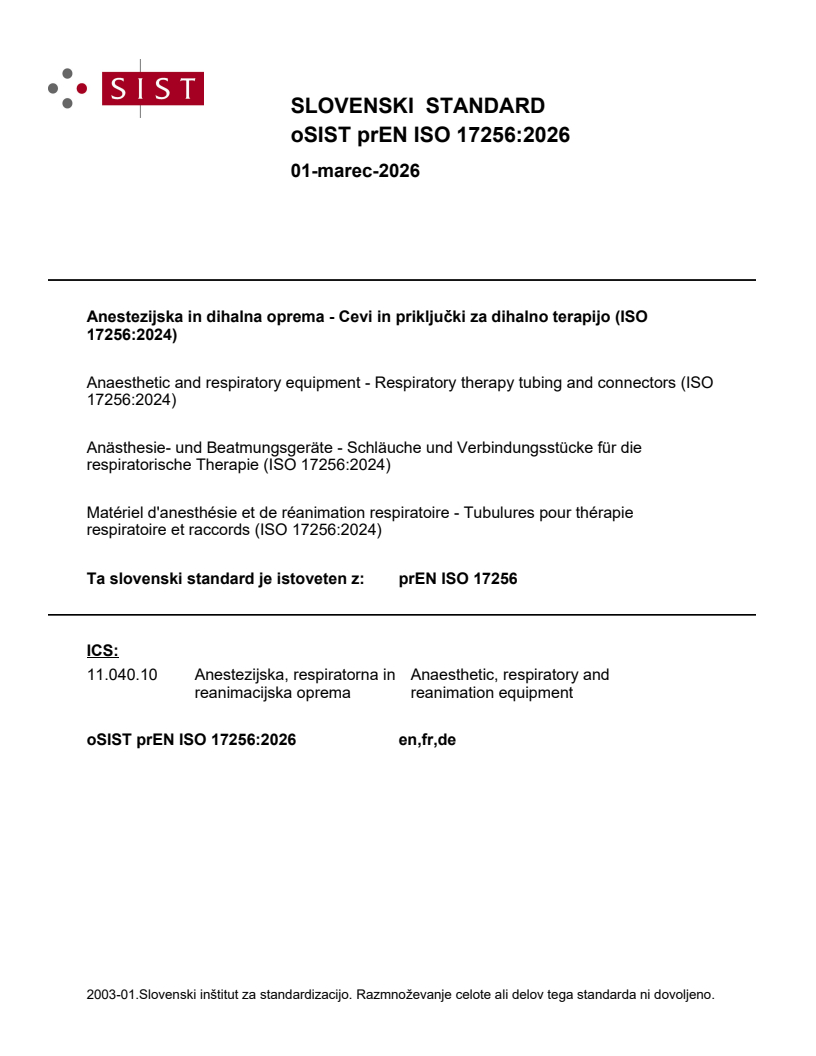
SLOVENSKI STANDARD
01-marec-2026
Anestezijska in dihalna oprema - Cevi in priključki za dihalno terapijo (ISO
17256:2024)
Anaesthetic and respiratory equipment - Respiratory therapy tubing and connectors (ISO
17256:2024)
Anästhesie- und Beatmungsgeräte - Schläuche und Verbindungsstücke für die
respiratorische Therapie (ISO 17256:2024)
Matériel d'anesthésie et de réanimation respiratoire - Tubulures pour thérapie
respiratoire et raccords (ISO 17256:2024)
Ta slovenski standard je istoveten z: prEN ISO 17256
ICS:
11.040.10 Anestezijska, respiratorna in Anaesthetic, respiratory and
reanimacijska oprema reanimation equipment
2003-01.Slovenski inštitut za standardizacijo. Razmnoževanje celote ali delov tega standarda ni dovoljeno.
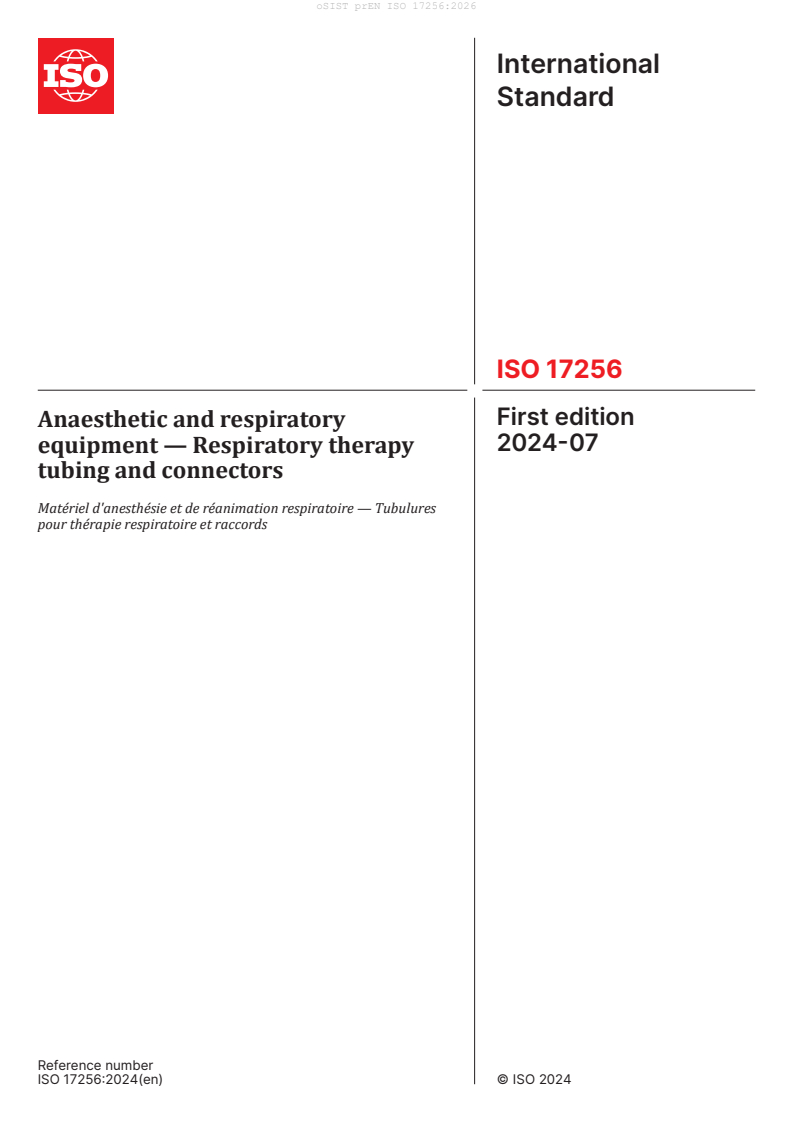
International
Standard
ISO 17256
First edition
Anaesthetic and respiratory
2024-07
equipment — Respiratory therapy
tubing and connectors
Matériel d'anesthésie et de réanimation respiratoire — Tubulures
pour thérapie respiratoire et raccords
Reference number
ISO 17256:2024(en) © ISO 2024
ISO 17256:2024(en)
© ISO 2024
All rights reserved. Unless otherwise specified, or required in the context of its implementation, no part of this publication may
be reproduced or utilized otherwise in any form or by any means, electronic or mechanical, including photocopying, or posting on
the internet or an intranet, without prior written permission. Permission can be requested from either ISO at the address below
or ISO’s member body in the country of the requester.
ISO copyright office
CP 401 • Ch. de Blandonnet 8
CH-1214 Vernier, Geneva
Phone: +41 22 749 01 11
Email: copyright@iso.org
Website: www.iso.org
Published in Switzerland
ii
ISO 17256:2024(en)
Contents Page
Foreword .iv
Introduction .v
1 Scope . 1
2 Normative references . 1
3 Terms and definitions . 1
4 General requirements . 2
4.1 General .2
4.2 Test methods and conditions .2
5 Materials . 2
5.1 General .2
5.2 Biological assessment of gas pathways .2
6 Design requirements . 2
6.1 General .2
6.2 Specific design requirements .3
6.3 Inlet connectors .5
6.4 Outlet connectors .6
7 Requirements for respiratory tubing, extension tubing and connectors supplied sterile . 6
8 Packaging. 6
9 Information supplied by the manufacturer . 6
9.1 General .6
9.2 Information supplied by the manufacturer .6
Annex A (informative) Rationale . 7
Annex B (normative) Respiratory therapy equipment tubing connectors. 9
Annex C (informative) Hazard identification for the purposes of risk assessment .11
Bibliography .12
iii
ISO 17256:2024(en)
Foreword
ISO (the International Organization for Standardization) is a worldwide federation of national standards
bodies (ISO member bodies). The work of preparing International Standards is normally carried out through
ISO technical committees. Each member body interested in a subject for which a technical committee
has been established has the right to be represented on that committee. International organizations,
governmental and non-governmental, in liaison with ISO, also take part in the work. ISO collaborates closely
with the International Electrotechnical Commission (IEC) on all matters of electrotechnical standardization.
The procedures used to develop this document and those intended for its further maintenance are described
in the ISO/IEC Directives, Part 1. In particular, the different approval criteria needed for the different types
of ISO document should be noted. This document was drafted in accordance with the editorial rules of the
ISO/IEC Directives, Part 2 (see www.iso.org/directives).
ISO draws attention to the possibility that the implementation of this document may involve the use of (a)
patent(s). ISO takes no position concerning the evidence, validity or applicability of any claimed patent
rights in respect thereof. As of the date of publication of this document, ISO had not received notice of (a)
patent(s) which may be required to implement this document. However, implementers are cautioned that
this may not represent the latest information, which may be obtained from the patent database available at
www.iso.org/patents. ISO shall not be held responsible for identifying any or all such patent rights.
Any trade name used in this document is information given for the convenience of users and does not
constitute an endorsement.
For an explanation of the voluntary nature of standards, the meaning of ISO specific terms and expressions
related to conformity assessment, as well as information about ISO's adherence to the World Trade
Organization (WTO) principles in the Technical Barriers to Trade (TBT), see www.iso.org/iso/foreword.html.
This document was prepared by Technical Committee ISO/TC 121, Anaesthetic and respiratory equipment
Subcommittee SC 2, Airway devices and related equipment.
Any feedback or questions on this document should be directed to the user’s national standards body. A
complete listing of these bodies can be found at www.iso.org/members.html.
iv
ISO 17256:2024(en)
Introduction
Respiratory tubing and connectors form the essential conduit between the patient interface and the gas supply
device. The connectors specified in this document have been selected taking into consideration the risks of
misconnection with other medical devices commonly used within the same environment. The requirements
in this document were further developed and are to be circulated to all ISO/TC 121 subcommittees as
recommendations.
Respiratory tubing and connectors are used extensively in healthcare facilities and increasingly in the
home healthcare environment where medically trained personnel are not always in attendance. These
environments have been carefully considered throughout the development of this document.
[1]
This document recognizes the significant use and the inherent safety of the EN 13544-2 specified nipple
as the gas outlet on respiratory gas supply devices and therefore specifies a compatible elastomeric (funnel)
connector as the inlet of the respiratory tubing. This document also recognizes the high risks associated with
misconnection of the previously prescribed elastomeric (funnel) connector at the outlet (patient end) of the
tubing and has therefore specified the new R2 respiratory small-bore connector as the outlet connector if
the respiratory tubing is not integrated with the patient interface device (e.g. face mask, nasal cannula).
The concept of extension tubing, commonly used to provide flexibility of movement for the patient in home-
care environments and hospital environments, such as MRI units, toilets and endoscopy units, has now been
included in this document with particular emphasis on the connectors.
[1]
This document is adapted from EN 13544-2:2009 and has been modified as follows:
— the change of outlet from an elastomeric funnel to an R2 respiratory small-bore connector;
— requirements for extension tubing;
— requirements for respiratory tubing integrated with patient interface devices;
— a requirement to assess the biocompatibility of the materials of the devices that provide a gas pathway
has been added;
— the dimensions of the nipple have been better defined;
— the option to specify a gas-specific threaded connection at the inlet of the respiratory tubing to replace
the elastomeric funnel inlet connector has been made clearer;
— the gas-specific threaded inlet connectors now include gasses other than oxygen and air; and
— a hazard identification annex has been added (Annex C).
v
International Standard ISO 17256:2024(en)
Anaesthetic and respiratory equipment — Respiratory
therapy tubing and connectors
1 Scope
This document specifies requirements for the respiratory tubing and connectors used to convey respirable
gases to a patient in the healthcare and homecare environments and provide a safe connection between the
gas supply device and the patient interface. Respiratory tubing and connectors are mainly used for delivery of
oxygen but can also be used for respirable air or oxygen/air mixtures and breathable medicinal gas mixtures
such as oxygen/nitrous oxide or oxygen/helium mixtures. This document also specifies requirements for
respiratory therapy extension tubing.
NOTE 1 The gas supply devices referred to in this document do not include anaesthetic machines/workstations and
ventilators.
NOTE 2 This document does not cover breathing tubes for breathing systems. These are specified in ISO 5367.
This document is written following the format of ISO 18190, General standard for airways and related
equipment. The requirements in this device-specific standard take precedence over any conflicting
requirements in the General standard
2 Normative references
The following documents are referred to in the text in such a way that some or all of their content constitutes
requirements of this document. For dated references, only the edition cited applies. For undated references,
the latest edition of the referenced document (including any amendments) applies.
ISO 4135, Anaesthetic and respiratory equipment — Vocabulary
ISO 18190:2016, Anaesthetic and respiratory equipment — General requirements for airways and related
equipment
ISO 18562-1, Biocompatibility evaluation of breathing gas pathways in healthcare applications — Part 1:
Evaluation and testing within a risk management process
ISO 20417, Medical devices — Information to be supplied by the manufacturer
ISO 21920-1, Geometrical product specifications (GPS) — Surface texture: Profile — Part 1: Indication of
surface tex
...
Questions, Comments and Discussion
Ask us and Technical Secretary will try to provide an answer. You can facilitate discussion about the standard in here.
Loading comments...