


kSIST FprEN ISO 10360-102:2025
(Main)Geometrical product specifications (GPS) - Acceptance and reverification tests for coordinate measuring systems (CMS) - Part 102: Grammar of symbols for metrological characteristics and their specifications (ISO/FDIS 10360-102:2025)
Geometrical product specifications (GPS) - Acceptance and reverification tests for coordinate measuring systems (CMS) - Part 102: Grammar of symbols for metrological characteristics and their specifications (ISO/FDIS 10360-102:2025)
This document specifies the grammar of symbols used in ISO 10360 series in order to identify metrological characteristics of coordinate measuring systems (CMSs) and their specifications.
This document does not provide the meaning of these symbols, neither of whole symbols nor of their components. These meanings are specified in the ISO 10360 documents introducing them.
Geometrische Produktspezifikation (GPS) - Annahmeprüfung und Bestätigungsprüfung für Koordinatenmesssysteme (KMS) - Teil 102: Schreibweise (Grammatik) der Symbole für messtechnische Merkmale und ihre Spezifikation (ISO/FDIS 10360‑102:2025)
Dieses Dokument legt die Schreibweise (Grammatik) der in der Normenreihe ISO 10360 verwendeten Symbole fest, um messtechnische Merkmale für Koordinatenmesssysteme (KMS) und deren Spezifikationen zu identifizieren.
Dieses Dokument enthält keine Angaben zur Bedeutung dieser Symbole, weder der vollständigen Symbole noch ihrer Komponenten. Diese Bedeutungen sind in den ISO 10360-Dokumenten festgelegt, die sie einführen.
Spécification géométrique des produits (GPS) - Essais de réception et de vérification périodique des systèmes à mesurer tridimensionnels (SMT) - Partie 102: Syntaxe des symboles pour les caractéristiques métrologiques et leurs spécifications (ISO/FDIS 10360-102)
Le présent document spécifie la grammaire des symboles utilisés dans la série ISO 10360 afin d'identifier les caractéristiques métrologiques des systèmes à mesurer tridimensionnels (SMT) et leurs spécifications.
Le présent document ne fournit pas la signification de ces symboles, ni des symboles entiers, ni de leurs composantes. Ces significations sont spécifiées dans les documents ISO 10360 les présentant.
Specifikacija geometrijskih veličin izdelka (GPS) - Preskusi za sprejemljivost in ponovno overjanje koordinatnih merilnih strojev (KMS) - 102. del: Slovnica simbolov za meroslovne značilnosti in njihove specifikacije (ISO/FDIS 10360‑102:2025)
General Information
- Status
- Not Published
- Public Enquiry End Date
- 29-Apr-2025
- Technical Committee
- ISEL - Mechanical elements
- Current Stage
- 5020 - Formal vote (FV) (Adopted Project)
- Start Date
- 09-Dec-2025
- Due Date
- 27-Jan-2026
- Completion Date
- 10-Dec-2025
Overview
The draft international standard kSIST FprEN ISO 10360-102:2025:2025 titled Geometrical product specifications (GPS) - Acceptance and reverification tests for coordinate measuring systems (CMS) - Part 102: Grammar of symbols for metrological characteristics and their specifications defines a structured grammar for the symbols used within the ISO 10360 series. These symbols identify critical metrological characteristics of coordinate measuring systems (CMSs), including their maximum permissible errors (MPEs) or limits (MPLs). This standard ensures a consistent and systematic approach to symbolization, supporting clarity and comparability in CMS performance evaluation.
Developed under the auspices of CEN and ISO/TC 213, this document targets professionals involved in standardization, metrology, and CMS testing by offering standardized grammar rules to maintain coherence across industry standards.
Key Topics
Grammar of Symbols (G3 Grammar):
The core concept of the standard is the G3 grammar that defines the structure and formation rules for symbols representing CMS metrological characteristics. These symbols are composed of several structured components:- Test Value Component: Represents the measured value in the acceptance or reverification test.
- Procedure Component: Details the specific test procedure used.
- Technology Component: Identifies the type or category of the CMS technology (e.g., tactile, laser).
- Specification Component: Used for specifications related to permissible limits or errors.
One-to-One Symbol-Characteristic Relationship:
Each metrological characteristic of a CMS has a corresponding unique symbol, and specifications derive from these symbols by adding additional components. This unambiguous relationship facilitates easy reference and reduces confusion.Consistency Across CMS Technologies:
The grammar supports symbols across different CMS technologies, allowing performance comparisons between diverse systems such as tactile machines and laser trackers.Readability and Machine Processing:
Although the grammar can produce complex and lengthy symbols, it prioritizes systematic, mnemonic, and machine-parsable symbols to aid users in understanding and software systems in automated processing.Normative References:
The standard references several key documents including ISO 10360-1 (vocabulary of CMS), ISO 14978 (general GPS concepts), ISO 80000-1 (quantities and units), and ISO/IEC Guide 99 (vocabulary of metrology), ensuring integration within the broader GPS framework.
Applications
Standardization of CMS Testing:
Organizations conducting acceptance and reverification tests for coordinate measuring machines benefit from clear and uniform symbol usage, improving documentation and reporting.Quality Assurance in Manufacturing:
Manufacturers utilizing CMS for product inspection can better interpret measurement results against standardized metrological characteristics, aiding compliance with international standards.CMS Technology Development:
Developers of diverse CMS technologies can use the grammar to create relevant symbols and specifications, supporting transparent communication about system capabilities.Metrology Software Tools:
Software for CMS data acquisition and analysis can implement machine-readable G3 symbols, enabling automated validation, traceability, and reporting.Regulatory and Compliance Reference:
Regulatory bodies referencing GPS standards in technical regulations gain a reliable method for identifying and specifying CMS measurement performance.
Related Standards
- ISO 10360-1: Vocabulary for acceptance and reverification tests of coordinate measuring machines (CMMs).
- ISO 14978: Geometrical product specifications – General concepts and requirements for GPS measuring equipment.
- ISO 80000-1: Quantities and units – establishing uniform definitions essential for symbol standardization.
- ISO/IEC Guide 99 (VIM): International vocabulary of metrology providing fundamental terms related to measurement.
- Other ISO 10360 Parts: Addressing specific CMS types and their acceptance/reverification test procedures, such as tactile or optical systems.
By defining a grammar for symbols that represent metrological characteristics and their specifications, kSIST FprEN ISO 10360-102:2025 facilitates consistent, clear, and comparable communication across the coordinate measuring systems community. This fosters better standard implementation, improved CMS performance transparency, and streamlined quality assurance practices in industrial metrology.

Get Certified
Connect with accredited certification bodies for this standard

BSMI (Bureau of Standards, Metrology and Inspection)
Taiwan's standards and inspection authority.
Sponsored listings
Frequently Asked Questions
kSIST FprEN ISO 10360-102:2025 is a draft published by the Slovenian Institute for Standardization (SIST). Its full title is "Geometrical product specifications (GPS) - Acceptance and reverification tests for coordinate measuring systems (CMS) - Part 102: Grammar of symbols for metrological characteristics and their specifications (ISO/FDIS 10360-102:2025)". This standard covers: This document specifies the grammar of symbols used in ISO 10360 series in order to identify metrological characteristics of coordinate measuring systems (CMSs) and their specifications. This document does not provide the meaning of these symbols, neither of whole symbols nor of their components. These meanings are specified in the ISO 10360 documents introducing them.
This document specifies the grammar of symbols used in ISO 10360 series in order to identify metrological characteristics of coordinate measuring systems (CMSs) and their specifications. This document does not provide the meaning of these symbols, neither of whole symbols nor of their components. These meanings are specified in the ISO 10360 documents introducing them.
kSIST FprEN ISO 10360-102:2025 is classified under the following ICS (International Classification for Standards) categories: 17.040.30 - Measuring instruments; 17.040.40 - Geometrical Product Specification (GPS). The ICS classification helps identify the subject area and facilitates finding related standards.
kSIST FprEN ISO 10360-102:2025 is available in PDF format for immediate download after purchase. The document can be added to your cart and obtained through the secure checkout process. Digital delivery ensures instant access to the complete standard document.
Standards Content (Sample)
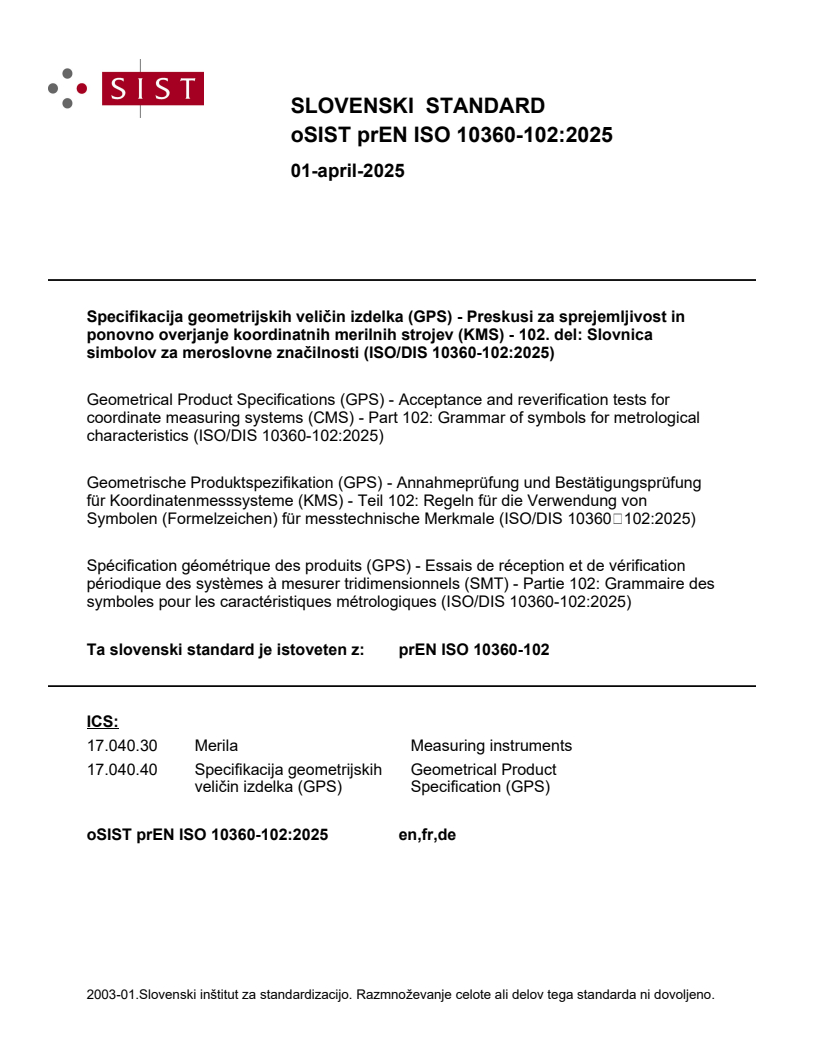
SLOVENSKI STANDARD
oSIST prEN ISO 10360-102:2025
01-april-2025
Specifikacija geometrijskih veličin izdelka (GPS) - Preskusi za sprejemljivost in
ponovno overjanje koordinatnih merilnih strojev (KMS) - 102. del: Slovnica
simbolov za meroslovne značilnosti (ISO/DIS 10360-102:2025)
Geometrical Product Specifications (GPS) - Acceptance and reverification tests for
coordinate measuring systems (CMS) - Part 102: Grammar of symbols for metrological
characteristics (ISO/DIS 10360-102:2025)
Geometrische Produktspezifikation (GPS) - Annahmeprüfung und Bestätigungsprüfung
für Koordinatenmesssysteme (KMS) - Teil 102: Regeln für die Verwendung von
Symbolen (Formelzeichen) für messtechnische Merkmale (ISO/DIS 10360‑102:2025)
Spécification géométrique des produits (GPS) - Essais de réception et de vérification
périodique des systèmes à mesurer tridimensionnels (SMT) - Partie 102: Grammaire des
symboles pour les caractéristiques métrologiques (ISO/DIS 10360-102:2025)
Ta slovenski standard je istoveten z: prEN ISO 10360-102
ICS:
17.040.30 Merila Measuring instruments
17.040.40 Specifikacija geometrijskih Geometrical Product
veličin izdelka (GPS) Specification (GPS)
oSIST prEN ISO 10360-102:2025 en,fr,de
2003-01.Slovenski inštitut za standardizacijo. Razmnoževanje celote ali delov tega standarda ni dovoljeno.
oSIST prEN ISO 10360-102:2025
oSIST prEN ISO 10360-102:2025
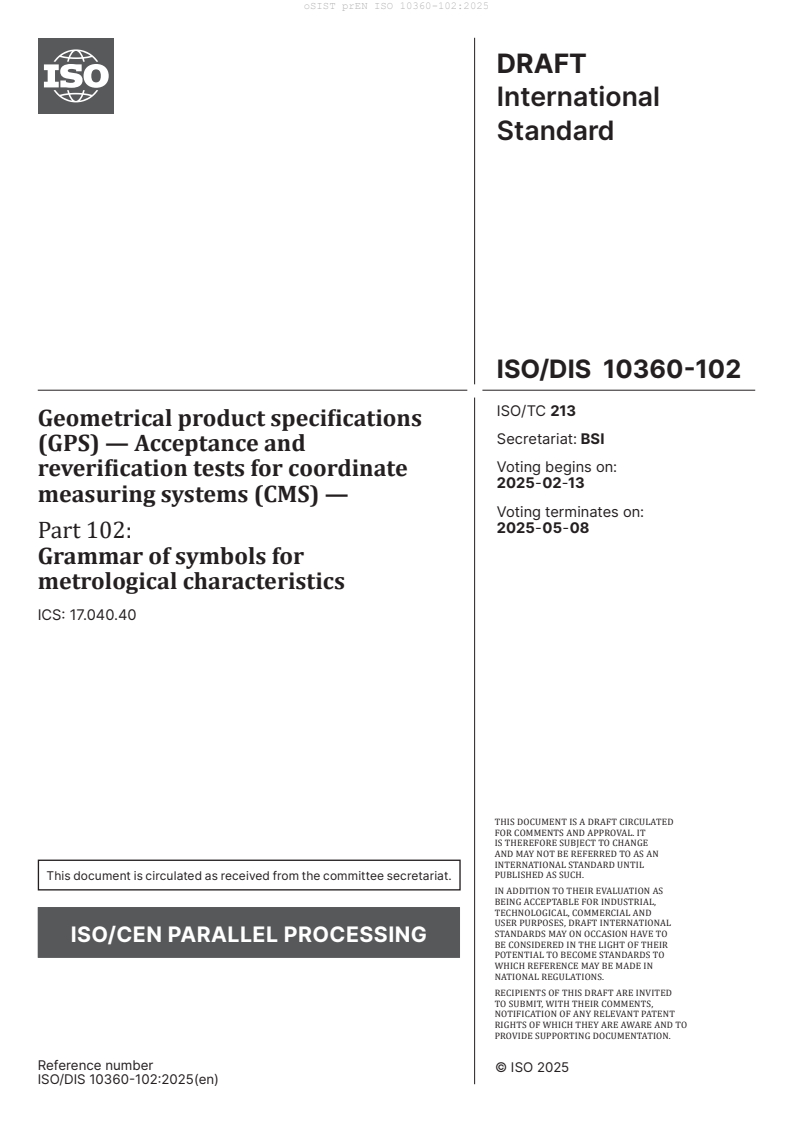
DRAFT
International
Standard
ISO/DIS 10360-102
ISO/TC 213
Geometrical product specifications
Secretariat: BSI
(GPS) — Acceptance and
Voting begins on:
reverification tests for coordinate
2025-02-13
measuring systems (CMS) —
Voting terminates on:
2025-05-08
Part 102:
Grammar of symbols for
metrological characteristics
ICS: 17.040.40
THIS DOCUMENT IS A DRAFT CIRCULATED
FOR COMMENTS AND APPROVAL. IT
IS THEREFORE SUBJECT TO CHANGE
AND MAY NOT BE REFERRED TO AS AN
INTERNATIONAL STANDARD UNTIL
PUBLISHED AS SUCH.
This document is circulated as received from the committee secretariat.
IN ADDITION TO THEIR EVALUATION AS
BEING ACCEPTABLE FOR INDUSTRIAL,
TECHNOLOGICAL, COMMERCIAL AND
USER PURPOSES, DRAFT INTERNATIONAL
STANDARDS MAY ON OCCASION HAVE TO
ISO/CEN PARALLEL PROCESSING
BE CONSIDERED IN THE LIGHT OF THEIR
POTENTIAL TO BECOME STANDARDS TO
WHICH REFERENCE MAY BE MADE IN
NATIONAL REGULATIONS.
RECIPIENTS OF THIS DRAFT ARE INVITED
TO SUBMIT, WITH THEIR COMMENTS,
NOTIFICATION OF ANY RELEVANT PATENT
RIGHTS OF WHICH THEY ARE AWARE AND TO
PROVIDE SUPPORTING DOCUMENTATION.
Reference number
ISO/DIS 10360-102:2025(en)
oSIST prEN ISO 10360-102:2025
DRAFT
ISO/DIS 10360-102:2025(en)
International
Standard
ISO/DIS 10360-102
ISO/TC 213
Geometrical product specifications
Secretariat: BSI
(GPS) — Acceptance and
Voting begins on:
reverification tests for coordinate
measuring systems (CMS) —
Voting terminates on:
Part 102:
Grammar of symbols for
metrological characteristics
ICS: 17.040.40
THIS DOCUMENT IS A DRAFT CIRCULATED
FOR COMMENTS AND APPROVAL. IT
IS THEREFORE SUBJECT TO CHANGE
AND MAY NOT BE REFERRED TO AS AN
INTERNATIONAL STANDARD UNTIL
PUBLISHED AS SUCH.
This document is circulated as received from the committee secretariat.
IN ADDITION TO THEIR EVALUATION AS
BEING ACCEPTABLE FOR INDUSTRIAL,
© ISO 2025
TECHNOLOGICAL, COMMERCIAL AND
USER PURPOSES, DRAFT INTERNATIONAL
All rights reserved. Unless otherwise specified, or required in the context of its implementation, no part of this publication may
STANDARDS MAY ON OCCASION HAVE TO
ISO/CEN PARALLEL PROCESSING
be reproduced or utilized otherwise in any form or by any means, electronic or mechanical, including photocopying, or posting on
BE CONSIDERED IN THE LIGHT OF THEIR
the internet or an intranet, without prior written permission. Permission can be requested from either ISO at the address below
POTENTIAL TO BECOME STANDARDS TO
WHICH REFERENCE MAY BE MADE IN
or ISO’s member body in the country of the requester.
NATIONAL REGULATIONS.
ISO copyright office
RECIPIENTS OF THIS DRAFT ARE INVITED
CP 401 • Ch. de Blandonnet 8
TO SUBMIT, WITH THEIR COMMENTS,
CH-1214 Vernier, Geneva
NOTIFICATION OF ANY RELEVANT PATENT
Phone: +41 22 749 01 11
RIGHTS OF WHICH THEY ARE AWARE AND TO
PROVIDE SUPPORTING DOCUMENTATION.
Email: copyright@iso.org
Website: www.iso.org
Published in Switzerland Reference number
ISO/DIS 10360-102:2025(en)
ii
oSIST prEN ISO 10360-102:2025
ISO/DIS 10360-102:2025(en)
Contents Page
Foreword .iv
Introduction .v
1 Scope . 1
2 Normative references . 1
3 Terms and definitions . 1
4 Objectives . 2
5 Grammar of symbols . 3
6 Comparability of metrological characteristics . 5
7 Alternatives in G3 . 5
7.1 Alternative format .5
7.2 Reduced G3 symbols .6
Annex A (normative) Grammar and writing rules for the G3 symbols . 7
Annex B (informative) The evolution of the ISO 10360 symbols .11
Annex C (informative) Relation to the GPS matrix model .12
iii
oSIST prEN ISO 10360-102:2025
ISO/DIS 10360-102:2025(en)
Foreword
ISO (the International Organization for Standardization) is a worldwide federation of national standards
bodies (ISO member bodies). The work of preparing International Standards is normally carried out through
ISO technical committees. Each member body interested in a subject for which a technical committee
has been established has the right to be represented on that committee. International organizations,
governmental and non-governmental, in liaison with ISO, also take part in the work. ISO collaborates closely
with the International Electrotechnical Commission (IEC) on all matters of electrotechnical standardization.
The procedures used to develop this document and those intended for its further maintenance are described
in the ISO/IEC Directives, Part 1. In particular, the different approval criteria needed for the different types
of ISO documents should be noted. This document was drafted in accordance with the editorial rules of the
ISO/IEC Directives, Part 2 (see www.iso.org/directives).
Attention is drawn to the possibility that some of the elements of this document may be the subject of patent
rights. ISO shall not be held responsible for identifying any or all such patent rights. Details of any patent
rights identified during the development of the document will be in the Introduction and/or on the ISO list of
patent declarations received (see www.iso.org/patents).
Any trade name used in this document is information given for the convenience of users and does not
constitute an endorsement.
For an explanation of the voluntary nature of standards, the meaning of ISO specific terms and expressions
related to conformity assessment, as well as information about ISO's adherence to the World Trade
Organization (WTO) principles in the Technical Barriers to Trade (TBT), see www.iso.org/iso/foreword.html.
This document was prepared by Technical Committee ISO/TC 213, Dimensional and geometrical product
specifications and verification.
A list of all parts in the ISO 10360 series can be found on the ISO website.
Any feedback or questions on this document should be directed to the user’s national standards body. A
complete listing of these bodies can be found at www.iso.org/members.html.
iv
oSIST prEN ISO 10360-102:2025
ISO/DIS 10360-102:2025(en)
Introduction
The ISO 10360 series of documents is widely used in industry for the acceptance and the reverification
testing of CMSs (coordinate measuring systems). It includes several documents addressing different CMS
technologies. These documents are designed to ensure the highest possible degree of internal consistency in
spite of their diversity.
This and other documents of the ISO 10360 series with Part numbers in excess of 100 (e.g. ISO 10360-102)
describe the commonalities of the ISO 10360 series. The purpose is to provide a reference for the development
of future ISO 10360 documents and the revision of existing ISO 10360 documents as well as to disclose the
commonalities to the public and to improve awareness and understanding overall.
The ISO 10360 series of documents defines metrological characteristics – typically error parameters – and
their specifications (MPEs or MPLs, maximum permissible errors or limits) of CMSs. Symbols are associated
to them for convenience and ease of reference. The association of symbols to corresponding metrological
characteristics and their specifications is conventional and any is valid in principle, provided that it is
unambiguous (i.e. the correspondence is one-to-one) and in conformity to the requirements of ISO 80000-1.
In practice, the increasing number of ISO 10360 documents and of metrological characteristics therein
would result in a chaos of symbols without a systematic rule in assigning and interpreting them.
The symbols in the ISO 10360 series of documents follow an underlying grammar named G3, to create
valid and consistent symbols. Annex B recalls the evolution of the symbols of the ISO 10360 series and the
underlying grammar generations. Mastering the details of such grammar is the responsibility of standard
makers; familiarizing themselves with it (by understanding its foundations, goals and main characteristics)
is important for standard users too, to avoid confusion (symbols are sometimes long and complex) and to
take advantage in reading, interpreting and comparing.
Annex A provides a complete set of grammar rules for the G3 symbols and is intended mainly for standard
makers for defining new symbols of metrological characteristics and their specifications in Parts of the
ISO 10360 series of documents.
v
oSIST prEN ISO 10360-102:2025
oSIST prEN ISO 10360-102:2025
DRAFT International Standard ISO/DIS 10360-102:2025(en)
Geometrical product specifications (GPS) — Acceptance and
reverification tests for coordinate measuring systems (CMS) —
Part 102:
Grammar of symbols for metrological characteristics
1 Scope
This document defines the grammar of symbols used in the ISO 10360 series of documents to identify
metrological characteristics of coordinate measuring systems (CMSs) and their specifications.
This document does not provide the meaning of these symbols, neither of whole symbols nor of their
components. These meanings are defined in the ISO 10360 documents introducing them.
2 Normative references
The following documents are referred to in the text in such a way that some or all of their content constitutes
requirements of this document. For dated references, only the edition cited applies. For undated references,
the latest edition of the referenced document (including any amendments) applies.
ISO 10360-1, Geometrical product specifications (GPS) — Acceptance and reverification tests for coordinate
measuring machines (CMM) — Part 1: Vocabulary
ISO 14978, Geometrical product specifications (GPS) — General concepts and requirements for GPS measuring
equipment
ISO 80000-1, Quantities and units — Part 1: General
ISO/IEC Guide 99, International vocabulary of metrology — Basic and general concepts and associated terms (VIM)
3 Terms and definitions
For the purposes of this document, the following terms and definitions apply.
ISO and IEC maintain terminology databases for use in standardization at the following addresses:
— ISO Online browsing platform: available at https:// www .iso .org/ obp
— IEC Electropedia: available at https:// www .electropedia .org/
NOTE 1 “Coordinate Measuring Machine (CMM)” is defined in ISO 10360-1.
NOTE 2 “Maximum permissible Error (MPE)” is defined in ISO/IEC Guide 99.
NOTE 3 “Maximum permissible Limit (MPL)” is defined in ISO 14978.
3.1
grammar of symbols
G3
grammar of the symbols, defined in this document, associated with the metrological characteristics of CMSs
and their specifications as defined in ISO 10360 series of documents
oSIST prEN ISO 10360-102:2025
ISO/DIS 10360-102:2025(en)
3.2
G3 symbol
symbol compliant with G3
3.3
symbol component
component
portion of a G3 symbol that expresses a self-contained component of the meaning of the G3 symbol
Note 1 to entry: Symbol components are separated by punctuation.
Note 2 to entry: G3 symbols of metrological characteristics and their specifications are made of an ordered sequence
of symbol components.
3.4
test value symbol component
test value component
symbol component that identifies the value obtained in the test of a CMS capturing the metrological
characteristic with which the G3 symbol is associated
Note 1 to entry: Test value symbol components are indicated in green in this document for convenience.
3.5
procedure symbol component
procedure component
symbol component that identifies the procedural details of the metrological characteristic with which the
G3 symbol is associated
Note 1 to entry: Procedure symbol components are indicated in red in this document for convenience.
3.6
technology symbol component
technology component
symbol component that identifies the CMS type (or technology) with which the metrological characteristic’s
G3 symbol is associated
Note 1 to entry: Technology symbol components are indicated in blue in this document for convenience.
3.7
specification symbol component
specification component
symbol component that identifies a specification
Note 1 to entry: G3 symbols of metrological characteristics do not have a specification symbol component.
Note 2 to entry: Specification symbol components are indicated in magenta in this document for convenience.
3.8
symbol component word
word
smallest portion of a symbol component that carries a unit of meaning
Note 1 to entry: Note to entry: A symbol component may contain one or more words.
4 Objectives
The G3 has the following objectives:
— to maintain consistency of symbols throughout the ISO 10360 series of documents, and underpin
one-to-one correspondence between metrological characteristics and their specifications, and G3
symbols;
oSIST prEN ISO 10360-102:2025
ISO/DIS 10360-102:2025(en)
— to allow performance comparison of CMSs of a same or of different technologies, e.g. a laser tracker vs. a
(large) tactile CMM;
— to help users of standards in remembering definitions – or at least meanings – by looking at G3 symbols,
or even in guessing meanings before reading definitions;
— to generate machine-readable G3 symbols, i.e. possibly parsed by software.
To achieve these objectives, a concession was made to the complexity of the G3 symbols. The symbols
components are made of conventional (possibly abbreviated) words, and their combination in a G3 symbol
may result in a very long symbol line in spite of any limitation to the words’ length. In return of this, G3
symbols are systematic, rather readable and mnemonic.
G3 symbols do not substitute definitions of metrological characteristics and their specifications, even when
the meaning of a G3 symbol may be guessed from its syntax.
G3 is in compliance with ISO 80000-1.
5 Grammar of symbols
Any specification is associated with a metrological characteristic, which it specifies. A one-to-one
relationship between specifications and metrological characteristics exists, and identifying either one
identifies the other too. G3 symbols reflect this by an identical structure for any metrological characteristic
and its specification, the latter being derived from the former by adding the trailing specification symbol
component (see Table 1).
EXAMPLE 1 Let G be the G3 symbol of a metrological characteristic. Then the G3 symbol of its specification is G .
,S
NOTE 1 Colours are not part of the G3. The syntaxes in the following tables and in the other parts of this document
use colours for illustration only.
The ISO 10360 Parts define individual metrological characteristics as the performance of a CMS when
measuring:
1. a specific characteristic of a geometrical feature (e.g. the size of a sphere);
2. according to a specific test procedure (e.g. the length of the styli used);
3. with a CMS of a specific category or technology (e.g. tactile).
G3 symbols of metrological characteristics are the combination of three symbol components reflecting the
above three pieces of information:
— the test value component reflects 1. above;
— the procedure component reflects 2. above;
— the technology component reflects 3. above.
G3 symbols have the general syntax shown in Table 1. Column (a) shows the three components V, P, T
(“Metrological characteristic” row) – namely the test value, procedure and technology symbol components,
respectively – or four components V, P, T, S (“Specification” row) – namely V, P, T and the specification symbol
components. V, P, T are separated by colons in the subscript; S is separated by a comma in the subscript. Each
component conveys information that may be composed of multiple elements, each expressed by a word. Each
symbol component is then the combination of words separated by dots, as shown in column (b).
NOTE 2 m, n, p and q in Table 1 are the number of words in the test value, procedure, technology and specification
symbol components, respectively.
oSIST prEN ISO 10360-102:2025
ISO/DIS 10360-102:2025(en)
Table 1 — General syntax of symbols
Spelled out by components Spelled out in full by words
(a) (b)
… … …
Metrological characteristic V A
:P:T B1.B2. .Bn:P1.P2. .Pm:T1.T2. .Tp
… … …
A
B1.B2. .Bn:P1.P2. .Pm:T1.T2. .Tp,S1.
Specification V
:P:T,S …
S2. .Sq
The components V, P, T, S have the meaning defined in Table 2.
Table 2 — Semantics of the symbol components
Symbol Name Meaning
Value of the metrological characteristic subject to an
…
V = A Test value component
...
Questions, Comments and Discussion
Ask us and Technical Secretary will try to provide an answer. You can facilitate discussion about the standard in here.
Loading comments...