

SIST EN 1186-13:2003
(Main)Materials and articles in contact with foodstuffs - Plastics - Part 13: Test methods for overall migration at high temperatures
- Abstract
This European Standard describes test methods for the determination of the overall migration into fatty food simulants from plastics materials and articles, by total immersion of test specimens in a fatty food simulant at temperatures from 100 °C up to and including, 175 °C for selected times. Also described is a procedure with a substitute test medium. In this substitute procedure the mass of components adsorbed on modified polyphenylene oxide (MPPO) is taken as a measure for the assessment of the overall migration into olive oil.
NOTE 1 The total immersion test method has been written for use with the fatty food simulant, olive oil. The test method can also be used with appropriate modifications with 'other fatty food simulants ' called simulant D - a synthetic mixture of triglycerides, sunflower oil and corn oil. These other fatty food simulants will produce different chromatograms for the simulant methyl esters to those of the methyl esters of olive oil. Select suitable chromatogram peaks of the methyl esters of the other fatty food simulants for the quantitative determination of the simulant extracted from the test specimens.
NOTE 2 A comparative migration test carried out with polypropylene and polyethylene terephthalate high temperature application containers as test samples at conditions 2 h at 100 °C and 2 h at 175 °C, respectively, in contact with 14C-labelled synthetic triglyceride and MPPO provided test results comparable within the analytical tolerance of the methods.
NOTE 3 To obtain reproducible and repeatable results using the MPPO method it may be necessary to measure the temperature of the test specimen before starting the migration period. An appropriate method for measuring the temperature of the test specimen needs to be established.
The described methods are most suitable for food contact articles in the form of sheets and films, but can also be applied to a wide range of articles and containers.
- Status
- Published
- Publication Date
- 31-Dec-2002
- Technical Committee
- EPO - Packaging - sales and grouped
- Current Stage
- 6060 - National Implementation/Publication (Adopted Project)
- Start Date
- 01-Jan-2003
- Due Date
- 01-Jan-2003
- Completion Date
- 01-Jan-2003

SIST EN 1186-13:2003 is the Slovenian adoption of EN 1186-13:2002 from SIST. It covers test methods for overall migration at high temperatures from plastics materials and articles in contact with foodstuffs. The standard gives one method based on total immersion in olive oil and one substitute method based on modified polyphenylene oxide (MPPO), for laboratories that test food-contact plastics and packaging.
What does SIST EN 1186-13:2003 specify?
SIST EN 1186-13:2003 specifies how to measure overall migration from plastics into fatty food simulants at high temperature. It covers testing by total immersion from 100 °C up to and including 175 °C, and it also includes a substitute test medium based on MPPO.
The document is organized into a short front matter, Clause 1 on scope, Clause 2 on normative references, Clause 3 for Method A, and Clause 4 for Method B. It also has three informative annexes.
| Annex | What it covers |
|---|---|
| Annex A | Aluminium block for Method A |
| Annex B | Precision data |
| Annex ZA | Relationship to EU food-contact Directives |
What are the key requirements of SIST EN 1186-13:2003?
Selecting the test conditions
SIST EN 1186-13:2003 ties the test conditions to the intended conditions of use through EN 1186-1. In practice, the tester must choose the time and temperature so they match the intended contact situation.
Method A - total immersion in olive oil
Clause 3 describes Method A, where known-mass test specimens are immersed in olive oil, then removed, blotted, and reweighed. The migration is derived from mass loss per surface area, and absorbed oil is extracted and measured by gas chromatography after conversion to methyl esters.
Method A uses triheptadecanoin as an internal standard. That matters because it helps correct for losses or inefficiencies during hydrolysis, methylation, and extraction.
The method also requires temperature control using an aluminium block and a thermocouple. The block must reach the selected temperature before the migration period begins, and the standard sets short allowed times for the oil to regain temperature after immersion.
Method A - specimen handling and result treatment
SIST EN 1186-13:2003 requires at least three determinations on separate specimens, with four determinations carried out so one result can be discarded if needed. This reduces the effect of contamination, oil loss, or other handling errors.
The result is reported in milligrams per square decimetre. For the reader, that means the test is expressed as a surface-related migration value, not just as a mass change.
Method B - MPPO substitute test
Clause 4 gives the substitute procedure using modified polyphenylene oxide (MPPO). The article surface is covered with MPPO and heated in a conventional oven up to 175 °C, then the adsorbent is extracted with diethyl ether and the residue is weighed.
MPPO must be purified before first use, and the standard gives sample preparation rules for films, sheets, containers, and other articles. For flexible materials, the contact area is defined; for rigid articles, the flat bottom area is used where possible.
Reporting and precision
Clause 4 requires the result to be calculated from the residue on contacted and blank MPPO and expressed in milligrams per square decimetre. Annex B gives precision information, including repeatability from collaborative testing. Clause 4.7 also defines the test report content, including sample identification, exposure conditions, deviations, and results.
What terms does SIST EN 1186-13:2003 define?
- Overall migration - the total amount lost from the plastic during the test, reported per unit of surface area.
- Fatty food simulant - the test medium used to represent fatty foods, with olive oil as the main medium in Method A.
- Simulant D - a synthetic fatty simulant used with suitable modifications of the olive-oil method.
- Modified polyphenylene oxide (MPPO) - the porous adsorbent used in Method B to capture migrated substances.
- Triheptadecanoin - the internal standard added in Method A to support quantitative analysis.
- Methyl esters - the analytical form used after oil hydrolysis and methylation for gas chromatographic measurement.
Who uses SIST EN 1186-13:2003?
SIST EN 1186-13:2003 is used by testing laboratories, food-contact plastics manufacturers, packaging producers, and quality or regulatory teams working with materials and articles intended for food contact. It is particularly relevant when assessing sheets, films, containers, and other articles that need high-temperature migration testing. Buyers and specifiers use it to define the test method they want applied to a food-contact plastic.
What changed in SIST EN 1186-13:2003 from the previous edition?
SIST EN 1186-13:2003 supersedes ENV 1186-13:1999.
Which standards are used with SIST EN 1186-13:2003?
- EN 1186-1:2002 - gives guidance for selecting test conditions and provides the time-temperature framework used with both methods.
- EN 1186-2:2002 - supplies the reagents, apparatus, sample handling, calculation approach, and test report rules used directly with Method A.
- The standard also sits within the EN 1186 series for plastics in contact with foodstuffs, where other parts cover olive oil, aqueous simulants, pouches, article filling, low temperatures, and substitute tests.
What does the SIST EN 1186-13:2003 document contain?
The document contains two full test procedures, each with principle, reagents, apparatus, sample preparation, procedure, expression of results, and test report requirements. Method A includes a temperature-controlled aluminium block setup, repeated weighing, oil extraction, and gas chromatographic determination. Method B includes MPPO cleaning, exposure in an oven, ether extraction, nitrogen evaporation, and gravimetric weighing of residue.
It also contains a calculation formula for the MPPO result, a table for extraction solvent volumes, a figure of the aluminium block, precision data in Annex B, and a directive relationship note in Annex ZA.
Relations
- Effective Date
- 01-Jan-2003
- Effective Date
- 28-Jan-2026
- Effective Date
- 28-Jan-2026
- Effective Date
- 28-Jan-2026
- Referred By
SIST-TS CEN/TS 17287:2019 - Requirements and test methods for electronic cigarette devices - Effective Date
- 28-Jan-2026
- Effective Date
- 28-Jan-2026
- Effective Date
- 18-Jan-2023
- Effective Date
- 22-Dec-2008
Get Certified
Connect with accredited certification bodies for this standard

BSI Group
BSI (British Standards Institution) is the business standards company that helps organizations make excellence a habit.

Bureau Veritas
Bureau Veritas is a world leader in laboratory testing, inspection and certification services.

DNV
DNV is an independent assurance and risk management provider.
Sponsored listings
Frequently Asked Questions
SIST EN 1186-13:2003 is a standard published by the Slovenian Institute for Standardization (SIST). Its full title is "Materials and articles in contact with foodstuffs - Plastics - Part 13: Test methods for overall migration at high temperatures". This standard covers: This European Standard describes test methods for the determination of the overall migration into fatty food simulants from plastics materials and articles, by total immersion of test specimens in a fatty food simulant at temperatures from 100 °C up to and including, 175 °C for selected times. Also described is a procedure with a substitute test medium. In this substitute procedure the mass of components adsorbed on modified polyphenylene oxide (MPPO) is taken as a measure for the assessment of the overall migration into olive oil. NOTE 1 The total immersion test method has been written for use with the fatty food simulant, olive oil. The test method can also be used with appropriate modifications with 'other fatty food simulants ' called simulant D - a synthetic mixture of triglycerides, sunflower oil and corn oil. These other fatty food simulants will produce different chromatograms for the simulant methyl esters to those of the methyl esters of olive oil. Select suitable chromatogram peaks of the methyl esters of the other fatty food simulants for the quantitative determination of the simulant extracted from the test specimens. NOTE 2 A comparative migration test carried out with polypropylene and polyethylene terephthalate high temperature application containers as test samples at conditions 2 h at 100 °C and 2 h at 175 °C, respectively, in contact with 14C-labelled synthetic triglyceride and MPPO provided test results comparable within the analytical tolerance of the methods. NOTE 3 To obtain reproducible and repeatable results using the MPPO method it may be necessary to measure the temperature of the test specimen before starting the migration period. An appropriate method for measuring the temperature of the test specimen needs to be established. The described methods are most suitable for food contact articles in the form of sheets and films, but can also be applied to a wide range of articles and containers.
This European Standard describes test methods for the determination of the overall migration into fatty food simulants from plastics materials and articles, by total immersion of test specimens in a fatty food simulant at temperatures from 100 °C up to and including, 175 °C for selected times. Also described is a procedure with a substitute test medium. In this substitute procedure the mass of components adsorbed on modified polyphenylene oxide (MPPO) is taken as a measure for the assessment of the overall migration into olive oil. NOTE 1 The total immersion test method has been written for use with the fatty food simulant, olive oil. The test method can also be used with appropriate modifications with 'other fatty food simulants ' called simulant D - a synthetic mixture of triglycerides, sunflower oil and corn oil. These other fatty food simulants will produce different chromatograms for the simulant methyl esters to those of the methyl esters of olive oil. Select suitable chromatogram peaks of the methyl esters of the other fatty food simulants for the quantitative determination of the simulant extracted from the test specimens. NOTE 2 A comparative migration test carried out with polypropylene and polyethylene terephthalate high temperature application containers as test samples at conditions 2 h at 100 °C and 2 h at 175 °C, respectively, in contact with 14C-labelled synthetic triglyceride and MPPO provided test results comparable within the analytical tolerance of the methods. NOTE 3 To obtain reproducible and repeatable results using the MPPO method it may be necessary to measure the temperature of the test specimen before starting the migration period. An appropriate method for measuring the temperature of the test specimen needs to be established. The described methods are most suitable for food contact articles in the form of sheets and films, but can also be applied to a wide range of articles and containers.
SIST EN 1186-13:2003 is classified under the following ICS (International Classification for Standards) categories: 67.250 - Materials and articles in contact with foodstuffs. The ICS classification helps identify the subject area and facilitates finding related standards.
SIST EN 1186-13:2003 has the following relationships with other standards: It is inter standard links to SIST ENV 1186-13:2000, SIST EN 1186-2:2002, SIST EN 1186-1:2002, SIST-TS CEN/TS 14235:2003, SIST-TS CEN/TS 17287:2019, SIST EN 14338:2004, oSIST prEN 1186-13:2006, oSIST prEN 1186-13:2006. Understanding these relationships helps ensure you are using the most current and applicable version of the standard.
SIST EN 1186-13:2003 is associated with the following European legislation: EU Directives/Regulations: 89/109/EEC; Standardization Mandates: M/052. When a standard is cited in the Official Journal of the European Union, products manufactured in conformity with it benefit from a presumption of conformity with the essential requirements of the corresponding EU directive or regulation.
SIST EN 1186-13:2003 is available in PDF format for immediate download after purchase. The document can be added to your cart and obtained through the secure checkout process. Digital delivery ensures instant access to the complete standard document.
Standards Content (Sample)
2003-01.Slovenski inštitut za standardizacijo. Razmnoževanje celote ali delov tega standarda ni dovoljeno.Materiali in predmeti v stiku z živili - Polimerni materiali - 13. del: Preskusne metode za celotno migracijo pri visokih temperaturahWerkstoffe und Gegenstände in Kontakt mit Lebensmitteln - Kunststoffe - Teil 13: Prüfverfahren für die Gesamtmigration bei hohen TemperaturenMatériaux et objets en contact avec les denrées alimentaires - Matiere plastique - Partie 13: Méthodes d'essai pour la migration globale a hautes températuresMaterials and articles in contact with foodstuffs - Plastics - Part 13: Test methods for overall migration at high temperatures67.250Materiali in predmeti v stiku z živiliMaterials and articles in contact with foodstuffsICS:Ta slovenski standard je istoveten z:EN 1186-13:2002SIST EN 1186-13:2003en01-januar-2003SIST EN 1186-13:2003SLOVENSKI
STANDARDSIST ENV 1186-13:20001DGRPHãþD
EUROPEAN STANDARDNORME EUROPÉENNEEUROPÄISCHE NORMEN 1186-13September 2002ICS 67.250English versionMaterials and articles in contact with foodstuffs - Plastics - Part13: Test methods for overall migration at high temperaturesMatériaux et objets en contact avec les denréesalimentaires - Matière plastique - Partie 13: Méthodesd'essai pour la migration globale à hautes températuresWerkstoffe und Gegenstände in Kontakt mit Lebensmitteln- Kunststoffe - Teil 13: Prüfverfahren für dieGesamtmigration bei hohen TemperaturenThis European Standard was approved by CEN on 29 April 2002.CEN members are bound to comply with the CEN/CENELEC Internal Regulations which stipulate the conditions for giving this EuropeanStandard the status of a national standard without any alteration. Up-to-date lists and bibliographical references concerning such nationalstandards may be obtained on application to the Management Centre or to any CEN member.This European Standard exists in three official versions (English, French, German). A version in any other language made by translationunder the responsibility of a CEN member into its own language and notified to the Management Centre has the same status as the officialversions.CEN members are the national standards bodies of Austria, Belgium, Czech Republic, Denmark, Finland, France, Germany, Greece,Iceland, Ireland, Italy, Luxembourg, Malta, Netherlands, Norway, Portugal, Spain, Sweden, Switzerland and United Kingdom.EUROPEAN COMMITTEE FOR STANDARDIZATIONCOMITÉ EUROPÉEN DE NORMALISATIONEUROPÄISCHES KOMITEE FÜR NORMUNGManagement Centre: rue de Stassart, 36
B-1050 Brussels© 2002 CENAll rights of exploitation in any form and by any means reservedworldwide for CEN national Members.Ref. No. EN 1186-13:2002 ESIST EN 1186-13:2003
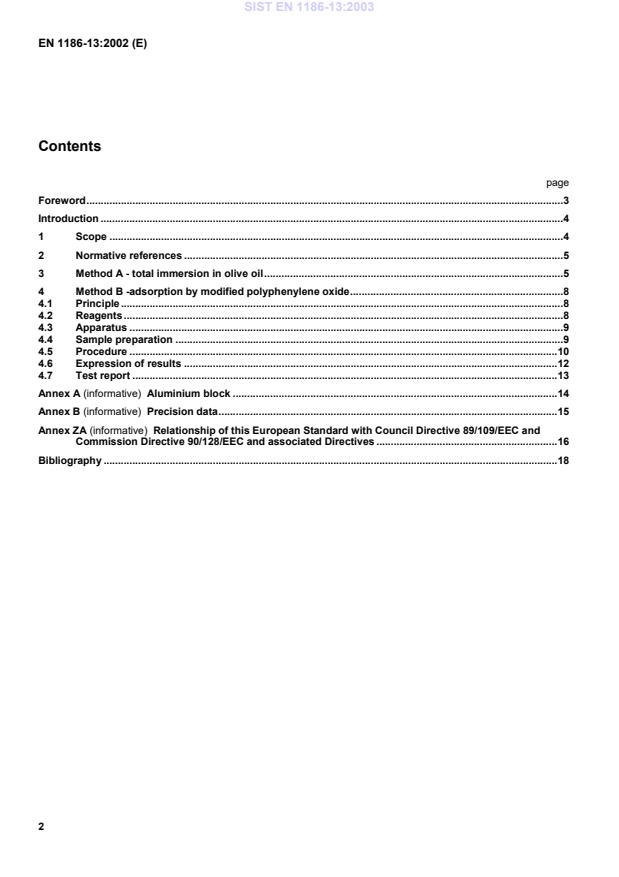
Aluminium block.14Annex B (informative)
Precision data.15Annex ZA (informative)
Relationship of this European Standard with Council Directive 89/109/EEC andCommission Directive 90/128/EEC and associated Directives.16Bibliography.18SIST EN 1186-13:2003
Further Directives andamendments to existing Directives are expected which could change the legislative requirements which thisstandard supports.
It is therefore strongly recommended that users of this standard refer to the latest relevantpublished Directive(s) before commencement of any of the test or tests described in this standard.EN 1186-13 Method A and Method B should be read in conjunction with EN 1186-1. Also, EN 1186-13 Method Ashould be read in conjunction with EN 1186-2.Further Parts of this standard have been prepared concerned with the determination of overall migration fromplastics materials into food simulants.
Their titles are as follows:EN 1186 Materials and articles in contact with foodstuffs – Plastics –Part 1Guide to the selection of conditions and test methods for overall migrationPart 2Test methods for overall migration into olive oil by total immersionPart 3Test methods for overall migration into aqueous food simulants by total immersionPart 4Test methods for overall migration into olive oil by cellPart 5Test methods for overall migration into aqueous food simulants by cellPart 6Test methods for overall migration into olive oil using a pouchPart 7Test methods for overall migration into aqueous food simulants using a pouchPart 8Test methods for overall migration into olive oil by article fillingPart 9Test methods for overall migration into aqueous food simulants by article fillingPart 10Test methods for overall migration into olive oil (modified method for use in cases whereincomplete extraction of olive oil occurs)Part 11Test methods for overall migration into mixtures of 14C-labelled synthetic triglyceridePart 12Test methods for overall migration at low temperaturesPart 14Test methods for 'substitute tests' for overall migration from plastics intended to come intocontact with fatty foodstuffs using test media iso-octane and 95 % ethanolSIST EN 1186-13:2003
Experience hasshown that it is difficult to achieve reproducible results owing to different laboratories having different equipmentwhich give rise to variations in the time taken to reach the exposure temperature.
A method is described fordetermining overall migration by total immersion using an aluminium block with a consistent thermal capacity.Other analytical difficulties with olive oil include possible oxidation of oil at elevated temperatures and the hazard topersonnel working with hot oil. Replacement of olive oil by an appropriate adsorbent material, in principal, can solveor reduce these problems and offers further experimental advantages.1 ScopeThis European Standard specifies test methods for the determination of the overall migration into fatty foodsimulants from plastics materials and articles, by total immersion of test specimens in a fatty food simulant attemperatures from 100 °C up to and including, 175 °C for selected times.
Also described is a procedure with asubstitute test medium.
In this substitute procedure the mass of components adsorbed on modified polyphenyleneoxide (MPPO) is taken as a measure for the assessment of the overall migration into olive oil.NOTE 1The total immersion test method has been written for use with the fatty food simulant, olive oil.
The test method canalso be used with appropriate modifications with 'other fatty food simulants' called simulant D - a synthetic mixture oftriglycerides, sunflower oil and corn oil.
These other fatty food simulants produce different chromatograms for the simulantmethyl esters to those of the methyl esters of olive oil.
Suitable chromatogram peaks of the methyl esters of the other fatty foodsimulants should be selected for the quantitative determination of the simulant extracted from the test specimens.NOTE 2A comparative migration test carried out with polypropylene and polyethylene terephthalate high temperatureapplication containers as test samples at conditions 2 h at 100 °C and 2 h at 175 °C, respectively, in contact with 14C-labelledsynthetic triglyceride and MPPO provided test results comparable within the analytical tolerance of the methods.NOTE 3To obtain reproducible and repeatable results using the MPPO method it may be necessary to measure thetemperature of the test specimen before starting the migration period.
An appropriate method for measuring the temperature ofthe test specimen needs to be established.The described methods are most suitable for food contact articles in the form of sheets and films, but can also beapplied to a wide range of articles and containers.SIST EN 1186-13:2003
Thesenormative references are cited at the appropriate places in the text, and the publications are listed hereafter. Fordated references, subsequent amendments to and revisions of any of these publications apply to this EuropeanStandard only when incorporated in it by amendment or revision.
For undated references the latest edition of thepublication referred to applies, including amendments (including amendments).EN 1186-1:2002, Materials and articles in contact with foodstuffs – Plastics – Part 1: Guide to the selection ofconditions and test methods for overall migration.EN 1186-2:2002, Materials and articles in contact with foodstuffs – Plastics – Part 2: Test methods for overallmigration into olive oil by total immersion.3 Method A - total immersion in olive oil3.1 PrincipleThe overall migration from a sample of the plastics is determined as the loss in mass per unit of surface areaintended to come into contact with foodstuffs.The selection of the conditions of test will be determined by the conditions of use, see clauses 4, 5 and 6 ofEN 1186-1:2002.Test specimens of known mass are immersed in olive oil for the exposure time, at temperatures from 100 °C up to175 °C, then taken from the olive oil, blotted to remove oil adhering to the surface, and reweighed.The specimens usually retain absorbed olive oil which is extracted and determined quantitatively by means of gaschromatography after conversion to methyl esters.
Methylation is carried out by reacting a borontrifluoride/methanol complex with fatty acids formed by hydrolysing the oil with potassium hydroxide.
An internalstandard, triheptadecanoin, is added prior to the extraction of the absorbed olive oil from the test specimens.
Thisensures that any active or extractable components of the plastics react with the internal standard, as well as withthe extracted olive oil. The internal standard is also subjected to the hydrolysis and methylation reactions, providingcompensation for any inefficiencies in the hydrolysis and methylation processes.Migration into the olive oil is calculated by subtracting the mass of olive oil retained by the test specimen from themass of the test specimen after removal from the olive oil, then subtracting this mass from the initial mass of thespecimen.The total loss in mass is expressed in milligrams per square decimetre of surface area of the specimen and theoverall migration is reported as the mean of a minimum of three determinations on separate test specimens.To allow for inaccuracies which may arise during the procedure and which may be difficult to detect, due forexample to contamination or loss of oil during the sample handling stages, four determinations are carried out onthe sample allowing for the result from one specimen to be discarded.This method includes variations which are applicable to certain plastics.NOTEBefore starting a migration exercise, the test sample should be examined for the presence of components interferingin the determination of the amount of olive oil extracted, see 9.3 of EN 1186-1:2002. If an unacceptable amount of interferenceis present then suitability of one of the 'other fatty food simulants' should be examined, see annex A and 9.3 and 9.5 of EN1186-1:2002.
If an interference is present which would interfere with the triheptadecanoin internal standard an alternativeinternal standard should be used, see annex A, and 9.3 of EN 1186-1:2002.3.2 ReagentsThe reagents shall be as described in clause 4 of EN 1186-2:2002.SIST EN 1186-13:2003
The wells in the block should hold the tubes so that there isclose contact between the tubes and the block.
The block should be of sufficient depth that when the specimen is placed in theoil in the tubes, the level of the oil is lower than, or equal to the height of the block.3.4 Preparation of test specimensPrepare the test specimens in accordance with EN 1186-2, except that an additional test specimen is required.This test specimen shall be placed in the tube in which the temperature is monitored.3.5 Procedure3.5.1 GeneralSee 7.1 of EN 1186-2:2002.3.5.2 Initial weighing of test specimensPerform the initial weighing in accordance with 7.2 of EN 1186-2:2002.3.5.3 Exposure to food simulantInsert a thermocouple in the metal block (3.3).
Place the metal block and thermocouple in the thermostaticallycontrolled oven or incubator, set at the test temperature and leave for 24 h.Observe the temperature of the metal block.
Confirm that the temperature of the metal block reaches the testtemperature, taking into account the tolerances specified in Table B.1 of EN 1186-1:2002.NOTE 1If the oven temperature is at the test temperature, but the temperature of the metal block is not, taking into accountthe tolerances specified in Table B.1 of EN 1186-1:2002, the accuracy of the thermocouple should be checked and thetemperature control of the oven.
The oven temperature should be adjusted, if necessary, either by increasing or decreasing theoven set temperature, until the temperature of the metal block reaches the test temperature.Take six of the glass tubes, mark them for identification purposes.
Measure 100 ml ± 5 ml of olive oil into eachtube by measuring cylinder and stopper the tube.NOTE 2If the procedure described in annex D of EN 1186-2:2002 is used, it can be necessary to dry all of the olive oil usedfor the migration test.Alternatively mark the tubes for a volume of 100 ml and fill with olive oil to the mark.
Place into one of the tubes athermometer or thermocouple and stopper the tubes.
Two extra tubes with a minimum of 50 ml of olive oil arerequired as blank simulant, if the procedure described in annex D of EN 1186-2:2002 is used.
Place the six oreight tubes, and two empty tubes, in the metal block or blocks (3.3) then put the metal block or blocks in thethermostatically controlled oven or incubator (5.12 of EN 1186-2:2002) set at the test temperature.
Leave until theolive oil has attained the test temperature, using the thermometer or thermocouple to monitor the temperature.NOTE 3More rapid temperature equilibration of the oil can be established by lifting the tubes from the block periodically androtating gently before replacing rapidly or by stirring the oil in the tubes with a metal or glass rod, without removing from theblock.Place into four of the tubes containing olive oil, weighed test specimens prepared as in 3.4 and conditioned ifnecessary.
Stopper the tubes.
Ensure that the test specimens are totally immersed in olive oil; if they are not, thenadd either glass beads or glass rods (5.22 of EN 1186-2:2002) to raise the level of the olive oil until total immersionSIST EN 1186-13:2003
Take particular care when placing the test specimens in the hot olive oil to prevent splashingor spillage of the olive oil on to the skin.
It is recommended that heat protective gloves and a face shield are worn.NOTE 4The olive oil in the fifth tube is used as a reference standard in constructing the calibration graph and if theprocedure described in annex D of EN 1186-2:2002 is used, as the third blank sample for Karl Fischer titrations.
The olive oil inthe sixth tube is used to check the temperature of the oil.
If glass beads or glass rods have been used to raise the level of theolive oil to achieve total immersion, then similar glass beads or glass rods should be added to the sixth tube.Place one test specimen in the sixth tube where the temperature of the oil is being monitored.NOTE 5If a test specimen is not added to the tube the temperature monitored can be high in comparison with thetemperature of the oil in the other tubes containing test specimens.
For the determination of migration from thin films, whichhave little thermal capacity, it is not necessary to include a test specimen in the sixth tube, only the supports and gauzes asused to mount the test specimens.
For thicker materials, which have some thermal capacity, it should consist of an extra testspecimen.Place the remaining two test specimens into the empty tubes and stopper.NOTE 6 These two test specimens are used to check whether the sample loses mass from the evaporation of volatiles,such as solvents, during the test period.Replace the block or blocks containing all eight or ten tubes in the thermostatically controlled oven or incubator setat the test temperature.
This part of the operation should be carried out in the minimum time to prevent undue heatloss.NOTE 7Where the test time for migration test is between 0,5 h and 4 h, it is particularly important that the time periodbetween placing the test specimens in the olive oil and the olive oil reaching the test temperature, be kept as short as possible.This time period can be minimized by placing the test specimens in the tubes without removing the tubes from the block andwithout removing the block from the oven or incubator.
It can be necessary to raise the tubes from the block to check that the oilis above the level of the sample and that the test pieces remain separated.
The tubes should be raised the minimum amountnecessary to carry out these checks and then replaced as quickly as possible.
The sixth tube, i.e. the tube in which thetemperature is monitored, should be treated in a similar manner.Observe the temperature of the thermostatically controlled oven or incubator or the olive oil in the sixth tube andleave the tubes for the selected test period, taking into account the tolerances specified in Table B.1 ofEN 1186-1:2002, after the olive oil in the sixth tube has reached a temperature within the tolerance specified inTable B.2 of EN 1186-1:2002.
For test temperatures
...