

SIST ES 202 782 V1.4.1:2022
(Main)Methods for Testing and Specification (MTS) - The Testing and Test Control Notation version 3 - TTCN-3 Language Extensions: Performance and Real Time Testing
General Information
- Abstract
The present document defines the real time and performance testing support package of TTCN-3. TTCN-3 can be used
for the specification of all types of reactive system tests over a variety of communication ports. Typical areas of
application are protocol testing (including mobile and Internet protocols), service testing (including supplementary
services), module testing, testing of OMG CORBA based platforms, APIs, etc. TTCN-3 is not restricted to conformance
testing and can be used for many other kinds of testing including interoperability, robustness, regression, system and
integration testing. The specification of test suites for physical layer protocols is outside the scope of the present
document.
TTCN-3 packages are intended to define additional TTCN-3 concepts, which are not mandatory as concepts in the
TTCN-3 core language, but which are optional as part of a package which is suited for dedicated applications and/or
usages of TTCN-3.
While the design of TTCN-3 package has taken into account the consistency of a combined usage of the core language
with a number of packages, the concrete usages of and guidelines for this package in combination with other packages
is outside the scope of the present document.
- Status
- Published
- Publication Date
- 30-Jun-2022
- Technical Committee
- SPN - Services and Protocols for Networks
- Current Stage
- 6060 - National Implementation/Publication (Adopted Project)
- Start Date
- 23-Jun-2022
- Due Date
- 28-Aug-2022
- Completion Date
- 01-Jul-2022
Buy Documents


ETSI ES 202 782 V1.4.1 (2022-04) - Methods for Testing and Specification (MTS) The Testing and Test Control Notation version 3 TTCN-3 Language Extensions: Performance and Real Time Testing

ETSI ES 202 782 V1.4.1 (2022-06) - Methods for Testing and Specification (MTS); The Testing and Test Control Notation version 3; TTCN-3 Language Extensions: Performance and Real Time Testing



Overview
SIST ES 202 782 V1.4.1:2022, published by the Slovenian Institute for Standardization (SIST), defines the performance and real time testing support package for the Testing and Test Control Notation version 3 (TTCN-3). This document provides extensions to the TTCN-3 core language, focused on the requirements for real time and performance testing of reactive systems. TTCN-3 is widely used for specifying tests of communication protocols, services, modules, APIs, and distributed or reactive systems.
The standard enhances TTCN-3 by introducing precise timing control and measurement capabilities, enabling reliable and repeatable performance and real-time testing scenarios. These language extensions are optional add-ons to TTCN-3, catering to advanced testing needs beyond standard conformance checking.
Key Topics
- Test System Clock: Introduction of a system-wide test clock for accurate time tracking within test case executions. This clock is synchronized with TTCN-3 timer mechanisms and is accessible throughout test runs.
- Precise Time Access: The
nowsymbol allows test components to retrieve the current timestamp, supporting accurate measurement of elapsed time and event occurrences. - Real-Time Ports: New extensions add a configurable real-time clause for communication ports. Only ports declared with this clause support precise timing measurements for messages and procedure calls.
- Reception Time Stamping: Extended TTCN-3 statements capture exact event times (such as receiving messages, triggering events, or handling exceptions) using redirections like
-> timestamp VariableRef, enabling analysis of message delays or order. - Wait Statements: Components can be suspended until a specified time point, helping coordinate message sending and simulate time-dependent behaviors.
- Outgoing Timing Measurements: Mechanisms for capturing precise send times of messages or calls, improving the integrity of performance metrics.
Applications
TTCN-3 Real Time and Performance Testing is applicable for any test scenario that requires strict timing constraints and performance evaluation, particularly in communication technologies. Common applications include:
- Protocol Testing: For both mobile and Internet protocols, ensuring messages are exchanged within required time frames.
- Service and Module Testing: Evaluation of supplementary services or software modules with respect to response time and throughput.
- API and CORBA Platform Testing: Verifying timing behavior of APIs and middleware based on CORBA, ensuring real time requirements are met.
- Interoperability, Robustness, Regression, System, and Integration Testing: Extending test coverage beyond mere conformance by evaluating how systems behave under real-world timing pressures.
By leveraging these TTCN-3 extensions, organizations benefit from:
- Detailed insight into response times and timing anomalies
- The ability to define, measure, and enforce real time constraints
- Enhanced test coverage for distributed, time-sensitive systems
Related Standards
For comprehensive and compatible use, the following standards are referenced or related to SIST ES 202 782 V1.4.1:2022:
- ETSI ES 201 873-1: TTCN-3 Core Language
- ETSI ES 201 873-4: Operational Semantics of TTCN-3
- ETSI ES 201 873-5: Runtime Interface (TRI) of TTCN-3
- ETSI ES 201 873-6: Control Interface (TCI) for TTCN-3
- ETSI ES 201 873-7: Using ASN.1 with TTCN-3
- ETSI ES 201 873-8/9/10: Additional mappings and documentation for TTCN-3
- ISO/IEC 9646-1: Conformance Testing Methodology and Framework
When integrating TTCN-3 performance and real time testing in your test environments, ensure alignment with these foundational and complementary standards for optimal interoperability and consistency.
Keywords: TTCN-3, real time testing, performance testing, protocol testing, system clock, timestamp, message timing, communication ports, standardization, test specification, SIST, ETSI
Buy Documents
ETSI ES 202 782 V1.4.1 (2022-04) - Methods for Testing and Specification (MTS) The Testing and Test Control Notation version 3 TTCN-3 Language Extensions: Performance and Real Time Testing
ETSI ES 202 782 V1.4.1 (2022-06) - Methods for Testing and Specification (MTS); The Testing and Test Control Notation version 3; TTCN-3 Language Extensions: Performance and Real Time Testing
Get Certified
Connect with accredited certification bodies for this standard

BSI Group
BSI (British Standards Institution) is the business standards company that helps organizations make excellence a habit.

NYCE
Mexican standards and certification body.
Sponsored listings
Frequently Asked Questions
SIST ES 202 782 V1.4.1:2022 is a standard published by the Slovenian Institute for Standardization (SIST). Its full title is "Methods for Testing and Specification (MTS) - The Testing and Test Control Notation version 3 - TTCN-3 Language Extensions: Performance and Real Time Testing". This standard covers: The present document defines the real time and performance testing support package of TTCN-3. TTCN-3 can be used for the specification of all types of reactive system tests over a variety of communication ports. Typical areas of application are protocol testing (including mobile and Internet protocols), service testing (including supplementary services), module testing, testing of OMG CORBA based platforms, APIs, etc. TTCN-3 is not restricted to conformance testing and can be used for many other kinds of testing including interoperability, robustness, regression, system and integration testing. The specification of test suites for physical layer protocols is outside the scope of the present document. TTCN-3 packages are intended to define additional TTCN-3 concepts, which are not mandatory as concepts in the TTCN-3 core language, but which are optional as part of a package which is suited for dedicated applications and/or usages of TTCN-3. While the design of TTCN-3 package has taken into account the consistency of a combined usage of the core language with a number of packages, the concrete usages of and guidelines for this package in combination with other packages is outside the scope of the present document.
The present document defines the real time and performance testing support package of TTCN-3. TTCN-3 can be used for the specification of all types of reactive system tests over a variety of communication ports. Typical areas of application are protocol testing (including mobile and Internet protocols), service testing (including supplementary services), module testing, testing of OMG CORBA based platforms, APIs, etc. TTCN-3 is not restricted to conformance testing and can be used for many other kinds of testing including interoperability, robustness, regression, system and integration testing. The specification of test suites for physical layer protocols is outside the scope of the present document. TTCN-3 packages are intended to define additional TTCN-3 concepts, which are not mandatory as concepts in the TTCN-3 core language, but which are optional as part of a package which is suited for dedicated applications and/or usages of TTCN-3. While the design of TTCN-3 package has taken into account the consistency of a combined usage of the core language with a number of packages, the concrete usages of and guidelines for this package in combination with other packages is outside the scope of the present document.
SIST ES 202 782 V1.4.1:2022 is classified under the following ICS (International Classification for Standards) categories: 35.060 - Languages used in information technology. The ICS classification helps identify the subject area and facilitates finding related standards.
SIST ES 202 782 V1.4.1:2022 is available in PDF format for immediate download after purchase. The document can be added to your cart and obtained through the secure checkout process. Digital delivery ensures instant access to the complete standard document.
Standards Content (Sample)
Final draft ETSI ES 202 782 V1.4.1 (2022-04)
ETSI STANDARD
Methods for Testing and Specification (MTS);
The Testing and Test Control Notation version 3;
TTCN-3 Language Extensions:
Performance and Real Time Testing
2 Final draft ETSI ES 202 782 V1.4.1 (2022-04)
Reference
RES/MTS-202782 ed141RealtPer
Keywords
performance, real time, testing, TTCN-3
ETSI
650 Route des Lucioles
F-06921 Sophia Antipolis Cedex - FRANCE
Tel.: +33 4 92 94 42 00 Fax: +33 4 93 65 47 16
Siret N° 348 623 562 00017 - APE 7112B
Association à but non lucratif enregistrée à la
Sous-Préfecture de Grasse (06) N° w061004871
Important notice
The present document can be downloaded from:
http://www.etsi.org/standards-search
The present document may be made available in electronic versions and/or in print. The content of any electronic and/or
print versions of the present document shall not be modified without the prior written authorization of ETSI. In case of any
existing or perceived difference in contents between such versions and/or in print, the prevailing version of an ETSI
deliverable is the one made publicly available in PDF format at www.etsi.org/deliver.
Users of the present document should be aware that the document may be subject to revision or change of status.
Information on the current status of this and other ETSI documents is available at
https://portal.etsi.org/TB/ETSIDeliverableStatus.aspx
If you find errors in the present document, please send your comment to one of the following services:
https://portal.etsi.org/People/CommiteeSupportStaff.aspx
If you find a security vulnerability in the present document, please report it through our
Coordinated Vulnerability Disclosure Program:
https://www.etsi.org/standards/coordinated-vulnerability-disclosure
Notice of disclaimer & limitation of liability
The information provided in the present deliverable is directed solely to professionals who have the appropriate degree of
experience to understand and interpret its content in accordance with generally accepted engineering or
other professional standard and applicable regulations.
No recommendation as to products and services or vendors is made or should be implied.
No representation or warranty is made that this deliverable is technically accurate or sufficient or conforms to any law
rule and/or regulation and further, no representation or warranty is made of merchantability or fitness
and/or governmental
for any particular purpose or against infringement of intellectual property rights.
In no event shall ETSI be held liable for loss of profits or any other incidental or consequential damages.
Any software contained in this deliverable is provided "AS IS" with no warranties, express or implied, including but not
limited to, the warranties of merchantability, fitness for a particular purpose and non-infringement of intellectual property
rights and ETSI shall not be held liable in any event for any damages whatsoever (including, without limitation, damages
for loss of profits, business interruption, loss of information, or any other pecuniary loss) arising out of or related to the use
of or inability to use the software.
Copyright Notification
No part may be reproduced or utilized in any form or by any means, electronic or mechanical, including photocopying and
microfilm except as authorized by written permission of ETSI.
The content of the PDF version shall not be modified without the written authorization of ETSI.
The copyright and the foregoing restriction extend to reproduction in all media.
© ETSI 2022.
All rights reserved.
ETSI
3 Final draft ETSI ES 202 782 V1.4.1 (2022-04)
Contents
Intellectual Property Rights . 5
Foreword . 5
Modal verbs terminology . 5
1 Scope . 6
2 References . 6
2.1 Normative references . 6
2.2 Informative references . 6
3 Definition of terms, symbols and abbreviations . 7
3.1 Terms . 7
3.2 Symbols . 7
3.3 Abbreviations . 7
4 Package conformance and compatibility . 7
5 Package concepts for the core language . 8
5.0 General . 8
5.1 The test system clock . 8
5.1.0 General . 8
5.1.1 Accessing the current test system time . 8
5.1.2 The precision of the system time . 9
5.2 Communication port types for real-time measurements . 9
5.3 Measuring timing information for dedicated incoming communication events . 10
5.3.0 General . 10
5.3.1 Obtain the reception time for messages with the receive statement . 10
5.3.2 Obtain the reception time for messages with the trigger statement . 11
5.3.3 Obtain the reception time for procedure calls with getcall statement . 11
5.3.4 Obtain the reception time for procedure replies with the getreply statement . 12
5.3.5 Obtain the reception time for exceptions with the catch statement . 12
5.4 The wait statement. 13
5.5 Measuring timing information for outgoing communication operations . 13
5.5.0 General . 13
5.5.1 Obtain the sending time for messages with the send statement . 14
5.5.2 Obtain the sending time for procedure calls with call statement . 14
5.5.3 Obtain the sending time for procedure replies with the reply statement . 14
5.5.4 Obtain the sending time for exceptions with the raise statement . 14
6 TRI extensions for the package . 15
6.1 triStartClock (TE → PA) . 15
6.2 triReadClock (TE → PA) . 15
6.3 triBeginWait (TE → PA) . 15
6.4 triEndWait (PA → TE) . 16
6.5 triWaitUntil (SA → PA) . 16
6.6 Communication Operations . 16
6.6.0 General . 16
6.6.1 triSendRT (TE → SA) . 17
6.6.2 triSendBCRT (TE → SA) . 17
6.6.3 triSendMCRT (TE → SA) . 18
6.6.4 triEnqueueMsgRT (SA → TE) . 18
6.6.5 triCallRT (TE → SA) . 19
6.6.6 triCallBCRT (TE → SA) . 20
6.6.7 triCallMCRT (TE → SA) . 21
6.6.8 triReplyRT (TE → SA) . 22
6.6.9 triReplyBCRT (TE → SA) . 23
6.6.10 triReplyMCRT (TE → SA) . 24
6.6.11 triRaiseRT (TE → SA) . 25
ETSI
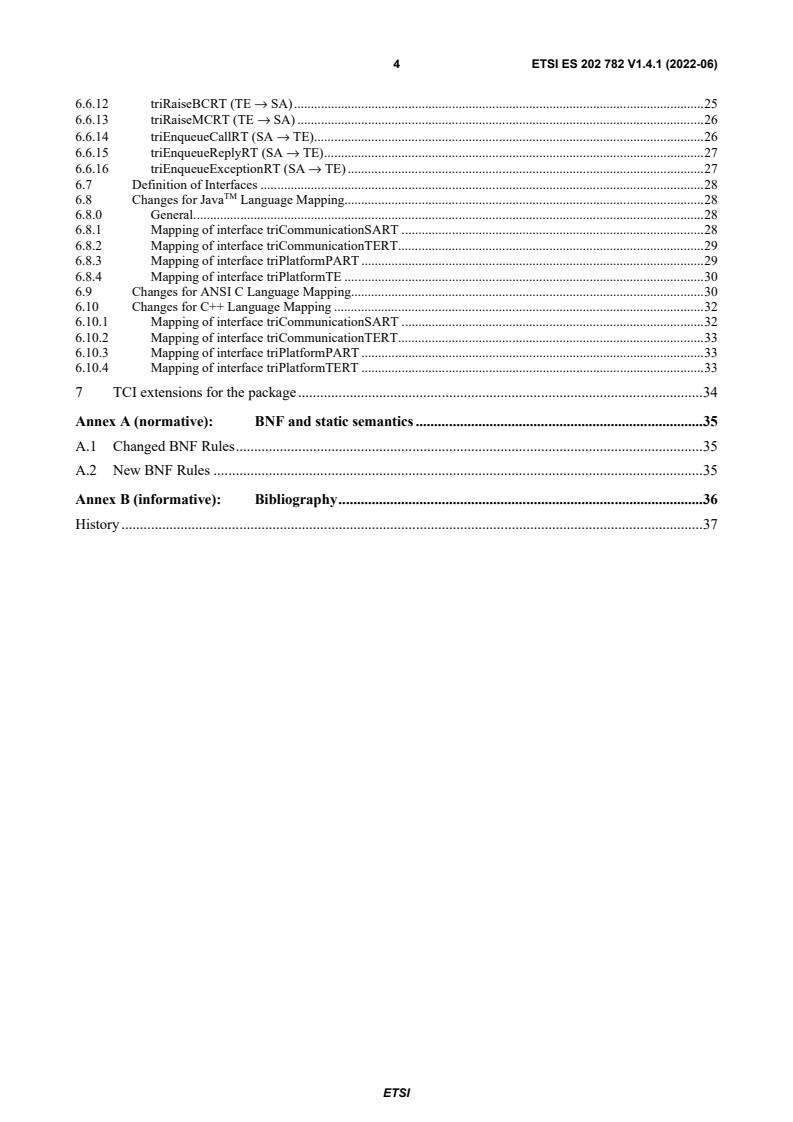
4 Final draft ETSI ES 202 782 V1.4.1 (2022-04)
6.6.12 triRaiseBCRT (TE → SA) . 25
6.6.13 triRaiseMCRT (TE → SA) . 26
6.6.14 triEnqueueCallRT (SA → TE) . 26
6.6.15 triEnqueueReplyRT (SA → TE) . 27
6.6.16 triEnqueueExceptionRT (SA → TE) . 27
6.7 Definition of Interfaces . 28
TM
6.8 Changes for Java Language Mapping. 28
6.8.0 General . 28
6.8.1 Mapping of interface triCommunicationSART . 28
6.8.2 Mapping of interface triCommunicationTERT . 29
6.8.3 Mapping of interface triPlatformPART . 29
6.8.4 Mapping of interface triPlatformTE . 30
6.9 Changes for ANSI C Language Mapping . 30
6.10 Changes for C++ Language Mapping . 32
6.10.1 Mapping of interface triCommunicationSART . 32
6.10.2 Mapping of interface triCommunicationTERT . 33
6.10.3 Mapping of interface triPlatformPART . 33
6.10.4 Mapping of interface triPlatformTERT . 33
7 TCI extensions for the package . 34
Annex A (normative): BNF and static semantics . 35
A.1 Changed BNF Rules . 35
A.2 New BNF Rules . 35
Annex B (informative): Bibliography . 36
History . 37
ETSI
5 Final draft ETSI ES 202 782 V1.4.1 (2022-04)
Intellectual Property Rights
Essential patents
IPRs essential or potentially essential to normative deliverables may have been declared to ETSI. The declarations
pertaining to these essential IPRs, if any, are publicly available for ETSI members and non-members, and can be
found in ETSI SR 000 314: "Intellectual Property Rights (IPRs); Essential, or potentially Essential, IPRs notified to
ETSI in respect of ETSI standards", which is available from the ETSI Secretariat. Latest updates are available on the
ETSI Web server (https://ipr.etsi.org/).
Pursuant to the ETSI Directives including the ETSI IPR Policy, no investigation regarding the essentiality of IPRs,
including IPR searches, has been carried out by ETSI. No guarantee can be given as to the existence of other IPRs not
referenced in ETSI SR 000 314 (or the updates on the ETSI Web server) which are, or may be, or may become,
essential to the present document.
Trademarks
The present document may include trademarks and/or tradenames which are asserted and/or registered by their owners.
ETSI claims no ownership of these except for any which are indicated as being the property of ETSI, and conveys no
right to use or reproduce any trademark and/or tradename. Mention of those trademarks in the present document does
not constitute an endorsement by ETSI of products, services or organizations associated with those trademarks.
DECT™, PLUGTESTS™, UMTS™ and the ETSI logo are trademarks of ETSI registered for the benefit of its
Members. 3GPP™ and LTE™ are trademarks of ETSI registered for the benefit of its Members and of the 3GPP
Organizational Partners. oneM2M™ logo is a trademark of ETSI registered for the benefit of its Members and of the ®
oneM2M Partners. GSM and the GSM logo are trademarks registered and owned by the GSM Association.
Foreword
This final draft ETSI Standard (ES) has been produced by ETSI Technical Committee Methods for Testing and
Specification (MTS), and is now submitted for the ETSI standards Membership Approval Procedure.
The present document relates to the multi-part standard ETSI ES 201 873 covering the Testing and Test Control
Notation version 3, as identified in ETSI ES 201 873-1 [1].
Modal verbs terminology
In the present document "shall", "shall not", "should", "should not", "may", "need not", "will", "will not", "can" and
"cannot" are to be interpreted as described in clause 3.2 of the ETSI Drafting Rules (Verbal forms for the expression of
provisions).
"must" and "must not" are NOT allowed in ETSI deliverables except when used in direct citation.
ETSI
6 Final draft ETSI ES 202 782 V1.4.1 (2022-04)
1 Scope
The present document defines the real time and performance testing support package of TTCN-3. TTCN-3 can be used
for the specification of all types of reactive system tests over a variety of communication ports. Typical areas of
application are protocol testing (including mobile and Internet protocols), service testing (including supplementary
services), module testing, testing of OMG CORBA based platforms, APIs, etc. TTCN-3 is not restricted to conformance
testing and can be used for many other kinds of testing including interoperability, robustness, regression, system and
integration testing. The specification of test suites for physical layer protocols is outside the scope of the present
document.
TTCN-3 packages are intended to define additional TTCN-3 concepts, which are not mandatory as concepts in the
TTCN-3 core language, but which are optional as part of a package which is suited for dedicated applications and/or
usages of TTCN-3.
While the design of TTCN-3 package has taken into account the consistency of a combined usage of the core language
with a number of packages, the concrete usages of and guidelines for this package in combination with other packages
is outside the scope of the present document.
2 References
2.1 Normative references
References are either specific (identified by date of publication and/or edition number or version number) or
non-specific. For specific references, only the cited version applies. For non-specific references, the latest version of the
reference document (including any amendments) applies.
Referenced documents which are not found to be publicly available in the expected location might be found at
https://docbox.etsi.org/Reference.
NOTE: While any hyperlinks included in this clause were valid at the time of publication, ETSI cannot guarantee
their long term validity.
The following referenced documents are necessary for the application of the present document.
[1] ETSI ES 201 873-1 (V4.6.1): "Methods for Testing and Specification (MTS); The Testing and
Test Control Notation version 3; Part 1: TTCN-3 Core Language".
[2] ETSI ES 201 873-4 (V4.4.1): "Methods for Testing and Specification (MTS); The Testing and
Test Control Notation version 3; Part 4: TTCN-3 Operational Semantics".
[3] ETSI ES 201 873-5 (V4.6.1): "Methods for Testing and Specification (MTS); The Testing and
Test Control Notation version 3; Part 5: TTCN-3 Runtime Interface (TRI)".
[4] ETSI ES 201 873-6 (V4.6.1): "Methods for Testing and Specification (MTS); The Testing and
Test Control Notation version 3; Part 6: TTCN-3 Control Interface (TCI)".
[5] ISO/IEC 9646-1: "Information technology - Open Systems Interconnection - Conformance testing
methodology and framework; Part 1: General concepts".
2.2 Informative references
References are either specific (identified by date of publication and/or edition number or version number) or
non-specific. For specific references, only the cited version applies. For non-specific references, the latest version of the
reference document (including any amendments) applies.
NOTE: While any hyperlinks included in this clause were valid at the time of publication, ETSI cannot guarantee
their long term validity.
ETSI
7 Final draft ETSI ES 202 782 V1.4.1 (2022-04)
The following referenced documents are not necessary for the application of the present document but they assist the
user with regard to a particular subject area.
[i.1] ETSI ES 201 873-7 (V4.5.1): "Methods for Testing and Specification (MTS); The Testing and
Test Control Notation version 3; Part 7: Using ASN.1 with TTCN-3".
[i.2] ETSI ES 201 873-8 (V4.5.1): "Methods for Testing and Specification (MTS); The Testing and
Test Control Notation version 3; Part 8: The IDL to TTCN-3 Mapping".
[i.3] ETSI ES 201 873-9 (V4.5.1): "Methods for Testing and Specification (MTS); The Testing and
Test Control Notation version 3; Part 9: Using XML schema with TTCN-3".
[i.4] ETSI ES 201 873-10 (V4.5.1): "Methods for Testing and Specification (MTS); The Testing and
Test Control Notation version 3; Part 10: TTCN-3 Documentation Comment Specification".
3 Definition of terms, symbols and abbreviations
3.1 Terms
For the purposes of the present document, the terms given in ETSI ES 201 873-1 [1], ETSI ES 201 873-4 [2], ETSI
ES 201 873-5 [3], ETSI ES 201 873-6 [4] and ISO/IEC 9646-1 [5] apply.
3.2 Symbols
Void.
3.3 Abbreviations
For the purposes of the present document, the abbreviations given in ETSI ES 201 873-1 [1], ETSI ES 201 873-4 [2],
ETSI ES 201 873-5 [3], ETSI ES 201 873-6 [4] and ISO/IEC 9646-1 [5] apply.
4 Package conformance and compatibility
The package presented in the present document is identified by the package tag:
"TTCN-3:2014 Real Time and Performance Testing" - to be used with modules complying with the
present document.
For an implementation claiming to conform to this package version, all features specified in the present document shall
be implemented consistently with the requirements given in the present document and in ETSI ES 201 873-1 [1], ETSI
ES 201 873-4 [2], ETSI ES 201 873-5 [3] and ETSI ES 201 873-6 [4].
The package presented in the present document is compatible with:
• ETSI ES 201 873-1 (V4.6.1) [1]
• ETSI ES 201 873-4 (V4.4.1) [2]
• ETSI ES 201 873-5 (V4.6.1) [3]
• ETSI ES 201 873-6 (V4.6.1) [4]
• ETSI ES 201 873-7 (V4.5.1) [i.1]
• ETSI ES 201 873-8 (V4.5.1) [i.2]
• ETSI ES 201 873-9 (V4.5.1) [i.3]
ETSI
8 Final draft ETSI ES 202 782 V1.4.1 (2022-04)
• ETSI ES 201 873-10 (V4.5.1) [i.4]
If later versions of those parts are available and should be used instead, the compatibility to the package presented in the
present document has to be checked individually. The present document is also compatible with the versions V4.2.1,
V4.3.1, V4.4.1 and V4.5.1 of the above documents.
5 Package concepts for the core language
5.0 General
Real-time systems have to respect special requirements for timing. Often functional requirements are directly connected
to the timing of the messages and procedure calls. Thus, checking the message values and the message order is not
sufficient here. A test component shall be able to check whether a message has been received in time and shall be able
to control the timing for the stimulation.
Thus, a test language has to provide means to measure time, to specify time points and time spans, to control the timing
of the stimulation, and to calculate and compare time values. Moreover the test execution engine has to ensure that the
specified actions (time measurement, timed stimulation) are executed correctly with respect to the required precision.
To fulfil the requirements for testing real time system the following TTCN-3 core language extensions have been
defined:
• A test system wide available test system clock, that allows the measurement of time during test case execution.
• Means to directly and precisely access the time points of the relevant interaction events between the test
system and the system under test.
Real-time measurements at ports require additional resources (e.g. functionality that monitor ports and collect
timestamps that describe the reception time of messages, calls, replies or exceptions) that may slow down the test
execution. In order to avoid unnecessary delays at ports, such resources may only be provided when needed. An
additional real-time clause for ports shall indicate the need for real-time measurement at a port.
5.1 The test system clock
5.1.0 General
In RT TTCN-3 time progress is measured with a test system clock. The clock is initialized (set to 0.0) at the beginning
of each test case execution and is available during the complete test run in each component. The clock values are
represented as float values. The system clock and the already available TTCN-3 timer mechanisms are synchronized
with respect to time progress.
5.1.1 Accessing the current test system time
The current value of the test system clock by means of the symbol now. The now symbol is used as a TTCN-3
expression that yields the current test system clock value in seconds. The test system clock value is represented by
means of a float number. The symbol now can be applied in each expression inside of testcase definitions and
function definitions. It is not allowed for the TTCN-3 control part and in guard conditions of alt branches.
EXAMPLE 1:
// Use of now to retrieve the actual time
var float myTimePoint := now;
EXAMPLE 2:
// Use of now to retrieve the send time of a message
var float sendTimePoint;
// .
p.send(m);
sendTimePoint:= now;
ETSI
9 Final draft ETSI ES 202 782 V1.4.1 (2022-04)
EXAMPLE 3:
// Measuring time progress
var float startTime;
startTime:= now;
p.send(m1);
// .
p.receive(m2);
if(now-startTime >= 10.0){.};
Syntactical Structure
OpCall ::= ConfigurationOps | VerdictOps | TimerOps | TestcaseInstance |
FunctionInstance | TemplateOps | ActivateOp | NowOperation
NowOperation ::= NowKeyword
NowKeyword ::= "now"
5.1.2 The precision of the system time
The requirements on the overall precision of the test system clock can be specified by means of the stepsize annotation.
The stepsize annotation is allowed for modules only and can be used to state the minimal necessary precision for time
measurement provided by the test system clock. The precision is defined by means of a charstring value that represents
a decimal number which states the smallest necessary time distance in seconds that is measurable by the test system
clock. A concrete test system has to fulfil the requirements given by the stepsize annotation to be adequate for the
execution of the respective test case definitions. When a test system is not adequate for the test case execution the user
shall be informed, at least test run shall end with an error verdict.
EXAMPLE:
// specifies the requirement on a necessary precision of a millisecond
module myModule{
…
} with {stepsize “0.001”};
In case of module imports with different stepsize annotation the test system has to respect the stepsize annotation with
the highest precision.
5.2 Communication port types for real-time measurements
This package extends the port type definition of message-based and procedure-based ports with a realtime clause.
Ports facilitate communication between test components and between test components and the test system interface.
Only instances of ports with a realtime clause shall be used for real-time measurements. This means, the redirection
operator -> timestamp shall only be used by receiving operations (i.e. the operations receive, trigger,
getcall, getreply and catch) applied to ports with a realtime clause.
Syntactical Structure
Message-based port:
type port PortTypeIdentifier message [realtime] "{"
{ ( in | out | inout ) { MessageType [ "," ] }+ ";" }
"}"
Procedure-based port:
type port PortTypeIdentifier procedure [realtime] "{"
{ ( in | out | inout ) { Signature [ "," ] }+ ";" }
"}"
ETSI
10 Final draft ETSI ES 202 782 V1.4.1 (2022-04)
5.3 Measuring timing information for dedicated incoming
communication events
5.3.0 General
Testing real time systems requires exact timing information that relates directly to the communication (reception and
distribution of messages and procedure calls) between the test system and the system under test. The timing information
that can be obtained by the now symbol or the TTCN-3 timer construct is related to the logical structure of the test
program, thus it allows the measurement on TTCN-3 statement level. Time measurement on TTCN-3 statement level
may be affected by blocked queues, decoding and matching procedures. It is not exact with respect to the real timing of
the reception and disposal of messages and procedure calls at the interface between the test system and the SUT.
RT TTCN-3 introduces a mechanism to store the arrival time of messages, procedure calls at system adapter level. The
time points of message reception are automatically registered by the system adapter, communicated to the test
executable and stored with the message. The timing information can be retrieved directly at the communication
statements by means of the redirection operator -> timestamp.
The existing redirections for getcall, getreply, receive, trigger, catch, and check operations are extended by an optional
clause timestamp. A redirect specification of the form:
-> timestamp VariableRef
specifies the redirection of the time point, which has been measured at message, procedure call, reply or exception
arrival to a given float variable. The redirection is processed when the respective communication statement matches.
Restrictions
The redirection operator -> timestamp shall only be used by receiving operations (i.e. the operations receive,
trigger, getcall, getreply and catch) applied to ports with a realtime clause.
5.3.1 Obtain the reception time for messages with the receive statement
The existing redirections for receive are extended by an optional clause "timestamp VariableRef". A receive statement
that holds a timestamp clause and that is executed successfully (i.e. it matches a message) allocates the given variable
with the reception time of the matched message.
EXAMPLE 1:
p.receive(t)-> timestamp myTime;
// yields the reception time of a message
if(myTime>MAX){setverdict(fail);}
EXAMPLE 2:
interleave{
[ ] FrontOut.receive(ON) -> timestamp f_actv{
if(f_actv>MAX){setverdict(fail);}
};
[ ] RearOut.receive(ON) -> timestamp r_actv{
if(r_actv>MAX){setverdict(fail);}
};
}
Syntactical Structure
( Port | any port ) "." receive ["(" TemplateInstance ")"] [ from AddressRef ]
[ -> [ value VariableRef ] [ sender VariableRef ] [ timestamp VariableRef] ]
ETSI
11 Final draft ETSI ES 202 782 V1.4.1 (2022-04)
5.3.2 Obtain the reception time for messages with the trigger statement
The existing redirections for trigger are extended by an optional clause "timestamp VariableRef". A trigger statement
that holds a timestamp clause and that is executed successfully (i.e. it matches a message) allocates the given variable
with the reception time of the matched message.
EXAMPLE 1:
p.trigger(t)-> timestamp myTime;
// yields the reception time of a message
if(myTime>MAX){setverdict(fail);}
EXAMPLE 2:
interleave{
[ ] FrontOut.trigger(ON) -> timestamp f_actv{
if(f_actv>MAX){setverdict(fail);}
};
[ ] RearOut.trigger(ON) -> timestamp r_actv{
if(r_actv>MAX){setverdict(fail);}
};
}
Syntactical Structure
( Port | any port ) "." trigger [ "(" TemplateInstance ")" ] [ from AddressRef ]
[ -> [ value VariableRef ] [ sender VariableRef ] ] [ timestamp VariableRef] ]
5.3.3 Obtain the reception time for procedure calls with getcall statement
The existing redirections for getcall are extended by an optional clause "timestamp VariableRef". A getcall statement
that holds a timestamp clause and that is executed successfully (i.e. it matches an incoming call) allocates the given
variable with the reception time of the matched message.
EXAMPLE 1:
p.getcall(proc: {m})-> timestamp myTime;
// yields the reception time of the message call matched by m
if(myTime>MAX){setverdict(fail);}
EXAMPLE 2:
alt{
[ ] p.getcall(proc: {m1})-> timestamp f_actv {
if(f_actv>MAX){setverdict(fail);}
};
[ ] p.getcall(proc: {m2})-> timestamp r_actv {
if(f_actv>MAX){setverdict(fail);}
};
}
Syntactical Structure
( Port | any port ) "." getcall [ "(" TemplateInstance ")" ] [ from AddressRef ]
[ "->" [ param "(" { VariableRef ":=" ParameterIdentifier ) "," } |
{ VariableRef | NotUsedSymbol ) "," }
")" ]
[ sender VariableRef ]
[ timestamp VariableRef]
]
ETSI
12 Final draft ETSI ES 202 782 V1.4.1 (2022-04)
5.3.4 Obtain the reception time for procedure replies with the getreply
statement
The existing redirections for getreply are extended by an optional clause "timestamp VariableRef". A getreply
statement that holds a timestamp clause and that is executed successfully (i.e. it matches an incoming procedure reply)
allocates the given variable with the reception time of the matched message.
EXAMPLE 1:
p.getreply(proc: {m})-> timestamp myTime;
// yields the reception time of the message call matched by m
if(myTime>MAX){setverdict(fail);}
EXAMPLE 2:
p.call(proc: {_message:= m},20.0){
[ ] p.getreply(proc: {m1})-> timestamp f_actv {
if(f_actv>MAX){setverdict(fail);}
};
[ ] p.getreply(proc: {m2})-> timestamp r_actv {
if(f_actv>MAX){setverdict(fail);}
};
}
Syntactical Structure
( Port | any port ) "." getreply [ "(" TemplateInstance [ value TemplateInstance ] ")" ] [ from
AddressRef ]
[ "->" [ value VariableRef ]
[ param "(" { VariableRef ":=" ParameterIdentifier ) "," } |
{ VariableRef | NotUsedSymbol ) "," }
")" ]
[ sender VariableRef ]
[ timestamp VariableRef]
]
5.3.5 Obtain the reception time for exceptions with the catch statement
The existing redirections for catch are extended by an optional clause "timestamp VariableRef". A catch statement
that holds a timestamp clause and that is executed successfully (i.e. it matches an incoming exception) allocates the
given variable with the reception time of the matched message.
EXAMPLE 1:
p.catch(timeout)-> timestamp myTime;
// yields the reception time of the message call matched by m
if(myTime>MAX){setverdict(fail);}
EXAMPLE 2:
p.call(proc: {_message:= m},20.0){
[ ] p.getreply(proc: {m1})-> timestamp f_actv {
if(f_actv>MAX){setverdict(fail);}
};
[ ] p.catch(*)-> timestamp r_actv {
if(f_actv>MAX){setverdict(fail);}
};
}
Syntactical Structure
( Port | any port ) "." catch [ "(" ( Signature "," TemplateInstance ) | TimeoutKeyword ")" ] [
from AddressRef ]
[ "->" [ value VariableRef
[ sender VariableRef ]
[ timestamp VariableRef]
]
ETSI
13 Final draft ETSI ES 202 782 V1.4.1 (2022-04)
5.4 The wait statement
The wait statement suspends the execution of a component until a given point in time. The time point is specified as a
float value and relates to the internal clock.
The execution of wait statement suspends the execution of the related component until the point in time specified by its
argument. If the argument holds a value that precedes the actual clock value an error verdict shall be set.
EXAMPLE 1:
wait(100.0); // suspends the execution of a component
// until 100.0 seconds after the start of the testcase
Syntactical Structure
WaitStatement::= wait "(" Expression ")"
Besides the exact measurement of timing information regarding incoming communication events, a real time test
system has to ensure the correct timing for message and procedure call application. The correct scheduling of message
and procedure call application has been realized by combining the wait statement directly with the send operation. In
this case, the execution of a test component is suspended until the given point in time is reached and afterwards the send
operation is executed.
EXAMPLE 2:
wait(specified_send_time);
p_out.send(OUT_MSG);
// suspends the sending of OUT_MSG until specified_send_time is reached
5.5 Measuring timing information for outgoing communication
operations
5.5.0 General
Realtime measurements should be as exact as possible. Therefore, it has to be possible to measure the exact time when
the adapter has sent a message or a call to the SUT. The point in time to be measured should be after the message or call
parameters have been encoded (if necessary), right before the actual sending to the SUT is performed. By comparing
this timestamp with the timestamp obtained from the responding incoming communication operation, the exact
stimulus-response duration can be measured by the testcase.
To that end, all outgoing communication operations are augmented by an optional timestamp redirection assignment
notation that allows the measuring of the time when the communication to the SUT is performed.
A redirect specification of the form:
-> timestamp VariableRef
specifies the redirection of the time point, which has been measured right before message, procedure call, reply or
exception sending to the SUT by the adapter to a given float variable. The redirection is processed after the sending
operation is successful.
Restrictions
The redirection operator -> timestamp shall only be used by sending operations (i.e. the operations send, call,
reply and raise) applied to ports with a realtime clause.
NOTE: If the wait operation is used right before the operation, the variable will be initialized with the value given
to the wait operation.
ETSI
14 Final draft ETSI ES 202 782 V1.4.1 (2022-04)
5.5.1 Obtain the sending time for messages with the send statement
The send statement is extended by an optional redirection clause "-> timestamp VariableRef". A send statement that
holds a timestamp redirection clause and that is executed successfully assigns the given variable with the sending time
of the sent message.
EXAMPLE:
p.send(t)-> timestamp myTime;
// yields the sending time of a message
p.receive(t2) -> timestamp myTime2;
if(myTime2-myTime>MAX){setverdict(fail);}
Syntactical Structure
Port "." send ["(" TemplateInstance ")"] [ to AddressRef ]
[ -> timestamp VariableRef ]
5.5.2 Obtain the sending time for procedure calls with call statement
The call statement is extended by an optional redirection clause "-> timestamp VariableRef". A call statement that
holds a timestamp redirection clause and that is executed successfully assigns the given variable with the sending time
of the call.
EXAMPLE:
p.call(proc: {m}, nowait) -> timestamp myTime;
// yields the sending time of the message call
p.getreply(proc: ?) -> timestamp myTime2;
if(myTime2-myTime>MAX){setverdict(fail);}
Syntactical Structure
Port "." call [ "(" TemplateInstance, CallTimeout ")" ] [ to AddressRef ]
[ "->" timestamp VariableRef ]
[{ CallAlternatives }]
5.5.3 Obtain the sending time for procedure replies with the reply
statement
The existing reply statement is extended by an optional redirection clause "-> timestamp VariableRef". A reply
statement that holds a timestamp redirection clause and that is executed successfully assigns the given variable with the
sending time of the reply.
EXAMPLE:
p.reply(proc: {m})-> timestamp myTime;
// yields the sending time of the reply
if(myTime>MAX){setverdict(fail);}
Syntactical Structure
Port "." reply [ "(" TemplateInstance [ value TemplateInstance ] ")" ] [ to AddressRef ]
[ "->" timestamp VariableRef ]
5.5.4 Obtain the sending time for exceptions with the raise statement
The existing raise statement is extended by an optional redirection clause "-> timestamp VariableRef". A raise
statement that holds a timestamp redirection clause and that is executed successfully assigns the given variable with the
sending time of the exception.
EXAMPLE:
p.raise(proc, e) -> timestamp myTime;
// yields the sending time of the raised exception
if(myTime>MAX){setverdict(fail);}
ETSI
15 Final draft ETSI ES 202 782 V1.4.1 (2022-04)
Syntactical Structure
Port "." raise [ "(" ( Signature "," TemplateInstance ) ")" ] [ to AddressRef ]
[ "->" timestamp VariableRef ]
6 TRI extensions for the package
6.1 triStartClock (TE → PA)
TriStatus triStartClock(in long ticksPerSecond)
Signature
In Parameters ticksPerSecond the precision of the clock given in ticks per second
Out Parameters n.a.
Return Value The return status of the operation. The return status indicates the success
(TRI_OK) or failure (TRI_Error) of the operation
Constraints n.a.
Effect The operation starts the test system clock with a given precision. The precision
is defined by the in parameter ticksPerSecond. The parameter specifies the
number of time units (ticks) that characterizes a second
6.2 triReadClock (TE → PA)
TriStatus triReadClock(out long timepoint)
Signature
In Parameters n.a.
Out Parameters timepoint current time
Return Value The return status of the operation. The return status indicates the success
(TRI_OK) or failure (TRI_Error) of the operation
Constraints There was a preceding invocation of
triStartClock(in long ticksPerSecond)
Effect The operation yields the actual clock value. The clock value is given by the out
parameter timepoint, which represents the number of time units (ticks) that
has elapsed since the start of the clock (see triStartClock)
6.3 triBeginWait (TE → PA)
TriStatus triBeginWait(in long timepoint,
Signature
in TriComponentIDType component)
In Parameters timepoint point in time until execution of a component should be suspended
component component whose execution should be suspended
Out Parameters n.a.
Return Value The return status of the operation. The return status indicates the success
(TRI_OK) or failure (TRI_Error) of the operation
Constraints There was a preceding invocation of
triStartClock(in long ticksPerSecond)
Effect The operation signals that the execution of component component should be
suspended until the specified point of time timepoint
At this point in time the PA will issue a
triEndWait(component) operation
timepoint is expressed as the number of time units (ticks) that has elapsed
since the start of the clock (see triStartClock)
A call to this operation returns immediately. The operation merely triggers the
corresponding triEndWait operation, it does not schedule the execution of the
co
...
ETSI STANDARD
Methods for Testing and Specification (MTS);
The Testing and Test Control Notation version 3;
TTCN-3 Language Extensions:
Performance and Real Time Testing
2 ETSI ES 202 782 V1.4.1 (2022-06)
Reference
RES/MTS-202782 ed141RealtPer
Keywords
performance, real time, testing, TTCN-3
ETSI
650 Route des Lucioles
F-06921 Sophia Antipolis Cedex - FRANCE
Tel.: +33 4 92 94 42 00 Fax: +33 4 93 65 47 16
Siret N° 348 623 562 00017 - APE 7112B
Association à but non lucratif enregistrée à la
Sous-Préfecture de Grasse (06) N° w061004871
Important notice
The present document can be downloaded from:
http://www.etsi.org/standards-search
The present document may be made available in electronic versions and/or in print. The content of any electronic and/or
print versions of the present document shall not be modified without the prior written authorization of ETSI. In case of any
existing or perceived difference in contents between such versions and/or in print, the prevailing version of an ETSI
deliverable is the one made publicly available in PDF format at www.etsi.org/deliver.
Users of the present document should be aware that the document may be subject to revision or change of status.
Information on the current status of this and other ETSI documents is available at
https://portal.etsi.org/TB/ETSIDeliverableStatus.aspx
If you find errors in the present document, please send your comment to one of the following services:
https://portal.etsi.org/People/CommiteeSupportStaff.aspx
If you find a security vulnerability in the present document, please report it through our
Coordinated Vulnerability Disclosure Program:
https://www.etsi.org/standards/coordinated-vulnerability-disclosure
Notice of disclaimer & limitation of liability
The information provided in the present deliverable is directed solely to professionals who have the appropriate degree of
experience to understand and interpret its content in accordance with generally accepted engineering or
other professional standard and applicable regulations.
No recommendation as to products and services or vendors is made or should be implied.
No representation or warranty is made that this deliverable is technically accurate or sufficient or conforms to any law
rule and/or regulation and further, no representation or warranty is made of merchantability or fitness
and/or governmental
for any particular purpose or against infringement of intellectual property rights.
In no event shall ETSI be held liable for loss of profits or any other incidental or consequential damages.
Any software contained in this deliverable is provided "AS IS" with no warranties, express or implied, including but not
limited to, the warranties of merchantability, fitness for a particular purpose and non-infringement of intellectual property
rights and ETSI shall not be held liable in any event for any damages whatsoever (including, without limitation, damages
for loss of profits, business interruption, loss of information, or any other pecuniary loss) arising out of or related to the use
of or inability to use the software.
Copyright Notification
No part may be reproduced or utilized in any form or by any means, electronic or mechanical, including photocopying and
microfilm except as authorized by written permission of ETSI.
The content of the PDF version shall not be modified without the written authorization of ETSI.
The copyright and the foregoing restriction extend to reproduction in all media.
© ETSI 2022.
All rights reserved.
ETSI
3 ETSI ES 202 782 V1.4.1 (2022-06)
Contents
Intellectual Property Rights . 5
Foreword . 5
Modal verbs terminology . 5
1 Scope . 6
2 References . 6
2.1 Normative references . 6
2.2 Informative references . 6
3 Definition of terms, symbols and abbreviations . 7
3.1 Terms . 7
3.2 Symbols . 7
3.3 Abbreviations . 7
4 Package conformance and compatibility . 7
5 Package concepts for the core language . 8
5.0 General . 8
5.1 The test system clock . 8
5.1.0 General . 8
5.1.1 Accessing the current test system time . 8
5.1.2 The precision of the system time . 9
5.2 Communication port types for real-time measurements . 9
5.3 Measuring timing information for dedicated incoming communication events . 10
5.3.0 General . 10
5.3.1 Obtain the reception time for messages with the receive statement . 10
5.3.2 Obtain the reception time for messages with the trigger statement . 11
5.3.3 Obtain the reception time for procedure calls with getcall statement . 11
5.3.4 Obtain the reception time for procedure replies with the getreply statement . 12
5.3.5 Obtain the reception time for exceptions with the catch statement . 12
5.4 The wait statement. 13
5.5 Measuring timing information for outgoing communication operations . 13
5.5.0 General . 13
5.5.1 Obtain the sending time for messages with the send statement . 14
5.5.2 Obtain the sending time for procedure calls with call statement . 14
5.5.3 Obtain the sending time for procedure replies with the reply statement . 14
5.5.4 Obtain the sending time for exceptions with the raise statement . 14
6 TRI extensions for the package . 15
6.1 triStartClock (TE → PA) . 15
6.2 triReadClock (TE → PA) . 15
6.3 triBeginWait (TE → PA) . 15
6.4 triEndWait (PA → TE) . 16
6.5 triWaitUntil (SA → PA) . 16
6.6 Communication Operations . 16
6.6.0 General . 16
6.6.1 triSendRT (TE → SA) . 17
6.6.2 triSendBCRT (TE → SA) . 17
6.6.3 triSendMCRT (TE → SA) . 18
6.6.4 triEnqueueMsgRT (SA → TE) . 18
6.6.5 triCallRT (TE → SA) . 19
6.6.6 triCallBCRT (TE → SA) . 20
6.6.7 triCallMCRT (TE → SA) . 21
6.6.8 triReplyRT (TE → SA) . 22
6.6.9 triReplyBCRT (TE → SA) . 23
6.6.10 triReplyMCRT (TE → SA) . 24
6.6.11 triRaiseRT (TE → SA) . 25
ETSI
4 ETSI ES 202 782 V1.4.1 (2022-06)
6.6.12 triRaiseBCRT (TE → SA) . 25
6.6.13 triRaiseMCRT (TE → SA) . 26
6.6.14 triEnqueueCallRT (SA → TE) . 26
6.6.15 triEnqueueReplyRT (SA → TE) . 27
6.6.16 triEnqueueExceptionRT (SA → TE) . 27
6.7 Definition of Interfaces . 28
TM
6.8 Changes for Java Language Mapping. 28
6.8.0 General . 28
6.8.1 Mapping of interface triCommunicationSART . 28
6.8.2 Mapping of interface triCommunicationTERT . 29
6.8.3 Mapping of interface triPlatformPART . 29
6.8.4 Mapping of interface triPlatformTE . 30
6.9 Changes for ANSI C Language Mapping . 30
6.10 Changes for C++ Language Mapping . 32
6.10.1 Mapping of interface triCommunicationSART . 32
6.10.2 Mapping of interface triCommunicationTERT . 33
6.10.3 Mapping of interface triPlatformPART . 33
6.10.4 Mapping of interface triPlatformTERT . 33
7 TCI extensions for the package . 34
Annex A (normative): BNF and static semantics . 35
A.1 Changed BNF Rules . 35
A.2 New BNF Rules . 35
Annex B (informative): Bibliography . 36
History . 37
ETSI
5 ETSI ES 202 782 V1.4.1 (2022-06)
Intellectual Property Rights
Essential patents
IPRs essential or potentially essential to normative deliverables may have been declared to ETSI. The declarations
pertaining to these essential IPRs, if any, are publicly available for ETSI members and non-members, and can be
found in ETSI SR 000 314: "Intellectual Property Rights (IPRs); Essential, or potentially Essential, IPRs notified to
ETSI in respect of ETSI standards", which is available from the ETSI Secretariat. Latest updates are available on the
ETSI Web server (https://ipr.etsi.org/).
Pursuant to the ETSI Directives including the ETSI IPR Policy, no investigation regarding the essentiality of IPRs,
including IPR searches, has been carried out by ETSI. No guarantee can be given as to the existence of other IPRs not
referenced in ETSI SR 000 314 (or the updates on the ETSI Web server) which are, or may be, or may become,
essential to the present document.
Trademarks
The present document may include trademarks and/or tradenames which are asserted and/or registered by their owners.
ETSI claims no ownership of these except for any which are indicated as being the property of ETSI, and conveys no
right to use or reproduce any trademark and/or tradename. Mention of those trademarks in the present document does
not constitute an endorsement by ETSI of products, services or organizations associated with those trademarks.
DECT™, PLUGTESTS™, UMTS™ and the ETSI logo are trademarks of ETSI registered for the benefit of its
Members. 3GPP™ and LTE™ are trademarks of ETSI registered for the benefit of its Members and of the 3GPP
Organizational Partners. oneM2M™ logo is a trademark of ETSI registered for the benefit of its Members and of the ®
oneM2M Partners. GSM and the GSM logo are trademarks registered and owned by the GSM Association.
Foreword
This ETSI Standard (ES) has been produced by ETSI Technical Committee Methods for Testing and Specification
(MTS).
The present document relates to the multi-part standard ETSI ES 201 873 covering the Testing and Test Control
Notation version 3, as identified in ETSI ES 201 873-1 [1].
Modal verbs terminology
In the present document "shall", "shall not", "should", "should not", "may", "need not", "will", "will not", "can" and
"cannot" are to be interpreted as described in clause 3.2 of the ETSI Drafting Rules (Verbal forms for the expression of
provisions).
"must" and "must not" are NOT allowed in ETSI deliverables except when used in direct citation.
ETSI
6 ETSI ES 202 782 V1.4.1 (2022-06)
1 Scope
The present document defines the real time and performance testing support package of TTCN-3. TTCN-3 can be used
for the specification of all types of reactive system tests over a variety of communication ports. Typical areas of
application are protocol testing (including mobile and Internet protocols), service testing (including supplementary
services), module testing, testing of OMG CORBA based platforms, APIs, etc. TTCN-3 is not restricted to conformance
testing and can be used for many other kinds of testing including interoperability, robustness, regression, system and
integration testing. The specification of test suites for physical layer protocols is outside the scope of the present
document.
TTCN-3 packages are intended to define additional TTCN-3 concepts, which are not mandatory as concepts in the
TTCN-3 core language, but which are optional as part of a package which is suited for dedicated applications and/or
usages of TTCN-3.
While the design of TTCN-3 package has taken into account the consistency of a combined usage of the core language
with a number of packages, the concrete usages of and guidelines for this package in combination with other packages
is outside the scope of the present document.
2 References
2.1 Normative references
References are either specific (identified by date of publication and/or edition number or version number) or
non-specific. For specific references, only the cited version applies. For non-specific references, the latest version of the
reference document (including any amendments) applies.
Referenced documents which are not found to be publicly available in the expected location might be found at
https://docbox.etsi.org/Reference.
NOTE: While any hyperlinks included in this clause were valid at the time of publication, ETSI cannot guarantee
their long term validity.
The following referenced documents are necessary for the application of the present document.
[1] ETSI ES 201 873-1 (V4.6.1): "Methods for Testing and Specification (MTS); The Testing and
Test Control Notation version 3; Part 1: TTCN-3 Core Language".
[2] ETSI ES 201 873-4 (V4.4.1): "Methods for Testing and Specification (MTS); The Testing and
Test Control Notation version 3; Part 4: TTCN-3 Operational Semantics".
[3] ETSI ES 201 873-5 (V4.6.1): "Methods for Testing and Specification (MTS); The Testing and
Test Control Notation version 3; Part 5: TTCN-3 Runtime Interface (TRI)".
[4] ETSI ES 201 873-6 (V4.6.1): "Methods for Testing and Specification (MTS); The Testing and
Test Control Notation version 3; Part 6: TTCN-3 Control Interface (TCI)".
[5] ISO/IEC 9646-1: "Information technology - Open Systems Interconnection - Conformance testing
methodology and framework; Part 1: General concepts".
2.2 Informative references
References are either specific (identified by date of publication and/or edition number or version number) or
non-specific. For specific references, only the cited version applies. For non-specific references, the latest version of the
reference document (including any amendments) applies.
NOTE: While any hyperlinks included in this clause were valid at the time of publication, ETSI cannot guarantee
their long term validity.
ETSI
7 ETSI ES 202 782 V1.4.1 (2022-06)
The following referenced documents are not necessary for the application of the present document but they assist the
user with regard to a particular subject area.
[i.1] ETSI ES 201 873-7 (V4.5.1): "Methods for Testing and Specification (MTS); The Testing and
Test Control Notation version 3; Part 7: Using ASN.1 with TTCN-3".
[i.2] ETSI ES 201 873-8 (V4.5.1): "Methods for Testing and Specification (MTS); The Testing and
Test Control Notation version 3; Part 8: The IDL to TTCN-3 Mapping".
[i.3] ETSI ES 201 873-9 (V4.5.1): "Methods for Testing and Specification (MTS); The Testing and
Test Control Notation version 3; Part 9: Using XML schema with TTCN-3".
[i.4] ETSI ES 201 873-10 (V4.5.1): "Methods for Testing and Specification (MTS); The Testing and
Test Control Notation version 3; Part 10: TTCN-3 Documentation Comment Specification".
3 Definition of terms, symbols and abbreviations
3.1 Terms
For the purposes of the present document, the terms given in ETSI ES 201 873-1 [1], ETSI ES 201 873-4 [2], ETSI
ES 201 873-5 [3], ETSI ES 201 873-6 [4] and ISO/IEC 9646-1 [5] apply.
3.2 Symbols
Void.
3.3 Abbreviations
For the purposes of the present document, the abbreviations given in ETSI ES 201 873-1 [1], ETSI ES 201 873-4 [2],
ETSI ES 201 873-5 [3], ETSI ES 201 873-6 [4] and ISO/IEC 9646-1 [5] apply.
4 Package conformance and compatibility
The package presented in the present document is identified by the package tag:
"TTCN-3:2014 Real Time and Performance Testing" - to be used with modules complying with the
present document.
For an implementation claiming to conform to this package version, all features specified in the present document shall
be implemented consistently with the requirements given in the present document and in ETSI ES 201 873-1 [1], ETSI
ES 201 873-4 [2], ETSI ES 201 873-5 [3] and ETSI ES 201 873-6 [4].
The package presented in the present document is compatible with:
• ETSI ES 201 873-1 (V4.6.1) [1]
• ETSI ES 201 873-4 (V4.4.1) [2]
• ETSI ES 201 873-5 (V4.6.1) [3]
• ETSI ES 201 873-6 (V4.6.1) [4]
• ETSI ES 201 873-7 (V4.5.1) [i.1]
• ETSI ES 201 873-8 (V4.5.1) [i.2]
• ETSI ES 201 873-9 (V4.5.1) [i.3]
ETSI
8 ETSI ES 202 782 V1.4.1 (2022-06)
• ETSI ES 201 873-10 (V4.5.1) [i.4]
If later versions of those parts are available and should be used instead, the compatibility to the package presented in the
present document has to be checked individually. The present document is also compatible with the versions V4.2.1,
V4.3.1, V4.4.1 and V4.5.1 of the above documents.
5 Package concepts for the core language
5.0 General
Real-time systems have to respect special requirements for timing. Often functional requirements are directly connected
to the timing of the messages and procedure calls. Thus, checking the message values and the message order is not
sufficient here. A test component shall be able to check whether a message has been received in time and shall be able
to control the timing for the stimulation.
Thus, a test language has to provide means to measure time, to specify time points and time spans, to control the timing
of the stimulation, and to calculate and compare time values. Moreover the test execution engine has to ensure that the
specified actions (time measurement, timed stimulation) are executed correctly with respect to the required precision.
To fulfil the requirements for testing real time system the following TTCN-3 core language extensions have been
defined:
• A test system wide available test system clock, that allows the measurement of time during test case execution.
• Means to directly and precisely access the time points of the relevant interaction events between the test
system and the system under test.
Real-time measurements at ports require additional resources (e.g. functionality that monitor ports and collect
timestamps that describe the reception time of messages, calls, replies or exceptions) that may slow down the test
execution. In order to avoid unnecessary delays at ports, such resources may only be provided when needed. An
additional real-time clause for ports shall indicate the need for real-time measurement at a port.
5.1 The test system clock
5.1.0 General
In RT TTCN-3 time progress is measured with a test system clock. The clock is initialized (set to 0.0) at the beginning
of each test case execution and is available during the complete test run in each component. The clock values are
represented as float values. The system clock and the already available TTCN-3 timer mechanisms are synchronized
with respect to time progress.
5.1.1 Accessing the current test system time
The current value of the test system clock by means of the symbol now. The now symbol is used as a TTCN-3
expression that yields the current test system clock value in seconds. The test system clock value is represented by
means of a float number. The symbol now can be applied in each expression inside of testcase definitions and
function definitions. It is not allowed for the TTCN-3 control part and in guard conditions of alt branches.
EXAMPLE 1:
// Use of now to retrieve the actual time
var float myTimePoint := now;
EXAMPLE 2:
// Use of now to retrieve the send time of a message
var float sendTimePoint;
// .
p.send(m);
sendTimePoint:= now;
ETSI
9 ETSI ES 202 782 V1.4.1 (2022-06)
EXAMPLE 3:
// Measuring time progress
var float startTime;
startTime:= now;
p.send(m1);
// .
p.receive(m2);
if(now-startTime >= 10.0){.};
Syntactical Structure
OpCall ::= ConfigurationOps | VerdictOps | TimerOps | TestcaseInstance |
FunctionInstance | TemplateOps | ActivateOp | NowOperation
NowOperation ::= NowKeyword
NowKeyword ::= "now"
5.1.2 The precision of the system time
The requirements on the overall precision of the test system clock can be specified by means of the stepsize annotation.
The stepsize annotation is allowed for modules only and can be used to state the minimal necessary precision for time
measurement provided by the test system clock. The precision is defined by means of a charstring value that represents
a decimal number which states the smallest necessary time distance in seconds that is measurable by the test system
clock. A concrete test system has to fulfil the requirements given by the stepsize annotation to be adequate for the
execution of the respective test case definitions. When a test system is not adequate for the test case execution the user
shall be informed, at least test run shall end with an error verdict.
EXAMPLE:
// specifies the requirement on a necessary precision of a millisecond
module myModule{
…
} with {stepsize “0.001”};
In case of module imports with different stepsize annotation the test system has to respect the stepsize annotation with
the highest precision.
5.2 Communication port types for real-time measurements
This package extends the port type definition of message-based and procedure-based ports with a realtime clause.
Ports facilitate communication between test components and between test components and the test system interface.
Only instances of ports with a realtime clause shall be used for real-time measurements. This means, the redirection
operator -> timestamp shall only be used by receiving operations (i.e. the operations receive, trigger,
getcall, getreply and catch) applied to ports with a realtime clause.
Syntactical Structure
Message-based port:
type port PortTypeIdentifier message [realtime] "{"
{ ( in | out | inout ) { MessageType [ "," ] }+ ";" }
"}"
Procedure-based port:
type port PortTypeIdentifier procedure [realtime] "{"
{ ( in | out | inout ) { Signature [ "," ] }+ ";" }
"}"
ETSI
10 ETSI ES 202 782 V1.4.1 (2022-06)
5.3 Measuring timing information for dedicated incoming
communication events
5.3.0 General
Testing real time systems requires exact timing information that relates directly to the communication (reception and
distribution of messages and procedure calls) between the test system and the system under test. The timing information
that can be obtained by the now symbol or the TTCN-3 timer construct is related to the logical structure of the test
program, thus it allows the measurement on TTCN-3 statement level. Time measurement on TTCN-3 statement level
may be affected by blocked queues, decoding and matching procedures. It is not exact with respect to the real timing of
the reception and disposal of messages and procedure calls at the interface between the test system and the SUT.
RT TTCN-3 introduces a mechanism to store the arrival time of messages, procedure calls at system adapter level. The
time points of message reception are automatically registered by the system adapter, communicated to the test
executable and stored with the message. The timing information can be retrieved directly at the communication
statements by means of the redirection operator -> timestamp.
The existing redirections for getcall, getreply, receive, trigger, catch, and check operations are extended by an optional
clause timestamp. A redirect specification of the form:
-> timestamp VariableRef
specifies the redirection of the time point, which has been measured at message, procedure call, reply or exception
arrival to a given float variable. The redirection is processed when the respective communication statement matches.
Restrictions
The redirection operator -> timestamp shall only be used by receiving operations (i.e. the operations receive,
trigger, getcall, getreply and catch) applied to ports with a realtime clause.
5.3.1 Obtain the reception time for messages with the receive statement
The existing redirections for receive are extended by an optional clause "timestamp VariableRef". A receive statement
that holds a timestamp clause and that is executed successfully (i.e. it matches a message) allocates the given variable
with the reception time of the matched message.
EXAMPLE 1:
p.receive(t)-> timestamp myTime;
// yields the reception time of a message
if(myTime>MAX){setverdict(fail);}
EXAMPLE 2:
interleave{
[ ] FrontOut.receive(ON) -> timestamp f_actv{
if(f_actv>MAX){setverdict(fail);}
};
[ ] RearOut.receive(ON) -> timestamp r_actv{
if(r_actv>MAX){setverdict(fail);}
};
}
Syntactical Structure
( Port | any port ) "." receive ["(" TemplateInstance ")"] [ from AddressRef ]
[ -> [ value VariableRef ] [ sender VariableRef ] [ timestamp VariableRef] ]
ETSI
11 ETSI ES 202 782 V1.4.1 (2022-06)
5.3.2 Obtain the reception time for messages with the trigger statement
The existing redirections for trigger are extended by an optional clause "timestamp VariableRef". A trigger statement
that holds a timestamp clause and that is executed successfully (i.e. it matches a message) allocates the given variable
with the reception time of the matched message.
EXAMPLE 1:
p.trigger(t)-> timestamp myTime;
// yields the reception time of a message
if(myTime>MAX){setverdict(fail);}
EXAMPLE 2:
interleave{
[ ] FrontOut.trigger(ON) -> timestamp f_actv{
if(f_actv>MAX){setverdict(fail);}
};
[ ] RearOut.trigger(ON) -> timestamp r_actv{
if(r_actv>MAX){setverdict(fail);}
};
}
Syntactical Structure
( Port | any port ) "." trigger [ "(" TemplateInstance ")" ] [ from AddressRef ]
[ -> [ value VariableRef ] [ sender VariableRef ] ] [ timestamp VariableRef] ]
5.3.3 Obtain the reception time for procedure calls with getcall statement
The existing redirections for getcall are extended by an optional clause "timestamp VariableRef". A getcall statement
that holds a timestamp clause and that is executed successfully (i.e. it matches an incoming call) allocates the given
variable with the reception time of the matched message.
EXAMPLE 1:
p.getcall(proc: {m})-> timestamp myTime;
// yields the reception time of the message call matched by m
if(myTime>MAX){setverdict(fail);}
EXAMPLE 2:
alt{
[ ] p.getcall(proc: {m1})-> timestamp f_actv {
if(f_actv>MAX){setverdict(fail);}
};
[ ] p.getcall(proc: {m2})-> timestamp r_actv {
if(f_actv>MAX){setverdict(fail);}
};
}
Syntactical Structure
( Port | any port ) "." getcall [ "(" TemplateInstance ")" ] [ from AddressRef ]
[ "->" [ param "(" { VariableRef ":=" ParameterIdentifier ) "," } |
{ VariableRef | NotUsedSymbol ) "," }
")" ]
[ sender VariableRef ]
[ timestamp VariableRef]
]
ETSI
12 ETSI ES 202 782 V1.4.1 (2022-06)
5.3.4 Obtain the reception time for procedure replies with the getreply
statement
The existing redirections for getreply are extended by an optional clause "timestamp VariableRef". A getreply
statement that holds a timestamp clause and that is executed successfully (i.e. it matches an incoming procedure reply)
allocates the given variable with the reception time of the matched message.
EXAMPLE 1:
p.getreply(proc: {m})-> timestamp myTime;
// yields the reception time of the message call matched by m
if(myTime>MAX){setverdict(fail);}
EXAMPLE 2:
p.call(proc: {_message:= m},20.0){
[ ] p.getreply(proc: {m1})-> timestamp f_actv {
if(f_actv>MAX){setverdict(fail);}
};
[ ] p.getreply(proc: {m2})-> timestamp r_actv {
if(f_actv>MAX){setverdict(fail);}
};
}
Syntactical Structure
( Port | any port ) "." getreply [ "(" TemplateInstance [ value TemplateInstance ] ")" ] [ from
AddressRef ]
[ "->" [ value VariableRef ]
[ param "(" { VariableRef ":=" ParameterIdentifier ) "," } |
{ VariableRef | NotUsedSymbol ) "," }
")" ]
[ sender VariableRef ]
[ timestamp VariableRef]
]
5.3.5 Obtain the reception time for exceptions with the catch statement
The existing redirections for catch are extended by an optional clause "timestamp VariableRef". A catch statement
that holds a timestamp clause and that is executed successfully (i.e. it matches an incoming exception) allocates the
given variable with the reception time of the matched message.
EXAMPLE 1:
p.catch(timeout)-> timestamp myTime;
// yields the reception time of the message call matched by m
if(myTime>MAX){setverdict(fail);}
EXAMPLE 2:
p.call(proc: {_message:= m},20.0){
[ ] p.getreply(proc: {m1})-> timestamp f_actv {
if(f_actv>MAX){setverdict(fail);}
};
[ ] p.catch(*)-> timestamp r_actv {
if(f_actv>MAX){setverdict(fail);}
};
}
Syntactical Structure
( Port | any port ) "." catch [ "(" ( Signature "," TemplateInstance ) | TimeoutKeyword ")" ] [
from AddressRef ]
[ "->" [ value VariableRef
[ sender VariableRef ]
[ timestamp VariableRef]
]
ETSI
13 ETSI ES 202 782 V1.4.1 (2022-06)
5.4 The wait statement
The wait statement suspends the execution of a component until a given point in time. The time point is specified as a
float value and relates to the internal clock.
The execution of wait statement suspends the execution of the related component until the point in time specified by its
argument. If the argument holds a value that precedes the actual clock value an error verdict shall be set.
EXAMPLE 1:
wait(100.0); // suspends the execution of a component
// until 100.0 seconds after the start of the testcase
Syntactical Structure
WaitStatement::= wait "(" Expression ")"
Besides the exact measurement of timing information regarding incoming communication events, a real time test
system has to ensure the correct timing for message and procedure call application. The correct scheduling of message
and procedure call application has been realized by combining the wait statement directly with the send operation. In
this case, the execution of a test component is suspended until the given point in time is reached and afterwards the send
operation is executed.
EXAMPLE 2:
wait(specified_send_time);
p_out.send(OUT_MSG);
// suspends the sending of OUT_MSG until specified_send_time is reached
5.5 Measuring timing information for outgoing communication
operations
5.5.0 General
Realtime measurements should be as exact as possible. Therefore, it has to be possible to measure the exact time when
the adapter has sent a message or a call to the SUT. The point in time to be measured should be after the message or call
parameters have been encoded (if necessary), right before the actual sending to the SUT is performed. By comparing
this timestamp with the timestamp obtained from the responding incoming communication operation, the exact
stimulus-response duration can be measured by the testcase.
To that end, all outgoing communication operations are augmented by an optional timestamp redirection assignment
notation that allows the measuring of the time when the communication to the SUT is performed.
A redirect specification of the form:
-> timestamp VariableRef
specifies the redirection of the time point, which has been measured right before message, procedure call, reply or
exception sending to the SUT by the adapter to a given float variable. The redirection is processed after the sending
operation is successful.
Restrictions
The redirection operator -> timestamp shall only be used by sending operations (i.e. the operations send, call,
reply and raise) applied to ports with a realtime clause.
NOTE: If the wait operation is used right before the operation, the variable will be initialized with the value given
to the wait operation.
ETSI
14 ETSI ES 202 782 V1.4.1 (2022-06)
5.5.1 Obtain the sending time for messages with the send statement
The send statement is extended by an optional redirection clause "-> timestamp VariableRef". A send statement that
holds a timestamp redirection clause and that is executed successfully assigns the given variable with the sending time
of the sent message.
EXAMPLE:
p.send(t)-> timestamp myTime;
// yields the sending time of a message
p.receive(t2) -> timestamp myTime2;
if(myTime2-myTime>MAX){setverdict(fail);}
Syntactical Structure
Port "." send ["(" TemplateInstance ")"] [ to AddressRef ]
[ -> timestamp VariableRef ]
5.5.2 Obtain the sending time for procedure calls with call statement
The call statement is extended by an optional redirection clause "-> timestamp VariableRef". A call statement that
holds a timestamp redirection clause and that is executed successfully assigns the given variable with the sending time
of the call.
EXAMPLE:
p.call(proc: {m}, nowait) -> timestamp myTime;
// yields the sending time of the message call
p.getreply(proc: ?) -> timestamp myTime2;
if(myTime2-myTime>MAX){setverdict(fail);}
Syntactical Structure
Port "." call [ "(" TemplateInstance, CallTimeout ")" ] [ to AddressRef ]
[ "->" timestamp VariableRef ]
[{ CallAlternatives }]
5.5.3 Obtain the sending time for procedure replies with the reply
statement
The existing reply statement is extended by an optional redirection clause "-> timestamp VariableRef". A reply
statement that holds a timestamp redirection clause and that is executed successfully assigns the given variable with the
sending time of the reply.
EXAMPLE:
p.reply(proc: {m})-> timestamp myTime;
// yields the sending time of the reply
if(myTime>MAX){setverdict(fail);}
Syntactical Structure
Port "." reply [ "(" TemplateInstance [ value TemplateInstance ] ")" ] [ to AddressRef ]
[ "->" timestamp VariableRef ]
5.5.4 Obtain the sending time for exceptions with the raise statement
The existing raise statement is extended by an optional redirection clause "-> timestamp VariableRef". A raise
statement that holds a timestamp redirection clause and that is executed successfully assigns the given variable with the
sending time of the exception.
EXAMPLE:
p.raise(proc, e) -> timestamp myTime;
// yields the sending time of the raised exception
if(myTime>MAX){setverdict(fail);}
ETSI
15 ETSI ES 202 782 V1.4.1 (2022-06)
Syntactical Structure
Port "." raise [ "(" ( Signature "," TemplateInstance ) ")" ] [ to AddressRef ]
[ "->" timestamp VariableRef ]
6 TRI extensions for the package
6.1 triStartClock (TE → PA)
TriStatus triStartClock(in long ticksPerSecond)
Signature
In Parameters ticksPerSecond the precision of the clock given in ticks per second
Out Parameters n.a.
Return Value The return status of the operation. The return status indicates the success
(TRI_OK) or failure (TRI_Error) of the operation
Constraints n.a.
Effect The operation starts the test system clock with a given precision. The precision
is defined by the in parameter ticksPerSecond. The parameter specifies the
number of time units (ticks) that characterizes a second
6.2 triReadClock (TE → PA)
TriStatus triReadClock(out long timepoint)
Signature
In Parameters n.a.
Out Parameters timepoint current time
Return Value The return status of the operation. The return status indicates the success
(TRI_OK) or failure (TRI_Error) of the operation
Constraints There was a preceding invocation of
triStartClock(in long ticksPerSecond)
Effect The operation yields the actual clock value. The clock value is given by the out
parameter timepoint, which represents the number of time units (ticks) that
has elapsed since the start of the clock (see triStartClock)
6.3 triBeginWait (TE → PA)
TriStatus triBeginWait(in long timepoint,
Signature
in TriComponentIDType component)
In Parameters timepoint point in time until execution of a component should be suspended
component component whose execution should be suspended
Out Parameters n.a.
Return Value The return status of the operation. The return status indicates the success
(TRI_OK) or failure (TRI_Error) of the operation
Constraints There was a preceding invocation of
triStartClock(in long ticksPerSecond)
Effect The operation signals that the execution of component component should be
suspended until the specified point of time timepoint
At this point in time the PA will issue a
triEndWait(component) operation
timepoint is expressed as the number of time units (ticks) that has elapsed
since the start of the clock (see triStartClock)
A call to this operation returns immediately. The operation merely triggers the
corresponding triEndWait operation, it does not schedule the execution of the
component
If timepoint represent a point of time in the past then the operation returns a
TRI_Error value and has no other effect
ETSI
16 ETSI ES 202 782 V1.4.1 (2022-06)
6.4 triEndWait (PA →
...
SLOVENSKI STANDARD
01-september-2022
Metode za preskušanje in specificiranje (MTS) - 3. različica preskušanja in zapisa
krmilnih preskusov - Razširitev nabora jezikov TTCN-3: zmogljivost in
realnočasovno preskušanje
Methods for Testing and Specification (MTS) - The Testing and Test Control Notation
version 3 - TTCN-3 Language Extensions: Performance and Real Time Testing
Ta slovenski standard je istoveten z: ETSI ES 202 782 V1.4.1 (2022-06)
ICS:
35.060 Jeziki, ki se uporabljajo v Languages used in
informacijski tehniki in information technology
tehnologiji
2003-01.Slovenski inštitut za standardizacijo. Razmnoževanje celote ali delov tega standarda ni dovoljeno.
ETSI STANDARD
Methods for Testing and Specification (MTS);
The Testing and Test Control Notation version 3;
TTCN-3 Language Extensions:
Performance and Real Time Testing
2 ETSI ES 202 782 V1.4.1 (2022-06)
Reference
RES/MTS-202782 ed141RealtPer
Keywords
performance, real time, testing, TTCN-3
ETSI
650 Route des Lucioles
F-06921 Sophia Antipolis Cedex - FRANCE
Tel.: +33 4 92 94 42 00 Fax: +33 4 93 65 47 16
Siret N° 348 623 562 00017 - APE 7112B
Association à but non lucratif enregistrée à la
Sous-Préfecture de Grasse (06) N° w061004871
Important notice
The present document can be downloaded from:
http://www.etsi.org/standards-search
The present document may be made available in electronic versions and/or in print. The content of any electronic and/or
print versions of the present document shall not be modified without the prior written authorization of ETSI. In case of any
existing or perceived difference in contents between such versions and/or in print, the prevailing version of an ETSI
deliverable is the one made publicly available in PDF format at www.etsi.org/deliver.
Users of the present document should be aware that the document may be subject to revision or change of status.
Information on the current status of this and other ETSI documents is available at
https://portal.etsi.org/TB/ETSIDeliverableStatus.aspx
If you find errors in the present document, please send your comment to one of the following services:
https://portal.etsi.org/People/CommiteeSupportStaff.aspx
If you find a security vulnerability in the present document, please report it through our
Coordinated Vulnerability Disclosure Program:
https://www.etsi.org/standards/coordinated-vulnerability-disclosure
Notice of disclaimer & limitation of liability
The information provided in the present deliverable is directed solely to professionals who have the appropriate degree of
experience to understand and interpret its content in accordance with generally accepted engineering or
other professional standard and applicable regulations.
No recommendation as to products and services or vendors is made or should be implied.
No representation or warranty is made that this deliverable is technically accurate or sufficient or conforms to any law
rule and/or regulation and further, no representation or warranty is made of merchantability or fitness
and/or governmental
for any particular purpose or against infringement of intellectual property rights.
In no event shall ETSI be held liable for loss of profits or any other incidental or consequential damages.
Any software contained in this deliverable is provided "AS IS" with no warranties, express or implied, including but not
limited to, the warranties of merchantability, fitness for a particular purpose and non-infringement of intellectual property
rights and ETSI shall not be held liable in any event for any damages whatsoever (including, without limitation, damages
for loss of profits, business interruption, loss of information, or any other pecuniary loss) arising out of or related to the use
of or inability to use the software.
Copyright Notification
No part may be reproduced or utilized in any form or by any means, electronic or mechanical, including photocopying and
microfilm except as authorized by written permission of ETSI.
The content of the PDF version shall not be modified without the written authorization of ETSI.
The copyright and the foregoing restriction extend to reproduction in all media.
© ETSI 2022.
All rights reserved.
ETSI
3 ETSI ES 202 782 V1.4.1 (2022-06)
Contents
Intellectual Property Rights . 5
Foreword . 5
Modal verbs terminology . 5
1 Scope . 6
2 References . 6
2.1 Normative references . 6
2.2 Informative references . 6
3 Definition of terms, symbols and abbreviations . 7
3.1 Terms . 7
3.2 Symbols . 7
3.3 Abbreviations . 7
4 Package conformance and compatibility . 7
5 Package concepts for the core language . 8
5.0 General . 8
5.1 The test system clock . 8
5.1.0 General . 8
5.1.1 Accessing the current test system time . 8
5.1.2 The precision of the system time . 9
5.2 Communication port types for real-time measurements . 9
5.3 Measuring timing information for dedicated incoming communication events . 10
5.3.0 General . 10
5.3.1 Obtain the reception time for messages with the receive statement . 10
5.3.2 Obtain the reception time for messages with the trigger statement . 11
5.3.3 Obtain the reception time for procedure calls with getcall statement . 11
5.3.4 Obtain the reception time for procedure replies with the getreply statement . 12
5.3.5 Obtain the reception time for exceptions with the catch statement . 12
5.4 The wait statement. 13
5.5 Measuring timing information for outgoing communication operations . 13
5.5.0 General . 13
5.5.1 Obtain the sending time for messages with the send statement . 14
5.5.2 Obtain the sending time for procedure calls with call statement . 14
5.5.3 Obtain the sending time for procedure replies with the reply statement . 14
5.5.4 Obtain the sending time for exceptions with the raise statement . 14
6 TRI extensions for the package . 15
6.1 triStartClock (TE → PA) . 15
6.2 triReadClock (TE → PA) . 15
6.3 triBeginWait (TE → PA) . 15
6.4 triEndWait (PA → TE) . 16
6.5 triWaitUntil (SA → PA) . 16
6.6 Communication Operations . 16
6.6.0 General . 16
6.6.1 triSendRT (TE → SA) . 17
6.6.2 triSendBCRT (TE → SA) . 17
6.6.3 triSendMCRT (TE → SA) . 18
6.6.4 triEnqueueMsgRT (SA → TE) . 18
6.6.5 triCallRT (TE → SA) . 19
6.6.6 triCallBCRT (TE → SA) . 20
6.6.7 triCallMCRT (TE → SA) . 21
6.6.8 triReplyRT (TE → SA) . 22
6.6.9 triReplyBCRT (TE → SA) . 23
6.6.10 triReplyMCRT (TE → SA) . 24
6.6.11 triRaiseRT (TE → SA) . 25
ETSI
4 ETSI ES 202 782 V1.4.1 (2022-06)
6.6.12 triRaiseBCRT (TE → SA) . 25
6.6.13 triRaiseMCRT (TE → SA) . 26
6.6.14 triEnqueueCallRT (SA → TE) . 26
6.6.15 triEnqueueReplyRT (SA → TE) . 27
6.6.16 triEnqueueExceptionRT (SA → TE) . 27
6.7 Definition of Interfaces . 28
TM
6.8 Changes for Java Language Mapping. 28
6.8.0 General . 28
6.8.1 Mapping of interface triCommunicationSART . 28
6.8.2 Mapping of interface triCommunicationTERT . 29
6.8.3 Mapping of interface triPlatformPART . 29
6.8.4 Mapping of interface triPlatformTE . 30
6.9 Changes for ANSI C Language Mapping . 30
6.10 Changes for C++ Language Mapping . 32
6.10.1 Mapping of interface triCommunicationSART . 32
6.10.2 Mapping of interface triCommunicationTERT . 33
6.10.3 Mapping of interface triPlatformPART . 33
6.10.4 Mapping of interface triPlatformTERT . 33
7 TCI extensions for the package . 34
Annex A (normative): BNF and static semantics . 35
A.1 Changed BNF Rules . 35
A.2 New BNF Rules . 35
Annex B (informative): Bibliography . 36
History . 37
ETSI
5 ETSI ES 202 782 V1.4.1 (2022-06)
Intellectual Property Rights
Essential patents
IPRs essential or potentially essential to normative deliverables may have been declared to ETSI. The declarations
pertaining to these essential IPRs, if any, are publicly available for ETSI members and non-members, and can be
found in ETSI SR 000 314: "Intellectual Property Rights (IPRs); Essential, or potentially Essential, IPRs notified to
ETSI in respect of ETSI standards", which is available from the ETSI Secretariat. Latest updates are available on the
ETSI Web server (https://ipr.etsi.org/).
Pursuant to the ETSI Directives including the ETSI IPR Policy, no investigation regarding the essentiality of IPRs,
including IPR searches, has been carried out by ETSI. No guarantee can be given as to the existence of other IPRs not
referenced in ETSI SR 000 314 (or the updates on the ETSI Web server) which are, or may be, or may become,
essential to the present document.
Trademarks
The present document may include trademarks and/or tradenames which are asserted and/or registered by their owners.
ETSI claims no ownership of these except for any which are indicated as being the property of ETSI, and conveys no
right to use or reproduce any trademark and/or tradename. Mention of those trademarks in the present document does
not constitute an endorsement by ETSI of products, services or organizations associated with those trademarks.
DECT™, PLUGTESTS™, UMTS™ and the ETSI logo are trademarks of ETSI registered for the benefit of its
Members. 3GPP™ and LTE™ are trademarks of ETSI registered for the benefit of its Members and of the 3GPP
Organizational Partners. oneM2M™ logo is a trademark of ETSI registered for the benefit of its Members and of the ®
oneM2M Partners. GSM and the GSM logo are trademarks registered and owned by the GSM Association.
Foreword
This ETSI Standard (ES) has been produced by ETSI Technical Committee Methods for Testing and Specification
(MTS).
The present document relates to the multi-part standard ETSI ES 201 873 covering the Testing and Test Control
Notation version 3, as identified in ETSI ES 201 873-1 [1].
Modal verbs terminology
In the present document "shall", "shall not", "should", "should not", "may", "need not", "will", "will not", "can" and
"cannot" are to be interpreted as described in clause 3.2 of the ETSI Drafting Rules (Verbal forms for the expression of
provisions).
"must" and "must not" are NOT allowed in ETSI deliverables except when used in direct citation.
ETSI
6 ETSI ES 202 782 V1.4.1 (2022-06)
1 Scope
The present document defines the real time and performance testing support package of TTCN-3. TTCN-3 can be used
for the specification of all types of reactive system tests over a variety of communication ports. Typical areas of
application are protocol testing (including mobile and Internet protocols), service testing (including supplementary
services), module testing, testing of OMG CORBA based platforms, APIs, etc. TTCN-3 is not restricted to conformance
testing and can be used for many other kinds of testing including interoperability, robustness, regression, system and
integration testing. The specification of test suites for physical layer protocols is outside the scope of the present
document.
TTCN-3 packages are intended to define additional TTCN-3 concepts, which are not mandatory as concepts in the
TTCN-3 core language, but which are optional as part of a package which is suited for dedicated applications and/or
usages of TTCN-3.
While the design of TTCN-3 package has taken into account the consistency of a combined usage of the core language
with a number of packages, the concrete usages of and guidelines for this package in combination with other packages
is outside the scope of the present document.
2 References
2.1 Normative references
References are either specific (identified by date of publication and/or edition number or version number) or
non-specific. For specific references, only the cited version applies. For non-specific references, the latest version of the
reference document (including any amendments) applies.
Referenced documents which are not found to be publicly available in the expected location might be found at
https://docbox.etsi.org/Reference.
NOTE: While any hyperlinks included in this clause were valid at the time of publication, ETSI cannot guarantee
their long term validity.
The following referenced documents are necessary for the application of the present document.
[1] ETSI ES 201 873-1 (V4.6.1): "Methods for Testing and Specification (MTS); The Testing and
Test Control Notation version 3; Part 1: TTCN-3 Core Language".
[2] ETSI ES 201 873-4 (V4.4.1): "Methods for Testing and Specification (MTS); The Testing and
Test Control Notation version 3; Part 4: TTCN-3 Operational Semantics".
[3] ETSI ES 201 873-5 (V4.6.1): "Methods for Testing and Specification (MTS); The Testing and
Test Control Notation version 3; Part 5: TTCN-3 Runtime Interface (TRI)".
[4] ETSI ES 201 873-6 (V4.6.1): "Methods for Testing and Specification (MTS); The Testing and
Test Control Notation version 3; Part 6: TTCN-3 Control Interface (TCI)".
[5] ISO/IEC 9646-1: "Information technology - Open Systems Interconnection - Conformance testing
methodology and framework; Part 1: General concepts".
2.2 Informative references
References are either specific (identified by date of publication and/or edition number or version number) or
non-specific. For specific references, only the cited version applies. For non-specific references, the latest version of the
reference document (including any amendments) applies.
NOTE: While any hyperlinks included in this clause were valid at the time of publication, ETSI cannot guarantee
their long term validity.
ETSI
7 ETSI ES 202 782 V1.4.1 (2022-06)
The following referenced documents are not necessary for the application of the present document but they assist the
user with regard to a particular subject area.
[i.1] ETSI ES 201 873-7 (V4.5.1): "Methods for Testing and Specification (MTS); The Testing and
Test Control Notation version 3; Part 7: Using ASN.1 with TTCN-3".
[i.2] ETSI ES 201 873-8 (V4.5.1): "Methods for Testing and Specification (MTS); The Testing and
Test Control Notation version 3; Part 8: The IDL to TTCN-3 Mapping".
[i.3] ETSI ES 201 873-9 (V4.5.1): "Methods for Testing and Specification (MTS); The Testing and
Test Control Notation version 3; Part 9: Using XML schema with TTCN-3".
[i.4] ETSI ES 201 873-10 (V4.5.1): "Methods for Testing and Specification (MTS); The Testing and
Test Control Notation version 3; Part 10: TTCN-3 Documentation Comment Specification".
3 Definition of terms, symbols and abbreviations
3.1 Terms
For the purposes of the present document, the terms given in ETSI ES 201 873-1 [1], ETSI ES 201 873-4 [2], ETSI
ES 201 873-5 [3], ETSI ES 201 873-6 [4] and ISO/IEC 9646-1 [5] apply.
3.2 Symbols
Void.
3.3 Abbreviations
For the purposes of the present document, the abbreviations given in ETSI ES 201 873-1 [1], ETSI ES 201 873-4 [2],
ETSI ES 201 873-5 [3], ETSI ES 201 873-6 [4] and ISO/IEC 9646-1 [5] apply.
4 Package conformance and compatibility
The package presented in the present document is identified by the package tag:
"TTCN-3:2014 Real Time and Performance Testing" - to be used with modules complying with the
present document.
For an implementation claiming to conform to this package version, all features specified in the present document shall
be implemented consistently with the requirements given in the present document and in ETSI ES 201 873-1 [1], ETSI
ES 201 873-4 [2], ETSI ES 201 873-5 [3] and ETSI ES 201 873-6 [4].
The package presented in the present document is compatible with:
• ETSI ES 201 873-1 (V4.6.1) [1]
• ETSI ES 201 873-4 (V4.4.1) [2]
• ETSI ES 201 873-5 (V4.6.1) [3]
• ETSI ES 201 873-6 (V4.6.1) [4]
• ETSI ES 201 873-7 (V4.5.1) [i.1]
• ETSI ES 201 873-8 (V4.5.1) [i.2]
• ETSI ES 201 873-9 (V4.5.1) [i.3]
ETSI
8 ETSI ES 202 782 V1.4.1 (2022-06)
• ETSI ES 201 873-10 (V4.5.1) [i.4]
If later versions of those parts are available and should be used instead, the compatibility to the package presented in the
present document has to be checked individually. The present document is also compatible with the versions V4.2.1,
V4.3.1, V4.4.1 and V4.5.1 of the above documents.
5 Package concepts for the core language
5.0 General
Real-time systems have to respect special requirements for timing. Often functional requirements are directly connected
to the timing of the messages and procedure calls. Thus, checking the message values and the message order is not
sufficient here. A test component shall be able to check whether a message has been received in time and shall be able
to control the timing for the stimulation.
Thus, a test language has to provide means to measure time, to specify time points and time spans, to control the timing
of the stimulation, and to calculate and compare time values. Moreover the test execution engine has to ensure that the
specified actions (time measurement, timed stimulation) are executed correctly with respect to the required precision.
To fulfil the requirements for testing real time system the following TTCN-3 core language extensions have been
defined:
• A test system wide available test system clock, that allows the measurement of time during test case execution.
• Means to directly and precisely access the time points of the relevant interaction events between the test
system and the system under test.
Real-time measurements at ports require additional resources (e.g. functionality that monitor ports and collect
timestamps that describe the reception time of messages, calls, replies or exceptions) that may slow down the test
execution. In order to avoid unnecessary delays at ports, such resources may only be provided when needed. An
additional real-time clause for ports shall indicate the need for real-time measurement at a port.
5.1 The test system clock
5.1.0 General
In RT TTCN-3 time progress is measured with a test system clock. The clock is initialized (set to 0.0) at the beginning
of each test case execution and is available during the complete test run in each component. The clock values are
represented as float values. The system clock and the already available TTCN-3 timer mechanisms are synchronized
with respect to time progress.
5.1.1 Accessing the current test system time
The current value of the test system clock by means of the symbol now. The now symbol is used as a TTCN-3
expression that yields the current test system clock value in seconds. The test system clock value is represented by
means of a float number. The symbol now can be applied in each expression inside of testcase definitions and
function definitions. It is not allowed for the TTCN-3 control part and in guard conditions of alt branches.
EXAMPLE 1:
// Use of now to retrieve the actual time
var float myTimePoint := now;
EXAMPLE 2:
// Use of now to retrieve the send time of a message
var float sendTimePoint;
// .
p.send(m);
sendTimePoint:= now;
ETSI
9 ETSI ES 202 782 V1.4.1 (2022-06)
EXAMPLE 3:
// Measuring time progress
var float startTime;
startTime:= now;
p.send(m1);
// .
p.receive(m2);
if(now-startTime >= 10.0){.};
Syntactical Structure
OpCall ::= ConfigurationOps | VerdictOps | TimerOps | TestcaseInstance |
FunctionInstance | TemplateOps | ActivateOp | NowOperation
NowOperation ::= NowKeyword
NowKeyword ::= "now"
5.1.2 The precision of the system time
The requirements on the overall precision of the test system clock can be specified by means of the stepsize annotation.
The stepsize annotation is allowed for modules only and can be used to state the minimal necessary precision for time
measurement provided by the test system clock. The precision is defined by means of a charstring value that represents
a decimal number which states the smallest necessary time distance in seconds that is measurable by the test system
clock. A concrete test system has to fulfil the requirements given by the stepsize annotation to be adequate for the
execution of the respective test case definitions. When a test system is not adequate for the test case execution the user
shall be informed, at least test run shall end with an error verdict.
EXAMPLE:
// specifies the requirement on a necessary precision of a millisecond
module myModule{
…
} with {stepsize “0.001”};
In case of module imports with different stepsize annotation the test system has to respect the stepsize annotation with
the highest precision.
5.2 Communication port types for real-time measurements
This package extends the port type definition of message-based and procedure-based ports with a realtime clause.
Ports facilitate communication between test components and between test components and the test system interface.
Only instances of ports with a realtime clause shall be used for real-time measurements. This means, the redirection
operator -> timestamp shall only be used by receiving operations (i.e. the operations receive, trigger,
getcall, getreply and catch) applied to ports with a realtime clause.
Syntactical Structure
Message-based port:
type port PortTypeIdentifier message [realtime] "{"
{ ( in | out | inout ) { MessageType [ "," ] }+ ";" }
"}"
Procedure-based port:
type port PortTypeIdentifier procedure [realtime] "{"
{ ( in | out | inout ) { Signature [ "," ] }+ ";" }
"}"
ETSI
10 ETSI ES 202 782 V1.4.1 (2022-06)
5.3 Measuring timing information for dedicated incoming
communication events
5.3.0 General
Testing real time systems requires exact timing information that relates directly to the communication (reception and
distribution of messages and procedure calls) between the test system and the system under test. The timing information
that can be obtained by the now symbol or the TTCN-3 timer construct is related to the logical structure of the test
program, thus it allows the measurement on TTCN-3 statement level. Time measurement on TTCN-3 statement level
may be affected by blocked queues, decoding and matching procedures. It is not exact with respect to the real timing of
the reception and disposal of messages and procedure calls at the interface between the test system and the SUT.
RT TTCN-3 introduces a mechanism to store the arrival time of messages, procedure calls at system adapter level. The
time points of message reception are automatically registered by the system adapter, communicated to the test
executable and stored with the message. The timing information can be retrieved directly at the communication
statements by means of the redirection operator -> timestamp.
The existing redirections for getcall, getreply, receive, trigger, catch, and check operations are extended by an optional
clause timestamp. A redirect specification of the form:
-> timestamp VariableRef
specifies the redirection of the time point, which has been measured at message, procedure call, reply or exception
arrival to a given float variable. The redirection is processed when the respective communication statement matches.
Restrictions
The redirection operator -> timestamp shall only be used by receiving operations (i.e. the operations receive,
trigger, getcall, getreply and catch) applied to ports with a realtime clause.
5.3.1 Obtain the reception time for messages with the receive statement
The existing redirections for receive are extended by an optional clause "timestamp VariableRef". A receive statement
that holds a timestamp clause and that is executed successfully (i.e. it matches a message) allocates the given variable
with the reception time of the matched message.
EXAMPLE 1:
p.receive(t)-> timestamp myTime;
// yields the reception time of a message
if(myTime>MAX){setverdict(fail);}
EXAMPLE 2:
interleave{
[ ] FrontOut.receive(ON) -> timestamp f_actv{
if(f_actv>MAX){setverdict(fail);}
};
[ ] RearOut.receive(ON) -> timestamp r_actv{
if(r_actv>MAX){setverdict(fail);}
};
}
Syntactical Structure
( Port | any port ) "." receive ["(" TemplateInstance ")"] [ from AddressRef ]
[ -> [ value VariableRef ] [ sender VariableRef ] [ timestamp VariableRef] ]
ETSI
11 ETSI ES 202 782 V1.4.1 (2022-06)
5.3.2 Obtain the reception time for messages with the trigger statement
The existing redirections for trigger are extended by an optional clause "timestamp VariableRef". A trigger statement
that holds a timestamp clause and that is executed successfully (i.e. it matches a message) allocates the given variable
with the reception time of the matched message.
EXAMPLE 1:
p.trigger(t)-> timestamp myTime;
// yields the reception time of a message
if(myTime>MAX){setverdict(fail);}
EXAMPLE 2:
interleave{
[ ] FrontOut.trigger(ON) -> timestamp f_actv{
if(f_actv>MAX){setverdict(fail);}
};
[ ] RearOut.trigger(ON) -> timestamp r_actv{
if(r_actv>MAX){setverdict(fail);}
};
}
Syntactical Structure
( Port | any port ) "." trigger [ "(" TemplateInstance ")" ] [ from AddressRef ]
[ -> [ value VariableRef ] [ sender VariableRef ] ] [ timestamp VariableRef] ]
5.3.3 Obtain the reception time for procedure calls with getcall statement
The existing redirections for getcall are extended by an optional clause "timestamp VariableRef". A getcall statement
that holds a timestamp clause and that is executed successfully (i.e. it matches an incoming call) allocates the given
variable with the reception time of the matched message.
EXAMPLE 1:
p.getcall(proc: {m})-> timestamp myTime;
// yields the reception time of the message call matched by m
if(myTime>MAX){setverdict(fail);}
EXAMPLE 2:
alt{
[ ] p.getcall(proc: {m1})-> timestamp f_actv {
if(f_actv>MAX){setverdict(fail);}
};
[ ] p.getcall(proc: {m2})-> timestamp r_actv {
if(f_actv>MAX){setverdict(fail);}
};
}
Syntactical Structure
( Port | any port ) "." getcall [ "(" TemplateInstance ")" ] [ from AddressRef ]
[ "->" [ param "(" { VariableRef ":=" ParameterIdentifier ) "," } |
{ VariableRef | NotUsedSymbol ) "," }
")" ]
[ sender VariableRef ]
[ timestamp VariableRef]
]
ETSI
12 ETSI ES 202 782 V1.4.1 (2022-06)
5.3.4 Obtain the reception time for procedure replies with the getreply
statement
The existing redirections for getreply are extended by an optional clause "timestamp VariableRef". A getreply
statement that holds a timestamp clause and that is executed successfully (i.e. it matches an incoming procedure reply)
allocates the given variable with the reception time of the matched message.
EXAMPLE 1:
p.getreply(proc: {m})-> timestamp myTime;
// yields the reception time of the message call matched by m
if(myTime>MAX){setverdict(fail);}
EXAMPLE 2:
p.call(proc: {_message:= m},20.0){
[ ] p.getreply(proc: {m1})-> timestamp f_actv {
if(f_actv>MAX){setverdict(fail);}
};
[ ] p.getreply(proc: {m2})-> timestamp r_actv {
if(f_actv>MAX){setverdict(fail);}
};
}
Syntactical Structure
( Port | any port ) "." getreply [ "(" TemplateInstance [ value TemplateInstance ] ")" ] [ from
AddressRef ]
[ "->" [ value VariableRef ]
[ param "(" { VariableRef ":=" ParameterIdentifier ) "," } |
{ VariableRef | NotUsedSymbol ) "," }
")" ]
[ sender VariableRef ]
[ timestamp VariableRef]
]
5.3.5 Obtain the reception time for exceptions with the catch statement
The existing redirections for catch are extended by an optional clause "timestamp VariableRef". A catch statement
that holds a timestamp clause and that is executed successfully (i.e. it matches an incoming exception) allocates the
given variable with the reception time of the matched message.
EXAMPLE 1:
p.catch(timeout)-> timestamp myTime;
// yields the reception time of the message call matched by m
if(myTime>MAX){setverdict(fail);}
EXAMPLE 2:
p.call(proc: {_message:= m},20.0){
[ ] p.getreply(proc: {m1})-> timestamp f_actv {
if(f_actv>MAX){setverdict(fail);}
};
[ ] p.catch(*)-> timestamp r_actv {
if(f_actv>MAX){setverdict(fail);}
};
}
Syntactical Structure
( Port | any port ) "." catch [ "(" ( Signature "," TemplateInstance ) | TimeoutKeyword ")" ] [
from AddressRef ]
[ "->" [ value VariableRef
[ sender VariableRef ]
[ timestamp VariableRef]
]
ETSI
13 ETSI ES 202 782 V1.4.1 (2022-06)
5.4 The wait statement
The wait statement suspends the execution of a component until a given point in time. The time point is specified as a
float value and relates to the internal clock.
The execution of wait statement suspends the execution of the related component until the point in time specified by its
argument. If the argument holds a value that precedes the actual clock value an error verdict shall be set.
EXAMPLE 1:
wait(100.0); // suspends the execution of a component
// until 100.0 seconds after the start of the testcase
Syntactical Structure
WaitStatement::= wait "(" Expression ")"
Besides the exact measurement of timing information regarding incoming communication events, a real time test
system has to ensure the correct timing for message and procedure call application. The correct scheduling of message
and procedure call application has been realized by combining the wait statement directly with the send operation. In
this case, the execution of a test component is suspended until the given point in time is reached and afterwards the send
operation is executed.
EXAMPLE 2:
wait(specified_send_time);
p_out.send(OUT_MSG);
// suspends the sending of OUT_MSG until specified_send_time is reached
5.5 Measuring timing information for outgoing communication
operations
5.5.0 General
Realtime measurements should be as exact as possible. Therefore, it has to be possible to measure the exact time when
the adapter has sent a message or a call to the SUT. The point in time to be measured should be after the message or call
parameters have been encoded (if necessary), right before the actual sending to the SUT is performed. By comparing
this timestamp with the timestamp obtained from the responding incoming communication operation, the exact
stimulus-response duration can be measured by the testcase.
To that end, all outgoing communication operations are augmented by an optional timestamp redirection assignment
notation that allows the measuring of the time when the communication to the SUT is performed.
A redirect specification of the form:
-> timestamp VariableRef
specifies the redirection of the time point, which has been measured right before message, procedure call, reply or
exception sending to the SUT by the adapter to a given float variable. The redirection is processed after the sending
operation is successful.
Restrictions
The redirection operator -> timestamp shall only be used by sending operations (i.e. the operations send, call,
reply and raise) applied to ports with a realtime clause.
NOTE: If the wait operation is used right before the operation, the variable will be initialized with the value given
to the wait operation.
ETSI
14 ETSI ES 202 782 V1.4.1 (2022-06)
5.5.1 Obtain the sending time for messages with the send statement
The send statement is extended by an optional redirection clause "-> timestamp VariableRef". A send statement that
holds a timestamp redirection clause and that is executed successfully assigns the given variable with the sending time
of the sent message.
EXAMPLE:
p.send(t)-> timestamp myTime;
// yields the sending time of a message
p.receive(t2) -> timestamp myTime2;
if(myTime2-myTime>MAX){setverdict(fail);}
Syntactical Structure
Port "." send ["(" TemplateInstance ")"] [ to AddressRef ]
[ -> timestamp VariableRef ]
5.5.2 Obtain the sending time for procedure calls with call statement
The call statement is extended by an optional redirection clause "-> timestamp VariableRef". A call statement that
holds a timestamp redirection clause and that is executed successfully assigns the given variable with the sending time
of the call.
EXAMPLE:
p.call(proc: {m}, nowait) -> timestamp myTime;
// yields the sending time of the message call
p.getreply(proc: ?) -> timestamp myTime2;
if(myTime2-myTime>MAX){setverdict(fail);}
Syntactical Structure
Port "." call [ "(" TemplateInstance, CallTimeout ")" ] [ to AddressRef ]
[ "->" timestamp VariableRef ]
[{ CallAlternatives }]
5.5.3 Obtain the sending time for procedure replies with the reply
statement
The existing reply statement is extended by an optional redirection clause "-> timestamp VariableRef". A reply
statement that holds a timestamp redirection clause and that is executed successfully assigns the given variable with the
sending time of the reply.
EXAMPLE:
p.reply(proc: {m})-> timestamp myTime;
// yields the sending time of the reply
if(myTime>MAX){setverdict(fail);}
Syntactical Structure
Port "." reply [ "(" TemplateInstance [ value TemplateInstance ] ")" ] [ to AddressRef ]
[ "->" timestamp VariableRef ]
5.5.4 Obtain the sending time for exceptions with the raise statement
The existing raise statement is extended by an optional redirection clause "-> timestamp VariableRef". A raise
statement that holds a timestamp redirection clause and that is executed successfully assigns the given variable with the
sending time of the exception.
EXAMPLE:
p.raise(proc, e) -> timestamp myTime;
// yields the sending time of the raised exception
if(myTime>MAX){setverdict(fail);}
ETSI
15 ETSI ES 202 782 V1.4.1 (2022-06)
Syntactical Structure
Port "." raise [ "(" ( Signature "," TemplateInstance ) ")" ] [ to AddressRef ]
[ "->" timestamp VariableRef ]
6 TRI extensions for the package
6.1 triStartClock (TE → PA)
TriStatus triStartClock(in long ticksPerSecond)
Signature
In Parameters ticksPerSecond the precision of the clock given in ticks per second
Out Parameters n.a.
Return Value The return status of the operation. The return status indicates the success
(TRI_OK) or failure (TRI_Error) of the operation
Constraints n.a.
Effect The operation starts the test system clock with a given precision. The precision
is defined by the in parameter ticksPerSecond. The parameter specifies the
number of time units (ticks) that characterizes a second
6.2 triReadClock (TE → PA)
TriStatus triReadClock(out long timepoint)
Signature
In Parameters n.a.
Out Parameters timepoint current time
Return Value The return status of the operation. The return status indicates the success
(TRI_OK) or failure (TRI_Error) of the operation
Constraints There was a preceding invocation of
triStartClock(in long ticksPerSecond)
Effect The operation yields the actual clock value. The clock value is given by the out
parameter timepoint, which represents the number of time units (ti
...