

SIST EN ISO 4577:2019
(Main)Plastics - Polypropylene and propylene-copolymers - Determination of thermal oxidative stability in air - Oven method (ISO 4577:2019)
General Information
- Abstract
This document specifies a method for the determination of the resistance of moulded test specimens of polypropylene and propylene-copolymers to accelerated ageing by heat in the presence of air using a forced draught oven.
The method represents an attempt to estimate the service life of parts fabricated from propylene plastics.
The stability determined by this method is not directly related to the suitability of the material for use when different environmental conditions prevail.
NOTE The specified thermal levels are considered sufficiently severe to cause failure of commercial grades of heat-stable propylene plastics within a reasonable period of time. If desired, lower temperatures can be applied to estimate the performance of propylene plastics with lower heat stabilities.
- Status
- Published
- Public Enquiry End Date
- 23-Jun-2019
- Publication Date
- 16-Sep-2019
- Technical Committee
- IPMA - Polimer materials and products
- Current Stage
- 6060 - National Implementation/Publication (Adopted Project)
- Start Date
- 13-Sep-2019
- Due Date
- 18-Nov-2019
- Completion Date
- 17-Sep-2019


Overview
EN ISO 4577:2019 - Plastics - Polypropylene and propylene-copolymers - Determination of thermal oxidative stability in air - Oven method specifies a laboratory procedure to evaluate the resistance of moulded polypropylene (PP) and propylene-copolymers to accelerated ageing by heat in the presence of air using a forced‑draught oven. The method provides an empirical time‑to‑failure under severe thermal‑oxidative conditions and can be used to estimate service life of parts made from propylene plastics. Results are indicative for the specified test environment and are not directly predictive under different service conditions.
Key topics and technical requirements
- Test principle: Accelerated ageing in a forced‑draught oven with visual inspection; failure = localized crazing, crumbling and/or discoloration.
- Recommended temperature: 150 °C (tests may be run at 100–150 °C; lower temperatures may be used for less heat‑stable grades).
- Oven & airflow: Mechanical convection (forced‑draught) oven; exhaust ≥ one oven‑chamber volume per 10 min; air velocity at specimen positions 0.75–1.0 m/s.
- Temperature control: Range up to 200 °C; stability ±1 °C at a single location and ±1.5 °C throughout the oven. Temperature recording is recommended.
- Specimens: Cut from compression‑moulded sheet per ISO 19069‑2; dimensions 50 × 10 × 1.0 mm (±0.05 mm); at least five specimens per test.
- Specimen mounting: Stationary, uniaxial or biaxial rotating holders are allowed; biaxial rotation is reference method in disputes.
- Measurements & reporting: Daily visual inspections; report time to failure in days; if failure at 150 °C < 7 days, repeat at lower temperatures (e.g., 140 °C) to obtain ~7‑day endpoint.
- Data interpretation: For life‑temperature relationships, perform tests at several temperatures and apply the Arrhenius relation (plot log time to failure vs 1/T in kelvins).
Applications and users
- Useful for materials testing, quality control, and R&D in polymer production and conversion industries.
- Typical users: polymer manufacturers, component designers, test laboratories, automotive and appliance OEMs assessing thermal ageing of polypropylene parts.
- Helps compare heat stability between grades, screen formulations, and estimate relative service life under thermal‑oxidative stress.
Related standards
- ISO 19069‑2 - Preparation of test specimens from polypropylene moulding/extrusion materials.
- ISO 291 - Standard atmospheres for conditioning and testing.
- EN ISO 4577:2019 supersedes earlier editions (e.g., EN ISO 4577:1999) and is the CEN‑endorsed version of ISO 4577:2019.
Keywords: EN ISO 4577:2019, thermal oxidative stability, polypropylene, propylene‑copolymers, oven method, accelerated ageing, forced draught oven, Arrhenius, test specimens.
Relations
- Effective Date
- 11-Sep-2019
- Effective Date
- 23-Dec-2015
Get Certified
Connect with accredited certification bodies for this standard

DIN CERTCO
DIN Group product certification.

Smithers Quality Assessments
US management systems and product certification.
Sponsored listings
Frequently Asked Questions
SIST EN ISO 4577:2019 is a standard published by the Slovenian Institute for Standardization (SIST). Its full title is "Plastics - Polypropylene and propylene-copolymers - Determination of thermal oxidative stability in air - Oven method (ISO 4577:2019)". This standard covers: This document specifies a method for the determination of the resistance of moulded test specimens of polypropylene and propylene-copolymers to accelerated ageing by heat in the presence of air using a forced draught oven. The method represents an attempt to estimate the service life of parts fabricated from propylene plastics. The stability determined by this method is not directly related to the suitability of the material for use when different environmental conditions prevail. NOTE The specified thermal levels are considered sufficiently severe to cause failure of commercial grades of heat-stable propylene plastics within a reasonable period of time. If desired, lower temperatures can be applied to estimate the performance of propylene plastics with lower heat stabilities.
This document specifies a method for the determination of the resistance of moulded test specimens of polypropylene and propylene-copolymers to accelerated ageing by heat in the presence of air using a forced draught oven. The method represents an attempt to estimate the service life of parts fabricated from propylene plastics. The stability determined by this method is not directly related to the suitability of the material for use when different environmental conditions prevail. NOTE The specified thermal levels are considered sufficiently severe to cause failure of commercial grades of heat-stable propylene plastics within a reasonable period of time. If desired, lower temperatures can be applied to estimate the performance of propylene plastics with lower heat stabilities.
SIST EN ISO 4577:2019 is classified under the following ICS (International Classification for Standards) categories: 83.080.20 - Thermoplastic materials. The ICS classification helps identify the subject area and facilitates finding related standards.
SIST EN ISO 4577:2019 has the following relationships with other standards: It is inter standard links to SIST EN ISO 4577:2000, SIST EN ISO 4577:2000. Understanding these relationships helps ensure you are using the most current and applicable version of the standard.
SIST EN ISO 4577:2019 is available in PDF format for immediate download after purchase. The document can be added to your cart and obtained through the secure checkout process. Digital delivery ensures instant access to the complete standard document.
Standards Content (Sample)
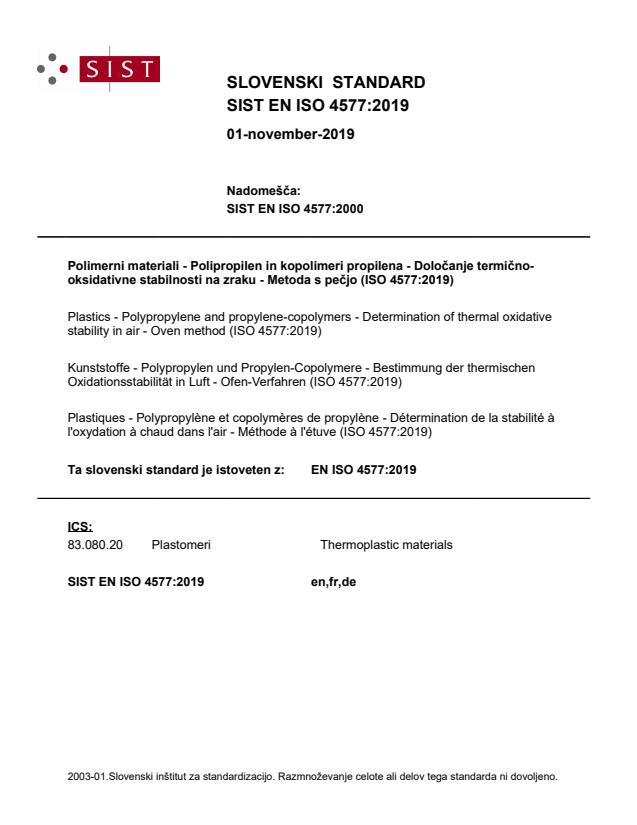
SLOVENSKI STANDARD
01-november-2019
Nadomešča:
SIST EN ISO 4577:2000
Polimerni materiali - Polipropilen in kopolimeri propilena - Določanje termično-
oksidativne stabilnosti na zraku - Metoda s pečjo (ISO 4577:2019)
Plastics - Polypropylene and propylene-copolymers - Determination of thermal oxidative
stability in air - Oven method (ISO 4577:2019)
Kunststoffe - Polypropylen und Propylen-Copolymere - Bestimmung der thermischen
Oxidationsstabilität in Luft - Ofen-Verfahren (ISO 4577:2019)
Plastiques - Polypropylène et copolymères de propylène - Détermination de la stabilité à
l'oxydation à chaud dans l'air - Méthode à l'étuve (ISO 4577:2019)
Ta slovenski standard je istoveten z: EN ISO 4577:2019
ICS:
83.080.20 Plastomeri Thermoplastic materials
2003-01.Slovenski inštitut za standardizacijo. Razmnoževanje celote ali delov tega standarda ni dovoljeno.
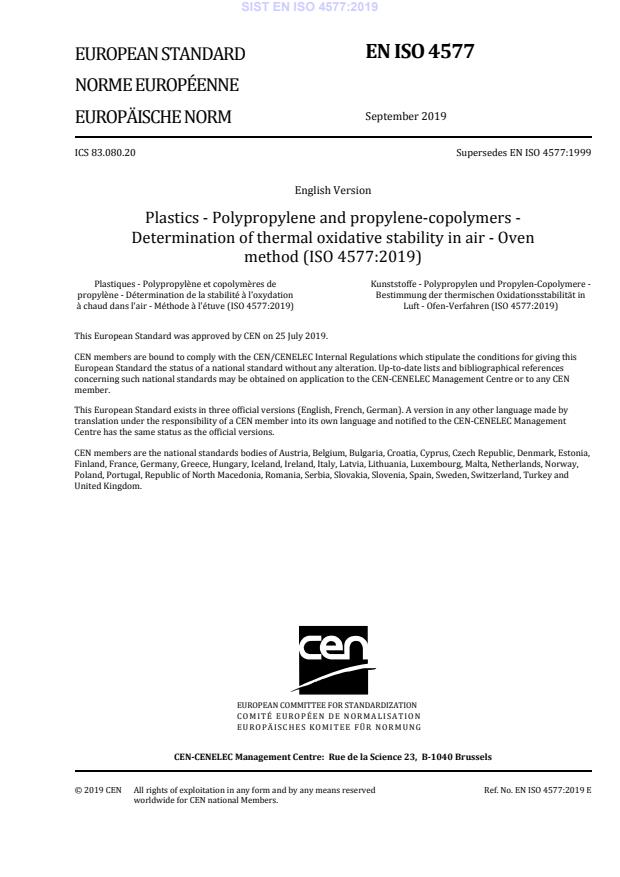
EN ISO 4577
EUROPEAN STANDARD
NORME EUROPÉENNE
September 2019
EUROPÄISCHE NORM
ICS 83.080.20 Supersedes EN ISO 4577:1999
English Version
Plastics - Polypropylene and propylene-copolymers -
Determination of thermal oxidative stability in air - Oven
method (ISO 4577:2019)
Plastiques - Polypropylène et copolymères de Kunststoffe - Polypropylen und Propylen-Copolymere -
propylène - Détermination de la stabilité à l'oxydation Bestimmung der thermischen Oxidationsstabilität in
à chaud dans l'air - Méthode à l'étuve (ISO 4577:2019) Luft - Ofen-Verfahren (ISO 4577:2019)
This European Standard was approved by CEN on 25 July 2019.
CEN members are bound to comply with the CEN/CENELEC Internal Regulations which stipulate the conditions for giving this
European Standard the status of a national standard without any alteration. Up-to-date lists and bibliographical references
concerning such national standards may be obtained on application to the CEN-CENELEC Management Centre or to any CEN
member.
This European Standard exists in three official versions (English, French, German). A version in any other language made by
translation under the responsibility of a CEN member into its own language and notified to the CEN-CENELEC Management
Centre has the same status as the official versions.
CEN members are the national standards bodies of Austria, Belgium, Bulgaria, Croatia, Cyprus, Czech Republic, Denmark, Estonia,
Finland, France, Germany, Greece, Hungary, Iceland, Ireland, Italy, Latvia, Lithuania, Luxembourg, Malta, Netherlands, Norway,
Poland, Portugal, Republic of North Macedonia, Romania, Serbia, Slovakia, Slovenia, Spain, Sweden, Switzerland, Turkey and
United Kingdom.
EUROPEAN COMMITTEE FOR STANDARDIZATION
COMITÉ EUROPÉEN DE NORMALISATION
EUROPÄISCHES KOMITEE FÜR NORMUNG
CEN-CENELEC Management Centre: Rue de la Science 23, B-1040 Brussels
© 2019 CEN All rights of exploitation in any form and by any means reserved Ref. No. EN ISO 4577:2019 E
worldwide for CEN national Members.
Contents Page
European foreword . 3
European foreword
This document (EN ISO 4577:2019) has been prepared by Technical Committee 61 "Plastics" in
collaboration with Technical Committee CEN/TC 249 “Plastics” the secretariat of which is held by NBN.
This European Standard shall be given the status of a national standard, either by publication of an
identical text or by endorsement, at the latest by March 2020, and conflicting national standards shall
be withdrawn at the latest by March 2020.
Attention is drawn to the possibility that some of the elements of this document may be the subject of
patent rights. CEN shall not be held responsible for identifying any or all such patent rights.
This document supersedes EN ISO 4577:1999.
According to the CEN-CENELEC Internal Regulations, the national standards organizations of the
following countries are bound to implement this European Standard: Austria, Belgium, Bulgaria,
Croatia, Cyprus, Czech Republic, Denmark, Estonia, Finland, France, Germany, Greece, Hungary, Iceland,
Ireland, Italy, Latvia, Lithuania, Luxembourg, Malta, Netherlands, Norway, Poland, Portugal, Republic of
North Macedonia, Romania, Serbia, Slovakia, Slovenia, Spain, Sweden, Switzerland, Turkey and the
United Kingdom.
Endorsement notice
The text of ISO 4577:2019 has been approved by CEN as EN ISO 4577:2019 without any modification.
INTERNATIONAL ISO
STANDARD 4577
Second edition
2019-07
Plastics — Polypropylene
and propylene-copolymers —
Determination of thermal oxidative
stability in air — Oven method
Plastiques — Polypropylène et copolymères de propylène —
Détermination de la stabilité à l'oxydation à chaud dans l'air —
Méthode à l'étuve
Reference number
ISO 4577:2019(E)
©
ISO 2019
ISO 4577:2019(E)
© ISO 2019
All rights reserved. Unless otherwise specified, or required in the context of its implementation, no part of this publication may
be reproduced or utilized otherwise in any form or by any means, electronic or mechanical, including photocopying, or posting
on the internet or an intranet, without prior written permission. Permission can be requested from either ISO at the address
below or ISO’s member body in the country of the requester.
ISO copyright office
CP 401 • Ch. de Blandonnet 8
CH-1214 Vernier, Geneva
Phone: +41 22 749 01 11
Fax: +41 22 749 09 47
Email: copyright@iso.org
Website: www.iso.org
Published in Switzerland
ii © ISO 2019 – All rights reserved
ISO 4577:2019(E)
Contents Page
Foreword .iv
1 Scope . 1
2 Normative references . 1
3 Terms and definitions . 1
4 Principle . 1
5 Apparatus . 2
6 Test specimens. 5
7 Conditioning . 5
8 Test conditions . 5
9 Procedure. 5
10 Expression of results . 6
11 Test report . 6
Bibliography . 7
ISO 4577:2019(E)
Foreword
ISO (the International Organization for Standardization) is a worldwide federation of national standards
bodies (ISO member bodies). The work of preparing International Standards is normally carried out
through ISO technical committees. Each member body interested in a subject for which a technical
committee has been established has the right to be represented on that committee. International
organizations, governmental and non-governmental, in liaison with ISO, also take part in the work.
ISO collaborates closely with the International Electrotechnical Commission (IEC) on all matters of
electrotechnical standardization.
The procedures used to develop this document and those intended for its further maintenance are
described in the ISO/IEC Directives, Part 1. In particular, the different approval criteria needed for the
different types of ISO documents should be noted. This document was drafted in accordance with the
editorial rules of the ISO/IEC Directives, Part 2 (see www .iso .org/directives).
Attention is drawn to the possibility that some of the elements of this document may be the subject of
patent rights. ISO shall not be held responsible for identifying any or all such patent rights. Details of
any patent rights identified during the development of the document will be in the Introduction and/or
on the ISO list of patent declarations received (see www .iso .org/patents).
Any trade name used in this document is information given for the convenience of users and does not
constitute an endorsement.
For an explanation of the voluntary nature of standards, the meaning of ISO specific terms and
expressions related to conformity assessment, as well as information about ISO's adherence to the
World Trade Organization (WTO) principles in the Technical Barriers to Trade (TBT) see www .iso
.org/iso/foreword .html.
This document was prep
...