

SIST EN 1993-1-5:2007
(Main)Eurocode 3 - Design of steel structures - Part 1-5: Plated structural elements
General Information
- Abstract
(1) EN 1993-1-5 gives design requirements of stiffened and unstiffened plates which are subject to inplane
forces.
(2) Effects due to shear lag, in-plane load introduction and plate buckling for I-section girders and box
girders are covered. Also covered are plated structural components subject to in-plane loads as in tanks and
silos. The effects of out-of-plane loading are outside the scope of this document.
NOTE 1: The rules in this part complement the rules for class 1, 2, 3 and 4 sections, see EN 1993-1-1.
NOTE 2: For the design of slender plates which are subject to repeated direct stress and/or shear and also
fatigue due to out-of-plane bending of plate elements (breathing) see EN 1993-2 and EN 1993-6.
NOTE 3: For the effects of out-of-plane loading and for the combination of in-plane effects and out-of-plane
loading effects see EN 1993-2 and EN 1993-1-7.
NOTE 4: Single plate elements may be considered as flat where the curvature radius r satisfies:
t
a
r
2
³ (1.1)
where a is the panel width
t is the plate thickness
- Status
- Published
- Publication Date
- 28-Feb-2007
- Technical Committee
- KON - Structures
- Current Stage
- 6060 - National Implementation/Publication (Adopted Project)
- Start Date
- 01-Mar-2007
- Due Date
- 01-Mar-2007
- Completion Date
- 01-Mar-2007



Overview
SIST EN 1993-1-5:2007, also known as Eurocode 3 - Design of steel structures - Part 1-5: Plated structural elements, establishes comprehensive design requirements for stiffened and unstiffened steel plates subject to in-plane loading. Issued by SIST and harmonized across the EU as EN 1993-1-5, this standard is integral to ensuring the safety, efficiency, and reliability of steel structures featuring plated elements such as I-section girders, box girders, tanks, and silos.
The document outlines methodologies for addressing key structural effects like shear lag, in-plane load introduction, and plate buckling, supporting structural designers and engineers in realizing complex and efficient steel structures. It complements other core sections of Eurocode 3, especially concerning the classification and verification of sections.
Key Topics
Design Scope
- Covers stiffened and unstiffened plates under in-plane forces only
- Excludes effects of out-of-plane loading
Shear Lag Effects
- Guidance on accounting for non-uniform stress distribution (shear lag) in flanges and plates
- Methods for determining effective widths for elastic and ultimate limit states
Plate Buckling
- Procedures for plate buckling assessment due to direct stresses
- Specific rules for both local and global buckling in plated elements
Stiffened and Unstiffened Elements
- Requirements for the use of transverse and longitudinal stiffeners
- Calculation of effective areas for both types of plate elements
Interaction Effects
- Guidance on the interaction between shear, bending, and axial forces
- Design equations for combined stress states
Member Verification
- Criteria and calculations for verifying adequacy of members at serviceability and ultimate limit states
- Consideration of global analysis with effective area modifications
Determinants for Flat Plate Elements
- Rules to determine when a curved plate may be considered “flat” for design purposes
Applications
SIST EN 1993-1-5:2007 is a vital resource in a variety of steel structure design projects, particularly where plates form major load-bearing components. Typical applications include:
- Bridges and Viaducts: I-section girders and box girders rely on plated webs and flanges, requiring detailed verification of buckling and shear lag
- Industrial Buildings and Warehouses: Structural components often use flat or stiffened plates in both primary and secondary steelwork
- Storage Tanks and Silos: Plated wall and roof elements subject to in-plane pressures
- Cranes and Gantry Systems: Plate buckling and stiffener design are crucial for structural safety
- Marine and Offshore Structures: Incorporating large plated panels under significant loads
By following the requirements of this standard, engineers ensure that steel structural components are both safe and durable, minimizing the risks of structural instability due to buckling, inappropriate load distribution, or underestimation of shear effects.
Related Standards
To achieve holistic compliance and optimal safety in steel structural design, SIST EN 1993-1-5:2007 should be used alongside other relevant standards, including:
- EN 1993-1-1: General rules and rules for buildings – for classification of steel sections and basic structural principles
- EN 1993-2: Bridges – special rules on fatigue and out-of-plane effects for slender plate elements
- EN 1993-1-7: Plated structures subjected to out-of-plane loading
- EN 1993-6: Towers, masts, and chimneys – fatigue verification in plated structures
National annexes specify parameters and provide additional guidance, allowing adaptation to local conditions or practices.
Keywords: Eurocode 3, design of steel structures, plated elements, plate buckling, shear lag, stiffened plate, unstiffened plate, structural steel, I-section girder, box girder, tanks, silos, in-plane load, steel structure standard, SIST EN 1993-1-5:2007.
Relations
- Effective Date
- 01-Jul-2024
- Effective Date
- 28-Jan-2026
- Effective Date
- 19-May-2026
- Effective Date
- 09-Feb-2026
- Effective Date
- 09-Feb-2026
- Effective Date
- 28-Jan-2026
- Effective Date
- 28-Jan-2026
- Effective Date
- 28-Jan-2026
- Effective Date
- 28-Jan-2026
- Effective Date
- 28-Jan-2026
- Effective Date
- 28-Jan-2026
- Effective Date
- 28-Jan-2026
- Effective Date
- 01-Oct-2019
- Effective Date
- 01-Jun-2017
- Effective Date
- 01-Jun-2009
Get Certified
Connect with accredited certification bodies for this standard

DIBt (Deutsches Institut für Bautechnik)
German Institute for Building Technology.
DIN CERTCO
DIN Group product certification.

Aboma Certification B.V.
Specialized in construction, metal, and transport sectors.
Sponsored listings
Frequently Asked Questions
SIST EN 1993-1-5:2007 is a standard published by the Slovenian Institute for Standardization (SIST). Its full title is "Eurocode 3 - Design of steel structures - Part 1-5: Plated structural elements". This standard covers: (1) EN 1993-1-5 gives design requirements of stiffened and unstiffened plates which are subject to inplane forces. (2) Effects due to shear lag, in-plane load introduction and plate buckling for I-section girders and box girders are covered. Also covered are plated structural components subject to in-plane loads as in tanks and silos. The effects of out-of-plane loading are outside the scope of this document. NOTE 1: The rules in this part complement the rules for class 1, 2, 3 and 4 sections, see EN 1993-1-1. NOTE 2: For the design of slender plates which are subject to repeated direct stress and/or shear and also fatigue due to out-of-plane bending of plate elements (breathing) see EN 1993-2 and EN 1993-6. NOTE 3: For the effects of out-of-plane loading and for the combination of in-plane effects and out-of-plane loading effects see EN 1993-2 and EN 1993-1-7. NOTE 4: Single plate elements may be considered as flat where the curvature radius r satisfies: t a r 2 ³ (1.1) where a is the panel width t is the plate thickness
(1) EN 1993-1-5 gives design requirements of stiffened and unstiffened plates which are subject to inplane forces. (2) Effects due to shear lag, in-plane load introduction and plate buckling for I-section girders and box girders are covered. Also covered are plated structural components subject to in-plane loads as in tanks and silos. The effects of out-of-plane loading are outside the scope of this document. NOTE 1: The rules in this part complement the rules for class 1, 2, 3 and 4 sections, see EN 1993-1-1. NOTE 2: For the design of slender plates which are subject to repeated direct stress and/or shear and also fatigue due to out-of-plane bending of plate elements (breathing) see EN 1993-2 and EN 1993-6. NOTE 3: For the effects of out-of-plane loading and for the combination of in-plane effects and out-of-plane loading effects see EN 1993-2 and EN 1993-1-7. NOTE 4: Single plate elements may be considered as flat where the curvature radius r satisfies: t a r 2 ³ (1.1) where a is the panel width t is the plate thickness
SIST EN 1993-1-5:2007 is classified under the following ICS (International Classification for Standards) categories: 91.010.30 - Technical aspects; 91.080.13 - Steel structures. The ICS classification helps identify the subject area and facilitates finding related standards.
SIST EN 1993-1-5:2007 has the following relationships with other standards: It is inter standard links to kSIST FprEN 1993-1-5:2023, kSIST FprEN 1993-1-1:2022, SIST-TS CLC/TS 50711:2026, SIST EN 50583-1:2016, SIST EN 50583-2:2016, SIST EN 1998-4:2006, SIST EN 15859:2010, SIST EN 1991-1-7:2006, SIST EN 1994-1-1:2005, SIST EN 1993-1-3:2007, SIST EN 13480-3:2012, SIST EN ISO 10374:2000, SIST EN 1993-1-5:2007/A2:2019, SIST EN 1993-1-5:2007/A1:2017, SIST EN 1993-1-5:2007/AC:2009. Understanding these relationships helps ensure you are using the most current and applicable version of the standard.
SIST EN 1993-1-5:2007 is associated with the following European legislation: EU Directives/Regulations: 2005-01-4408, 305/2011, 89/106/EEC; Standardization Mandates: M/265, M/BC/CEN/89/11. When a standard is cited in the Official Journal of the European Union, products manufactured in conformity with it benefit from a presumption of conformity with the essential requirements of the corresponding EU directive or regulation.
SIST EN 1993-1-5:2007 is available in PDF format for immediate download after purchase. The document can be added to your cart and obtained through the secure checkout process. Digital delivery ensures instant access to the complete standard document.
Standards Content (Sample)
2003-01.Slovenski inštitut za standardizacijo. Razmnoževanje celote ali delov tega standarda ni dovoljeno.Eurocode 3 - Design of steel structures - Part 1-5: Plated structural elementsNRQVWUXNFLMHEurocode 3 - Calcul des structures en acier - Partie 1-5: Plaques planesEurocode 3 - Bemessung und Konstruktion von Stahlbauten - Teil 1-5: Plattenförmige BauteileTa slovenski standard je istoveten z:EN 1993-1-5:2006SIST EN 1993-1-5:2007en91.080.10Kovinske konstrukcijeMetal structures91.010.30Technical aspectsICS:SIST ENV 1993-1-5:20011DGRPHãþDSLOVENSKI
STANDARDSIST EN 1993-1-5:200701-marec-2007
EUROPEAN STANDARDNORME EUROPÉENNEEUROPÄISCHE NORMEN 1993-1-5October 2006ICS 91.010.30; 91.080.10Supersedes ENV 1993-1-5:1997
English VersionEurocode 3 - Design of steel structures - Part 1-5: Platedstructural elementsEurocode 3 - Calcul des structures en acier - Partie 1-5:Plaques planesEurocode 3 - Bemessung und konstruktion von Stahlbauten- Teil 1-5: PlattenbeulenThis European Standard was approved by CEN on 13 January 2006.CEN members are bound to comply with the CEN/CENELEC Internal Regulations which stipulate the conditions for giving this EuropeanStandard the status of a national standard without any alteration. Up-to-date lists and bibliographical references concerning such nationalstandards may be obtained on application to the Central Secretariat or to any CEN member.This European Standard exists in three official versions (English, French, German). A version in any other language made by translationunder the responsibility of a CEN member into its own language and notified to the Central Secretariat has the same status as the officialversions.CEN members are the national standards bodies of Austria, Belgium, Cyprus, Czech Republic, Denmark, Estonia, Finland, France,Germany, Greece, Hungary, Iceland, Ireland, Italy, Latvia, Lithuania, Luxembourg, Malta, Netherlands, Norway, Poland, Portugal, Romania,Slovakia, Slovenia, Spain, Sweden, Switzerland and United Kingdom.EUROPEAN COMMITTEE FOR STANDARDIZATIONCOMITÉ EUROPÉEN DE NORMALISATIONEUROPÄISCHES KOMITEE FÜR NORMUNGManagement Centre: rue de Stassart, 36
B-1050 Brussels© 2006 CENAll rights of exploitation in any form and by any means reservedworldwide for CEN national Members.Ref. No. EN 1993-1-5:2006: E
EN 1993-1-5: 2006 (E)
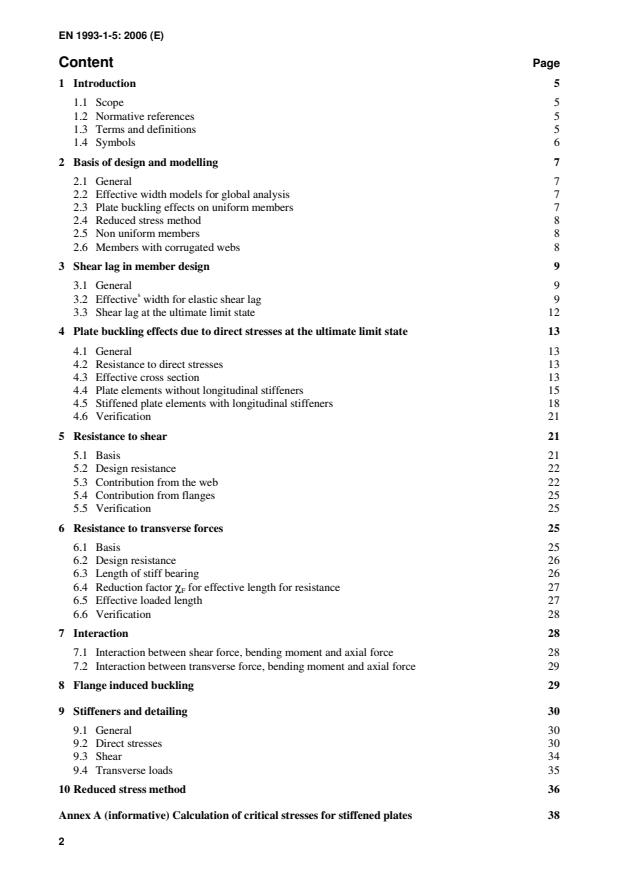
2 Content Page 1 Introduction 5 1.1 Scope 5 1.2 Normative references 5 1.3 Terms and definitions 5 1.4 Symbols 6 2 Basis of design and modelling 7 2.1 General 7 2.2 Effective width models for global analysis 7 2.3 Plate buckling effects on uniform members 7 2.4 Reduced stress method 8 2.5 Non uniform members 8 2.6 Members with corrugated webs 8 3 Shear lag in member design 9 3.1 General 9 3.2 Effectives width for elastic shear lag 9 3.3 Shear lag at the ultimate limit state 12 4 Plate buckling effects due to direct stresses at the ultimate limit state 13 4.1 General 13 4.2 Resistance to direct stresses 13 4.3 Effective cross section 13 4.4 Plate elements without longitudinal stiffeners 15 4.5 Stiffened plate elements with longitudinal stiffeners 18 4.6 Verification 21 5 Resistance to shear 21 5.1 Basis 21 5.2 Design resistance 22 5.3 Contribution from the web 22 5.4 Contribution from flanges 25 5.5 Verification 25 6 Resistance to transverse forces 25 6.1 Basis 25 6.2 Design resistance 26 6.3 Length of stiff bearing 26 6.4 Reduction factor cF for effective length for resistance 27 6.5 Effective loaded length 27 6.6 Verification 28 7 Interaction 28 7.1 Interaction between shear force, bending moment and axial force 28 7.2 Interaction between transverse force, bending moment and axial force 29 8 Flange induced buckling 29 9 Stiffeners and detailing 30 9.1 General 30 9.2 Direct stresses 30 9.3 Shear 34 9.4 Transverse loads 35 10 Reduced stress method 36 Annex A (informative) Calculation of critical stresses for stiffened plates 38
EN 1993-1-5: 2006 (E)
3 Annex B (informative) Non uniform members
43 Annex C (informative) Finite Element Methods of Analysis (FEM) 45 Annex D (informative) Plate girders with corrugated webs 50 Annex E (normative) Alternative methods for determining effective cross sections 53
EN 1993-1-5: 2006 (E)
4 Foreword
This European Standard EN 1993-1-5,, Eurocode 3: Design of steel structures Part 1.5: Plated structural elements, has been prepared by Technical Committee CEN/TC250 « Structural Eurocodes », the Secretariat of which is held by BSI. CEN/TC250 is responsible for all Structural Eurocodes.
This European Standard shall be given the status of a National Standard, either by publication of an identical text or by endorsement, at the latest by April 2007 and conflicting National Standards shall be withdrawn at latest by March 2010.
This Eurocode supersedes ENV 1993-1-5.
According to the CEN-CENELEC Internal Regulations, the National Standard Organizations of the following countries are bound to implement this European Standard: Austria, Belgium, Cyprus, Czech Republic, Denmark, Estonia, Finland, France, Germany, Greece, Hungary, Iceland, Ireland, Italy, Latvia, Lithuania, Luxembourg, Malta, Netherlands, Norway, Poland, Portugal, Romania, Slovakia, Slovenia, Spain, Sweden, Switzerland and United Kingdom.
National annex for EN 1993-1-5
This standard gives alternative procedures, values and recommendations with notes indicating where national choices may have to be made. The National Standard implementing EN 1993-1-5 should have a National Annex containing all Nationally Determined Parameters to be used for the design of steel structures to be constructed in the relevant country.
National choice is allowed in EN 1993-1-5 through: – 2.2(5) – 3.3(1) – 4.3(6) – 5.1(2) – 6.4(2) – 8(2) – 9.1(1) – 9.2.1(9) – 10(1) – 10(5) – C.2(1) – C.5(2) – C.8(1) – C.9(3) – D.2.2(2)
EN 1993-1-5: 2006 (E)
5 1 Introduction 1.1 Scope
(1) EN 1993-1-5 gives design requirements of stiffened and unstiffened plates which are subject to in-plane forces. (2) Effects due to shear lag, in-plane load introduction and plate buckling for I-section girders and box girders are covered. Also covered are plated structural components subject to in-plane loads as in tanks and silos. The effects of out-of-plane loading are outside the scope of this document.
NOTE 1:
The rules in this part complement the rules for class 1, 2, 3 and 4 sections, see EN 1993-1-1.
NOTE 2:
For the design of slender plates which are subject to repeated direct stress and/or shear and also fatigue due to out-of-plane bending of plate elements (breathing) see EN 1993-2 and EN 1993-6.
NOTE 3:
For the effects of out-of-plane loading and for the combination of in-plane effects and out-of-plane loading effects see EN 1993-2 and EN 1993-1-7. NOTE 4:
Single plate elements may be considered as flat where the curvature radius r satisfies:
tar2³
(1.1) where a is the panel width
t is the plate thickness 1.2 Normative references
(1) This European Standard incorporates, by dated or undated reference, provisions from other publications. These normative references are cited at the appropriate places in the text and the publications are listed hereafter. For dated references, subsequent amendments to or revisions of any of these publications apply to this European Standard only when incorporated in it by amendment or revision. For undated references the latest edition of the publication referred to applies. EN 1993-1-1 Eurocode 3 :Design of steel structures: Part 1-1: General rules and rules for buildings 1.3 Terms and definitions
For the purpose of this standard, the following terms and definitions apply: 1.3.1
elastic critical stress stress in a component at which the component becomes unstable when using small deflection elastic theory of a perfect structure 1.3.2
membrane stress stress at mid-plane of the plate 1.3.3
gross cross-section the total cross-sectional area of a member but excluding discontinuous longitudinal stiffeners 1.3.4
effective cross-section and effective width the gross cross-section or width reduced for the effects of plate buckling or shear lag or both; to distinguish between their effects the word “effective” is clarified as follows: “effectivep“ denotes effects of plate buckling
EN 1993-1-5: 2006 (E)
“effectives“ denotes effects of shear lag “effective“ denotes effects of plate buckling and shear lag 1.3.5
plated structure a structure built up from nominally flat plates which are connected together; the plates may be stiffened or unstiffened 1.3.6
stiffener a plate or section attached to a plate to resist buckling or to strengthen the plate; a stiffener is denoted:
– longitudinal if its direction is parallel to the member;
– transverse if its direction is perpendicular to the member. 1.3.7
stiffened plate plate with transverse or longitudinal stiffeners or both 1.3.8
subpanel unstiffened plate portion surrounded by flanges and/or stiffeners 1.3.9
hybrid girder girder with flanges and web made of different steel grades; this standard assumes higher steel grade in flanges compared to webs 1.3.10
sign convention unless otherwise stated compression is taken as positive 1.4 Symbols
(1) In addition to those given in EN 1990 and EN 1993-1-1, the following symbols are used: As total area of all the longitudinal stiffeners of a stiffened plate; Ast gross cross sectional area of one transverse stiffener; Aeff
effective cross sectional area; Ac,eff effectivep cross sectional area; Ac,eff,loc effectivep cross sectional area for local buckling; a length of a stiffened or unstiffened plate; b width of a stiffened or unstiffened plate; bw clear width between welds;
beff effectives width for elastic shear lag; FEd design transverse force; hw clear web depth between flanges; Leff
effective length for resistance to transverse forces, see 6; Mf.Rd
design plastic moment of resistance of a cross-section consisting of the flanges only; Mpl.Rd design plastic moment of resistance of the cross-section (irrespective of cross-section class); MEd design bending moment; NEd design axial force; t thickness of the plate;
EN 1993-1-5: 2006 (E)
7 VEd design shear force including shear from torque; Weff
effective elastic section modulus;
effectives width factor for elastic shear lag;
(2) Additional symbols are defined where they first occur.
2 Basis of design and modelling 2.1 General
(1)P The effects of shear lag and plate buckling shall be taken into account at the ultimate, serviceability or fatigue limit states. NOTE:
Partial factors gM0 and gM1 used in this part are defined for different applications in the National Annexes of EN 1993-1 to EN 1993-6. 2.2 Effective width models for global analysis
(1)P The effects of shear lag and of plate buckling on the stiffness of members and joints shall be taken into account in the global analysis. (2) The effects of shear lag of flanges in global analysis may be taken into account by the use of an effectives width. For simplicity this effectives width may be assumed to be uniform over the length of the span. (3) For each span of a member the effectives width of flanges should be taken as the lesser of the full width and L/8 per side of the web, where L is the span or twice the distance from the support to the end of a cantilever. (4) The effects of plate buckling in elastic global analysis may be taken into account by effectivep cross sectional areas of the elements in compression, see 4.3.
(5) For global analysis the effect of plate buckling on the stiffness may be ignored when the effectivep cross-sectional area of an element in compression is
larger than rlim times the gross cross-sectional area of the same element. NOTE 1:
The parameter rlim may be given in the National Annex. The value rlim = 0,5 is recommended.
NOTE 2:
For determining the stiffness when (5) is not fulfilled, see Annex E. 2.3 Plate buckling effects on uniform members
(1) Effectivep width models for direct stresses, resistance models for shear buckling and buckling due to transverse loads as well as interactions between these models for determining the resistance of uniform members at the ultimate limit state may be used when the following conditions apply: – panels are rectangular and flanges are parallel;
– the diameter of any unstiffened open hole or cut out does not exceed 0,05b, where b is the width of the panel.
NOTE:
The rules may apply to non rectangular panels provided the angle alimit (see Figure 2.1) is not greater than 10 degrees. If limit exceeds 10, panels may be assessed assuming it to be a rectangular panel based on the larger of b1 and b2 of the panel.
EN 1993-1-5: 2006 (E)
Figure 2.1:
Definition of angle aaaa (2) For the calculation of stresses at the serviceability and fatigue limit state the effectives area may be used if the condition in 3.1 is fulfilled. For ultimate limit states the effective area according to 3.3 should be used with b replaced by bult. 2.4 Reduced stress method
(1) As an alternative to the use of the effectivep width models for direct stresses given in sections 4 to 7, the cross sections may be assumed to be class 3 sections provided that the stresses in each panel do not exceed the limits specified in section 10. NOTE:
The reduced stress method is analogous to the effectivep width method (see 2.3) for single plated elements. However, in verifying the stress limitations no load shedding has been assumed between the plated elements of the cross section. 2.5 Non uniform members
(1) Non uniform members (e.g. haunched members, non rectangular panels) or members with regular or irregular large openings may be analysed using Finite Element (FE) methods.
NOTE 1:
See Annex B for non uniform members.
NOTE 2:
For FE-calculations see Annex C. 2.6 Members with corrugated webs
(1) For members with corrugated webs, the bending stiffness should be based on the flanges only and webs should be considered to transfer shear and transverse loads.
NOTE:
For plate buckling resistance of flanges in compression and the shear resistance of webs see Annex D.
a a b 1 b 2
EN 1993-1-5: 2006 (E)
9 3 Shear lag in member design 3.1 General
(1) Shear lag in flanges may be neglected if b0 < Le/50 where b0 is taken as the flange outstand or half the width of an internal element and Le is the length between points of zero bending moment, see 3.2.1(2).
(2) Where the above limit for b0 is exceeded the effects due to shear lag in flanges should be considered at serviceability and fatigue limit state verifications by the use of an effectives width according to 3.2.1 and a stress distribution according to 3.2.2. For the ultimate limit state verification an effective area according to 3.3 may be used. (3) Stresses due to patch loading in the web applied at the flange level should be determined from 3.2.3.
3.2 Effectives width for elastic shear lag 3.2.1 Effective width
(1) The effectives width beff for shear lag under elastic conditions should be determined from:
beff =
b0
(3.1)
where the effectives factor
is given in Table 3.1.
This effective width may be relevant for serviceability and fatigue limit states.
(2) Provided adjacent spans do not differ more than 50% and any cantilever span is not larger than half the adjacent span the effective lengths Le may be determined from Figure 3.1. For all other cases Le should be taken as the distance between adjacent points of zero bending moment.
Figure 3.1:
Effective length Le for continuous beam and distribution of effectives width
L LL L
/ 4L
/ 2L
/ 4 L
/ 4L
/ 2 L
/ 4L
= 0, 85 L
L
= 0 , 7 0L
L
=
0 , 2 5
(L
+
L
) L
=
2 Lb
: b
: b
: b
: b b b b b b 1 1 11 11 1 11 1 eee e2 22222 222 2 203 3
EN 1993-1-5: 2006 (E) 10
1 for flange outstand 2 for internal flange 3 plate thickness t 4 stiffeners with =issAA
Figure 3.2:
Notations for shear lag
Table 3.1:
Effectives width factor
Verification
– value
0,02
= 1,0 sagging bending 214,611kbb+== 0,02 <
0,70 hogging bending 226,1250010,611kkkbb+-+== sagging bending kbb9,511== > 0,70 hogging bending kbb6,812== all
end support 0 = (0,55 + 0,025 / ) 1, but 0 < 1 all
Cantilever
= 2 at support and at the end
= 0 b0 / Le
with
tbAs001+=a in which As is the area of all longitudinal stiffeners within the width b0 and other symbols are as defined in Figure 3.1 and Figure 3.2.
bb bb ef fe ff 0 04 1 23 C L
EN 1993-1-5: 2006 (E)
11 3.2.2 Stress distribution due to shear lag (1) The distribution of longitudinal stresses across the flange plate due to shear lag should be obtained from Figure 3.3. bbyyb
=
bssssbb12(y)(y)effeff00b
=
bb
= 5
b0010b ()()()()4021212/120,025,1:20,0byy--+=-=>sssssbsb ()()4112/10:20,0byy-==£sssb
s1 is calculated with the effective width of the flange beff
Figure 3.3:
Distribution of stresses due to shear lag 3.2.3 In-plane load effects (1) The elastic stress distribution in a stiffened or unstiffened plate due to the local introduction of in-plane forces (patch loads), see Figure 3.4, should be determined from:
()lstweffEdEdzatbF,,+=s
(3.2) with: 21+=nszsbeeeff
wsttan1,878,01636,0+=
fsetss2+=
where ast,1 is the gross cross-sectional area of the stiffeners smeared over the length se. This may be taken, conservatively, as the area of the stiffeners divided by the spacing sst;
tw is the web thickness;
z is the distance to flange.
NOTE:
The equation (3.2) is valid when sst/se £ 0,5; otherwise the contribution of stiffeners should be neglected.
EN 1993-1-5: 2006 (E) 12
1 stiffener 2 simplified stress distribution 3 actual stress distribution
Figure 3.4:
In-plane load introduction NOTE:
The above stress distribution may also be used for the fatigue verification.
3.3 Shear lag at the ultimate limit state
(1) At the ultimate limit state shear lag effects may be determined as follows: a) elastic shear lag effects as determined for serviceability and fatigue limit states, b) combined effects of shear lag and of plate buckling, c) elastic-plastic shear lag effects allowing for limited plastic strains.
NOTE 1:
The National Annex may choose the method to be applied. Unless specified otherwise in EN 1993-2 to EN 1993-6, the method in NOTE 3 is recommended.
NOTE 2:
The combined effects of plate buckling and shear lag may be taken into account by using Aeff as given by:
ulteffceffAAb,= (3.3) where Ac,eff is the effectivep area of the compression flange due to plate buckling (see 4.4 and 4.5);
bult is the effectives width factor for the effect of shear lag at the ultimate limit state, which may be taken as b determined from Table 3.1 with a0 replaced by
feffctbA0,*0=a
(3.4)
tf is the flange thickness.
b s ss z F 1 :1 t t z , E dz , E d f w ef fs tef fs e1 s 2 3
EN 1993-1-5: 2006 (E)
13 NOTE 3:
Elastic-plastic shear lag effects allowing for limited plastic strains may be taken into account using Aeff as follows:
bbkeffceffceffAAA,,³= (3.5) where b and k are taken from Table 3.1.
The expressions in NOTE 2 and NOTE 3 may also be applied for flanges in tension in which case Ac,eff should be replaced by the gross area of the tension flange.
4 Plate buckling effects due to direct stresses at the ultimate limit state 4.1 General
(1) This section gives rules to account for plate buckling effects from direct stresses at the ultimate limit state when the following criteria are met: a) The panels are rectangular and flanges are parallel or nearly parallel (see 2.3); b) Stiffeners, if any, are provided in the longitudinal or transverse direction or both; c) Open holes and cut outs are small (see 2.3); d) Members are of uniform cross section; e) No flange induced web buckling occurs. NOTE 1:
For compression flange buckling in the plane of the web see section 8.
NOTE 2:
For stiffeners and detailing of plated members subject to plate buckling see section 9. 4.2 Resistance to direct stresses
(1) The resistance of plated members may be determined using the effective areas of plate elements in compression for class 4 sections using cross sectional data (Aeff, Ieff, Weff) for cross sectional verifications and member verifications for column buckling and lateral torsional buckling according to EN 1993-1-1.
(2)
Effectivep areas should be determined on the basis of the linear strain distributions with the attainment of yield strain in the mid plane of the compression plate. 4.3 Effective cross section
(1) In calculating longitudinal stresses, account should be taken of the combined effect of shear lag and plate buckling using the effective areas given in 3.3.
(2) The effective cross sectional properties of members should be based on the effective areas of the compression elements and on the effectives area of the tension elements due to shear lag.
(3) The effective area Aeff should be determined assuming that the cross section is subject only to stresses due to uniform axial compression. For non-symmetrical cross sections the possible shift eN of the centroid of the effective area Aeff relative to the centre of gravity of the gross cross-section, see Figure 4.1, gives an additional moment which should be taken into account in the cross section verification using 4.6.
(4) The effective section modulus Weff should be determined assuming the cross section is subject only to bending stresses, see Figure 4.2. For biaxial bending effective section moduli should be determined about both main axes. NOTE:
As an alternative to 4.3(3) and (4) a single effective section may be determined from NEd and MEd acting simultaneously. The effects of eN should be taken into account as in 4.3(3). This requires an iterative procedure.
EN 1993-1-5: 2006 (E) 14 (5) The stress in a flange should be calculated using the elastic section modulus with reference to the mid- plane of the flange. (6) Hybrid girders may have flange material with yield strength fyf up to fh´fyw provided that:
a) the increase of flange stresses caused by yielding of the web is taken into account by limiting the stresses in the web to fyw ; b) fyf (rather than fyw) is used in determining the effective area of the web.
NOTE:
The National Annex may specify the value fh. A value of fh = 2,0 is recommended.
(7)
The increase of deformations and of stresses at serviceability and fatigue limit states may be ignored for hybrid girders complying with 4.3(6) including the NOTE.
(8) For hybrid girders complying with 4.3(6) the stress range limit in EN 1993-1-9 may be taken as 1,5fyf.
Gross cross section Effective cross section G centroid of the gross cross section G´ centroid of the effective cross section 1 centroidal axis of the gross cross section 2 centroidal axis of the effective cross section 3 non effective zone Figure 4.1:
Class 4 cross-sections - axial force
GG´G´G112233
Gross cross section Effective cross section G centroid of the gross cross section G´ centroid of the effective cross section 1 centroidal axis of the gross cross section 2 centroidal axis of the effective cross section 3 non effective zone Figure 4.2:
Class 4 cross-sections - bending moment
G1 23 3 GG´e N
EN 1993-1-5: 2006 (E)
15 4.4 Plate elements without longitudinal stiffeners
(1) The effectivep areas of flat compression elements should be obtained using Table 4.1 for internal elements and Table 4.2 for outstand elements. The effectivep area of the compression zone of a plate with the gross cross-sectional area Ac should be obtained from:
Ac,eff =
Ac
(4.1) where
is the reduction factor for plate buckling.
(2) The reduction factor
may be taken as follows: – internal compression elements:
r = 1,0
for 673,0£pl
()0,13055,02£+-=pplylr for 673,0>pl
, where ()03³+y (4.2) – outstand compression elements:
r = 1,0
for 748,0£pl
0,1188,02£-=ppllr for 748,0>pl (4.3) where seslktbfcryp4,28/==
is the stress ratio determined in accordance with 4.4(3) and 4.4(4) b is the appropriate width to be taken as follows (for definitions, see Table 5.2 of EN 1993-1-1)
bw for webs;
b for internal flange elements (except RHS);
b - 3 t for flanges of RHS;
c for outstand flanges;
h for equal-leg angles;
h for unequal-leg angles; k is the buckling factor corresponding to the stress ratio
and boundary conditions. For long plates k is given in Table 4.1 or Table 4.2 as appropriate; t is the thickness; cr is the elastic critical plate buckling stress see equation (A.1) in Annex A.1(2) and Table 4.1 and Table 4.2; []2/235mmNfy=e
(3) For flange elements of I-sections and box girders the stress ratio y used in Table 4.1 and Table 4.2 should be based on the properties of the gross cross-sectional area, due allowance being made for shear lag in the flanges if relevant. For web elements the stress ratio
used in Table 4.1 should be obtained using a stress distribution based on the effective area of the compression flange and the gross area of the web.
NOTE:
If the stress distribution results from different stages of construction (as e.g. in a composite bridge) the stresses from the various stages may first be calculated with a cross section consisting of effective flanges and
EN 1993-1-5: 2006 (E) 16 gross web and these stresses are added together. This resulting stress distribution determines an effective web section that can be used for all stages to calculate the final stress distribution for stress analysis.
(4) Except as given in 4.4(5), the plate slenderness pl of an element may be replaced by:
0,,/MyEdcompredpfgsll=
(4.4) where com,Ed is the maximum design compressive stress in the element determined using the effectivep area of the section caused by all simultaneous actions.
NOTE 1:
The above procedure is conservative and requires an iterative calculation in which the stress ratio
(see Table 4.1 and Table 4.2) is determined at each step from the stresses calculated on the effectivep cross-section defined at the end of the previous step. NOTE 2:
See also alternative procedure in Annex E.
(5) For the verification of the design buckling resistance of a class 4 member using 6.3.1, 6.3.2 or 6.3.4 of EN 1993-1-1, either the plate slenderness pl or redp,l with com,Ed based on second order analysis with global imperfections should be used. (6) For aspect ratios a/b < 1 a column type of buckling may occur and the check should be performed according to 4.5.4 using the reduction factor rc.
NOTE:
This applies e.g. for flat elements between transverse stiffeners where plate buckling could be column-like and require a reduction factor rc close to cc as for column buckling, see Figure 4.3 a) and b). For plates with longitudinal stiffeners column type buckling may also occur for a/b ³ 1, see Figure 4.3 c).
a) column-like behaviour of plates without longitudinal supports b) column-like behaviour of an unstiffened plate with a small aspect ratio a
c) column-like behaviour of a longitudinally stiffened plate with a large aspect ratio a
Figure 4.3:
Column-like behaviour
EN 1993-1-5: 2006 (E)
Table 4.1:
Internal compression elements Stress distribution (compression positive) Effectivep width beff
= 1:
beff = `b
be1 = 0,5 beff
be2 = 0,5 beff
1 >
0:
beff = `b
effebby-=521 be2 = beff - be1
< 0:
beff =
bc = `b / (1-)
be1 = 0,4 beff
be2 = 0,6 beff
= 2/1 1 1 >
> 0 0 0 >
> -1 -1 -1 >
> -3 Buckling factor k 4,0 8,2 / (1,05 + ) 7,81 7,81 - 6,29 + 9,782 23,9 5,98 (1 - )2
Table 4.2:
Outstand compression elements Stress distribution (compression positive) Effectivep width beff
1 >
0:
beff =
c
< 0:
beff =
bc =
c / (1-)
= 2/1 1 0 -1 1
-3 Buckling factor k 0,43 0,57 0,85 0,57 - 0,21 + 0,072
1 >
0:
beff =
c
< 0:
beff =
bc =
c / (1-)
= 2/1 1 1 >
> 0 0 0 >
> -1 -1 Buckling factor k 0,43 0,578 / ( + 0,34) 1,70 1,7 - 5 + 17,12 23,8
b s s 1 2b b e2e1b s s 1 2b b e2 e 1 b s s 1 2b bbbe2t e 1 c s s 21 b c ef f s s 21 b b b ef f t c s s 12b c e f f s s 12b c b b e f f t
EN 1993-1-5: 2006 (E) 18 4.5 Stiffened plate elements with longitudinal stiffeners 4.5.1 General (1) For plates with longitudinal stiffeners the effectivep areas from local buckling of the various subpanels between the stiffeners and the effectivep areas from the global buckling of the stiffened panel should be accounted for. (2) The effectivep section area of each subpanel should be determined by a reduction factor in accordance with 4.4 to account for local plate buckling. The stiffened plate with effectivep section areas for the stiffeners should be checked for global plate buckling (by modelling it as an equivalent orthotropic plate) and a reduction factor
should be determined for overall plate buckling.
(3) The effectivep area of the compression zone of the stiffened plate should be taken as:
+=tbAAeffedgeloceffcceffc,,,,r
(4.5) where Ac,eff,loc is the effectivep section areas of all the stiffeners and subpanels that are fully or partially in the compression zone except the effective parts supported by an adjacent plate element with the width bedge,eff, see example in Figure 4.4. (4) The area Ac,eff,loc should be obtained from:
tbAAlocccloceffsloceffc,,,,+=r
(4.6) where c applies to the part of the stiffened panel width that is in compression except the parts bedge,eff, see Figure 4.4;
As,eff
is the sum of the effectivep sections according to 4.4 of all longitudinal stiffeners with gross area As located in the compression zone;
bc,loc
is the width of the compressed part of each subpanel;
loc
is the reduction factor from 4.4(2) for each subpanel.
Figure 4.4:
Stiffened plate under uniform compression NOTE:
For non-uniform compression see Figure A.1.
A c
b 1
b 2
b 3
2 1b
2 b 3
b 1
b 2
b 3
2 11 r b
2 33r b
Ac,eff,loc
2 22r b
2 1 1 , , 1 r b b eff edge =
eff edge b ,, 3
2 22 r b
EN 1993-1-5: 2006 (E)
(5) In determining the reduction factor c for overall buckling, the reduction factor for column-type buckling, which is more severe than the reduction factor than for plate buckling, should be considered.
(6) Interpolation should be carried out in accordance with 4.5.4(1) between the reduction factor
for plate buckling and the reduction factor c for column buckling to determine rc see 4.5.4.
(7) The reduction of the compressed area Ac,eff,loc through c may be taken as a uniform reduction across the whole cross section. (8) If shear lag is relevant (see 3.3), the effective cross-sectional area Ac,eff of the compression zone of the stiffened plate should then be taken as *,effcA accounting not only for local plate buckling effects but also for shear lag effects.
(9) The effective cross-sectional area of the tension zone of the stiffened plate should be taken as the gross area of the tension zone reduced for shear lag if relevant, see 3.3.
(10) The effective section modulus Weff should be taken as the second moment of area of the effective cross section divided by the distance from its centroid to the mid depth of the flange plate. 4.5.2 Plate type behaviour (1) The relative plate slenderness pl of the equivalent plate is defined as:
pcrycApf,,sbl= (4.7) with cloceffccAAA,,,=b where Ac is the gross area of the compression zone of the stiffened plate except the parts of subpanels supported by an adjacent plate, see Figure 4.4 (to be multiplied by the shear lag factor if shear lag is relevant, see 3.3);
Ac,eff,loc is the effective area of the same part of the plate (including shear lag effect, if relevant) with due allowance made for possible plate buckling of subpanels and/or stiffeners.
(2) The reduction factor
for the equivalent orthotropic plate is obtained from 4.4(2) provided pl is calculated from equation (4.7). NOTE:
For calculation of scr,p see Annex A. 4.5.3 Column type buckling behaviour (1) The elastic critical column buckling stress cr,c of an unstiffened (see 4.4) or stiffened (see 4.5) plate should be taken as the buckling stress with the supports along the longitudinal edges removed.
(2) For an unstiffened plate the elastic critical column buckling stress scr,c may be obtained from
()2222,112atEccrnps-= (4.8) (3) For a stiffened plate scr,c may be determined from the elastic critical column buckling stress scr,sl of the stiffener closest to the panel edge with the highest compressive stress as follows:
21,1,2,aAIEssscrps=
(4.9)
EN 1993-1-5: 2006 (E) 20 where
1,sI is the second moment of area of the gross cross section of the stiffener and the adjacent parts of the plate, relative to the out-of-plane bending of the plate;
1,sA is the gross cross-sectional area of the stiffener and the adjacent parts of the plate according to Figure A.1.
NOTE:
cr,c may be obtained from 1,,,scscrccrbbss= , where scr,c is related to the compressed edge of the plate, and , bsl1 and bc
are geometric values from the stress distribution used for the extrapolation, see Figure A.1.
(4) The relative column slenderness cl is defined as follows:
ccrycf,sl= for unstiffened plates
(4.10)
ccrycAcf,,sbl= for stiffened plates (4.11) with 1,,1,,seffscAAA=b ;
1,sA is defined in 4.5.3(3);
effsA,1, is the effective cross-sectional area of the stiffener and the adjacent parts of the plate with due allowance for plate buckling, see Figure A.1.
(5) The reduction factor c should be obtained from 6.3.1.2 of EN 1993-1-1. For unstiffened plates
= 0,21 corresponding to buckling curve a should be used. For stiffened plates its value should be increased to: eie/09,0+=aa (4.12) with 1,1,ssAIi=
e = max (e1, e2) is the largest distance from the respective centroids of the plating and the one-sided stiffener (or of the centroids of either set of stiffeners when present on both sides) to the neutral axis of the effective column, see Figure A.1;
= 0,34 (curve b) for closed section stiffeners;
= 0,49 (curve c) for open section stiffeners. 4.5.4 Interaction between plate and column buckling
(1) The final reduction factor c should be obtained by interpolation between c and
as follows:
()()ccccxxcrr+--=2 (4.13) where 1,,-=ccrpcrssx
but
10££x
scr,p is the elastic critical plate buckling stress, see Annex A.1(2);
scr,c is the elastic critical column buckling stress according to 4.5.3(2) and (3), respectively;
EN 1993-1-5: 2006 (E)
cc is the reduction factor due to column buckling.
is the reduction factor due to plate buckling, see 4.4(1). 4.6 Verification
(1) Member verification for uniaxial bending should be performed as follows:
0,1001£++=MeffyNEdEdMeffyEdWfeNMAfNggh
(4.14) where Aeff is the effective cross-section area in accordance with 4.3(3);
eN is the shift in the position of neutral axis, see 4.3(3);
MEd is the design bending moment;
NEd is the design axial force;
Weff is the effective elastic section modulus, see 4.3(4);
gM0 is the partial factor, see application parts EN 1993-2 to 6.
NOTE:
For members subject to compression and biaxial bending the above equation (4.14) may be modified as follows:
0,10,,,0,,,01£++++=MeffzyNzEdEdzMeffyyNyEdEdyMeffyEdWfeNMWfeNMAfNgggh (4.15) My,Ed, Mz,Ed are the design bending moments with respect to y–y and z–z axes respectively; eyN, ezN are the eccentricities with respect to the neutral axis.
(2) Action effects MEd and NEd should include global second order effects where relevant.
(3) The plate buckling verification of the panel should be carried out for the stress resultants at a distance 0,4a or 0,5b, whichever is the smallest, from the panel end where the stresses are the greater. In this case the gross sectional resistance needs to be checked at the end of the panel.
5 Resistance to shear 5.1 Basis
(1) This section gives rules for shear resistance of plates considering shear buckling at the ultimate limit state where the following criteria are met: a) the panels are rectangular within the angle limit stated in 2.3; b) stiffeners, if any, are provided in the longitudinal or transverse direction or both; c) all holes and cut outs are small (see 2.3); d) members are of uniform cross section. (2) Plates with hw/t greater than eh72 for an unstiffened web, or tehk31 for a stiffened web, should be checked for resistance to shear buckling and should be provided with transverse stiffeners at the supports, where []2/235mmNfy=e.
EN 1993-1-5: 2006 (E) 22
NOTE 1:
hw see Figure 5.1 and for kt see 5.3(3).
NOTE 2:
The National Annex will define h. The value h = 1,20 is recommended for steel grades up to and including S460. For higher steel grades h = 1,00 is recommended. 5.2 Design resistance
(1) For unstiffened or stiffened webs the design resistance for shear should be taken as:
1,,,3MwywRdbfRdbwRdbthfVVVgh£+=
(5.1) in which the contribution from the web is given by:
1,3MwywwRdbwthfVgc=
(5.2) and the contribution from the flanges Vbf,Rd is according to 5.4.
(2) Stiffeners should comply with the requirements in 9.3 and welds should fulfil the requirement given in 9.3.5.
Cross section notations
a) No end post b) Rigid end post c) Non-rigid end post
Figure 5.1:
End supports 5.3 Contribution from the web
(1) For webs with transverse stiffeners at supports only and for webs with either intermediate transverse stiffeners or longitudinal stiffeners or both, the factor cw for the contribution of the web to the shear buckling resistance should be obtained from Table 5.1 or Figure 5.2.
Table 5.1:
Contribution from the web w to shear buckling resistance
Rigid end post Non-rigid end post hl/83,0
NOTE:
See 6.2.6 in EN 1993-1-1.
b hw t tf f
a eA e
EN 1993-1-5: 2006 (E)
23 (2) Figure 5.1 shows various end supports for girders: a) No end post, see 6.1 (2), type c); b) Rigid end posts, see 9.3.1; this case is also applicable for panels at an intermediate support of a continuous girder; c) Non rigid end posts see 9.3.2. (3) The slenderness parameter wl in Table 5.1 and Figure 5.2 should be taken as:
crywwftl76,0= (5.3) where Ecrkstt= (5.4)
NOTE 1:
Values for E and k may be taken from Annex A.
NOTE 2:
The slenderness parameter wl may be taken as follows: a) transverse stiffeners at supports only:
elthww4,86=
(5.5) b) transverse stiffeners at supports and intermediate transverse or longitudinal stiffeners or both:
telkthww4,37=
(5.6) in which k is the minimum shear buckling coefficient for the web panel.
NOTE 3:
Where non-rigid transverse stiffeners are also used in addition to rigid transverse stiffeners, kt is taken as the minimum of the values from the web panels between any two transverse stiffeners (e.g. a2 ´ hw and a3 ´ hw) and that between two rigid stiffeners containing non-rigid transverse stiffeners (e.g. a4 ´ hw).
NOTE 4:
Rigid boundaries may be assumed for panels bordered by flanges and rigid transverse stiffeners. The web buckling analysis can then be based on the panels between two adjacent transverse stiffeners (e.g. a1 ´ hw in Figure 5.3).
NOTE 5:
For non-rigid transverse stiffeners the minimum value kt may be obtained from the buckling analysis of the following:
1. a combination of two adjacent web panels with one flexible transverse stiffener 2. a combination of three adjacent web panels with two flexible transverse stiffeners For procedure to determine kt see Annex A.3.
(4) The second moment of area of a longitudinal stiffener should be reduced to 1/3 of its actual value when calculating k. Formulae for k taking this reduction into account in A.3 may be used.
EN 1993-1-5: 2006 (E) 24
1 Rigid end post 2 Non-rigid end post 3 Range of recommended h
Figure 5.2:
Shear buckling factor w (5) For webs with longitudinal stiffeners the slenderness parameter wl in (3) should not be taken as less than
iwiwkthtel4,37=
(5.7) where hwi and kti refer to the subpanel with the largest slenderness parameter wl of all subpanels within the web panel under consideration. NOTE:
To calculate ki the expression given in A.3 may be used with kst = 0.
1 Rigid transverse stiffener 2 Longitudinal stiffener 3 Non-rigid transverse stiffener 0 0,1 0,2 0,3 0,4 0,5 0,6 0,7 0,8 0,9 1 1,1 1,2 1,3 0 0,2 0,4 0,6 0,8 1 1,2 1,4 1,6 1,8 2 2,2 2,4 2,6 2,8 3
w
w123
EN 1993-1-5: 2006 (E)
25 Figure 5.3:
Web with transverse and longitudinal stiffeners
5.4 Contribution from flanges
(1) When the flange resistance is not completely utilized in resisting the bending moment (MEd < Mf,Rd) the contribution from the flanges should be obtained as follows:
-=2,12,1RdfEdMyfffRdbfMMcftbVg
(5.8) bf and tf are taken for the flange which provides the least axial resistance, bf
being taken as not larger than 15tf on each side of the web,
0,,MkfRdfMMg= is the moment of resistance of the cross section consisting of the effective area of the flanges only,
+=ywwyffffhtftbac226,125,0
(2) When an axial force NEd is present, the value of Mf,Rd should be reduced by multiplying it by the following factor: ()+-0211MyfffEdfAANg
(5.9) where Af1 and Af2 are the areas of the top and bottom flanges respectively. 5.5 Verification
(1) The verification should be performed as follows:
0,1,3£=RdbEdVVh
(5.10) where VEd is the design shear force including shear from torque.
6 Resistance to transverse forces
6.1 Basis
(1) The design resistance of the webs of rolled beams and welded girders should be determined in accordance with 6.2, provided that the compression flange is adequately restrained in the lateral direction.
(2) The load is applied as follows: a) through the flange and resisted by shear forces in the web, see Figure 6.1 (a); b) through one flange and transferred through the web directly to the other flange, see Figure 6.1 (b). c) through one flange adjacent to an unstiffened end, see Figure 6.1 (c)
EN 1993-1-5: 2006 (E) 26 (3) For box girders with inclined webs the resistance of both the web and flange should be checked. The internal forces to be taken into account are the components of the external load in the plane of the web and flange respectively. (4) The interaction of the transverse force, bending moment and axial force should be verified using 7.2.
Type (a) Type (b) Type (c)
226+=ahkwF 225,3+=ahkwF 662£++=wsFhcsk Figure 6.1:
Buckling coefficients for different types of load application 6.2 Design resistance
(1) For unstiffened or stiffened webs the design resistance to local buckling under transverse forces should be taken as 1MweffywRdtLfFg= (6.1) where tw is the thickness of the web;
fyw is the yield strength of the web;
Leff is the effective length for resistance to transverse forces, which should be determined from
yFeffLc= (6.2) where y is the effective loaded length, see 6.5, appropriate to the length of stiff bearing ss, see 6.3;
cF is the reduction factor due to local buckling, see 6.4(1). 6.3 Length of stiff bearing
(1) The length of stiff bearing ss on the flange should be taken as the distance over which the applied load is effectively distributed at a slope of 1:1, see Figure 6.2. However, ss should not be taken as larger than hw.
(2) If several concentrated forces are closely spaced, the resistance should be checked for each individual force as well as for the total load with ss as the centre-to-centre distance between the outer loads.
Figure 6.2:
Length of stiff bearing
a F F F V V h V S S S 1,S 2 , S w S s s s s
c s ss F F F F F S S S S S 4 5° s s s s s ss s S
=
0t f s
EN 1993-1-5: 2006 (E)
27 (3) If the bearing surface of the applied load rests at an angle to the flange surface, see Figure 6.2, ss should be taken as zero. 6.4 Reduction factor ccccF for effective length for resistance
(1) The reduction factor cF should be obtained from:
0,15,0£=FFlc (6.3) where crywwyFFft=l (6.4)
wwFcrhtEkF39,0= (6.5) (2) For webs without longitudinal stiffeners kF should be obtained from Figure 6.1.
NOTE:
For webs with longitudinal stiffeners information may be given in the National Annex. The following rules are recommended:
For webs with longitudinal stiffeners kF may be taken as
swFabahkg-++=21,044,52612
(6.6) where b1 is the depth of the loaded subpanel taken as the clear distance between the loaded flange and the stiffener
-+£=abhathIwwwss1331,3,0210139,10g (6.7) where 1,sI is the second moment of area of the stiffener closest to the loaded flange including contributing parts of the web according to Figure 9.1. Equation (6.6) is valid for 3,005,01££ab and 3,01£whb and loading according to type a) in Figure 6.1.
(3) y should be obtained from 6.5. 6.5 Effective loaded length
(1) The effective loaded length y should be calculated as follows:
wywfyftfbfm=1 (6.8)
5,005,002,0222£=>=FFfwifmifthmll (6.9) For box girders, bf in equation (6.8) should be limited to 15etf on each side of the web.
(2) For types a) and b) in Figure 6.1, y should be obtained using:
()2112mmtsfsy+++=
, but £y distance between adjacent transverse stiffeners (6.10)
EN 1993-1-5: 2006 (E) 28 (3) For type c) y should be taken as the smallest value obtained from the equations (6.11), (6.12) and (6.13). 2212mtmtfefey+++=
(6.11)
21mmtfey++= (6.12)
cshftEkswywwFe+£=22 (6.13) 6.6 Verification
(1) The verification should be performed as follows:
0,112£=MweffywEdtLfFgh
(6.14) where FEd is the design transverse force;
Leff
is the effective length for resistance to transverse forces, see 6.2(2);
tw is the thickness of the plate.
7 Interaction 7.1 Interaction between shear force, bending moment and axial force
(1) Provided that 3h (see below) does not exceed 0,5 , the design resistance to bending moment and axial force need not be reduced to allow for the shear force. If 3h is more than 0,5 the combined effects of bending and shear in
...