


SIST EN 50160:2011/A2:2019
(Amendment)Voltage characteristics of electricity supplied by public electricity networks
Voltage characteristics of electricity supplied by public electricity networks
3 rather small amendments
A note 2 will solve the issue of the different approaches in frequency
Flagged data idea (IEC TS 62749) will be integrated in EN 50160
A new chapter “Frequency range 2-150kHz” will be integrated
Merkmale der Spannung in öffentlichen Elektrizitätsversorgungsnetzen
Caractéristiques de la tension fournie par les réseaux publics de distribution
Značilnosti napetosti v javnih razdelilnih omrežjih - Dopolnilo A2
General Information
- Status
- Withdrawn
- Publication Date
- 15-Oct-2019
- Withdrawal Date
- 20-Nov-2025
- Technical Committee
- NTF - Electricity energy supply systems
- Current Stage
- 9900 - Withdrawal (Adopted Project)
- Start Date
- 21-Nov-2025
- Due Date
- 14-Dec-2025
- Completion Date
- 21-Nov-2025
Relations
- Replaced By
SIST EN 50160:2023 - Voltage characteristics of electricity supplied by public distribution networks - Effective Date
- 20-Dec-2022
- Revised
SIST EN 50160:2023 - Voltage characteristics of electricity supplied by public distribution networks - Effective Date
- 24-Dec-2019



Frequently Asked Questions
SIST EN 50160:2011/A2:2019 is a amendment published by the Slovenian Institute for Standardization (SIST). Its full title is "Voltage characteristics of electricity supplied by public electricity networks". This standard covers: 3 rather small amendments A note 2 will solve the issue of the different approaches in frequency Flagged data idea (IEC TS 62749) will be integrated in EN 50160 A new chapter “Frequency range 2-150kHz” will be integrated
3 rather small amendments A note 2 will solve the issue of the different approaches in frequency Flagged data idea (IEC TS 62749) will be integrated in EN 50160 A new chapter “Frequency range 2-150kHz” will be integrated
SIST EN 50160:2011/A2:2019 is classified under the following ICS (International Classification for Standards) categories: 29.240.01 - Power transmission and distribution networks in general. The ICS classification helps identify the subject area and facilitates finding related standards.
SIST EN 50160:2011/A2:2019 has the following relationships with other standards: It is inter standard links to SIST EN 50160:2023, SIST EN 50160:2023. Understanding these relationships helps ensure you are using the most current and applicable version of the standard.
SIST EN 50160:2011/A2:2019 is associated with the following European legislation: EU Directives/Regulations: 2016/631; Standardization Mandates: M/490. When a standard is cited in the Official Journal of the European Union, products manufactured in conformity with it benefit from a presumption of conformity with the essential requirements of the corresponding EU directive or regulation.
SIST EN 50160:2011/A2:2019 is available in PDF format for immediate download after purchase. The document can be added to your cart and obtained through the secure checkout process. Digital delivery ensures instant access to the complete standard document.
Standards Content (Sample)
SLOVENSKI STANDARD
01-november-2019
Značilnosti napetosti v javnih razdelilnih omrežjih - Dopolnilo A2
Voltage characteristics of electricity supplied by public electricity networks
Merkmale der Spannung in öffentlichen Elektrizitätsversorgungsnetzen
Caractéristiques de la tension fournie par les réseaux publics de distribution
Ta slovenski standard je istoveten z: EN 50160:2010/A2:2019
ICS:
29.240.01 Omrežja za prenos in Power transmission and
distribucijo električne energije distribution networks in
na splošno general
2003-01.Slovenski inštitut za standardizacijo. Razmnoževanje celote ali delov tega standarda ni dovoljeno.
EUROPEAN STANDARD EN 50160:2010/A2
NORME EUROPÉENNE
EUROPÄISCHE NORM
September 2019
ICS 29.020
English Version
Voltage characteristics of electricity supplied by public electricity
networks
Caractéristiques de la tension fournie par les réseaux Merkmale der Spannung in öffentlichen
publics de distribution Elektrizitätsversorgungsnetzen
This amendment A2 modifies the European Standard EN 50160:2010; it was approved by CENELEC on 2019-03-25. CENELEC members
are bound to comply with the CEN/CENELEC Internal Regulations which stipulate the conditions for giving this amendment the status of a
national standard without any alteration.
Up-to-date lists and bibliographical references concerning such national standards may be obtained on application to the CEN-CENELEC
Management Centre or to any CENELEC member.
This amendment exists in three official versions (English, French, German). A version in any other language made by translation under the
responsibility of a CENELEC member into its own language and notified to the CEN-CENELEC Management Centre has the same status as
the official versions.
CENELEC members are the national electrotechnical committees of Austria, Belgium, Bulgaria, Croatia, Cyprus, the Czech Republic,
Denmark, Estonia, Finland, France, Germany, Greece, Hungary, Iceland, Ireland, Italy, Latvia, Lithuania, Luxembourg, Malta, the
Netherlands, Norway, Poland, Portugal, Republic of North Macedonia, Romania, Serbia, Slovakia, Slovenia, Spain, Sweden, Switzerland,
Turkey and the United Kingdom.
European Committee for Electrotechnical Standardization
Comité Européen de Normalisation Electrotechnique
Europäisches Komitee für Elektrotechnische Normung
CEN-CENELEC Management Centre: Rue de la Science 23, B-1040 Brussels
© 2019 CENELEC All rights of exploitation in any form and by any means reserved worldwide for CENELEC Members.
Ref. No. EN 50160:2010/A2:2019 E
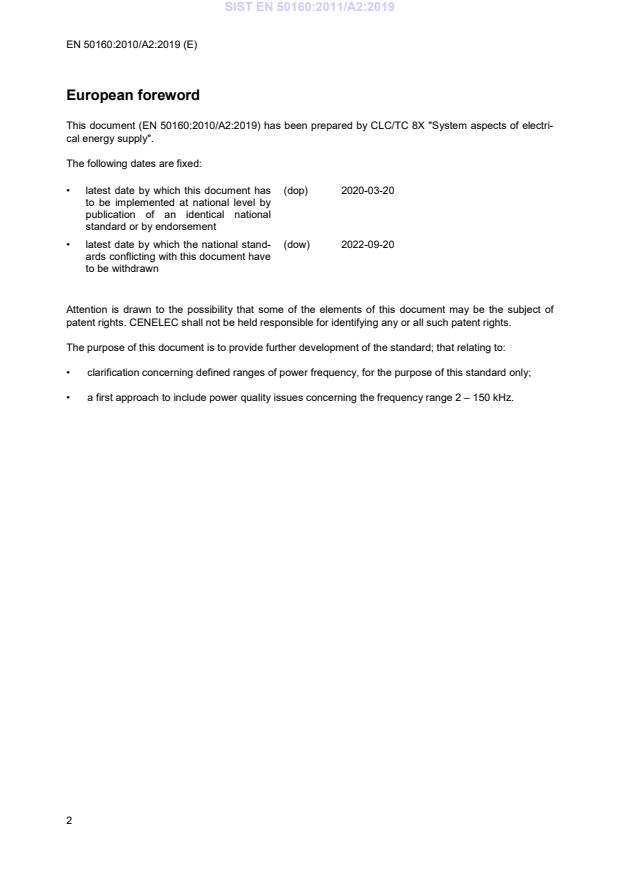
European foreword
This document (EN 50160:2010/A2:2019) has been prepared by CLC/TC 8X "System aspects of electri-
cal energy supply".
The following dates are fixed:
• latest date by which this document has (dop) 2020-03-20
to be implemented at national level by
publication of an identical national
standard or by endorsement
• latest date by which the national stand- (dow) 2022-09-20
ards conflicting with this document have
to be withdrawn
Attention is drawn to the possibility that some of the elements of this document may be the subject of
patent rights. CENELEC shall not be held responsible for identifying any or all such patent rights.
The purpose of this document is to provide further development of the standard; that relating to:
• clarification concerning defined ranges of power frequency, for the purpose of this standard only;
• a first approach to include power quality issues concerning the frequency range 2 – 150 kHz.
1 Modification to Clause 2
Modify the reference to EN 61000-4-30:2009 to:
EN 61000-4-30:2015 Electromagnetic compatibility (EMC) – Part 4-30: Testing and measurement tech-
niques – Power quality measurement methods (IEC 61000-4-30:2015)
2 Modification to Clause 3
Add the following definitions and renumber the subsequent definitions:
3.10
mains communicating system (MCS)
electrical system using signals to transmit information on electricity supply systems, either on the public
electricity distribution network or within installations of network users
3.18
power quality
characteristics of the electricity at a given point on an electrical system, evaluated against a set of refer-
ence technical parameters
Note 1 to entry: These parameters might, in some cases, relate to the compatibility between electricity supplied on a
network and the loads connected to that network.
3 Modification to 4.1
Add a third bullet point after the first paragraph:
– other phenomena, i.e. phenomena occurring in the presence of mains communicating systems
(MCS) and/or equipment using switch-mode technology connected to the grid.
4 Modification to 4.2.1
Renumber the current NOTE as NOTE 2 and start with a new NOTE 1, which reads:
NOTE 1 This standard defines the frequency range for normal network conditions. During exceptional conditions
wider frequency tolerances can apply temporarily in order to maintain the continuity of electricity supply.
5 Modification to 4.2.7
Delete 4.2.7 "Mains signaling voltage" and move it, with some modification, to a new subclause 4.4
"Mains communication voltage" (see Clause 6).
6 Addition of a new subclause 4.4
After 4.3.3 Transient overvoltages, add the following new subclause 4.4.
NOTE 1 The tables will need to be renumbered throughout the standard as the table in 4.4 is numbered "Table 4".
NOTE 2 With regard to the recent edition of the standard, which, for mains signalling voltages only, deals with the
frequency range 0,1 – 95 kHz, the draft for items 4.4 and 5.4 “Other phenomena” proceeds in considering also the
frequency range 0,1 – 2 kHz.
4.4 Other phenomena (see also Annex C)
4.4.1 General
This subclause deals with phenomena which, due to their characteristics, have not been described in the
previous subclauses.
Table 4 provides an overview of the situation concerning standardized PQ levels:
a
Table 4 — PQ standardization in the frequency range below 150 kHz
Type of equipment
Frequency range
MCS Others
0,1 – 2 kHz Normative PQ levels See Clauses 4 – 6 of the
(see item 4.4.2) standard
a, c, d, e
2 – 9 kHz Normative PQ levels Under consideration
(see item 4.4.2)
a, c, d, e
9 – 95 kHz Normative PQ levels Under consideration
(see item 4.4.2)
b, e a, c, d, e
95 – 150 kHz Under consideration Under consideration
a
Compatibility levels for non-intentional emissions for the frequency range 2 – 30 kHz have
been published with IEC 61000-2-2:2002/AMD1:2017.
Compatibility levels for non-intentional emissions for the frequency range 30 -150 kHz have
been published with IEC 61000-2-2:2002/AMD2:2018.
b
Emission limits for MCS signals are defined in EN 50065-1.
c
Design values for e
...
Questions, Comments and Discussion
Ask us and Technical Secretary will try to provide an answer. You can facilitate discussion about the standard in here.
Loading comments...