

kSIST FprEN 3613:2026
(Main)Aerospace series - Bolts, normal hexagonal head, relieved shank, long thread, in heat resisting nickel base alloy NI-PH2601 (Inconel 718), silver plated - Classification: 1 275 MPa/650 °C
- Abstract
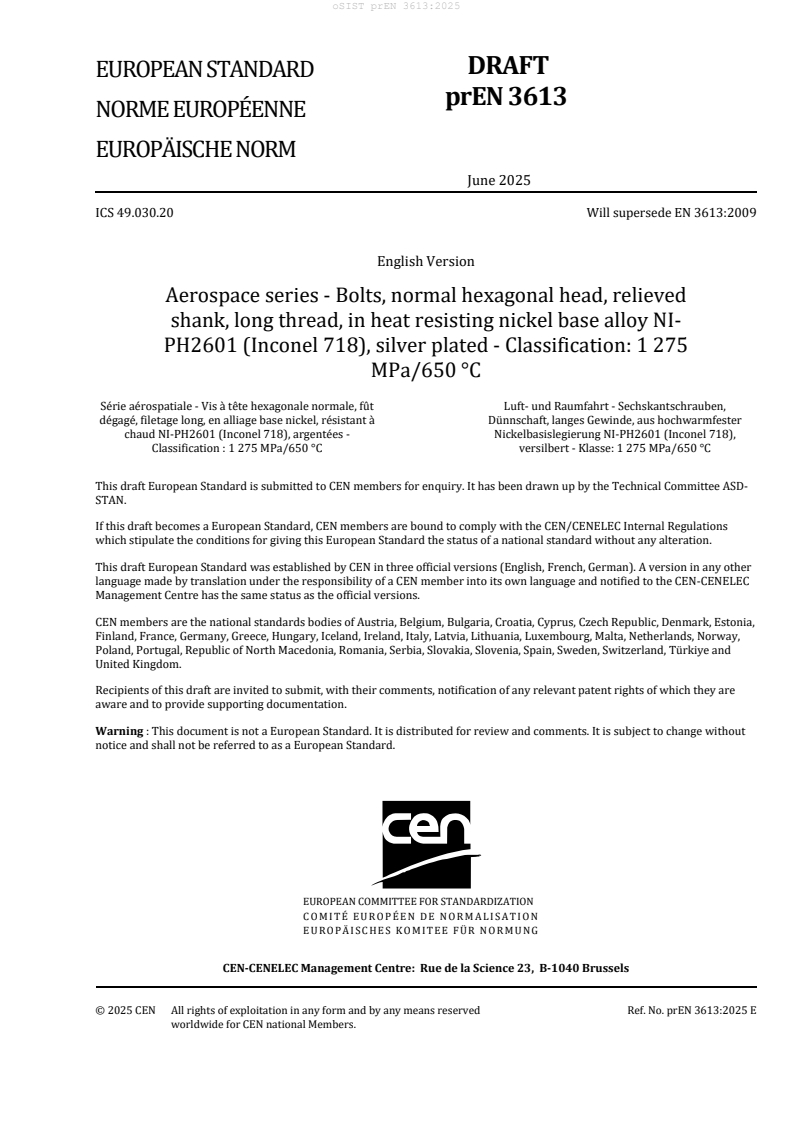
This document specifies the characteristics of bolts normal hexagonal head with relieved shank and long thread in heat resisting nickel base alloy NI-PH2601 (Inconel 718), for aerospace applications.
Classification: 1 275 MPa /650 °C
- Status
- Not Published
- Public Enquiry End Date
- 09-Sep-2025
- Technical Committee
- I13 - Imaginarni 13
- Current Stage
- 5020 - Formal vote (FV) (Adopted Project)
- Start Date
- 02-Jun-2026
- Due Date
- 21-Jul-2026
- Completion Date
- 09-Jun-2026

kSIST FprEN 3613:2026 is a SIST draft European Standard for aerospace bolts with a normal hexagonal head, relieved shank and long thread, made from heat resisting nickel base alloy NI-PH2601 (Inconel 718) and silver plated. It specifies the bolt characteristics for aerospace applications and assigns the classification 1 275 MPa/650 °C.
What does kSIST FprEN 3613:2026 specify?
kSIST FprEN 3613:2026 specifies the characteristics of a defined family of aerospace bolts. It covers the bolt form, dimensions, material, coating, marking and technical specification needed to identify and control these parts in use.
The document is organized into:
- Clause 1 - Scope
- Clause 2 - Normative references
- Clause 3 - Terms and definitions
- Clause 4 - Required characteristics
- Clause 5 - Designation
- Clause 6 - Marking
- Clause 7 - Technical specification
Figure 1 shows the configuration, and Tables 1 and 2 give the dimensional data and available lengths and masses.
What are the key requirements of kSIST FprEN 3613:2026?
kSIST FprEN 3613:2026 is mainly a product-definition standard. It tells manufacturers and buyers what the finished bolt must look like, what material and coating to use, how to identify it, and which companion standards govern the details.
- Configuration, dimensions, tolerances and masses are defined in Clause 4.1, Figure 1, Table 1 and Table 2. Dimensions are in millimetres and apply after silver plating. In practice, this means inspection has to be done against the finished part, not just the pre-plated blank.
- Thread form and geometry are tied to MJ threads, with lead and runout threads according to ISO 3353-1 and limit dimensions according to ISO 5855-1 and ISO 5855-2. This matters because the thread system determines interchangeability and fit in aerospace assemblies.
- Surface roughness is specified in Clause 4.2 and linked to Figure 1. The note on the figure says the roughness is measured prior to coating, so the process control has to distinguish between the base part and the plated part.
- Material is given in Clause 4.3 as a nickel alloy in accordance with TR 3775, for example SAE AMS5662. For procurement and certification, this means the alloy supply has to be traceable to the named material specification.
- Surface coating in Clause 4.4 requires silver plating all over in accordance with EN 2786, category A, with coating thickness 3 µm to 6 µm on the thread flanks measured at the pitch diameter. That makes the coating a controlled functional requirement, not just a surface finish.
- Edge treatment is required by the figure note, which calls for removal of sharp edges of 0,1 to 0,4. In practice, this reduces handling damage and sharp-edge issues on production parts.
- Designation in Clause 5 uses the standard number plus a diameter code and a length code. This is what procurement and drawing notes use to order the exact bolt variant.
- Marking in Clause 6 follows EN 2424, Category A, at the location shown in Figure 1. This supports traceability after manufacture and during maintenance.
- Technical specification in Clause 7 refers to EN 2583. That means this bolt standard works together with the broader technical specification for the same bolt family and class.
What terms does kSIST FprEN 3613:2026 define?
- NI-PH2601 (Inconel 718) - the heat resisting nickel base alloy named in the scope and material clause.
- MJ threads - the aerospace metric thread system used for these bolts, with general requirements and limit dimensions in ISO 5855-1 and ISO 5855-2.
- Relieved shank - the bolt form with a reduced shank section named in the scope and shown in Figure 1.
- EN 2786 - the standard used for electrolytic silver plating of fasteners.
- EN 2424 - the standard used for marking aerospace products.
- EN 2583 - the technical specification standard for bolts in the same alloy and class.
- SAE AMS5662 - a nickel alloy material specification cited as an example of the material requirement.
Who uses kSIST FprEN 3613:2026?
kSIST FprEN 3613:2026 is used by aerospace bolt manufacturers, fastener suppliers, plating shops, inspection teams, quality managers and purchasers. They use it to specify the bolt on drawings and orders, verify dimensions and coating, control marking, and check that supplied parts match the required aerospace bolt family.
It is also relevant to design engineers and maintenance organizations that need a clearly identified bolt type for aerospace assemblies.
What changed in kSIST FprEN 3613:2026 from the previous edition?
kSIST FprEN 3613:2026 supersedes EN 3613:2009. The foreword states two significant technical changes:
- SAE AMS5662 was added to the material clause.
- The thread surface requirement was removed.
Which standards are used with kSIST FprEN 3613:2026?
- EN 2424 - gives the marking rules for aerospace products.
- EN 2583 - provides the technical specification for bolts with MJ threads in NI-PH2601 (Inconel 718), classification 1 275 MPa/650 °C.
- EN 2786 - gives the requirements for electrolytic silver plating of fasteners.
- ISO 3353-1 - covers lead and runout threads for rolled external threads.
- ISO 5855-1 - gives the general requirements for MJ threads.
- ISO 5855-2 - gives the limit dimensions for MJ bolts and nuts.
- TR 3775 - provides material information for bolts and pins.
- SAE AMS5662 - is a cited nickel alloy material specification.
What does the kSIST FprEN 3613:2026 document contain?
The document contains one configuration figure, two dimensional tables, and the clauses needed to identify and control the bolt. Figure 1 shows the bolt shape, thread area, marking location and edge treatment. Table 1 gives the diameter codes, thread codes and principal dimensions, while Table 2 gives available lengths and masses for the diameter codes.
It also includes a designation example, so users can build a complete ordering designation from the document number, diameter code and length code. The marking and technical specification clauses point to EN 2424 and EN 2583 for traceability and product control.
Relations
- Effective Date
- 12-Feb-2025
Get Certified
Connect with accredited certification bodies for this standard

BUREAU VERITAS Certification Germany
Bureau Veritas certification in Germany.

Element Materials Technology
Materials testing and product certification.

AQMS Ltd.
AQMS provides ISO certification to SMEs across the UK.
Sponsored listings
Frequently Asked Questions
kSIST FprEN 3613:2026 is a draft published by the Slovenian Institute for Standardization (SIST). Its full title is "Aerospace series - Bolts, normal hexagonal head, relieved shank, long thread, in heat resisting nickel base alloy NI-PH2601 (Inconel 718), silver plated - Classification: 1 275 MPa/650 °C". This standard covers: This document specifies the characteristics of bolts normal hexagonal head with relieved shank and long thread in heat resisting nickel base alloy NI-PH2601 (Inconel 718), for aerospace applications. Classification: 1 275 MPa /650 °C
This document specifies the characteristics of bolts normal hexagonal head with relieved shank and long thread in heat resisting nickel base alloy NI-PH2601 (Inconel 718), for aerospace applications. Classification: 1 275 MPa /650 °C
kSIST FprEN 3613:2026 is classified under the following ICS (International Classification for Standards) categories: 49.030.20 - Bolts, screws, studs. The ICS classification helps identify the subject area and facilitates finding related standards.
kSIST FprEN 3613:2026 has the following relationships with other standards: It is inter standard links to SIST EN 3613:2009. Understanding these relationships helps ensure you are using the most current and applicable version of the standard.
kSIST FprEN 3613:2026 is available in PDF format for immediate download after purchase. The document can be added to your cart and obtained through the secure checkout process. Digital delivery ensures instant access to the complete standard document.
Standards Content (Sample)
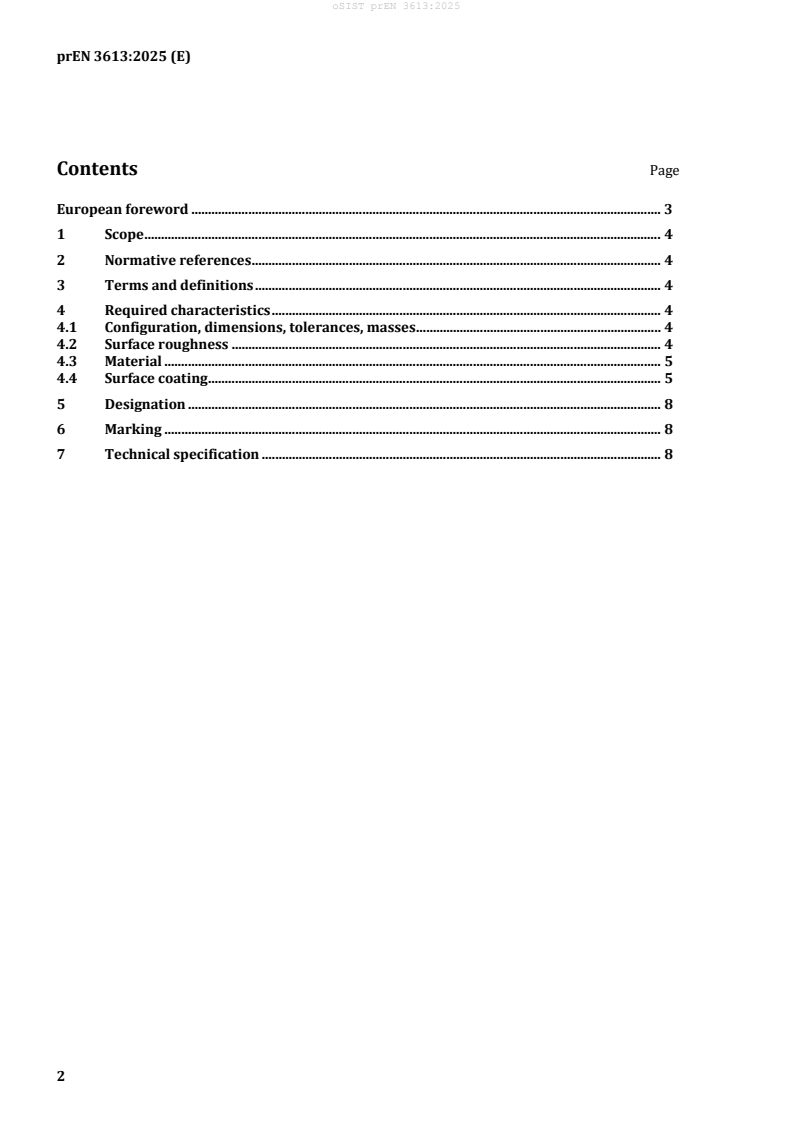
Contents
- 1 Scope
- 2 Normative references
- 3 Terms and definitions
- 4 Required characteristics
- 4.1 Configuration, dimensions, tolerances, masses
- 4.2 Surface roughness
- 4.3 Material
- 4.4 Surface coating
- 5 Designation
- 6 Marking
- 7 Technical specification
1 Scope
This document specifies the characteristics of bolts normal hexagonal head with relieved shank and long thread in heat resisting nickel base alloy NI-PH2601 (Inconel 718), for aerospace applications. 1 2 Classification: 1 275 MPa /650 °C
2 Normative references
The following documents are referred to in the text in such a way that some or all of their content constitutes requirements of this document. For dated references, only the edition cited applies. For undated references, the latest edition of the referenced document (including any amendments) applies. EN 2424, Aerospace series — Marking of aerospace products EN 2583, Aerospace series — Bolts, MJ threads, in heat resisting nickel base alloy NI-PH2601 (Inconel 718) - Classification: 1 275 MPa (at ambient temperature)/650°C — Technical specification EN 2786, Aerospace series — Electrolytic silver plating of fasteners ISO 3353-1, Aerospace — Lead and runout threads — Part 1: Rolled external threads ISO 5855-1, Aerospace — MJ threads — Part 1: General requirements ISO 5855-2, Aerospace — MJ threads — Part 2: Limit dimensions for bolts and nuts TR 3775, Bolts and pins — Materials
SAE AMS5662, Nickel Alloy, Corrosion- and Heat-Resistant, Bars, Forgings, Rings, and Stock for Forgings and Rings 52.5Ni — 19Cr — 3.0Mo — 5.1Cb (Nb) — 0.90Ti — 0.50Al — 18Fe Consumable Electrode or Vacuum Induction Melted 1 775 °F (968 °C) Solution Heat Treated, Precipitation-Hardenable
3 Terms and definitions
No terms and definitions are listed in this document.
ISO and IEC maintain terminology databases for use in standardization at the following addresses:
- ISO Online browsing platform: available at https://www.iso.org/obp/
- IEC Electropedia: available at https://www.electropedia.org/
4 Required characteristics
4.1 Configuration, dimensions, tolerances, masses
Configuration shall be according to Figure 1 and Tables 1 and 2. Dimensions and tolerances are in millimetres. They apply after silver plating.
4.2 Surface roughness
Surface roughness shall be in accordance with Figure 1. Values apply after silver plating.
Minimum tensile strength class at ambient temperature.
Maximum test temperature of the parts.
Published by Society of Automotive Engineers (SAE), available at: https://www.sae.org/.
oSIST prEN 3613:2025 prEN 3613:2025 (E)
4.3 Material
Nickel alloy shall be in accordance with TR 3775 e.g. SAE AMS5662.
4.4 Surface coating
Silver coat all over shall be according to EN 2786, category A, coating thickness 3 µm to 6 µm on the thread flanks measured at the pitch diameter.
...