


kSIST FprEN 12390-10:2026
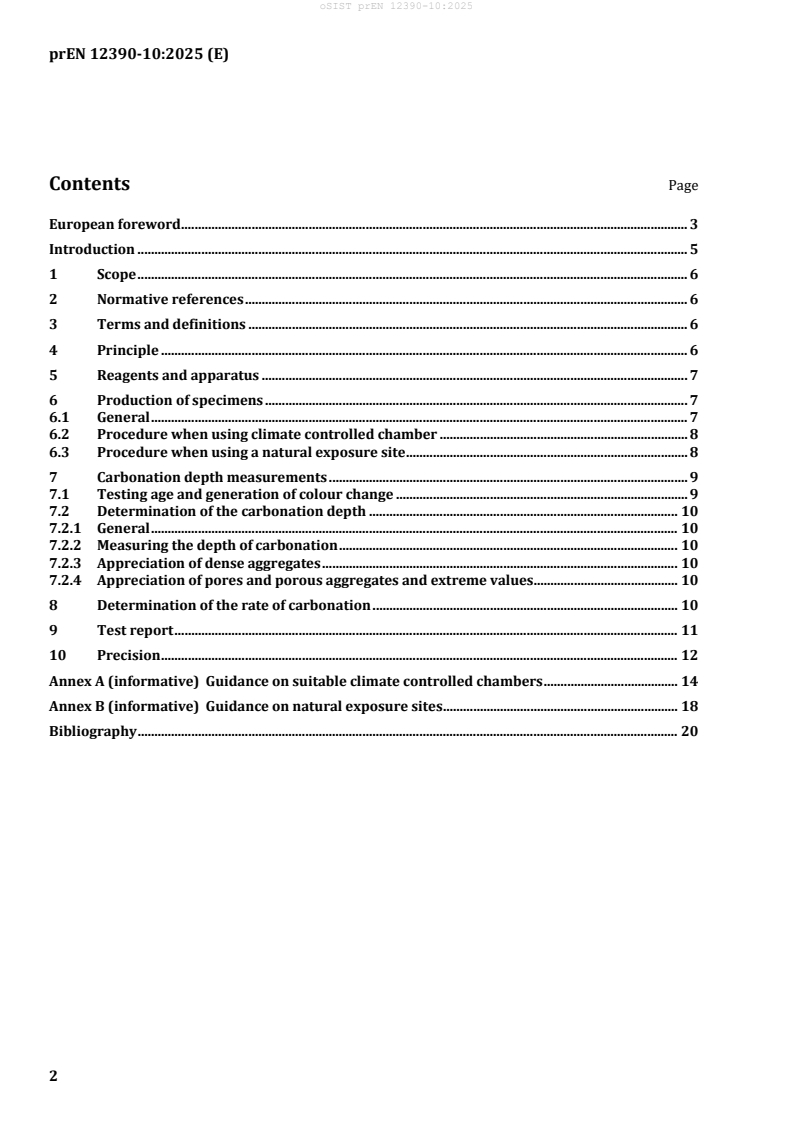
(Main)Testing hardened concrete - Part 10: Determination of the carbonation resistance of concrete at atmospheric levels of carbon dioxide
General Information
- Abstract
This document specifies a method of determining the carbonation rate of a concrete, expressed in mm/√a.
This document establishes a procedure where a standardized climate-controlled chamber is used and where specimens are placed on a natural exposure site protected from direct rainfall. The standardized climate-controlled chamber procedure is the reference method.
These procedures are applicable for the initial testing of concrete, including that manufactured with slowly reacting binders, provided that the ages at which the carbonation depth is measured, the number of measurements required to calculate the carbonation rate, as well as the length of exposure to CO2, are appropriately selected, as described in this document.
These procedures are not applicable for factory production control.
- Status
- Not Published
- Public Enquiry End Date
- 21-Dec-2025
- Technical Committee
- BBB - Concrete, reinforced concrete and prestressed concrete
- Current Stage
- 5020 - Formal vote (FV) (Adopted Project)
- Start Date
- 27-Aug-2026
- Due Date
- 15-Oct-2026

Overview
kSIST FprEN 12390-10:2026 is a draft European standard established by SIST that outlines the procedure for determining the carbonation resistance of hardened concrete when exposed to atmospheric levels of carbon dioxide. As part of the EN 12390 series, this document plays a vital role in evaluating the durability of concrete structures, especially with respect to the protection of steel reinforcement from corrosion initiated by the carbonation process. It focuses on initial testing of concrete, including concrete with slowly reacting binders, and is not intended for factory production control.
Carbonation-induced corrosion is a significant durability concern for reinforced and prestressed concrete, often impacting long-term performance. By providing standardized methods for assessing carbonation resistance, this standard supports consistent durability evaluations and aids in predicting the service life of concrete structures.
Key Topics
- Carbonation Rate Determination: Provides a method to measure the carbonation rate (expressed in mm/√a) using both standardized climate-controlled chambers and natural exposure sites. The reference method is the climate chamber approach.
- Standardized Test Conditions: Specifies controlled chamber conditions (CO₂ concentration at 0.040%, temperature at 20 ± 2°C, and 65 ± 2% relative humidity) and the use of particular test specimens, typically prismatic beams or cubes.
- Measurement Protocols: Involves exposing concrete specimens to defined conditions, breaking them at specified intervals (3, 6, and 12 months), and applying an indicator solution (such as phenolphthalein) to measure the depth of carbonation.
- Applicability: Suitable for initial testing, including mixtures using slowly reacting binders; not designed for factory production control.
- Test Reporting: Requires detailed documentation of procedures, results, and test conditions, including specifics on environmental monitoring and any deviations.
Applications
This standard is crucial for various stakeholders in the construction and materials testing sectors:
- Concrete Mix Design: Enables objective assessment and comparison of different concrete mixes with respect to carbonation resistance, supporting optimization for durability.
- Durability Classification: Assists in classifying concrete on the basis of its carbonation resistance, which is essential for quality control, certification, and specification compliance.
- Research and Development: Facilitates studies on the effects of binders, admixtures, and mix proportions on carbonation rates, supporting innovation in concrete technology.
- Service Life Prediction: Provides input parameters for models estimating the initiation of reinforcement corrosion, aiding in maintenance planning and lifecycle management.
- Regulatory and Assessment Bodies: Supports conformity assessment and benchmarking of concrete performance across projects and regions, ensuring alignment with European norms.
Related Standards
kSIST FprEN 12390-10:2026 is part of a comprehensive suite of EN 12390 standards, which collectively address core aspects of testing hardened concrete. Key related standards include:
- EN 12390-1: Shape, dimensions, and requirements for specimens and moulds.
- EN 12390-2: Making and curing specimens for strength testing.
- EN 12390-3: Compressive strength of test specimens.
- EN 12390-8: Depth of penetration of water under pressure.
- EN 12390-12: Accelerated carbonation method (alternative and complementary to Part 10).
- EN 12390-11: Chloride resistance determination.
- CEN/TR 16563: Principles for equivalent durability procedures.
- EN 206: Concrete - Specification, performance, production, and conformity.
For precise testing procedures and compliance with European guidelines on concrete durability, consulting the full EN 12390 series is recommended. This ensures robust assessment of concrete quality, helping to safeguard structural longevity and meet industry best practices in hardened concrete testing.
Relations
- Effective Date
- 09-Feb-2021
Get Certified
Connect with accredited certification bodies for this standard

DIBt (Deutsches Institut für Bautechnik)
German Institute for Building Technology.
DIN CERTCO
DIN Group product certification.

Aboma Certification B.V.
Specialized in construction, metal, and transport sectors.
Sponsored listings
Frequently Asked Questions
kSIST FprEN 12390-10:2026 is a draft published by the Slovenian Institute for Standardization (SIST). Its full title is "Testing hardened concrete - Part 10: Determination of the carbonation resistance of concrete at atmospheric levels of carbon dioxide". This standard covers: This document specifies a method of determining the carbonation rate of a concrete, expressed in mm/√a. This document establishes a procedure where a standardized climate-controlled chamber is used and where specimens are placed on a natural exposure site protected from direct rainfall. The standardized climate-controlled chamber procedure is the reference method. These procedures are applicable for the initial testing of concrete, including that manufactured with slowly reacting binders, provided that the ages at which the carbonation depth is measured, the number of measurements required to calculate the carbonation rate, as well as the length of exposure to CO2, are appropriately selected, as described in this document. These procedures are not applicable for factory production control.
This document specifies a method of determining the carbonation rate of a concrete, expressed in mm/√a. This document establishes a procedure where a standardized climate-controlled chamber is used and where specimens are placed on a natural exposure site protected from direct rainfall. The standardized climate-controlled chamber procedure is the reference method. These procedures are applicable for the initial testing of concrete, including that manufactured with slowly reacting binders, provided that the ages at which the carbonation depth is measured, the number of measurements required to calculate the carbonation rate, as well as the length of exposure to CO2, are appropriately selected, as described in this document. These procedures are not applicable for factory production control.
kSIST FprEN 12390-10:2026 is classified under the following ICS (International Classification for Standards) categories: 91.100.30 - Concrete and concrete products. The ICS classification helps identify the subject area and facilitates finding related standards.
kSIST FprEN 12390-10:2026 has the following relationships with other standards: It is inter standard links to SIST EN 12390-10:2019. Understanding these relationships helps ensure you are using the most current and applicable version of the standard.
kSIST FprEN 12390-10:2026 is available in PDF format for immediate download after purchase. The document can be added to your cart and obtained through the secure checkout process. Digital delivery ensures instant access to the complete standard document.
Standards Content (Sample)
SLOVENSKI STANDARD
oSIST prEN 12390-10:2025
01-december-2025
Preskušanje strjenega betona - 10. del: Določanje odpornosti betona proti
karbonatizaciji pri atmosferski koncentraciji ogljikovega dioksida
Testing hardened concrete - Part 10: Determination of the carbonation resistance of
concrete at atmospheric levels of carbon dioxide
Prüfung von Festbeton - Teil 10: Bestimmung des Karbonatisierungswiderstandes von
Beton bei atmosphärischer Konzentration von Kohlenstoffdioxid
Essais pour béton durci - Partie 10 : Détermination de la résistance à la carbonatation du
béton à des niveaux atmosphériques de dioxyde de carbone
Ta slovenski standard je istoveten z: prEN 12390-10
ICS:
91.100.30 Beton in betonski izdelki Concrete and concrete
products
oSIST prEN 12390-10:2025 en,fr,de
2003-01.Slovenski inštitut za standardizacijo. Razmnoževanje celote ali delov tega standarda ni dovoljeno.
oSIST prEN 12390-10:2025
oSIST prEN 12390-10:2025
DRAFT
EUROPEAN STANDARD
prEN 12390-10
NORME EUROPÉENNE
EUROPÄISCHE NORM
October 2025
ICS 91.100.30 Will supersede EN 12390-10:2018
English Version
Testing hardened concrete - Part 10: Determination of the
carbonation resistance of concrete at atmospheric levels of
carbon dioxide
Essais pour béton durci - Partie 10 : Détermination de Prüfung von Festbeton - Teil 10: Bestimmung des
la résistance à la carbonatation du béton à des niveaux Karbonatisierungswiderstandes von Beton bei
atmosphériques de dioxyde de carbone atmosphärischer Konzentration von Kohlenstoffdioxid
This draft European Standard is submitted to CEN members for enquiry. It has been drawn up by the Technical Committee
CEN/TC 104.
If this draft becomes a European Standard, CEN members are bound to comply with the CEN/CENELEC Internal Regulations
which stipulate the conditions for giving this European Standard the status of a national standard without any alteration.
This draft European Standard was established by CEN in three official versions (English, French, German). A version in any other
language made by translation under the responsibility of a CEN member into its own language and notified to the CEN-CENELEC
Management Centre has the same status as the official versions.
CEN members are the national standards bodies of Austria, Belgium, Bulgaria, Croatia, Cyprus, Czech Republic, Denmark, Estonia,
Finland, France, Germany, Greece, Hungary, Iceland, Ireland, Italy, Latvia, Lithuania, Luxembourg, Malta, Netherlands, Norway,
Poland, Portugal, Republic of North Macedonia, Romania, Serbia, Slovakia, Slovenia, Spain, Sweden, Switzerland, Türkiye and
United Kingdom.
Recipients of this draft are invited to submit, with their comments, notification of any relevant patent rights of which they are
aware and to provide supporting documentation.
Warning : This document is not a European Standard. It is distributed for review and comments. It is subject to change without
notice and shall not be referred to as a European Standard.
EUROPEAN COMMITTEE FOR STANDARDIZATION
COMITÉ EUROPÉEN DE NORMALISATION
EUROPÄISCHES KOMITEE FÜR NORMUNG
CEN-CENELEC Management Centre: Rue de la Science 23, B-1040 Brussels
© 2025 CEN All rights of exploitation in any form and by any means reserved Ref. No. prEN 12390-10:2025 E
worldwide for CEN national Members.
oSIST prEN 12390-10:2025
prEN 12390-10:2025 (E)
Contents Page
European foreword . 3
Introduction . 5
1 Scope . 6
2 Normative references . 6
3 Terms and definitions . 6
4 Principle . 6
5 Reagents and apparatus . 7
6 Production of specimens . 7
6.1 General . 7
6.2 Procedure when using climate controlled chamber . 8
6.3 Procedure when using a natural exposure site . 8
7 Carbonation depth measurements . 9
7.1 Testing age and generation of colour change . 9
7.2 Determination of the carbonation depth . 10
7.2.1 General . 10
7.2.2 Measuring the depth of carbonation . 10
7.2.3 Appreciation of dense aggregates . 10
7.2.4 Appreciation of pores and porous aggregates and extreme values . 10
8 Determination of the rate of carbonation . 10
9 Test report . 11
10 Precision . 12
Annex A (informative) Guidance on suitable climate controlled chambers . 14
Annex B (informative) Guidance on natural exposure sites . 18
Bibliography . 20
oSIST prEN 12390-10:2025
prEN 12390-10:2025 (E)
European foreword
This document (prEN 12390-10:2025) has been prepared by Technical Committee CEN/TC 104
“Concrete and related products”,”, the secretariat of which is held by SN.
This document is currently submitted to the CEN Enquiry.
This document will supersede EN 12390-10:2018.
prEN 12390-10:2025 includes the following significant technical changes with respect to
EN 12390-10:2018:
— The scope has been updated in order to account for slowly reacting binders.
The EN 12390 series, under the general title Testing hardened concrete, consists of the following parts:
— Part 1: Shape, dimensions and other requirements for specimens and moulds
— Part 2: Making and curing specimens for strength tests
— Part 3: Compressive strength of test specimens
— Part 4: Compressive strength - Specification for testing machines
— Part 5: Flexural strength of test specimens
— Part 6: Tensile splitting strength of test specimens
— Part 7: Density of hardened concrete
— Part 8: Depth of penetration of water under pressure
— Part 9: Freeze–thaw resistance with de-icing salts - Scaling (Technical Specification)
— Part 10: Determination of the carbonation resistance of concrete at atmospheric levels of carbon
dioxide
— Part 11: Determination of the chloride resistance of concrete, unidirectional diffusion
— Pert 12: Determination of the carbonation resistance of concrete – Accelerated carbonation method
— Part 13: Determination of the secant modulus of elasticity in compression
— Part 14: Semi-adiabatic method for the determination of heat released by concrete during its
hardening process
— Part 15: Adiabatic method for the determination of heat released by concrete during its hardening
process
— Part 16: Determination of the shrinkage of concrete
— Part 17: Determination of creep of concrete in compression
oSIST prEN 12390-10:2025
prEN 12390-10:2025 (E)
— Part 18: Determination of the chloride migration coefficient
— Part 19: Determination of electrical resistivity
oSIST prEN 12390-10:2025
prEN 12390-10:2025 (E)
Introduction
In reinforced and prestressed concrete structures, a sufficient concrete cover protects conventional
steel reinforcement from corrosion and contributes to ensure that the intended working life is achieved.
Reinforcement corrosion induced by carbonation can play a significant role in a structure’s
serviceability and consequently carbonation resistance of concrete, in particular of the cover zone, is an
important property to be quantified.
This document describes a test method for the quantification of the carbonation rate of any freshly cast
concrete. This document quantifies concrete behaviour in the conditions of carbonation at natural
levels of carbon dioxide. For standardization purposes, the carbon dioxide concentration in the climate
controlled chamber is fixed at 400 ppm, which is an increase of 50 ppm over the value used in the
previous version of this document. However, atmospheric levels of carbon dioxide are not constant in
location or time, and in some urban and industrial areas, carbon dioxide concentration exceeds
400 ppm.
From a European perspective, it makes sense to have common test procedures and common assessment
procedures, but with various possible purposes.
One of the intended applications of this document is the comparison of concrete mixtures, and in
particular the assessment of the impact of a change of constituent, e.g. cement type, addition, or the
impact of a change in mix proportions, e.g. w/c ratio, cement content, fines content. Such a comparison,
is also carried out when assessing the durability performance, and more precisely the ‘equivalent
durability’ with respect to carbonation, of a concrete, with unknown carbonation resistance or of a
concrete with one or more unfamiliar constituents. CEN/TR 16563 sets out basic principles to be
followed by 'equivalent durability' procedures.
In addition, this document provides parameters used in the classification of concrete on the basis of its
carbonation resistance.
Moreover, the rate of carbonation, as determined by the described test procedure, is used in some
models that estimate the start of reinforcement corrosion.
As this document provides test procedures, it only describes the production of standardized test
results; how these test results are used is not within the scope of this document.
oSIST prEN 12390-10:2025
prEN 12390-10:2025 (E)
1 Scope
This document specifies a method of determining the carbonation rate of a concrete, expressed in
mm/√a.
This document establishes a procedure where a standardized climate controlled chamber is used and
where specimens are placed on a natural exposure site protected from direct rainfall. The standardized
climate controlled chamber procedure is the reference method.
These procedures are applicable for the initial testing of concrete, including those manufactured with
slowly reacting binders, provided that the ages at which the carbonation depth is measured, the number
of measurements required to calculate the carbonation rate, as well as the length of exposure to CO , are
appropriately selected, as described in this document.
These procedures are not applicable for factory production control.
2 Normative references
The following documents are referred to in the text in such a way that some or all of their content
constitutes requirements of this document. For dated references, only the edition cited applies. For
undated references, the latest edition of the referenced document (including any amendments) applies.
EN 12390-1, Testing hardened concrete — Part 1: Shape, dimensions and other requirements for
specimens and moulds
EN 12390-2, Testing hardened concrete — Part 2: Making and curing specimens for strength tests
EN 12390-3, Testing hardened concrete — Part 3: Compressive strength of test specimens
3 Terms and definitions
No terms and definitions are listed in this document.
ISO and IEC maintain terminology databases for use in standardization at the following addresses:
— IEC Electropedia: available at https://www.electropedia.org/
— ISO Online browsing platform: available at https://www.iso.org/obp
4 Principle
Pairs of beams of concrete (or two cubes per test age) from the same batch of concrete are stored in a
climate controlled chamber as specified in 5.4 or on a natural exposure site as specified in 5.5. After
defined periods of exposure, an approximately 50 mm thick slice of the beam is broken off at each test
age and tested for its carbonation depth. If cubes are being used, they are broken in half and one half of
each cube is used to measure the carbonation depth, the other half being discarded.
The carbonation depth is measured at three locations on each face of each beam/cube giving a potential
total of 12 measurements per specimen and potentially 24 measurements for the two specimens. The
mean carbonation depth of all measurements is calculated. The remains of the beams are returned to
the climate controlled chamber for testing at other pre-defined ages. Using at least three sets of
measurements taken at 3 months, 6 months and 1 year, the rate of carbonation expressed as mm/√a is
determined.
oSIST prEN 12390-10:2025
prEN 12390-10:2025 (E)
5 Reagents and apparatus
5.1 A solution of 1 g of phenolphthalein powder dissolved in a solution of 70 ml ethanol and 30 ml of
deionized water. Phenolphthalein is the reference method but an alternative indicator giving a colour
change in the range pH 8 to pH 11 that gives a sufficiently clear colour change in concrete to
differentiate the neutralized zone may be used, e.g. thymolphthalein, flavonoids, curcumine, or
antocianines.
WARNING — Phenolphthalein is listed on the REACH candidate list of substances of very high concern
for authorization. Phenolphthalein powder should be handled with the greatest care using safety gloves
in a fume cupboard fitted with an extractor.
5.2 Where used, a fixing solution to permanently fix the colour change in the concrete specimen (see
7.1).
NOTE Suppliers of some indicator solutions also provide a fixing solution that permanently fixes the colour
change.
5.3 A magnifier and a gauge to measure the depth of carbonation perpendicular to the exposed
concrete surface which ensure a precision of the measurement of 0,5 mm.
5.4 A climate controlled chamber controlling the average over the test duration carbon dioxide
concentration at (0,040 ± 0,001) % by volume with no variation outside (0,040 ± 0,005) %, temperature
at (20 ± 2) °C and a relative humidity at (65 ± 2) % (see Annex A for details of a suitable chamber).
5.5 Alternatively to climate controlled chamber, a natural exposure site where specimens are
protected from direct precipitation such as rain, hail and snow (see Annex B for details of a suitable
arrangement). The site shall be equipped with instruments to measure relative humidity, temperature
and carbon dioxide concentration at least 4 times per day. If this is not possible, local meteorological
data can be used.
5.6 Apparatus for recording the relative humidity, which ensures a precision of the measurement
of ± 1,0 %, and the temperature with a precision of ± 0,5 °C.
5.7 Apparatus for recording CO concentration with a precision of ± 0,001 % by volume. If a climate
controlled chamber is being used, it shall be fitted with an audible/visual/electronic alarm to signify
breaching of limits.
5.8 Fan to provide a homogeneous CO concentration in the air. Type, dimensions and power of the
fan shall be adapted to the dimension of the chamber.
6 Production of specimens
6.1 General
Representative samples of the constituents, e.g. cement, aggregates, shall be used for making the test
specimens. Either a sample of concrete is taken from the concrete production plant or the concrete
mixes shall be produced using the laboratory’s standard procedures. The specimens for one test, which
include specimens for the carbonation test and compressive strength tests, shall be cast from a single
batch of concrete.
For laboratory production, a minimum batch volume of 50 l is recommended.
oSIST prEN 12390-10:2025
prEN 12390-10:2025 (E)
Each test shall comprise at least two prismatic beams each being at least 350 mm long and the other
dimensions at least three times the maximum aggregate size or two cubes per test age with a side
length of at least three times the maximum aggregate size. Beams are the reference specimens.
Avoid or minimize the use of mould release agents on the moulds as they may influence the carbonation
depth.
All compressive strength specimens, either cubes or cylinders, shall be made and cured in accordance
with EN 12390-1 and EN 12390-2 and tested in accordance with EN 12390-3.
6.2 Procedure when using climate controlled chamber
After moulding the test specimens, cover the exposed concrete surface with polythene or similar
impermeable sheeting to prevent drying. After (24 ± 2) h, the moulds shall be stripped and the test
specimens transferred without delay into the standard curing condition according to EN 12390-2. After
27 days of standard curing, the test specimens shall be exposed to laboratory air, T = (20 ± 2) °C,
RH = (65 ± 5) % for (16 ± 2) h and then they are placed in the climate controlled chamber.
NOTE 1 The reason for the 27 day wet curing is to allow cements to hydrate prior to carbonation testing as
further hydration is hindered by the carbonation test conditions.
NOTE 2 In climate controlled chambers that do not have the facility to reduce the relative humidity, if the test
specimens are placed immediately in the climate controlled chamber, the rate of carbonation decreases when the
relative humidity is too high and (temporarily) exceeds the limit. If the climate controlled chamber is fitted with
facilities to reduce the relative humidity (not the normal situation), the test specimens can be placed directly in
the climate controlled chamber.
The test specimens shall be positioned in the climate controlled chamber in a way that permits air to
circulate freely around all the four faces to be tested. This is either by horizontal storage or vertical
storage, but ensuring a 50 mm gap between adjacent specimens. The temperature shall be measured at
least once per day at a constant time.
The relative humidity and carbon dioxide concentration shall be measured and recorded at least once
every two hours. The average carbon dioxide concentration in the climate controlled chamber over the
duration of the test shall be (0,040 ± 0,001) % with no variation outside (0,040 ± 0,005) %.
6.3 Procedure when using a natural exposure site
For each concrete mix, cast at least two beams or at least six cubes for carbonation testing and at least 2
or if the strength development is not known, at least 5 compressive strength specimens from a single
batch of concrete. The test specimens shall be cast horizontally in accordance with EN 12390-2. After
finishing the test specimens, cover the exposed surface with polythene or similar impermeable sheeting
to prevent drying.
After (24 ± 2) h, the moulds shall be stripped and the carbonation test specimens transferred without
delay into close-fitting, sealed polythene bags or similar storage material and stored at (20 ± 2) °C until
they have reached 50 % of the reference strength. If the temperature range is from 15 °C to 25 °C, 50 %
of the reference strength
...