

SIST EN 415-7:2007+A1:2008
(Main)Safety of packaging machines - Part 7: Group and secondary packaging machines
General Information
- Abstract
This European Standard applies to the following groups of machines:
Group and secondary packaging machines and the collating systems associated with them.
The individual machines are described in 3.2 of this European Standard.
This European Standard deals with safety requirements for machine design, construction, installation, commissioning, operation, adjustment, maintenance and cleaning of group and secondary packaging machines.
The extent to which hazards, hazardous situations and events are covered, are indicated in Clause 4.
Exclusions
This European Standard is not applicable to the following machines:
- machines that were manufactured before the date of publication of this document by CEN;
- strapping machines. These machines are covered by EN 415-8;
- crate loaders and un-loaders for pre-formed rigid containers. These machines are covered by
EN 415-2;
- cartoning machines. Cartoning machines are covered by EN 415-3.
This European Standard does not consider the following hazards:
- use of group and secondary packaging machines in potentially explosive atmospheres;
- health, safety or hygiene hazards associated with the products that may be handled by the machines, but does include general advice on this subject;
- hazards that may be associated with electromagnetic emissions from group and secondary packaging machines;
- hazards that may be associated with decommissioning group and secondary packaging machines.
- Status
- Published
- Publication Date
- 21-Aug-2008
- Technical Committee
- DTN - Lift and transport appliances
- Current Stage
- 6060 - National Implementation/Publication (Adopted Project)
- Start Date
- 18-Aug-2008
- Due Date
- 23-Oct-2008
- Completion Date
- 22-Aug-2008
- Directive
- 2006/42/EC - Directive 2006/42/EC of the European Parliament and of the Council of 17 May 2006 on machinery, and amending Directive 95/16/EC (recast)OJ Ref: C 214, STANDARDI TIPA C, L 7.9.2026 UMIK 20.1.2027 OJ Date: 08-Sep-2009 Conflicting Date: 20-Jan-2027
98/37/EC - MachineryOJ Ref: C 22 OJ Date: 28-Jan-2009


Overview
EN 415-7:2006+A1:2008 - “Safety of packaging machines - Part 7: Group and secondary packaging machines” is a CEN standard that specifies safety requirements for the design, construction, installation, commissioning, operation, adjustment, maintenance and cleaning of group and secondary packaging machines and their collating systems. It defines the scope of hazards covered (see Clause 4) and lists clear exclusions (e.g., machines made before publication, strapping machines, crate loaders/unloaders, cartoning machines). The standard does not address potentially explosive atmospheres, detailed product health/hygiene risks, electromagnetic emissions or machine decommissioning.
Key topics and technical requirements
- Risk-based approach: guidance to identify and control hazards specific to group and secondary packaging machinery.
- Hazard categories: mechanical, electrical, thermal, noise, ergonomic, product/material hazards, failures and hygienic design.
- Machine types addressed: tray erecting, case erecting (semi- and fully automatic), place packing, horizontal case loading, case taping (manual, self-adjusting, fully automatic), wraparound case packing, plus collating systems.
- Protective measures: requirements to eliminate or reduce mechanical hazards (guards, interlocks), electrical safety, thermal protection, noise reduction and hygiene features.
- Design for maintenance and cleaning: safe access, lock-out procedures and ergonomics to reduce operator risk during adjustment and cleaning.
- Verification and testing: provisions for verifying that safety measures meet the standard’s requirements (see Clause 6).
- Common mechanisms: specific guidance for frequently used mechanisms on group and secondary packaging machines (magazines, transport, forming, loading, sealing and discharge systems).
Practical applications and users
Who benefits from using EN 415-7:
- Machine manufacturers and OEMs designing group/secondary packaging machinery
- System integrators and automation engineers installing collating and case packing lines
- Safety engineers and compliance officers performing risk assessments for packaging machinery
- Plant managers, maintenance teams and operators seeking safe operation and cleaning procedures
- Notified bodies and inspectors verifying conformity to European safety practices
Practical uses:
- Defining safety specifications for new machines and retrofits
- Creating machine guards, interlock and control system requirements
- Developing safe maintenance and cleaning protocols
- Supporting conformity assessment and documentation for procurement and CE-related processes
Related standards
- EN 415 series (other parts): EN 415-2 (crate loaders/un-loaders), EN 415-3 (cartoning machines), EN 415-8 (strapping machines)
- Use EN 415-7 together with general machinery safety standards and applicable national regulations for complete compliance.
Keywords: EN 415-7, safety of packaging machines, group and secondary packaging machines, packaging machinery safety, machine design, risk assessment, hygienic design, case packing, tray erecting.
Relations
- Replaces
SIST EN 415-7:2007 - Safety of packaging machines - Part 7: Group and secondary packaging machines - Effective Date
- 01-Sep-2010
- Effective Date
- 25-Aug-2026
- Effective Date
- 09-Feb-2026
- Effective Date
- 09-Feb-2026
- Effective Date
- 09-Feb-2026
- Effective Date
- 09-Feb-2026
- Effective Date
- 09-Feb-2026
- Effective Date
- 09-Feb-2026
- Effective Date
- 09-Feb-2026
- Effective Date
- 09-Feb-2026
- Effective Date
- 09-Feb-2026
- Effective Date
- 09-Feb-2026
- Effective Date
- 28-Jan-2026
- Effective Date
- 28-Jan-2026
- Effective Date
- 28-Jan-2026
Get Certified
Connect with accredited certification bodies for this standard

BRCGS (Brand Reputation Compliance Global Standards)
Global food safety and quality standards owner.
Sponsored listings
Frequently Asked Questions
SIST EN 415-7:2007+A1:2008 is a standard published by the Slovenian Institute for Standardization (SIST). Its full title is "Safety of packaging machines - Part 7: Group and secondary packaging machines". This standard covers: This European Standard applies to the following groups of machines: Group and secondary packaging machines and the collating systems associated with them. The individual machines are described in 3.2 of this European Standard. This European Standard deals with safety requirements for machine design, construction, installation, commissioning, operation, adjustment, maintenance and cleaning of group and secondary packaging machines. The extent to which hazards, hazardous situations and events are covered, are indicated in Clause 4. Exclusions This European Standard is not applicable to the following machines: - machines that were manufactured before the date of publication of this document by CEN; - strapping machines. These machines are covered by EN 415-8; - crate loaders and un-loaders for pre-formed rigid containers. These machines are covered by EN 415-2; - cartoning machines. Cartoning machines are covered by EN 415-3. This European Standard does not consider the following hazards: - use of group and secondary packaging machines in potentially explosive atmospheres; - health, safety or hygiene hazards associated with the products that may be handled by the machines, but does include general advice on this subject; - hazards that may be associated with electromagnetic emissions from group and secondary packaging machines; - hazards that may be associated with decommissioning group and secondary packaging machines.
This European Standard applies to the following groups of machines: Group and secondary packaging machines and the collating systems associated with them. The individual machines are described in 3.2 of this European Standard. This European Standard deals with safety requirements for machine design, construction, installation, commissioning, operation, adjustment, maintenance and cleaning of group and secondary packaging machines. The extent to which hazards, hazardous situations and events are covered, are indicated in Clause 4. Exclusions This European Standard is not applicable to the following machines: - machines that were manufactured before the date of publication of this document by CEN; - strapping machines. These machines are covered by EN 415-8; - crate loaders and un-loaders for pre-formed rigid containers. These machines are covered by EN 415-2; - cartoning machines. Cartoning machines are covered by EN 415-3. This European Standard does not consider the following hazards: - use of group and secondary packaging machines in potentially explosive atmospheres; - health, safety or hygiene hazards associated with the products that may be handled by the machines, but does include general advice on this subject; - hazards that may be associated with electromagnetic emissions from group and secondary packaging machines; - hazards that may be associated with decommissioning group and secondary packaging machines.
SIST EN 415-7:2007+A1:2008 is classified under the following ICS (International Classification for Standards) categories: 55.200 - Packaging machinery. The ICS classification helps identify the subject area and facilitates finding related standards.
SIST EN 415-7:2007+A1:2008 has the following relationships with other standards: It is inter standard links to SIST EN 415-7:2007, SIST ISO 7000:2004, SIST EN 61310-1:1999, SIST EN 62061:2005, SIST EN 61496-1:2005, SIST EN 61508-2:2011, SIST EN 61508-1:2011, SIST EN IEC 61496-3:2025, SIST EN 61310-3:2008, SIST EN 60204-1:1999, SIST EN 61508-3:2011, SIST EN 60529:1997, SIST EN 574:1998, SIST EN 1005-3:2002+A1:2008, SIST EN 614-1:1998. Understanding these relationships helps ensure you are using the most current and applicable version of the standard.
SIST EN 415-7:2007+A1:2008 is associated with the following European legislation: EU Directives/Regulations: 2006/42/EC, 98/37/EC, EUR-PUB, EUR-PUB; Standardization Mandates: M/079, M/396. When a standard is cited in the Official Journal of the European Union, products manufactured in conformity with it benefit from a presumption of conformity with the essential requirements of the corresponding EU directive or regulation.
SIST EN 415-7:2007+A1:2008 is available in PDF format for immediate download after purchase. The document can be added to your cart and obtained through the secure checkout process. Digital delivery ensures instant access to the complete standard document.
Standards Content (Sample)
SLOVENSKI STANDARD
01-oktober-2008
Pakirne naprave - Varnost pakirnih naprav - 7. del: Zbirne in dodatne pakirne
naprave
Safety of packaging machines - Part 7: Group and secondary packaging machines
Sicherheit von Verpackungsmaschinen - Teil 7: Sammelpackmaschinen
Sécurité des machines d'emballage - Partie 7: Machines de groupe et d'emballage
secondaire
Ta slovenski standard je istoveten z: EN 415-7:2006+A1:2008
ICS:
55.200 Pakirni stroji Packaging machinery
2003-01.Slovenski inštitut za standardizacijo. Razmnoževanje celote ali delov tega standarda ni dovoljeno.
EUROPEAN STANDARD
EN 415-7:2006+A1
NORME EUROPÉENNE
EUROPÄISCHE NORM
July 2008
ICS 55.200 Supersedes EN 415-7:2006
English Version
Safety of packaging machines - Part 7: Group and secondary
packaging machines
Sécurité des machines d'emballage - Partie 7: Machines de Sicherheit von Verpackungsmaschinen - Teil 7:
groupe et d'emballage, secondaire Sammelpackmaschinen
This European Standard was approved by CEN on 20 April 2006 and includes Amendment 1 approved by CEN on 25 May 2008.
CEN members are bound to comply with the CEN/CENELEC Internal Regulations which stipulate the conditions for giving this European
Standard the status of a national standard without any alteration. Up-to-date lists and bibliographical references concerning such national
standards may be obtained on application to the CEN Management Centre or to any CEN member.
This European Standard exists in three official versions (English, French, German). A version in any other language made by translation
under the responsibility of a CEN member into its own language and notified to the CEN Management Centre has the same status as the
official versions.
CEN members are the national standards bodies of Austria, Belgium, Bulgaria, Cyprus, Czech Republic, Denmark, Estonia, Finland,
France, Germany, Greece, Hungary, Iceland, Ireland, Italy, Latvia, Lithuania, Luxembourg, Malta, Netherlands, Norway, Poland, Portugal,
Romania, Slovakia, Slovenia, Spain, Sweden, Switzerland and United Kingdom.
EUROPEAN COMMITTEE FOR STANDARDIZATION
COMITÉ EUROPÉEN DE NORMALISATION
EUROPÄISCHES KOMITEE FÜR NORMUNG
Management Centre: rue de Stassart, 36 B-1050 Brussels
© 2008 CEN All rights of exploitation in any form and by any means reserved Ref. No. EN 415-7:2006+A1:2008: E
worldwide for CEN national Members.
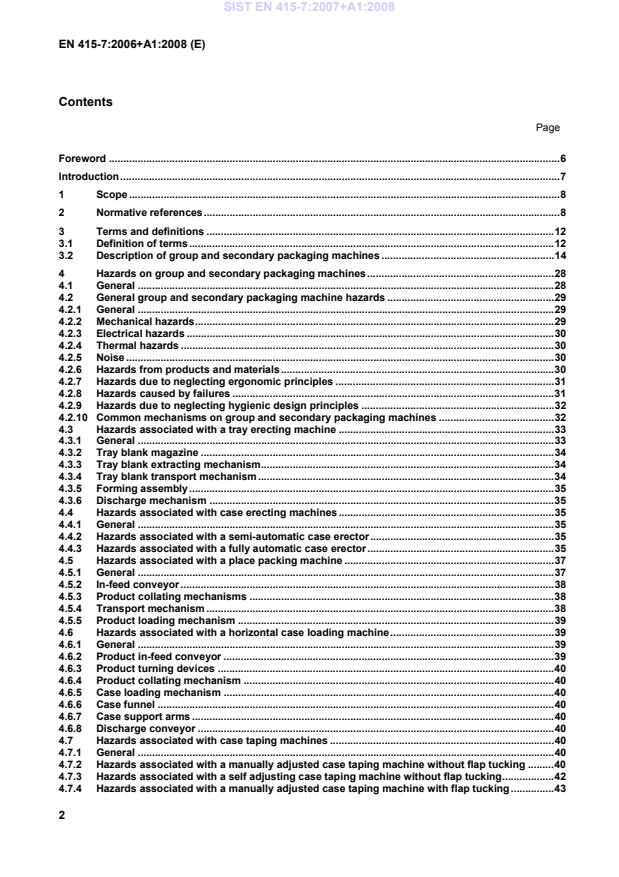
Contents
Page
Foreword .6
Introduction.7
1 Scope .8
2 Normative references.8
3 Terms and definitions .12
3.1 Definition of terms.12
3.2 Description of group and secondary packaging machines .14
4 Hazards on group and secondary packaging machines.28
4.1 General .28
4.2 General group and secondary packaging machine hazards .29
4.2.1 General .29
4.2.2 Mechanical hazards.29
4.2.3 Electrical hazards .30
4.2.4 Thermal hazards .30
4.2.5 Noise .30
4.2.6 Hazards from products and materials.30
4.2.7 Hazards due to neglecting ergonomic principles .31
4.2.8 Hazards caused by failures .31
4.2.9 Hazards due to neglecting hygienic design principles .32
4.2.10 Common mechanisms on group and secondary packaging machines .32
4.3 Hazards associated with a tray erecting machine .33
4.3.1 General .33
4.3.2 Tray blank magazine .34
4.3.3 Tray blank extracting mechanism.34
4.3.4 Tray blank transport mechanism.34
4.3.5 Forming assembly.35
4.3.6 Discharge mechanism .35
4.4 Hazards associated with case erecting machines .35
4.4.1 General .35
4.4.2 Hazards associated with a semi-automatic case erector.35
4.4.3 Hazards associated with a fully automatic case erector.35
4.5 Hazards associated with a place packing machine .37
4.5.1 General .37
4.5.2 In-feed conveyor.38
4.5.3 Product collating mechanisms .38
4.5.4 Transport mechanism .38
4.5.5 Product loading mechanism .39
4.6 Hazards associated with a horizontal case loading machine.39
4.6.1 General .39
4.6.2 Product in-feed conveyor .39
4.6.3 Product turning devices .40
4.6.4 Product collating mechanism .40
4.6.5 Case loading mechanism .40
4.6.6 Case funnel .40
4.6.7 Case support arms .40
4.6.8 Discharge conveyor .40
4.7 Hazards associated with case taping machines .40
4.7.1 General .40
4.7.2 Hazards associated with a manually adjusted case taping machine without flap tucking .40
4.7.3 Hazards associated with a self adjusting case taping machine without flap tucking.42
4.7.4 Hazards associated with a manually adjusted case taping machine with flap tucking.43
4.7.5 Hazards associated with a fully automatic case taping machine.45
4.8 Hazards associated with a wraparound case packing machine.46
4.8.1 General .46
4.8.2 Case blank magazine .47
4.8.3 Product in-feed conveyor .48
4.8.4 Transport mechanism .48
4.8.5 Case erecting mechanism .48
4.8.6 Product loading mechanism .48
4.8.7 Flap tucking mechanisms.48
4.8.8 Case sealing devices.48
4.8.9 Case compression.48
4.8.10 Discharge conveyor .48
5 Safety requirements and measures for group and secondary packaging machines .49
5.1 General .49
5.2 General requirements for group and secondary packaging machines .49
5.2.1 General .49
5.2.2 Requirements to eliminate mechanical hazards .49
5.2.3 Electrical requirements.56
5.2.4 Thermal hazards .58
5.2.5 Noise reduction.58
5.2.6 Measures to control hazards generated by products and materials .59
5.2.7 Ergonomic design principles .60
5.2.8 Requirements to prevent hazards caused by failures.61
5.2.9 Hygienic design requirements .63
5.2.10 Requirements for mechanisms used on most group and secondary packaging machines.64
5.3 Safety requirements for a tray erecting machine.66
5.3.1 General .66
5.3.2 Tray blank magazine .66
5.3.3 Tray blank extracting mechanism.67
5.3.4 Tray blank transport mechanism.67
5.3.5 Forming assembly.67
5.3.6 Discharge mechanism .67
5.4 Safety requirements for a case erecting machine .67
5.4.1 Safety requirements for a semi-automatic case erector .67
5.4.2 Safety requirements for a fully automatic case erector .68
5.5 Safety requirements for a place packing machine.69
5.5.1 General .69
5.5.2 In-feed conveyor.69
5.5.3 Product collating mechanisms .69
5.5.4 Transport mechanism .69
5.5.5 Product loading mechanism .69
5.6 Safety requirements for a horizontal case loading machine .71
5.6.1 General .71
5.6.2 In-feed conveyor – See 5.3.6.2. .71
5.6.3 Product turning devices .71
5.6.4 Product stacking mechanism.71
5.6.5 Case loading mechanism .71
5.6.6 Case funnel .71
5.6.7 Case support arms .72
5.6.8 Discharge conveyor – See 5.3.6.72
5.7 Safety requirements for case taping machines.72
5.7.1 Safety requirements for a manually adjusted case taping machine without flap tucking.72
5.7.2 Safety requirements for a self adjusting case taping machine without flap tucking .73
5.7.3 Safety requirements for a manually adjusted case taping machine with flap tucking .73
5.7.4 Safety requirements for a fully automatic case taping machine .74
5.7.5 Noise reduction.74
5.8 Safety requirements for a wraparound case packing machine .74
5.8.1 General .74
5.8.2 Case blank magazine .74
5.8.3 In-feed conveyor.74
5.8.4 Transport mechanism .74
5.8.5 Case erecting mechanism .75
5.8.6 Product loading mechanism .75
5.8.7 Flap tucking.75
5.8.8 Case closing devices – See 5.4.2.6.75
5.8.9 Case compression.75
5.8.10 Discharge conveyor .75
6 Verification of safety requirements and measures .75
6.1 General .75
6.2 Visual inspections with the machine stopped.75
6.2.1 Mechanical parts.75
6.2.2 Pneumatic systems .75
6.2.3 Hydraulic systems.75
6.2.4 Electrical systems .75
6.2.5 Guards .76
6.2.6 Design requirements.76
6.3 Measurements with the machine stopped .76
6.3.1 Guards .76
6.3.2 Electrical testing.76
6.4 Visual inspections with the machine running .76
6.4.1 Guards .76
6.4.2 Interlocking devices .76
6.4.3 Dissipation of stored energy.76
6.5 Measurements with the machine running.76
6.5.1 Measurement and declaration of noise emission .76
6.5.2 Temperature .76
6.6 Verification procedures .77
7 Information for use.79
7.1 Markings .79
7.2 Signals and warning signs .79
7.3 Instruction handbook.80
7.3.1 General .80
7.3.2 Requirements specific to group and secondary packaging machines .80
Annex A (normative) Noise test code for group and secondary packaging machines - grade of
accuracy 2 and 3.82
A.1 Scope .82
A.2 Definitions .82
A.3 Determination of emission sound pressure level at the work station .82
A.4 Determination of the sound power level .83
A.5 Installation and mounting conditions.83
A.6 Operating conditions.83
A.7 Measurement uncertainties .85
A.8 Information to be recorded.85
A.9 Information to be reported.85
A.10 Declaration and verification of noise emission values.86
Annex B (normative) Methods of safeguarding small and medium sized apertures.88
B.1 General .88
B.2 Interlocked guard.88
B.3 Interlocked guard with ESPE trip device.90
B.4 ESPE trip device .92
B.5 Automatic guard .94
Annex C (normative) Methods of safeguarding large apertures.96
C.1 General .96
C.2 ESPE in a vertical plane.96
C.3 Dynamic cell positioning of ESPE .98
C.4 Positioning of ESPE .99
Annex D (normative) ESPE Muting .101
Annex ZA (informative) Relationship between this European Standard and the Essential
Requirements of EU Directive 98/37/EC.103
Annex ZB (informative) !Relationship between this European Standard and the Essential
Requirements of EU Directive 2006/42/EC".104
Bibliography.105
Foreword
This document (EN 415-7:2006+A1:2008) has been prepared by Technical Committee CEN/TC 146,
"Packaging machines - Safety", the secretariat of which is held by UNI.
This European Standard shall be given the status of a national standard, either by publication of an identical
text or by endorsement, at the latest by January 2009, and conflicting national standards shall be withdrawn
at the latest by January 2009.
This document includes Amendment 1, approved by CEN on 2008-05-25.
This document supersedes EN 415-7:2006.
The start and finish of text introduced or altered by amendment is indicated in the text by tags ! ".
This document has been prepared under a mandate given to CEN by the European Commission and the
European Free Trade Association and supports essential requirements of EU Directives.
For the relationship with EC Directives, see informative Annex ZA, which is an integral part of this document.
Other standards produced by the Technical Committee are:
EN 415 Safety of packaging machines;
Part 1: Terminology and classification of packaging machines and associated equipment.
Part 2: Pre-formed rigid container packaging machines.
Part 3: Form, fill and seal machines.
Part 4: Palletisers and depalletisers.
Part 5: Wrapping machines.
Part 6: Pallet wrapping machines.
Part 8: Strapping machines.
According to the CEN/CENELEC Internal Regulations, the national standards organizations of the following
countries are bound to implement this European Standard: Austria, Belgium, Bulgaria, Cyprus, Czech
Republic, Denmark, Estonia, Finland, France, Germany, Greece, Hungary, Iceland, Ireland, Italy, Latvia,
Lithuania, Luxembourg, Malta, Netherlands, Norway, Poland, Portugal, Romania, Slovakia, Slovenia, Spain,
Sweden, Switzerland and United Kingdom.
Introduction
Group and secondary packaging machines are used extensively in Europe, in an increasingly wide range of
industries. They contain several significant hazards and have the potential to cause serious injury.
This document is a type C standard as defined in the Introduction of EN ISO 12100-1:2003.
The machinery concerned and the extent to which hazards, hazardous situations and events are covered are
indicated in the scope of this European Standard.
When provisions of this type C standard are different from those which are stated in type A or B standards,
the provisions of this type C standard take precedence over the provisions of the other standards, for
machines that have been designed and built according to the provisions of this type C standard.
1 Scope
This European Standard applies to the following groups of machines:
Group and secondary packaging machines and the collating systems associated with them.
The individual machines are described in 3.2 of this European Standard.
This European Standard deals with safety requirements for machine design, construction, installation,
commissioning, operation, adjustment, maintenance and cleaning of group and secondary packaging
machines.
The extent to which hazards, hazardous situations and events are covered, are indicated in Clause 4.
Exclusions
This European Standard is not applicable to the following machines:
machines that were manufactured before the date of publication of this document by CEN;
strapping machines. These machines are covered by EN 415-8;
crate loaders and un-loaders for pre-formed rigid containers. These machines are covered by
EN 415-2;
cartoning machines. Cartoning machines are covered by EN 415-3.
This European Standard does not consider the following hazards:
use of group and secondary packaging machines in potentially explosive atmospheres;
health, safety or hygiene hazards associated with the products that may be handled by the
machines, but does include general advice on this subject;
hazards that may be associated with electromagnetic emissions from group and secondary
packaging machines;
hazards that may be associated with decommissioning group and secondary packaging machines.
2 Normative references
The following referenced documents are indispensable for the application of this document. For dated
references, only the edition cited applies. For undated references, the latest edition of the referenced
document (including any amendments) applies.
EN 294:1992, Safety of machinery — Safety distances to prevent danger zones being reached by the upper
limbs
EN 349:1993, Safety of machinery — Minimum gaps to avoid crushing of parts of the human body
EN 415-1:2000, Packaging machines safety — Part 1: Terminology and classification for packaging
machines and associated equipment
EN 418, Safety of machinery — Emergency stop equipment, functional aspects, principles for design
EN 563, Safety of machinery — Temperatures of touchable surfaces — Ergonomics data to establish
temperature limit values for hot surfaces
EN 574:1996, Safety of machinery — Two-hand control devices — Functional aspects — Principles for
design
EN 614-1:1995, Safety of machinery — Ergonomic design principles — Part 1: Terminology and general
principles
EN 619, Continuous handling equipment and systems — Safety and EMC requirements for equipment for
mechanical handling of unit loads
EN 626-1, Safety of machinery — Reduction of risks to health from hazardous substances emitted by
machinery — Part 1: Principles and specifications for machinery manufacturers
EN 626-2, Safety of machinery — Reduction of risk to health from hazardous substances emitted by
machinery — Part 2: Methodology leading to verification procedures
EN 775, Manipulating industrial robots — Safety (ISO 10218:1992, modified)
EN 811, Safety of machinery — Safety distances to prevent danger zones being reached by the lower limbs
EN 894-1, Safety of machinery — Ergonomics requirements for the design of displays and control actuators
— Part 1: General principals for human interactions with displays and control actuators
EN 894-2, Safety of machinery — Ergonomics requirements for the design of displays and control actuators
— Part 2: Displays
EN 894-3, Safety of machinery — Ergonomics requirements for the design of displays and control actuators
— Part 3: Control actuators
EN 953:1997, Safety of machinery — Guards - General requirements for the design and construction of fixed
and moveable guards
EN 954-1:1996, Safety of machinery — Safety related parts of control systems — Part 1: General principles
for design
EN 982:1996, Safety of machinery — Safety requirements for fluid power systems and their components —
Hydraulics
EN 983:1996, Safety of machinery — Safety requirements for fluid power systems and their components —
Pneumatics
EN 999, Safety of machinery — The positioning of protective equipment in respect of approach speeds of
parts of the human body
EN 1005-2:2003, Safety of machinery — Human physical performance — Part 2: Manual handling of
machinery and component parts of machinery
EN 1005-3, Safety of machinery — Human physical performance — Part 3: Recommended force limits for
machinery operation
EN 1005-4:2005, Safety of machinery — Human physical performance — Part 4: Evaluation of working
postures and movements in relation to machinery
EN 1037, Safety of machinery — Prevention of unexpected start-up
EN 1050, Safety of machinery — Principles for risk assessment
EN 1088:1995, Safety of machinery — Interlocking devices associated with guards — Principles for design
and selection
EN 1672-2:2005, Food processing machinery — Basic concepts — Part 2: Hygiene requirements
EN 1760-1, Safety of machinery — Pressure sensitive protective devices — Part 1: General principles for the
design and testing of pressure sensitive mats and pressure sensitive floors
EN 1760-2, Safety of machinery — Pressure sensitive protective devices — Part 2: General principles for the
design and testing of pressure sensitive edges and pressure sensitive bars
EN 13478, Safety of machinery — Fire prevention and protection
EN 60204-1:1997, Safety of machinery — Electrical equipment of machines — Part 1: General requirements
(IEC 60204-1:1997)
EN 60529, Degrees of protection provided by enclosures (IP code) (IEC 60529:1989)
EN 61310-1:1995, Safety of machinery — Indication, marking and actuation — Part 1: Requirements for
visual, auditory and tactile signals (ISO 61310-1:1995)
EN 61310-3, Safety of machinery — Indication marking and actuation — Part 3: Requirements for the
location and operation of actuators (ISO 61310-3:1999)
EN 61496-1:2004, Safety of machinery — Electro-sensitive protective equipment — Part 1: General
requirements and tests (ISO 61496-1:2004, modified)
CLC/TS 61496-3, Safety of machinery — Electro-sensitive protective equipment — Part 3: Particular
requirements for Active Opto-electronic Protective Devices responsive to Diffuse Reflection (AOPDDR) (IEC
61496-3:2001)
EN 61508-1, Functional safety of electrical/electronic/programmable electronic safety-related systems —
Part 1: General requirements (IEC 61508-1:1998 + Corrigendum 1999)
EN 61508-2, Functional safety of electrical/electronic/programmable electronic safety-related systems —
Part 2: Requirements for electrical/electronic/programmable electronic safety-related systems (IEC 61508-
2:2000)
EN 61508-3, Functional safety of electrical/electronic/programmable electronic safety-related systems —
Part 3: Software requirements (IEC 61508-3:1998 + Corrigendum 1999)
EN 62061:2005 Safety of machinery — Functional safety of safety-related electrical, electronic and
programmable electronic control systems (IEC 62061:2005)
EN ISO 3744:1995, Acoustics — Determination of sound power levels of noise sources using sound
pressure — Engineering method in an essentially free field over a reflecting plane (ISO 3744:1994)
EN ISO 3746:1995, Acoustics — Determination of sound power levels of noise sources using sound
pressure — Survey method using an enveloping measurement surface over a reflecting plane (ISO
3746:1995)
EN ISO 3747:2000, Acoustics — Determination of sound power levels of noise sources using sound
pressure — Comparison method for use in situ (ISO 3747:2000)
EN ISO 4871:1996, Acoustics — Declaration and verification of noise emission values of machinery and
equipment (ISO 4871:1996)
EN ISO 9614-2:1996, Acoustics — Determination of sound power levels of noise sources using sound
intensity — Part 2: Measurement by scanning (ISO 9614-2:1996)
EN ISO 11201:1995, Acoustics — Noise emitted by machinery and equipment — Measurement of emission
sound pressure levels at a work station and at other specified positions — Engineering method in an
essentially free field over a reflective plane (ISO 11201:1995)
EN ISO 11202:1995, Acoustics — Noise emitted by machinery and equipment — Measurement of emission
sound pressure levels at a work station and at other specified positions — Survey method in situ (ISO
11202:1995)
EN ISO 11204:1995, Acoustics — Noise emitted by machinery and equipment — Measurement of emission
sound pressure levels at a work station and at other specified positions — Method requiring environmental
corrections (ISO 11204:1995)
EN ISO 12001:1996, Acoustics — Noise emitted by machinery and equipment - rules for the drafting and
presentation of a noise test code (ISO 12001:1996)
EN ISO 12100-1:2003, Safety of machinery — Basic concepts, general principles for design — Part 1: Basic
terminology, methodology (ISO 12100-1:2003)
EN ISO 12100-2:2003, Safety of machinery; basic concepts, general principles for design — Part 2:
Technical principles (ISO 12100-2:2003)
EN ISO 14122-1:2001, Safety of machinery — Permanent means of access to machinery — Part 1: Choice
of fixed means of access between two levels (ISO 14122-1:2001)
EN ISO 14122-2, Safety of machinery — Permanent means of access to machinery — Part 2: Working
platforms and walkways (ISO 14122-2:2001)
EN ISO 14122-3, Safety of machinery — Permanent means of access to machinery — Part 3: Stairs,
stepladders and guard-rails (ISO 14122-3:2001)
EN ISO 14122-4, Safety of machinery — Permanent means of access to machinery — Part 4: Fixed ladders
(ISO 14122-4:2004)
IEC 60417-1:2002, Graphical symbols for use on equipment — Part 1: Overview and application
ISO 7000, Graphical symbols for use on equipment — Index and synopsis
3 Terms and definitions
For the purposes of this document, the terms and definitions given in Clause 3 of EN ISO 12100-1:2003,
EN 415-1:2000 and the following apply.
3.1 Definition of terms
3.1.1
pack, package
assembly of product and packaging materials produced by a packaging machine
3.1.2
group package
package comprising a number of products, grouped together for distribution
NOTE Group packages include cases, trays, crates and carton board sleeves
3.1.3
secondary package
package comprising one or a number of products, grouped together for distribution
NOTE Secondary packages include cases, trays, crates and carton board sleeves
3.1.4
product
substance, article or articles (including packs or packages) that are handled in the packaging machine
3.1.5
packaging material
material used to make a package
EXAMPLE corrugated board, carton board
3.1.6
carton
container that is made from carton board, generally between 250 µm and 1 000 µm in thickness, and is
usually delivered to the user in the form of a carton blank or folded and side seam glued
3.1.7
carton blank
individual carton in the flat after cutting and creasing and with the strippings removed
3.1.8
carton tray
rectangular open carton with sides and ends made from carton board generally between 250 µm and
1 000 µm in thickness and usually delivered to the user in the form of a carton blank
3.1.9
carton board
paper board used for folding cartons generally between 250 µm and 1 000 µm thick and pliable enough so
that it can be folded along score lines without cracking the material
3.1.10
case
container, which is generally made from corrugated board that is used to contain groups of packages and is
delivered to the user in the form of a glued or stitched case or a flat blank
3.1.11
corrugated board
material comprising one or more sheets of fluted paper stuck between flat sheets of paper
3.1.12
tray
open topped container, typically made from carton board or corrugated board and supplied to the user as a
flat blank or pre-glued and folded
3.1.13
tuck erection
process in which carton board or corrugated board packages are formed or closed by pushing pre-cut tabs
into slots
3.1.14
side seam
longitudinal seal which is made, usually by the carton or case manufacturer by stapling, heat-sealing or
applying adhesive, when a carton or case blank is formed into a flat carton or case
3.1.15
wraparound case
case, usually made from corrugated board, which is supplied to the user as a flat blank and is folded and
glued around the product in a wraparound case packing machine to produce the finished pack
3.1.16
wraparound lid
lid, usually made from corrugated board, which is supplied to the user as a flat blank and is folded and glued
around a group package in a wraparound lidding machine to produce the finished transit pack
3.1.17
wraparound sleeve
package, usually made from either carton board or corrugated board, which is supplied to the user as a flat
blank and is folded and secured around the product in a wraparound sleeving machine to produce the
finished pack
3.1.18
wraparound tray
tray, usually made from corrugated board, which is supplied to the user as a flat blank and is folded and
glued around the product in a wraparound tray packing machine to produce the finished pack
3.1.19
cold adhesive
adhesive that is liquid at room temperature, e.g. PVA adhesive
3.1.20
PVA adhesive
water dispersible emulsion adhesive made from polyvinyl acetate
3.1.21
hot melt adhesive
adhesive that is solid at room temperature and which is melted and applied at elevated temperature
3.1.22
pressure sensitive tape
tape usua
...