

kSIST prES 202 336-1 V1.1.3:2011
(Main)Environmental Engineering (EE) - Monitoring and Control Interface for Infrastructure Equipment (Power, Cooling and Building Environment Systems used in Telecommunication Networks) - Part 1: Generic Interface
- Abstract
Preparation of a new version of ES 202 336-1 to incorporate the following: ·Amendment and update references to sub parts of the standard. This to include correction of document titles and numbering to align with the present structure. ·Addition of a new section to cover the requirements of control system sensors and actuators. ·Update section 9.4.2 alarm and event message to align with other parts of the standard. ·Provide XSD file allowing XML files to be checked. Other editorial and technical changes necessary to ensure the core part of this standard relates fully and correctly to all sub parts. The extent of this work will only become clear when the document is reviewed.
- Status
- Not Published
- Technical Committee
- SPN - Services and Protocols for Networks
- Current Stage
- 5020 - Formal vote (FV) (Adopted Project)
- Start Date
- 11-May-2011
- Due Date
- 29-Jun-2011
- Completion Date
- 24-Jun-2011
Buy Documents
es_20233601v010103m - Environmental Engineering (EE); Monitoring and Control Interface for Infrastructure Equipment (Power, Cooling and Building Environment Systems used in Telecommunication Networks) Part 1: Generic Interface
es_20233601v010201p - Environmental Engineering (EE); Monitoring and Control Interface for Infrastructure Equipment (Power, Cooling and Building Environment Systems used in Telecommunication Networks) Part 1: Generic Interface
kSIST prES 202 336-1 V1.1.3:2011 from SIST is the generic interface standard for monitoring and control of infrastructure equipment in telecommunication networks. It specifies the common XML-based information model, network architecture and REST exchange method used to connect site equipment with management applications for power, cooling and building environment systems. It is written for operators, manufacturers, and integrators that need a shared way to supervise multi-vendor equipment.
What does kSIST prES 202 336-1 V1.1.3:2011 specify?
kSIST prES 202 336-1 V1.1.3:2011 specifies the generic core of the Monitoring and Control Interface for Infrastructure Equipment. It applies to power, cooling and building environment systems used in telecommunication centres and access network locations, with interoperability across heterogeneous management interfaces as the main objective.
The document defines the site equipment map, the common set of exchanged information, and the minimum network architecture needed to exchange data between equipment and management systems. It is organized as clauses 1 to 9, followed by annexes A to G.
| Annex | What it covers |
|---|---|
| A | Communication between LMA/RMA and IEM&C agent using REST |
| B | Data coherence and reliability for IEM&C |
| C | Network element functions and software architecture choices |
| D | Network capacity and timing |
| E | Overview of the XML format |
| F | Hints on OSI or IP models, network layers and access protocols |
| G | Bibliography |
What are the key requirements of kSIST prES 202 336-1 V1.1.3:2011?
The standard requires a distributed supervision architecture built around site equipment units and management applications. In practice, that means the equipment should expose data in a form that can be collected, normalized and displayed at local or remote level.
Network roles and transport
- The management network is described as a subset of TMN (Telecommunications Management Network), using units such as CU, XCU, DGU, LMA and RMA.
- Each XCU and DGU shall be a HTTP node with a URL address and shall exchange XML-formatted data.
- New exchanges shall use TCP/IP with REST, based on HTTP methods, and annex A defines the GET and POST behaviour.
- HTTPS shall be used for security in LMA and RMA, and authentication is required on any unit.
In practice, this means equipment suppliers need to provide web-addressable nodes and operators need a network stack that can carry XML over standard IP services.
XML structure and hierarchy
- Clause 9 makes the root element of the document the
<site>element. - The XML hierarchy shall reflect the site structure, so a system such as a dc system belongs under
<energy_system>rather than at the same level as the site. - Repeated equipment of the same type shall be distinguished with an
idvalue of typexs:integer. - The document uses standard child tables for description, alarms, events, data, historical data, configuration and control.
This matters because integration tools, XSD validation and management software depend on a stable tree structure rather than free-form XML.
Alarms, events and message exchange
- Clause 7 requires at least three alarm synthesis loops at equipment interface level: major, minor and user defined.
- A global critical alarm should also be provided by DGU or LMA when a site-wide view is available.
- Clause 9.4.2 describes alarm and event messages sent by HTTP POST over TCP/IP when an event occurs.
- Alarm and event messages use structured attributes such as severity type, severity level, time stamp and event type, with event types including alarm set, alarm clear, information and cold start.
In practice, maintenance teams can use this structure to separate fault reporting from ordinary state changes and to correlate local events with supervisory alarms.
Supervision functions
- LMA shall at minimum monitor several equipment on one site, provide a local site view, keep logs, and send alarm notifications.
- RMA shall at minimum monitor several sites, provide a multi-site view, and support alarm notification.
- Some monitoring, logging and alarm functions may also be implemented in XCU or DGU.
This means the standard supports both local operations and remote supervision, so the same site data can be reused at several management levels.
Performance, reliability and evolution
- Annex D gives capacity and timing recommendations for server count, log storage and refresh times.
- Annex B recommends data coherence, redundancy, mirrored storage, time synchronisation and recovery mechanisms.
- Clause 7.8 allows progressive migration from older interfaces by adding DGU gateways or introducing new XCU and LMA components without replacing all existing equipment.
- The standard also allows existing X25, POTS and GSM connections at RMA level through gateways to TCP/IP Ethernet.
For users, this means the architecture is meant to coexist with legacy equipment while moving toward XML over IP.
What terms does kSIST prES 202 336-1 V1.1.3:2011 define?
- Control Unit (CU) - A unit dedicated to controlling one or more pieces of equipment at a site.
- Data Gathering Unit (DGU) - A unit that collects serial, digital and analogue data, mediates between interfaces and protocols, and forwards information to management applications.
- Local Management Application (LMA) - The local server application that processes site information for supervision and control.
- Remote Management Application (RMA) - The remote supervision application used to monitor several sites and handle alarms and analysis.
- Infrastructure Equipment Monitoring & Control (IEM&C) - The mediation and supervision environment used for infrastructure equipment monitoring and control.
- Alarm - Information signalling an abnormal state different from the specified normal state.
- Event - Information signalling a state change that is not an alarm.
- XML Schema Definition (XSD) - The schema format used to check whether XML documents follow the document structure.
Who uses kSIST prES 202 336-1 V1.1.3:2011?
kSIST prES 202 336-1 V1.1.3:2011 is used by telecom operators, infrastructure equipment manufacturers, system integrators and maintenance teams. It is especially relevant for people who design or procure power, cooling, access, video, generator, UPS and other building environment supervision systems.
Engineers use it to define the interface between equipment and management software. Quality managers and buyers use it to check that multi-vendor systems can exchange alarms, measurements, configuration and control data in a common format.
What changed in kSIST prES 202 336-1 V1.1.3:2011 from the previous edition?
The scope states that this version prepares a new version of ES 202 336-1 to:
- update references to sub-parts and correct document titles and numbering
- add a new section for control system sensors and actuators
- align section 9.4.2 on alarm and event messages with the other parts
- provide an XSD file for checking XML files
- make editorial and technical changes so the core part matches the sub-parts
Which standards are used with kSIST prES 202 336-1 V1.1.3:2011?
| Standard | What it contributes |
|---|---|
| ETS 300 132-1, EN 300 132-2, EN 300 132-3, EN 302 099 | Power supply interfaces and powering arrangements for telecom equipment |
| ITU-T M.3010 | TMN principles and network function naming |
| ITU-T M.3100 | Generic network information model |
| ITU-T X.733 | Alarm reporting function |
| IEC 60839-5-4 | Alarm transmission system requirements used for availability of alarm synthesis |
| RFC 2616 | HTTP/1.1, used by the REST exchange model |
| ISO/IEC 7498 | OSI reference model |
| IEEE 802 series | Ethernet and LAN technology |
| ISO/IEC 10164 | Systems management functions |
| ISO/IEC 8879 | SGML background referenced for markup concepts |
The document also works with the companion parts of ES 202 336 for specific equipment categories, including DC power, AC UPS, AC distribution switchboards, diesel backup generators, air conditioning, other utilities, remote power feeding, alternative power and inverter systems.
What does the kSIST prES 202 336-1 V1.1.3:2011 document contain?
The document contains a network overview, a site and equipment hierarchy, and the XML structure used to exchange data between equipment and management applications. It includes tables that define standard XML children such as <description_table>, <alarm_table>, <event_table>, <data_table>, <data_record_table>, <config_table> and <control_table>.
It also includes worked XML examples for alarm and event messages, plus an embedded XSD description for compliance checking. Annex A gives the REST methods and URI examples, while annexes B to D focus on reliability, software architecture, and timing or capacity. Annex E explains XML, XSD, XSLT and XPath, and annex F compares OSI and IP models and access protocols.
Buy Documents
es_20233601v010103m - Environmental Engineering (EE); Monitoring and Control Interface for Infrastructure Equipment (Power, Cooling and Building Environment Systems used in Telecommunication Networks) Part 1: Generic Interface
es_20233601v010201p - Environmental Engineering (EE); Monitoring and Control Interface for Infrastructure Equipment (Power, Cooling and Building Environment Systems used in Telecommunication Networks) Part 1: Generic Interface
Get Certified
Connect with accredited certification bodies for this standard

ANCE
Mexican certification and testing association.

IMP NDT d.o.o.
Non-destructive testing services. Radiography, ultrasonic, magnetic particle, penetrant, visual inspection.

Inštitut za kovinske materiale in tehnologije
Institute of Metals and Technology. Materials testing, metallurgical analysis, NDT.
Sponsored listings
Frequently Asked Questions
kSIST prES 202 336-1 V1.1.3:2011 is a standard published by the Slovenian Institute for Standardization (SIST). Its full title is "Environmental Engineering (EE) - Monitoring and Control Interface for Infrastructure Equipment (Power, Cooling and Building Environment Systems used in Telecommunication Networks) - Part 1: Generic Interface". This standard covers: Preparation of a new version of ES 202 336-1 to incorporate the following: ·Amendment and update references to sub parts of the standard. This to include correction of document titles and numbering to align with the present structure. ·Addition of a new section to cover the requirements of control system sensors and actuators. ·Update section 9.4.2 alarm and event message to align with other parts of the standard. ·Provide XSD file allowing XML files to be checked. Other editorial and technical changes necessary to ensure the core part of this standard relates fully and correctly to all sub parts. The extent of this work will only become clear when the document is reviewed.
Preparation of a new version of ES 202 336-1 to incorporate the following: ·Amendment and update references to sub parts of the standard. This to include correction of document titles and numbering to align with the present structure. ·Addition of a new section to cover the requirements of control system sensors and actuators. ·Update section 9.4.2 alarm and event message to align with other parts of the standard. ·Provide XSD file allowing XML files to be checked. Other editorial and technical changes necessary to ensure the core part of this standard relates fully and correctly to all sub parts. The extent of this work will only become clear when the document is reviewed.
kSIST prES 202 336-1 V1.1.3:2011 is classified under the following ICS (International Classification for Standards) categories: 19.040 - Environmental testing; 33.050.01 - Telecommunication terminal equipment in general. The ICS classification helps identify the subject area and facilitates finding related standards.
kSIST prES 202 336-1 V1.1.3:2011 is available in PDF format for immediate download after purchase. The document can be added to your cart and obtained through the secure checkout process. Digital delivery ensures instant access to the complete standard document.
Standards Content (Sample)
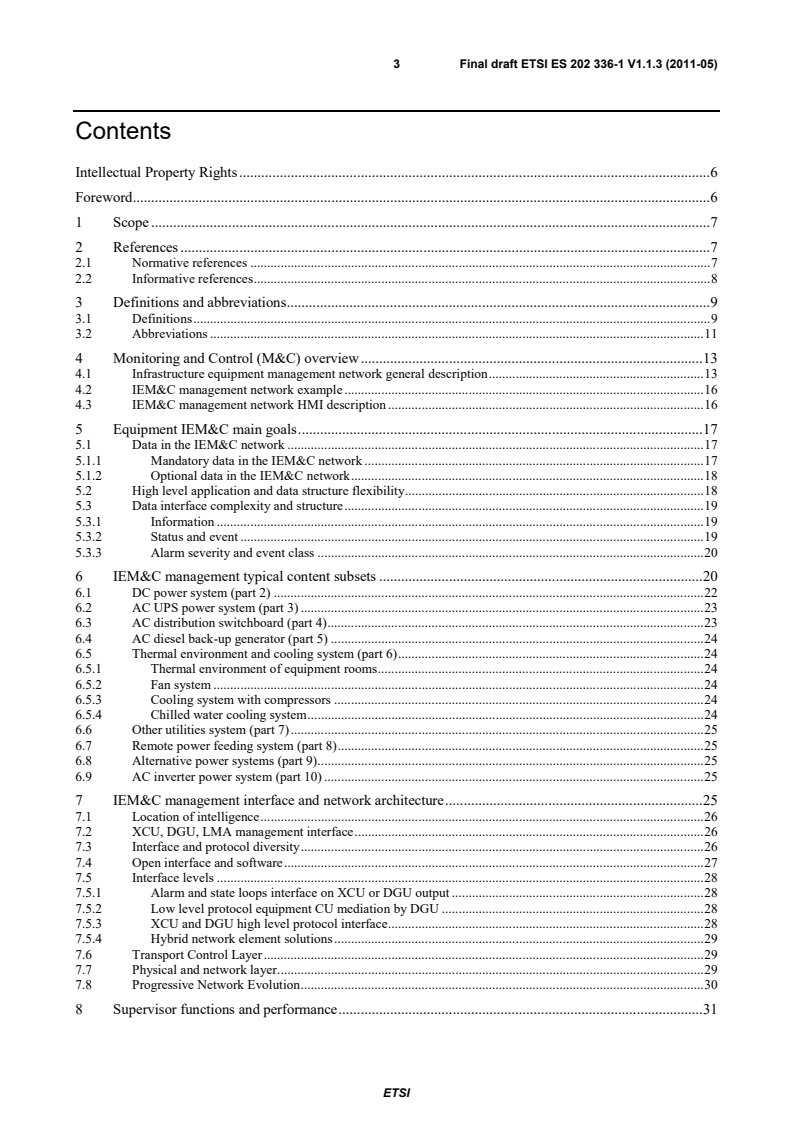
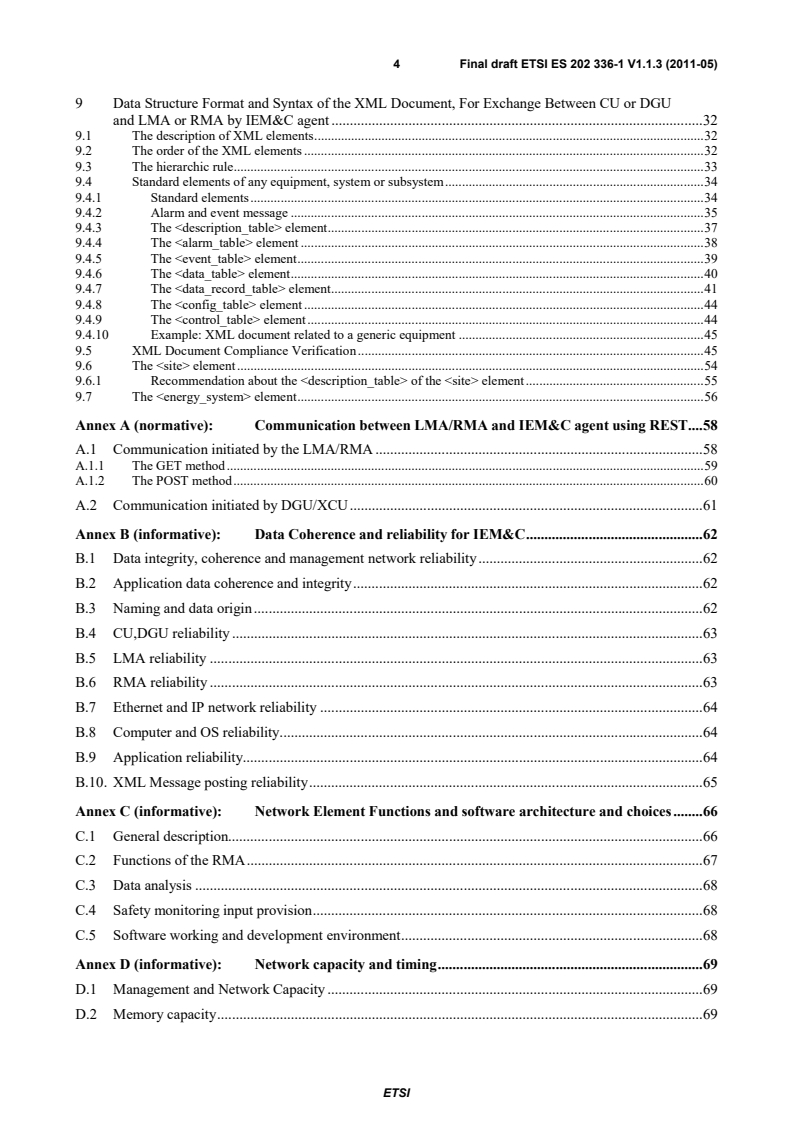
Contents
- 1 Scope
- 2 References
- 2.1 Normative references
- 8 Final draft ETSI ES 202 336-1 V1.1.3 (2011-05)
- 2.2 Informative references
- 9 Final draft ETSI ES 202 336-1 V1.1.3 (2011-05)
- 3 Definitions and abbreviations
- 3.1 Definitions
- 10 Final draft ETSI ES 202 336-1 V1.1.3 (2011-05)
- 11 Final draft ETSI ES 202 336-1 V1.1.3 (2011-05)
- 3.2 Abbreviations
- 12 Final draft ETSI ES 202 336-1 V1.1.3 (2011-05)
- 13 Final draft ETSI ES 202 336-1 V1.1.3 (2011-05)
- 4 Monitoring and Control (M&C) overview
- 4.1 Infrastructure equipment management network general
- 14 Final draft ETSI ES 202 336-1 V1.1.3 (2011-05)
- 15 Final draft ETSI ES 202 336-1 V1.1.3 (2011-05)
- 16 Final draft ETSI ES 202 336-1 V1.1.3 (2011-05)
- 4.2 IEM&C management network example
- 4.3 IEM&C management network HMI description
- 17 Final draft ETSI ES 202 336-1 V1.1.3 (2011-05)
- 5 Equipment IEM&C main goals
- 5.1 Data in the IEM&C network
- 18 Final draft ETSI ES 202 336-1 V1.1.3 (2011-05)
- 5.2 High level application and data structure flexibility
- 19 Final draft ETSI ES 202 336-1 V1.1.3 (2011-05)
- 5.3 Data interface complexity and structure
- 20 Final draft ETSI ES 202 336-1 V1.1.3 (2011-05)
- 6 IEM&C management typical content subsets
- 21 Final draft ETSI ES 202 336-1 V1.1.3 (2011-05)
- 22 Final draft ETSI ES 202 336-1 V1.1.3 (2011-05)
- 6.1 DC power system (part 2)
- 23 Final draft ETSI ES 202 336-1 V1.1.3 (2011-05)
- 6.2 AC UPS power system (part 3)
- 6.3 AC distribution switchboard (part 4)
- 24 Final draft ETSI ES 202 336-1 V1.1.3 (2011-05)
- 6.4 AC diesel back-up generator (part 5)
- 6.5 Thermal environment and cooling system (part 6)
- 25 Final draft ETSI ES 202 336-1 V1.1.3 (2011-05)
- 6.6 Other utilities system (part 7)
- 6.7 Remote power feeding system (part 8)
- 6.8 Alternative power systems (part 9)
- 6.9 AC inverter power system (part 10)
- 7 IEM&C management interface and network
- 26 Final draft ETSI ES 202 336-1 V1.1.3 (2011-05)
- 7.1 Location of intelligence
- 7.2 XCU, DGU, LMA management interface
- 7.3 Interface and protocol diversity
- 27 Final draft ETSI ES 202 336-1 V1.1.3 (2011-05)
- 7.4 Open interface and software
- 28 Final draft ETSI ES 202 336-1 V1.1.3 (2011-05)
- 7.5 Interface levels
- 29 Final draft ETSI ES 202 336-1 V1.1.3 (2011-05)
- 7.6 Transport Control Layer
- 7.7 Physical and network layer
- 30 Final draft ETSI ES 202 336-1 V1.1.3 (2011-05)
- 7.8 Progressive Network Evolution
- 31 Final draft ETSI ES 202 336-1 V1.1.3 (2011-05)
- 8 Supervisor functions and performance
- 32 Final draft ETSI ES 202 336-1 V1.1.3 (2011-05)
- 9 Data Structure Format and Syntax of the XML
- 9.1 The description of XML elements
- 9.2 The order of the XML elements
- 33 Final draft ETSI ES 202 336-1 V1.1.3 (2011-05)
- 9.3 The hierarchic rule
- 34 Final draft ETSI ES 202 336-1 V1.1.3 (2011-05)
- 9.4 Standard elements of any equipment, system or subsystem
- 35 Final draft ETSI ES 202 336-1 V1.1.3 (2011-05)
- 36 Final draft ETSI ES 202 336-1 V1.1.3 (2011-05)
- 37 Final draft ETSI ES 202 336-1 V1.1.3 (2011-05)
- 38 Final draft ETSI ES 202 336-1 V1.1.3 (2011-05)
- 39 Final draft ETSI ES 202 336-1 V1.1.3 (2011-05)
- 40 Final draft ETSI ES 202 336-1 V1.1.3 (2011-05)
- 41 Final draft ETSI ES 202 336-1 V1.1.3 (2011-05)
- 42 Final draft ETSI ES 202 336-1 V1.1.3 (2011-05)
- 43 Final draft ETSI ES 202 336-1 V1.1.3 (2011-05)
- 44 Final draft ETSI ES 202 336-1 V1.1.3 (2011-05)
- 45 Final draft ETSI ES 202 336-1 V1.1.3 (2011-05)
- 9.5 XML Document Compliance Verification
- 46 Final draft ETSI ES 202 336-1 V1.1.3 (2011-05)
1 Scope
The present document applies to monitoring and control of Infrastructure Environment i.e. power, cooling and building environment systems for telecommunication centres and access network locations. Interoperability of heterogeneous management interfaces and systems with multi-vendor equipment is the key issue. The present document gives a general approach from equipment to management system. The multi-part deliverable is composed of a generic core part (the present document) and several specific parts for equipment category (ES 202 336-2 and following [15] and [i.14]). The core document defines:
- The site equipment map and its division in functional subsets e.g. DC system which introduces part 2 and following parts of this multi-part deliverable.
- The generic set of exchanged information required at the interface of equipment, which is instanced for each equipment subset in part 2 and following parts of this multi-part deliverable.
- The minimum requirement for network architecture allowing some compatibility with old existing interface and the mechanism to exchange data between network element.
- The data interface protocol for remote or local site management (Machine to Machine Interface MMI) and Human Machine Interface HMI for monitoring and controlling.
- Recommendations for sure management network such as dependability, data back-up, data coherence and synchronization all along the management network, response time, fault detection and partial service in case of failure.
2 References
References are either specific (identified by date of publication and/or edition number or version number) or non-specific. For specific references, only the cited version applies. For non-specific references, the latest version of the reference document (including any amendments) applies.
Referenced documents which are not found to be publicly available in the expected location might be found at http://docbox.etsi.org/Reference.
NOTE: While any hyperlinks included in this clause were valid at the time of publication ETSI cannot guarantee their long term validity.
2.1 Normative references
The following referenced documents are necessary for the application of the present document. [1] ETSI ETS 300 132-1: "Equipment Engineering (EE); Power supply interface at the input to telecommunications equipment; Part 1: Operated by alternating current (AC) derived from direct current (DC) sources".
[2] ETSI EN 300 132-2: "Environmental Engineering (EE); Power supply interface at the input to telecommunications equipment; Part 2: Operated by direct current (DC)". [3] ETSI EN 300 132-3: "Environmental Engineering (EE); Power supply interface at the input to telecommunications equipment; Part 3: Operated by rectified current source, alternating current source or direct current source up to 400 V".
[4] ETSI EN 302 099: "Environmental Engineering (EE); Powering of equipment in access network". [5] ITU-T Recommendation M.3010: "Principles for a Telecommunications management network". ETSI
8 Final draft ETSI ES 202 336-1 V1.1.3 (2011-05)
[6] ITU-T Recommendation M.3100: "Generic network information model". [7] ITU-T Recommendation X.733: "Information technology - Open Systems Interconnection - Systems Management: Alarm reporting function".
[8] IEC 60839-5-4: "Alarm systems - Part 5: Requirements for alarm transmission systems - Section 4: Alarm transmission systems using dedicated alarm transmission paths". [9] ITU-T Recommendation X.25: "Interface between Data Terminal Equipment (DTE) and Data Circuit-terminating Equipment (DCE) for terminals operating in the packet mode and connected to public data networks by dedicated circuit".
[10] IETF RFC 2616: "Hypertext Transfer Protocol - HTTP/1.1".
[11] ISO/IEC 7498: "Open Systems Interconnection (OSI) - Basic Reference Model". [12] IEEE 802.series (all parts): "IEEE Standard for Telecommunications and Information Exchange Between systems - Local and metropolitan area networks".
[13] ISO/IEC 10164 (all parts): "Information technology - Open Systems Interconnection - Systems Management".
[14] ISO/IEC 8879: "Information processing - Text and office systems - Standard Generalized Markup Language (SGML)".
[15] ETSI ES 202 336 (parts 2, 3, 5, 7 and 8): "Environmental Engineering (EE); Monitoring and Control Interface for Infrastructure Equipment (Power, Cooling and Building Environment Systems used in Telecommunication Networks)".
[16] IEC 61076-2-101: "Connectors for electronic equipment - Product requirements - Part 2-101: Circular connectors - Detail specification for M12 connectors with screw-locking".
2.2 Informative references
The following referenced documents are not necessary for the application of the present document but they assist the user with regard to a particular subject area.
[i.1] ETSI TR 102 121: "Environmental Engineering (EE); Guidance for power distribution to telecommunication and datacom equipment".
[i.2] ETSI TR 102 336: "Environmental Engineering (EE); Power and cooling system control and monitoring guidance".
[i.3] REST.
NOTE: Described in: http://en.wikipedia.org/wiki/REST, http://www.ics.uci.edu/~fielding/pubs/dissertation/rest_arch_style.htm (Ref article from Roy Thomas) and http://www.peej.co.uk/articles/rest.html .
[i.4] IETF RFC 2516: "A Method for Transmitting PPP Over Ethernet (PPPoE)". [i.5] IETF RFC 1191: "Path MTU discovery".
[i.6] IETF RFC 871: "Perspective on the ARPANET reference model". [i.7] IETF RFC 1662: "PPP in HDLC-like Framing".
[i.8] IETF RFC 1994: "PPP Challenge Handshake Authentication Protocol (CHAP)". [i.9] IETF RFC 2364: "PPP Over AAL5".
[i.10] IETF RFC 2615: "PPP over SONET/SDH".
[i.11] IETF RFC 1661: "The Point-to-Point Protocol (PPP)".
ETSI
9 Final draft ETSI ES 202 336-1 V1.1.3 (2011-05)
[i.12] ISO/IEC 8327: "Information technology -- Open Systems Interconnection -- Connection-oriented Session protocol: Protocol specification".
[i.13] IEC/TR 62102: "Electrical safety –Classification of interfaces for equipment to be connected to information and communications technology networks".
[i.14] ETSI ES 202 336 (parts 4, 6, 9 and 10): "Environmental Engineering (EE); Monitoring and Control Interface for Infrastructure Equipment (Power, Cooling and Building Environment Systems used in Telecommunication Networks)".
NOTE: These standards are not yet publicly available.
3 Definitions and abbreviations
3.1 Definitions
For the purposes of the present document, the following terms and definitions apply:
NOTE: Terms referring to energy interface, equipment and distribution are described in power distribution guidance and standards ETS 300 132-1 [1], EN 300 132-2 [2], EN 300 132-3 [3] for AC and DC interface and EN 302 099 [4] for access network equipment powering.
alarm: any information signalling abnormal state, i.e. different to specified normal state of hardware, software, environment condition (temperature, humidity, etc.) NOTE: The alarm signal can be understood by itself by an operator and have at least one severity qualification or codification (colour, level, etc.).
alarm loop: electrical loop which open or closed state correspond to alarm start (set) or end (clear) state alarm message: text parts of the alarm structure alarm structure: organized set of information fields in an alarm data frame (time stamp, set/clear, text, etc.) battery: complete arrangement of battery cells or blocks in one string or more in parallel battery cell: basic electrochemical element (e.g. 2 V for lead acid battery) battery string: number of serially interconnected battery blocks or cells client post: any device (laptop, PDA, console, etc.) connected to servers via the operation system networks to perform maintenance or supervision operations NOTE: It is independent of object class and object properties. The most common functions are GET and SET, equivalent to monitor and control.
Common Management Information Protocol (CMIP): protocol using CMIS service to obtain remote monitoring and control NOTE: CMIP is much richer than SNMP but much more complex to implement. Common Management Information Service (CMIS): generic services to handle objects (operation and notification of results) Control Unit (CU): integrated unit in an equipment to monitor and control this equipment through sensors and actuators Control form Style Sheet (CSS): simple mechanism for adding style (e.g. fonts, colours, spacing) to Web documents, Tutorials, books, mailing lists for users, etc.
ETSI
10 Final draft ETSI ES 202 336-1 V1.1.3 (2011-05)
Data Gathering Unit (DGU): functional unit used for several functions:
- collect serial, digital, and analogue data;
- option to send (output) serial or digital commands;
- forward/receive information to/from the Local/Remote Management Application via agreed protocols;
- mediation between interfaces and protocols.
NOTE: This function may be integrated as part of specific equipment. Dynamic Host Configuration Protocol (DHCP): protocol used for self configuration of TCP/IP parameters of a workstation assigning IP address and a sub network mask NOTE: DHCP may also configure DNS.
Dynamic Name Server (DNS): associates a single domain name to an IP address dynamic synoptic: dynamic display of geographical maps, networks, installations and equipment Ethernet: LAN protocol NOTE: Equivalent to IEEE 802.1 to 11 [12].
event: any information signalling a change of state which is not an alarm: e.g. battery test, change of state of battery charge NOTE: The alarm signal can be understood by itself by an operator and have at least one severity qualification or codification (colour, level, etc.). It is transmitted in a formatted structure with text message and other fields like for alarm, e.g. an event can be coded as an alarm with severity "0". eXtensible Mark-up Language (XML): application profile or restricted form of SGML NOTE: By construction, XML documents are conforming SGML the Standard Generalized Markup Language (ISO/IEC 8879 [14]). documents.XML is designed to describe data and focus on what data is. XML is different from the well known Hypertext Transfer Mark-up Language (HTML) which was designed to display data and to focus on how data looks.
Guidelines for Definition of Managed Objects (GDMO): syntax specification for the classification of objects and properties NOTE: Associated to ASN.1 language for object definition.
infrastructure equipment: power, cooling and building environment systems used in telecommunications centres and Access Networks locations EXAMPLE: Cabinets, shelters, underground locations, etc.
Intranet: internal company network generally using Ethernet protocol and extended IP addresses logbook: chronological file that contains alarm and event messages may be paper or electronic Management Information Base (MIB): dynamic data base that gathers all objects and should evolve to include automatic and manual configuration tools with self coherence tests menu: list of possible input command choices that may be presented in different ways on a display NOTE: Selection is normally made by a keyboard, a pointing device, a mouse or directly by finger on a sensitive screen.
object: class description of items that accept a set of properties or functions NOTE: Generic objects can include more specific items and inherit from their properties. If correctly structured, object programming can allow the system to evolve, i.e. be more future-proof. The code should intrinsically be open and structured.
ETSI
11 Final draft ETSI ES 202 336-1 V1.1.3 (2011-05)
Hypertext Preprocessor (PHP): powerful tool for making dynamic and interactive Web pages pop-up: information or command screen that appears when a menu choice is selected NOTE: For example this may be a pop-up menu when the pointer is on a title button. REpresentational State Transfer (REST): way to build an application for distributed system as www Simple Object Access Protocol (SOAP): way to communicate between applications running on different operating systems, with different technologies and programming languages NOTE: SOAP communicates over HTTP, because HTTP is supported by all Internet browsers and servers, SOAP traffic is not blocked by firewalls and proxy servers (see W3C). Systems Management Function (SMF): object properties or classes with projection on CMIS application context communication NOTE: Set of ISO system management functions according to ISO/IEC 10164 [13]. warning: low severity alarm windows: virtual area on the display that corresponds to a specific application web: common name for the Internet or Intranet World Wide Web Consortium (W3C): consortium founded in October 1994 to develop common interoperable protocols and promote World Wide Web NOTE: See http://www.w3c.org.
XML enabled CU (XCU): CU enabled to communicate using XML interface as defined in the present document eXtended HTML (XHTML): stricter and cleaner version of HTML. XHTML consists of all the elements in HTML 4.01 combined with the syntax of XML NOTE: It can be read by all XML browser (see W3C).
XML Schema Definition (XSD): new more detailed XML description compared to the previous one, the DTD eXtensible Style sheet Language (XSL): language for expressing style sheets NOTE: It consists of two parts, a language for transforming XML documents, and an XML vocabulary for specifying formatting semantics. An XSL style sheet specifies the presentation of a class of XML documents by describing how an instance of the class is transformed into an XML document that uses the formatting vocabulary.
3.2 Abbreviations
For the purposes of the present document, the following abbreviations apply:
AC Alternative Current ADSL Asynchronous Digital Subscriber Line API Application Programming Interface ASN.1 Abstract Syntax Notation One ATM Asynchronous Transfer Mode CHAP Challenge-Handshake Authentication Protocol CIM Common Information Model CMIP Common Management Information Protocol (OSI) CMIS Common Management Information Service (OSI) CSMA/CD Carrier Sense Multiple Access with Collision Detection CSS Control form Style Sheet CU Control Unit DB Database DC Direct Current DCF Data Communication Function in TMN ETSI
12 Final draft ETSI ES 202 336-1 V1.1.3 (2011-05)
DEG Diesel Engine Generator DGU Data Gathering Unit DHCP Dynamic Host Configuration Protocol DNS Dynamic Name Server DSL Digital Subscriber Line DTD Document Type Definition EMC Electro Magnetic Compatibility EP Exploitation Post FCS Frame Check Sequence FTP File Transfer Protocol GDMO Guidelines for Definition of Managed Objects GSM Global System for Mobile HMI Human-Machine Interface HTML HyperText Transfer Mark up Language HTTP HyperText Transfer Protocol HTTPS HyperText Transfer Protocol Secure IEM&C Infrastructure Equipment Monitoring & Control (mediation agent) IP Internet Protocol IPCP Internet Protocol Control Protocol ISDN Integrated Service Digital Network LCP Link Control Protocol LED Light Emitting Device LLC Logical Link Control LMA Local Management Application LON Local Operated Network M&C Monitoring and Control MAC Media Access Control address MCF Management Communication Function (in TMN) MEP Mobile Exploitation Post MF Mediation Function (in TMN) MIB Management Information Base NOTE: In SNMP for example.
MMC Maintenance Management Computer MMI Machine to Machine Interface MTTR Mean Time To Repair MTU Maximum Transmission Unit NEF Network Element Function (in TMN) NEM Network Element Management NMS Network Management System OLE Object Linking and Embedding OPC OLE for Process Control OSF Operating System Function (in TMN) OSI Open Service Interconnexion (in TMN) PAP Password Authentication Protocol PDA Personal Digital Assistant PHP Hypertext Preprocessor PoS Packet over SONET POTS Plain Old Telephone Service PPPoA Point-To-Point Protocol over ATM PPPoE Point-to-Point Protocol over Ethernet PSTN Public Switched Telephone Network REST REpresentational State Transfer RFC Request For Comments RMA Remote Management Application RPC Remote Procedure Calls SCTP Stream Control Transfer Protocol SDH Synchronous Data Hierarchy SGML Standard Generalized Markup Language NOTE: See ISO/IEC 8879 [14].
ETSI
13 Final draft ETSI ES 202 336-1 V1.1.3 (2011-05)
SMF Systems Management Functions SMS Short Message System SMTP Simple Mail Transfer Protocol SNMP Simple Network Management Protocol SOAP Simple Object Access Protocol TCP Transmission Control Protocol for IP TMN Telecommunications Management Network NOTE: See ITU-T Recommendation M.3010 [5].
UDP Use Datagram Protocol UPS Uninterruptible Power Supply URI Uniform Resource Identifier URL Uniform Resource Locator USB Universal Serial Bus VPN Virtual Private Network WSF Work Station Function WAN Wide Array Network W3C World Wide Web Consortium xDSL Digital Subscriber Line XCU XML enabled CU XML eXtensible Mark-up Language (see W3C) XHTML eXtended HTML XSD XML Schema Definition XSL Extensible Stylesheet Language XSLT eXtensible Stylesheet Language Transformation XSLTb eXtensible Style Language Transformation (attribute b)
4 Monitoring and Control (M&C) overview
Monitoring and control of power, cooling and building environment systems are used to simplify operation, to reduce maintenance time and site intervention, to reduce human error risk, to give useful data for statistical analysis and management (i.e. operation cost, reliability or quality management, power consumption estimation). To achieve this purpose, monitored information and control are needed:
- The information are alarms, events, measurements, data recordings and events logs.
- The controls are commands to the equipment, alarm acknowledge, configuration and settings. Several management levels are possible for telecommunication installations and equipment. They are described considering complexity of the system, response time and required level of details from basic alarms to complex analysis level. In many cases, the same basic information is needed from the equipment-monitoring interface but address different services that prepares information as requested by users categories.
4.1 Infrastructure equipment management network general
description Infrastructure Equipment (powering, cooling, building facilities) management network is a subset of TMN. The infrastructure equipment management network can be defined by functional interfaces between network elements. Referring to ITU-T Recommendation M.3010 documents for nomenclature [5] and [6], the element can be understood as generic part of Telecommunication Management Network (TMN):
- The Control Unit (CU) is dedicated to control one or more equipment in a site. ETSI
14 Final draft ETSI ES 202 336-1 V1.1.3 (2011-05)
- The XCU connects to e.g. a legacy equipment and translates its data to conform to the "TMN" standardized format X. The XCU may also be a unit that gathers building facilities alarm loops and makes them available in the standardized format X. These XCU are Network Element Function (NEF) in ITU-T Recommendation M.3010 [5].
- The Data Gathering Unit (DGU) is used to gather one or more CU field bus to adapt with TMN protocol and format. The DGU is a Mediation Function in ITU-T Recommendation M.3010 [5] (MF).
- CU and DGU may be combined in the same unit, especially in the case of small centers where there are few building facilities alarm loops and few equipment.
- The Local Management Application (LMA) and Remote (RMA) servers process information received from the XCU and DGU to achieve the functionalities of the management system i.e. Operating System Function (OSF) in ITU-T Recommendation M.3010 [5].
- LMA can be combined with XCU or DGU.
...
Contents
- 1 Scope
- 2 References
- 2.1 Normative references
- 8 ETSI ES 202 336-1 V1.2.1 (2011-07)
- 2.2 Informative references
- 9 ETSI ES 202 336-1 V1.2.1 (2011-07)
- 3 Definitions and abbreviations
- 3.1 Definitions
- 10 ETSI ES 202 336-1 V1.2.1 (2011-07)
- 11 ETSI ES 202 336-1 V1.2.1 (2011-07)
- 3.2 Abbreviations
- 12 ETSI ES 202 336-1 V1.2.1 (2011-07)
- 13 ETSI ES 202 336-1 V1.2.1 (2011-07)
- 4 Monitoring and Control (M&C) overview
- 4.1 Infrastructure equipment management network general
- 14 ETSI ES 202 336-1 V1.2.1 (2011-07)
- 15 ETSI ES 202 336-1 V1.2.1 (2011-07)
- 16 ETSI ES 202 336-1 V1.2.1 (2011-07)
- 4.2 IEM&C management network example
- 4.3 IEM&C management network HMI description
- 17 ETSI ES 202 336-1 V1.2.1 (2011-07)
- 5 Equipment IEM&C main goals
- 5.1 Data in the IEM&C network
- 18 ETSI ES 202 336-1 V1.2.1 (2011-07)
- 5.2 High level application and data structure flexibility
- 19 ETSI ES 202 336-1 V1.2.1 (2011-07)
- 5.3 Data interface complexity and structure
- 20 ETSI ES 202 336-1 V1.2.1 (2011-07)
- 6 IEM&C management typical content subsets
- 21 ETSI ES 202 336-1 V1.2.1 (2011-07)
- 22 ETSI ES 202 336-1 V1.2.1 (2011-07)
- 6.1 DC power system (part 2)
- 23 ETSI ES 202 336-1 V1.2.1 (2011-07)
- 6.2 AC UPS power system (part 3)
- 6.3 AC distribution switchboard (part 4)
- 24 ETSI ES 202 336-1 V1.2.1 (2011-07)
- 6.4 AC diesel back-up generator (part 5)
- 6.5 Thermal environment and cooling system (part 6)
- 25 ETSI ES 202 336-1 V1.2.1 (2011-07)
- 6.6 Other utilities system (part 7)
- 6.7 Remote power feeding system (part 8)
- 6.8 Alternative power systems (part 9)
- 6.9 AC inverter power system (part 10)
- 7 IEM&C management interface and network
- 26 ETSI ES 202 336-1 V1.2.1 (2011-07)
- 7.1 Location of intelligence
- 7.2 XCU, DGU, LMA management interface
- 7.3 Interface and protocol diversity
- 27 ETSI ES 202 336-1 V1.2.1 (2011-07)
- 7.4 Open interface and software
- 28 ETSI ES 202 336-1 V1.2.1 (2011-07)
- 7.5 Interface levels
- 29 ETSI ES 202 336-1 V1.2.1 (2011-07)
- 7.6 Transport Control Layer
- 7.7 Physical and network layer
- 30 ETSI ES 202 336-1 V1.2.1 (2011-07)
- 7.8 Progressive Network Evolution
- 31 ETSI ES 202 336-1 V1.2.1 (2011-07)
- 8 Supervisor functions and performance
- 32 ETSI ES 202 336-1 V1.2.1 (2011-07)
- 9 Data Structure Format and Syntax of the XML
- 9.1 The description of XML elements
- 9.2 The order of the XML elements
- 33 ETSI ES 202 336-1 V1.2.1 (2011-07)
- 9.3 The hierarchic rule
- 34 ETSI ES 202 336-1 V1.2.1 (2011-07)
- 9.4 Standard elements of any equipment, system or subsystem
- 35 ETSI ES 202 336-1 V1.2.1 (2011-07)
- 36 ETSI ES 202 336-1 V1.2.1 (2011-07)
- 37 ETSI ES 202 336-1 V1.2.1 (2011-07)
- 38 ETSI ES 202 336-1 V1.2.1 (2011-07)
- 39 ETSI ES 202 336-1 V1.2.1 (2011-07)
- 40 ETSI ES 202 336-1 V1.2.1 (2011-07)
- 41 ETSI ES 202 336-1 V1.2.1 (2011-07)
- 42 ETSI ES 202 336-1 V1.2.1 (2011-07)
- 43 ETSI ES 202 336-1 V1.2.1 (2011-07)
- 44 ETSI ES 202 336-1 V1.2.1 (2011-07)
- 45 ETSI ES 202 336-1 V1.2.1 (2011-07)
- 9.5 XML Document Compliance Verification
- 46 ETSI ES 202 336-1 V1.2.1 (2011-07)
1 Scope
The present document applies to monitoring and control of Infrastructure Environment i.e. power, cooling and building environment systems for telecommunication centres and access network locations. Interoperability of heterogeneous management interfaces and systems with multi-vendor equipment is the key issue. The present document gives a general approach from equipment to management system. The multi-part deliverable is composed of a generic core part (the present document) and several specific parts for equipment category (ES 202 336-2 and following [15] and [i.14]). The core document defines:
- The site equipment map and its division in functional subsets e.g. DC system which introduces part 2 and following parts of this multi-part deliverable.
- The generic set of exchanged information required at the interface of equipment, which is instanced for each equipment subset in part 2 and following parts of this multi-part deliverable.
- The minimum requirement for network architecture allowing some compatibility with old existing interface and the mechanism to exchange data between network element.
- The data interface protocol for remote or local site management (Machine to Machine Interface MMI) and Human Machine Interface HMI for monitoring and controlling.
- Recommendations for sure management network such as dependability, data back-up, data coherence and synchronization all along the management network, response time, fault detection and partial service in case of failure.
2 References
References are either specific (identified by date of publication and/or edition number or version number) or non-specific. For specific references, only the cited version applies. For non-specific references, the latest version of the reference document (including any amendments) applies.
Referenced documents which are not found to be publicly available in the expected location might be found at http://docbox.etsi.org/Reference.
NOTE: While any hyperlinks included in this clause were valid at the time of publication ETSI cannot guarantee their long term validity.
2.1 Normative references
The following referenced documents are necessary for the application of the present document. [1] ETSI ETS 300 132-1: "Equipment Engineering (EE); Power supply interface at the input to telecommunications equipment; Part 1: Operated by alternating current (AC) derived from direct current (DC) sources".
[2] ETSI EN 300 132-2: "Environmental Engineering (EE); Power supply interface at the input to telecommunications equipment; Part 2: Operated by direct current (DC)". [3] ETSI EN 300 132-3: "Environmental Engineering (EE); Power supply interface at the input to telecommunications equipment; Part 3: Operated by rectified current source, alternating current source or direct current source up to 400 V".
[4] ETSI EN 302 099: "Environmental Engineering (EE); Powering of equipment in access network". [5] ITU-T Recommendation M.3010: "Principles for a Telecommunications management network". ETSI
8 ETSI ES 202 336-1 V1.2.1 (2011-07)
[6] ITU-T Recommendation M.3100: "Generic network information model". [7] ITU-T Recommendation X.733: "Information technology - Open Systems Interconnection - Systems Management: Alarm reporting function".
[8] IEC 60839-5-4: "Alarm systems - Part 5: Requirements for alarm transmission systems - Section 4: Alarm transmission systems using dedicated alarm transmission paths". [9] ITU-T Recommendation X.25: "Interface between Data Terminal Equipment (DTE) and Data Circuit-terminating Equipment (DCE) for terminals operating in the packet mode and connected to public data networks by dedicated circuit".
[10] IETF RFC 2616: "Hypertext Transfer Protocol - HTTP/1.1".
[11] ISO/IEC 7498: "Open Systems Interconnection (OSI) - Basic Reference Model". [12] IEEE 802.series (all parts): "IEEE Standard for Telecommunications and Information Exchange Between systems - Local and metropolitan area networks".
[13] ISO/IEC 10164 (all parts): "Information technology - Open Systems Interconnection - Systems Management".
[14] ISO/IEC 8879: "Information processing - Text and office systems - Standard Generalized Markup Language (SGML)".
[15] ETSI ES 202 336 (parts 2, 3, 5, 7 and 8): "Environmental Engineering (EE); Monitoring and Control Interface for Infrastructure Equipment (Power, Cooling and Building Environment Systems used in Telecommunication Networks)".
[16] IEC 61076-2-101: "Connectors for electronic equipment - Product requirements - Part 2-101: Circular connectors - Detail specification for M12 connectors with screw-locking".
2.2 Informative references
The following referenced documents are not necessary for the application of the present document but they assist the user with regard to a particular subject area.
[i.1] ETSI TR 102 121: "Environmental Engineering (EE); Guidance for power distribution to telecommunication and datacom equipment".
[i.2] ETSI TR 102 336: "Environmental Engineering (EE); Power and cooling system control and monitoring guidance".
[i.3] REST.
NOTE: Described in: http://en.wikipedia.org/wiki/REST, http://www.ics.uci.edu/~fielding/pubs/dissertation/rest_arch_style.htm (Ref article from Roy Thomas) and http://www.peej.co.uk/articles/rest.html .
[i.4] IETF RFC 2516: "A Method for Transmitting PPP Over Ethernet (PPPoE)". [i.5] IETF RFC 1191: "Path MTU discovery".
[i.6] IETF RFC 871: "Perspective on the ARPANET reference model". [i.7] IETF RFC 1662: "PPP in HDLC-like Framing".
[i.8] IETF RFC 1994: "PPP Challenge Handshake Authentication Protocol (CHAP)". [i.9] IETF RFC 2364: "PPP Over AAL5".
[i.10] IETF RFC 2615: "PPP over SONET/SDH".
[i.11] IETF RFC 1661: "The Point-to-Point Protocol (PPP)".
ETSI
9 ETSI ES 202 336-1 V1.2.1 (2011-07)
[i.12] ISO/IEC 8327: "Information technology -- Open Systems Interconnection -- Connection-oriented Session protocol: Protocol specification".
[i.13] IEC/TR 62102: "Electrical safety –Classification of interfaces for equipment to be connected to information and communications technology networks".
[i.14] ETSI ES 202 336 (parts 4, 6, 9 and 10): "Environmental Engineering (EE); Monitoring and Control Interface for Infrastructure Equipment (Power, Cooling and Building Environment Systems used in Telecommunication Networks)".
NOTE: These standards are not yet publicly available.
3 Definitions and abbreviations
3.1 Definitions
For the purposes of the present document, the following terms and definitions apply:
NOTE: Terms referring to energy interface, equipment and distribution are described in power distribution guidance and standards ETS 300 132-1 [1], EN 300 132-2 [2], EN 300 132-3 [3] for AC and DC interface and EN 302 099 [4] for access network equipment powering.
alarm: any information signalling abnormal state, i.e. different to specified normal state of hardware, software, environment condition (temperature, humidity, etc.) NOTE: The alarm signal can be understood by itself by an operator and have at least one severity qualification or codification (colour, level, etc.).
alarm loop: electrical loop which open or closed state correspond to alarm start (set) or end (clear) state alarm message: text parts of the alarm structure alarm structure: organized set of information fields in an alarm data frame (time stamp, set/clear, text, etc.) battery: complete arrangement of battery cells or blocks in one string or more in parallel battery cell: basic electrochemical element (e.g. 2 V for lead acid battery) battery string: number of serially interconnected battery blocks or cells client post: any device (laptop, PDA, console, etc.) connected to servers via the operation system networks to perform maintenance or supervision operations NOTE: It is independent of object class and object properties. The most common functions are GET and SET, equivalent to monitor and control.
Common Management Information Protocol (CMIP): protocol using CMIS service to obtain remote monitoring and control NOTE: CMIP is much richer than SNMP but much more complex to implement. Common Management Information Service (CMIS): generic services to handle objects (operation and notification of results) Control Unit (CU): integrated unit in an equipment to monitor and control this equipment through sensors and actuators Control form Style Sheet (CSS): simple mechanism for adding style (e.g. fonts, colours, spacing) to Web documents, Tutorials, books, mailing lists for users, etc.
ETSI
10 ETSI ES 202 336-1 V1.2.1 (2011-07)
Data Gathering Unit (DGU): functional unit used for several functions:
- collect serial, digital, and analogue data;
- option to send (output) serial or digital commands;
- forward/receive information to/from the Local/Remote Management Application via agreed protocols;
- mediation between interfaces and protocols.
NOTE: This function may be integrated as part of specific equipment. Dynamic Host Configuration Protocol (DHCP): protocol used for self configuration of TCP/IP parameters of a workstation assigning IP address and a sub network mask NOTE: DHCP may also configure DNS.
Dynamic Name Server (DNS): associates a single domain name to an IP address dynamic synoptic: dynamic display of geographical maps, networks, installations and equipment Ethernet: LAN protocol NOTE: Equivalent to IEEE 802.1 to 11 [12].
event: any information signalling a change of state which is not an alarm: e.g. battery test, change of state of battery charge NOTE: The alarm signal can be understood by itself by an operator and have at least one severity qualification or codification (colour, level, etc.). It is transmitted in a formatted structure with text message and other fields like for alarm, e.g. an event can be coded as an alarm with severity "0". eXtensible Mark-up Language (XML): application profile or restricted form of SGML NOTE: By construction, XML documents are conforming SGML the Standard Generalized Markup Language (ISO/IEC 8879 [14]). documents.XML is designed to describe data and focus on what data is. XML is different from the well known Hypertext Transfer Mark-up Language (HTML) which was designed to display data and to focus on how data looks.
Guidelines for Definition of Managed Objects (GDMO): syntax specification for the classification of objects and properties NOTE: Associated to ASN.1 language for object definition.
infrastructure equipment: power, cooling and building environment systems used in telecommunications centres and Access Networks locations EXAMPLE: Cabinets, shelters, underground locations, etc.
Intranet: internal company network generally using Ethernet protocol and extended IP addresses logbook: chronological file that contains alarm and event messages may be paper or electronic Management Information Base (MIB): dynamic data base that gathers all objects and should evolve to include automatic and manual configuration tools with self coherence tests menu: list of possible input command choices that may be presented in different ways on a display NOTE: Selection is normally made by a keyboard, a pointing device, a mouse or directly by finger on a sensitive screen.
object: class description of items that accept a set of properties or functions NOTE: Generic objects can include more specific items and inherit from their properties. If correctly structured, object programming can allow the system to evolve, i.e. be more future-proof. The code should intrinsically be open and structured.
ETSI
11 ETSI ES 202 336-1 V1.2.1 (2011-07)
Hypertext Preprocessor (PHP): powerful tool for making dynamic and interactive Web pages pop-up: information or command screen that appears when a menu choice is selected NOTE: For example this may be a pop-up menu when the pointer is on a title button. REpresentational State Transfer (REST): way to build an application for distributed system as www Simple Object Access Protocol (SOAP): way to communicate between applications running on different operating systems, with different technologies and programming languages NOTE: SOAP communicates over HTTP, because HTTP is supported by all Internet browsers and servers, SOAP traffic is not blocked by firewalls and proxy servers (see W3C). Systems Management Function (SMF): object properties or classes with projection on CMIS application context communication NOTE: Set of ISO system management functions according to ISO/IEC 10164 [13]. warning: low severity alarm windows: virtual area on the display that corresponds to a specific application web: common name for the Internet or Intranet World Wide Web Consortium (W3C): consortium founded in October 1994 to develop common interoperable protocols and promote World Wide Web NOTE: See http://www.w3c.org.
XML enabled CU (XCU): CU enabled to communicate using XML interface as defined in the present document eXtended HTML (XHTML): stricter and cleaner version of HTML. XHTML consists of all the elements in HTML 4.01 combined with the syntax of XML NOTE: It can be read by all XML browser (see W3C).
XML Schema Definition (XSD): new more detailed XML description compared to the previous one, the DTD eXtensible Style sheet Language (XSL): language for expressing style sheets NOTE: It consists of two parts, a language for transforming XML documents, and an XML vocabulary for specifying formatting semantics. An XSL style sheet specifies the presentation of a class of XML documents by describing how an instance of the class is transformed into an XML document that uses the formatting vocabulary.
3.2 Abbreviations
For the purposes of the present document, the following abbreviations apply:
AC Alternative Current ADSL Asynchronous Digital Subscriber Line API Application Programming Interface ASN.1 Abstract Syntax Notation One ATM Asynchronous Transfer Mode CHAP Challenge-Handshake Authentication Protocol CIM Common Information Model CMIP Common Management Information Protocol (OSI) CMIS Common Management Information Service (OSI) CSMA/CD Carrier Sense Multiple Access with Collision Detection CSS Control form Style Sheet CU Control Unit DB Database DC Direct Current DCF Data Communication Function in TMN ETSI
12 ETSI ES 202 336-1 V1.2.1 (2011-07)
DEG Diesel Engine Generator DGU Data Gathering Unit DHCP Dynamic Host Configuration Protocol DNS Dynamic Name Server DSL Digital Subscriber Line DTD Document Type Definition EMC Electro Magnetic Compatibility EP Exploitation Post FCS Frame Check Sequence FTP File Transfer Protocol GDMO Guidelines for Definition of Managed Objects GSM Global System for Mobile HMI Human-Machine Interface HTML HyperText Transfer Mark up Language HTTP HyperText Transfer Protocol HTTPS HyperText Transfer Protocol Secure IEM&C Infrastructure Equipment Monitoring & Control (mediation agent) IP Internet Protocol IPCP Internet Protocol Control Protocol ISDN Integrated Service Digital Network LCP Link Control Protocol LED Light Emitting Device LLC Logical Link Control LMA Local Management Application LON Local Operated Network M&C Monitoring and Control MAC Media Access Control address MCF Management Communication Function (in TMN) MEP Mobile Exploitation Post MF Mediation Function (in TMN) MIB Management Information Base NOTE: In SNMP for example.
MMC Maintenance Management Computer MMI Machine to Machine Interface MTTR Mean Time To Repair MTU Maximum Transmission Unit NEF Network Element Function (in TMN) NEM Network Element Management NMS Network Management System OLE Object Linking and Embedding OPC OLE for Process Control OSF Operating System Function (in TMN) OSI Open Service Interconnexion (in TMN) PAP Password Authentication Protocol PDA Personal Digital Assistant PHP Hypertext Preprocessor PoS Packet over SONET POTS Plain Old Telephone Service PPPoA Point-To-Point Protocol over ATM PPPoE Point-to-Point Protocol over Ethernet PSTN Public Switched Telephone Network REST REpresentational State Transfer RFC Request For Comments RMA Remote Management Application RPC Remote Procedure Calls SCTP Stream Control Transfer Protocol SDH Synchronous Data Hierarchy SGML Standard Generalized Markup Language NOTE: See ISO/IEC 8879 [14].
ETSI
13 ETSI ES 202 336-1 V1.2.1 (2011-07)
SMF Systems Management Functions SMS Short Message System SMTP Simple Mail Transfer Protocol SNMP Simple Network Management Protocol SOAP Simple Object Access Protocol TCP Transmission Control Protocol for IP TMN Telecommunications Management Network NOTE: See ITU-T Recommendation M.3010 [5].
UDP Use Datagram Protocol UPS Uninterruptible Power Supply URI Uniform Resource Identifier URL Uniform Resource Locator USB Universal Serial Bus VPN Virtual Private Network WSF Work Station Function WAN Wide Array Network W3C World Wide Web Consortium xDSL Digital Subscriber Line XCU XML enabled CU XML eXtensible Mark-up Language (see W3C) XHTML eXtended HTML XSD XML Schema Definition XSL Extensible Stylesheet Language XSLT eXtensible Stylesheet Language Transformation XSLTb eXtensible Style Language Transformation (attribute b)
4 Monitoring and Control (M&C) overview
Monitoring and control of power, cooling and building environment systems are used to simplify operation, to reduce maintenance time and site intervention, to reduce human error risk, to give useful data for statistical analysis and management (i.e. operation cost, reliability or quality management, power consumption estimation). To achieve this purpose, monitored information and control are needed:
- The information are alarms, events, measurements, data recordings and events logs.
- The controls are commands to the equipment, alarm acknowledge, configuration and settings. Several management levels are possible for telecommunication installations and equipment. They are described considering complexity of the system, response time and required level of details from basic alarms to complex analysis level. In many cases, the same basic information is needed from the equipment-monitoring interface but address different services that prepares information as requested by users categories.
4.1 Infrastructure equipment management network general
description Infrastructure Equipment (powering, cooling, building facilities) management network is a subset of TMN. The infrastructure equipment management network can be defined by functional interfaces between network elements. Referring to ITU-T Recommendation M.3010 documents for nomenclature [5] and [6], the element can be understood as generic part of Telecommunication Management Network (TMN):
- The Control Unit (CU) is dedicated to control one or more equipment in a site. ETSI
14 ETSI ES 202 336-1 V1.2.1 (2011-07)
- The XCU connects to e.g. a legacy equipment and translates its data to conform to the "TMN" standardized format X. The XCU may also be a unit that gathers building facilities alarm loops and makes them available in the standardized format X. These XCU are Network Element Function (NEF) in ITU-T Recommendation M.3010 [5].
- The Data Gathering Unit (DGU) is used to gather one or more CU field bus to adapt with TMN protocol and format. The DGU is a Mediation Function in ITU-T Recommendation M.3010 [5] (MF).
- CU and DGU may be combined in the same unit, especially in the case of small centers where there are few building facilities alarm loops and few equipment.
- The Local Management Application (LMA) and Remote (RMA) servers process information received from the XCU and DGU to achieve the functionalities of the management system i.e. Operating System Function (OSF) in ITU-T Recommendation M.3010 [5].
- LMA can be combined with XCU or DGU.
...