

SIST EN 300 019-1-2 V3.1.1:2026
(Main)Environmental Engineering (EE) - Environmental conditions and environmental tests for telecommunications equipment - Part 1: Classification of environmental conditions - Subpart 2: Transportation
- Abstract
The present document defines classes of environmental conditions and their severities to which telecommunication equipment may be exposed. The severities specified are those which will have a low probability of being exceeded; generally less than 1 % of the time of a transport. The present document applies to equipment being transported from one place to another after being made ready for dispatch from the manufacturer's works. The most commonly used methods of transportation have been taken into account, i.e. ground, water and air transport. Loading and unloading as well as temporary storage, have been included. Where the equipment is packaged the environmental conditions apply to the packaged equipment. NOTE: Normal transportation time is considered to be 30 days or less. Where the total transportation time exceeds 30 days then additional storage or packaging precautions should be considered. The tests applicable to verify the compliance with the transportation and handling environmental classes of the present document, are defined in ETSI EN 300 019-2-2 [i.5].
- Status
- Published
- Public Enquiry End Date
- 31-Jul-2026
- Publication Date
- 29-Sep-2026
- Technical Committee
- SPN - Services and Protocols for Networks
- Current Stage
- 6060 - National Implementation/Publication (Adopted Project)
- Start Date
- 28-Sep-2026
- Due Date
- 03-Dec-2026
- Completion Date
- 30-Sep-2026
Buy Documents
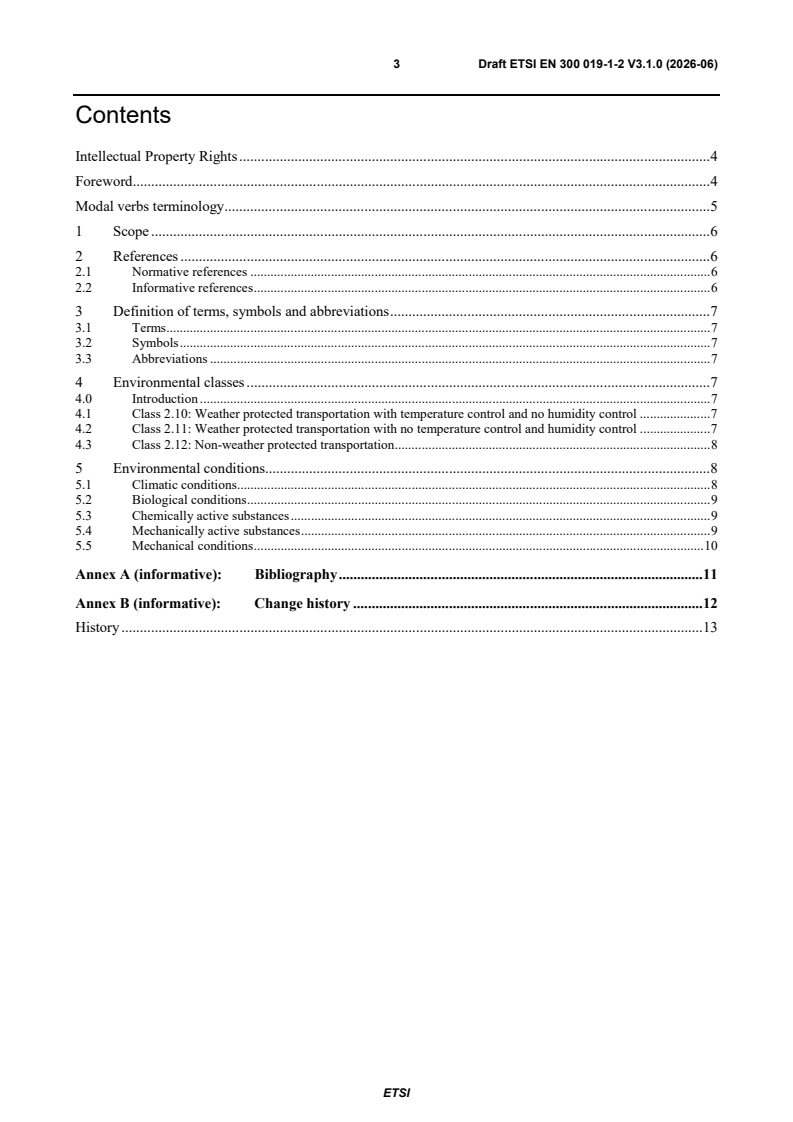
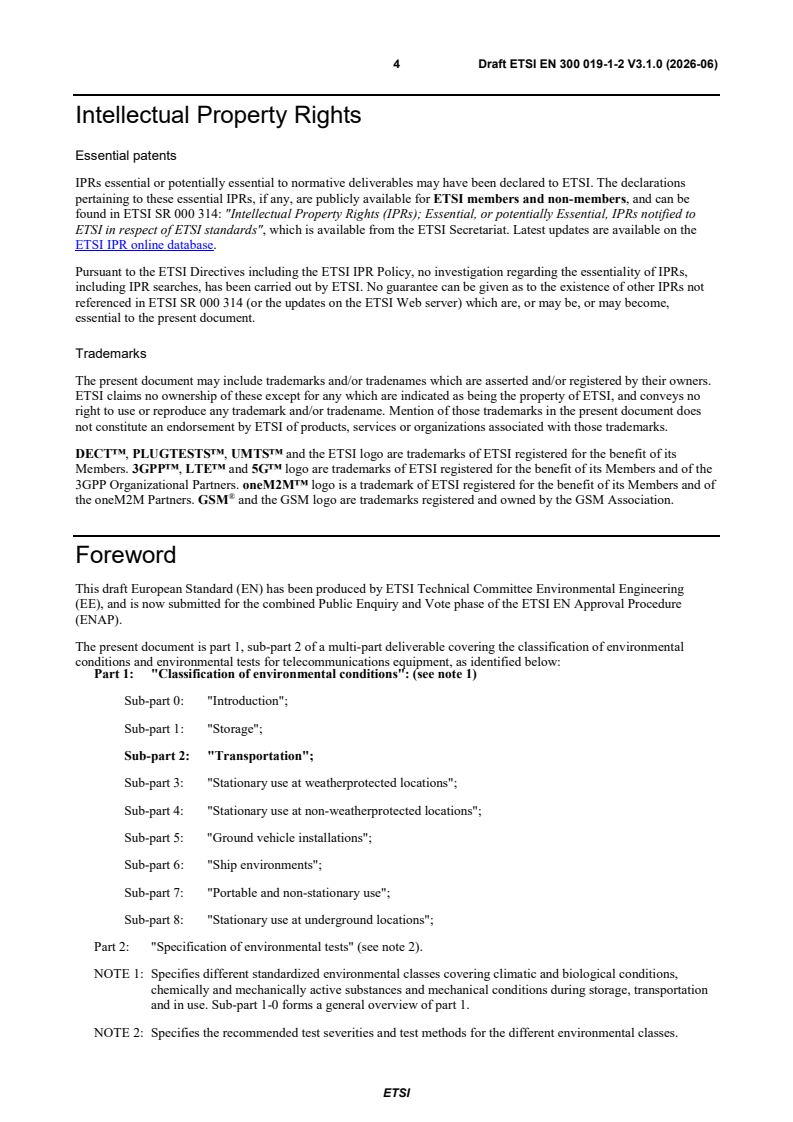
ETSI EN 300 019-1-2 V3.1.0 (2026-06) - Environmental Engineering (EE); Environmental conditions and environmental tests for telecommunications equipment; Part 1: Classification of environmental conditions; Subpart 2: Transportation
ETSI EN 300 019-1-2 V3.1.1 (2026-09) - Environmental Engineering (EE); Environmental conditions and environmental tests for telecommunications equipment; Part 1: Classification of environmental conditions; Subpart 2: Transportation

SIST EN 300 019-1-2 V3.1.1:2026 is the Slovenian edition of ETSI EN 300 019-1-2, published by SIST. It classifies transportation environmental conditions and severities for telecommunications equipment, so manufacturers, packers, logistics teams and test laboratories can specify the transport environment a product must survive and link it to the related test standard.
What does SIST EN 300 019-1-2 V3.1.1:2026 specify?
SIST EN 300 019-1-2 V3.1.1:2026 specifies environmental condition classes for telecommunications equipment during transportation. It covers equipment sent from the manufacturer's works to another place, including loading, unloading and temporary storage, and it applies to packaged equipment when packaging is used.
The standard focuses on transport conditions with a low probability of being exceeded, generally less than 1% of transport time. It takes account of ground, water and air transport, and it notes that normal transportation time is considered to be 30 days or less.
The document is organized into clauses 1 to 5, plus two informative annexes:
- Annex A - Bibliography
- Annex B - Change history
What are the key requirements of SIST EN 300 019-1-2 V3.1.1:2026?
SIST EN 300 019-1-2 V3.1.1:2026 defines three transportation classes in Clause 4 and groups the conditions in Clause 5. In practice, the class you choose sets the expected transport environment and the packaging or handling assumptions behind it.
Class selection in Clause 4
- Class 2.10 is for weather-protected transportation with limited temperature control and no humidity control, where special care has been taken in handling. This is the milder protected-transport case.
- Class 2.11 is for weather-protected transportation with no temperature control and humidity control in unventilated enclosures. It can include heated, pressurized aircraft holds and excludes polar climate.
- Class 2.12 is for non-weather-protected transportation in temperate, tropical and cold climates. It is the exposed-transport class, and arid and polar climates are excluded.
These classes are also linked to combinations from IEC 60721-3-2. That matters if you already use that classification system, because it helps you map transport routes to the right environmental profile.
Environmental condition groups in Clause 5
Clause 5 splits the transport environment into five groups: climatic, biological, chemically active substances, mechanically active substances, and mechanical conditions. This structure helps teams check whether the route, packaging and handling plan cover the full transport exposure.
- Clause 5.1 lists climatic conditions such as temperature, humidity, pressure, solar and heat radiation, precipitation, ice and frost, water from other sources, and temperature shock. In practice, this is the checklist for climate-related packaging and route decisions.
- Clause 5.2 covers biological conditions, including mould, fungus, rodents and other harmful animals. This matters for storage stops and routes through exposed locations.
- Clause 5.3 covers chemically active substances such as salt mist, sulfur dioxide, hydrogen sulfide, hydrogen chloride, hydrogen fluoride, ammonia, ozone and nitrogen oxides. This is relevant when transport passes industrial or marine environments.
- Clause 5.4 covers mechanically active substances such as sand and dust. This helps when choosing sealed packaging or protective handling.
- Clause 5.5 covers mechanical conditions such as random vibration, shock, free fall, toppling, rolling and pitching, steady-state acceleration and static load. This is the part most directly used for packaging design, palletizing and transport qualification.
The scope also notes that the tests used to verify compliance with these transportation and handling classes are defined in ETSI EN 300 019-2-2.
What terms does SIST EN 300 019-1-2 V3.1.1:2026 define?
SIST EN 300 019-1-2 V3.1.1:2026 defines a small set of transport-environment terms in Clause 3.
- Absolute humidity - the mass of water vapour in grammes associated with one cubic metre of dry air in an air/water vapour mixture.
- Relative humidity - the ratio of water-vapour partial pressure in moist air to that in saturated air at the same temperature.
- Weatherprotected location - a location where equipment is protected from direct weather influences.
- Non-weatherprotected location - a location where equipment, packaged or unpackaged, is not protected from the environment in any way.
Who uses SIST EN 300 019-1-2 V3.1.1:2026?
SIST EN 300 019-1-2 V3.1.1:2026 is used by telecommunications equipment manufacturers, packaging engineers, logistics and transport planners, environmental test laboratories, and quality or procurement teams. They use it to agree the transport environment, select a class, and decide how equipment should be packed, handled and tested before shipment.
What changed in SIST EN 300 019-1-2 V3.1.1:2026 from the previous edition?
SIST EN 300 019-1-2 V3.1.1:2026 revises the environmental classes based on IEC 60721-3-2:2018. The change history states that the new classes are not comparable with the previous classes taken from IEC 60721-3-2:1997, so new class numbers were defined.
Which standards are used with SIST EN 300 019-1-2 V3.1.1:2026?
SIST EN 300 019-1-2 V3.1.1:2026 is used with ETSI EN 300 019-2-2, which specifies the environmental tests for transportation and handling. It also draws on IEC 60721-3-2:2018 for the class structure and class combinations named in Clause 4.
What does the SIST EN 300 019-1-2 V3.1.1:2026 document contain?
SIST EN 300 019-1-2 V3.1.1:2026 contains the class definitions, the environmental-condition tables, and the notes that explain how to interpret them. Table 1 covers climatic parameters, Table 2 biological conditions, Table 3 chemically active substances, Table 4 mechanically active substances, and Table 5 mechanical conditions.
The document also includes the definitions of key terms, the link to the companion test part, and an informative bibliography. Annex B gives the change history, which is useful when comparing this edition with earlier versions.
Buy Documents
ETSI EN 300 019-1-2 V3.1.0 (2026-06) - Environmental Engineering (EE); Environmental conditions and environmental tests for telecommunications equipment; Part 1: Classification of environmental conditions; Subpart 2: Transportation
ETSI EN 300 019-1-2 V3.1.1 (2026-09) - Environmental Engineering (EE); Environmental conditions and environmental tests for telecommunications equipment; Part 1: Classification of environmental conditions; Subpart 2: Transportation
Get Certified
Connect with accredited certification bodies for this standard

ANCE
Mexican certification and testing association.

IMP NDT d.o.o.
Non-destructive testing services. Radiography, ultrasonic, magnetic particle, penetrant, visual inspection.

Inštitut za kovinske materiale in tehnologije
Institute of Metals and Technology. Materials testing, metallurgical analysis, NDT.
Sponsored listings
Frequently Asked Questions
SIST EN 300 019-1-2 V3.1.1:2026 is a standard published by the Slovenian Institute for Standardization (SIST). Its full title is "Environmental Engineering (EE) - Environmental conditions and environmental tests for telecommunications equipment - Part 1: Classification of environmental conditions - Subpart 2: Transportation". This standard covers: The present document defines classes of environmental conditions and their severities to which telecommunication equipment may be exposed. The severities specified are those which will have a low probability of being exceeded; generally less than 1 % of the time of a transport. The present document applies to equipment being transported from one place to another after being made ready for dispatch from the manufacturer's works. The most commonly used methods of transportation have been taken into account, i.e. ground, water and air transport. Loading and unloading as well as temporary storage, have been included. Where the equipment is packaged the environmental conditions apply to the packaged equipment. NOTE: Normal transportation time is considered to be 30 days or less. Where the total transportation time exceeds 30 days then additional storage or packaging precautions should be considered. The tests applicable to verify the compliance with the transportation and handling environmental classes of the present document, are defined in ETSI EN 300 019-2-2 [i.5].
The present document defines classes of environmental conditions and their severities to which telecommunication equipment may be exposed. The severities specified are those which will have a low probability of being exceeded; generally less than 1 % of the time of a transport. The present document applies to equipment being transported from one place to another after being made ready for dispatch from the manufacturer's works. The most commonly used methods of transportation have been taken into account, i.e. ground, water and air transport. Loading and unloading as well as temporary storage, have been included. Where the equipment is packaged the environmental conditions apply to the packaged equipment. NOTE: Normal transportation time is considered to be 30 days or less. Where the total transportation time exceeds 30 days then additional storage or packaging precautions should be considered. The tests applicable to verify the compliance with the transportation and handling environmental classes of the present document, are defined in ETSI EN 300 019-2-2 [i.5].
SIST EN 300 019-1-2 V3.1.1:2026 is classified under the following ICS (International Classification for Standards) categories: 19.040 - Environmental testing; 33.050.01 - Telecommunication terminal equipment in general. The ICS classification helps identify the subject area and facilitates finding related standards.
SIST EN 300 019-1-2 V3.1.1:2026 is available in PDF format for immediate download after purchase. The document can be added to your cart and obtained through the secure checkout process. Digital delivery ensures instant access to the complete standard document.
Standards Content (Sample)
Contents
- 1 Scope
- 2 References
- 2.1 Normative references
- 2.2 Informative references
- 7 Draft ETSI EN 300 019-1-2 V3.1.0 (2026-06)
- 3 Definition of terms, symbols and abbreviations
- 3.1 Terms
- 3.2 Symbols
- 3.3 Abbreviations
- 4 Environmental classes
- 4.0 Introduction
- 4.1 Class 2.10: Weather protected transportation with
- 4.2 Class 2.11: Weather protected transportation with no
- 8 Draft ETSI EN 300 019-1-2 V3.1.0 (2026-06)
- 4.3 Class 2.12: Non-weather protected transportation
- 5 Environmental conditions
- 5.1 Climatic conditions
- 9 Draft ETSI EN 300 019-1-2 V3.1.0 (2026-06)
- 5.2 Biological conditions
- 5.3 Chemically active substances
- 5.4 Mechanically active substances
- 10 Draft ETSI EN 300 019-1-2 V3.1.0 (2026-06)
- 5.5 Mechanical conditions
- 11 Draft ETSI EN 300 019-1-2 V3.1.0 (2026-06)
- Bibliography
- 12 Draft ETSI EN 300 019-1-2 V3.1.0 (2026-06)
- 13 Draft ETSI EN 300 019-1-2 V3.1.0 (2026-06)
1 Scope
The present document defines classes of environmental conditions and their severities to which telecommunication equipment may be exposed. The severities specified are those which will have a low probability of being exceeded; generally less than 1 % of the time of a transport.
The present document applies to equipment being transported from one place to another after being made ready for dispatch from the manufacturer's works. The most commonly used methods of transportation have been taken into account, i.e. ground, water and air transport. Loading and unloading as well as temporary storage, have been included. Where the equipment is packaged the environmental conditions apply to the packaged equipment. NOTE: Normal transportation time is considered to be 30 days or less. Where the total transportation time exceeds 30 days then additional storage or packaging precautions should be considered. The tests applicable to verify the compliance with the transportation and handling environmental classes of the present document, are defined in ETSI EN 300 019-2-2 [i.5].
2 References
2.1 Normative references
References are either specific (identified by date of publication and/or edition number or version number) or non-specific. For specific references, only the cited version applies. For non-specific references, the latest version of the referenced document (including any amendments) applies.
Referenced documents which are not found to be publicly available in the expected location might be found in the ETSI docbox.
NOTE: While any hyperlinks included in this clause were valid at the time of publication, ETSI cannot guarantee their long-term validity.
The following referenced documents are necessary for the application of the present document. Not applicable.
2.2 Informative references
References are either specific (identified by date of publication and/or edition number or version number) or non-specific. For specific references, only the cited version applies. For non-specific references, the latest version of the referenced document (including any amendments) applies.
NOTE: While any hyperlinks included in this clause were valid at the time of publication, ETSI cannot guarantee their long-term validity.
The following referenced documents may be useful in implementing an ETSI deliverable or add to the reader's understanding, but are not required for conformance to the present document. [i.1] Void.
[i.2] IEC 60721-3-2: 2018: "Classification of environmental conditions - Part 3-2: Classification of groups of environmental parameters and their severities - Section 2: Transportation and handling". [i.3] Void.
[i.4] Void.
[i.5] ETSI EN 300 019-2-2: "Environmental Engineering (EE); Environmental conditions and environmental tests for telecommunications equipment; Part 2-2: Specification of environmental tests; Transportation".
ETSI
7 Draft ETSI EN 300 019-1-2 V3.1.0 (2026-06)
3 Definition of terms, symbols and abbreviations
3.1 Terms
For the purposes of the present document, the following terms apply:
absolute humidity: mass of water vapour in grammes which is associated with one cubic metre of dry air in an air/water vapour mixture non-weatherprotected location: equipment, packaged or unpackaged, is not protected in any way from the environment relative humidity: ratio of the partial pressure of the water vapour in moist air at a given temperature, to the partial pressure of the water vapour in saturated air at the same temperature weatherprotected location: location at which the equipment is protected from direct weather influences NOTE: Totally weatherprotected location: the equipment, packaged or unpackaged, is contained within an enclosure which affords some protection from the environment, ranging from a temperature controlled container to a waterproof cover placed over the equipment. Ventilation ranges from controlled air flow to the raising of part of a waterproof cover to allow for natural air flow.
3.2 Symbols
Void.
3.3 Abbreviations
Void.
...
Contents
- 1 Scope
- 2 References
- 2.1 Normative references
- 2.2 Informative references
- 7 ETSI EN 300 019-1-2 V3.1.1 (2026-09)
- 3 Definition of terms, symbols and abbreviations
- 3.1 Terms
- 3.2 Symbols
- 3.3 Abbreviations
- 4 Environmental classes
- 4.0 Introduction
- 4.1 Class 2.10: Weather protected transportation with
- 4.2 Class 2.11: Weather protected transportation with no
- 8 ETSI EN 300 019-1-2 V3.1.1 (2026-09)
- 4.3 Class 2.12: Non-weather protected transportation
- 5 Environmental conditions
- 5.1 Climatic conditions
- 9 ETSI EN 300 019-1-2 V3.1.1 (2026-09)
- 5.2 Biological conditions
- 5.3 Chemically active substances
- 5.4 Mechanically active substances
- 10 ETSI EN 300 019-1-2 V3.1.1 (2026-09)
- 5.5 Mechanical conditions
- 11 ETSI EN 300 019-1-2 V3.1.1 (2026-09)
- Bibliography
- 12 ETSI EN 300 019-1-2 V3.1.1 (2026-09)
- 13 ETSI EN 300 019-1-2 V3.1.1 (2026-09)
1 Scope
The present document defines classes of environmental conditions and their severities to which telecommunication equipment may be exposed. The severities specified are those which will have a low probability of being exceeded; generally less than 1 % of the time of a transport.
The present document applies to equipment being transported from one place to another after being made ready for dispatch from the manufacturer's works. The most commonly used methods of transportation have been taken into account, i.e. ground, water and air transport. Loading and unloading as well as temporary storage, have been included. Where the equipment is packaged the environmental conditions apply to the packaged equipment. NOTE: Normal transportation time is considered to be 30 days or less. Where the total transportation time exceeds 30 days then additional storage or packaging precautions should be considered. The tests applicable to verify the compliance with the transportation and handling environmental classes of the present document, are defined in ETSI EN 300 019-2-2 [i.5].
2 References
2.1 Normative references
References are either specific (identified by date of publication and/or edition number or version number) or non-specific. For specific references, only the cited version applies. For non-specific references, the latest version of the referenced document (including any amendments) applies.
Referenced documents which are not found to be publicly available in the expected location might be found in the ETSI docbox.
NOTE: While any hyperlinks included in this clause were valid at the time of publication, ETSI cannot guarantee their long-term validity.
The following referenced documents are necessary for the application of the present document. Not applicable.
2.2 Informative references
References are either specific (identified by date of publication and/or edition number or version number) or non-specific. For specific references, only the cited version applies. For non-specific references, the latest version of the referenced document (including any amendments) applies.
NOTE: While any hyperlinks included in this clause were valid at the time of publication, ETSI cannot guarantee their long-term validity.
The following referenced documents may be useful in implementing an ETSI deliverable or add to the reader's understanding, but are not required for conformance to the present document. [i.1] Void.
[i.2] IEC 60721-3-2:2018: "Classification of environmental conditions - Part 3-2: Classification of groups of environmental parameters and their severities - Section 2: Transportation and handling". [i.3] Void.
[i.4] Void.
[i.5] ETSI EN 300 019-2-2: "Environmental Engineering (EE); Environmental conditions and environmental tests for telecommunications equipment; Part 2-2: Specification of environmental tests; Transportation".
ETSI
7 ETSI EN 300 019-1-2 V3.1.1 (2026-09)
3 Definition of terms, symbols and abbreviations
3.1 Terms
For the purposes of the present document, the following terms apply:
absolute humidity: mass of water vapour in grammes which is associated with one cubic metre of dry air in an air/water vapour mixture non-weatherprotected location: equipment, packaged or unpackaged, is not protected in any way from the environment relative humidity: ratio of the partial pressure of the water vapour in moist air at a given temperature, to the partial pressure of the water vapour in saturated air at the same temperature weatherprotected location: location at which the equipment is protected from direct weather influences NOTE: Totally weatherprotected location: the equipment, packaged or unpackaged, is contained within an enclosure which affords some protection from the environment, ranging from a temperature controlled container to a waterproof cover placed over the equipment. Ventilation ranges from controlled air flow to the raising of part of a waterproof cover to allow for natural air flow.
3.2 Symbols
Void.
3.3 Abbreviations
Void.
...
Contents
- 1 Scope
- 2 References
- 2.1 Normative references
- 2.2 Informative references
- 7 ETSI EN 300 019-1-2 V3.1.1 (2026-09)
- 3 Definition of terms, symbols and abbreviations
- 3.1 Terms
- 3.2 Symbols
- 3.3 Abbreviations
- 4 Environmental classes
- 4.0 Introduction
- 4.1 Class 2.10: Weather protected transportation with
- 4.2 Class 2.11: Weather protected transportation with no
- 8 ETSI EN 300 019-1-2 V3.1.1 (2026-09)
- 4.3 Class 2.12: Non-weather protected transportation
- 5 Environmental conditions
- 5.1 Climatic conditions
- 9 ETSI EN 300 019-1-2 V3.1.1 (2026-09)
- 5.2 Biological conditions
- 5.3 Chemically active substances
- 5.4 Mechanically active substances
- 10 ETSI EN 300 019-1-2 V3.1.1 (2026-09)
- 5.5 Mechanical conditions
- 11 ETSI EN 300 019-1-2 V3.1.1 (2026-09)
- Bibliography
- 12 ETSI EN 300 019-1-2 V3.1.1 (2026-09)
- 13 ETSI EN 300 019-1-2 V3.1.1 (2026-09)
1 Scope
The present document defines classes of environmental conditions and their severities to which telecommunication equipment may be exposed. The severities specified are those which will have a low probability of being exceeded; generally less than 1 % of the time of a transport.
The present document applies to equipment being transported from one place to another after being made ready for dispatch from the manufacturer's works. The most commonly used methods of transportation have been taken into account, i.e. ground, water and air transport. Loading and unloading as well as temporary storage, have been included. Where the equipment is packaged the environmental conditions apply to the packaged equipment. NOTE: Normal transportation time is considered to be 30 days or less. Where the total transportation time exceeds 30 days then additional storage or packaging precautions should be considered. The tests applicable to verify the compliance with the transportation and handling environmental classes of the present document, are defined in ETSI EN 300 019-2-2 [i.5].
2 References
2.1 Normative references
References are either specific (identified by date of publication and/or edition number or version number) or non-specific. For specific references, only the cited version applies. For non-specific references, the latest version of the referenced document (including any amendments) applies.
Referenced documents which are not found to be publicly available in the expected location might be found in the ETSI docbox.
NOTE: While any hyperlinks included in this clause were valid at the time of publication, ETSI cannot guarantee their long-term validity.
The following referenced documents are necessary for the application of the present document. Not applicable.
2.2 Informative references
References are either specific (identified by date of publication and/or edition number or version number) or non-specific. For specific references, only the cited version applies. For non-specific references, the latest version of the referenced document (including any amendments) applies.
NOTE: While any hyperlinks included in this clause were valid at the time of publication, ETSI cannot guarantee their long-term validity.
The following referenced documents may be useful in implementing an ETSI deliverable or add to the reader's understanding, but are not required for conformance to the present document. [i.1] Void.
[i.2] IEC 60721-3-2:2018: "Classification of environmental conditions - Part 3-2: Classification of groups of environmental parameters and their severities - Section 2: Transportation and handling". [i.3] Void.
[i.4] Void.
[i.5] ETSI EN 300 019-2-2: "Environmental Engineering (EE); Environmental conditions and environmental tests for telecommunications equipment; Part 2-2: Specification of environmental tests; Transportation".
ETSI
SIST EN 300 019-1-2 V3.1.1:2026
7 ETSI EN 300 019-1-2 V3.1.1 (2026-09)
3 Definition of terms, symbols and abbreviations
3.1 Terms
For the purposes of the present document, the following terms apply:
absolute humidity: mass of water vapour in grammes which is associated with one cubic metre of dry air in an air/water vapour mixture non-weatherprotected location: equipment, packaged or unpackaged, is not protected in any way from the environment relative humidity: ratio of the partial pressure of the water vapour in moist air at a given temperature, to the partial pressure of the water vapour in saturated air at the same temperature weatherprotected location: location at which the equipment is protected from direct weather influences NOTE: Totally weatherprotected location: the equipment, packaged or unpackaged, is contained within an enclosure which affords some protection from the environment, ranging from a temperature controlled container to a waterproof cover placed over the equipment. Ventilation ranges from controlled air flow to the raising of part of a waterproof cover to allow for natural air flow.
3.2 Symbols
Void.
3.3 Abbreviations
Void.
...