

SIST-TP ISO/TR 10657:2022
(Main)Explanatory notes on ISO 76
General Information
- Abstract
This document specifies supplementary background information regarding the derivation of formulae and factors given in ISO 76:2006.
- Status
- Published
- Publication Date
- 10-Feb-2022
- Technical Committee
- ISEL - Mechanical elements
- Current Stage
- 6060 - National Implementation/Publication (Adopted Project)
- Start Date
- 10-Feb-2022
- Due Date
- 17-Apr-2022
- Completion Date
- 11-Feb-2022
Buy Documents




ISO/TR 10657:2021 - Explanatory notes on ISO 76

ISO/TR 10657:2021 - Explanatory notes on ISO 76/12/2021
Overview
ISO/TR 10657:2021 - "Explanatory notes on ISO 76" - is an ISO Technical Report that provides supplementary background and derivations for the formulae and factors used in ISO 76 (methods for evaluating static load ratings of rolling bearings). It documents the mathematical basis, symbols and assumptions behind the basic static load ratings and static equivalent-load calculations for ball and roller bearings, clarifying how the values and tables in ISO 76:2006 (and its amendments) were obtained.
Key topics
- Scope and purpose: explanatory background information supporting ISO 76:2006, not a normative standard itself.
- Symbols and definitions: complete list of symbols used in load-rating formulae (C0r, C0a, P0r, P0a, X, Y, f, γ, κ, E(κ), etc.).
- Basic static load ratings: derivation for point-contact and line-contact cases; treatment for radial ball bearings, thrust (axial) bearings, self-aligning types and roller bearings.
- Static equivalent load: theoretical and practical formulae for converting combined radial/axial loads into equivalent static radial or axial loads. Includes single- and double-row cases and approximate formulae.
- Load factors and coefficients: development and explanation of the static radial load factor (X), static axial load factor (Y) and the load rating factor (f). Tables and graphs referenced from ISO 76 are explained.
- Annex A: values for auxiliary parameters (γ, κ) and the complete elliptic integral E(κ) used in contact calculations.
- Historical context: explanatory notes on earlier editions and rationale for revisions (e.g., contact-stress basis and safety factor inclusion).
Applications and users
ISO/TR 10657:2021 is intended for:
- Bearing designers and mechanical engineers who need to understand and validate static load-rating calculations from ISO 76.
- Test laboratories and quality engineers performing static load evaluation and verification.
- OEMs and drivetrain, gearbox, automotive and industrial equipment manufacturers specifying bearing selection and safety factors.
- Standards developers and technical committees seeking the derivation and assumptions behind published tables and coefficients.
Practical uses include interpreting ISO 76 tables, implementing formulae in bearing-selection software, verifying static safety margins and documenting design justification.
Related standards
- ISO 76:2006 (Methods of evaluating static load ratings) - primary normative reference explained by this TR.
- ISO 76/Amd.1:2017 - amendment referenced and clarified in the report.
- Earlier editions and technical history (ISO/TR 10657:1991, ISO 76:1978/1987) are discussed for context.
Keywords: ISO/TR 10657:2021, ISO 76, rolling bearings, static load ratings, basic static load rating, static equivalent load, load rating factor f, static radial load factor X, static axial load factor Y.
Relations
- Effective Date
- 30-Nov-2013
Buy Documents
ISO/TR 10657:2021 - Explanatory notes on ISO 76
ISO/TR 10657:2021 - Explanatory notes on ISO 76/12/2021
Frequently Asked Questions
SIST-TP ISO/TR 10657:2022 is a technical report published by the Slovenian Institute for Standardization (SIST). Its full title is "Explanatory notes on ISO 76". This standard covers: This document specifies supplementary background information regarding the derivation of formulae and factors given in ISO 76:2006.
This document specifies supplementary background information regarding the derivation of formulae and factors given in ISO 76:2006.
SIST-TP ISO/TR 10657:2022 is classified under the following ICS (International Classification for Standards) categories: 21.100.20 - Rolling bearings. The ICS classification helps identify the subject area and facilitates finding related standards.
SIST-TP ISO/TR 10657:2022 has the following relationships with other standards: It is inter standard links to SIST ISO/TR 10657:2001. Understanding these relationships helps ensure you are using the most current and applicable version of the standard.
SIST-TP ISO/TR 10657:2022 is available in PDF format for immediate download after purchase. The document can be added to your cart and obtained through the secure checkout process. Digital delivery ensures instant access to the complete standard document.
Standards Content (Sample)
SLOVENSKI STANDARD
01-april-2022
Zapisek razlag k standardu ISO 76
Explanatory notes on ISO 76
Notes explicatives sur l'ISO 76
Ta slovenski standard je istoveten z: ISO/TR 10657:2021
ICS:
21.100.20 Kotalni ležaji Rolling bearings
2003-01.Slovenski inštitut za standardizacijo. Razmnoževanje celote ali delov tega standarda ni dovoljeno.
TECHNICAL ISO/TR
REPORT 10657
Second edition
2021-11
Explanatory notes on ISO 76
Notes explicatives sur l'ISO 76
Reference number
© ISO 2021
All rights reserved. Unless otherwise specified, or required in the context of its implementation, no part of this publication may
be reproduced or utilized otherwise in any form or by any means, electronic or mechanical, including photocopying, or posting on
the internet or an intranet, without prior written permission. Permission can be requested from either ISO at the address below
or ISO’s member body in the country of the requester.
ISO copyright office
CP 401 • Ch. de Blandonnet 8
CH-1214 Vernier, Geneva
Phone: +41 22 749 01 11
Email: copyright@iso.org
Website: www.iso.org
Published in Switzerland
ii
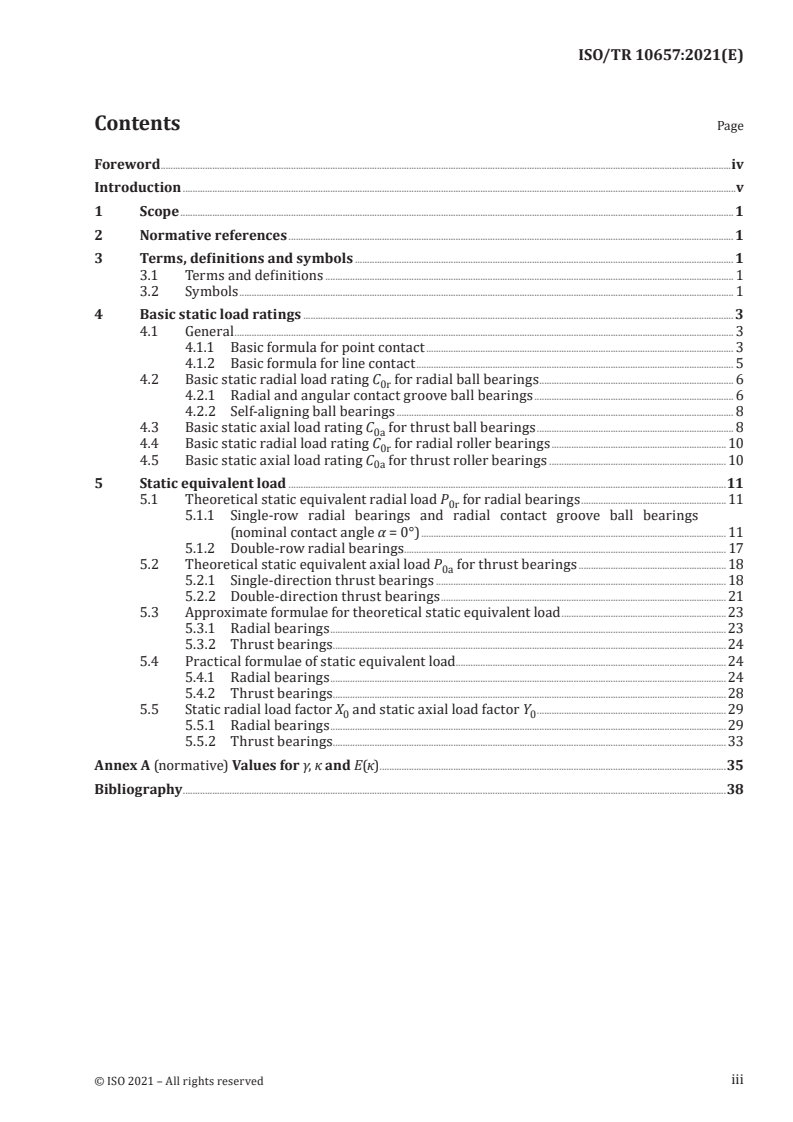
Contents Page
Foreword .iv
Introduction .v
1 Scope . 1
2 Normative references . 1
3 Terms, definitions and symbols . 1
3.1 Terms and definitions . 1
3.2 Symbols . 1
4 Basic static load ratings . 3
4.1 General . 3
4.1.1 Basic formula for point contact . 3
4.1.2 Basic formula for line contact . 5
4.2 Basic static radial load rating C for radial ball bearings . 6
0r
4.2.1 Radial and angular contact groove ball bearings . 6
4.2.2 Self-aligning ball bearings . 8
4.3 Basic static axial load rating C for thrust ball bearings . 8
0a
4.4 Basic static radial load rating C for radial roller bearings . 10
0r
4.5 Basic static axial load rating C for thrust roller bearings . 10
0a
5 Static equivalent load .11
5.1 Theoretical static equivalent radial load P for radial bearings . 11
0r
5.1.1 Single-row radial bearings and radial contact groove ball bearings
(nominal contact angle α = 0°) . 11
5.1.2 Double-row radial bearings . 17
5.2 Theoretical static equivalent axial load P for thrust bearings . 18
0a
5.2.1 Single-direction thrust bearings . 18
5.2.2 Double-direction thrust bearings . 21
5.3 Approximate formulae for theoretical static equivalent load . 23
5.3.1 Radial bearings . 23
5.3.2 Thrust bearings . . 24
5.4 Practical formulae of static equivalent load . 24
5.4.1 Radial bearings . 24
5.4.2 Thrust bearings . .28
5.5 Static radial load factor X and static axial load factor Y .29
0 0
5.5.1 Radial bearings .29
5.5.2 Thrust bearings . 33
Annex A (normative) Values for γ, κ and E(κ) .35
Bibliography .38
iii
Foreword
ISO (the International Organization for Standardization) is a worldwide federation of national standards
bodies (ISO member bodies). The work of preparing International Standards is normally carried out
through ISO technical committees. Each member body interested in a subject for which a technical
committee has been established has the right to be represented on that committee. International
organizations, governmental and non-governmental, in liaison with ISO, also take part in the work.
ISO collaborates closely with the International Electrotechnical Commission (IEC) on all matters of
electrotechnical standardization.
The procedures used to develop this document and those intended for its further maintenance are
described in the ISO/IEC Directives, Part 1. In particular, the different approval criteria needed for the
different types of ISO documents should be noted. This document was drafted in accordance with the
editorial rules of the ISO/IEC Directives, Part 2 (see www.iso.org/directives).
Attention is drawn to the possibility that some of the elements of this document may be the subject of
patent rights. ISO shall not be held responsible for identifying any or all such patent rights. Details of
any patent rights identified during the development of the document will be in the Introduction and/or
on the ISO list of patent declarations received (see www.iso.org/patents).
Any trade name used in this document is information given for the convenience of users and does not
constitute an endorsement.
For an explanation of the voluntary nature of standards, the meaning of ISO specific terms and
expressions related to conformity assessment, as well as information about ISO's adherence to
the World Trade Organization (WTO) principles in the Technical Barriers to Trade (TBT), see
www.iso.org/iso/foreword.html.
This document was prepared by Technical Committee ISO/TC 4, Rolling bearings, Subcommittee SC 8,
Load ratings and life.
This second edition cancels and replaces the first edition (ISO 10657:1991), which has been technically
revised.
The main changes compared to the previous edition are as follows:
— New subclause 0.4 and 0.5 included with explanations concerning the 2006 edition of ISO 76:2006
and ISO 76/Amd.1:2017;
— Inclusion of Clause 3 for symbols;
— Table 16 and Table 18 amended according to additional values in ISO 76:2006 (values of X and Y at
0 0
contact angles 5° and 10° of angular contact ball bearings).
Any feedback or questions on this document should be directed to the user’s national standards body. A
complete listing of these bodies can be found at www.iso.org/members.html.
iv
Introduction
0.1 ISO/R 76:1958
ISO/R 76, Ball and Roller Bearings — Methods of Evaluating Static Load Ratings, was drawn up by
Technical Committee ISO/TC 4, Ball and Roller Bearings.
[2],[3]
ISO/R 76 was based on the studies of A. Palmgren et al . The basic static load ratings were defined
to correspond to a total permanent deformation of rolling element and raceway at the most heavily
stressed rolling element/raceway contact of 0,000 1 of the rolling element diameter. Then the standard
values confined to the basic static load ratings for special inner design rolling bearings were laid down.
ISO/R 76:1958 was approved by 28 (out of a total of 38) member bodies and was then submitted to the
ISO Council, which decided, in December 1958, to accept it as an ISO Recommendation.
0.2 ISO 76:1978
ISO/TC 4 decided to include the revision of ISO/R 76 in its programme of work and ISO/TC 4/SC 8
secretariat was requested to prepare a draft proposal. As a result, the secretariat submitted a draft
[3]
proposal in January 1976.
The draft proposal was accepted by 6 of the 8 members of ISO/TC 4/SC 8. Of the remaining two, Japan
[4]
preferred further study and USA, its counter proposal, document ISO/TC 4/SC 8 N 64 . The draft was
then submitted to the ISO Central Secretariat. After the draft had been approved by the ISO member
bodies, the ISO Council decided in June 1978 to accept it as an International Standard.
ISO 76:1978 adopted the SI unit newton and was revised in total, but without essential changes of
substance. However, values of X and Y for the nominal contact angles 15° and 45° for angular contact
0 0
groove ball bearings were added to the table to calculate the static equivalent radial loads of radial ball
bearings (see ISO 76:1978, Table 2).
0.3 ISO 76:1987
[4]
During the revision of ISO/R 76:1958, USA had in 1975 submitted a counter proposal for the basic
static load ratings based on a calculated contact stress.
The secretariat requested a vote on the revision of the static load ratings based on a contact stress level
in January 1978 and afterward circulated the voted results in June 1978, and the item No. of revision
work had become No. 157 of the programme of work of TC 4.
[5] [6]
ISO/TC 4/SC 8, considering the proposals made in the documents TC 4/SC 8 N 75 and TC 4 N 865 ,
as well as the comments made by TC 4 members and that several SC 8 members expressed a need
for updating ISO 76, agreed to continue its study taking into account the possibility of using either
permanent deformation or stress level as a basis for static load ratings, and ISO/TC 4/SC 8 requested
its secretariat to prepare a new draft. The new draft was intended to be prepared with the principles
and formulae of the document TC 4/SC 8 N 75, and to include levels of contact stress for various rolling
element contact stated to be generally corresponding to a permanent deformation of 0,000 1 of the
rolling element diameter at the centre of the most heavily stressed rolling element/raceway contact.
For roller bearings a stress level of 4 000 MPa was agreed and then ISO/TC 4/SC 8 agreed, by a majority
vote, that static load ratings should correspond to calculated contact stresses of
4 000 MPa for roller bearings,
4 600 MPa for self-aligning ball bearings, and
4 200 MPa for all other ball bearings to which the standard applies.
For these calculated contact stresses, a total permanent deformation occurs at the centre of the most
heavily stressed rolling element/raceway contact, and its deformation is approximately 0,000 1 of the
rolling element diameter.
v
ISO 76 was submitted to the ISO Central Secretariat in 1985, and after it had been approved by the
ISO members, the ISO Council decided in February 1987 to accept it as an International Standard.
Furthermore, ISO/TC 4/SC 8 decided that supplementary background information, regarding the
derivation of formulae and factors given in ISO 76, should be published as a Technical Report. This
Technical report was published as ISO/TR 10657:1991.
An Amendment to ISO 76:1987 that explains the discontinuities in load ratings between radial- and
axial bearings was published as ISO 76:1987/Amd.1:1999.
0.4 ISO 76:2006
A systematic review of ISO 76:1987 was agreed in 2003, based on the prior held balloting process and
documents TC 4/SC 8 N 233 and N 235.
ISO 76:2006 includes editorial adaptations and updates as well as an extension by the static safety
factor S . Furthermore, ISO 76:1987/Amd.1:1999 was integrated and became the informative Annex A
“Discontinuities in the calculation of basic static load ratings”.
0.5 ISO 76:2006/Amd.1:2017
ISO 76:2006/Amd.1:2017 includes the following items:
— graphs for the factors f , X and Y taken from draft ÖNORM M 6320 to be included in an informative
0 0 0
annex;
— formulae for the calculation of the load rating factor f from ISO/TR 10657 to be introduced in the
normative part of the standard;
— the tables for the load rating factor f will stay in the normative part of the standard, however a
sentence will be introduced stating that the results obtained from formulae are preferred.
vi
TECHNICAL REPORT ISO/TR 10657:2021(E)
Explanatory notes on ISO 76
1 Scope
This document specifies supplementary background information regarding the derivation of formulae
and factors given in ISO 76:2006.
2 Normative references
There are no normative references in this document.
3 Terms, definitions and symbols
3.1 Terms and definitions
No terms and definitions are listed in this document.
ISO and IEC maintain terminology databases for use in standardization at the following addresses:
— ISO Online browsing platform: available at https:// www .iso .org/ obp
— IEC Electropedia: available at https:// www .electropedia .org/
3.2 Symbols
C basic static axial load rating, in newtons
0a
C basic static radial load rating, in newtons
0r
D pitch diameter of ball or roller set, in millimetres
pw
D nominal ball diameter, in millimetres
w
D roller diameter applicable in the calculation of load ratings, in millimetres
we
E modulus of elasticity (Young’ s modulus), in megapascals
E , E modulus of elasticity of body 1 (rolling element) and of body 2 (raceway), in megapascals
1 2
E(κ) complete elliptic integral of the second kind
E E/(1 − ν )
F bearing axial load (axial component of actual bearing load), in newtons
a
F bearing radial load (radial component of actual bearing load), in newtons
r
F(ρ) relative curvature difference
J (ε) axial load integral
a
J (ε) radial load integral
r
K(κ) complete elliptic integral of the first kind
L length of roller applicable in the calculation of load ratings, in millimetres
we
P theoretical static equivalent axial load for thrust bearing, general speaking, called static
0a
equivalent axial load, in newtons
P theoretical static equivalent radial load for radial bearing, general speaking, called static
0r
equivalent radial load, in newtons
Q normal force between rolling element and raceway, in newtons
Q maximum normal force between rolling element and raceway, in newtons
max
S Stribeck number
X static radial load factor
Y static axial load factor
Z number of balls carrying load in one direction, number of balls or rollers per row, or number
of rolling elements per row
a semi-major axis of the projected contact ellipse, semilength of the contact surface
b semi-minor axis of the projected contact ellipse, semi-width of the contact surface
2/3
c compression constant, in 1/megapascals
f osculation = r/D
w
f osculation at the outer ring = r /D
e e w
f osculation at the inner ring = r /D
i i w
f factor which depends on the geometry of the bearing components and on applicable stress level
i number of rows of balls or rollers in a bearing
k load distribution parameter
r curvature radius of a raceway cross-section, in millimetres
r outer ring groove radius, in millimetres
e
r inner ring groove radius, in millimetres
i
t exponent in load–deflection formula
x distance in direction of the semi-major axis, in millimetres
y distance in direction of the semi-minor axis, in millimetres
α nominal contact angle, in degrees
α′ actual contact angle, in degrees
γ auxiliary parameter, γ = D cos α /D for ball bearings with α ≠ 90°
w pw
γ = D /D for ball bearings with α = 90°
w pw
γ = D cos α /D for roller bearings with α ≠ 90°
we pw
γ = D /D for roller bearings with α = 90°
we pw
ε parameter indicating the width of the loaded zone
κ ratio of semi-major to semi-minor axis = a/b
ν Poisson’s ratio
ν Poisson’s ratio of body 1 (rolling element)
ν Poisson’s ratio of body 2 (raceway)
Σρ curvature sum
ρ , ρ principal curvature of body 1 (rolling element)
11 12
ρ , ρ principal curvature of body 2 (raceway)
21 22
σ calculated contact stress, in megapascals
σ maximum calculated contact stress, in megapascals
max
ϕ auxiliary angle, in radians
ψ one half of the loaded arc
4 Basic static load ratings
4.1 General
4.1.1 Basic formula for point contact
The relationship between a calculated contact stress and a rolling element load within an elliptical
contact area is given in Reference [8] as Formula (1),
12/
3Q x y
σ =−1 − (1)
2π ab a b
It is concluded that the maximum calculated contact stress (σ ) occurs at the point of x = 0 and y = 0,
max
3Q 2π ab
σσ== orQ (2)
maxmax
2π ab 3
According to the Hertz’s theory,
13/
113/
2 2 2
2κκE () 11−νν−
3Q
1 2
a = + (3)
πΣ2 ρ EE
1 2
13/
13/
2 2
2E κ
() 3Q 11−νν−
1 2
b= + (4)
πΣκρ2 EE
1 2
where
κ = a/b
12/
π/2
1
E(κ) 2
=−11− sin φφd
∫
κ
Σρ = ρ + ρ + ρ + ρ
11 12 21 22
ρρ=
11 12
=
D
w
Substituting Formula (3) and Formula (4) into Formula (2) for the case of E = E = E and ν = ν = ν,
1 2 1 2
E()κ
32π
Q =σκ (5)
max
Σρ
3E
and
2 K ()κ
1− −10 −F ρ = (6)
()
E κ
()
κ −1
where
E
E
=
1−ν
E = 2,07 × 10 MPa
ν = 0,3
−12/
π/2
1
K(κ)
=−11− sin φφd
∫
κ
ρρ−+ρρ−
11 12 21 22
=
F()ρ
ρρ++ρρ+
11 12 21 22
Consequently, from Formula (5),
E ()κ
−10 3
Q =×6,476 20651 0 κ σ (7)
max
Σρ
4.1.2 Basic formula for line contact
The relationship between a calculated contact stress and a rolling element load for a line contact is
given in Reference [9] as follows,
12/
2Q y
σ =−1 (8)
πLb b
we
It is concluded that the maximum calculated contact stress (σ ) from Formula (8) occurs at the line of
max
y = 0,
2Q π Lb
we
σσ== orQ (9)
max max
π Lb 2
we
And also b is given by the following formula,
12/
2 2
4Q 11−νν−
1 2
b = + (10)
π LEΣρ E
we 1 2
where
Σρ = ρ + ρ + ρ + ρ
11 12 21 22
ρ
=
D
we
ρ
2 γ
=± ; the upper sign applies to inner ring contact and the lower to outer ring contact;
D 1 γ
we
ρ
= 0
ρ
= 0
D cos α
we
γ =
D
pw
Substituting Formula (10) into Formula (9) for the case of E = E = E and ν = ν = ν,
1 2 1 2
L
2 we
Q=2πσ
max
E Σρ
where
E
E
=
1−ν
E = 2,07 × 10 MPa
ν = 0,3
Consequently,
L
−52we
Q =×2,762 173 210 σ (11)
max
Σρ
4.2 Basic static radial load rating C for radial ball bearings
0r
4.2.1 Radial and angular contact groove ball bearings
The curvature sum Σρ and the relative curvature difference F(ρ) of radial and angular contact groove
ball bearings is given by the following formulae,
2 γ 1
Σρ =±2 − (12)
Df1γ 2
w ie()
γ 1
±+
1γ 2f
ie
()
F()ρ = (13)
γ 1
2±−
1γ 2f
ie
()
where
the upper sign applies to inner ring contact and the lower to outer ring contact;
D cos α
w
γ
=
D
pw
f denotes
i(e)
r
i
f
i = forinnerr ingcontact, and
D
w
r
e
= forouter ringcontact
f
e
D
w
Substituting Formula (12) into Formula (7),
D E ()κ
−10 w 3
Q =×6,476 206510 κ σ (14)
maax
2 γ 1
2 ±−
1 γ 2f
ie
()
Substituting Formula (12) and Formula (14) into Formula (15) (see Reference [10]), and furthermore
exchanging Q for Q , gives
max
C = ZQ cos (15)
0rmax
S
where S is a function of the loaded zone parameter ε. If one half of the balls are loaded then S = 4,37
applies. A common value used in general bearing calculations is S = 5, which leads to a rather
conservative estimate of the maximum ball load.
C = 0,2 Z Q cos α (16)
0r max
Consequently,
σ E ()κ
1
−10 max 2
C =×02,,6 476 20651××04() 000 κ × ZD cos α
0r w
γ 1
4 000 4
22 ±−
1 γ 2f
ie()
where the upper sign refers to the inner ring and the lower sign refers to the outer ring. Therefore,
introducing the number of rows, i, of balls gives Formula (17):
Cf= iZ D cos (17)
00rw
where f is the factor which depends on the geometry of the bearing components and on applicable
stress level:
σ E κ
()
max
f =2,072 κ (18)
γ 1
4 000
2 ±−
1 γ 2f
ie()
For an inner ring with f = 0,52, Formula (18) becomes,
i
σ E ()κ
max
f =2,072 κ (19)
0
4 000 γ 1
2 + −
1 − γ 10, 4
and for an outer ring with f = 0,53,
e
σ E κ
()
max
f =2,072 κ (20)
0
γ 1
4 000
2 − −
1 + γ 10, 6
The smaller value between the f values calculated from Formula (19) and Formula (20) is used in the
calculation of static load ratings.
The values of factor f in Table 1 of ISO 76:2006 are calculated from substituting the values for κ, E(κ)
and γ = D cos α/D shown in Table A.1, and σ = 4 200 MPa into the above formula.
w pw max
These values apply to bearings with a cross-sectional raceway groove radius not larger than 0,52 D in
w
radial and angular contact groove ball bearing inner rings, and 0,53 D in radial and angular contact
w
groove ball bearing outer rings and self-aligning ball bearing inner rings
The load-carrying ability of a bearing is not necessarily increased by the use of a smaller groove radius,
but is reduced by the use of a larger groove radius. In the latter case, a correspondingly reduced value
of f is used.
4.2.2 Self‑aligning ball bearings
The curvature sum Σρ of self-aligning ball bearings is given by the following formula for an outer ring:
Σρ = (21)
D 1+γ
w
Substituting Formula (21) into Formula (7),
D
−10 3
w
Q =×6,476 206510 κγ1 + E κσ (22)
() ()
max
In general, κ = a/b = 1 for the case of contact between an outer ring raceway and balls of self-aligning
ball bearings. Consequently,
12/
/ /
π 2 π 2
1 π
E κ =−11 − sin φφdd==φ
()
∫ ∫
0 0
κ
Therefore, Formula (22) is obtained
D
−10 w 3
Q =×6,476 206510 κγ1 + π σ (23)
()
max
Substituting Formula (23) into Formula (16) and moreover exchanging Q for Q ,
max
σ
π
max 2
CZ=2,072 ()1 + γα D cos
0r w
4 000 4
Introducing the number of rows of balls i yields Formula (24)
Cf= iZ D cos (24)
00rw
where
σ
π
max
f =2,072 ()1 + γ (25)
0
4 000 4
The values of factor f in Table 1 of ISO 76:2006 are calculated from substituting σ = 4 600 MPa and
0 max
values of γ = D cos α/D shown in the Table 1 of ISO 76:2006 into Formula (25).
w pw
4.3 Basic static axial load rating C for thrust ball bearings
0a
The curvature sum Σρ and the relative curvature difference F(ρ) of thrust ball bearings is given by the
following formulae:
2 γ 1
Σρ =±2 − (26)
Df1γ 2
w
γ 1
±+
1γ 2f
F()ρ = (27)
γ 1
2±−
1γ 2f
where the upper sign refers to the inner ring and the lower sign refers to the outer ring and
f = r/D
w
Substituting Formula (26) into Formula (7),
D E ()κ
−10 w 3
Q =×6,476 206510 κ σ (28)
max
γ 1
2 ±−
1 γ 2f
Substituting Formula (28) into the following Formula (29),
C = Z Q sin α (29)
0a max
Therefore,
σ E κ
()
max 2
C =10,362 κ ZD sin α (30)
0a ww
γ 1
4 000
2 ±−
1 γ 2f
The smaller value C calculated from Formula (30) is adopted. For washers with f = 0,54, using the
0a
upper sign gives Formula (31),
Cf= ZD sin (31)
00aw
where
σ E ()κ
max
=
f 10,362 κ (32)
0
γ 1
4 000
2 + −
1 − γ 10, 8
The values of factor f in Table 1 of ISO 76:2006 are calculated from substituting the values for κ, E(κ)
and γ = D cos α/D shown in Table A.2, and σ = 4 200 MPa into Formula (32).
w pw max
4.4 Basic static radial load rating C for radial roller bearings
0r
The curvature sum Σρ for radial roller bearings is given by the following formula,
Σ ρ = (33)
D 1 γ
we
Substituting Formula (33) into Formula (11) and adopting the smaller Q,
−52
QL=×1,381 0867101 − γσD (34)
()
we we max
Substituting Formula (34) into the following formula gives Formula (35),
C = ZQ cos (35)
0rmax
S
where S is a function of the loaded zone parameter ε. If one half of the rollers are loaded then S = 4,08
applies. A common value used in general bearing calculations is S = 5, which leads to a rather
conservative estimate of the maximum roller load.
σ
max
CZ=44,194 774 ()1 − γα LD cos
0r we we
4 000
Consequently, adopting σ = 4 000 MPa and introducing the number of rows, i, of rollers gives
max
Formula (36),
D cos α
we
C =−44 1 iZ LD cos (36)
0r we we
D
pw
NOTE The value has been rounded for use in the final document.
4.5 Basic static axial load rating C for thrust roller bearings
0a
The curvature sum Σρ of thrust roller bearings is given by Formula (33) and Q is given by Formula (34).
Substituting Formula (33) and Formula (34) into Formula (29),
σ
max
CZ=220,973 87 ()1 − γα LD sin
0a we we
4 000
Consequently, adopting σ = 4 000 MPa, gives Formula (37)
max
D cos α
we
C =−220 1 ZL D sin (37)
0a we we
D
pw
NOTE The value has been rounded for use in the final document.
5 Static equivalent load
5.1 Theoretical static equivalent radial load P for radial bearings
0r
5.1.1 Single‑row radial bearings and radial contact groove ball bearings (nominal contact
angle α = 0°)
Assuming both the bearing rings will yield a parallel displacement when a radial and axial loads act
simultaneously on single-row radial bearings, the maximum rolling element load, Q , is given by
max
Formula (38):
F F
r a
Q == (38)
max
ZJ cossαα ZJin
r a
The radial and axial load integrals are given by Formula (39)
t
+ψ
1 1
o
JJ= ()ε =−1 ()1 −cosd ψψcos ψ
rr
∫
−ψ
2π 2ε
o
(39)
t
+ψ
1 1
o
JJ= ()ε = 1 −−()1 cosd ψψ
aa
∫
−ψ
22π 2ε
o
where t is the exponent in the deflection-load formula
t = 3/2 for point contact;
t = 1,1 for line contact.
Assuming the bearing has no radial internal clearance under mounting, the static equivalent radial load
becomes P = F when the rings displace in the radial direction (ε = 0,5). Consequently, the following
0r r
formula can be obtained from Formula (38)
P
0r
Q =
max
ZJ cosα 05,
()
r
the following relationship yields
F J
r r
= (40)
P J ()05,
0r r
F cot α J
a a
= (41)
P J ()05,
0r r
The values calculated from Formula (40) and Formula (41) for a constant contact angle α are given in
Table 1. In accordance with the functional relationship given in this table, the static equivalent radial
load P for the given values of F , F and α can be obtained. The relationship between F /P and F cot α/
0r r a r 0r a
P is also shown in Figure 1.
0r
Table 1 — Values for F /P and F cot α/P versus F tan α/F for single‑row radial bearings
r 0r a 0r r a
Ball bearings Roller bearings
ε
F tan α/F F /P F cot α/P F tan α/F F /P F cot α/P
r a r 0r a 0r r a r 0r a 0r
0,5 0,822 5 1 1,215 8 0,794 0 1 1,259 5
0,6 0,783 5 1,055 8 1,347 5 0,748 2 1,046 9 1,399 3
0,7 0,742 7 1,094 9 1,474 3 0,700 0 1,074 6 1,535 3
0,8 0,699 5 1,118 3 1,598 8 0,648 4 1,083 4 1,670 9
0,9 0,652 9 1,125 5 1,723 9 0,591 7 1,071 1 1,810 2
1 0,600 0 1,112 8 1,854 7 0,523 8 1,028 6 1,963 8
1,25 0,453 8 1,000 3 2,204 3 0,360 0 0,847 4 2,354 1
1,67 0,308 0 0,816 5 2,651 2 0,233 3 0,646 4 2,770 3
2,5 0,185 0 0,585 2 3,163 7 0,137 2 0,438 2 3,194 8
5 0,083 1 0,310 8 3,740 0 0,061 1 0,221 8 3,631 7
∞ 0 0 4,370 6 0 0 4,076 6
Key
1 ball bearing
2 roller bearing
NOTE A, B and C are used to define line segments.
Figure 1 — Theoretical relationship between radial and axial loads versus static equivalent
load for single‑row radial bearings
Table 1 and Figure 1 are calculated and plotted based on the assumption of a constant contact angle.
However, the above relationship is also approximately applicable to ball bearings (e.g. angular contact
groove ball bearings), a contact angle of which varies with the load, if cot α′ given by the following
[12]
Formula (42) is substituted for cot α
23/
F
cos α c
a
=+1 (42)
2
′ 2r
cos α
′
ZD sin α
w
−1
D
w
where
c is the compression constant depending on the elastic modulus and conformity 2 r/D ;
w
r is the curvature radius of a raceway cross-section;
D is the nominal ball diameter (see Table 2).
w
c
Table 2 — Values of c and
r
2 −1
D
w
2 r/D 1,032 5 1,035 1,037 5 1,06
w
c × 10 4,321 7 4,387 1 4,474 5 4,954 7
c
r 0,013 23 0,012 53 0,011 93 0,008 258
21−
D
w
2/3
NOTE The unit of c is "1/MPa ".
F
a
For an example of 2 r/D = 1,035, the values of cot α′ for each value of for angular contact groove
w
ZD
w
ball bearings with α = 15° ∼ 45° are given in Table 3.
Table 3 — Example of values of cot α´ for angular contact groove ball bearings
F
a
ZD
w
α
0,5 1 2 5 10
cot α´
15° 3,024 2,793 2,526 2,154 1,865
20° 2,450 2,322 2,164 1,905 1,691
25° 1,997 1,929 1,834 1,664 1,511
30° 1,651 1,613 1,552 1,444 1,337
35° 1,381 1,356 1,317 1,248 1,171
40° 1,163 1,146 1,122 1,072 1,018
45° 0,975 0,969 0,952 0,920 0,879
2 2
NOTE F /ZD = ( F / C ) f cos α, since C = f ZD cos α.
a w a 0r 0 0r 0 w
Furthermore, for single and double-row radial contact groove ball bearings, Table 4 can be obtained
[7]
from Formula (40), Formula (41) and the following Formula (43) :
38/
14/
38/
F
2c 1
a
′′
sint αα≈≈an 1 − (43)
2
r
2 ε
Ji ZD
a w
21−
D
w
For given values of F and F a provisional value of α′ is found using Formula (44). Next, Table 4 is used
r a
to find ε and F /P or F cot α′/P and then P can be determined.
r 0r a 0r 0r
Table 4 — Values of F /P and F cot α′/P versus F tan α′/F for radial contact groove ball
r 0r a 0r r a
bearings
ε F tan α′/Fa F / P F cot α´/ P
r r 0r a 0r
0,5 ∞ 1 0
0,6 1,143 2 1,055 8 0,923 8
0,7 0,905 5 1,094 9 1,209 6
0,8 0,785 9 1,118 3 1,423 1
0,9 0,701 3 1,125 5 1,605 1
1 0,628 0 1,112 8 1,772 1
1,25 0,463 2 1,000 3 2,160 0
1,67 0,310 5 0,816 5 2,603 5
2,5 0,185 5 0,585 2 3,154 8
5 0,083 1 0,310 8 3,737 7
∞ 0 0 4,370 6
38/
14/
F
2c
a
tan α ′ ≈ (44)
r
iZ D
w
21−
D
w
For 2 r/D = 1,035, for example, the values of tan α′ for each value of F /i Z D are given in Table 5.
w a w
Table 5 — Example of values of contact angle for radial contact groove ball bearings
0,5 1 2 5 10
F /i Z D
a w
tan α′ 0,211 0 0,251 0 0,298 5 0,375 3 0,446 3
NOTE F /i Z D = (F /C ) f
a w a 0r 0
Moreover, the relationship between F /P and F cot α′/P is given in Figure 2.
r 0r a 0r
NOTE A, B and C are used to define line segments.
Figure 2 — Theoretical relationship between radial and axial loads versus static equivalent
load for radial contact bearings
5.1.2 Double‑row radial bearings
Assuming both the bearing rings will yield a parallel displacement when a radial load and an axial load
act simultaneously on a double-row radial bearing and designating each row as I and II,
F = F + F ; F = F + F
r rI rII a aI aII
and the maximum rolling element load for each row is given by Formulae (45), see Reference [16].
F F
r a
Q ==
max
ZJ cossαα ZJin
r a
(45)
t
ε
II
QQ=
maxIImaxI
ε
I
where
t
ε
II
JJ= ()ε + J ()ε
rr I rII
ε
I
(46)
t
ε
II
JJ= ()ε − J ()ε
aa I aII
ε
I
where t is the exponent in the deflection-load formula
t = 3/2 for point contact;
t = 1,1 for line contact.
Assuming the bearing has no radial internal clearance, the static equivalent load P = F , when the
0r r
P
0r
bearing rings displace in the radial direction (ε = ε = 0,5), andQ = that is, in this
I II max
ZJ cosα ()05,
r
case Formula (40) and Formula (41) are valid. The values calculated from Formula (40) and Formula (41)
for a constant contact angle α are given in Table 6. In accordance with the functional relationship given
in this table, the static equivalent radial load, P , for the given values of F , F and α can be obtained.
0r r a
The relationship between F /P and F cot α/P is shown in Figure 3. Furthermore, for double-row
r 0r a 0r
radial contact groove ball bearings, the contact angle of which varies with the load, P can be obtained
0r
approximately by using α´ by Formula (42) instead of α in Table 6.
Table 6 — Values of F /P and F cot α/P versus F tan α/F for double‑row radial bearings
r 0r a 0r r a
Ball bearings Roller bearings
ε ε
I II
F tan α/F F /P F cot α/P F tan α/F F /P F cot α/P
r a r 0r a 0r r a r 0r a 0r
0,5 0,5 ∞ 1 0 ∞ 1 0
0,6 0,4 2,046 5 0,779 7 0,381 0 2,390 8 0,821 7 0,343 7
0,7 0,3 1,091 6 0,663 4 0,607 8 1,210 1 0,702 2 0,580 3
0,8 0,2 0,800 5 0,602 6 0,752 8 0,822 9 0,618 7 0,751 8
0,9 0,1 0,671 3 0,572 1 0,852 3 0,634 0 0,558 6 0,881 1
1 0 0,600 0 0,556 4 0,927 4 0,523 8 0,514 3 0,981 9
1,25 0 0,453 8 0,500 1 1,102 1 0,360 0 0,423 7 1,177 1
1,67 0 0,308 0 0,408 3 1,325 6 0,233 3 0,323 2 1,385 2
2,5 0 0,185 0 0,292 6 1,581 9 0,137 2 0,219 1 1,597 4
5 0 0,083 1 0,155 4 1,869 9 0,061 1 0,110 9 1,815 8
∞ 0 0 0 2,185 0 0 0 2,038 3
Key
1 ball bearing
2 roller bearing
NOTE A, B and C are used to define line segments.
Figure 3 — Theoretical relationship between radial and axial loads versus static equivalent
load for double‑row radial bearings
5.2 Theoretical static equivalent axial load P for thrust bearings
0a
5.2.1 Single‑direction thrust bearings
Single-direction thrust bearings which can support radial loads can be considered as single-row radial
contact bearings with a large contact angle.
When bearing washers displace in the axial direction in Formula (41) which is valid for single-row
radial contact bearings with a constant contact angle, ε = ∞ and J = 1, and since the static equivalent
a
axial load P = F , substituting this relationship, the following formula is obtained
0a a
P = P cot α J (0,5)
0r 0a r
Substituting this formula into Formula (40) and Formula (41), the following formulae yield
F tan α
r
= J (47)
r
P
0a
F
a
= J (48)
a
P
0a
The values in Table 7 can be obtained from Formula (47) and Formula (48). In accordance with the
functional relationship given in this table, the static equivalent axial load P for the given values of F ,
0a r
F and α can be obtained. The relationship between F /P and F tan α/P is given in Figure 4.
a a 0a r 0a
Key
1 ball bearing
2 roller bearing
NOTE A, B and C are used to define line segments.
Figure 4 — Theoretical relationship between axial and radial loads versus static equivalent
load for single‑direction thrust bearings
Table 7 — Values of F /P and F tan α/P versus F tan α/F for single‑direction thrust bearings
a 0a r 0a r a
Ball bearings Roller bearings
ε
F tan α/F F /P F tan α/P F tan α/F F /P F tan α/P
r a a 0a r 0a r a a 0a r 0a
0,5 0,822 5 0,278 2 0,228 8 0,794 0 0,309 0 0,245 3
0,6 0,783 5 0,308 4 0,241 6 0,748 2 0,343 3 0,256 8
0,7 0,742 7 0,337 4 0,250 5 0,700 0 0,376 6 0,263 6
0,8 0,699 5 0,365 8 0,255 9 0,648 4 0,409 9 0,265 8
0,9 0,652 9 0,394 5 0,257 6 0,591 7 0,444 1 0,262 8
1 0,600 0 0,424 4 0,254 6 0,523 8 0,481 7 0,252 3
1,25 0,453 8 0,504 4 0,228 9 0,360 0 0,577 5 0,207 9
1,67 0,308 0 0,606 7 0,186 8 0,233 3 0,679 6 0,158 6
2,5 0,185 0 0,724 0 0,133 9 0,137 2 0,783 7 0,107 5
5 0,083 1 0,855 8 0,071 1 0,061 1 0,890 9 0,054 4
∞ 0 1 0 0 1 0
5.2.2 Double‑direction thrust bearings
Double-direction thrust bearings which can support radial loads can be considered as double-row
radial contact bearings with a large contact angle.
For this case, the same Formula (47) and Formula (48) as for single-direction thrust bearings are valid
and Table 8 can be obtained. In accordance with the functional relationship given in this table, the static
equivalent axial load P for the given values of F , F and α can be obtained. The relationship between
0a r a
F /P and F tan α/P is given in Figure 5.
a 0a r 0a
Key
1 ball bearing
2 roller bearing
NOTE A, B and C are used to define line segments.
Figure 5 — Theoretical relationship between axial and radial loads versus static equivalent
load for double‑direction thrust bearings
Table 8 — Values of F /P and F tan α/P versus F tan α/F for double‑direction thrust bearings
a 0a r 0a r a
Ball bearings Roller bearings
ε ε
I II
F tan α/F F /P F tan α/P F tan α/F F /P F tan α/P
r a a 0a r 0a r a a 0a r 0a
0,5 0,5 ∞ 0 0,457 7 ∞ 0 0,490 6
0,6 0,4 2,046 5 0,174 4 0,356 8 2,390 8 0,168 6 0,403 1
0,7 0,3 1,091 6 0,278 2 0,303 6 1,210 1 0,284 7 0,344 5
0,8 0,2 0,800 5 0,344 5 0,275 8 0,822 9 0,368 9 0,303 5
0,9 0,1 0,671 3 0,390 0 0,261 8 0,634 0 0,432 3 0,274 1
1 0 0,600 0 0,424 4 0,254 6 0,523 8 0,481 7 0,252 3
1,25 0 0,453 8 0,504 4 0,228 9 0,360 0 0,577 5 0,207 9
1,67 0 0,308 0 0,606 7 0,186 8 0,233 3 0,679 6 0,158 6
2,5 0 0,185 0 0,724 0 0,133 9 0,137 2 0,783 7 0,107 5
5 0 0,083 1 0,855 8 0,071 1 0,061 1 0,890 9 0,054 4
∞ 0 0 1 0 0 1 0
5.3 Approximate formulae for theoretical static equivalent load
5.3.1 Radial bearings
From a practical standpoint, it is preferable to replace the theoretical curves in Figure 1 and Figure 3
for radial contact bearings with a constant contact angle by two straight line segments AB, BC and a
straight line AC, respectively.
The static equivalent radial load P given by the straight-line segments and straight lines is shown in
0r
Table 9 and Table 10, respectively.
For radial ball bearings the contact angle of which varies with the load, the formulae given in Table 9 and
Table 10 are approximately applicable if cot α´ by Formula (42) is substituted for cot α in the formulae.
Table 9 — Approximate formulae for theoretical static equivalent radial loads for single‑row
radial bearings (straight line segments AB and BC in Figure 1)
Abscissa Approximate formulae of P
0r
Bearing type
Point A Point B Point C Segment AB Segment BC
Single-row ball
(1,22, 1) (2,21, 1) (4,37, 0) P = F P = 0,494 F + 0,229 cot α F
0r r 0r r a
bearings
Single-row roller
(1,26, 1) (2,03, 1) (4,08, 0) P = F P = 0,502 F + 0,245 cot α F
0r r 0r r a
bearings
Tab
...
TECHNICAL ISO/TR
REPORT 10657
Second edition
2021-11
Explanatory notes on ISO 76
Notes explicatives sur l'ISO 76
Reference number
© ISO 2021
All rights reserved. Unless otherwise specified, or required in the context of its implementation, no part of this publication may
be reproduced or utilized otherwise in any form or by any means, electronic or mechanical, including photocopying, or posting on
the internet or an intranet, without prior written permission. Permission can be requested from either ISO at the address below
or ISO’s member body in the country of the requester.
ISO copyright office
CP 401 • Ch. de Blandonnet 8
CH-1214 Vernier, Geneva
Phone: +41 22 749 01 11
Email: copyright@iso.org
Website: www.iso.org
Published in Switzerland
ii
Contents Page
Foreword .iv
Introduction .v
1 Scope . 1
2 Normative references . 1
3 Terms, definitions and symbols . 1
3.1 Terms and definitions . 1
3.2 Symbols . 1
4 Basic static load ratings . 3
4.1 General . 3
4.1.1 Basic formula for point contact . 3
4.1.2 Basic formula for line contact . 5
4.2 Basic static radial load rating C for radial ball bearings . 6
0r
4.2.1 Radial and angular contact groove ball bearings . 6
4.2.2 Self-aligning ball bearings . 8
4.3 Basic static axial load rating C for thrust ball bearings . 8
0a
4.4 Basic static radial load rating C for radial roller bearings . 10
0r
4.5 Basic static axial load rating C for thrust roller bearings . 10
0a
5 Static equivalent load .11
5.1 Theoretical static equivalent radial load P for radial bearings . 11
0r
5.1.1 Single-row radial bearings and radial contact groove ball bearings
(nominal contact angle α = 0°) . 11
5.1.2 Double-row radial bearings . 17
5.2 Theoretical static equivalent axial load P for thrust bearings . 18
0a
5.2.1 Single-direction thrust bearings . 18
5.2.2 Double-direction thrust bearings . 21
5.3 Approximate formulae for theoretical static equivalent load . 23
5.3.1 Radial bearings . 23
5.3.2 Thrust bearings . . 24
5.4 Practical formulae of static equivalent load . 24
5.4.1 Radial bearings . 24
5.4.2 Thrust bearings . .28
5.5 Static radial load factor X and static axial load factor Y .29
0 0
5.5.1 Radial bearings .29
5.5.2 Thrust bearings . 33
Annex A (normative) Values for γ, κ and E(κ) .35
Bibliography .38
iii
Foreword
ISO (the International Organization for Standardization) is a worldwide federation of national standards
bodies (ISO member bodies). The work of preparing International Standards is normally carried out
through ISO technical committees. Each member body interested in a subject for which a technical
committee has been established has the right to be represented on that committee. International
organizations, governmental and non-governmental, in liaison with ISO, also take part in the work.
ISO collaborates closely with the International Electrotechnical Commission (IEC) on all matters of
electrotechnical standardization.
The procedures used to develop this document and those intended for its further maintenance are
described in the ISO/IEC Directives, Part 1. In particular, the different approval criteria needed for the
different types of ISO documents should be noted. This document was drafted in accordance with the
editorial rules of the ISO/IEC Directives, Part 2 (see www.iso.org/directives).
Attention is drawn to the possibility that some of the elements of this document may be the subject of
patent rights. ISO shall not be held responsible for identifying any or all such patent rights. Details of
any patent rights identified during the development of the document will be in the Introduction and/or
on the ISO list of patent declarations received (see www.iso.org/patents).
Any trade name used in this document is information given for the convenience of users and does not
constitute an endorsement.
For an explanation of the voluntary nature of standards, the meaning of ISO specific terms and
expressions related to conformity assessment, as well as information about ISO's adherence to
the World Trade Organization (WTO) principles in the Technical Barriers to Trade (TBT), see
www.iso.org/iso/foreword.html.
This document was prepared by Technical Committee ISO/TC 4, Rolling bearings, Subcommittee SC 8,
Load ratings and life.
This second edition cancels and replaces the first edition (ISO 10657:1991), which has been technically
revised.
The main changes compared to the previous edition are as follows:
— New subclause 0.4 and 0.5 included with explanations concerning the 2006 edition of ISO 76:2006
and ISO 76/Amd.1:2017;
— Inclusion of Clause 3 for symbols;
— Table 16 and Table 18 amended according to additional values in ISO 76:2006 (values of X and Y at
0 0
contact angles 5° and 10° of angular contact ball bearings).
Any feedback or questions on this document should be directed to the user’s national standards body. A
complete listing of these bodies can be found at www.iso.org/members.html.
iv
Introduction
0.1 ISO/R 76:1958
ISO/R 76, Ball and Roller Bearings — Methods of Evaluating Static Load Ratings, was drawn up by
Technical Committee ISO/TC 4, Ball and Roller Bearings.
[2],[3]
ISO/R 76 was based on the studies of A. Palmgren et al . The basic static load ratings were defined
to correspond to a total permanent deformation of rolling element and raceway at the most heavily
stressed rolling element/raceway contact of 0,000 1 of the rolling element diameter. Then the standard
values confined to the basic static load ratings for special inner design rolling bearings were laid down.
ISO/R 76:1958 was approved by 28 (out of a total of 38) member bodies and was then submitted to the
ISO Council, which decided, in December 1958, to accept it as an ISO Recommendation.
0.2 ISO 76:1978
ISO/TC 4 decided to include the revision of ISO/R 76 in its programme of work and ISO/TC 4/SC 8
secretariat was requested to prepare a draft proposal. As a result, the secretariat submitted a draft
[3]
proposal in January 1976.
The draft proposal was accepted by 6 of the 8 members of ISO/TC 4/SC 8. Of the remaining two, Japan
[4]
preferred further study and USA, its counter proposal, document ISO/TC 4/SC 8 N 64 . The draft was
then submitted to the ISO Central Secretariat. After the draft had been approved by the ISO member
bodies, the ISO Council decided in June 1978 to accept it as an International Standard.
ISO 76:1978 adopted the SI unit newton and was revised in total, but without essential changes of
substance. However, values of X and Y for the nominal contact angles 15° and 45° for angular contact
0 0
groove ball bearings were added to the table to calculate the static equivalent radial loads of radial ball
bearings (see ISO 76:1978, Table 2).
0.3 ISO 76:1987
[4]
During the revision of ISO/R 76:1958, USA had in 1975 submitted a counter proposal for the basic
static load ratings based on a calculated contact stress.
The secretariat requested a vote on the revision of the static load ratings based on a contact stress level
in January 1978 and afterward circulated the voted results in June 1978, and the item No. of revision
work had become No. 157 of the programme of work of TC 4.
[5] [6]
ISO/TC 4/SC 8, considering the proposals made in the documents TC 4/SC 8 N 75 and TC 4 N 865 ,
as well as the comments made by TC 4 members and that several SC 8 members expressed a need
for updating ISO 76, agreed to continue its study taking into account the possibility of using either
permanent deformation or stress level as a basis for static load ratings, and ISO/TC 4/SC 8 requested
its secretariat to prepare a new draft. The new draft was intended to be prepared with the principles
and formulae of the document TC 4/SC 8 N 75, and to include levels of contact stress for various rolling
element contact stated to be generally corresponding to a permanent deformation of 0,000 1 of the
rolling element diameter at the centre of the most heavily stressed rolling element/raceway contact.
For roller bearings a stress level of 4 000 MPa was agreed and then ISO/TC 4/SC 8 agreed, by a majority
vote, that static load ratings should correspond to calculated contact stresses of
4 000 MPa for roller bearings,
4 600 MPa for self-aligning ball bearings, and
4 200 MPa for all other ball bearings to which the standard applies.
For these calculated contact stresses, a total permanent deformation occurs at the centre of the most
heavily stressed rolling element/raceway contact, and its deformation is approximately 0,000 1 of the
rolling element diameter.
v
ISO 76 was submitted to the ISO Central Secretariat in 1985, and after it had been approved by the
ISO members, the ISO Council decided in February 1987 to accept it as an International Standard.
Furthermore, ISO/TC 4/SC 8 decided that supplementary background information, regarding the
derivation of formulae and factors given in ISO 76, should be published as a Technical Report. This
Technical report was published as ISO/TR 10657:1991.
An Amendment to ISO 76:1987 that explains the discontinuities in load ratings between radial- and
axial bearings was published as ISO 76:1987/Amd.1:1999.
0.4 ISO 76:2006
A systematic review of ISO 76:1987 was agreed in 2003, based on the prior held balloting process and
documents TC 4/SC 8 N 233 and N 235.
ISO 76:2006 includes editorial adaptations and updates as well as an extension by the static safety
factor S . Furthermore, ISO 76:1987/Amd.1:1999 was integrated and became the informative Annex A
“Discontinuities in the calculation of basic static load ratings”.
0.5 ISO 76:2006/Amd.1:2017
ISO 76:2006/Amd.1:2017 includes the following items:
— graphs for the factors f , X and Y taken from draft ÖNORM M 6320 to be included in an informative
0 0 0
annex;
— formulae for the calculation of the load rating factor f from ISO/TR 10657 to be introduced in the
normative part of the standard;
— the tables for the load rating factor f will stay in the normative part of the standard, however a
sentence will be introduced stating that the results obtained from formulae are preferred.
vi
TECHNICAL REPORT ISO/TR 10657:2021(E)
Explanatory notes on ISO 76
1 Scope
This document specifies supplementary background information regarding the derivation of formulae
and factors given in ISO 76:2006.
2 Normative references
There are no normative references in this document.
3 Terms, definitions and symbols
3.1 Terms and definitions
No terms and definitions are listed in this document.
ISO and IEC maintain terminology databases for use in standardization at the following addresses:
— ISO Online browsing platform: available at https:// www .iso .org/ obp
— IEC Electropedia: available at https:// www .electropedia .org/
3.2 Symbols
C basic static axial load rating, in newtons
0a
C basic static radial load rating, in newtons
0r
D pitch diameter of ball or roller set, in millimetres
pw
D nominal ball diameter, in millimetres
w
D roller diameter applicable in the calculation of load ratings, in millimetres
we
E modulus of elasticity (Young’ s modulus), in megapascals
E , E modulus of elasticity of body 1 (rolling element) and of body 2 (raceway), in megapascals
1 2
E(κ) complete elliptic integral of the second kind
E E/(1 − ν )
F bearing axial load (axial component of actual bearing load), in newtons
a
F bearing radial load (radial component of actual bearing load), in newtons
r
F(ρ) relative curvature difference
J (ε) axial load integral
a
J (ε) radial load integral
r
K(κ) complete elliptic integral of the first kind
L length of roller applicable in the calculation of load ratings, in millimetres
we
P theoretical static equivalent axial load for thrust bearing, general speaking, called static
0a
equivalent axial load, in newtons
P theoretical static equivalent radial load for radial bearing, general speaking, called static
0r
equivalent radial load, in newtons
Q normal force between rolling element and raceway, in newtons
Q maximum normal force between rolling element and raceway, in newtons
max
S Stribeck number
X static radial load factor
Y static axial load factor
Z number of balls carrying load in one direction, number of balls or rollers per row, or number
of rolling elements per row
a semi-major axis of the projected contact ellipse, semilength of the contact surface
b semi-minor axis of the projected contact ellipse, semi-width of the contact surface
2/3
c compression constant, in 1/megapascals
f osculation = r/D
w
f osculation at the outer ring = r /D
e e w
f osculation at the inner ring = r /D
i i w
f factor which depends on the geometry of the bearing components and on applicable stress level
i number of rows of balls or rollers in a bearing
k load distribution parameter
r curvature radius of a raceway cross-section, in millimetres
r outer ring groove radius, in millimetres
e
r inner ring groove radius, in millimetres
i
t exponent in load–deflection formula
x distance in direction of the semi-major axis, in millimetres
y distance in direction of the semi-minor axis, in millimetres
α nominal contact angle, in degrees
α′ actual contact angle, in degrees
γ auxiliary parameter, γ = D cos α /D for ball bearings with α ≠ 90°
w pw
γ = D /D for ball bearings with α = 90°
w pw
γ = D cos α /D for roller bearings with α ≠ 90°
we pw
γ = D /D for roller bearings with α = 90°
we pw
ε parameter indicating the width of the loaded zone
κ ratio of semi-major to semi-minor axis = a/b
ν Poisson’s ratio
ν Poisson’s ratio of body 1 (rolling element)
ν Poisson’s ratio of body 2 (raceway)
Σρ curvature sum
ρ , ρ principal curvature of body 1 (rolling element)
11 12
ρ , ρ principal curvature of body 2 (raceway)
21 22
σ calculated contact stress, in megapascals
σ maximum calculated contact stress, in megapascals
max
ϕ auxiliary angle, in radians
ψ one half of the loaded arc
4 Basic static load ratings
4.1 General
4.1.1 Basic formula for point contact
The relationship between a calculated contact stress and a rolling element load within an elliptical
contact area is given in Reference [8] as Formula (1),
12/
3Q x y
σ =−1 − (1)
2π ab a b
It is concluded that the maximum calculated contact stress (σ ) occurs at the point of x = 0 and y = 0,
max
3Q 2π ab
σσ== orQ (2)
maxmax
2π ab 3
According to the Hertz’s theory,
13/
113/
2 2 2
2κκE () 11−νν−
3Q
1 2
a = + (3)
πΣ2 ρ EE
1 2
13/
13/
2 2
2E κ
() 3Q 11−νν−
1 2
b= + (4)
πΣκρ2 EE
1 2
where
κ = a/b
12/
π/2
1
E(κ) 2
=−11− sin φφd
∫
κ
Σρ = ρ + ρ + ρ + ρ
11 12 21 22
ρρ=
11 12
=
D
w
Substituting Formula (3) and Formula (4) into Formula (2) for the case of E = E = E and ν = ν = ν,
1 2 1 2
E()κ
32π
Q =σκ (5)
max
Σρ
3E
and
2 K ()κ
1− −10 −F ρ = (6)
()
E κ
()
κ −1
where
E
E
=
1−ν
E = 2,07 × 10 MPa
ν = 0,3
−12/
π/2
1
K(κ)
=−11− sin φφd
∫
κ
ρρ−+ρρ−
11 12 21 22
=
F()ρ
ρρ++ρρ+
11 12 21 22
Consequently, from Formula (5),
E ()κ
−10 3
Q =×6,476 20651 0 κ σ (7)
max
Σρ
4.1.2 Basic formula for line contact
The relationship between a calculated contact stress and a rolling element load for a line contact is
given in Reference [9] as follows,
12/
2Q y
σ =−1 (8)
πLb b
we
It is concluded that the maximum calculated contact stress (σ ) from Formula (8) occurs at the line of
max
y = 0,
2Q π Lb
we
σσ== orQ (9)
max max
π Lb 2
we
And also b is given by the following formula,
12/
2 2
4Q 11−νν−
1 2
b = + (10)
π LEΣρ E
we 1 2
where
Σρ = ρ + ρ + ρ + ρ
11 12 21 22
ρ
=
D
we
ρ
2 γ
=± ; the upper sign applies to inner ring contact and the lower to outer ring contact;
D 1 γ
we
ρ
= 0
ρ
= 0
D cos α
we
γ =
D
pw
Substituting Formula (10) into Formula (9) for the case of E = E = E and ν = ν = ν,
1 2 1 2
L
2 we
Q=2πσ
max
E Σρ
where
E
E
=
1−ν
E = 2,07 × 10 MPa
ν = 0,3
Consequently,
L
−52we
Q =×2,762 173 210 σ (11)
max
Σρ
4.2 Basic static radial load rating C for radial ball bearings
0r
4.2.1 Radial and angular contact groove ball bearings
The curvature sum Σρ and the relative curvature difference F(ρ) of radial and angular contact groove
ball bearings is given by the following formulae,
2 γ 1
Σρ =±2 − (12)
Df1γ 2
w ie()
γ 1
±+
1γ 2f
ie
()
F()ρ = (13)
γ 1
2±−
1γ 2f
ie
()
where
the upper sign applies to inner ring contact and the lower to outer ring contact;
D cos α
w
γ
=
D
pw
f denotes
i(e)
r
i
f
i = forinnerr ingcontact, and
D
w
r
e
= forouter ringcontact
f
e
D
w
Substituting Formula (12) into Formula (7),
D E ()κ
−10 w 3
Q =×6,476 206510 κ σ (14)
maax
2 γ 1
2 ±−
1 γ 2f
ie
()
Substituting Formula (12) and Formula (14) into Formula (15) (see Reference [10]), and furthermore
exchanging Q for Q , gives
max
C = ZQ cos (15)
0rmax
S
where S is a function of the loaded zone parameter ε. If one half of the balls are loaded then S = 4,37
applies. A common value used in general bearing calculations is S = 5, which leads to a rather
conservative estimate of the maximum ball load.
C = 0,2 Z Q cos α (16)
0r max
Consequently,
σ E ()κ
1
−10 max 2
C =×02,,6 476 20651××04() 000 κ × ZD cos α
0r w
γ 1
4 000 4
22 ±−
1 γ 2f
ie()
where the upper sign refers to the inner ring and the lower sign refers to the outer ring. Therefore,
introducing the number of rows, i, of balls gives Formula (17):
Cf= iZ D cos (17)
00rw
where f is the factor which depends on the geometry of the bearing components and on applicable
stress level:
σ E κ
()
max
f =2,072 κ (18)
γ 1
4 000
2 ±−
1 γ 2f
ie()
For an inner ring with f = 0,52, Formula (18) becomes,
i
σ E ()κ
max
f =2,072 κ (19)
0
4 000 γ 1
2 + −
1 − γ 10, 4
and for an outer ring with f = 0,53,
e
σ E κ
()
max
f =2,072 κ (20)
0
γ 1
4 000
2 − −
1 + γ 10, 6
The smaller value between the f values calculated from Formula (19) and Formula (20) is used in the
calculation of static load ratings.
The values of factor f in Table 1 of ISO 76:2006 are calculated from substituting the values for κ, E(κ)
and γ = D cos α/D shown in Table A.1, and σ = 4 200 MPa into the above formula.
w pw max
These values apply to bearings with a cross-sectional raceway groove radius not larger than 0,52 D in
w
radial and angular contact groove ball bearing inner rings, and 0,53 D in radial and angular contact
w
groove ball bearing outer rings and self-aligning ball bearing inner rings
The load-carrying ability of a bearing is not necessarily increased by the use of a smaller groove radius,
but is reduced by the use of a larger groove radius. In the latter case, a correspondingly reduced value
of f is used.
4.2.2 Self‑aligning ball bearings
The curvature sum Σρ of self-aligning ball bearings is given by the following formula for an outer ring:
Σρ = (21)
D 1+γ
w
Substituting Formula (21) into Formula (7),
D
−10 3
w
Q =×6,476 206510 κγ1 + E κσ (22)
() ()
max
In general, κ = a/b = 1 for the case of contact between an outer ring raceway and balls of self-aligning
ball bearings. Consequently,
12/
/ /
π 2 π 2
1 π
E κ =−11 − sin φφdd==φ
()
∫ ∫
0 0
κ
Therefore, Formula (22) is obtained
D
−10 w 3
Q =×6,476 206510 κγ1 + π σ (23)
()
max
Substituting Formula (23) into Formula (16) and moreover exchanging Q for Q ,
max
σ
π
max 2
CZ=2,072 ()1 + γα D cos
0r w
4 000 4
Introducing the number of rows of balls i yields Formula (24)
Cf= iZ D cos (24)
00rw
where
σ
π
max
f =2,072 ()1 + γ (25)
0
4 000 4
The values of factor f in Table 1 of ISO 76:2006 are calculated from substituting σ = 4 600 MPa and
0 max
values of γ = D cos α/D shown in the Table 1 of ISO 76:2006 into Formula (25).
w pw
4.3 Basic static axial load rating C for thrust ball bearings
0a
The curvature sum Σρ and the relative curvature difference F(ρ) of thrust ball bearings is given by the
following formulae:
2 γ 1
Σρ =±2 − (26)
Df1γ 2
w
γ 1
±+
1γ 2f
F()ρ = (27)
γ 1
2±−
1γ 2f
where the upper sign refers to the inner ring and the lower sign refers to the outer ring and
f = r/D
w
Substituting Formula (26) into Formula (7),
D E ()κ
−10 w 3
Q =×6,476 206510 κ σ (28)
max
γ 1
2 ±−
1 γ 2f
Substituting Formula (28) into the following Formula (29),
C = Z Q sin α (29)
0a max
Therefore,
σ E κ
()
max 2
C =10,362 κ ZD sin α (30)
0a ww
γ 1
4 000
2 ±−
1 γ 2f
The smaller value C calculated from Formula (30) is adopted. For washers with f = 0,54, using the
0a
upper sign gives Formula (31),
Cf= ZD sin (31)
00aw
where
σ E ()κ
max
=
f 10,362 κ (32)
0
γ 1
4 000
2 + −
1 − γ 10, 8
The values of factor f in Table 1 of ISO 76:2006 are calculated from substituting the values for κ, E(κ)
and γ = D cos α/D shown in Table A.2, and σ = 4 200 MPa into Formula (32).
w pw max
4.4 Basic static radial load rating C for radial roller bearings
0r
The curvature sum Σρ for radial roller bearings is given by the following formula,
Σ ρ = (33)
D 1 γ
we
Substituting Formula (33) into Formula (11) and adopting the smaller Q,
−52
QL=×1,381 0867101 − γσD (34)
()
we we max
Substituting Formula (34) into the following formula gives Formula (35),
C = ZQ cos (35)
0rmax
S
where S is a function of the loaded zone parameter ε. If one half of the rollers are loaded then S = 4,08
applies. A common value used in general bearing calculations is S = 5, which leads to a rather
conservative estimate of the maximum roller load.
σ
max
CZ=44,194 774 ()1 − γα LD cos
0r we we
4 000
Consequently, adopting σ = 4 000 MPa and introducing the number of rows, i, of rollers gives
max
Formula (36),
D cos α
we
C =−44 1 iZ LD cos (36)
0r we we
D
pw
NOTE The value has been rounded for use in the final document.
4.5 Basic static axial load rating C for thrust roller bearings
0a
The curvature sum Σρ of thrust roller bearings is given by Formula (33) and Q is given by Formula (34).
Substituting Formula (33) and Formula (34) into Formula (29),
σ
max
CZ=220,973 87 ()1 − γα LD sin
0a we we
4 000
Consequently, adopting σ = 4 000 MPa, gives Formula (37)
max
D cos α
we
C =−220 1 ZL D sin (37)
0a we we
D
pw
NOTE The value has been rounded for use in the final document.
5 Static equivalent load
5.1 Theoretical static equivalent radial load P for radial bearings
0r
5.1.1 Single‑row radial bearings and radial contact groove ball bearings (nominal contact
angle α = 0°)
Assuming both the bearing rings will yield a parallel displacement when a radial and axial loads act
simultaneously on single-row radial bearings, the maximum rolling element load, Q , is given by
max
Formula (38):
F F
r a
Q == (38)
max
ZJ cossαα ZJin
r a
The radial and axial load integrals are given by Formula (39)
t
+ψ
1 1
o
JJ= ()ε =−1 ()1 −cosd ψψcos ψ
rr
∫
−ψ
2π 2ε
o
(39)
t
+ψ
1 1
o
JJ= ()ε = 1 −−()1 cosd ψψ
aa
∫
−ψ
22π 2ε
o
where t is the exponent in the deflection-load formula
t = 3/2 for point contact;
t = 1,1 for line contact.
Assuming the bearing has no radial internal clearance under mounting, the static equivalent radial load
becomes P = F when the rings displace in the radial direction (ε = 0,5). Consequently, the following
0r r
formula can be obtained from Formula (38)
P
0r
Q =
max
ZJ cosα 05,
()
r
the following relationship yields
F J
r r
= (40)
P J ()05,
0r r
F cot α J
a a
= (41)
P J ()05,
0r r
The values calculated from Formula (40) and Formula (41) for a constant contact angle α are given in
Table 1. In accordance with the functional relationship given in this table, the static equivalent radial
load P for the given values of F , F and α can be obtained. The relationship between F /P and F cot α/
0r r a r 0r a
P is also shown in Figure 1.
0r
Table 1 — Values for F /P and F cot α/P versus F tan α/F for single‑row radial bearings
r 0r a 0r r a
Ball bearings Roller bearings
ε
F tan α/F F /P F cot α/P F tan α/F F /P F cot α/P
r a r 0r a 0r r a r 0r a 0r
0,5 0,822 5 1 1,215 8 0,794 0 1 1,259 5
0,6 0,783 5 1,055 8 1,347 5 0,748 2 1,046 9 1,399 3
0,7 0,742 7 1,094 9 1,474 3 0,700 0 1,074 6 1,535 3
0,8 0,699 5 1,118 3 1,598 8 0,648 4 1,083 4 1,670 9
0,9 0,652 9 1,125 5 1,723 9 0,591 7 1,071 1 1,810 2
1 0,600 0 1,112 8 1,854 7 0,523 8 1,028 6 1,963 8
1,25 0,453 8 1,000 3 2,204 3 0,360 0 0,847 4 2,354 1
1,67 0,308 0 0,816 5 2,651 2 0,233 3 0,646 4 2,770 3
2,5 0,185 0 0,585 2 3,163 7 0,137 2 0,438 2 3,194 8
5 0,083 1 0,310 8 3,740 0 0,061 1 0,221 8 3,631 7
∞ 0 0 4,370 6 0 0 4,076 6
Key
1 ball bearing
2 roller bearing
NOTE A, B and C are used to define line segments.
Figure 1 — Theoretical relationship between radial and axial loads versus static equivalent
load for single‑row radial bearings
Table 1 and Figure 1 are calculated and plotted based on the assumption of a constant contact angle.
However, the above relationship is also approximately applicable to ball bearings (e.g. angular contact
groove ball bearings), a contact angle of which varies with the load, if cot α′ given by the following
[12]
Formula (42) is substituted for cot α
23/
F
cos α c
a
=+1 (42)
2
′ 2r
cos α
′
ZD sin α
w
−1
D
w
where
c is the compression constant depending on the elastic modulus and conformity 2 r/D ;
w
r is the curvature radius of a raceway cross-section;
D is the nominal ball diameter (see Table 2).
w
c
Table 2 — Values of c and
r
2 −1
D
w
2 r/D 1,032 5 1,035 1,037 5 1,06
w
c × 10 4,321 7 4,387 1 4,474 5 4,954 7
c
r 0,013 23 0,012 53 0,011 93 0,008 258
21−
D
w
2/3
NOTE The unit of c is "1/MPa ".
F
a
For an example of 2 r/D = 1,035, the values of cot α′ for each value of for angular contact groove
w
ZD
w
ball bearings with α = 15° ∼ 45° are given in Table 3.
Table 3 — Example of values of cot α´ for angular contact groove ball bearings
F
a
ZD
w
α
0,5 1 2 5 10
cot α´
15° 3,024 2,793 2,
...
TECHNICAL ISO/TR
REPORT 10657
Second edition
2021-11
Explanatory notes on ISO 76
Notes explicatives sur l'ISO 76
Reference number
© ISO 2021
All rights reserved. Unless otherwise specified, or required in the context of its implementation, no part of this publication may
be reproduced or utilized otherwise in any form or by any means, electronic or mechanical, including photocopying, or posting on
the internet or an intranet, without prior written permission. Permission can be requested from either ISO at the address below
or ISO’s member body in the country of the requester.
ISO copyright office
CP 401 • Ch. de Blandonnet 8
CH-1214 Vernier, Geneva
Phone: +41 22 749 01 11
Email: copyright@iso.org
Website: www.iso.org
Published in Switzerland
ii
Contents Page
Foreword .iv
Introduction .v
1 Scope . 1
2 Normative references . 1
3 Terms, definitions and symbols . 1
3.1 Terms and definitions . 1
3.2 Symbols . 1
4 Basic static load ratings . 3
4.1 General . 3
4.1.1 Basic formula for point contact . 3
4.1.2 Basic formula for line contact . 5
4.2 Basic static radial load rating C for radial ball bearings . 6
0r
4.2.1 Radial and angular contact groove ball bearings . 6
4.2.2 Self-aligning ball bearings . 8
4.3 Basic static axial load rating C for thrust ball bearings . 8
0a
4.4 Basic static radial load rating C for radial roller bearings . 10
0r
4.5 Basic static axial load rating C for thrust roller bearings . 10
0a
5 Static equivalent load .11
5.1 Theoretical static equivalent radial load P for radial bearings . 11
0r
5.1.1 Single-row radial bearings and radial contact groove ball bearings
(nominal contact angle α = 0°) . 11
5.1.2 Double-row radial bearings . 17
5.2 Theoretical static equivalent axial load P for thrust bearings . 18
0a
5.2.1 Single-direction thrust bearings . 18
5.2.2 Double-direction thrust bearings . 21
5.3 Approximate formulae for theoretical static equivalent load . 23
5.3.1 Radial bearings . 23
5.3.2 Thrust bearings . . 24
5.4 Practical formulae of static equivalent load . 24
5.4.1 Radial bearings . 24
5.4.2 Thrust bearings . .28
5.5 Static radial load factor X and static axial load factor Y .29
0 0
5.5.1 Radial bearings .29
5.5.2 Thrust bearings . 33
Annex A (normative) Values for γ, κ and E(κ) .35
Bibliography .38
iii
Foreword
ISO (the International Organization for Standardization) is a worldwide federation of national standards
bodies (ISO member bodies). The work of preparing International Standards is normally carried out
through ISO technical committees. Each member body interested in a subject for which a technical
committee has been established has the right to be represented on that committee. International
organizations, governmental and non-governmental, in liaison with ISO, also take part in the work.
ISO collaborates closely with the International Electrotechnical Commission (IEC) on all matters of
electrotechnical standardization.
The procedures used to develop this document and those intended for its further maintenance are
described in the ISO/IEC Directives, Part 1. In particular, the different approval criteria needed for the
different types of ISO documents should be noted. This document was drafted in accordance with the
editorial rules of the ISO/IEC Directives, Part 2 (see www.iso.org/directives).
Attention is drawn to the possibility that some of the elements of this document may be the subject of
patent rights. ISO shall not be held responsible for identifying any or all such patent rights. Details of
any patent rights identified during the development of the document will be in the Introduction and/or
on the ISO list of patent declarations received (see www.iso.org/patents).
Any trade name used in this document is information given for the convenience of users and does not
constitute an endorsement.
For an explanation of the voluntary nature of standards, the meaning of ISO specific terms and
expressions related to conformity assessment, as well as information about ISO's adherence to
the World Trade Organization (WTO) principles in the Technical Barriers to Trade (TBT), see
www.iso.org/iso/foreword.html.
This document was prepared by Technical Committee ISO/TC 4, Rolling bearings, Subcommittee SC 8,
Load ratings and life.
This second edition cancels and replaces the first edition (ISO 10657:1991), which has been technically
revised.
The main changes compared to the previous edition are as follows:
— New subclause 0.4 and 0.5 included with explanations concerning the 2006 edition of ISO 76:2006
and ISO 76/Amd.1:2017;
— Inclusion of Clause 3 for symbols;
— Table 16 and Table 18 amended according to additional values in ISO 76:2006 (values of X and Y at
0 0
contact angles 5° and 10° of angular contact ball bearings).
Any feedback or questions on this document should be directed to the user’s national standards body. A
complete listing of these bodies can be found at www.iso.org/members.html.
iv
Introduction
0.1 ISO/R 76:1958
ISO/R 76, Ball and Roller Bearings — Methods of Evaluating Static Load Ratings, was drawn up by
Technical Committee ISO/TC 4, Ball and Roller Bearings.
[2],[3]
ISO/R 76 was based on the studies of A. Palmgren et al . The basic static load ratings were defined
to correspond to a total permanent deformation of rolling element and raceway at the most heavily
stressed rolling element/raceway contact of 0,000 1 of the rolling element diameter. Then the standard
values confined to the basic static load ratings for special inner design rolling bearings were laid down.
ISO/R 76:1958 was approved by 28 (out of a total of 38) member bodies and was then submitted to the
ISO Council, which decided, in December 1958, to accept it as an ISO Recommendation.
0.2 ISO 76:1978
ISO/TC 4 decided to include the revision of ISO/R 76 in its programme of work and ISO/TC 4/SC 8
secretariat was requested to prepare a draft proposal. As a result, the secretariat submitted a draft
[3]
proposal in January 1976.
The draft proposal was accepted by 6 of the 8 members of ISO/TC 4/SC 8. Of the remaining two, Japan
[4]
preferred further study and USA, its counter proposal, document ISO/TC 4/SC 8 N 64 . The draft was
then submitted to the ISO Central Secretariat. After the draft had been approved by the ISO member
bodies, the ISO Council decided in June 1978 to accept it as an International Standard.
ISO 76:1978 adopted the SI unit newton and was revised in total, but without essential changes of
substance. However, values of X and Y for the nominal contact angles 15° and 45° for angular contact
0 0
groove ball bearings were added to the table to calculate the static equivalent radial loads of radial ball
bearings (see ISO 76:1978, Table 2).
0.3 ISO 76:1987
[4]
During the revision of ISO/R 76:1958, USA had in 1975 submitted a counter proposal for the basic
static load ratings based on a calculated contact stress.
The secretariat requested a vote on the revision of the static load ratings based on a contact stress level
in January 1978 and afterward circulated the voted results in June 1978, and the item No. of revision
work had become No. 157 of the programme of work of TC 4.
[5] [6]
ISO/TC 4/SC 8, considering the proposals made in the documents TC 4/SC 8 N 75 and TC 4 N 865 ,
as well as the comments made by TC 4 members and that several SC 8 members expressed a need
for updating ISO 76, agreed to continue its study taking into account the possibility of using either
permanent deformation or stress level as a basis for static load ratings, and ISO/TC 4/SC 8 requested
its secretariat to prepare a new draft. The new draft was intended to be prepared with the principles
and formulae of the document TC 4/SC 8 N 75, and to include levels of contact stress for various rolling
element contact stated to be generally corresponding to a permanent deformation of 0,000 1 of the
rolling element diameter at the centre of the most heavily stressed rolling element/raceway contact.
For roller bearings a stress level of 4 000 MPa was agreed and then ISO/TC 4/SC 8 agreed, by a majority
vote, that static load ratings should correspond to calculated contact stresses of
4 000 MPa for roller bearings,
4 600 MPa for self-aligning ball bearings, and
4 200 MPa for all other ball bearings to which the standard applies.
For these calculated contact stresses, a total permanent deformation occurs at the centre of the most
heavily stressed rolling element/raceway contact, and its deformation is approximately 0,000 1 of the
rolling element diameter.
v
ISO 76 was submitted to the ISO Central Secretariat in 1985, and after it had been approved by the
ISO members, the ISO Council decided in February 1987 to accept it as an International Standard.
Furthermore, ISO/TC 4/SC 8 decided that supplementary background information, regarding the
derivation of formulae and factors given in ISO 76, should be published as a Technical Report. This
Technical report was published as ISO/TR 10657:1991.
An Amendment to ISO 76:1987 that explains the discontinuities in load ratings between radial- and
axial bearings was published as ISO 76:1987/Amd.1:1999.
0.4 ISO 76:2006
A systematic review of ISO 76:1987 was agreed in 2003, based on the prior held balloting process and
documents TC 4/SC 8 N 233 and N 235.
ISO 76:2006 includes editorial adaptations and updates as well as an extension by the static safety
factor S . Furthermore, ISO 76:1987/Amd.1:1999 was integrated and became the informative Annex A
“Discontinuities in the calculation of basic static load ratings”.
0.5 ISO 76:2006/Amd.1:2017
ISO 76:2006/Amd.1:2017 includes the following items:
— graphs for the factors f , X and Y taken from draft ÖNORM M 6320 to be included in an informative
0 0 0
annex;
— formulae for the calculation of the load rating factor f from ISO/TR 10657 to be introduced in the
normative part of the standard;
— the tables for the load rating factor f will stay in the normative part of the standard, however a
sentence will be introduced stating that the results obtained from formulae are preferred.
vi
TECHNICAL REPORT ISO/TR 10657:2021(E)
Explanatory notes on ISO 76
1 Scope
This document specifies supplementary background information regarding the derivation of formulae
and factors given in ISO 76:2006.
2 Normative references
There are no normative references in this document.
3 Terms, definitions and symbols
3.1 Terms and definitions
No terms and definitions are listed in this document.
ISO and IEC maintain terminology databases for use in standardization at the following addresses:
— ISO Online browsing platform: available at https:// www .iso .org/ obp
— IEC Electropedia: available at https:// www .electropedia .org/
3.2 Symbols
C basic static axial load rating, in newtons
0a
C basic static radial load rating, in newtons
0r
D pitch diameter of ball or roller set, in millimetres
pw
D nominal ball diameter, in millimetres
w
D roller diameter applicable in the calculation of load ratings, in millimetres
we
E modulus of elasticity (Young’ s modulus), in megapascals
E , E modulus of elasticity of body 1 (rolling element) and of body 2 (raceway), in megapascals
1 2
E(κ) complete elliptic integral of the second kind
E E/(1 − ν )
F bearing axial load (axial component of actual bearing load), in newtons
a
F bearing radial load (radial component of actual bearing load), in newtons
r
F(ρ) relative curvature difference
J (ε) axial load integral
a
J (ε) radial load integral
r
K(κ) complete elliptic integral of the first kind
L length of roller applicable in the calculation of load ratings, in millimetres
we
P theoretical static equivalent axial load for thrust bearing, general speaking, called static
0a
equivalent axial load, in newtons
P theoretical static equivalent radial load for radial bearing, general speaking, called static
0r
equivalent radial load, in newtons
Q normal force between rolling element and raceway, in newtons
Q maximum normal force between rolling element and raceway, in newtons
max
S Stribeck number
X static radial load factor
Y static axial load factor
Z number of balls carrying load in one direction, number of balls or rollers per row, or number
of rolling elements per row
a semi-major axis of the projected contact ellipse, semilength of the contact surface
b semi-minor axis of the projected contact ellipse, semi-width of the contact surface
2/3
c compression constant, in 1/megapascals
f osculation = r/D
w
f osculation at the outer ring = r /D
e e w
f osculation at the inner ring = r /D
i i w
f factor which depends on the geometry of the bearing components and on applicable stress level
i number of rows of balls or rollers in a bearing
k load distribution parameter
r curvature radius of a raceway cross-section, in millimetres
r outer ring groove radius, in millimetres
e
r inner ring groove radius, in millimetres
i
t exponent in load–deflection formula
x distance in direction of the semi-major axis, in millimetres
y distance in direction of the semi-minor axis, in millimetres
α nominal contact angle, in degrees
α′ actual contact angle, in degrees
γ auxiliary parameter, γ = D cos α /D for ball bearings with α ≠ 90°
w pw
γ = D /D for ball bearings with α = 90°
w pw
γ = D cos α /D for roller bearings with α ≠ 90°
we pw
γ = D /D for roller bearings with α = 90°
we pw
ε parameter indicating the width of the loaded zone
κ ratio of semi-major to semi-minor axis = a/b
ν Poisson’s ratio
ν Poisson’s ratio of body 1 (rolling element)
ν Poisson’s ratio of body 2 (raceway)
Σρ curvature sum
ρ , ρ principal curvature of body 1 (rolling element)
11 12
ρ , ρ principal curvature of body 2 (raceway)
21 22
σ calculated contact stress, in megapascals
σ maximum calculated contact stress, in megapascals
max
ϕ auxiliary angle, in radians
ψ one half of the loaded arc
4 Basic static load ratings
4.1 General
4.1.1 Basic formula for point contact
The relationship between a calculated contact stress and a rolling element load within an elliptical
contact area is given in Reference [8] as Formula (1),
12/
3Q x y
σ =−1 − (1)
2π ab a b
It is concluded that the maximum calculated contact stress (σ ) occurs at the point of x = 0 and y = 0,
max
3Q 2π ab
σσ== orQ (2)
maxmax
2π ab 3
According to the Hertz’s theory,
13/
113/
2 2 2
2κκE () 11−νν−
3Q
1 2
a = + (3)
πΣ2 ρ EE
1 2
13/
13/
2 2
2E κ
() 3Q 11−νν−
1 2
b= + (4)
πΣκρ2 EE
1 2
where
κ = a/b
12/
π/2
1
E(κ) 2
=−11− sin φφd
∫
κ
Σρ = ρ + ρ + ρ + ρ
11 12 21 22
ρρ=
11 12
=
D
w
Substituting Formula (3) and Formula (4) into Formula (2) for the case of E = E = E and ν = ν = ν,
1 2 1 2
E()κ
32π
Q =σκ (5)
max
Σρ
3E
and
2 K ()κ
1− −10 −F ρ = (6)
()
E κ
()
κ −1
where
E
E
=
1−ν
E = 2,07 × 10 MPa
ν = 0,3
−12/
π/2
1
K(κ)
=−11− sin φφd
∫
κ
ρρ−+ρρ−
11 12 21 22
=
F()ρ
ρρ++ρρ+
11 12 21 22
Consequently, from Formula (5),
E ()κ
−10 3
Q =×6,476 20651 0 κ σ (7)
max
Σρ
4.1.2 Basic formula for line contact
The relationship between a calculated contact stress and a rolling element load for a line contact is
given in Reference [9] as follows,
12/
2Q y
σ =−1 (8)
πLb b
we
It is concluded that the maximum calculated contact stress (σ ) from Formula (8) occurs at the line of
max
y = 0,
2Q π Lb
we
σσ== orQ (9)
max max
π Lb 2
we
And also b is given by the following formula,
12/
2 2
4Q 11−νν−
1 2
b = + (10)
π LEΣρ E
we 1 2
where
Σρ = ρ + ρ + ρ + ρ
11 12 21 22
ρ
=
D
we
ρ
2 γ
=± ; the upper sign applies to inner ring contact and the lower to outer ring contact;
D 1 γ
we
ρ
= 0
ρ
= 0
D cos α
we
γ =
D
pw
Substituting Formula (10) into Formula (9) for the case of E = E = E and ν = ν = ν,
1 2 1 2
L
2 we
Q=2πσ
max
E Σρ
where
E
E
=
1−ν
E = 2,07 × 10 MPa
ν = 0,3
Consequently,
L
−52we
Q =×2,762 173 210 σ (11)
max
Σρ
4.2 Basic static radial load rating C for radial ball bearings
0r
4.2.1 Radial and angular contact groove ball bearings
The curvature sum Σρ and the relative curvature difference F(ρ) of radial and angular contact groove
ball bearings is given by the following formulae,
2 γ 1
Σρ =±2 − (12)
Df1γ 2
w ie()
γ 1
±+
1γ 2f
ie
()
F()ρ = (13)
γ 1
2±−
1γ 2f
ie
()
where
the upper sign applies to inner ring contact and the lower to outer ring contact;
D cos α
w
γ
=
D
pw
f denotes
i(e)
r
i
f
i = forinnerr ingcontact, and
D
w
r
e
= forouter ringcontact
f
e
D
w
Substituting Formula (12) into Formula (7),
D E ()κ
−10 w 3
Q =×6,476 206510 κ σ (14)
maax
2 γ 1
2 ±−
1 γ 2f
ie
()
Substituting Formula (12) and Formula (14) into Formula (15) (see Reference [10]), and furthermore
exchanging Q for Q , gives
max
C = ZQ cos (15)
0rmax
S
where S is a function of the loaded zone parameter ε. If one half of the balls are loaded then S = 4,37
applies. A common value used in general bearing calculations is S = 5, which leads to a rather
conservative estimate of the maximum ball load.
C = 0,2 Z Q cos α (16)
0r max
Consequently,
σ E ()κ
1
−10 max 2
C =×02,,6 476 20651××04() 000 κ × ZD cos α
0r w
γ 1
4 000 4
22 ±−
1 γ 2f
ie()
where the upper sign refers to the inner ring and the lower sign refers to the outer ring. Therefore,
introducing the number of rows, i, of balls gives Formula (17):
Cf= iZ D cos (17)
00rw
where f is the factor which depends on the geometry of the bearing components and on applicable
stress level:
σ E κ
()
max
f =2,072 κ (18)
γ 1
4 000
2 ±−
1 γ 2f
ie()
For an inner ring with f = 0,52, Formula (18) becomes,
i
σ E ()κ
max
f =2,072 κ (19)
0
4 000 γ 1
2 + −
1 − γ 10, 4
and for an outer ring with f = 0,53,
e
σ E κ
()
max
f =2,072 κ (20)
0
γ 1
4 000
2 − −
1 + γ 10, 6
The smaller value between the f values calculated from Formula (19) and Formula (20) is used in the
calculation of static load ratings.
The values of factor f in Table 1 of ISO 76:2006 are calculated from substituting the values for κ, E(κ)
and γ = D cos α/D shown in Table A.1, and σ = 4 200 MPa into the above formula.
w pw max
These values apply to bearings with a cross-sectional raceway groove radius not larger than 0,52 D in
w
radial and angular contact groove ball bearing inner rings, and 0,53 D in radial and angular contact
w
groove ball bearing outer rings and self-aligning ball bearing inner rings
The load-carrying ability of a bearing is not necessarily increased by the use of a smaller groove radius,
but is reduced by the use of a larger groove radius. In the latter case, a correspondingly reduced value
of f is used.
4.2.2 Self‑aligning ball bearings
The curvature sum Σρ of self-aligning ball bearings is given by the following formula for an outer ring:
Σρ = (21)
D 1+γ
w
Substituting Formula (21) into Formula (7),
D
−10 3
w
Q =×6,476 206510 κγ1 + E κσ (22)
() ()
max
In general, κ = a/b = 1 for the case of contact between an outer ring raceway and balls of self-aligning
ball bearings. Consequently,
12/
/ /
π 2 π 2
1 π
E κ =−11 − sin φφdd==φ
()
∫ ∫
0 0
κ
Therefore, Formula (22) is obtained
D
−10 w 3
Q =×6,476 206510 κγ1 + π σ (23)
()
max
Substituting Formula (23) into Formula (16) and moreover exchanging Q for Q ,
max
σ
π
max 2
CZ=2,072 ()1 + γα D cos
0r w
4 000 4
Introducing the number of rows of balls i yields Formula (24)
Cf= iZ D cos (24)
00rw
where
σ
π
max
f =2,072 ()1 + γ (25)
0
4 000 4
The values of factor f in Table 1 of ISO 76:2006 are calculated from substituting σ = 4 600 MPa and
0 max
values of γ = D cos α/D shown in the Table 1 of ISO 76:2006 into Formula (25).
w pw
4.3 Basic static axial load rating C for thrust ball bearings
0a
The curvature sum Σρ and the relative curvature difference F(ρ) of thrust ball bearings is given by the
following formulae:
2 γ 1
Σρ =±2 − (26)
Df1γ 2
w
γ 1
±+
1γ 2f
F()ρ = (27)
γ 1
2±−
1γ 2f
where the upper sign refers to the inner ring and the lower sign refers to the outer ring and
f = r/D
w
Substituting Formula (26) into Formula (7),
D E ()κ
−10 w 3
Q =×6,476 206510 κ σ (28)
max
γ 1
2 ±−
1 γ 2f
Substituting Formula (28) into the following Formula (29),
C = Z Q sin α (29)
0a max
Therefore,
σ E κ
()
max 2
C =10,362 κ ZD sin α (30)
0a ww
γ 1
4 000
2 ±−
1 γ 2f
The smaller value C calculated from Formula (30) is adopted. For washers with f = 0,54, using the
0a
upper sign gives Formula (31),
Cf= ZD sin (31)
00aw
where
σ E ()κ
max
=
f 10,362 κ (32)
0
γ 1
4 000
2 + −
1 − γ 10, 8
The values of factor f in Table 1 of ISO 76:2006 are calculated from substituting the values for κ, E(κ)
and γ = D cos α/D shown in Table A.2, and σ = 4 200 MPa into Formula (32).
w pw max
4.4 Basic static radial load rating C for radial roller bearings
0r
The curvature sum Σρ for radial roller bearings is given by the following formula,
Σ ρ = (33)
D 1 γ
we
Substituting Formula (33) into Formula (11) and adopting the smaller Q,
−52
QL=×1,381 0867101 − γσD (34)
()
we we max
Substituting Formula (34) into the following formula gives Formula (35),
C = ZQ cos (35)
0rmax
S
where S is a function of the loaded zone parameter ε. If one half of the rollers are loaded then S = 4,08
applies. A common value used in general bearing calculations is S = 5, which leads to a rather
conservative estimate of the maximum roller load.
σ
max
CZ=44,194 774 ()1 − γα LD cos
0r we we
4 000
Consequently, adopting σ = 4 000 MPa and introducing the number of rows, i, of rollers gives
max
Formula (36),
D cos α
we
C =−44 1 iZ LD cos (36)
0r we we
D
pw
NOTE The value has been rounded for use in the final document.
4.5 Basic static axial load rating C for thrust roller bearings
0a
The curvature sum Σρ of thrust roller bearings is given by Formula (33) and Q is given by Formula (34).
Substituting Formula (33) and Formula (34) into Formula (29),
σ
max
CZ=220,973 87 ()1 − γα LD sin
0a we we
4 000
Consequently, adopting σ = 4 000 MPa, gives Formula (37)
max
D cos α
we
C =−220 1 ZL D sin (37)
0a we we
D
pw
NOTE The value has been rounded for use in the final document.
5 Static equivalent load
5.1 Theoretical static equivalent radial load P for radial bearings
0r
5.1.1 Single‑row radial bearings and radial contact groove ball bearings (nominal contact
angle α = 0°)
Assuming both the bearing rings will yield a parallel displacement when a radial and axial loads act
simultaneously on single-row radial bearings, the maximum rolling element load, Q , is given by
max
Formula (38):
F F
r a
Q == (38)
max
ZJ cossαα ZJin
r a
The radial and axial load integrals are given by Formula (39)
t
+ψ
1 1
o
JJ= ()ε =−1 ()1 −cosd ψψcos ψ
rr
∫
−ψ
2π 2ε
o
(39)
t
+ψ
1 1
o
JJ= ()ε = 1 −−()1 cosd ψψ
aa
∫
−ψ
22π 2ε
o
where t is the exponent in the deflection-load formula
t = 3/2 for point contact;
t = 1,1 for line contact.
Assuming the bearing has no radial internal clearance under mounting, the static equivalent radial load
becomes P = F when the rings displace in the radial direction (ε = 0,5). Consequently, the following
0r r
formula can be obtained from Formula (38)
P
0r
Q =
max
ZJ cosα 05,
()
r
the following relationship yields
F J
r r
= (40)
P J ()05,
0r r
F cot α J
a a
= (41)
P J ()05,
0r r
The values calculated from Formula (40) and Formula (41) for a constant contact angle α are given in
Table 1. In accordance with the functional relationship given in this table, the static equivalent radial
load P for the given values of F , F and α can be obtained. The relationship between F /P and F cot α/
0r r a r 0r a
P is also shown in Figure 1.
0r
Table 1 — Values for F /P and F cot α/P versus F tan α/F for single‑row radial bearings
r 0r a 0r r a
Ball bearings Roller bearings
ε
F tan α/F F /P F cot α/P F tan α/F F /P F cot α/P
r a r 0r a 0r r a r 0r a 0r
0,5 0,822 5 1 1,215 8 0,794 0 1 1,259 5
0,6 0,783 5 1,055 8 1,347 5 0,748 2 1,046 9 1,399 3
0,7 0,742 7 1,094 9 1,474 3 0,700 0 1,074 6 1,535 3
0,8 0,699 5 1,118 3 1,598 8 0,648 4 1,083 4 1,670 9
0,9 0,652 9 1,125 5 1,723 9 0,591 7 1,071 1 1,810 2
1 0,600 0 1,112 8 1,854 7 0,523 8 1,028 6 1,963 8
1,25 0,453 8 1,000 3 2,204 3 0,360 0 0,847 4 2,354 1
1,67 0,308 0 0,816 5 2,651 2 0,233 3 0,646 4 2,770 3
2,5 0,185 0 0,585 2 3,163 7 0,137 2 0,438 2 3,194 8
5 0,083 1 0,310 8 3,740 0 0,061 1 0,221 8 3,631 7
∞ 0 0 4,370 6 0 0 4,076 6
Key
1 ball bearing
2 roller bearing
NOTE A, B and C are used to define line segments.
Figure 1 — Theoretical relationship between radial and axial loads versus static equivalent
load for single‑row radial bearings
Table 1 and Figure 1 are calculated and plotted based on the assumption of a constant contact angle.
However, the above relationship is also approximately applicable to ball bearings (e.g. angular contact
groove ball bearings), a contact angle of which varies with the load, if cot α′ given by the following
[12]
Formula (42) is substituted for cot α
23/
F
cos α c
a
=+1 (42)
2
′ 2r
cos α
′
ZD sin α
w
−1
D
w
where
c is the compression constant depending on the elastic modulus and conformity 2 r/D ;
w
r is the curvature radius of a raceway cross-section;
D is the nominal ball diameter (see Table 2).
w
c
Table 2 — Values of c and
r
2 −1
D
w
2 r/D 1,032 5 1,035 1,037 5 1,06
w
c × 10 4,321 7 4,387 1 4,474 5 4,954 7
c
r 0,013 23 0,012 53 0,011 93 0,008 258
21−
D
w
2/3
NOTE The unit of c is "1/MPa ".
F
a
For an example of 2 r/D = 1,035, the values of cot α′ for each value of for angular contact groove
w
ZD
w
ball bearings with α = 15° ∼ 45° are given in Table 3.
Table 3 — Example of values of cot α´ for angular contact groove ball bearings
F
a
ZD
w
α
0,5 1 2 5 10
cot α´
15° 3,024 2,793 2,
...