


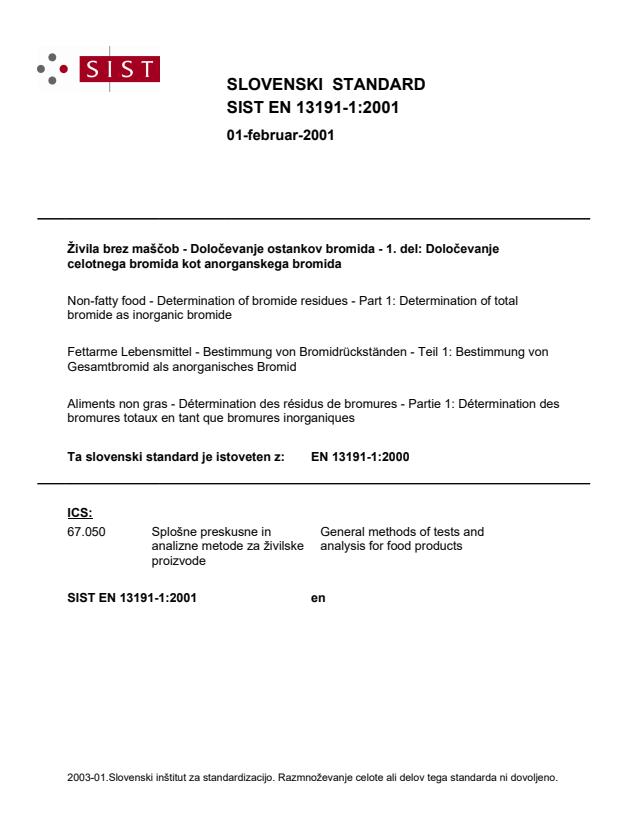
SIST EN 13191-1:2001
(Main)Non-fatty food - Determination of bromide residues - Part 1: Determination of total bromide as inorganic bromide
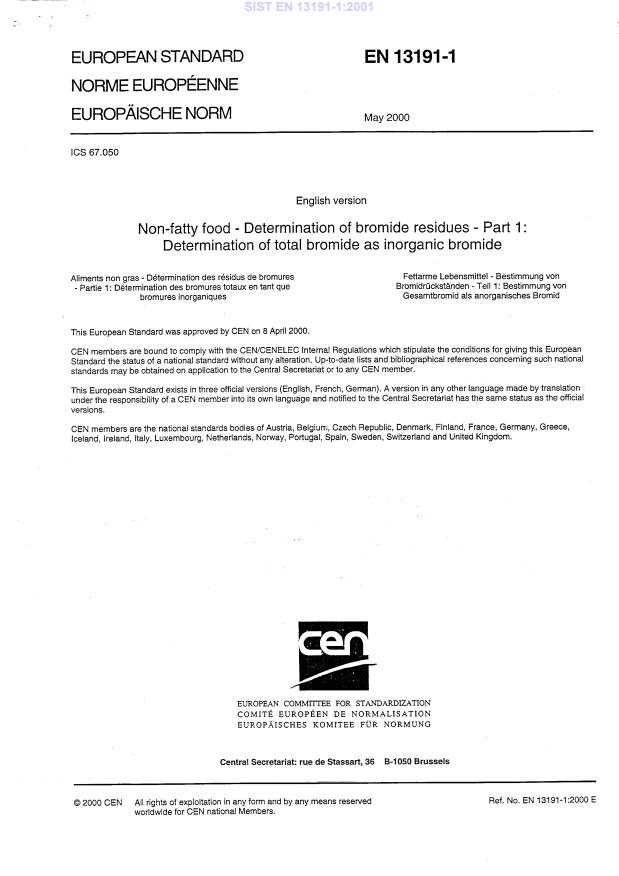
Non-fatty food - Determination of bromide residues - Part 1: Determination of total bromide as inorganic bromide
This European Standard specifies a gas chromatographic (GC) method for the determination of bromide residues (including some organic bromine present) as inorganic bromide in non-fatty foods. Generally, the maximum residue levels are expressed in terms of bromide ion from all sources but not including covalently bound bromine. The method is applicable to beets, carrots, chicory, endives, cereal grains, lettuce, potatoes, spinach, strawberries and tomato. It has been validated in an interlaboratory test on lettuce (1).
Fettarme Lebensmittel - Bestimmung von Bromidrückständen - Teil 1: Bestimmung von Gesamtbromid als anorganisches Bromid
Diese Europäische Norm legt ein gaschromatographisches (GC) Verfahren zur Bestimmung von Bromidrückständen (einschließlich vorhandenem organischem Brom) als anorganisches Bromid in fettarmen Lebensmitteln fest. Im allgemeinen sind die Höchstmengen auf Bromidion aus allen Quellen bezogen, schließen aber kovalent gebundenes Brom nicht ein. Dieses Verfahren ist anwendbar auf Rüben, Karotten, Chicorée, Endivien, Getreide, Salat, Kartoffeln, Spinat, Erdbeeren und Tomaten. Es ist in einem Ringversuch an Salat validiert worden (1).
Aliments non gras - Détermination des résidus de bromures - Partie 1: Détermination des bromures totaux en tant que bromures inorganiques
La présente norme européenne spécifie une méthode par chromatographie en phase gazeuse (CPG) pour la détermination des résidus de bromures (y compris certains bromures organiques présents) en tant que bromures inorganiques dans les aliments non gras. En général, les limites maximales de niveaux de résidus sont exprimées en termes d'ions bromures pour toutes les sources à l'exception du bromure lié par covalence.
Živila brez maščob - Določevanje ostankov bromida - 1. del: Določevanje celotnega bromida kot anorganskega bromida
General Information
- Status
- Published
- Publication Date
- 31-Jan-2001
- Technical Committee
- KŽP - Agricultural food products
- Current Stage
- 6060 - National Implementation/Publication (Adopted Project)
- Start Date
- 01-Feb-2001
- Due Date
- 01-Feb-2001
- Completion Date
- 01-Feb-2001
Relations
- Effective Date
- 28-Jan-2026
Overview
SIST EN 13191-1:2001 is a European Standard developed by CEN that provides a reliable method for determining bromide residues in non-fatty foods. The standard outlines a gas chromatographic (GC) procedure to measure total bromide as inorganic bromide, which includes certain forms of organic bromine present in foods. This method is crucial for food safety laboratories, regulatory agencies, and quality control in the food industry, helping ensure that bromide levels remain within permitted maximum residue limits (MRLs).
By focusing on inorganic bromide analysis, this standard addresses the significant concern regarding bromide residues from various sources in food products, supporting compliance with European regulations on food contaminants.
Key Topics
- Scope of the Standard: Applies specifically to non-fatty food matrices such as beets, carrots, chicory, endives, cereal grains, lettuce, potatoes, spinach, strawberries, and tomatoes.
- Method Employed: Gas chromatographic (GC) determination of bromide residues, which allows sensitive and specific detection of bromide ions even in the presence of some organic bromine compounds.
- Residue Expression: Results are usually expressed as the total bromide ion originating from all sources, excluding covalently bound bromine in food.
- Validation: The method has been validated through interlaboratory tests, ensuring its reliability - particularly demonstrated with lettuce samples.
- Food Safety Compliance: Supports monitoring and enforcement of maximum residue levels in food products as required by EU regulations.
Applications
The implementation of SIST EN 13191-1:2001 is vital across various food safety and analysis scenarios, including:
- Routine Testing in Food Analysis Laboratories: Ensures consistency and accuracy in measuring bromide residues for non-fatty foods.
- Regulatory Monitoring: Enables governmental and EU authorities to verify that food products comply with legal bromide residue limits.
- Quality Control in Food Production: Assists producers and suppliers of cereals, root vegetables, leafy greens, and fruits in monitoring their products to maintain safety certifications and consumer trust.
- Research and Development: Used by food scientists for developing improved processing techniques that minimize unwanted bromide residue in food products.
Related Standards
Several standards complement SIST EN 13191-1:2001 in the field of food residue analysis:
- General Food Testing Standards: EN ISO 17025 (Testing and calibration laboratories - competence requirements)
- Food Safety Standards: Regulation (EC) No 396/2005 on maximum residue levels of pesticides in food and feed
- Other Methods for Bromide and Related Ions: National and international standards may govern alternative methods or different food matrix types.
- EN 13191-2: If available, may provide additional or confirmatory methods for bromide residue determination in foods.
Practical Benefits
Adopting SIST EN 13191-1:2001 brings several practical advantages to stakeholders:
- Harmonization of Testing Procedures across Europe for non-fatty food safety assessments
- Facilitation of International Trade by complying with widely recognized and validated residue analysis methods
- Protection of Consumer Health by enabling the detection of bromide residues at acceptable levels in everyday food products
For organizations and laboratories involved in food testing, following SIST EN 13191-1:2001 ensures adherence to best practices for monitoring bromide residues in non-fatty foods, supporting both regulatory compliance and consumer safety.

Get Certified
Connect with accredited certification bodies for this standard

BSI Group
BSI (British Standards Institution) is the business standards company that helps organizations make excellence a habit.

Bureau Veritas
Bureau Veritas is a world leader in laboratory testing, inspection and certification services.

DNV
DNV is an independent assurance and risk management provider.
Sponsored listings
Frequently Asked Questions
SIST EN 13191-1:2001 is a standard published by the Slovenian Institute for Standardization (SIST). Its full title is "Non-fatty food - Determination of bromide residues - Part 1: Determination of total bromide as inorganic bromide". This standard covers: This European Standard specifies a gas chromatographic (GC) method for the determination of bromide residues (including some organic bromine present) as inorganic bromide in non-fatty foods. Generally, the maximum residue levels are expressed in terms of bromide ion from all sources but not including covalently bound bromine. The method is applicable to beets, carrots, chicory, endives, cereal grains, lettuce, potatoes, spinach, strawberries and tomato. It has been validated in an interlaboratory test on lettuce (1).
This European Standard specifies a gas chromatographic (GC) method for the determination of bromide residues (including some organic bromine present) as inorganic bromide in non-fatty foods. Generally, the maximum residue levels are expressed in terms of bromide ion from all sources but not including covalently bound bromine. The method is applicable to beets, carrots, chicory, endives, cereal grains, lettuce, potatoes, spinach, strawberries and tomato. It has been validated in an interlaboratory test on lettuce (1).
SIST EN 13191-1:2001 is classified under the following ICS (International Classification for Standards) categories: 67.050 - General methods of tests and analysis for food products. The ICS classification helps identify the subject area and facilitates finding related standards.
SIST EN 13191-1:2001 has the following relationships with other standards: It is inter standard links to SIST EN ISO 3696:1998. Understanding these relationships helps ensure you are using the most current and applicable version of the standard.
SIST EN 13191-1:2001 is available in PDF format for immediate download after purchase. The document can be added to your cart and obtained through the secure checkout process. Digital delivery ensures instant access to the complete standard document.
Standards Content (Sample)
2003-01.Slovenski inštitut za standardizacijo. Razmnoževanje celote ali delov tega standarda ni dovoljeno.HYDQMHFettarme Lebensmittel - Bestimmung von Bromidrückständen - Teil 1: Bestimmung von Gesamtbromid als anorganisches BromidAliments non gras - Détermination des résidus de bromures - Partie 1: Détermination des bromures totaux en tant que bromures inorganiquesNon-fatty food - Determination of bromide residues - Part 1: Determination of total bromide as inorganic
...
Questions, Comments and Discussion
Ask us and Technical Secretary will try to provide an answer. You can facilitate discussion about the standard in here.
Loading comments...