

SIST-V ETSI/EG 202 730 V1.1.1:2009
(Main)Electromagnetic compatibility and Radio spectrum Matters (ERM) - Code of Practice in respect of the control, use and application of Ground Probing Radar (GPR) and Wall Probing Radar (WPR) systems and equipment
- Abstract
The existing code of practice is TR102 554 V1.1.1 document, the revised version is being upgraded to an EG, the content will be very similar to the existing document.
- Status
- Published
- Publication Date
- 08-Oct-2009
- Technical Committee
- MOC - Mobile Communications
- Current Stage
- 6060 - National Implementation/Publication (Adopted Project)
- Start Date
- 02-Oct-2009
- Due Date
- 07-Dec-2009
- Completion Date
- 09-Oct-2009
Buy Documents
ETSI EG 202 730 V1.1.1 (2009-07) - Electromagnetic compatibility and Radio spectrum Matters (ERM); Code of Practice in respect of the control, use and application of Ground Probing Radar (GPR) and Wall Probing Radar (WPR) systems and equipment
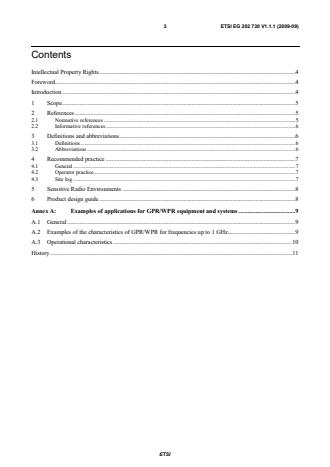
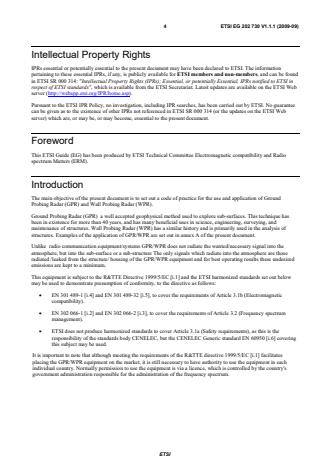
ETSI EG 202 730 V1.1.1 (2009-09) - Electromagnetic compatibility and Radio spectrum Matters (ERM); Code of Practice in respect of the control, use and application of Ground Probing Radar (GPR) and Wall Probing Radar (WPR) systems and equipment

SIST-V ETSI/EG 202 730 V1.1.1:2009 is the Slovenian adoption of ETSI EG 202 730 V1.1.1, an ETSI Guide on electromagnetic compatibility and radio spectrum matters for Ground Probing Radar (GPR) and Wall Probing Radar (WPR). It sets out a code of practice for the control, use and application of GPR/WPR systems and equipment, with practical guidance for operators and manufacturers. The document is aimed at competent professional users and at those designing equipment that must limit unwanted radiation and interference.
What does SIST-V ETSI/EG 202 730 V1.1.1:2009 specify?
SIST-V ETSI/EG 202 730 V1.1.1:2009 specifies recommended practice for controlling and applying GPR and WPR equipment so that useful signals go into the ground or structure, not into the atmosphere. Clause 1 frames the guide as a tool for reducing interference and informing users about proper operating procedures.
The document is organized into:
- Scope
- References
- Definitions and abbreviations
- Recommended practice
- Sensitive Radio Environments
- Product design guide
- Annex A with application examples
| Annex | What it covers |
|---|---|
| Annex A | Examples of applications for GPR/WPR equipment and systems, including technical and operational characteristics |
What are the key requirements of SIST-V ETSI/EG 202 730 V1.1.1:2009?
The main requirements are practical operating rules, logging expectations, precautions near sensitive sites, and design measures that reduce stray radiation. The guide is written so that users can apply it in the field and manufacturers can build equipment around it.
Operator practice
Clause 4.2 says operators should follow the manufacturer’s instructions and keep radiation leakage as low as possible. In practice, that means switching on the transmitter only during measurements, using the required deactivation mechanism, and keeping the operating face in contact with absorptive earth or structural material whenever practical.
Clause 4.2 also tells users to check for nearby sensitive radio sites before planned use. If airfields, radio astronomy sites or similar locations are present, the user should liaise with the responsible organization before measuring.
Site log
Clause 4.3 requires a log for every use of GPR/WPR equipment. The log should capture the map reference, what was measured, the equipment details including antenna data, and the time and date.
This matters because interference questions are easier to investigate when the location, equipment and operating time are recorded. The guide also says an electronic format is ideal because it is easier for spectrum administrations to access.
Sensitive Radio Environments
Clause 5 identifies airfields, prisons, defense establishments and radio astronomy sites as particularly sensitive radio environments. Within 1,5 km of these or other sensitive locations, operators should be especially alert and may need to record details before getting clearance to operate.
For users, this means radio planning is part of the job, not an afterthought. Even where sensitive sites are not obvious, the guide expects the operator to keep following the recommended practice.
Product design guide
Clause 6 gives manufacturers guidance on reducing interference risk by design. It points to antennas that limit radiation away from the material under test, mechanical design that reduces inadvertent emissions, and software or simple sensors such as proximity or tilt sensors to define operating conditions.
The clause also recommends built-in means to record the time and date of measurements. That supports the site log and helps trace any later interference issue.
What terms does SIST-V ETSI/EG 202 730 V1.1.1:2009 define?
- Ground Probing Radar (GPR) - a radar device used to explore sub-surfaces.
- Wall Probing Radar (WPR) - a radar device used for the analysis of sub-structures.
- ElectroMagnetic Compatibility (EMC) - the ability of equipment to operate without creating or suffering unacceptable interference.
- Pulse Repetition Rate (PRF) - the rate at which radar pulses are transmitted.
- Bandwidth (BW) - the range of frequencies occupied by the signal.
- Peak Level (PL) - the peak emission level used in the guide’s technical summary.
- Radar Cross-Section (RCS) - a measure used to describe how a target reflects radar energy.
- Ultra High Frequency (UHF) - a frequency range used in the document’s application examples.
Who uses SIST-V ETSI/EG 202 730 V1.1.1:2009?
The guide is used by manufacturers, operators, and competent professional personnel who deploy GPR/WPR equipment. It is also relevant to radio spectrum administrations and organizations responsible for sensitive sites such as airfields or radio astronomy locations.
In practice, it supports work in geophysical surveying, geological and mining work, foundations, land management, agriculture, civil engineering inspection, utility mapping, archaeology, highway and runway inspection, detailed structural inspection, and anti-personnel mine detection.
What changed in SIST-V ETSI/EG 202 730 V1.1.1:2009 from the previous edition?
SIST-V ETSI/EG 202 730 V1.1.1:2009 is the revised version of TR 102 554 V1.1.1, upgraded from a Technical Report to an ETSI Guide. The scope says the content is intended to remain very similar to the earlier document.
Which standards are used with SIST-V ETSI/EG 202 730 V1.1.1:2009?
Clause 2.2 and the introduction name these companion documents and their roles:
- Directive 1999/5/EC (R&TTE Directive) - the regulatory framework the guide is linked to.
- ETSI EN 302 066-1 - technical characteristics and test methods for GPR/WPR imaging systems.
- ETSI EN 302 066-2 - harmonized requirements covering Article 3.2 spectrum aspects.
- ETSI EN 301 489-1 - common EMC technical requirements for radio equipment and services.
- ETSI EN 301 489-32 - EMC conditions specific to GPR and WPR applications.
- CENELEC EN 60950 - safety standard mentioned for Article 3.1a safety matters.
What does the SIST-V ETSI/EG 202 730 V1.1.1:2009 document contain?
Annex A gives application examples and summarizes typical technical characteristics for different frequency ranges, including tables for GPR/WPR behavior up to 1 GHz. It also summarizes operational characteristics such as soil attenuation and typical uses by application area.
The main body contains the recommended operator practice, logging requirements, precautions for sensitive radio environments, and product design guidance. Together, these sections show what users should do in the field and what manufacturers should consider in equipment design.
Buy Documents
ETSI EG 202 730 V1.1.1 (2009-07) - Electromagnetic compatibility and Radio spectrum Matters (ERM); Code of Practice in respect of the control, use and application of Ground Probing Radar (GPR) and Wall Probing Radar (WPR) systems and equipment
ETSI EG 202 730 V1.1.1 (2009-09) - Electromagnetic compatibility and Radio spectrum Matters (ERM); Code of Practice in respect of the control, use and application of Ground Probing Radar (GPR) and Wall Probing Radar (WPR) systems and equipment
Get Certified
Connect with accredited certification bodies for this standard

ANCE
Mexican certification and testing association.

Intertek Slovenia
Intertek testing, inspection, and certification services in Slovenia.

LNE (Laboratoire National de Métrologie et d'Essais)
French national laboratory for metrology and testing.
Sponsored listings
Frequently Asked Questions
SIST-V ETSI/EG 202 730 V1.1.1:2009 is a standard published by the Slovenian Institute for Standardization (SIST). Its full title is "Electromagnetic compatibility and Radio spectrum Matters (ERM) - Code of Practice in respect of the control, use and application of Ground Probing Radar (GPR) and Wall Probing Radar (WPR) systems and equipment". This standard covers: The existing code of practice is TR102 554 V1.1.1 document, the revised version is being upgraded to an EG, the content will be very similar to the existing document.
The existing code of practice is TR102 554 V1.1.1 document, the revised version is being upgraded to an EG, the content will be very similar to the existing document.
SIST-V ETSI/EG 202 730 V1.1.1:2009 is classified under the following ICS (International Classification for Standards) categories: 33.060.01 - Radiocommunications in general; 33.100.01 - Electromagnetic compatibility in general. The ICS classification helps identify the subject area and facilitates finding related standards.
SIST-V ETSI/EG 202 730 V1.1.1:2009 is available in PDF format for immediate download after purchase. The document can be added to your cart and obtained through the secure checkout process. Digital delivery ensures instant access to the complete standard document.
Standards Content (Sample)
Final draft ETSI EG 202 730 V1.1.1 (2009-07)
ETSI Guide
Electromagnetic compatibility
and Radio spectrum Matters (ERM);
Code of Practice in respect of the control,
use and application of Ground Probing Radar (GPR) and
Wall Probing Radar (WPR) systems and equipment
2 Final draft ETSI EG 202 730 V1.1.1 (2009-07)
Reference
DEG/ERM-TGUWB-010
Keywords
radar, UWB
ETSI
650 Route des Lucioles
F-06921 Sophia Antipolis Cedex - FRANCE
Tel.: +33 4 92 94 42 00 Fax: +33 4 93 65 47 16
Siret N° 348 623 562 00017 - NAF 742 C
Association à but non lucratif enregistrée à la
Sous-Préfecture de Grasse (06) N° 7803/88
Important notice
Individual copies of the present document can be downloaded from:
http://www.etsi.org
The present document may be made available in more than one electronic version or in print. In any case of existing or
perceived difference in contents between such versions, the reference version is the Portable Document Format (PDF).
In case of dispute, the reference shall be the printing on ETSI printers of the PDF version kept on a specific network drive
within ETSI Secretariat.
Users of the present document should be aware that the document may be subject to revision or change of status.
Information on the current status of this and other ETSI documents is available at
http://portal.etsi.org/tb/status/status.asp
If you find errors in the present document, please send your comment to one of the following services:
http://portal.etsi.org/chaircor/ETSI_support.asp
Copyright Notification
No part may be reproduced except as authorized by written permission.
The copyright and the foregoing restriction extend to reproduction in all media.
© European Telecommunications Standards Institute 2009.
All rights reserved.
TM TM TM TM
DECT , PLUGTESTS , UMTS , TIPHON , the TIPHON logo and the ETSI logo are Trade Marks of ETSI registered
for the benefit of its Members.
TM
3GPP is a Trade Mark of ETSI registered for the benefit of its Members and of the 3GPP Organizational Partners.
LTE™ is a Trade Mark of ETSI currently being registered
for the benefit of its Members and of the 3GPP Organizational Partners.
GSM® and the GSM logo are Trade Marks registered and owned by the GSM Association.
ETSI
3 Final draft ETSI EG 202 730 V1.1.1 (2009-07)
Contents
Intellectual Property Rights . 4
Foreword . 4
Introduction . 4
1 Scope . 5
2 References . 5
2.1 Normative references . 5
2.2 Informative references . 6
3 Definitions and abbreviations . 6
3.1 Definitions . 6
3.2 Abbreviations . 6
4 Recommended practice . 7
4.1 General . 7
4.2 Operator practice . 7
4.3 Site log . 7
5 Sensitive Radio Environments . 8
6 Product design guide . 8
Annex A: Examples of applications for GPR/WPR equipment and systems . 9
A.1 General . 9
A.2 Examples of the characteristics of GPR/WPR for frequencies up to 1 GHz . 9
A.3 Operational characteristics . 10
History . 11
ETSI
4 Final draft ETSI EG 202 730 V1.1.1 (2009-07)
Intellectual Property Rights
IPRs essential or potentially essential to the present document may have been declared to ETSI. The information
pertaining to these essential IPRs, if any, is publicly available for ETSI members and non-members, and can be found
in ETSI SR 000 314: "Intellectual Property Rights (IPRs); Essential, or potentially Essential, IPRs notified to ETSI in
respect of ETSI standards", which is available from the ETSI Secretariat. Latest updates are available on the ETSI Web
server (http://webapp.etsi.org/IPR/home.asp).
Pursuant to the ETSI IPR Policy, no investigation, including IPR searches, has been carried out by ETSI. No guarantee
can be given as to the existence of other IPRs not referenced in ETSI SR 000 314 (or the updates on the ETSI Web
server) which are, or may be, or may become, essential to the present document.
Foreword
This ETSI Guide (EG) has been produced by ETSI Technical Committee Electromagnetic compatibility and Radio
spectrum Matters (ERM), and is now submitted for the ETSI standards Membership Approval Procedure.
Introduction
The main objective of the present document is to set out a code of practice for the use and application of Ground
Probing Radar (GPR) and Wall Probing Radar (WPR).
Ground Probing Radar (GPR) a well accepted geophysical method used to explore sub-surfaces. This technique has
been in existence for more than 40 years, and has many beneficial uses in science, engineering, surveying, and
maintenance of structures. Wall Probing Radar (WPR) has a similar history and is primarily used in the analysis of
structures. Examples of the application of GPR/WPR are set out in annex A of the present document.
Unlike radio communication equipment/systems GPR/WPR does not radiate the wanted/necessary signal into the
atmosphere, but into the sub-surface or a sub-structure The only signals which radiate into the atmosphere are those
radiated /leaked from the structure/ housing of the GPR/WPR equipment and for best operating results these undesired
emissions are kept to a minimum.
This equipment is subject to the R&TTE Directive 1999/5/EC [i.1] and the ETSI harmonized standards set out below
may be used to demonstrate presumption of conformity, to the directive as follows:
• EN 301 489-1 [i.4] and EN 301 489-32 [i.5], to cover the requirements of Article 3.1b (Electromagnetic
compatibility).
• EN 302 066-1 [i.2] and EN 302 066-2 [i.3], to cover the requirements of Article 3.2 (Frequency spectrum
management).
• ETSI does not produce harmonized standards to cover Article 3.1a (Safety requirements), as this is the
responsibility of the standards body CENELEC, but the CENELEC Generic standard EN 60950 [i.6] covering
this subject may be used.
It is important to note that although meeting the requirements of the R&TTE directive 1999/5/EC [i.1] facilitates
placing the GPR/WPR equipment on the market, it is still necessary to have authority to use the equipment in each
individual country. Normally permission to use the equipment is via a licence, which is controlled by the country's
government administration responsible for the administration of the frequency spectrum.
ETSI
5 Final draft ETSI EG 202 730 V1.1.1 (2009-07)
1 Scope
The present document sets out the code of practice for the control and application of Ground Probing Radar (GPR) and
Wall Probing Radar (WPR) systems and equipment.
This type of equipment is normally used by competent professional personnel.
Applications of GPR/WPR are shown in the annex A.
The modern world relies on a wide variety of radio systems covering many diverse activities, ranging from systems on
which safety of life depends, through to communications systems used scientifically, and commercially including the
general public, broadcasting and many other applications. These diverse radio systems operate successfully together
because compatibility requirements for each service have been carefully considered in terms of the planning of the radio
frequency spectrum. Radio systems normally operate successfully together, but on occasions because of exceptional
situations interference may occur. In this context GPR/WPR systems are no different to other radio systems.
The undesired radiation emitted from GPR/WPR systems have been carefully evaluated as part of the spectrum
requirements and it has been demonstrated from practical use, that these systems are unlikely to cause interference to
other radio systems.
This code of practice has been produced to ensure that interference from GPR/WPR systems to other radio systems is
minimized, and that GPR/WPR users are made aware of the appropriate procedures set out in the present document.
2 References
References are either specific (identified by date of publication and/or edition number or version number) or non-
specific.
• For a specific reference, subsequent revisions do not apply.
• Non-specific reference may be made only to a complete document or a part thereof and only in the following
cases:
- if it is accepted that it will be possible to use all future changes of the referenced document for the
purposes of the referring document;
- for informative references.
Referenced documents which are not found to be publicly available in the expected location might be found at
http://docbox.etsi.org/Refe
...
ETSI Guide
Electromagnetic compatibility
and Radio spectrum Matters (ERM);
Code of Practice in respect of the control,
use and application of Ground Probing Radar (GPR) and
Wall Probing Radar (WPR) systems and equipment
2 ETSI EG 202 730 V1.1.1 (2009-09)
Reference
DEG/ERM-TGUWB-010
Keywords
radar, UWB
ETSI
650 Route des Lucioles
F-06921 Sophia Antipolis Cedex - FRANCE
Tel.: +33 4 92 94 42 00 Fax: +33 4 93 65 47 16
Siret N° 348 623 562 00017 - NAF 742 C
Association à but non lucratif enregistrée à la
Sous-Préfecture de Grasse (06) N° 7803/88
Important notice
Individual copies of the present document can be downloaded from:
http://www.etsi.org
The present document may be made available in more than one electronic version or in print. In any case of existing or
perceived difference in contents between such versions, the reference version is the Portable Document Format (PDF).
In case of dispute, the reference shall be the printing on ETSI printers of the PDF version kept on a specific network drive
within ETSI Secretariat.
Users of the present document should be aware that the document may be subject to revision or change of status.
Information on the current status of this and other ETSI documents is available at
http://portal.etsi.org/tb/status/status.asp
If you find errors in the present document, please send your comment to one of the following services:
http://portal.etsi.org/chaircor/ETSI_support.asp
Copyright Notification
No part may be reproduced except as authorized by written permission.
The copyright and the foregoing restriction extend to reproduction in all media.
© European Telecommunications Standards Institute 2009.
All rights reserved.
TM TM TM TM
DECT , PLUGTESTS , UMTS , TIPHON , the TIPHON logo and the ETSI logo are Trade Marks of ETSI registered
for the benefit of its Members.
TM
3GPP is a Trade Mark of ETSI registered for the benefit of its Members and of the 3GPP Organizational Partners.
LTE™ is a Trade Mark of ETSI currently being registered
for the benefit of its Members and of the 3GPP Organizational Partners.
GSM® and the GSM logo are Trade Marks registered and owned by the GSM Association.
ETSI
3 ETSI EG 202 730 V1.1.1 (2009-09)
Contents
Intellectual Property Rights . 4
Foreword . 4
Introduction . 4
1 Scope . 5
2 References . 5
2.1 Normative references . 5
2.2 Informative references . 6
3 Definitions and abbreviations . 6
3.1 Definitions . 6
3.2 Abbreviations . 6
4 Recommended practice . 7
4.1 General . 7
4.2 Operator practice . 7
4.3 Site log . 7
5 Sensitive Radio Environments . 8
6 Product design guide . 8
Annex A: Examples of applications for GPR/WPR equipment and systems . 9
A.1 General . 9
A.2 Examples of the characteristics of GPR/WPR for frequencies up to 1 GHz . 9
A.3 Operational characteristics . 10
History . 11
ETSI
4 ETSI EG 202 730 V1.1.1 (2009-09)
Intellectual Property Rights
IPRs essential or potentially essential to the present document may have been declared to ETSI. The information
pertaining to these essential IPRs, if any, is publicly available for ETSI members and non-members, and can be found
in ETSI SR 000 314: "Intellectual Property Rights (IPRs); Essential, or potentially Essential, IPRs notified to ETSI in
respect of ETSI standards", which is available from the ETSI Secretariat. Latest updates are available on the ETSI Web
server (http://webapp.etsi.org/IPR/home.asp).
Pursuant to the ETSI IPR Policy, no investigation, including IPR searches, has been carried out by ETSI. No guarantee
can be given as to the existence of other IPRs not referenced in ETSI SR 000 314 (or the updates on the ETSI Web
server) which are, or may be, or may become, essential to the present document.
Foreword
This ETSI Guide (EG) has been produced by ETSI Technical Committee Electromagnetic compatibility and Radio
spectrum Matters (ERM).
Introduction
The main objective of the present document is to set out a code of practice for the use and application of Ground
Probing Radar (GPR) and Wall Probing Radar (WPR).
Ground Probing Radar (GPR) a well accepted geophysical method used to explore sub-surfaces. This technique has
been in existence for more than 40 years, and has many beneficial uses in science, engineering, surveying, and
maintenance of structures. Wall Probing Radar (WPR) has a similar history and is primarily used in the analysis of
structures. Examples of the application of GPR/WPR are set out in annex A of the present document.
Unlike radio communication equipment/systems GPR/WPR does not radiate the wanted/necessary signal into the
atmosphere, but into the sub-surface or a sub-structure The only signals which radiate into the atmosphere are those
radiated /leaked from the structure/ housing of the GPR/WPR equipment and for best operating results these undesired
emissions are kept to a minimum.
This equipment is subject to the R&TTE Directive 1999/5/EC [i.1] and the ETSI harmonized standards set out below
may be used to demonstrate presumption of conformity, to the directive as follows:
• EN 301 489-1 [i.4] and EN 301 489-32 [i.5], to cover the requirements of Article 3.1b (Electromagnetic
compatibility).
• EN 302 066-1 [i.2] and EN 302 066-2 [i.3], to cover the requirements of Article 3.2 (Frequency spectrum
management).
• ETSI does not produce harmonized standards to cover Article 3.1a (Safety requirements), as this is the
responsibility of the standards body CENELEC, but the CENELEC Generic standard EN 60950 [i.6] covering
this subject may be used.
It is important to note that although meeting the requirements of the R&TTE directive 1999/5/EC [i.1] facilitates
placing the GPR/WPR equipment on the market, it is still necessary to have authority to use the equipment in each
individual country. Normally permission to use the equipment is via a licence, which is controlled by the country's
government administration responsible for the administration of the frequency spectrum.
ETSI
5 ETSI EG 202 730 V1.1.1 (2009-09)
1 Scope
The present document sets out the code of practice for the control and application of Ground Probing Radar (GPR) and
Wall Probing Radar (WPR) systems and equipment.
This type of equipment is normally used by competent professional personnel.
Applications of GPR/WPR are shown in the annex A.
The modern world relies on a wide variety of radio systems covering many diverse activities, ranging from systems on
which safety of life depends, through to communications systems used scientifically, and commercially including the
general public, broadcasting and many other applications. These diverse radio systems operate successfully together
because compatibility requirements for each service have been carefully considered in terms of the planning of the radio
frequency spectrum. Radio systems normally operate successfully together, but on occasions because of exceptional
situations interference may occur. In this context GPR/WPR systems are no different to other radio systems.
The undesired radiation emitted from GPR/WPR systems have been carefully evaluated as part of the spectrum
requirements and it has been demonstrated from practical use, that these systems are unlikely to cause interference to
other radio systems.
This code of practice has been produced to ensure that interference from GPR/WPR systems to other radio systems is
minimized, and that GPR/WPR users are made aware of the appropriate procedures set out in the present document.
2 References
References are either specific (identified by date of publication and/or edition number or version number) or non-
specific.
• For a specific reference, subsequent revisions do not apply.
• Non-specific reference may be made only to a complete document or a part thereof and only in the following
cases:
- if it is accepted that it will be possible to use all future changes of the referenced document for the
purposes of the referring document;
- for informative references.
Referenced documents which are not found to be publicly available in the expected location might be found at
http://docbox.etsi.org/Reference.
NOTE: While any hyperlinks included in
...
SLOVENSKI STANDARD
01-november-2009
Elektromagnetna združljivost in zadeve v zvezi z radijskim spektrom (ERM) -
Pravila ravnanja glede nadzora, uporabe in delovanja sistemov in opreme radarja
za sondiranje tal (GPR) in radarja za sondiranje zidov (WPR)
Electromagnetic compatibility and Radio spectrum Matters (ERM) - Code of Practice in
respect of the control, use and application of Ground Probing Radar (GPR) and Wall
Probing Radar (WPR) systems and equipment
Ta slovenski standard je istoveten z: EG 202 730 Version 1.1.1
ICS:
33.060.01 Radijske komunikacije na Radiocommunications in
splošno general
33.100.01 Elektromagnetna združljivost Electromagnetic compatibility
na splošno in general
2003-01.Slovenski inštitut za standardizacijo. Razmnoževanje celote ali delov tega standarda ni dovoljeno.
ETSI Guide
Electromagnetic compatibility
and Radio spectrum Matters (ERM);
Code of Practice in respect of the control,
use and application of Ground Probing Radar (GPR) and
Wall Probing Radar (WPR) systems and equipment
2 ETSI EG 202 730 V1.1.1 (2009-09)
Reference
DEG/ERM-TGUWB-010
Keywords
radar, UWB
ETSI
650 Route des Lucioles
F-06921 Sophia Antipolis Cedex - FRANCE
Tel.: +33 4 92 94 42 00 Fax: +33 4 93 65 47 16
Siret N° 348 623 562 00017 - NAF 742 C
Association à but non lucratif enregistrée à la
Sous-Préfecture de Grasse (06) N° 7803/88
Important notice
Individual copies of the present document can be downloaded from:
http://www.etsi.org
The present document may be made available in more than one electronic version or in print. In any case of existing or
perceived difference in contents between such versions, the reference version is the Portable Document Format (PDF).
In case of dispute, the reference shall be the printing on ETSI printers of the PDF version kept on a specific network drive
within ETSI Secretariat.
Users of the present document should be aware that the document may be subject to revision or change of status.
Information on the current status of this and other ETSI documents is available at
http://portal.etsi.org/tb/status/status.asp
If you find errors in the present document, please send your comment to one of the following services:
http://portal.etsi.org/chaircor/ETSI_support.asp
Copyright Notification
No part may be reproduced except as authorized by written permission.
The copyright and the foregoing restriction extend to reproduction in all media.
© European Telecommunications Standards Institute 2009.
All rights reserved.
TM TM TM TM
DECT , PLUGTESTS , UMTS , TIPHON , the TIPHON logo and the ETSI logo are Trade Marks of ETSI registered
for the benefit of its Members.
TM
3GPP is a Trade Mark of ETSI registered for the benefit of its Members and of the 3GPP Organizational Partners.
LTE™ is a Trade Mark of ETSI currently being registered
for the benefit of its Members and of the 3GPP Organizational Partners.
GSM® and the GSM logo are Trade Marks registered and owned by the GSM Association.
ETSI
3 ETSI EG 202 730 V1.1.1 (2009-09)
Contents
Intellectual Property Rights . 4
Foreword . 4
Introduction . 4
1 Scope . 5
2 References . 5
2.1 Normative references . 5
2.2 Informative references . 6
3 Definitions and abbreviations . 6
3.1 Definitions . 6
3.2 Abbreviations . 6
4 Recommended practice . 7
4.1 General . 7
4.2 Operator practice . 7
4.3 Site log . 7
5 Sensitive Radio Environments . 8
6 Product design guide . 8
Annex A: Examples of applications for GPR/WPR equipment and systems . 9
A.1 General . 9
A.2 Examples of the characteristics of GPR/WPR for frequencies up to 1 GHz . 9
A.3 Operational characteristics . 10
History . 11
ETSI
4 ETSI EG 202 730 V1.1.1 (2009-09)
Intellectual Property Rights
IPRs essential or potentially essential to the present document may have been declared to ETSI. The information
pertaining to these essential IPRs, if any, is publicly available for ETSI members and non-members, and can be found
in ETSI SR 000 314: "Intellectual Property Rights (IPRs); Essential, or potentially Essential, IPRs notified to ETSI in
respect of ETSI standards", which is available from the ETSI Secretariat. Latest updates are available on the ETSI Web
server (http://webapp.etsi.org/IPR/home.asp).
Pursuant to the ETSI IPR Policy, no investigation, including IPR searches, has been carried out by ETSI. No guarantee
can be given as to the existence of other IPRs not referenced in ETSI SR 000 314 (or the updates on the ETSI Web
server) which are, or may be, or may become, essential to the present document.
Foreword
This ETSI Guide (EG) has been produced by ETSI Technical Committee Electromagnetic compatibility and Radio
spectrum Matters (ERM).
Introduction
The main objective of the present document is to set out a code of practice for the use and application of Ground
Probing Radar (GPR) and Wall Probing Radar (WPR).
Ground Probing Radar (GPR) a well accepted geophysical method used to explore sub-surfaces. This technique has
been in existence for more than 40 years, and has many beneficial uses in science, engineering, surveying, and
maintenance of structures. Wall Probing Radar (WPR) has a similar history and is primarily used in the analysis of
structures. Examples of the application of GPR/WPR are set out in annex A of the present document.
Unlike radio communication equipment/systems GPR/WPR does not radiate the wanted/necessary signal into the
atmosphere, but into the sub-surface or a sub-structure The only signals which radiate into the atmosphere are those
radiated /leaked from the structure/ housing of the GPR/WPR equipment and for best operating results these undesired
emissions are kept to a minimum.
This equipment is subject to the R&TTE Directive 1999/5/EC [i.1] and the ETSI harmonized standards set out below
may be used to demonstrate presumption of conformity, to the directive as follows:
• EN 301 489-1 [i.4] and EN 301 489-32 [i.5], to cover the requirements of Article 3.1b (Electromagnetic
compatibility).
• EN 302 066-1 [i.2] and EN 302 066-2 [i.3], to cover the requirements of Article 3.2 (Frequency spectrum
management).
• ETSI does not produce harmonized standards to cover Article 3.1a (Safety requirements), as this is the
responsibility of the standards body CENELEC, but the CENELEC Generic standard EN 60950 [i.6] covering
this subject may be used.
It is important to note that although meeting the requirements of the R&TTE directive 1999/5/EC [i.1] facilitates
placing the GPR/WPR equipment on the market, it is still necessary to have authority to use the equipment in each
individual country. Normally permission to use the equipment is via a licence, which is controlled by the country's
government administration responsible for the administration of the frequency spectrum.
ETSI
5 ETSI EG 202 730 V1.1.1 (2009-09)
1 Scope
The present document sets out the code of practice for the control and application of Ground Probing Radar (GPR) and
Wall Probing Radar (WPR) systems and equipment.
This type of equipment is normally used by competent professional personnel.
Applications of GPR/WPR are shown in the annex A.
The modern world relies on a wide variety of radio systems covering many diverse activities, ranging from systems on
which safety of life depends, through to communications systems used scientifically, and commercially including the
general public, broadcasting and many other applications. These diverse radio systems operate successfully together
because compatibility requirements for each service have been carefully considered in terms of the planning of the radio
frequency spectrum. Radio systems normally operate successfully together, but on occasions because of exceptional
situations interference may occur. In this context GPR/WPR systems are no different to other radio systems.
The undesired radiation emitted from GPR/WPR systems have been carefully evaluated as part of the spectrum
requirements and it has been demonstrated from practical use, that these systems are unlikely to cause interference to
other radio systems.
This code of practice has been produced to ensure that interference from GPR/WPR systems to other radio systems is
minimized, and that GPR/WPR users are made aware of the appropriate procedures set out in the present document.
2 References
References are either specific (identified by date of publication and/or edition number or version number) or non-
specific.
• For a specific reference, subsequent revisi
...