

SIST EN 12469-1:2026
(Main)Biological safety cabinets - Part 1: Classes and basic requirements
General Information
- Abstract
This document specifies the minimum requirements for BSC with respect to design, construction, safety and hygiene and gives general test methods for their verification.
The requirements for the different classes are given in the respective parts of EN 12469.
- Status
- Published
- Public Enquiry End Date
- 18-Sep-2024
- Publication Date
- 07-Dec-2025
- Technical Committee
- I13 - Imaginarni 13
- Current Stage
- 6060 - National Implementation/Publication (Adopted Project)
- Start Date
- 04-Dec-2025
- Due Date
- 08-Feb-2026
- Completion Date
- 08-Dec-2025

Overview
SIST EN 12469-1:2026, published by CEN, establishes the minimum requirements for biological safety cabinets (BSC) in terms of design, construction, safety, and hygiene, alongside general test methods for verification. This European Standard, a core part of the EN 12469 series, serves as a foundational reference for stakeholders in laboratory safety, specifying minimum provisions to ensure operator, product, and environmental protection when handling biological agents and hazardous microorganisms.
BSCs are essential for risk control in laboratories dealing with biological agents. The standard applies to new BSCs and supports manufacturers, laboratory personnel, safety officers, and facility designers by specifying minimum requirements for safety, containment, performance, and hygiene.
Key Topics
BSC Classes: EN 12469-1 categorizes biological safety cabinets into three main classes (I, II, III), each offering distinct levels of protection:
- Class I: Protection for operator and environment.
- Class II: Protection for operator, environment, product, and cross-contamination.
- Class III: Maximum protection via a fully enclosed workspace with barrier systems (e.g. glove boxes).
Design and Construction:
- Requirements for stability, ergonomic access (knee and footwell dimensions), and cleanability.
- Use of materials resistant to cleaning, disinfection, and bio-decontamination agents.
- Filter systems must meet HEPA standards (e.g., H14 efficiency) and ensure tight seals to prevent leakage.
- Glazing must comply with impact resistance standards, and sashes must remain secure in case of single faults.
Safety Features:
- Alarm systems: mandatory audible and visual indicators for critical failures; compliance with EN 842 and EN ISO 7731.
- Electrical safety and protection of sockets as per EN 61010-1 and EN 60529.
- Provisions for safe gas supply connections in line with EN 13792, discouraging flammable gas use inside BSCs.
Testing and Verification:
- Type and Factory Tests: Confirmation that all design and safety criteria are met prior to use.
- Commissioning and Routine Testing: Ensure ongoing compliance, recommended at least annually or per risk assessment.
- Verification includes airflow patterns, filter efficiency, noise, and vibration levels.
Documentation and Marking:
- Cabinets must be provided with comprehensive operating manuals, logbooks, and brief usage instructions for safe operation and maintenance.
- ID plates with key identification and performance data are required.
Applications
SIST EN 12469-1:2026 is crucial for:
- Laboratory environments (clinical, research, pharmaceutical, industrial) handling hazardous or potentially hazardous biological materials.
- Organizations seeking regulatory compliance for biosafety and biocontainment.
- Procurement of BSCs meeting recognized European quality and safety marks.
- Training and operational protocols for laboratory staff and biosafety officers.
- Guidance for facility designers and engineers to ensure laboratories meet biosafety containment requirements for different classes of biological agents.
Related Standards
To ensure comprehensive laboratory biosafety, reference should also be made to:
- EN 12469-2: BSC Class II requirements
- EN 12469-3: BSC Class III requirements
- EN 12469-4: BSC Class I requirements
- EN 12469-5: Installation, commissioning, and routine testing procedures
- EN 1822-1: High efficiency air filters (HEPA/ULPA) specifications
- EN 61010-1: Electrical safety for laboratory equipment
- EN ISO 14644-3: Cleanroom test methods
Implementing SIST EN 12469-1:2026 enhances laboratory biosafety, strengthens containment protocols, and ensures equipment performance and hygiene, supporting a safer research environment and regulatory compliance across Europe.
Relations
- Splited From
SIST EN 12469:2000 - Biotechnology - Performance criteria for microbiological safety cabinets - Effective Date
- 09-Aug-2023
- Effective Date
- 18-Mar-2026
- Effective Date
- 09-Feb-2026
- Effective Date
- 09-Feb-2026
- Effective Date
- 09-Feb-2026
- Effective Date
- 09-Feb-2026
- Effective Date
- 28-Jan-2026
- Effective Date
- 28-Jan-2026
- Effective Date
- 28-Jan-2026
- Effective Date
- 28-Jan-2026
- Effective Date
- 28-Jan-2026
- Effective Date
- 28-Jan-2026
- Effective Date
- 28-Jan-2026
- Effective Date
- 28-Jan-2026
- Effective Date
- 28-Jan-2026
Frequently Asked Questions
SIST EN 12469-1:2026 is a standard published by the Slovenian Institute for Standardization (SIST). Its full title is "Biological safety cabinets - Part 1: Classes and basic requirements". This standard covers: This document specifies the minimum requirements for BSC with respect to design, construction, safety and hygiene and gives general test methods for their verification. The requirements for the different classes are given in the respective parts of EN 12469.
This document specifies the minimum requirements for BSC with respect to design, construction, safety and hygiene and gives general test methods for their verification. The requirements for the different classes are given in the respective parts of EN 12469.
SIST EN 12469-1:2026 is classified under the following ICS (International Classification for Standards) categories: 07.080 - Biology. Botany. Zoology; 07.100.01 - Microbiology in general. The ICS classification helps identify the subject area and facilitates finding related standards.
SIST EN 12469-1:2026 has the following relationships with other standards: It is inter standard links to SIST EN 12469:2000, SIST ISO 6706:1995, SIST EN IEC/IEEE 82079-1:2020, SIST EN 61672-1:2014, SIST EN 60529:1997, SIST EN 61010-1:2010, SIST EN 13792:2002, SIST EN ISO 14738:2009, SIST EN ISO 7731:2008, SIST EN ISO 9017:2018, SIST EN 12600:2004, SIST EN 15008:2007, SIST EN ISO 8041-1:2017, SIST EN 842:1998+A1:2008, SIST EN ISO 5349-2:2002. Understanding these relationships helps ensure you are using the most current and applicable version of the standard.
SIST EN 12469-1:2026 is associated with the following European legislation: EU Directives/Regulations: 90/219/EEC, 90/220/EEC, 90/679/EEC; Standardization Mandates: M/BC/CEN/91/19. When a standard is cited in the Official Journal of the European Union, products manufactured in conformity with it benefit from a presumption of conformity with the essential requirements of the corresponding EU directive or regulation.
SIST EN 12469-1:2026 is available in PDF format for immediate download after purchase. The document can be added to your cart and obtained through the secure checkout process. Digital delivery ensures instant access to the complete standard document.
Standards Content (Sample)
SLOVENSKI STANDARD
01-januar-2026
Biološke varnostne omare - 1. del: Razredi in osnovne zahteve
Biological safety cabinets - Part 1: Classes and basic requirements
Biologische Sicherheitswerkbänke - Teil 1: Klassen und grundlegende Anforderungen
Postes de sécurité biologique - Partie 1: Types et exigences fondamentales
Ta slovenski standard je istoveten z: EN 12469-1:2025
ICS:
07.080 Biologija. Botanika. Zoologija Biology. Botany. Zoology
07.100.01 Mikrobiologija na splošno Microbiology in general
2003-01.Slovenski inštitut za standardizacijo. Razmnoževanje celote ali delov tega standarda ni dovoljeno.
EN 12469-1
EUROPEAN STANDARD
NORME EUROPÉENNE
November 2025
EUROPÄISCHE NORM
ICS 07.080
English Version
Biological safety cabinets - Part 1: Classes and basic
requirements
Postes de sécurité microbiologique - Partie 1: Types et Biologische Sicherheitswerkbänke - Teil 1: Klassen und
exigences fondamentales grundlegende Anforderungen
This European Standard was approved by CEN on 5 October 2025.
CEN members are bound to comply with the CEN/CENELEC Internal Regulations which stipulate the conditions for giving this
European Standard the status of a national standard without any alteration. Up-to-date lists and bibliographical references
concerning such national standards may be obtained on application to the CEN-CENELEC Management Centre or to any CEN
member.
This European Standard exists in three official versions (English, French, German). A version in any other language made by
translation under the responsibility of a CEN member into its own language and notified to the CEN-CENELEC Management
Centre has the same status as the official versions.
CEN members are the national standards bodies of Austria, Belgium, Bulgaria, Croatia, Cyprus, Czech Republic, Denmark, Estonia,
Finland, France, Germany, Greece, Hungary, Iceland, Ireland, Italy, Latvia, Lithuania, Luxembourg, Malta, Netherlands, Norway,
Poland, Portugal, Republic of North Macedonia, Romania, Serbia, Slovakia, Slovenia, Spain, Sweden, Switzerland, Türkiye and
United Kingdom.
EUROPEAN COMMITTEE FOR STANDARDIZATION
COMITÉ EUROPÉEN DE NORMALISATION
EUROPÄISCHES KOMITEE FÜR NORMUNG
CEN-CENELEC Management Centre: Rue de la Science 23, B-1040 Brussels
© 2025 CEN All rights of exploitation in any form and by any means reserved Ref. No. EN 12469-1:2025 E
worldwide for CEN national Members.
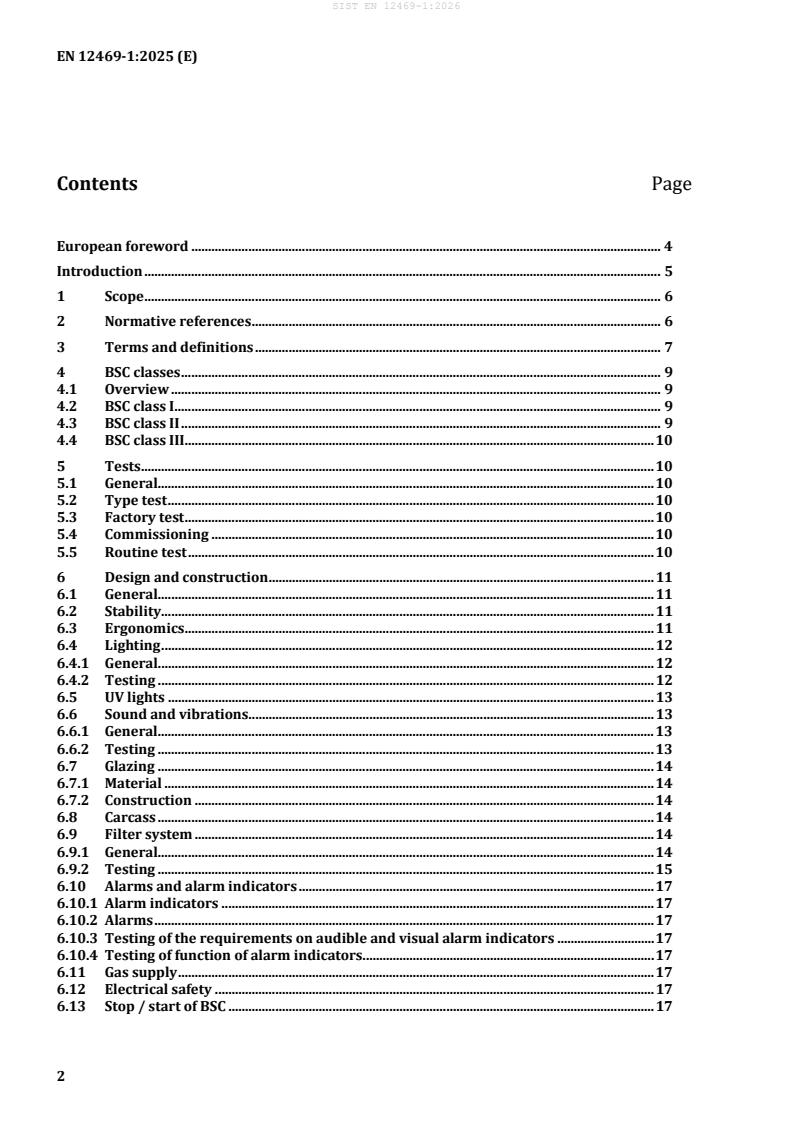
Contents Page
European foreword . 4
Introduction . 5
1 Scope . 6
2 Normative references . 6
3 Terms and definitions . 7
4 BSC classes . 9
4.1 Overview . 9
4.2 BSC class I . 9
4.3 BSC class II . 9
4.4 BSC class III. 10
5 Tests . 10
5.1 General. 10
5.2 Type test . 10
5.3 Factory test . 10
5.4 Commissioning . 10
5.5 Routine test . 10
6 Design and construction . 11
6.1 General. 11
6.2 Stability . 11
6.3 Ergonomics . 11
6.4 Lighting . 12
6.4.1 General. 12
6.4.2 Testing . 12
6.5 UV lights . 13
6.6 Sound and vibrations. 13
6.6.1 General. 13
6.6.2 Testing . 13
6.7 Glazing . 14
6.7.1 Material . 14
6.7.2 Construction . 14
6.8 Carcass . 14
6.9 Filter system . 14
6.9.1 General. 14
6.9.2 Testing . 15
6.10 Alarms and alarm indicators . 17
6.10.1 Alarm indicators . 17
6.10.2 Alarms . 17
6.10.3 Testing of the requirements on audible and visual alarm indicators . 17
6.10.4 Testing of function of alarm indicators. 17
6.11 Gas supply . 17
6.12 Electrical safety . 17
6.13 Stop / start of BSC . 17
6.14 Connection to exhaust systems. 18
6.15 Cleanability . 18
6.15.1 General . 18
6.15.2 Testing . 18
6.16 Bio-decontaminability . 19
6.17 Spillage tray . 19
7 Airflows . 19
8 Accompanying documents . 19
8.1 Operating manual . 19
8.1.1 General information . 19
8.1.2 Procedures for cleaning and bio-decontamination . 20
8.2 Equipment logbook . 20
8.3 Brief instructions for use . 20
9 Marking – ID plate . 21
Annex A (normative) Test room requirements . 22
A.1 Dimensions and construction . 22
A.2 Test room conditions . 22
A.3 BSC installation . 22
A.4 Test conditions . 23
A.4.1 General . 23
A.4.2 Test conditions for microbiological testing . 23
Bibliography . 24
European foreword
This document (EN 12469-1:2025) has been prepared by Technical Committee CEN/TC 332 “Laboratory
Equipment”, the secretariat of which is held by DIN.
This European Standard shall be given the status of a national standard, either by publication of an
identical text or by endorsement, at the latest by May 2026, and conflicting national standards shall be
withdrawn at the latest by May 2026.
Attention is drawn to the possibility that some of the elements of this document may be the subject of
patent rights. CEN shall not be held responsible for identifying any or all such patent rights.
1 2
This document, together with EN 12469-2:2025, prEN 12469-3:— prEN 12469-4:— and
EN 12469-5:2025, will partially supersede EN 12469:2000.
— the structure has been changed to emphasize different classes of biological safety cabinets (BSC);
— the text of the entire document has been revised and references have been updated.
EN 12469 consists of the following parts, under the general title Biological safety cabinets:
— Part 1: Classes and basic requirements
— Part 2: BSC class II
— Part 3: BSC class III
— Part 4: BSC class I
— Part 5: Installation, commissioning and routine testing
This document has been prepared under a standardization request addressed to CEN by the European
Commission. The Standing Committee of the EFTA States subsequently approves these requests for its
Member States.
Any feedback and questions on this document should be directed to the users’ national standards body.
A complete listing of these bodies can be found on the CEN website.
According to the CEN-CENELEC Internal Regulations, the national standards organisations of the
following countries are bound to implement this European Standard: Austria, Belgium, Bulgaria, Croatia,
Cyprus, Czech Republic, Denmark, Estonia, Finland, France, Germany, Greece, Hungary, Iceland, Ireland,
Italy, Latvia, Lithuania, Luxembourg, Malta, Netherlands, Norway, Poland, Portugal, Republic of North
Macedonia, Romania, Serbia, Slovakia, Slovenia, Spain, Sweden, Switzerland, Türkiye and the United
Kingdom.
Under preparation.
Under preparation.
Introduction
Biological safety cabinets (BSC) are designed to protect the operator and the environment against the
risks associated with the handling of biological agents. Depending on the classes, a BSC can additionally
protect the product.
Each BSC class has its own design and performance criteria. The choice of a BSC class depends on the type
of protection required and the assessment of the risk to be controlled.
EN 12469 describes the BSC classes, their design, correct usage, and testing principles.
This document is a product standard. Occupational health and safety assessments methods are not
included.
1 Scope
This document specifies the minimum requirements for BSC with respect to design, construction, safety
and hygiene and gives general test methods for their verification.
The requirements for the different classes are given in the respective parts of EN 12469.
2 Normative references
The following documents are referred to in the text in such a way that some or all of their content
constitutes requirements of this document. For dated references, only the edition cited applies. For
undated references, the latest edition of the referenced document (including any amendments) applies.
EN 842, Safety of machinery – Visual danger signals – General requirements, design and testing
EN 1822-1, High efficiency air filters (EPA, HEPA and ULPA) - Part 1: Classification, performance testing,
marking
EN 12600, Glass in building - Pendulum test - Impact test method and classification for flat glass
EN 13792, Colour coding of taps and valves for use in laboratories
EN 60529, Degrees of protection provided by enclosures (IP Code) (IEC 60529)
EN 61010-1, Safety requirements for electrical equipment for measurement, control, and laboratory use -
Part 1: General requirements (IEC 61010-1)
EN 61672-1, Electroacoustics - Sound level meters - Part 1: Specifications (IEC 61672-1)
EN ISO 5349-2, Mechanical vibration - Measurement and evaluation of human exposure to hand-
transmitted vibration - Part 2: Practical guidance for measurement at the workplace (ISO 5349-2)
EN ISO 7731, Ergonomics - Danger signals for public and work areas - Auditory danger signals (ISO 7731)
EN ISO 8041-1, Human response to vibration - Measuring instrumentation - Part 1: General purpose
vibration meters (ISO 8041-1)
EN ISO 11201:2010, Acoustics - Noise emitted by machinery and equipment - Determination of emission
sound pressure levels at a work station and at other specified positions in an essentially free field over a
reflecting plane with negligible environmental corrections (ISO 11201:2010)
EN ISO 14644-3, Cleanrooms and associated controlled environments - Part 3: Test methods (ISO 14644-3)
EN ISO 14738, Safety of machinery - Anthropometric requirements for the design of workstations at
machinery (ISO 14738)
EN IEC/IEEE 82079-1, Preparation of instructions for use - Structuring, content and presentation - Part 1:
General principles and detailed requirements
ISO 6706, Plastics laboratory ware — Graduated measuring cylinders
ISO/CIE 19476, Characterization of the performance of illuminance meters and luminance meters
3 Terms and definitions
For the purposes of this document, the following terms and definitions apply.
ISO and IEC maintain terminology databases for use in standardization at the following addresses:
— ISO Online browsing platform: available at https://www.iso.org/obp/
— IEC Electropedia: available at https://www.electropedia.org/
3.1
biological agent
any biological entity, cellular or non-cellular, naturally occurring or engineered, capable of replication or
of transferring genetic material that could be able to provoke infection, allergy, toxicity or other adverse
effects in humans, animals, or plants
Note 1 to entry: The definition of biological agents covers commonly used terms, such as pathogens, quarantine
microorganisms, microorganisms of dual-use potential.
Note 2 to entry: For the purpose of this document, prions are regarded as biological agents.
3.2
biological safety cabinet
BSC
ventilated enclosure intended to offer protection to the operator and the environment from the aerosols,
arising from the handling of potentially hazardous and hazardous microorganisms, with air discharged
to the atmosphere being filtered
Note 1 to entry: There are different classes of BSCs (see Clause 4).
3.3
carcass
cabinet body that includes e.g. the exterior surface welds, gaskets and seals
3.4
cleaning
removal of unwanted material from an object
3.5
containment
state achieved by a BSC with a defined degree of separation between operator and operation
3.6
cross-contamination
transfer of contaminants from one surface or component to another within the designated working area
3.7
bio-decontamination
removal and/or reduction of biological contaminants to an acceptable level
Note 1 to entry: The method of biological bio-decontamination used (e.g. application of hydrogen peroxide) should
be chosen to the intended use of the item decontaminated.
[SOURCE: ISO 11139:2018]
3.8
designated working area
area within the BSC workspace as described in the operating manual where performance is measured in
accordance with this document to establish operating performance relevant to protection of the operator,
and/or product protection including cross-contamination as necessary for the classes of BSC
3.9
disinfection
process to reduce the number of viable biological agents, by a suitable method to a desired level suitable
for further safe handling or use
Note 1 to entry: Suitable methods are wipe and spray techniques.
3.10
downflow
unidirectional airflow, flowing downward through the designated working area
3.11
filter system
system including filter, fittings, seals and other connecting parts
3.12
front aperture
opening to the working area on the front side of the BSC, which is limited by the sash
3.13
inflow
airflow from the outside of the BSC through the front aperture
3.14
inner space of the cabinet
possibly contaminated area
3.15
intake grill
air suction opening through which supply and/or recirculating air is drawn in
3.16
nominal set point
settings that the manufacturer designates at which the cabinet is intended to operate and at which it
provides the protective functions
3.17
operator protection
personal protection
protection of the operator from exposure to hazardous aerosols present inside the BSC
3.18
outer space of the cabinet
all parts of the BSC that do not belong to the inner space
Note 1 to entry: These are parts of the safety cabinet that do not come into contact with potentially contaminated
air and that are not in contact with the work material during intended use.
3.19
product protection
protection of a product against contamination from the outside entering the working area of the BSC
3.20
protective functions
generic term for the individual protective functions of the BSC, which are divided into operator
protection, environmental protection, product protection and cross-contamination protection
Note 1 to entry: Which protective functions apply to which class of BSC can be found in Clause 4, Table 1.
3.21
provocation points
PP
combination of airflow settings with defined deviations from the nominal setpoint
3.22
sash
front window
front visor
front screen
window located at the front of the BSC that forms a barrier between the operator and the designated
working area
4 BSC classes
4.1 Overview
Table 1 gives an overview of the BSC classes and minimum designated protection functions.
Table 1 — Designated protection functions for different BSC classes
Class
Protection
I II III
operator X X X
environmental X X X
product X X
cross-contamination X
4.2 BSC class I
A BSC class I is a BSC with a front aperture through which the operator can carry out manipulations inside
the cabinet and which is constructed so that the operator and the environment is protected. The escape
of airborne particulate contamination generated within the cabinet is controlled by means of an inward
airflow through the working front aperture and filtration of the exhaust air.
4.3 BSC class II
A BSC class II is a BSC with a front aperture through which the operator can carry out manipulations
inside the cabinet. The escape of airborne particulate contamination generated within the cabinet is
controlled by means of appropriate filtration and airflows. It provides operator, environmental and
product protection including protection against cross-contamination.
NOTE A typical way of achieving this is by means of a unidirectional downward airflow inside and in addition
an inflow at the front aperture.
4.4 BSC class III
A BSC class III is a BSC in which the working area is totally enclosed, and the operator is separated from
the work by a physical barrier in which filtered air is continuously supplied to the cabinet and the exhaust
air is controlled by means of appropriate filtration. It provides operator, environmental and p
...