

SIST EN 1888-3:2025
(Main)Child care articles - Wheeled child conveyances - Part 3: Pushchairs intended for leisure sport activities
General Information
- Abstract
This document specifies the safety requirements of pushchairs when used for running/jogging or skating (excluding ice skating), intended for the transport of one or two children up to 15 or 22 kg each.
Pushchairs intended to transport the carer while pushing (e.g. the combination of longboard and stroller) are excluded from the scope of this document.
This document applies in conjunction with and in addition to the European standards EN 1888 1:2018+A1:2022 or EN 1888-2:2018+A1:2022 and it cannot be used separately.
If the product has several functions or can be converted into another function, the relevant European standards apply to it.
- Status
- Published
- Public Enquiry End Date
- 31-Jul-2023
- Publication Date
- 16-Jun-2025
- Technical Committee
- OTR - Child use and care article
- Current Stage
- 6060 - National Implementation/Publication (Adopted Project)
- Start Date
- 16-Dec-2024
- Due Date
- 20-Feb-2025
- Completion Date
- 17-Jun-2025
- Directive
- 2001/95/EC - General product safety

Overview
SIST EN 1888-3:2025 is a European standard that specifies safety requirements for pushchairs intended for leisure sport activities. Developed by the Slovenian Institute for Standardization (SIST), this standard focuses on pushchairs designed for running, jogging, or skating (excluding ice skating) with one or two children, each weighing up to 15 kg or 22 kg. It ensures a higher level of safety during active transport of children, reflecting the special demands of sports use compared to everyday pushchairs.
This standard works in conjunction with EN 1888‑1:2018+A1:2022 and EN 1888‑2:2018+A1:2022 and cannot be applied in isolation. Products with multiple functions or convertibility must also meet all applicable European standards.
Key Topics
Scope and Applicability
- Covers pushchairs for running, jogging, and skating except ice skating
- For transporting children (not the carer) up to 15 kg or 22 kg each
- Excludes devices intended to carry both a child and the carer (such as stroller-longboard combinations)
Enhanced Safety Requirements
- Reinforced restraint systems with crotch and shoulder restraints for increased protection
- Specific protections against mechanical hazards (structural integrity, stability, entanglement, protrusions)
- Braking systems designed for higher speeds and more demanding emergency braking scenarios
- Visibility: Mandatory use of reflectors or retroreflective materials on all sides
Testing and Performance
- Additional performance tests for use at higher speeds
- Comprehensive wheel attachment and retention tests to prevent detachment under dynamic loads
- Suitability and stability under simulated real-world running/jogging conditions
Product Information and Warnings
- Mandatory age and weight warnings (prohibition of use for children under 9 months for sport activities)
- User instructions on safest seating, restraint system usage, braking operation, and clothing/protective gear
- Clear marking and purchase information in the country’s official language(s)
Applications
SIST EN 1888-3:2025 applies to manufacturers, importers, and distributors of sport-oriented pushchairs in European markets – especially those used for jogging, running, or skating with children. It is directly relevant for:
- Childcare product designers and safety engineers
- Testing laboratories and certification bodies
- Retailers offering specialized running or sport pushchairs
- Product compliance professionals and regulatory authorities
By complying with this standard, stakeholders ensure that child conveyances used for sport activities meet harmonized European safety expectations, helping reduce accidents and increase consumer confidence.
Related Standards
EN 1888‑1:2018+A1:2022
Child care articles – Wheeled child conveyances – Part 1: General safety requirements for pushchairs and prams; a core document that must be met for all products.EN 1888‑2:2018+A1:2022
Child care articles – Wheeled child conveyances – Part 2: Pushchairs for children above 15 kg up to 22 kg; applies where higher weight limits are relevant.Other references
ISO and IEC terminology databases for standardization, and references to international best practices in child equipment safety.
Practical Value
Adhering to SIST EN 1888-3:2025 ensures products are fit for active lifestyles while protecting young riders against hazards unique to running or skating. Compliance provides:
- Market access in European countries aligned with CEN/CENELEC rules
- Reputation for safety and quality, key for branding in child care equipment
- Protection against liability by demonstrating due diligence in product design and instructions
Overall, this standard supports safer family participation in leisure sport activities by setting a clear safety benchmark for pushchairs used in dynamic and potentially hazardous environments.
Relations
- Effective Date
- 28-Jan-2026
- Effective Date
- 28-Jan-2026
Frequently Asked Questions
SIST EN 1888-3:2025 is a standard published by the Slovenian Institute for Standardization (SIST). Its full title is "Child care articles - Wheeled child conveyances - Part 3: Pushchairs intended for leisure sport activities". This standard covers: This document specifies the safety requirements of pushchairs when used for running/jogging or skating (excluding ice skating), intended for the transport of one or two children up to 15 or 22 kg each. Pushchairs intended to transport the carer while pushing (e.g. the combination of longboard and stroller) are excluded from the scope of this document. This document applies in conjunction with and in addition to the European standards EN 1888 1:2018+A1:2022 or EN 1888-2:2018+A1:2022 and it cannot be used separately. If the product has several functions or can be converted into another function, the relevant European standards apply to it.
This document specifies the safety requirements of pushchairs when used for running/jogging or skating (excluding ice skating), intended for the transport of one or two children up to 15 or 22 kg each. Pushchairs intended to transport the carer while pushing (e.g. the combination of longboard and stroller) are excluded from the scope of this document. This document applies in conjunction with and in addition to the European standards EN 1888 1:2018+A1:2022 or EN 1888-2:2018+A1:2022 and it cannot be used separately. If the product has several functions or can be converted into another function, the relevant European standards apply to it.
SIST EN 1888-3:2025 is classified under the following ICS (International Classification for Standards) categories: 97.190 - Equipment for children. The ICS classification helps identify the subject area and facilitates finding related standards.
SIST EN 1888-3:2025 has the following relationships with other standards: It is inter standard links to SIST EN 1888-2:2019+A1:2024, SIST EN 1888-1:2019+A1:2024. Understanding these relationships helps ensure you are using the most current and applicable version of the standard.
SIST EN 1888-3:2025 is associated with the following European legislation: EU Directives/Regulations: 2001/95/EC; Standardization Mandates: M/264. When a standard is cited in the Official Journal of the European Union, products manufactured in conformity with it benefit from a presumption of conformity with the essential requirements of the corresponding EU directive or regulation.
SIST EN 1888-3:2025 is available in PDF format for immediate download after purchase. The document can be added to your cart and obtained through the secure checkout process. Digital delivery ensures instant access to the complete standard document.
Standards Content (Sample)
SLOVENSKI STANDARD
01-julij-2025
Izdelki za otroke - Otroški vozički - 3. del: Otroški vozički s sedežem, namenjeni
prostočasnim športnim dejavnostim
Child care articles - Wheeled child conveyances - Part 3: Pushchairs intended for leisure
sport activities
Artikel für Säuglinge und Kleinkinder - Transportmittel auf Rädern für Kinder - Teil 3:
Kinderwagen für Freizeitsportaktivitäten
Articles de puériculture - Voitures d'enfant - Partie 3 : Poussettes destinées à des
activités sportives
Ta slovenski standard je istoveten z: EN 1888-3:2024
ICS:
97.190 Otroška oprema Equipment for children
2003-01.Slovenski inštitut za standardizacijo. Razmnoževanje celote ali delov tega standarda ni dovoljeno.
EN 1888-3
EUROPEAN STANDARD
NORME EUROPÉENNE
July 2024
EUROPÄISCHE NORM
ICS 97.190
English Version
Child care articles - Wheeled child conveyances - Part 3:
Pushchairs intended for leisure sport activities
Articles de puericulture - Voitures d'enfant - Partie 3 : Artikel für Säuglinge und Kleinkinder - Transportmittel
Poussettes destinées à des activités sportivessportives auf Rädern für Kinder - Teil 3: Kinderwagen für
Freizeitsportaktivitäten
This European Standard was approved by CEN on 26 May 2024.
CEN members are bound to comply with the CEN/CENELEC Internal Regulations which stipulate the conditions for giving this
European Standard the status of a national standard without any alteration. Up-to-date lists and bibliographical references
concerning such national standards may be obtained on application to the CEN-CENELEC Management Centre or to any CEN
member.
This European Standard exists in three official versions (English, French, German). A version in any other language made by
translation under the responsibility of a CEN member into its own language and notified to the CEN-CENELEC Management
Centre has the same status as the official versions.
CEN members are the national standards bodies of Austria, Belgium, Bulgaria, Croatia, Cyprus, Czech Republic, Denmark, Estonia,
Finland, France, Germany, Greece, Hungary, Iceland, Ireland, Italy, Latvia, Lithuania, Luxembourg, Malta, Netherlands, Norway,
Poland, Portugal, Republic of North Macedonia, Romania, Serbia, Slovakia, Slovenia, Spain, Sweden, Switzerland, Türkiye and
United Kingdom.
EUROPEAN COMMITTEE FOR STANDARDIZATION
COMITÉ EUROPÉEN DE NORMALISATION
EUROPÄISCHES KOMITEE FÜR NORMUNG
CEN-CENELEC Management Centre: Rue de la Science 23, B-1040 Brussels
© 2024 CEN All rights of exploitation in any form and by any means reserved Ref. No. EN 1888-3:2024 E
worldwide for CEN national Members.
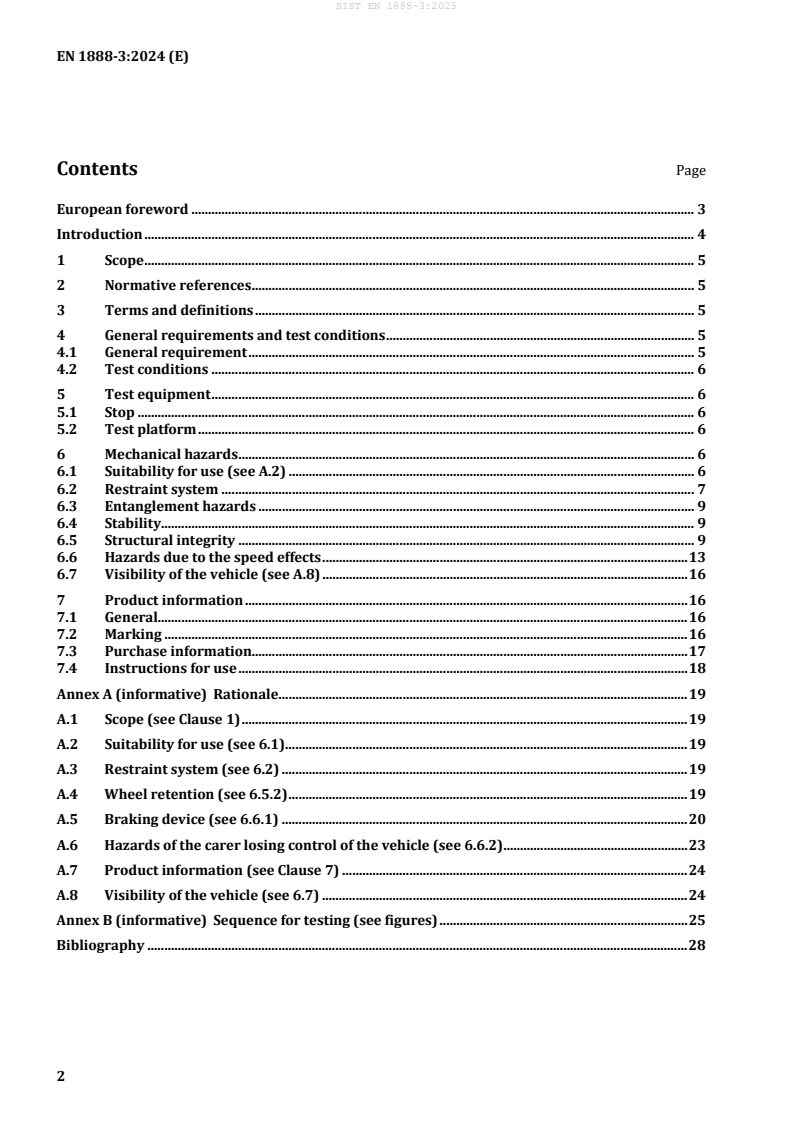
Contents Page
European foreword . 3
Introduction . 4
1 Scope . 5
2 Normative references . 5
3 Terms and definitions . 5
4 General requirements and test conditions . 5
4.1 General requirement . 5
4.2 Test conditions . 6
5 Test equipment . 6
5.1 Stop . 6
5.2 Test platform . 6
6 Mechanical hazards . 6
6.1 Suitability for use (see A.2) . 6
6.2 Restraint system . 7
6.3 Entanglement hazards . 9
6.4 Stability . 9
6.5 Structural integrity . 9
6.6 Hazards due to the speed effects . 13
6.7 Visibility of the vehicle (see A.8) . 16
7 Product information . 16
7.1 General. 16
7.2 Marking . 16
7.3 Purchase information. 17
7.4 Instructions for use . 18
Annex A (informative) Rationale . 19
A.1 Scope (see Clause 1) . 19
A.2 Suitability for use (see 6.1). 19
A.3 Restraint system (see 6.2) . 19
A.4 Wheel retention (see 6.5.2) . 19
A.5 Braking device (see 6.6.1) . 20
A.6 Hazards of the carer losing control of the vehicle (see 6.6.2) . 23
A.7 Product information (see Clause 7) . 24
A.8 Visibility of the vehicle (see 6.7) . 24
Annex B (informative) Sequence for testing (see figures) . 25
Bibliography . 28
European foreword
This document (EN 1888-3:2024) has been prepared by Technical Committee CEN/TC 252 “Child care
articles”, the secretariat of which is held by AFNOR.
This European Standard shall be given the status of a national standard, either by publication of an
identical text or by endorsement, at the latest by January 2025, and conflicting national standards shall
be withdrawn at the latest by January 2025.
Attention is drawn to the possibility that some of the elements of this document may be the subject of
patent rights. CEN shall not be held responsible for identifying any or all such patent rights.
Any feedback and questions on this document should be directed to the users’ national standards body.
A complete listing of these bodies can be found on the CEN website.
According to the CEN-CENELEC Internal Regulations, the national standards organisations of the
following countries are bound to implement this European Standard: Austria, Belgium, Bulgaria,
Croatia, Cyprus, Czech Republic, Denmark, Estonia, Finland, France, Germany, Greece, Hungary, Iceland,
Ireland, Italy, Latvia, Lithuania, Luxembourg, Malta, Netherlands, Norway, Poland, Portugal, Republic of
North Macedonia, Romania, Serbia, Slovakia, Slovenia, Spain, Sweden, Switzerland, Türkiye and the
United Kingdom.
Introduction
In November 2014 the European Working Group CEN/TC 252/WG 3 decided to split EN 1888 into
different parts to clearly treat in a different way, new products or new functions of wheeled child
conveyances.
This document covers pushchairs intended for sport activities and is only applicable in conjunction with
EN 1888-1:2018+A1:2022, which states general requirements for pushchairs and prams; and if
applicable, with EN 1888-2:2018+A1:2022, which states requirements for pushchairs intended for
children up to 22 kg.
Compliance with EN 1888-1:2018+A1:2022 is mandatory to comply with this document.
If the pushchair is intended for children up to 22 kg, compliance with EN 1888-2:2018+A1:2022 is
mandatory to comply with this document.
1 Scope
This document specifies the safety requirements of pushchairs when used for running/jogging or
skating (excluding ice skating), intended for the transport of one or two children up to 15 or 22 kg each.
Pushchairs intended to transport the carer while pushing (e.g. the combination of longboard and
stroller) are excluded from the scope of this document.
This document applies in conjunction with and in addition to the European standards
EN 1888-1:2018+A1:2022 or EN 1888-2:2018+A1:2022 and it cannot be used separately.
If the product has several functions or can be converted into another function, the relevant European
standards apply to it.
2 Normative references
The following documents are referred to in the text in such a way that some or all of their content
constitutes requirements of this document. For dated references, only the edition cited applies. For
undated references, the latest edition of the referenced document (including any amendments) applies.
EN 1888-1:2018+A1:2022, Child care articles - Wheeled child conveyances - Part 1: Pushchairs and prams
EN 1888-2:2018+A1:2022, Child care articles - Wheeled child conveyances - Part 2: Pushchairs for
children above 15 kg up to 22 kg
3 Terms and definitions
For the purposes of this document, the terms and definitions given in EN 1888-1:2018+A1:2022 and the
following apply.
ISO and IEC maintain terminology databases for use in standardization at the following addresses:
— IEC Electropedia: available at https://www.electropedia.org/
— ISO Online browsing platform: available at https://www.iso.org/obp
3.1
automatic emergency brake
automatically engaging device that stops the vehicle
Note 1 to entry: An automatic emergency brake can be combined with, but not replace or be replaced by the
parking device and/or braking device.
3.2
tether strap
safety strap attached to the vehicle to connect the carer
4 General requirements and test conditions
4.1 General requirement
The vehicle shall meet the requirements of EN 1888-1:2018+A1:2022 and, if applicable, also the
requirements of EN 1888-2:2018+A1:2022.
4.2 Test conditions
The additional tests of this document shall be conducted together with the relevant clauses of
EN 1888-1:2018+A1:2022 and EN 1888-2:2018+A1:2022 if applicable (see Annex B).
All the tests shall be conducted on the same sample.
5 Test equipment
5.1 Stop
A rigid bar with the dimensions given in Figure 1. The length of the stop shall be of at least the width of
the stroller.
Figure 1 — Stop
5.2 Test platform
Test surface, capable of inclination at an angle of 9° (0/+0,5)°, 12° (0/+0,5)° or 45° (0/+0,5)° to the
horizontal and covered with aluminium oxide paper of grade 80.
6 Mechanical hazards
6.1 Suitability for use (see A.2)
6.1.1 Requirements
The vehicle shall be fitted with a footrest.
There shall be no protruding rigid objects that are not padded or unprotected and that could come into
contact with a child’s head, between 270 mm and 550 mm measured on the backrest above the junction
line of the seat (see A.2).
The front wheel (s) of vehicles intended for sport activities shall pass over the stop (5.1), when tested in
accordance with 6.1.2.
6.1.2 Test method
Adjust the vehicle in the configuration recommended by the manufacturer in the instruction for use, for
sport use.
Adjust the backrest in the most upright position.
Place test mass B (see EN 1888-1:2018+A1:2022, 5.1.3) centrally against the backrest in such a way
that its bottom edge is in contact with the seat/back rest junction line. Restrain the test mass with the
restraint system and any appropriate strap if needed.
Repeat the test using test mass H (see EN 1888-2:2018+A1:2022, Clause 5) if the product allows the
usage for child up to 22 kg.
For the purpose of the test, the mass shall be properly attached to the seat unit, using the straps of the
restraint system. To achieve this and for better reproducibility additional means of attachment can be
used as well, without impairing the result of the test.
Position the vehicle as shown in Figure 2.
Release the vehicle and allow it to run freely down the slope until it impacts the stop (5.1)
Key
1 slope
2 stop
Figure 2 — Test of suitability for use
6.2 Restraint system
6.2.1 Additional requirement (see A.3)
The pushchair shall be fitted with a restraint system: the restraint system shall comprise at least a crotch
restraint and shoulder restraints.
When tested in accordance with 6.2.2 the anchoring points of the restraint system (frame, belt buckle,
etc.) shall not show any visible damage or be detached and shall function as intended.
When tested in accordance with 6.2.2 the original point D1 of test mass D (see
EN 1888-2:2018+A1:2022, 5.1.5) shall not exceed the vertical projection line of the front of the front
wheel during the test.
6.2.2 Test method
Place the vehicle on a horizontal flat and rigid surface; secure the movement of the vehicle such that the
wheels are firmly attached to the horizontal surface preventing the vehicle from tipping over during the
test.
Place test mass D against the backrest in the middle of the seat unit with the 225 mm axis against the
back rest and attach the restraint system in accordance with the manufacturer’s instructions with the
seat unit in the most upright position. Fasten any waist restraint around the torso section of test mass D
so that any slackness is removed, and the waist restraint is positioned above the leg stumps. If the
crotch restraint is adjustable, adjust it so that any slackness is removed, and the waist restraint is still
positioned above the leg stumps. Where the restraint system has shoulder straps that can be positioned
on the back of the seat unit in a range of positions, the shoulder straps shall be placed in the highest
position (to accommodate the tallest child). Place a 30 mm cuboid spacer block, made of a hard-smooth
material on each shoulder of test mass D. Adjust each shoulder strap so that any slackness is removed.
Remove the spacers.
Record the origin measurement D1 on the centre top of the test mass D.
Gradually apply a horizontal tensile force of 510 N from the centre top of test mass D (D1). Apply the
force within 5 s then maintain the force for 1 min and check whether the point D1 passes beyond the
vertical projection line of the front of the front wheel (See Figure 3).
For test purposes, a hook of negligible mass can be added at the test mass D.
NOTE It is not necessary that the tensile force remain horizontal throughout the test.
Key
1 origin of point D1
2 location point D1 under force
3 seat unit
4 test mass D
Figure 3 — Test method
6.3 Entanglement hazards
The requirements of EN 1888-1:2018+A1:2022, 8.4, do not apply to any tether strap (3.2) if provided.
6.4 Stability
The vehicle shall not tip over when tested in accordance with EN 1888-1:2018+A1:2022, 8.9.1.2 and/or
EN 1888-2:2018+A1:2022, 6.3; on the test platform inclined at 15° with wheels in locked and unlocked
position.
Any seat unit attachment device shall not become detached during the test.
6.5 Structural integrity
6.5.1 Irregular surface test
6.5.1.1 Requirement
When tested in accordance with 6.5.1.2 there shall be no break or deformation of any part of the
product that can impair the safety of the vehicle. Signs of wear shall not be regarded as a failure.
The vehicle shall not collapse; the locking mechanisms and attachment devices shall still function as
intended.
The swivelling function shall not be impaired, and the locking of swivelling wheels shall still work as
intended.
The devices used to connect the seat unit to the chassis shall not become disconnected, loosened or
damaged during or after testing.
After testing in accordance with 6.5.1.2 the vehicle shall still comply with 6.4 and with the following
requirements of EN 1888-1:2018+A1:2022:
— 8.2 entrapment hazards;
— 8.3 hazards from moving parts;
— 8.8 parking and braking device.
6.5.1.2 Test
The vehicle shall be tested in accordance with EN 1888-1:2018+A1:2022, 8.10.3.2, and
EN 1888-2:2018+A1:2022, 6.4.2, if the pushchair is intended for children up to 22 kg and subsequently,
36 000 times with a speed of (8 ± 0,1) km/h.
The additional 36 000 cycles are carried out with the front wheel(s) in the position recommended by
manufacturers for sport activities.
If there is an automatic emergency brake it shall be deactivated and maintained deactivated for the
entire irregular surface test.
The number of cycles and test masses shall be determined as shown in the Table 1 below:
Table 1 — Determination of cycles for the irregular surface test
Stroller intended for children up to 15 kg Stroller intended for children up to
(see EN 1888-1:2018+A1:2022 and 22 kg (see EN 1888-2:2018+A1:2022
EN 1888-3) and EN 1888-3)
Step
Test Test
Cycles Speed Cycles Speed
mass(es) mass(es)
Test mass B Test mass
1 72 000 5 km/h 72 000 5 km/h
(15 kg) B (15 kg)
Test mass B Test mass
2 36 000 8 km/h 24 000 5 km/h
(15 kg) H (22 kg)
Test mass
3 36 000 8 km/h
H (22 kg)
6.5.2 Wheels
6.5.2.1 Requirements
These requirements replace the requirements of EN 1888-1:2018+A1:2022, 8.10.5.
Any swivelling function of the wheels shall be lockable or the wheels shall not be swivelling.
After testing in accordance with 6.5.2.2.3, 6.5.2.2.4 and 6.5.2.2.5, removable swivel assemblies or fixed
wheels shall remain attached to the axle and the wheel assembly shall function as intended. Wheels
contained on both sides by a fork are exempt from 6.5.2.2.3 and 6.5.2.2.4.
Any removable-wheel fork assembly(s) shall incorporate an additional retention device and shall be so
designed as to prevent unintended detachment of the wheel or fork assembly from the vehicle when
tested in accordance with 6.5.2.2.5. Additional retention devices are excluded for wheels or fork
assemblies that require the use of tools for installation or removal.
6.5.2.2 Test methods
6.5.2.2.1 General
Test one rear and one front wheel for detachment from an axle in accordance with 6.5.2.2.2 and
6.5.2.2.3 for non-swivel wheel assemblies and with 6.5.2.2.4 for swivel wheel assemblies.
Test removable-wheel fork assembly in accordance with 6.5.2.2.5
6.5.2.2.2 Test method for non-swivel wheels
Secure the vehicle on an elevated surface so that a hanging weight may be applied to the vehicle’s wheel
without impeding their removal. Hang a 45 kg weight on the wheel along the axle centre line so that it
pulls against the wheel fastener, Figure 4a. The weight may be applied by means of a fixture/clamping
device that can be adjusted to fit different size wheels.
The fixture/clamping device shall be made to minimize damage to the wheel and to not impede the
force being applied through the wheel to the fastener. Gradually apply the weight within a period of 5 s
and then rotate the wheel clockwise 360°, then counter clockwise 360° for 10 cycles (1 cycle equals
turning 1 time clockwise 360° and 1 time counter clockwise 360°), Figure 5.
Each cycle shall not be less than 12 s or greater than 18 s.
a) Example of hanging weight on non-swivel wheels
b) Example of hanging weight on swivel wheels
Figure 4 — Example of hanging weight
Figure 5 — Turning the wheel
6.5.2.2.3 Test method for swivel wheels
Secure the vehicle on an elevated surface so that a hanging
...