

SIST EN 17826:2026
(Main)Child care articles - Chemical hazards - Requirements and test methods
General Information
- Abstract
This document specifies chemical product safety requirements and reference test methods for the following child care articles:
— Safety barriers
— Bedguards
— Baby carriers and child carriers
— Pushchairs and prams
— Carry cots, baby nests and carry cot stands
— Bath tubs and bathing aids
— Reclined cradles and infant swings
— Chair mounted seats
— Table mounted chairs
— Childs seats for bicycle
— Baby bouncers
— Children's harnesses and reins
— Baby walking frames
— Changing units
See also Clause A.1.
- Status
- Published
- Public Enquiry End Date
- 02-May-2022
- Publication Date
- 12-Feb-2026
- Technical Committee
- OTR - Child use and care article
- Current Stage
- 6060 - National Implementation/Publication (Adopted Project)
- Start Date
- 11-Feb-2026
- Due Date
- 18-Apr-2026
- Completion Date
- 13-Feb-2026
- Directive
- 2001/95/EC - General product safety

Overview
SIST EN 17826:2026 is a European standard developed by CEN, specifying chemical safety requirements and reference test methods for a comprehensive range of child care articles. Designed to minimize chemical hazards, this standard details requirements for materials used in products such as safety barriers, bedguards, prams, carriers, child seats, bathing aids, and other essential child care equipment. The standard focuses on safeguarding young children by limiting exposure to hazardous chemicals through swallowing, inhalation, sucking, licking, or prolonged skin contact.
Ensuring compliance with SIST EN 17826:2026 is critical for manufacturers, importers, and distributors aiming to access the European market and demonstrate a serious commitment to child safety and product quality.
Key Topics
SIST EN 17826:2026 covers the following key areas related to chemical hazards in child care articles:
- Migration of hazardous elements: Specifies limits for the migration of heavy metals and other elements that may pose a risk to children if accessible, protecting against ingestion or prolonged contact.
- Use of flame retardants: Restricts the presence of specific flame retardant substances in plastics, foams, and textiles due to their toxicological profile.
- Aniline content: Sets limits on aniline as it is a potential carcinogen, specifically in leather and textile parts accessible to children.
- Allergenic fragrances: Prohibits certain allergenic fragrances and requires clear labeling when other fragrances are present in child care products.
- Formaldehyde restrictions: Limits free and hydrolyzed formaldehyde content in textiles and leathers in child care articles, responding to its classification as a carcinogen and skin irritant.
- Polycyclic Aromatic Hydrocarbons (PAHs): Provides strict limits for PAHs in accessible rubber parts, which are known for their toxicity.
- Formamide emissions from EVA foams: Restricts formamide content and emissions in foam materials above specific surface areas, due to its reproductive toxicity.
All requirements are supported by referenced and harmonized European and international test methods, ensuring reliable, repeatable testing and market compliance.
Applications
SIST EN 17826:2026 is applicable to the following child care articles:
- Safety barriers, bedguards, and baby carriers
- Child carriers, pushchairs, prams, carry cots, baby nests, and stands
- Bath tubs, bathing aids, reclined cradles, and infant swings
- Chair mounted and table mounted seats
- Child bicycle seats, baby bouncers, and children’s harnesses and reins
- Baby walking frames and changing units
This standard is intended for manufacturers, product designers, testing laboratories, and regulatory bodies to ensure:
- Market compliance throughout the European Economic Area
- High standards of child product safety by managing chemical risks
- Competitive advantage through adherence to the latest safety benchmarks
It is especially relevant when developing or certifying new products or updating production processes to meet current chemical safety regulations.
Related Standards
When implementing SIST EN 17826:2026, consider related and referenced standards to ensure comprehensive compliance:
- EN 71-3:2019+A1:2021 - Safety of toys, migration of certain elements
- EN ISO 14184-1:2011 - Determination of free and hydrolysed formaldehyde in textiles
- EN ISO 14362-1:2017 / EN ISO 17234-1:2020 - Determination of aromatic amines and azo colorants in textiles and leathers
- EN ISO 17226-1:2021 - Formaldehyde in leather materials
- AFPS GS 2019-01-PAK - Testing and assessment of polycyclic aromatic hydrocarbons (PAHs)
- ISO 16000-6:2021 / ISO 16000-9:2024 - Emission testing methods for indoor air quality and VOCs
In addition, relevant European directives such as the Toy Safety Directive 2009/48/EC and REACH Regulation EC No. 1907/2006 should be consulted for overarching regulatory obligations on chemical safety.
SIST EN 17826:2026 is essential for ensuring child care articles are free from harmful chemical hazards, supporting both regulatory compliance and consumer trust.
Relations
- Effective Date
- 28-Jan-2026
- Effective Date
- 28-Jan-2026
- Effective Date
- 28-Jan-2026
- Effective Date
- 28-Jan-2026
- Effective Date
- 28-Jan-2026
Frequently Asked Questions
SIST EN 17826:2026 is a standard published by the Slovenian Institute for Standardization (SIST). Its full title is "Child care articles - Chemical hazards - Requirements and test methods". This standard covers: This document specifies chemical product safety requirements and reference test methods for the following child care articles: — Safety barriers — Bedguards — Baby carriers and child carriers — Pushchairs and prams — Carry cots, baby nests and carry cot stands — Bath tubs and bathing aids — Reclined cradles and infant swings — Chair mounted seats — Table mounted chairs — Childs seats for bicycle — Baby bouncers — Children's harnesses and reins — Baby walking frames — Changing units See also Clause A.1.
This document specifies chemical product safety requirements and reference test methods for the following child care articles: — Safety barriers — Bedguards — Baby carriers and child carriers — Pushchairs and prams — Carry cots, baby nests and carry cot stands — Bath tubs and bathing aids — Reclined cradles and infant swings — Chair mounted seats — Table mounted chairs — Childs seats for bicycle — Baby bouncers — Children's harnesses and reins — Baby walking frames — Changing units See also Clause A.1.
SIST EN 17826:2026 is classified under the following ICS (International Classification for Standards) categories: 97.190 - Equipment for children. The ICS classification helps identify the subject area and facilitates finding related standards.
SIST EN 17826:2026 has the following relationships with other standards: It is inter standard links to SIST EN 71-3:2019+A1:2021, SIST EN ISO 14184-1:2011, SIST EN ISO 17226-1:2021, SIST EN ISO 17234-1:2020, SIST EN ISO 14362-1:2017. Understanding these relationships helps ensure you are using the most current and applicable version of the standard.
SIST EN 17826:2026 is associated with the following European legislation: EU Directives/Regulations: 2001/95/EC, 2023/988/EU; Standardization Mandates: M/264. When a standard is cited in the Official Journal of the European Union, products manufactured in conformity with it benefit from a presumption of conformity with the essential requirements of the corresponding EU directive or regulation.
SIST EN 17826:2026 is available in PDF format for immediate download after purchase. The document can be added to your cart and obtained through the secure checkout process. Digital delivery ensures instant access to the complete standard document.
Standards Content (Sample)
SLOVENSKI STANDARD
01-marec-2026
Izdelki za otroke - Nevarnosti zaradi kemijskih lastnosti - Zahteve in preskusne
metode
Child care articles - Chemical hazards - Requirements and test methods
Artikel für Säuglinge und Kleinkinder - Chemische Gefährdungen - Anforderungen und
Prüfverfahren
Articles de puériculture - Risques chimiques - Exigences et méthodes d'essai
Ta slovenski standard je istoveten z: EN 17826:2025
ICS:
97.190 Otroška oprema Equipment for children
2003-01.Slovenski inštitut za standardizacijo. Razmnoževanje celote ali delov tega standarda ni dovoljeno.
EN 17826
EUROPEAN STANDARD
NORME EUROPÉENNE
December 2025
EUROPÄISCHE NORM
ICS 97.190
English Version
Child care articles - Chemical hazards - Requirements
Articles de puériculture - Risques chimiques - Artikel für Säuglinge und Kleinkinder - Chemische
Exigences Gefährdungen - Anforderungen
This European Standard was approved by CEN on 14 April 2025.
CEN members are bound to comply with the CEN/CENELEC Internal Regulations which stipulate the conditions for giving this
European Standard the status of a national standard without any alteration. Up-to-date lists and bibliographical references
concerning such national standards may be obtained on application to the CEN-CENELEC Management Centre or to any CEN
member.
This European Standard exists in three official versions (English, French, German). A version in any other language made by
translation under the responsibility of a CEN member into its own language and notified to the CEN-CENELEC Management
Centre has the same status as the official versions.
CEN members are the national standards bodies of Austria, Belgium, Bulgaria, Croatia, Cyprus, Czech Republic, Denmark, Estonia,
Finland, France, Germany, Greece, Hungary, Iceland, Ireland, Italy, Latvia, Lithuania, Luxembourg, Malta, Netherlands, Norway,
Poland, Portugal, Republic of North Macedonia, Romania, Serbia, Slovakia, Slovenia, Spain, Sweden, Switzerland, Türkiye and
United Kingdom.
EUROPEAN COMMITTEE FOR STANDARDIZATION
COMITÉ EUROPÉEN DE NORMALISATION
EUROPÄISCHES KOMITEE FÜR NORMUNG
CEN-CENELEC Management Centre: Rue de la Science 23, B-1040 Brussels
© 2025 CEN All rights of exploitation in any form and by any means reserved Ref. No. EN 17826:2025 E
worldwide for CEN national Members.
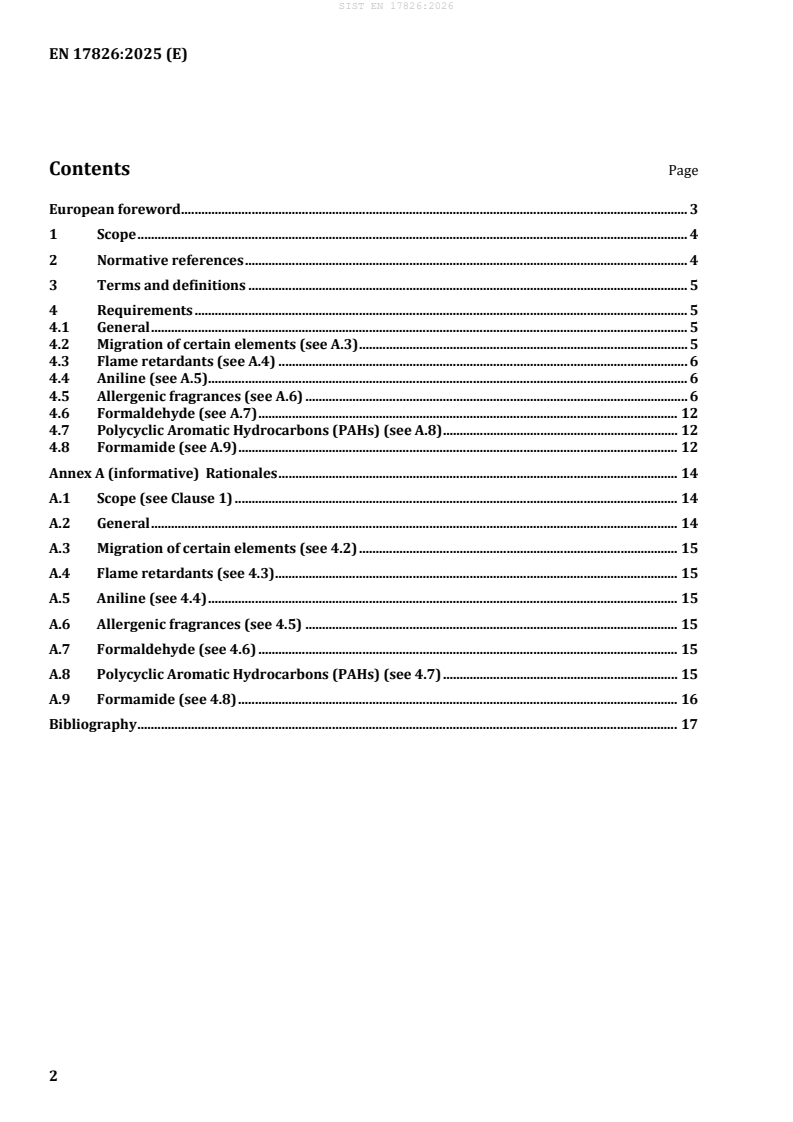
Contents Page
European foreword . 3
1 Scope . 4
2 Normative references . 4
3 Terms and definitions . 5
4 Requirements . 5
4.1 General . 5
4.2 Migration of certain elements (see A.3) . 5
4.3 Flame retardants (see A.4) . 6
4.4 Aniline (see A.5). 6
4.5 Allergenic fragrances (see A.6) . 6
4.6 Formaldehyde (see A.7) . 12
4.7 Polycyclic Aromatic Hydrocarbons (PAHs) (see A.8) . 12
4.8 Formamide (see A.9) . 12
Annex A (informative) Rationales . 14
A.1 Scope (see Clause 1) . 14
A.2 General . 14
A.3 Migration of certain elements (see 4.2) . 15
A.4 Flame retardants (see 4.3) . 15
A.5 Aniline (see 4.4) . 15
A.6 Allergenic fragrances (see 4.5) . 15
A.7 Formaldehyde (see 4.6) . 15
A.8 Polycyclic Aromatic Hydrocarbons (PAHs) (see 4.7) . 15
A.9 Formamide (see 4.8) . 16
Bibliography . 17
European foreword
This document (EN 17826:2025) has been prepared by Technical Committee CEN/TC 252 “Child care
articles”, the secretariat of which is held by AFNOR.
This European Standard shall be given the status of a national standard, either by publication of an
identical text or by endorsement, at the latest by June 2026, and conflicting national standards shall be
withdrawn at the latest by June 2026.
Attention is drawn to the possibility that some of the elements of this document may be the subject of
patent rights. CEN shall not be held responsible for identifying any or all such patent rights.
This document has been prepared under a standardization request addressed to CEN by the European
Commission. The Standing Committee of the EFTA States subsequently approves these requests for its
Member States.
Any feedback and questions on this document should be directed to the users’ national standards body.
A complete listing of these bodies can be found on the CEN website.
According to the CEN-CENELEC Internal Regulations, the national standards organisations of the
following countries are bound to implement this European Standard: Austria, Belgium, Bulgaria, Croatia,
Cyprus, Czech Republic, Denmark, Estonia, Finland, France, Germany, Greece, Hungary, Iceland, Ireland,
Italy, Latvia, Lithuania, Luxembourg, Malta, Netherlands, Norway, Poland, Portugal, Republic of North
Macedonia, Romania, Serbia, Slovakia, Slovenia, Spain, Sweden, Switzerland, Türkiye and the United
Kingdom.
1 Scope
This document specifies chemical product safety requirements and reference test methods for the
following child care articles:
— Safety barriers
— Bedguards
— Baby carriers and child carriers
— Pushchairs and prams
— Carry cots, baby nests and carry cot stands
— Bath tubs and bathing aids
— Reclined cradles and infant swings
— Chair mounted seats
— Table mounted chairs
— Childs seats for bicycle
— Baby bouncers
— Children's harnesses and reins
— Baby walking frames
— Changing units
See also Clause A.1.
2 Normative references
The following documents are referred to in the text in such a way that some or all of their content
constitutes requirements of this document. For dated references, only the edition cited applies. For
undated references, the latest edition of the referenced document (including any amendments) applies.
EN 71-3:2019+A1:2021, Safety of toys - Part 3: Migration of certain elements
EN ISO 14184-1:2011, Textiles - Determination of formaldehyde - Part 1: Free and hydrolysed formaldehyde
(water extraction method) (ISO 14184-1:2011)
EN ISO 14362-1:2017, Textiles - Methods for determination of certain aromatic amines derived from azo
colorants - Part 1: Detection of the use of certain azo colorants accessible with and without extracting the
fibres (ISO 14362-1:2017)
EN ISO 17226-1:2021, Leather - Chemical determination of formaldehyde content - Part 1: Method using
high-performance liquid chromatography (ISO 17226-1:2021)
EN ISO 17234-1:2020, Leather - Chemical tests for the determination of certain azo colourants in dyed
leathers - Part 1: Determination of certain aromatic amines derived from azo colorants (ISO 17234-1:2020)
3 Terms and definitions
For the purposes of this document, the following terms and definitions apply.
ISO and IEC maintain terminology databases for use in standardization at the following addresses:
— IEC Electropedia: available at https://www.electropedia.org/
— ISO Online browsing platform: available at https://www.iso.org/obp
4 Requirements
4.1 General
With the exceptions of requirements relating to emissions of formamide, the parts of the product which
shall comply with this document are defined in the relevant product safety standards.
When these parts of the product are not defined in the relevant product safety standards, the parts of the
products which shall comply shall be defined using the exposure principles described in this document,
based on their accessibility, function, volume or mass, and reasonable exposure due to sucking, licking,
swallowing, inhalation, or prolonged contact with skin.
For the purpose of this document “prolonged contact with skin” means continuous contact of more than
10 min duration or intermittent contact over a period of 30 min, per day.
NOTE The above definition of prolonged contact with skin has been taken from the REACH restriction on
phthalates (Regulation (EU) 2018/2005).
NOTE 2 A list of relevant EU legislation can be found in the Bibliography.
4.2 Migration of certain elements (see A.3)
The migration of elements from any parts which, due to their accessibility, function, volume or mass, can
reasonably lead to an exposure due to sucking, licking, swallowing, or prolonged contact with skin shall
not exceed any of the limits given in Table 1.
When testing is performed the method described in EN 71-3:2019+A1:2021 shall be used.
Table 1 — Migration limits of certain elements
Element Migration limit from
scraped-off material
mg/kg
Aluminium 28 130
Antimony 560
Arsenic 47
Barium 18 750
Boron 15 000
Cadmium 17
Chromium (III) 460
Chromium (VI) 0,053
Cobalt 130
Copper 7 700
Element Migration limit from
scraped-off material
mg/kg
Lead 23
Manganese 15 000
Mercury 94
Nickel 930
Selenium 460
Strontium 56 000
Tin 180 000
Organic tin 12
Zinc 46 000
NOTE Limits are taken from EN 71-3:2019+A1:2021, Table 2, column “Category III”.
4.3 Flame retardants (see A.4)
Materials made of plastics, foams, textiles and wood shall not contain any of the substances listed in
Table 2 in concentrations exceeding the limits stated.
When testing is performed, methods shall be used with a suitable limit of quantitation (LOQ) allowing to
verify the indicated limits.
Table 2 — Flame retardant limits
Compound CAS Number Content limit
Tris(2-chloroethyl) phosphate (TCEP) 115–96–8 5 mg/kg
Tris(2-chloro-1-methylethyl) phosphate (TCPP) 13674–84–5 5 mg/kg
Tris[2-chloro-1-(chloromethyl)ethyl] 13674–87–8 5 mg/kg
phosphate (TDCP)
NOTE Limits are taken from Directive 2009/48/EC, Annex II, appendix C.
4.4 Aniline (see A.5)
Aniline shall not exceed the limit of 30 mg/kg after reductive cleavage from parts made of textiles and
leather which, due to their accessibility, function, volume or mass, can reasonably lead to an exposure
due to sucking, licking, swallowing, or prolonged contact with skin.
When testing is performed, the method of EN ISO 14362-1:2017 and EN ISO 17234-1:2020, adapted as
appropriate to measure aniline, shall be used.
NOTE Limit is taken from Directive 2009/48/EC, Annex II, appendix C.
4.5 Allergenic fragrances (see A.6)
Any intentionally scented part or material shall not contain any of the allergenic fragrances as listed in
Table 3. However, the presence of traces of these fragrances shall be allowed, provided that such presence
is technically unavoidable under good manufacturing practice and does not exceed 100 mg/kg.
In addition, the names of the allergenic fragrances in Table 4 shall be listed on the article, on an affixed
label, on the packaging or in an accompanying leaflet, if intentionally added to any scented part or
material at concentrations exceeding 100 mg/kg.
In addition, intentionally scented products shall be labelled with the words “contains fragrance”.
Table 3 — Allergenic fragrances not allowed to be used
No Name of the allergenic fragrance CAS number
(1) Alanroot oil (Inula helenium) 97676–35–2
(2) Allylisothiocyanate 57–06–7
(3) Benzyl cyanide 140–29–4
(4) 4 tert-Butylphenol 98–54–4
(5) Chenopodium oil 8006–99–3
(6) Cyclamen alcohol 4756–19–8
(7) Diethyl maleate 141–05–9
(8) Dihydrocoumarin 119–84–6
(9) 2,4-Dihydroxy-3-methylbenzaldehyde 6248–20–0
(10) 3,7-Dimethyl-2-octen-1-ol (6,7- 40607–48–5
Dihydrogeraniol)
(11) 4,6-Dimethyl-8-tert-butylcoumarin 17874–34–9
(12) Dimethyl citraconate 617–54–9
(13) 7,11-Dimethyl-4.6,10-dodecatrien-3-one 26651–96–7
(14) 6,10-Dimethyl-3.5,9-undecatrien-2-one 141–10–6
(15) Diphenylamine 122–39–4
(16) Ethyl acrylate 140–88–5
(17) Fig leaf, fresh and preparations 68916–52–9
(18) trans-2-Heptenal 18829–55–5
(19) trans-2-Hexenal diethyl acetal 67746–30–9
(20) trans-2-Hexenal dimethyl acetal 18318–83–7
(21) Hydroabietyl alcohol 13393–93–6
(22) 4-Ethoxy-phenol 622–62–8
(23) 6-lsopropyl-2-decahydronaphthalenol 34131–99–2
(24) 7-Methoxycoumarin 531–59–9
(25) 4-Methoxyphenol 150–76–5
No Name of the allergenic fragrance CAS number
(26) 4-(p-Methoxyphenyl)-3-butene-2-one 943–88–4
(27) 1-(p-Methoxyphenyl)-1-penten-3-one 104–27–8
(28) Methyl trans-2-butenoate 623–43–8
(29) 6-Methylcoumarin 92–48–8
(30) 7-Methylcoumarin 2445–83–2
(31) 5-Methyl-2,3-hexanedione 13706–86–0
(32) Costus root oil (Saussurea lappa Clarke) 8023–88–9
(33) 7-Ethoxy-4-methylcoumarin 87–05–8
(34) Hexahydrocoumarin 700–82–3
(35) Peru balsam, crude (Exudation of Myroxylon 8007–00–9
pereirae (Royle) Klotzsch)
(36) 2-Pentylidene-cyclohexanone 25677–40–1
(37) 3.6,10-Trimethyl-3.5,9-undecatrien-2-one 1117–41–5
(38) Verbena oil (Lippia citriodora Kunth) 8024–12–2
(39) Musk ambrette (4-tert-Butyl-3-methoxy-2,6- 83–66–9
dinitrotoluene)
(40) 4-Phenyl-3-buten-2-one 122–57–6
(41) Amyl cinnamal 122–40–7
(42) Amylcinnamyl alcohol 101–85–9
(43) Benzyl alcohol 100–51–6
(44) Benzyl salicylate 118–58–1
...