

SIST EN 13358:2019
(Main)Bitumen and bituminous binders - Determination of the distillation characteristics of cut-back and fluxed bituminous binders made with mineral fluxes
General Information
- Abstract
This document specifies a method for the determination of the distillation characteristics of cut-back and fluxed bituminous binders made with mineral fluxes.
WARNING - The use of this document may involve hazardous materials, operations and equipment. This document does not purport to address all of the safety problems associated with its use. It is the responsibility of the user of this document to establish appropriate safety and health practices and to determine the applicability of regulatory limitations prior to use.
- Status
- Published
- Public Enquiry End Date
- 19-Jul-2018
- Publication Date
- 15-Oct-2019
- Technical Committee
- VLA - Water proofing
- Current Stage
- 6060 - National Implementation/Publication (Adopted Project)
- Start Date
- 03-Sep-2019
- Due Date
- 08-Nov-2019
- Completion Date
- 16-Oct-2019



Overview
EN 13358:2019 (CEN) specifies a laboratory method to determine the distillation characteristics of cut‑back and fluxed bituminous binders made with mineral fluxes. The standard describes how to distil petroleum‑fluidified bitumen at a controlled rate up to 360 °C and how to measure the volumes of distillate and residue across defined temperature ranges. It replaces EN 13358:2010 and was approved by CEN in May 2019.
Safety note: the procedure can involve hazardous materials and operations. Users must establish appropriate safety and health practices and verify regulatory limits before use.
Key topics and technical requirements
- Scope & principle
- Distillation of cut‑back and fluxed bituminous binders until liquid reaches 360 °C; measurement of distillate fractions and residue.
- Sample preparation
- Sampling per EN 58 and preparation per EN 12594; typical test portion is mass equivalent to 200 ml.
- Apparatus essentials
- 500 ml distillation flask with side‑arm, glass condenser (200–300 mm jacket), adapter (≈105° angle) and graduated receivers (25/50/100 ml).
- Heating options: adjustable gas burner (Tirrill or equivalent), electric heating plate or electric heating mantle (0–750 W control).
- Shield, insulation, and height‑adjustable support to control heat and prevent drafts.
- Temperature measuring device (sensor + readout) with range to at least 400 °C, readability to 1 °C and accuracy ±1 °C (platinum resistance RTDs recommended; mercury stem thermometers allowed only if permitted nationally).
- Balance with 0.1 g readability; residue container (~250 ml).
- Procedure specifics
- Thermometer/probe insertion depth and apparatus alignment; condenser coolant flow (reverse flow recommended).
- Barometric/altitude corrections for temperature readings (tables provided).
- Record volumes of distillate at corrected reference temperatures (see EN 15322).
- Results & quality
- Calculations for bituminous residue, total distillate and distillate fractions, with stated repeatability and reproducibility criteria.
- Test report requirements detailed in the standard.
Applications and users
- Quality control and specification testing for:
- Bitumen manufacturers and suppliers producing cut‑back and fluxed binders with mineral fluxes.
- Construction and asphalt laboratories assessing binder volatility and residue properties.
- Research laboratories evaluating formulation changes, binder performance, and regulatory compliance.
- Practical uses include evaluating evaporative loss, classifying light‑fraction removal, and producing residues for further physical testing.
Related standards
- EN 58 - Sampling of bituminous binders
- EN 12594 - Preparation of test samples
- EN 15322 - Reference corrected temperatures for distillate volume recording
- ASTM D402 (historical basis)
Keywords: EN 13358:2019, distillation characteristics, cut‑back bituminous binders, fluxed bituminous binders, mineral fluxes, bitumen testing, CEN, laboratory distillation method, bituminous residue.
Relations
- Effective Date
- 01-Nov-2019
- Effective Date
- 28-Jan-2026
- Effective Date
- 28-Jan-2026
- Effective Date
- 28-Jan-2026
- Effective Date
- 28-Jan-2026
Get Certified
Connect with accredited certification bodies for this standard

DIBt (Deutsches Institut für Bautechnik)
German Institute for Building Technology.
DIN CERTCO
DIN Group product certification.

Element Materials Technology
Materials testing and product certification.
Sponsored listings
Frequently Asked Questions
SIST EN 13358:2019 is a standard published by the Slovenian Institute for Standardization (SIST). Its full title is "Bitumen and bituminous binders - Determination of the distillation characteristics of cut-back and fluxed bituminous binders made with mineral fluxes". This standard covers: This document specifies a method for the determination of the distillation characteristics of cut-back and fluxed bituminous binders made with mineral fluxes. WARNING - The use of this document may involve hazardous materials, operations and equipment. This document does not purport to address all of the safety problems associated with its use. It is the responsibility of the user of this document to establish appropriate safety and health practices and to determine the applicability of regulatory limitations prior to use.
This document specifies a method for the determination of the distillation characteristics of cut-back and fluxed bituminous binders made with mineral fluxes. WARNING - The use of this document may involve hazardous materials, operations and equipment. This document does not purport to address all of the safety problems associated with its use. It is the responsibility of the user of this document to establish appropriate safety and health practices and to determine the applicability of regulatory limitations prior to use.
SIST EN 13358:2019 is classified under the following ICS (International Classification for Standards) categories: 75.140 - Waxes, bituminous materials and other petroleum products; 91.100.50 - Binders. Sealing materials. The ICS classification helps identify the subject area and facilitates finding related standards.
SIST EN 13358:2019 has the following relationships with other standards: It is inter standard links to SIST EN 13358:2010, SIST EN 58:2012, SIST EN 12594:2025, SIST EN 15322:2009, SIST EN 14733:2005+A1:2011. Understanding these relationships helps ensure you are using the most current and applicable version of the standard.
SIST EN 13358:2019 is associated with the following European legislation: EU Directives/Regulations: 305/2011. When a standard is cited in the Official Journal of the European Union, products manufactured in conformity with it benefit from a presumption of conformity with the essential requirements of the corresponding EU directive or regulation.
SIST EN 13358:2019 is available in PDF format for immediate download after purchase. The document can be added to your cart and obtained through the secure checkout process. Digital delivery ensures instant access to the complete standard document.
Standards Content (Sample)
SLOVENSKI STANDARD
01-november-2019
Nadomešča:
SIST EN 13358:2010
Bitumen in bitumenska veziva - Določevanje destilacijskih značilnosti rezanih in
fluksiranih bitumenskih veziv
Bitumen and bituminous binders - Determination of the distillation characteristics of cut-
back and fluxed bituminous binders made with mineral fluxes
Bitumen und bitumenhaltige Bindemittel - Bestimmung der Destillationseigenschaften
von mit Mineralölfluxmitteln verschnittenen und gefluxten bitumenhaltigen Bindemitteln
Bitumes et liants bitumineux - Détermination des caractéristiques de distillation des
bitumes fluidifiés et fluxés par des fluxants d'origine minérale
Ta slovenski standard je istoveten z: EN 13358:2019
ICS:
75.140 Voski, bitumni in drugi naftni Waxes, bituminous materials
proizvodi and other petroleum products
91.100.50 Veziva. Tesnilni materiali Binders. Sealing materials
2003-01.Slovenski inštitut za standardizacijo. Razmnoževanje celote ali delov tega standarda ni dovoljeno.
EN 13358
EUROPEAN STANDARD
NORME EUROPÉENNE
July 2019
EUROPÄISCHE NORM
ICS 91.100.50 Supersedes EN 13358:2010
English Version
Bitumen and bituminous binders - Determination of the
distillation characteristics of cut-back and fluxed
bituminous binders made with mineral fluxes
Bitumes et liants bitumineux - Détermination des Bitumen und bitumenhaltige Bindemittel -
caractéristiques de distillation des bitumes fluidifiés et Bestimmung der Destillationseigenschaften von mit
fluxés par des fluxants d'origine minérale Mineralölfluxmitteln verschnittenen und gefluxten
bitumenhaltigen Bindemitteln
This European Standard was approved by CEN on 19 May 2019.
CEN members are bound to comply with the CEN/CENELEC Internal Regulations which stipulate the conditions for giving this
European Standard the status of a national standard without any alteration. Up-to-date lists and bibliographical references
concerning such national standards may be obtained on application to the CEN-CENELEC Management Centre or to any CEN
member.
This European Standard exists in three official versions (English, French, German). A version in any other language made by
translation under the responsibility of a CEN member into its own language and notified to the CEN-CENELEC Management
Centre has the same status as the official versions.
CEN members are the national standards bodies of Austria, Belgium, Bulgaria, Croatia, Cyprus, Czech Republic, Denmark, Estonia,
Finland, France, Germany, Greece, Hungary, Iceland, Ireland, Italy, Latvia, Lithuania, Luxembourg, Malta, Netherlands, Norway,
Poland, Portugal, Republic of North Macedonia, Romania, Serbia, Slovakia, Slovenia, Spain, Sweden, Switzerland, Turkey and
United Kingdom.
EUROPEAN COMMITTEE FOR STANDARDIZATION
COMITÉ EUROPÉEN DE NORMALISATION
EUROPÄISCHES KOMITEE FÜR NORMUNG
CEN-CENELEC Management Centre: Rue de la Science 23, B-1040 Brussels
© 2019 CEN All rights of exploitation in any form and by any means reserved Ref. No. EN 13358:2019 E
worldwide for CEN national Members.
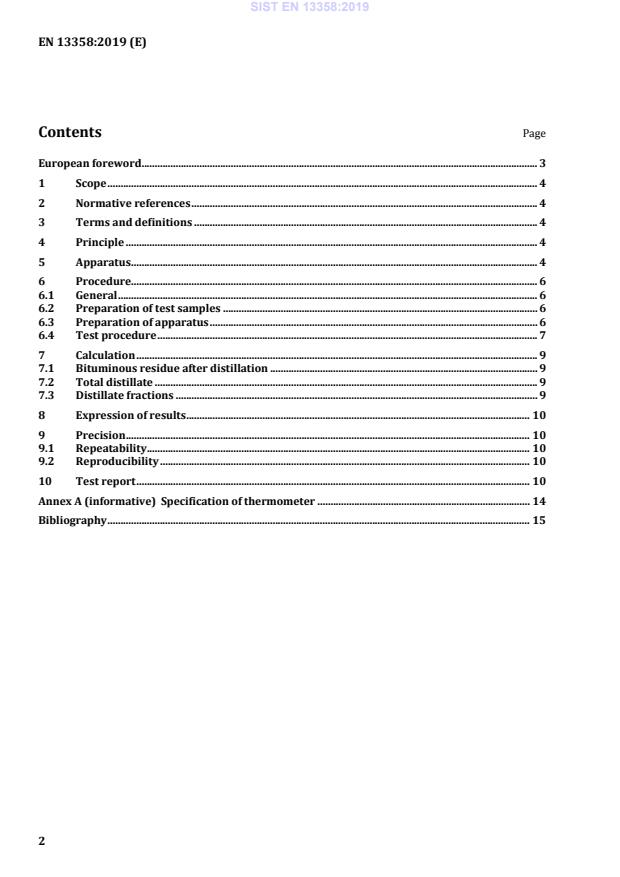
Contents Page
European foreword . 3
1 Scope . 4
2 Normative references . 4
3 Terms and definitions . 4
4 Principle . 4
5 Apparatus . 4
6 Procedure. 6
6.1 General . 6
6.2 Preparation of test samples . 6
6.3 Preparation of apparatus . 6
6.4 Test procedure . 7
7 Calculation . 9
7.1 Bituminous residue after distillation . 9
7.2 Total distillate . 9
7.3 Distillate fractions . 9
8 Expression of results . 10
9 Precision . 10
9.1 Repeatability . 10
9.2 Reproducibility . 10
10 Test report . 10
Annex A (informative) Specification of thermometer . 14
Bibliography . 15
European foreword
This document (EN 13358:2019) has been prepared by Technical Committee CEN/TC 336 “Bitumen and
bituminous binders”, the secretariat of which is held by AFNOR.
This European Standard shall be given the status of a national standard, either by publication of an
identical text or by endorsement, at the latest by January 2020, and conflicting national standards shall
be withdrawn at the latest by January 2020.
Attention is drawn to the possibility that some of the elements of this document may be the subject of
patent rights. CEN shall not be held responsible for identifying any or all such patent rights.
This document supersedes EN 13358:2010.
The main technical changes in comparison to the previous edition are:
— Clause 5: an electric heating plate or heating mantle may be used as alternatives to the gas burner;
— Clause 5: mercury stem thermometers are replaced by temperature measuring devices allowing
similar temperature determinations to be made. Annex A (characteristics of mercury stem
thermometer) becomes informative;
— Subclause 6.4.2: requirements on distillation rate (drops per minute) may be replaced by a minimum
rate of temperature increase in cases where the distillation process has a very low yield;
— Subclause 6.4.3: volumes of distillate are to be recorded at least at the reference corrected
temperatures mentioned in EN 15322;
— Clauses 6.4.3 and 10: the possibility to record volumes of distillate to a precision of 0,1 ml is
abandoned.
This document is based on ASTM D 402-97.
According to the CEN-CENELEC Internal Regulations, the national standards organisations of the
following countries are bound to implement this European Standard: Austria, Belgium, Bulgaria, Croatia,
Cyprus, Czech Republic, Denmark, Estonia, Finland, France, Germany, Greece, Hungary, Iceland, Ireland,
Italy, Latvia, Lithuania, Luxembourg, Malta, Netherlands, Norway, Poland, Portugal, Republic of North
Macedonia, Romania, Serbia, Slovakia, Slovenia, Spain, Sweden, Switzerland, Turkey and the United
Kingdom.
1 Scope
This document specifies a method for the determination of the distillation characteristics of cut-back and
fluxed bituminous binders made with mineral fluxes.
WARNING — The use of this document may involve hazardous materials, operations and
equipment. This document does not purport to address all of the safety problems associated with
its use. It is the responsibility of the user of this document to establish appropriate safety and
health practices and to determine the applicability of regulatory limitations prior to use.
2 Normative references
The following documents are referred to in the text in such a way that some or all of their content
constitutes requirements of this document. For dated references, only the edition cited applies. For
undated references, the latest edition of the referenced document (including any amendments) applies.
EN 58, Bitumen and bituminous binders — Sampling bituminous binders
EN 12594, Bitumen and bituminous binders — Preparation of test samples
3 Terms and definitions
For the purposes of this document, the following terms and definitions apply.
ISO and IEC maintain terminological databases for use in standardization at the following addresses:
— IEC Electropedia: available at http://www.electropedia.org/
— ISO Online browsing platform: available at https://www.iso.org/obp
3.1
distillation
process of evaporation and condensation of a liquid
3.2
mineral flux
flux which may be of carbochemical or petrochemical origin or a mixture of both
4 Principle
Petroleum cut-back and fluxed bituminous binders are distilled at a controlled rate until the temperature
of the liquid reaches 360 °C. The volumes of distillate and residue obtained over specified temperature
ranges are measured. The residue from the distillation and also the distillate can be tested as required.
5 Apparatus
Usual laboratory apparatus and glassware, together with the following:
5.1 Distillation flask, 500 ml and with side-arm, of dimensions given in Figure 1.
5.2 Heating system. Equipment needed when using a gas burner or equivalent (see Figure 3).
5.2.1 Shield, of steel, lined with 3 mm of suitable thermal insulation material and fitted with
transparent mica windows of the form and dimensions shown in Figure 2, which is used to protect the
distillation flask from air currents and to reduce radiation.
5.2.2 Shield cover (top), consisting of two parts of fire resistant millboard of 6 mm minimum
thickness.
5.2.3 Support for shield and distillation flask, two sheets 150 mm × 150 mm of a mesh of
approximately 1 mm wire gauze on a tripod or ring.
1)
5.2.4 Heat source, adjustable Tirrill gas burner or equivalent. It is advised to protect the gas burner
flame using a chimney, as shown in Figure 3.
5.2.5 Height adjustable platform, to support the gas burner.
5.3 Heating system. Equipment needed when using an electric heater.
5.3.1 Shield and shield cover, as described under 5.2.1 and 5.2.2.
5.3.2 Electric heater (replacing items 6, 7 and 8 in Figure 3), with a heating plate adequately surfaced
to support the distillation flask and designed so as to efficiently transfer the heat. The heating plate shall
be of sufficient dimensions to support the shield over its entire base. The heater shall be equipped with a
transformer capable of controlling from 0 W to 750 W.
5.3.3 Height adjustable platform, to support the electric heater.
5.4 Heating system. Equipment needed when using an electric heating mantle.
5.4.1 Electric heating mantle (replacing items 4, 6, 7 and 8 in Figure 3), of adequate inner size to fit
the 500 ml distillation flask and completely embed the 200 ml product sample once filled into the
distillation flask (see 6.3.1). The heating mantle shall be completed with a removable insulation collar to
cover the part of the distillation flask emerging from the heating mantle. The heating mantle shall be
equipped with a transformer capable of controlling from 0 W to 750 W.
5.4.2 Height adjustable platform, to support the electric heating mantle.
5.5 Condenser, standard glass-jacketed of nominal jacket length from 200 mm to 300 mm and overall
tube length of (450 ± 10) mm (see Figure 3).
5.6 Adapter, made with glass of approximately 1 mm thickness, with reinforced top, having an angle
of approximately 105°. The inside diameter shall be (18 ± 2) mm at the wide end and not less than 5 mm
at the narrow end. The lower surface of the adapter shall be on a smooth descending curve from the wider
end to the narrower. The inside line of the outlet end shall be vertical, and the outlet shall be cut or ground
(not
...